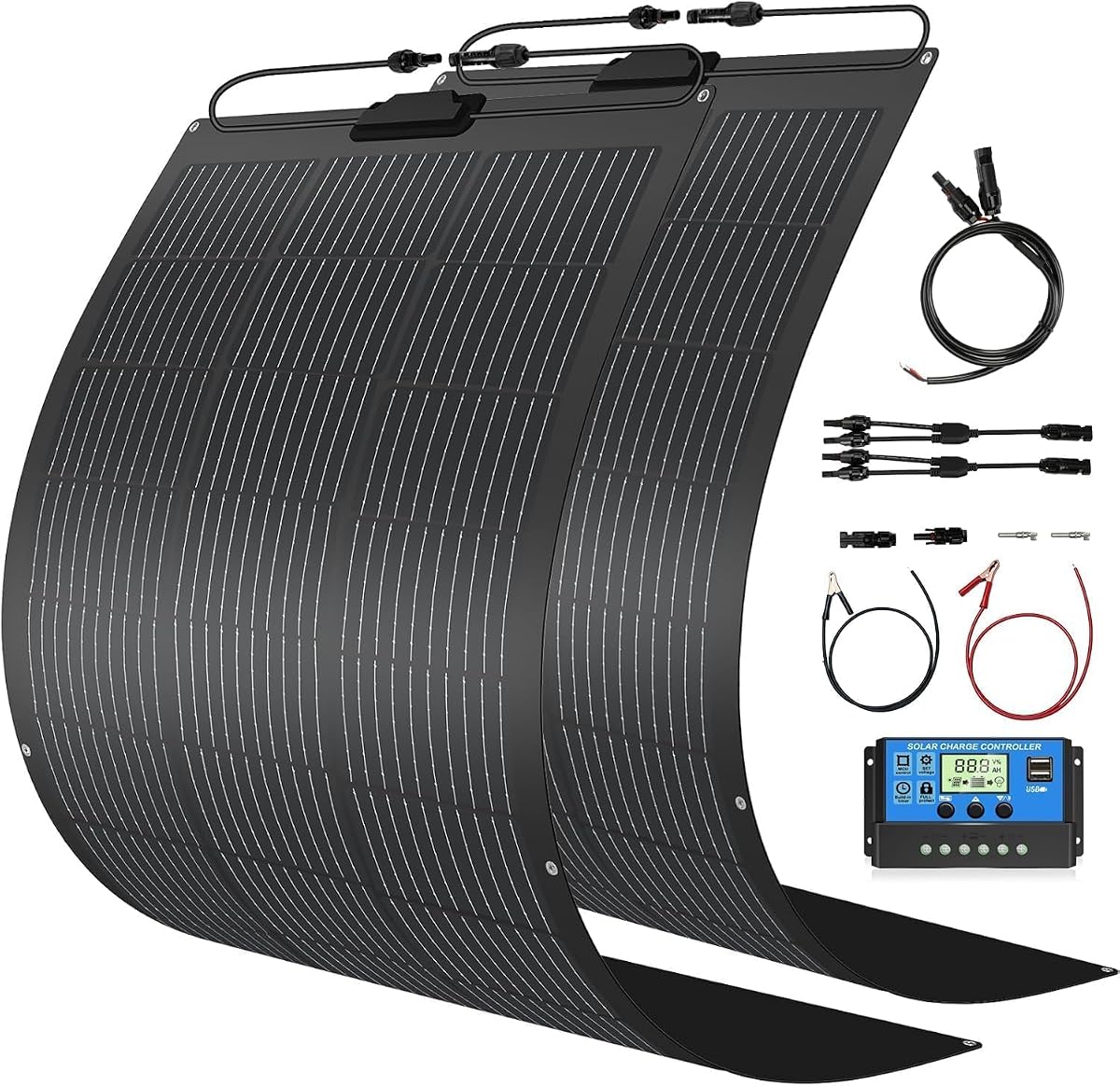
800W Dual 400W Flexible Solar Kit
5.0Editor score
Two 400-watt panels
Thirty-degree curved-roof fit
IP68 weather resistance
12V and 24V compatibility
Our guide compares the best flexible solar panels for RV rooftops, comparing output, flexibility, durability, efficiency, installation, and compatibility.
Flexible solar panels offer RV owners an attractive way to add renewable charging without the weight, bulk, or rigid profile of conventional rooftop modules. The best choices combine useful power ratings with enough bendability for curved roofs, dependable outdoor construction, and mounting options suited to mobile travel.
This guide compares ten flexible solar panels and multi-panel kits for RVs, vans, boats, and related off-grid installations. We evaluated the supplied specifications for rated output, cell technology, flexibility, water resistance, weight, installation hardware, electrical compatibility, shading features, and intended operating environments.
The ranking favors products that balance practical rooftop installation with credible charging capability. Individual panel sets can offer useful flexibility, while larger kits may better suit energy-intensive systems. Product listings, availability, technical details, and prices can change, so readers should verify current specifications before purchasing.
5.0Editor score

4.8Editor score
4.2Editor score
The comparison below highlights rated power, flexibility, outdoor protection, and installation approach across all ten flexible solar panel products, making it easier to identify the most suitable option for a particular RV rooftop and battery system.


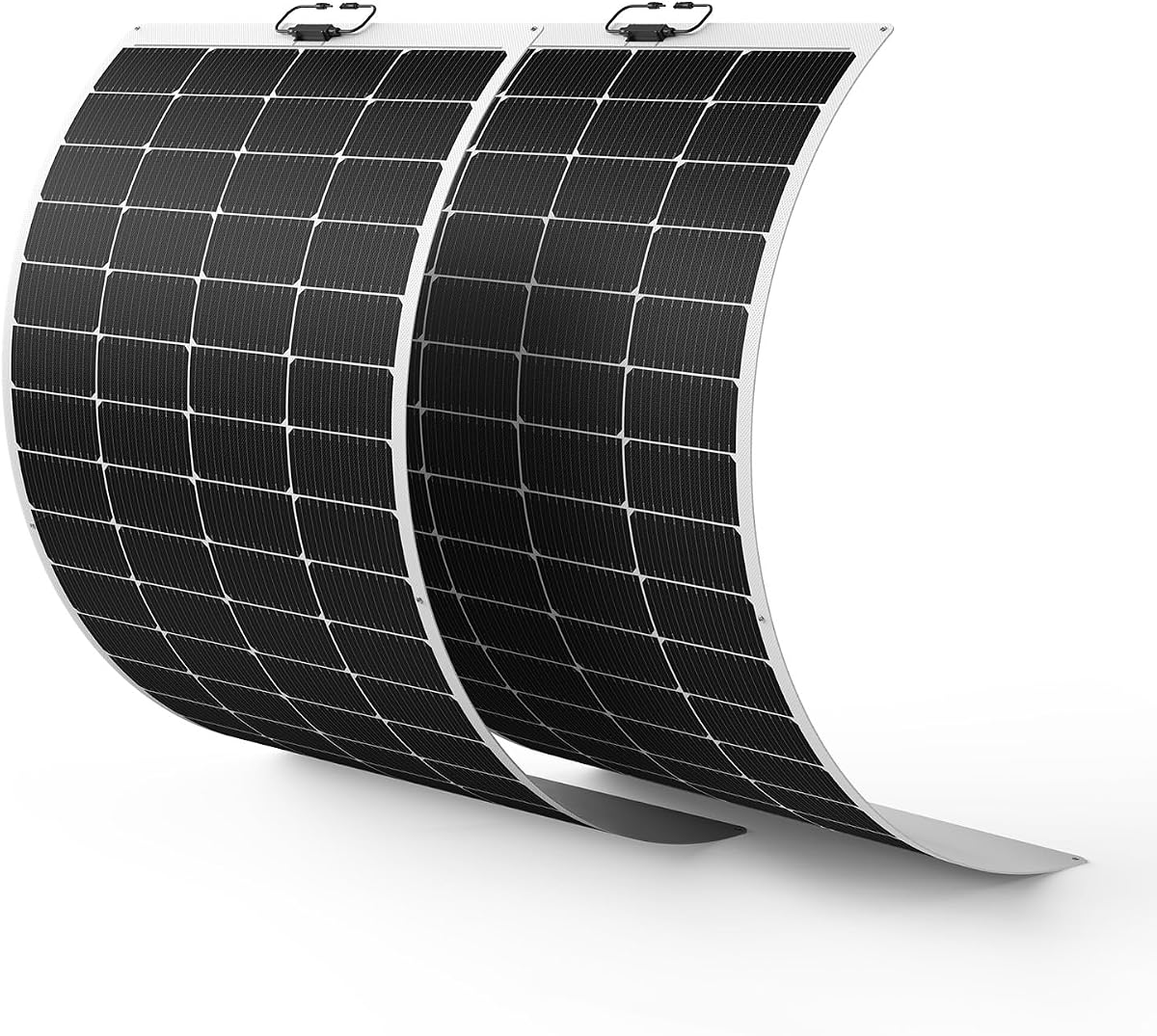


The Renogy Flexible Solar Panel 100 Watt is a compact, low-profile option for RV owners who want to add charging capability without installing a heavy rigid module. Its supplied rating is 4.4, and the most notable characteristics are its 100-watt rating, 240-degree bendability, and thin construction. The panel is listed as roughly 95% thinner than a rigid counterpart, making it especially relevant to campers concerned about roof clearance and visual bulk.
We may earn a commission when you buy through this link, at no additional cost to you.
Advanced polymer construction gives the panel a substantial weight advantage, with the listing stating that it weighs 70% less than conventional solar panels. That makes it easier to carry, position, and secure during travel. Its advertised wind resistance reaches 2400 pascals, while snow-load resistance is listed at 5400 pascals, giving the panel a credible outdoor foundation despite its relatively modest output. Applications include marine, rooftop, RV, boat, and other curved-surface installations.
The main limitation is that 100 watts is less output than many of the larger choices in this guide. A single panel may charge a small battery bank effectively, but RV users running refrigerators, lighting, electronics, or other continuous loads may need several modules. The supplied specifications also do not identify an IP water-and-dust rating for the panel itself, so buyers should pay close attention to connector placement, sealing, and the completeness of the installation rather than assuming the same level of enclosure protection as an IP-rated model.
Despite that limitation, this Renogy panel is a practical starting point for a modest system, a second panel for expansion, or a lightweight installation where roof aerodynamics and weight matter. It is particularly attractive for small RVs, vans, and travel trailers with limited usable roof area. For buyers seeking a simple, established flexible-panel format at a manageable power level, it remains one of the most straightforward products in the comparison.
At only about a tenth of an inch thick, this panel can sit close to the roof and preserve valuable clearance. That profile is useful where air conditioning, vents, roof racks, antennas, or storage equipment already compete for space.
The stated 240-degree bend range allows the panel to follow many curved RV surfaces instead of requiring a perfectly flat mounting plane. This flexibility expands the available roof area without adding a bulky frame.
We may earn a commission when you buy through this link, at no additional cost to you.
This 800-watt kit delivers the highest combined power in the group and stands out for travelers who want a substantial renewable charging system in a single package. It includes two flexible 400-watt monocrystalline panels and carries a supplied rating of 5.0. Rather than being a small maintenance panel or a lightweight add-on, it is positioned as a high-output kit for RVs, camper vans, boats, cabins, and remote worksites.
We may earn a commission when you buy through this link, at no additional cost to you.
The panels use monocrystalline cells with claimed efficiency above 24 percent and an ETFE surface. The stated ETFE coating is described as offering strong UV resistance and better light transmission than PET construction. Each panel weighs 4.4 pounds and is only 0.1 inch thick, so the kit adds useful charging capacity without the weight of conventional 400-watt rigid modules. The listed IP68 rating and salt-spray-resistant design also make the panels relevant to exposed marine and storm-prone installations.
The key compromise is flexibility. These panels bend to 30 degrees, considerably less than products rated for 180, 240, or 270 degrees. They can conform to moderate roof curves, but they are not intended to wrap around the tightest contours available in this category. A large RV may also require considerable roof area to accommodate two 400-watt modules, and adequate spacing from roof equipment should be considered before installation.
The kit is best for RV owners with a larger battery bank and a clear, relatively smooth roof area. It supports 12V and 24V lead-acid or LiFePO4 batteries and is described as compatible with Renogy and Victron controllers. For buyers seeking maximum listed output, a thin construction, and strong environmental specifications without moving to rigid panels, this is the premium option in the guide.
Two 400-watt modules provide substantial nominal charging capacity, yet the listing states that each flexible panel weighs only 4.4 pounds. This makes the kit more practical for mobile installations than comparably rated glass-covered systems, subject to the RV's actual roof-load and mounting requirements.
An IP68 rating, corrosion resistance, and ETFE construction address several common outdoor concerns. The panels are also described as able to withstand storms, snow, and marine environments, making them suitable for frequently exposed rooftop installations.
We may earn a commission when you buy through this link, at no additional cost to you.
The 200W Flexible Solar Panel combines a useful power rating with a broad stated bend range of 180 to 240 degrees. It is designed for RVs, boats, vans, campers, cabins, and curved rooftops, making it a natural fit for owners who need more flexibility than a lightly bendable panel can provide. Its supplied rating of 3.4 is lower than those of the other products, so buyers should weigh its specifications and reviews carefully.
We may earn a commission when you buy through this link, at no additional cost to you.
Its monocrystalline cells are stated to deliver 25 percent efficiency, and the ETFE coating is paired with a scratch-resistant polymer surface. The panel carries an IP67 waterproof and dustproof rating and lists an operating range of minus 20°C to 65°C. A lightweight, thin format and pre-drilled mounting holes simplify handling and installation, with the product positioned for one-person setup.
The lower customer rating is the clearest reason for caution. It may reflect a combination of expectations, installation experience, or individual system requirements rather than a single confirmed flaw, but the supplied data does not support dismissing the concern. Its IP67 rating also sits one step below the IP68 ratings claimed by several competitors. Buyers who need the strongest stated enclosure protection may prefer a model with an IP68 junction box.
Even with that caution, the combination of 200 watts, 25 percent stated efficiency, and 180-to-240-degree flexibility is appealing for curved RV roofs. It offers enough capacity to be more than a minimal accessory and remains light enough for mobile use. It is best viewed as a solid specification-driven option for campers who prioritize efficiency and conformability, while comparing current customer feedback before finalizing the purchase.
The stated 25 percent monocrystalline efficiency pairs with a 200-watt rating, allowing meaningful charging output in a relatively compact area. This can be useful for RVs where roof space must accommodate vents, air conditioners, racks, and other essential equipment.
A stated operating range of minus 20°C through 65°C supports year-round use in varied climates. The IP67 rating and scratch-resistant finish add further relevance for panels exposed to rain, dust, snow, and repeated handling during travel.
We may earn a commission when you buy through this link, at no additional cost to you.
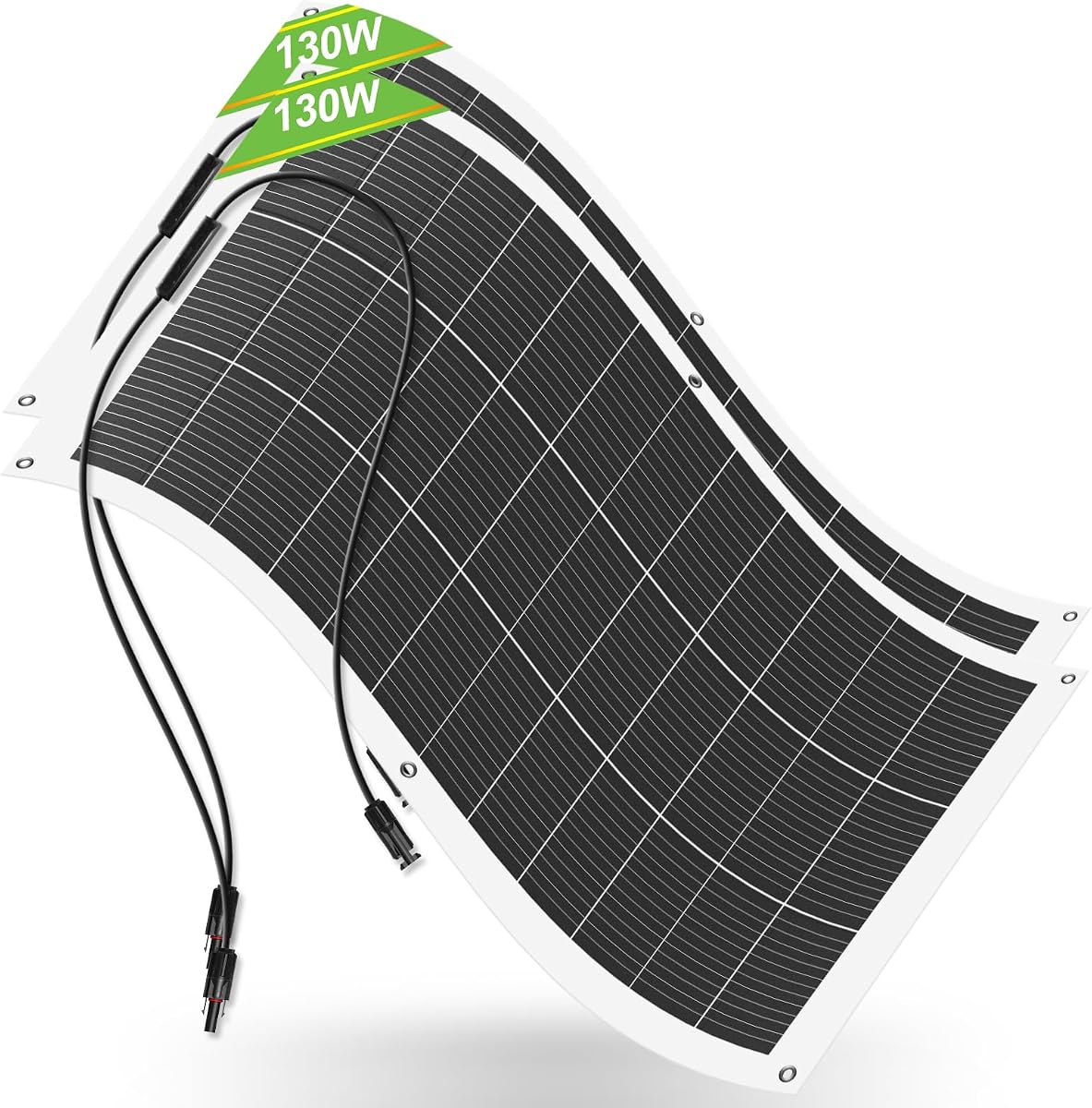
The ECO-WORTHY 260-watt kit includes two 130-watt flexible panels and combines strong bendability with a relatively compact footprint. Its 4.2 supplied rating places it in the middle of the group, while its most attractive specification is the stated 270-degree maximum bending angle. That makes it one of the most conformable options for irregular RV roofs, boat surfaces, trailers, and cabins.
We may earn a commission when you buy through this link, at no additional cost to you.
Each panel is listed as only 0.1 inch thick and 6.28 pounds in total for the two-panel set, offering a lightweight installation with minimal roof bulk. The panels use 18-busbar monocrystalline construction, and the product data claims up to 30 percent more output than the previous 100-watt version. A pre-installed IP68 junction box includes built-in diodes, while 2.9-foot cables support series or parallel expansion.
One point worth clarifying is that the product title states a 260-watt total, while the feature text also mentions energy generation figures in watt-hours. Those measures are not interchangeable. A panel's rated watts describe its electrical capacity under specified test conditions, while watt-hours depend on sunlight and time. Buyers should therefore base system design on the 260-watt combined rating and avoid treating any stated daily energy figure as guaranteed output.
Installation flexibility is another strength. Six metal-reinforced edge holes allow attachment with adhesive, silicone, double-sided tape, cable ties, or Velcro. That gives RV owners options for temporary or non-permanent mounting, although the chosen method should be suitable for the panel's weight, wind exposure, and roof material. This kit is a strong choice for travelers who want two moderate-output panels and extensive curvature capability in a lighter package.
A stated 270-degree bend range gives this kit exceptional freedom around roof contours and obstructions. The panels can conform more closely than conventional modules, helping RV owners use spaces that would be unsuitable for flat framed installations.
The included pair provides more flexibility than a single-panel system and can be configured in series or parallel. The pre-installed junction box, short connection cables, and reinforced holes simplify the initial setup while leaving room for future expansion.
We may earn a commission when you buy through this link, at no additional cost to you.
The ECO-WORTHY 400W HJT set combines two 200-watt flexible panels with N-type cells, 18-busbar construction, and an all-black design. Its 4.5 supplied rating makes it one of the stronger customer-rated options in the comparison. For RV owners who want substantial output without rigid glass panels, the set offers a compelling combination of efficiency, light weight, and understated appearance.
We may earn a commission when you buy through this link, at no additional cost to you.
The thinner and more numerous busbars are intended to improve electrical performance while reducing the risk of microcracks. The product listing states up to 25 percent conversion efficiency and more than 95 percent light transmittance through the ETFE material. Each panel includes four rust-resistant metal grommets and six stainless-steel zip ties, while the back can also be adhered directly to a suitable surface.
A built-in blocking diode is another useful feature, as it helps prevent reverse current from discharging a connected battery during darkness or low-light conditions. That protection is valuable in a multi-panel RV installation, although the system should still use a proper charge controller. The supplied information does not state a numerical bend range or water-resistance rating, so RV buyers should consult the current listing and installation instructions before committing to a specific roof geometry.
This kit is best for travelers who prioritize visual consistency and high conversion efficiency. The black finish blends well with many modern RV roofs, while the two-panel configuration can support a more capable battery setup than smaller single-panel choices. It is also a sensible option for boats, balconies, and gardens. Those who need a quantified bend angle or IP enclosure level may prefer one of the products that publishes those details more explicitly.
The 18-busbar configuration uses more numerous, narrower conductors than a conventional 12-busbar layout. The stated goals are improved power performance and lower microcrack risk, which are useful considerations for panels exposed to transport vibration and repeated flexing.
The all-black finish avoids the visual prominence of many framed solar modules. Because flexible panels can lie close to the roof, that lower profile and coordinated color can improve the appearance of a finished installation.
We may earn a commission when you buy through this link, at no additional cost to you.
The ZETAWALE 200W flexible panel stands out for its emphasis on partial-shading performance. Its 4.8 supplied rating is the highest among the individually reviewed panels, and the 200-watt rating places it in a useful middle ground for RV charging. The product combines N-type monocrystalline cells, a 25 percent stated conversion efficiency, and a flexible ETFE fiberglass construction.
We may earn a commission when you buy through this link, at no additional cost to you.
Upgraded bypass-diode technology is designed to route around shaded cells and reduce hot-spot risk. That matters on RV roofs where vents, satellite dishes, roof racks, trees, or building edges can cast partial shadows during the day. The panel can also support 12V battery charging or larger 24V and 48V off-grid arrangements when wired and controlled appropriately. Its stated flexibility reaches 270 degrees, allowing it to conform closely to curved roofs.
At 7.94 pounds, the panel is light enough for mobile use, though it is heavier than several smaller alternatives. ETFE is described as offering scratch resistance, self-cleaning behavior, impact resistance, and durability, while the thin construction preserves roof clearance. Pre-attached 2.95-foot cables and support for adhesive, hanging holes, or sealant mounting simplify installation without forcing one specific attachment method.
This is an excellent choice for campers who regularly encounter partial shade and want substantial flexibility in a single module. It also suits boats, vans, trailers, and remote work systems. A proper charge controller and correctly sized battery bank remain necessary, and buyers should verify whether the panel is being purchased alone or as part of a larger system. For its stated shading protection and construction, it is the leading individual panel in this guide.
Bypass diodes are intended to reduce the effects of localized shading by allowing current to bypass affected cell sections. This can help preserve usable output when a roof accessory or nearby object casts a shadow across only part of the panel.
The stated 270-degree bending capacity and 7.94-pound weight support easy handling and close conformity to curved surfaces. The panel can be mounted with adhesive, holes, or sealant, giving installers flexibility to match the roof and travel requirements.
We may earn a commission when you buy through this link, at no additional cost to you.
The Callsun 400W set uses two 200-watt flexible panels to provide a strong combined rating for large RVs and other demanding mobile installations. Its supplied rating is 4.4, and its defining feature is the white backsheet. Rather than functioning only as a power component, the design is intended to reduce heat buildup and blend visually with white yacht decks, boat surfaces, and white RV roofs.
We may earn a commission when you buy through this link, at no additional cost to you.
The panels offer 240 degrees of flexibility and are described as weighing 50 percent less than rigid panels, making the set easier to position on contoured surfaces. Premium ETFE coating and multilayer bonding are stated to resist hail, yellowing, and cracking. The IP68 waterproof junction box adds another layer of environmental protection, and the product is backed by a five-year warranty.
The set is listed as capable of generating up to 2 kilowatt-hours of daily power under ideal conditions. That figure is best treated as a conditional maximum rather than a standard daily guarantee because available sunlight, temperature, orientation, shading, and system losses all affect real energy collection. Series and parallel configurations are supported, allowing the voltage to be adapted for a 12V or 24V battery bank or portable power station.
This kit is a strong option for travelers with a large, relatively smooth white roof who want both appearance and high output. It is also relevant to catamarans and other marine installations where heat-reflective construction is valuable. Buyers should confirm roof area, available sunlight, and wiring configuration before installation. In return, they gain a thin 400-watt flexible array designed for aesthetic consistency and broad outdoor use.
The white backsheet is designed to reflect excess heat and limit power loss in hot climates. That makes the set especially relevant for RV roofs, yacht decks, and other exposed surfaces where dark roofing can create higher operating temperatures.
The two-panel format can support customized system layouts. Buyers can match the array to a 12V or 24V battery bank or portable power station, subject to the controller's input specifications and the electrical limits of the connected equipment.
We may earn a commission when you buy through this link, at no additional cost to you.
The BLUETTI 200W kit includes two flexible 100-watt panels and is especially relevant to RV owners who already use BLUETTI equipment. Its supplied rating is 4.5, and the listing identifies the set as designed for the BLUETTI RVSolar 48V system while remaining usable with other power setups. That makes connector familiarity and potential system integration important advantages.
We may earn a commission when you buy through this link, at no additional cost to you.
MONO PERC cells provide a stated efficiency of 23.4 percent, while a 240-degree bend range allows the panels to fit curved RV surfaces, boats, and camping tents. The IP67 rating covers resistance to water, dust, and corrosion. Installation is designed to avoid drilling: the panels can be secured using adhesive, hooks, or ties, which is helpful for travelers who want a less permanent rooftop setup.
The package includes two BLUETTI 100-watt flexible panels, two pairs of parallel connection cables, and a user manual. Because the primary system focus is a 48V RVSolar arrangement, buyers should carefully review electrical compatibility before using the set with a conventional 12V RV battery bank. A voltage-conversion device may be necessary if the panels and battery voltage do not align. The supplied data does not identify the size of any included charge controller, so one should not be assumed.
This kit is best for BLUETTI users seeking a tidy, coordinated array with simple parallel connections. The 23.4 percent efficiency is solid, the flexible format supports curved roofs, and the no-drill installation choices suit mobile use. For a standard RV electrical build, the competing 800-watt kit or 400-watt sets may provide clearer stated battery compatibility, but for BLUETTI-centered systems this product offers especially coherent integration.
The panels use a standard solar connector and are specifically designed for the BLUETTI RVSolar 48V system. For owners with compatible BLUETTI power stations and RV installations, this reduces the uncertainty of matching connectors and intended system behavior.
Adhesive, hooks, or ties provide several mounting choices without permanent drilling. Those options are useful on rental vehicles, touring RVs, and installations where removing the panels between trips may be convenient.
We may earn a commission when you buy through this link, at no additional cost to you.
The Renogy 200W Flexible Solar Panel offers a middle-ground rated output with the same broad 240-degree bendability associated with the smaller 100-watt model. Its 4.1 supplied rating is lower than most competitors, yet the stated construction, junction-box protection, and installation details make it a credible choice for standard RV rooftop charging.
We may earn a commission when you buy through this link, at no additional cost to you.
The panel uses half-cut PERC cell technology to improve light capture and electrical performance. It weighs approximately half as much as a comparable rigid panel and has an all-black, glare-free appearance. The IP67-rated waterproof junction box and solar connectors are designed for outdoor use, while stated load figures reach 5400 pascals for snow and 2400 pascals for wind.
Renogy estimates average daily production in the range of 800 to 1000 watt-hours depending on solar availability. As with all solar systems, that figure is conditional rather than guaranteed. Roof direction, weather, season, temperature, shading, wiring losses, and controller behavior all influence the result. RV users should design around the panel's 200-watt nameplate rating and their own energy consumption rather than relying on a single daily-production estimate.
Pre-drilled holes and 27.6-inch 12 AWG solar connector cables make installation more straightforward. The panel is best suited to owners seeking a single flexible module with moderate output and low visual impact. It can serve as the primary panel for a modest battery bank or as one component of a larger array. The lower supplied rating encourages shoppers to review recent customer feedback, but the technical package remains attractive for straightforward rooftop use.
Half-cut PERC cells are designed to improve light capture and electrical behavior. The technology gives this model a more modern cell platform while retaining the flexibility needed for curved RV mounting surfaces.
Pre-drilled mounting holes and long solar connector cables reduce the need for custom fabrication. RV owners can position the panel around roof contours, then connect it to a suitable controller and battery system with less preparation.
We may earn a commission when you buy through this link, at no additional cost to you.
The Xantrex 110W Solar Max Flex Panel is a compact flexible module with a strong marine orientation. Its 4.0 supplied rating is the lowest in the group, and its 110-watt output is modest compared with the multi-panel kits. Nevertheless, the panel's moisture-control construction and simple installation method can make it useful for smaller charging needs.
We may earn a commission when you buy through this link, at no additional cost to you.
Mesh-grid technology is described as providing more than 2,000 points of contact per cell. The stated purpose is to improve durability under tough weather conditions. A polyolefin thermoplastic encapsulate is highlighted as protecting the panel layers from moisture and reducing the risk of module corrosion in humid or salt-mist environments, an important consideration for coastal RV travel and exposed marine installations.
The peel-and-stick adhesive provides a fast, drill-free mounting option and eliminates the need for tools. That makes installation straightforward on a suitable clean, flat roof area. The supplied information gives fewer dimensions and electrical details than the other listings, so buyers should verify connector type, dimensions, and controller compatibility in the current product documentation before building a system around it.
This panel is best for RV owners who value a proven-style marine installation approach more than maximum charging capacity. It can support a smaller battery system, maintain a portable power station, or complement a larger flexible array. Those needing several hundred watts, explicit bend angles, or detailed waterproof ratings should review higher-output alternatives. As a simple 110-watt module with moisture-conscious construction, the Xantrex remains a focused option for compact systems.
The polyolefin encapsulate is designed to prevent moisture from entering the panel layers. That protection is particularly relevant where salt spray, humidity, condensation, or persistent rain could accelerate corrosion within the module.
The adhesive backing allows a drill-free installation without special tools. Surface preparation and environmental exposure remain important, so RV owners should follow the manufacturer's mounting guidance and confirm that the roof and adhesive are compatible.
We may earn a commission when you buy through this link, at no additional cost to you.
Choosing a flexible solar panel requires balancing physical fit, usable charging capacity, weather protection, electrical compatibility, and the way the panel will be mounted. The most highly rated specification is not automatically the most practical choice for a particular RV roof, so each factor deserves careful consideration.
Prioritize usable output for your energy budget. A larger nameplate rating cannot overcome an obstructed or poorly oriented roof.
Match the bend rating to the roof's most difficult contour. Do not force a less-flexible panel around a sharp curve.
Higher efficiency helps where space is tight, but durability and system design remain equally important.
Check the protected components, not just the headline rating. Keep connectors dry and follow all sealing instructions.
Account for weight, mounting hardware, roof condition, and safe access. The lightest option is not automatically the safest installation.
Verify voltage, connector, and controller requirements before wiring. Never assume a suitable controller is included.
Use an attachment method that suits the roof, travel pattern, and removal plan. Inspect bonds and restraints regularly.
Plan around both current and future shade sources. An unobstructed location often improves output more than a small efficiency gain.
Before installation, identify the panel's positive and negative leads, inspect the surface and junction box, and confirm compatibility with the charge controller and battery voltage. Clean the roof thoroughly, remove grease and debris, and make sure the mounting area is dry. Follow the manufacturer's instructions for allowable bend direction, minimum bend radius, adhesive preparation, and torque. Do not place the panel over a sharp roof seam, across an active roof vent, or where it will rub against another component during travel.
Mount the panel securely without trapping excessive water beneath it. If using adhesive or sealant, use only the specified products and allow the required curing time. If using holes, grommets, cable ties, or straps, protect the cables and check that the restraints cannot chafe against the laminate. Connect the panel through the appropriate controller, observe the stated polarity, and install any required fuse near the battery according to the system's wiring guidance. If more than one panel is present, follow the instructions for series or parallel configuration.
Inspect the installation at the start of each trip and periodically during use. Clean the surface with a soft cloth and clean water, avoiding harsh solvents and abrasive tools that could scratch the protective layer. Check the junction box, connectors, cables, mounting points, and seals for looseness, cracking, corrosion, or water entry. After severe wind, hail, or heavy snow, confirm that the panel and attachments remain secure. Keep electrical connectors protected and dry, and remove the panel temporarily if the manufacturer advises it during extreme conditions.
Yes, flexible solar panels are designed for mobile applications such as RVs, camper vans, boats, and trailers. Their thin, lightweight construction can conform to curved roofs and use space that rigid framed modules may not occupy well. Installation quality, electrical compatibility, and protection from wind and sharp edges remain important, so owners should follow the manufacturer's mounting and wiring instructions.
The required capacity depends on the RV's battery configuration, daily energy use, available sunlight, and how long the vehicle will travel without mains power. A single 100-watt or 110-watt panel may support a small system, while 200-watt modules suit more modest charging needs. Larger 400-watt and 800-watt sets are better suited to higher consumption, but the battery bank, controller, and available unshaded roof area must support the intended load.
It depends on the panel's stated bend rating and the geometry of the roof. Products in this guide list bend ranges from 30 to 270 degrees, but a higher number does not mean every area can be folded tightly. Sharp edges can stress or crack the laminate, so panels should follow smooth contours and never be forced beyond the manufacturer's stated limits.
Yes, a solar charge controller is generally necessary to regulate charging and protect the battery from inappropriate voltage or current. A built-in blocking diode helps prevent reverse current, but that is not a replacement for proper charge regulation. The controller must be compatible with the panel's voltage and configuration as well as the connected 12V, 24V, 48V, lead-acid, or LiFePO4 battery bank.
Both ratings indicate protection against dust and water under specified test conditions, with IP68 representing a stronger level of water ingress protection. The important detail is what the rating covers: the complete panel, only the junction box, or another component. RV owners should also keep connectors dry, follow sealing instructions, and inspect the installation because a rated panel can still be compromised by an improperly attached plug.
They can be suitable when the roof is properly prepared, the adhesive is compatible, and the installation follows the manufacturer's guidance. Wind uplift and thermal cycling create significant forces, so travelers should use the prescribed attachment method and inspect the panel after severe weather. Adding an appropriate mechanical restraint may be useful when permitted by the installation instructions, and panels should never be allowed to flap or rub against roof equipment.
Most of these products are designed for multi-panel expansion, with several kits explicitly supporting series or parallel configurations. Series wiring increases voltage, while parallel wiring increases current, and the correct arrangement depends on the controller and battery system. Match the total array to the controller's input limits and use suitable cable, fusing, and connection practices for the installed lead-acid or LiFePO4 batteries.
Winter charging is possible, but output generally declines because daylight hours are shorter and low temperatures reduce cell performance. Snow, ice, dirt, and shade can reduce output further. A panel may still maintain a battery during storage or support limited loads, but travelers should not expect summer charging results, and they should verify the battery's recommended charging temperatures and maintain a backup power plan.
The ZETAWALE 200W panel is the leading individual choice because it combines a strong supplied rating, 270-degree flexibility, high-efficiency N-type cells, and an emphasis on reducing partial-shading losses. The 800W dual 400-watt kit is the premium high-output option for owners with a large battery bank and sufficient roof area, while the ECO-WORTHY 260W dual 130-watt kit offers a budget-oriented pair with excellent bendability and an IP68 junction box.
The right choice ultimately depends on your RV's shape, usable roof area, electrical architecture, and daily energy demand. Prioritize an unobstructed location, adequate output, a compatible charge controller, secure mounting, and weather protection before focusing on small efficiency differences. Single-panel buyers may value portability, while multi-panel kits are more practical when continuous loads require stronger charging capability.
Product listings, technical claims, customer ratings, and prices can change after this guide was prepared. Before buying, confirm the current dimensions, connectors, bend limits, included accessories, waterproof ratings, and warranty terms with the manufacturer or seller. Then compare the final system configuration with your RV's available sunlight, battery capacity, and travel schedule to avoid choosing a panel that looks suitable but cannot deliver in the intended installation.