
SUNLU S1 Plus
4.3Editor score
Single-spool compact design
Built-in circulation fan
Adjustable 35–55°C range
Humidity and time display
Our Filament Dryer for 3D Printing guide compares capacity, heating, humidity controls, compatibility, and convenience for home users.
A filament dryer helps protect moisture-sensitive materials from the effects of humidity, allowing stored filament to remain ready for printing. The best models combine controlled heat, effective air circulation, useful environmental displays, and dependable sealing. Capacity, supported filament types, and the ability to dry while printing are also important considerations.
We compared ten filament dryers using the supplied specifications, focusing on spool capacity, adjustable temperature, heating method, airflow, timer controls, filament compatibility, and monitoring features. The list covers compact single-spool units, larger dry-and-store systems, and high-capacity models for workshops or multi-printer setups.
Each review explains the product's strongest benefits, practical limitations, and ideal user. The short comparison table provides a quick scan of the differences, while the buying guide focuses on what matters for filament care. Product availability, features, and prices may change, so confirm current details before purchasing.
4.3Editor score

4.6Editor score

4.5Editor score
The table below compares the ten dryers by their most consequential design features, including capacity, heating approach, temperature control, and filament compatibility.
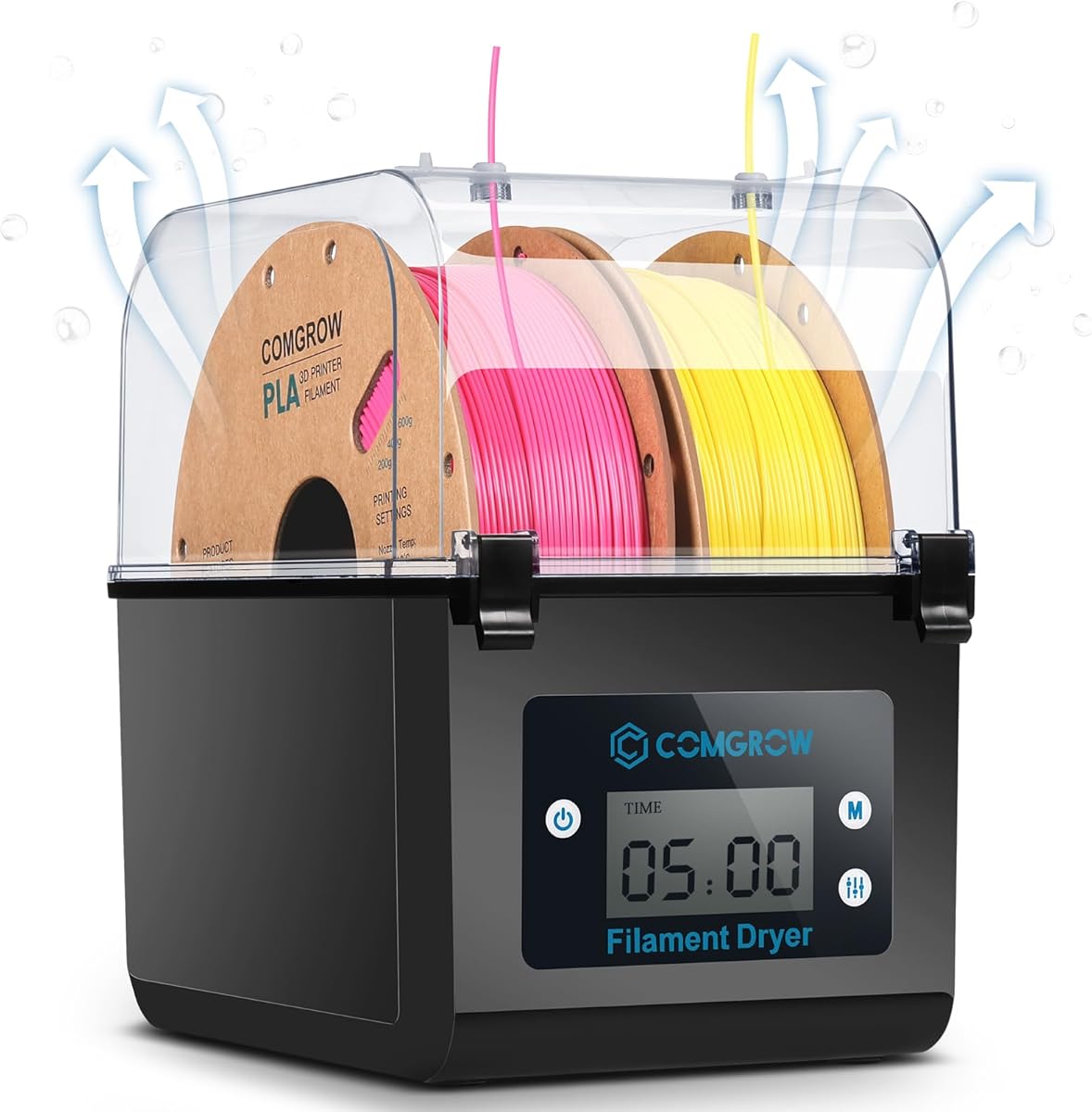



The Comgrow SH01 is a two-spool filament dryer with a 4.4 rating and a useful combination of monitored conditions, adjustable heat, and a relatively compact format. Its internal dimensions are listed as 9.29 by 6.49 by 9.13 inches, giving it enough room for two rolls of 1kg filament while avoiding the footprint of a four-spool cabinet.
We may earn a commission when you buy through this link, at no additional cost to you.
Its standout feature is the combination of a 2-inch LCD and touch-button controls. Users can see temperature and humidity information, then adjust the 40–50°C range and select a drying duration from six to twelve hours. The outlet uses a smooth silicone cable sheath and Teflon tube, which makes it possible to feed filament toward a printer during a drying cycle.
The SH01 is limited to a 50°C maximum and a relatively narrow timer selection, so it is less flexible than high-end dryers offering wider temperature ranges and longer programmable sessions. It also requires the outlet to remain open while operating so moisture can escape, then closed when the machine is not in use to preserve dry storage conditions.
This is a sensible choice for home users who regularly alternate between two materials and want a readable humidity display without a large cabinet. The product data also notes that E0 or E1 error messages can indicate loose or damaged motherboard cable connections, making it worth checking those connections if the unit does not begin its cycle.
The ability to hold two 1kg rolls makes the SH01 more versatile than a basic single-spool enclosure. It suits users who want to prepare one material while keeping another protected.
The LCD displays temperature and humidity, making it easier to judge when the chamber conditions are suitable. The screen and touch controls also simplify routine setting changes.
We may earn a commission when you buy through this link, at no additional cost to you.
The SUNLU S1 Plus is a compact, single-spool dryer rated 4.3 stars. It is designed for makers who need an affordable way to reduce the effects of wet filament without committing to a large dry-and-storage cabinet. The maximum spool size is listed as 210 by 89mm in height.
We may earn a commission when you buy through this link, at no additional cost to you.
A built-in fan helps move moisture away from the filament, while the 2-inch LCD displays temperature, time, and humidity. Users can hold the left button to change drying time and press the right button to adjust temperature across a 35–55°C range. This makes the controls straightforward even for first-time dryer users.
The main constraint is capacity. It is designed around one spool rather than multiple rolls, and its 55°C ceiling is below the more advanced Creality and SUNLU models. Nevertheless, it supports PLA, PETG, ABS, TPU, nylon, and PA filament in 1.75mm, 2.85mm, and 3.00mm diameters.
The S1 Plus is most appropriate for a single-printer household or for someone who dries filament one roll at a time. It offers the most attractive balance of useful monitoring and straightforward operation for buyers who want to address humidity without spending more on a high-capacity system.
The integrated fan is a meaningful upgrade over a passive heated enclosure. It promotes more consistent exposure of the spool to warmed air during a drying cycle.
Temperature, time, and humidity appear on the same display. This gives users immediate feedback without requiring a separate meter inside the chamber.
We may earn a commission when you buy through this link, at no additional cost to you.
The Creality Space Pi X4 is the most capable all-around dryer in this guide, earning a 4.6 rating. It accommodates four standard 1kg spools or two 2kg spools and uses two independently controlled 200W heating chambers. That combination gives it exceptional flexibility for busy makers and multi-material workflows.
We may earn a commission when you buy through this link, at no additional cost to you.
Its temperature ceiling of 85°C is a major distinction. The touch interface supports tailored ranges for everyday filaments and higher settings for advanced materials such as ABS, PET, PC, ASA, PA, and PAHT. The product information also emphasizes active humidity maintenance during printing pauses, allowing the enclosure to function as both a dryer and a protected storage chamber.
This level of capacity and control is unnecessary for someone printing occasionally with one spool, and the cabinet likely requires more counter space than compact models. Dual chambers can also introduce more controls than a new user needs, but independent operation is valuable when different materials require different drying conditions.
The X4 is the strongest recommendation for workshops, schools, or enthusiasts who regularly rotate multiple filament types. Its combination of capacity, temperature range, chamber flexibility, and continuous storage makes it the most versatile option among the ten products.
Separate heating chambers allow different filament groups to be dried under distinct conditions. This is particularly useful for mixed collections that include both everyday and high-temperature materials.
The sealed enclosure can maintain dry conditions between jobs or during pauses. An illuminated window lets users check spool status without repeatedly opening the cabinet.
We may earn a commission when you buy through this link, at no additional cost to you.
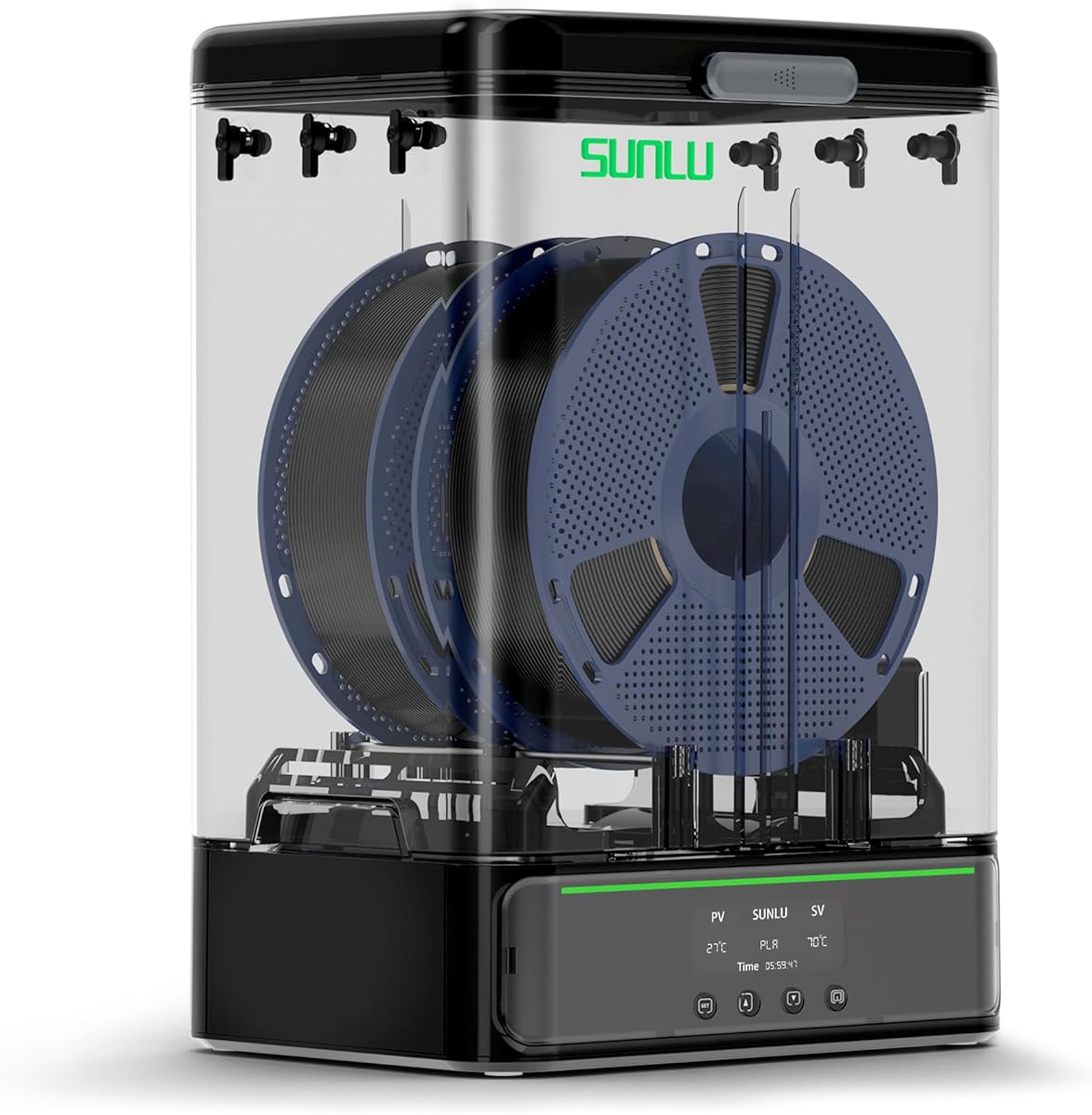
The SUNLU S4 is a premium four-spool dryer with a 4.5 rating. It is built for users who want to dry several rolls simultaneously, maintain different materials, and potentially route filament toward multiple printers. Its stated dimensions are 460 by 220 by 310mm externally and 450 by 175 by 207mm internally.
We may earn a commission when you buy through this link, at no additional cost to you.
The 350W PTC heater and three circulation fans support the 360-degree airflow arrangement described in the product information. The temperature range extends from 35 to 70°C, while the timer can be set from zero to 99 hours. Eight filament exit holes offer more loading angles and make multi-printer arrangements possible.
Its size and weight are meaningful trade-offs. The unit weighs 4kg and needs a permanent place on a sturdy work surface. The modification options for 3kg rolls or shoe drying add flexibility, but they are secondary to the primary purpose of managing 3D printing filament.
This S4 listing is ideal for a serious home workshop with several printers or a large filament inventory. It balances capacity, long programming windows, robust airflow, and wide outlet selection, making it a strong premium pick for advanced users.
Three fans are intended to distribute warmed air throughout the chamber. That design can produce more uniform drying than a single-fan unit when four spools are present.
Eight exit holes make it easier to serve several printers or work around different filament-loading directions. PTFE tubes and silicone plugs in the packing list support organized routing.
We may earn a commission when you buy through this link, at no additional cost to you.
The Creality Space Pi Plus is a dual-spool dryer with a 4.4 rating and a particularly approachable control scheme. Its 3.7-inch LCD touch screen gives users a large, readable interface, while one-key presets cover up to 12 filament types, including PLA-CF, PA-CF, and ASA.
We may earn a commission when you buy through this link, at no additional cost to you.
A 110W PTC heater and built-in fan circulate hot air throughout the chamber. The temperature can be adjusted from 45 to 70°C, and the timer can be programmed for up to 48 hours. The ability to switch between Celsius and Fahrenheit is a small convenience for international users.
Although the presets make common jobs quick, makers who experiment with unusual blends may still need to enter custom temperatures. Capacity is also limited to two spools, placing the model between compact units and the larger X4 and S4 cabinets.
This dryer is best for users who want guided setup without giving up manual control. Its strong screen, humidity display, and 12 presets make it particularly approachable for beginners and for households managing several common filament types.
One-key presets reduce the need to research drying settings for common materials. Custom adjustments remain available for unusual filament blends or changing ambient conditions.
The 3.7-inch screen presents temperature, time, and humidity in a clear format. Touch navigation and unit switching improve day-to-day convenience.
We may earn a commission when you buy through this link, at no additional cost to you.
The Polymaker Polydryer takes a different approach from a conventional drying box. With a 4.3 rating, it combines heated drying, sealed storage, and direct filament feeding so filament can move from drying to the printer without unnecessary exposure to ambient air.
We may earn a commission when you buy through this link, at no additional cost to you.
A built-in hygrometer helps users track the internal environment, while the storage-box design adds desiccant support. Together, these elements provide layered moisture defense rather than relying on heat alone. The system is intended to preserve conditions before, during, and between print sessions.
The product data provides less detail about exact temperature settings, heater wattage, and timer controls than some competing listings. That makes it harder to compare fine-grained drying performance, and the title specifically emphasizes 1kg filament use. Buyers who require precise programmable temperature ranges may prefer a model whose specifications are more explicit.
The Polydryer is appealing to users who think of filament care as a complete storage routine rather than a single heating session. It is a strong fit for anyone who frequently moves filament between storage, preparation, and direct printer feeding.
The sealed-storage approach reduces the need to transfer damp filament into a separate box. It can help preserve the benefits of a completed drying cycle between prints.
Heating, sealing, and desiccant protection work together. This multi-part strategy is useful where indoor humidity is high or filament is stored for extended periods.
We may earn a commission when you buy through this link, at no additional cost to you.
The Creality Space Pi SE is a single-spool dryer with a 4.3 rating and a quick heating cycle. It can reach 65°C within 15 minutes according to the supplied information, making it appealing for users who want to prepare filament without waiting through a long warm-up period.
We may earn a commission when you buy through this link, at no additional cost to you.
Its upgraded PTC heating system uses a built-in fan to circulate hot air throughout the chamber. Internal insulation is intended to retain warmth and reduce the chance of accidental contact with a hot surface. A display and knob provide control over drying time and temperature.
The temperature range is 45–65°C and the timer extends to 24 hours. This is less flexible than the Creality X4, which reaches 85°C, and it suits fewer simultaneous materials because only one 1kg spool fits. The product supports 1.75mm and 2.85mm filament, including PLA, PLA+, PETG, TPU, ABS, ASA, PP, PC, and nylon.
The Space Pi SE is a good match for a home maker with one printer and a need for a fast, straightforward dryer. It offers useful humidity monitoring and a broad material list without the complexity or footprint of a multi-spool cabinet.
A stated 15-minute rise to 65°C makes the unit practical for short-notice filament preparation. The insulated interior is intended to preserve heat once the target is reached.
The display presents humidity and drying hours through a countdown. This helps users monitor progress and judge when the filament is ready for storage or printing.
We may earn a commission when you buy through this link, at no additional cost to you.
This SUNLU S4 listing shares the core engineering of the S4 and carries a 4.6 rating. It is a high-throughput dryer for four 1kg spools, combining a 350W PTC heater with three circulation fans to promote the 360-degree heating arrangement described in the product data.
We may earn a commission when you buy through this link, at no additional cost to you.
The 35–70°C range and 0–99-hour timer offer broad control over drying sessions. Eight filament exit holes allow flexible routing for multiple printers and different loading orientations, which is a major advantage in a workshop rather than a single-printer setup.
Like the related S4 model, it has substantial dimensions and a 4kg net weight. Buyers with limited counter space may find the footprint inconvenient, and users who only occasionally print one material may not use its capacity efficiently. PTFE tubes, clips, silicone plugs, and a power cable are included in the packing list.
This listing is a strong option for users who need simultaneous multi-spool drying and flexible filament routing. Compared with smaller units, its value lies in throughput, even circulation, and the ability to serve several machines without moving a single spool between separate dryers.
Four-spool capacity reduces the need to rotate material through a one-spool device. That is especially useful for users with varied colors or multiple filament types in regular use.
Eight outlets support different loading directions and connections. The system is better suited to a dedicated filament station than a temporary countertop box.
We may earn a commission when you buy through this link, at no additional cost to you.
The SUNLU SP2 is a two-part dry-and-store system with a 4.4 rating. The dryer and storage box separate, allowing filament to move from active heating to protected storage. While the drying unit is described as holding two standard rolls, the storage box includes rollers and a bar holder that support larger spools, including 3kg rolls.
We may earn a commission when you buy through this link, at no additional cost to you.
A 250W PTC heating element is advertised as reaching 70°C within 15 minutes, with 360-degree surround heating intended to distribute warmth evenly. The HD LCD touch screen displays temperature, time, and humidity, offers material presets, and makes the controls easy to read from different positions.
The sealing system includes two sliding lid latches and bottom gaskets. A dryable hygrometer and desiccant containers add storage-side monitoring, though the large-roll arrangement requires the supplied support hardware or modification rather than allowing unrestricted placement in the heating chamber.
The SP2 is a compelling choice for makers who want to dry filament in one component and store it in another. It is especially useful for users with a mixed collection that includes standard spools and the occasional larger roll.
Separating the heated dryer from the sealed box creates a clear workflow. Users can dry material, then transfer it to storage without leaving it exposed during a long wait.
Rollers and a bar holder accommodate different spool sizes, from 250g and 500g packages to 3kg rolls. The arrangement is more varied than a dryer designed around a single standard spool.
We may earn a commission when you buy through this link, at no additional cost to you.
The SUNLU S2 is a single-spool dryer with a 4.3 rating and a 265 by 274 by 118mm internal capacity. It focuses on dependable heated drying, a broad 35–70°C temperature range, and a 0–99-hour timer, making it a straightforward option for regular filament maintenance.
We may earn a commission when you buy through this link, at no additional cost to you.
Its built-in spindle keeps the filament rotating for more even exposure to heat. The large touch screen supports temperature and timer changes, while the translucent lid lets users check the spool without breaking the enclosure. Filament can be dried during printing to maintain conditions throughout a long job.
The unit supports 1.75mm, 2.85mm, and 3.00mm filament, but it handles only one spool at a time. It also lacks the dedicated humidity readout found in several newer models, so users who need continuous environmental feedback may prefer the S1 Plus or a Creality unit.
The S2 is best for an established maker who wants broad drying control in a single-spool format. Its rotating-spool design, long timer, and high maximum temperature support long drying and storage routines without the bulk of a multi-spool cabinet.
The built-in spindle rotates the filament during the cycle. This movement can expose more of the spool to warmed air and support more even drying.
The S2 can remain connected to a printer during a drying session. This is useful for long jobs where the filament needs protection from a humid environment.
We may earn a commission when you buy through this link, at no additional cost to you.
The right filament dryer depends on how much material you use, which filament types you print, and how much control you need. Capacity, heating performance, airflow, sealing, and monitoring should be weighed against your available space and typical drying routine.
Capacity is one of the clearest indicators of how a dryer will fit into your workflow. Compact single-spool products are convenient for homes with one printer and limited counter space. Two-spool models offer a useful compromise, allowing one material to dry while another is stored or in use. Four-spool cabinets are better suited to workshops, schools, and users who rotate many colors or materials. The Creality Space Pi X4 goes further, accepting four 1kg spools or two 2kg spools, while the SUNLU S4 is designed around four 1kg rolls.
Choose capacity based on your normal material inventory rather than the largest amount you might eventually buy. A dryer that is too small can create a repetitive queue, while one that is unnecessarily large occupies valuable space and may encourage buying more filament than the enclosure can manage effectively.
Different filament materials have different drying needs, and the selected temperature should be appropriate for the filament. The Comgrow SH01 uses a restricted 40–50°C range, the SUNLU S1 Plus reaches 55°C, and several larger models extend to 65, 70, or 85°C. The X4's 85°C ceiling gives it flexibility for advanced materials, while the Space Pi Plus offers manual adjustment and twelve presets.
Prioritize enough range for the materials you actually use, along with clear temperature and timer controls. A broad range is useful in a mixed collection, but accurate and repeatable settings matter more than simply reaching the highest number. Presets can simplify routine use, while manual adjustment is helpful when conditions or blends change.
Heated chambers help filament release absorbed moisture, but heat alone may not distribute evenly around multiple spools. PTC systems appear throughout this guide, while several products add fans. The SUNLU S4 uses three circulation fans for 360-degree heating, the Space Pi X4 has independent chamber heating, and the SUNLU S2 rotates its spool to improve exposure. These approaches are intended to reduce the uneven drying that can occur with a simple heating pad.
For a single-spool enclosure, a modest fan or rotating spindle may be sufficient. For multiple spools, look for active circulation and a design that distributes air throughout the chamber. Independent chambers are even more useful when different filaments need substantially different temperatures.
A humidity display provides immediate feedback about the chamber environment and can be more informative than a simple heating timer. The Comgrow SH01, SUNLU S1 Plus, Creality Space Pi Plus, and Space Pi SE all display or track humidity in their supplied specifications. The Polymaker Polydryer includes a built-in hygrometer, while the SUNLU SP2 includes a dryable hygrometer and desiccant containers.
Monitoring does not replace knowledge of the filament manufacturer's recommended drying procedure. It does, however, help users recognize changes in the environment, compare drying sessions, and decide when filament should be moved into sealed storage. For frequent users, a readable display is usually more valuable than a less visible indicator.
Check both the material and diameter before buying. Most products support the major FDM materials—PLA, PETG, ABS, and TPU—while some also list PA, nylon, PC, ASA, PVB, or composite variants. Diameter compatibility commonly includes 1.75mm and 2.85mm, and several SUNLU models also support 3.00mm filament. Higher-temperature materials can also require different drying conditions from standard PLA.
Avoid treating a compatible spool shape as permission to apply any temperature. The enclosure should physically fit the spool, and the chosen heat setting should match the material. Users of specialty composites should confirm the listed material support and select a careful preset or manufacturer-approved temperature.
A dryer that can feed filament directly to a printer keeps the material protected during long jobs. The Comgrow SH01 includes a smooth outlet with a silicone cable sheath and Teflon tube, the SUNLU S4 offers eight exits, and the Polymaker Polydryer is designed around dry, store, and print without breaking the seal. These features are particularly valuable in basements, studios, and other humid locations.
Choose the number of outlets according to your printer count. A single tube may be sufficient for one machine, while multiple outlets offer more flexible loading angles and routing. Ensure that the included PTFE tubes, silicone plugs, and clips fit your setup and that the dryer's door or outlet can be sealed when the system is not operating.
Drying only helps if filament is protected afterward. A well-sealed lid, secure latches, and effective gaskets reduce the chance that humid room air will reabsorb into dry filament. The SUNLU SP2 uses two sliding latches and bottom gaskets, while the Polymaker Polydryer focuses on a connected sealed-storage design. The Creality X4 also describes a silicone-sealed enclosure for ongoing protection.
Look for a storage system that can keep the chamber closed between print sessions. Remember that some dryers require their outlet open during heating to allow moisture to drain and closed when inactive. Following that distinction prevents a drying cycle from being compromised or a dry enclosure from unnecessarily exposing its contents.
The best dryer is one that fits comfortably in the intended location and can be operated without constant frustration. Compact units have advantages in small rooms, while high-capacity models need durable surfaces and sufficient clearance. Interface quality also matters: the S2 and Space Pi Plus use large touch displays, the Comgrow SH01 uses a 2-inch screen with touch buttons, and the Space Pi SE uses a display and knob.
Review the physical dimensions, net weight, included accessories, and power requirements before ordering. Heater wattage alone does not determine performance, but larger heating systems usually accompany larger chambers and greater capacity. Choose the smallest system that comfortably handles your spools and preferred workflow.
Begin by identifying the filament material and following its recommended drying temperature and duration. Place the spool in the chamber so it sits level and can rotate if the dryer has a spindle. Connect any PTFE tube or outlet only after confirming that the filament feeds in the correct direction without excessive drag.
Select the temperature and timer using the manufacturer's presets or the filament supplier's guidance. Start the cycle and allow the chamber to reach the selected temperature before judging the drying progress. Monitor the display when humidity or a countdown timer is available, and avoid opening the enclosure unnecessarily because each opening exposes dry filament to room air.
After drying, transfer the filament directly to a sealed storage box or a dryer's storage compartment. If the dryer has a separate storage base, use the latches, gaskets, and included desiccant as intended. For direct printing, keep the outlet properly sealed around the tube and close unused ports with the supplied plugs. Clean removable components periodically according to the user guide, inspect cables and seals, and never block the chamber's ventilation or heating elements.
A dryer is especially useful in humid environments, for hygroscopic materials such as PETG, nylon, TPU, and some ABS, and for filament that has been stored open. It can help address moisture-related bubbling, stringing, poor adhesion, and inconsistent layers. PLA may need less attention in a dry room, but drying can still help after prolonged storage or exposure.
A single-spool dryer suits most homes with one printer and one material at a time. Two-spool models reduce waiting when several materials are in rotation, while four-spool systems fit workshops or multi-printer users. Choose a capacity that matches your routine and available counter space rather than the maximum amount of material you might eventually store.
Use the filament manufacturer's recommended settings whenever possible, since formulations can vary. PETG generally benefits from a higher drying temperature than many PLA products, and the supplied dryers range from 40°C to 85°C. Avoid choosing a temperature solely because it is the unit's maximum, as excessive heat can damage some filament or spool materials.
No. Dryers help address defects associated with moisture, but problems can also result from temperature, retraction, nozzle condition, belt tension, bed adhesion, or incompatible settings. If a print still has bubbles, stringing, or layer separation after appropriate drying, inspect the printer and confirm that the filament temperature and feed path are suitable.
It depends on the design and your environment. A model with effective sealing can maintain dry conditions between jobs, while other systems are better used for active drying and then paired with a sealed storage box. Keep unused outlets sealed, close the door or lid properly, and follow the specific instructions for opening the drying outlet while the unit is operating.
A higher ceiling provides more flexibility for advanced polymers, but it is not automatically more suitable for every setup. Many standard materials dry effectively within a moderate range, and unnecessary heat may consume more energy or require more careful supervision. Consider the filaments you use, their recommended settings, and the dryer's airflow before deciding.
Use the manufacturer's recommended drying time as a baseline and look for environmental readings when the dryer provides them. A low humidity display can indicate that the chamber is dry, but it is not a direct moisture measurement of the filament itself. Stable chamber conditions, a completed timer, and improved test prints are all useful signals.
Only when their drying requirements are compatible. Different materials may need distinct temperatures and durations, and the Space Pi X4's independent chambers offer more flexibility than a shared chamber. If drying several materials together, use conservative settings and confirm that all are approved for the selected temperature and duration.
The Creality Space Pi X4 is the strongest all-round option, combining four-spool capacity, dual heating chambers, a wide 85°C range, and active storage protection. The SUNLU S1 Plus is the best budget-oriented choice for a single-printer household, while the SUNLU S4 is the premier workshop pick for four-spool drying, extensive outlet routing, and three-fan circulation.
For most buyers, prioritize the materials you print, the number of spools you regularly use, and the required temperature range. A compact single-spool dryer is often sufficient for PLA, while humid locations, moisture-sensitive polymers, and multi-printer workflows justify stronger airflow, sealed storage, more outlets, and independent controls.
Before ordering, verify the current chamber dimensions, supported filament types, included tubing, electrical requirements, and manufacturer instructions. Product features and prices can change over time, so checking the current listing helps ensure the dryer still matches your filament-care needs.