
DREO Space Heater 1500W
4.6Editor score
37.5 dB brushless motor
41–95°F digital thermostat
ECO mode with oscillation
Our energy efficient space heater guide compares ten top models for heating speed, thermostat control, quiet operation, safety features, and room coverage.
An energy efficient space heater should warm a room quickly without running at maximum output all day. The most useful models combine a precise thermostat, automatic power management, quiet airflow, and dependable safety controls. This guide evaluates ten popular heaters for bedrooms, offices, living spaces, garages, basements, and other indoor areas.
The comparison considers maximum heating power, temperature controls, energy-saving modes, oscillation, room coverage, operating noise, timers, and built-in protections. It also distinguishes fan-based ceramic heaters from radiant and oil-filled designs, because efficiency depends on the type of heater and the space being heated rather than a single universal specification.
Each review identifies the strongest features, practical trade-offs, and the kind of room or user most likely to benefit. The top three selections are highlighted separately, while the complete ranking explains the performance of every model. Product ratings and availability can change, so confirm current details and seller information before purchasing.
4.6Editor score

4.4Editor score
4.4Editor score
The table below compares the heating technology, power, temperature controls, coverage, and most relevant convenience features across all ten models.
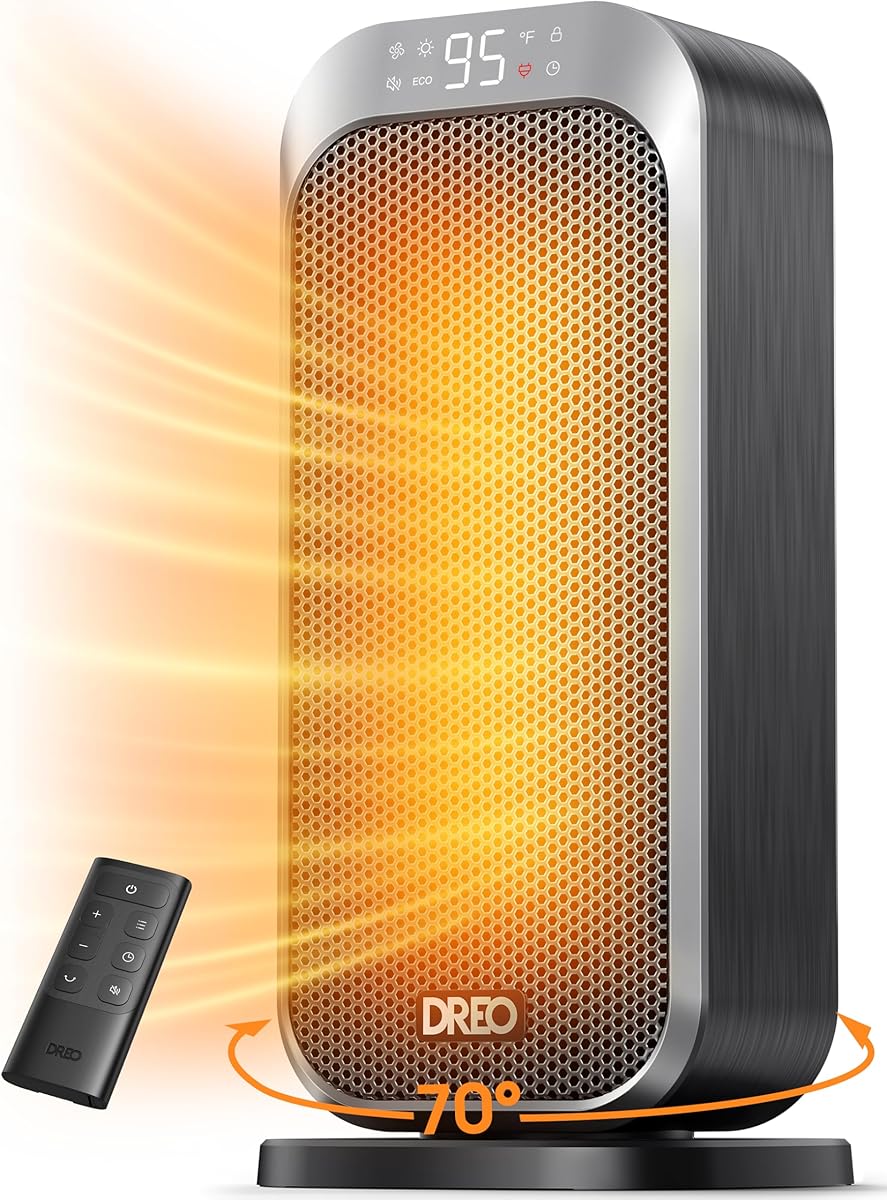



The DREO Space Heater combines a 1500W maximum output, a digital thermostat, and a 37.5 dB brushless motor in a compact indoor design. Its 4.6 rating reflects a strong balance of features, especially for shoppers who want more control than a basic two-level heater without moving to a large floor unit. The combination of quiet airflow, automatic temperature management, and oscillation makes it useful across offices, bedrooms, and living areas.
We may earn a commission when you buy through this link, at no additional cost to you.
The thermostat adjusts from 41°F to 95°F in 1°F increments, allowing the user to establish a specific target rather than relying on vague high and low settings. ECO mode automatically changes the heat level to help maintain that target, which is the most important efficiency feature in the product data. A 70-degree oscillation distributes air across a wider area, while the nine aerodynamic blades and brushless DC motor reduce turbulence and operating noise.
Safety is a meaningful strength. The ETL-listed Shield360° system includes tip-over and overheat protection, an enhanced safety plug, and UL94 V-0 flame-retardant materials. The trade-offs are familiar for this category: it uses fan-driven convection, so it is better suited to actively occupied rooms than to users who want fanless radiant warmth. It also does not provide a stated square-foot coverage figure, making room matching less precise than with several competing models.
This is our best overall energy efficient space heater because it combines useful automatic control, quiet operation, broad movement, and a thorough safety package without becoming complicated. Choose it for a desk, bedroom, office, garage, or basement where a compact heater should respond quickly to a chosen temperature. Users wanting silent radiant heat or explicit room-size guidance may prefer another model.
The 1°F thermostat and automatic ECO mode give the heater a practical way to avoid unnecessary high output. Selecting the desired temperature is more precise than choosing a general heat level and waiting for a manual adjustment.
At 37.5 dB, the brushless motor and aerodynamic blade design support use during sleep or focused work. The 70-degree oscillation helps carry warmth beyond a single fixed direction.
We may earn a commission when you buy through this link, at no additional cost to you.
The DREO Heater 319 is a 1500W PTC space heater with a 4.6 rating, a 34 dB operating level, and a full set of automated controls. It is especially appealing to buyers who want remote adjustment, a precise thermostat, and strong safety protections in one portable unit. Its 70-degree oscillation and advanced fan design also make it more flexible than a basic directional heater.
We may earn a commission when you buy through this link, at no additional cost to you.
The thermostat covers 41°F to 95°F in 1°F increments, helping the heater maintain a more stable environment. The product data also identifies a child lock, tip-over protection, V-0 flame-retardant material, overheat protection, safety plug, and ETL certification. These protections are valuable in a bedroom, office, or family room where the heater may operate unattended for long periods.
DREO claims its Hyperamics system can move heated air farther than traditional heaters, but buyers should treat that as a product claim rather than an independently verified laboratory result. The 34 dB level and winglet fan design are clearly positioned for quiet operation. One limitation is the absence of a stated room-size range, making it harder to compare coverage directly with models listing 250 or 270 square feet.
Choose the Heater 319 when convenience and safety controls are priorities. The included remote is useful at night, while the precise thermostat and oscillation make it suitable for a home office, bedroom, living room, or other frequently occupied area. Those seeking explicit large-room coverage or fanless operation should continue comparing the other models.
A remote control makes it easier to change the temperature or operating mode from across a room. That convenience is especially valuable during sleep or when the heater is positioned out of easy reach.
The combination of a child lock, tip-over shutdown, overheat protection, flame-retardant materials, and an ETL listing gives this model a well-rounded protection package.
We may earn a commission when you buy through this link, at no additional cost to you.
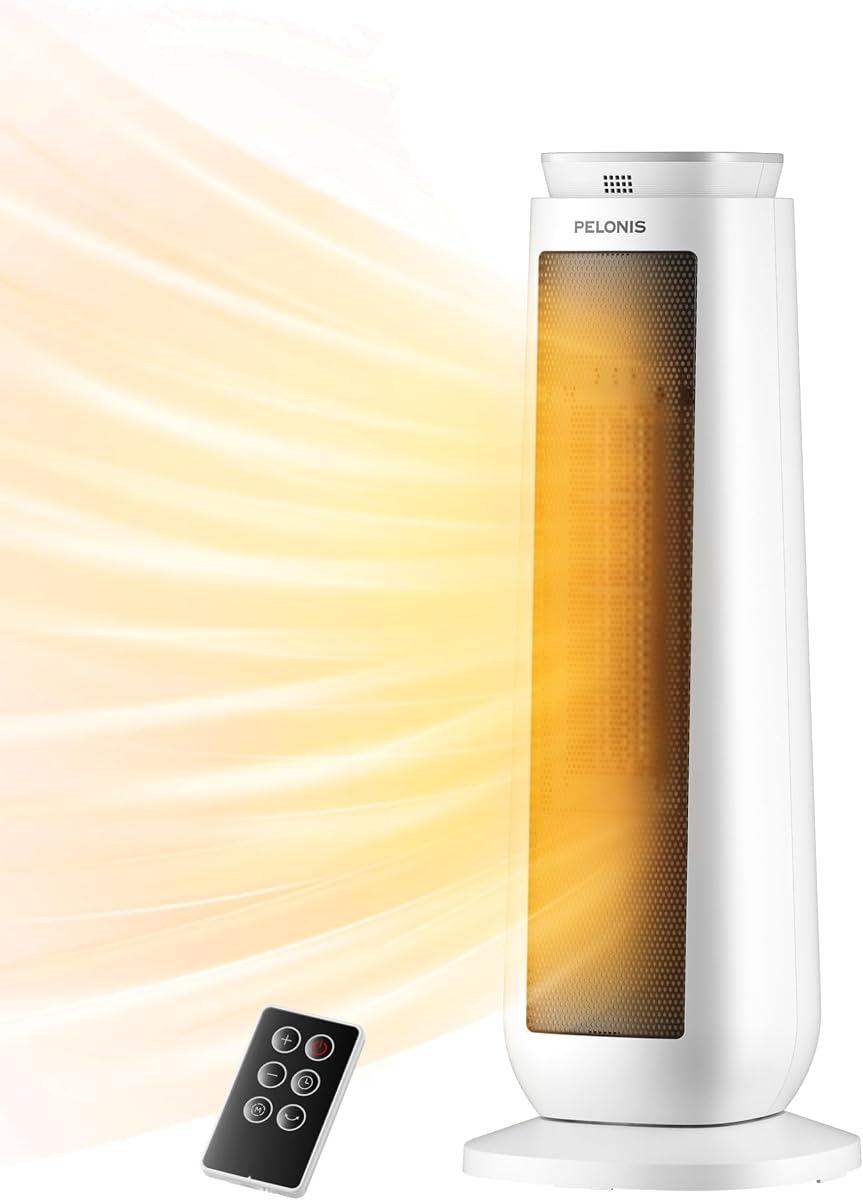
The PELONIS 23-inch tower uses ceramic resistance heating with a 1500W maximum output and a 4.4 rating. It offers three operating choices—High, Low, and ECO—plus a thermostat, oscillation, remote control, and an eight-hour timer. Its 106–167 square-foot coverage is clearly stated, making it easier to assess for a bedroom or office than heaters that do not publish a room-size range.
We may earn a commission when you buy through this link, at no additional cost to you.
The ECO setting is designed to adjust energy use according to ambient temperature, while the thermostat and separate heat levels allow more direct control. The ceramic elements are described as reaching 70°F in three seconds, although actual room warming will depend on insulation, room size, placement, and outside conditions. The product is rated for 110 volts and includes a carry handle for moving it between rooms.
At 50 dB, it is not as quiet as the DREO models in this ranking, which reach 25, 34, or 37.5 dB. Its eight-hour timer is also shorter than the 12-hour timers offered by several competitors. On the other hand, it has one of the clearest coverage specifications, a practical remote, and a three-mode heating setup that makes it easy to select an appropriate operating level.
This tower is a sensible choice for buyers who value a visible thermostat, an explicit ECO mode, and a stated coverage range. It fits well in a bedroom, living room, or office where the extra operating noise will be masked by normal activity. A silent bedroom or a larger area requiring a 12-hour timer may be better served by one of the DREO alternatives.
The stated 106–167 square-foot range makes room matching more straightforward. It also provides a useful point of comparison with other tower and large-room heaters in the guide.
High, Low, and ECO modes give users a quick choice between rapid heating, lower output, and automatic adjustment. The included remote and touch panel make those settings easy to reach.
We may earn a commission when you buy through this link, at no additional cost to you.
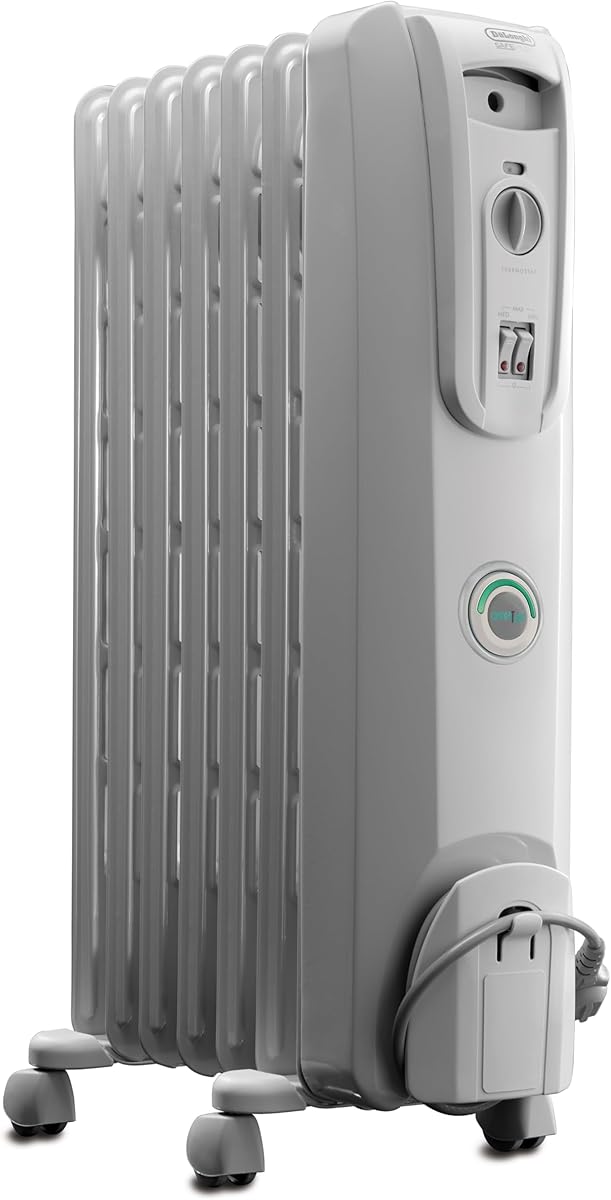
The De'Longhi EW7707CM is a 1500W oil-filled radiator designed for small and medium rooms, with a 4.4 rating. Unlike the fan-driven models in this guide, it uses concealed heating elements and radiant heat to provide steady warmth without moving air. That design makes it especially attractive to people who are sensitive to airborne dust, pollen, or dander.
We may earn a commission when you buy through this link, at no additional cost to you.
Its standout efficiency feature is ComfortTemp, which the manufacturer states can use up to 20 percent more efficiency than running the same thermostat at its maximum setting without that function. The model also has simple power and temperature controls, an anti-freeze setting that activates below 41°F, and an integrated handle and control panel. The sealed diathermic oil reservoir never requires refilling.
There are trade-offs. Oil-filled radiators generally take longer than fan-assisted PTC models to begin producing noticeable warmth, and their larger form takes up more floor space. This heater also has no digital display, remote, or exact room-size coverage figure. Those omissions are understandable for a simple radiant design, but they make it less versatile for users who want detailed control.
Choose the EW7707CM for a bedroom, quiet office, or living room where fanless radiant heat and automatic temperature management matter more than rapid warm-up or compact storage. Its steel construction, enclosed elements, thermal cut-off, rounded design, anti-freeze feature, and sealed oil reservoir also make it a durable, low-maintenance option for extended seasonal use.
The fanless radiant design warms objects and people without circulating room air. That can be beneficial for allergy-sensitive users who prefer not to have dust and pollen actively moved through the space.
ComfortTemp automatically maintains the selected temperature and adjusts power rather than continuously operating at maximum output. An anti-freeze function also provides selective use in cold conditions.
We may earn a commission when you buy through this link, at no additional cost to you.
The DREO 24-inch large-room heater combines a 1500W heating system with a stated coverage area of up to 250 square feet. Its 4.4 rating reflects a capable balance of airflow, temperature precision, oscillation, and quiet operation. It is designed for larger indoor spaces such as living rooms, offices, bedrooms, and finished basements or garages where more reach is needed.
We may earn a commission when you buy through this link, at no additional cost to you.
The product data highlights dual DC motors producing airflow at 10 feet per second, a 25 percent larger heating plate, and a claimed two-second heat-up time. ECO mode is described as reducing energy use by up to 40 percent, while the 41°F to 95°F thermostat uses 1°F increments. Three heat levels and a separate fan mode provide flexibility beyond basic heating.
A 70-degree oscillation helps spread warmth across the room, and 34 dB operation makes it less disruptive than many conventional heaters. The 12-hour timer is particularly useful for overnight or extended operation. The main caveat is that the energy-saving percentage and rapid heating claim depend on the manufacturer and should not be treated as a guarantee for every room or installation.
Choose this model when a clearly stated large-room capacity, a long timer, and automatic adjustment are priorities. It is a good fit for a home office, larger bedroom, or main living area. It is less suitable for users who require fanless radiant heat or want a very compact unit that can be stored away quickly.
The combination of ECO mode, a precise thermostat, and three heat levels allows the heater to respond to actual room conditions. Automatic adjustment is especially helpful when room temperatures change throughout the day.
The 12-hour timer lets the heater run through a full workday or most of the night without requiring repeated manual activation. It is a more useful duration than shorter eight-hour timers for overnight use.
We may earn a commission when you buy through this link, at no additional cost to you.
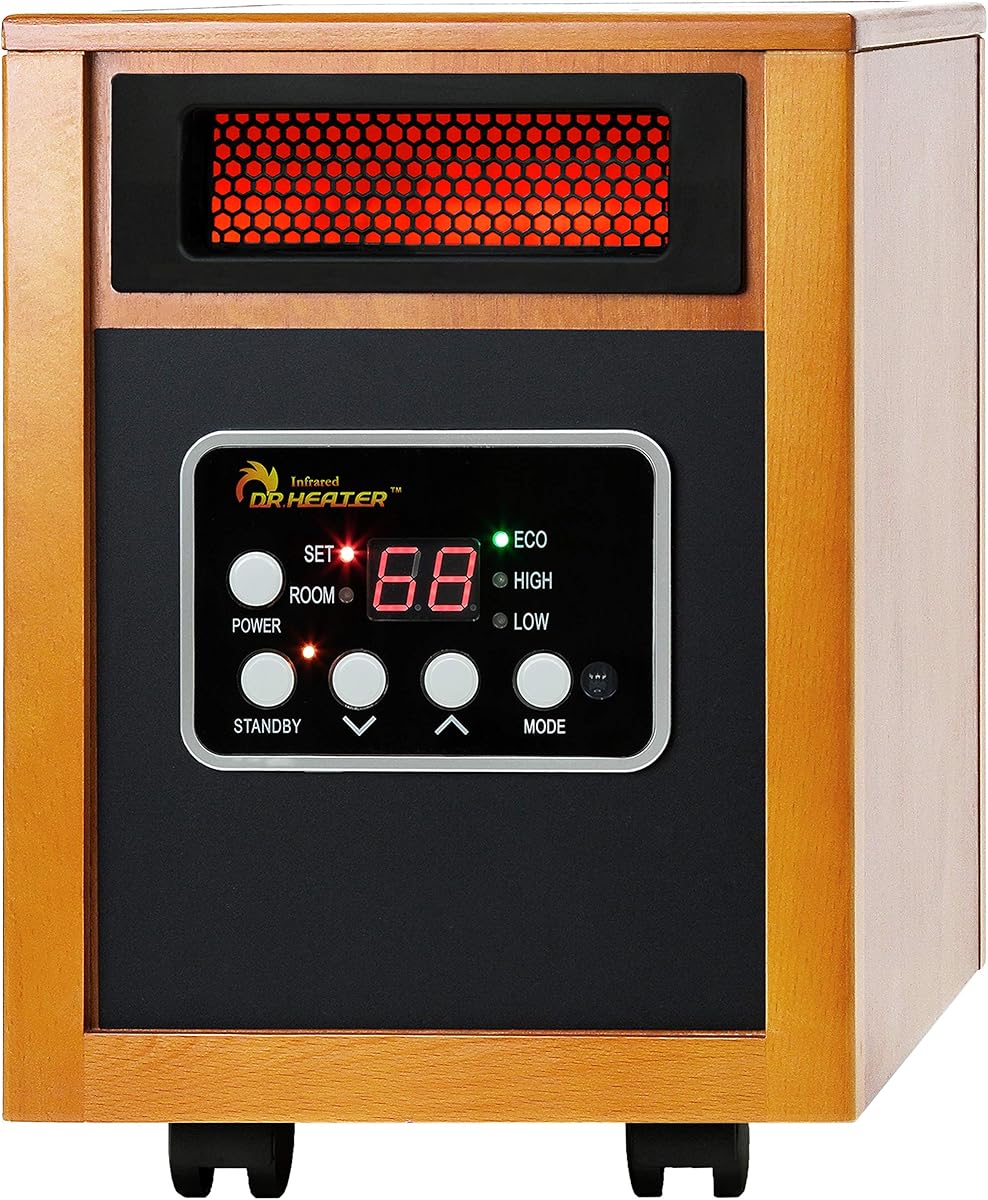
The Dr Infrared DR-968 uses both an infrared quartz tube and a PTC heating element in a 1500W portable design. It has a 4.5 rating, a listed output around 5200 BTU, and a 39 dB noise level. This hybrid approach is intended to provide the reach associated with radiant heating alongside the circulation benefits of a fan-assisted heater.
We may earn a commission when you buy through this link, at no additional cost to you.
High and low settings, an automatic energy-saving mode, an electronic thermostat, and a 12-hour automatic shutoff provide several ways to manage output. The thermostat range is 50°F to 85°F, and the included infrared remote makes adjustment convenient. A lifetime filter, caster wheels, and a six-foot power cord improve mobility and maintenance considerations.
The main drawback is portability. The heater weighs 19 pounds and uses 12.5 amps, making it substantial compared with compact desk models. It also lacks the 1°F thermostat increments and 25–34 dB operating levels found among the leading DREO options. Its stated large-room capability should therefore be considered alongside its size and electrical draw.
Buy the DR-968 if you want a hybrid heater with a remote, automatic high and low operation, and a generous timer. It works well for a large bedroom, office, or living room where the combination of radiant and forced-air warmth is desirable. For a small desk, quiet bedroom, or space with unusually sensitive power requirements, a lighter model may be more appropriate.
The infrared quartz tube and PTC element work together to combine radiant warmth with circulating air. This gives the model more flexibility than a pure oil-filled radiator or a basic fan heater.
The remote, automatic energy-saving mode, electronic thermostat, and 12-hour timer make it easy to establish a repeatable heating routine without frequent adjustment.
We may earn a commission when you buy through this link, at no additional cost to you.
The DREO 1500W ceramic heater has a 4.5 rating, a 34 dB operating level, and a stated heating coverage of 270 square feet. It is one of the most balanced selections in the guide, combining a large room target with smart ECO behavior, wide oscillation, and an extensive safety package. It can be used in bedrooms, basements, garages, offices, living rooms, dorms, and hot yoga studios.
We may earn a commission when you buy through this link, at no additional cost to you.
A built-in temperature sensor allows ECO mode to adjust the working mode independently. The heater can operate at 1000W or 1500W to maintain the selected ambient temperature, which is a more practical efficiency approach than leaving maximum heat running continuously. Its 70-degree trackball oscillation is claimed to improve heating coverage by 20 percent, and the oblique airflow design is intended to reduce wind noise.
Safety features include tip-over and overheat protection, a 12-hour timer, 24-hour automatic power-off without interaction, V-0 flame-retardant materials, and a six-foot flat cord. The manufacturer specifically instructs users not to use an extension cord and to plug the heater directly into a wall outlet. The lack of a remote means controls must be adjusted on the unit itself.
Choose this heater when you want a large stated coverage range without sacrificing low noise or automatic temperature management. It is a strong option for a bedroom, office, or living room where a balanced 1000W or 1500W output and extended scheduling are valuable. Users requiring remote control or fanless operation should weigh those limitations against the strong efficiency and safety features.
A built-in temperature sensor helps the heater select between lower and maximum working power according to ambient conditions. This automated approach can reduce unnecessary consumption compared with constant maximum output.
The 34 dB operating level and oblique fan design make this model suitable for sleep or focused work. A trackball-driven 70-degree oscillation spreads warmth without harsh blade noise.
We may earn a commission when you buy through this link, at no additional cost to you.
The DREO 25-inch electric heater combines a 1500W ceramic system with a notably low stated noise level of 25 dB. Its 4.4 rating and broad 100–270 square-foot coverage make it one of the strongest choices for larger rooms where quiet operation matters. The design is particularly well suited to bedrooms, offices, living rooms, and spacious work areas.
We may earn a commission when you buy through this link, at no additional cost to you.
The upgraded thermal design produces airflow at 11.5 feet per second, while the extended impeller increases the projected heat range. A dedicated temperature sensor supports automatic ECO Mode. The thermostat operates from 41°F to 95°F in 1°F increments, and four choices—H1, H2, H3, and ECO—give the user different levels of heat. It can also circulate air as a fan when the room is too warm.
The most notable advantage is the combination of 25 dB operation and 70-degree oscillation. Many quiet heaters cover only a small desk area, but this model is also positioned for rooms up to 270 square feet. The trade-off is its larger floor-heater format, which requires more placement space than compact models. Users who need a remote will also need to operate the controls directly on the unit.
This is our editor's choice for a quiet large-room heater because it does not limit efficiency to a small zone. The precise thermostat, ECO Mode, four heating settings, and strong safety package make it a versatile seasonal appliance. Pick it for a bedroom, office, or living room where low noise and broad coverage are the main requirements.
The 25 dB operating level makes the heater easier to tolerate during sleep, reading, or concentrated work while still retaining a large stated coverage range.
Four operating modes cover different comfort needs, while fan-only use can distribute room air when heating is not required. ECO Mode offers the most automated control.
We may earn a commission when you buy through this link, at no additional cost to you.
The DREO 60-degree tilt heater is a compact 1500W model with a 4.6 rating and a feature set aimed at offices, desks, and personal comfort. Unlike oscillating models that sweep side to side, it can be manually tilted through 0°, 20°, 40°, and 60° positions. This allows the user to direct warmth toward the floor, a chair, or the upper body more deliberately.
We may earn a commission when you buy through this link, at no additional cost to you.
The NTC chipset supports a 41°F to 95°F thermostat with 1°F increments, delivering a high degree of temperature control. Three heat settings and three fan settings offer additional operating flexibility, while remote and touch controls make the heater easy to adjust. A brushless DC motor and winglet fan design support a stated low operating level of 34 dB.
The product data claims warm air in two seconds and 53.9 percent more heated air than traditional heaters. Those are manufacturer claims that can vary with room conditions and placement. The heater also does not provide a stated square-foot coverage figure, and its tilt must be changed manually. It is therefore less suited to automatically distributing warmth throughout a large room.
Choose this model when you want focused, directional warmth with precise temperature control in an office, bedroom, or personal work area. It is a better match for someone seated at a desk than for heating an entire living room. If automatic room-wide distribution is the priority, choose a 70-degree oscillating model instead.
The four tilt positions let the user direct rising or descending warm air more accurately. This focused approach is useful when seated heat is more important than filling an entire room.
The 1°F thermostat and remote control make it simple to refine a personal comfort setting. Quiet 34 dB operation supports focused work and background use.
We may earn a commission when you buy through this link, at no additional cost to you.
The DREO 360-degree whole-room heater has a 4.8 rating, the highest listed rating in this guide, and pairs 1500W PTC heating with a 25 dB operating level. Its circular outlet is designed to release warm air in every direction, making it useful for centrally placed heating in bedrooms, living rooms, and offices. The stated coverage is 160–270 square feet.
We may earn a commission when you buy through this link, at no additional cost to you.
The heater uses a 360-degree air outlet and airflow at 9.5 feet per second to distribute warmth toward room corners. Its thermostat covers 41°F to 95°F in 1°F increments, and ECO Mode automatically adjusts output to maintain the selected temperature. The product data claims energy consumption can be up to 40 percent lower than with traditional heaters under the stated comparison.
A 1–12 hour timer, touch panel, remote control, and built-in ambient light improve convenience. Safety features include overheat protection, flame-retardant materials, and tip-over auto shutoff. One consideration is that this appears to be a newer model in the lineup, and no specific room heat-up time is stated. As always, claims about energy reduction and rapid warming should be evaluated in the context of the actual room and installation.
Choose the 360-degree heater for central placement in a medium or large room where even directional coverage matters. It is especially attractive for quiet bedrooms, reading areas, and offices that benefit from a refined appearance and remote control. Its 25 dB operation and broad distribution make it a strong all-around choice, though a 70-degree oscillating model may be simpler for buyers who only need side-to-side movement.
The circular outlet removes the need to aim the appliance toward one side of the room. That makes central placement more practical and supports more even distribution around the heater.
A 25 dB operating level is among the lowest in the guide, while the timer can be set from one to 12 hours. These details suit bedrooms, offices, and longer operating periods.
We may earn a commission when you buy through this link, at no additional cost to you.
The most efficient heater is one that can maintain your preferred temperature without unnecessary power draw, fits the intended room, and includes controls that make operation straightforward.
PTC ceramic heaters use a fan to move air across ceramic elements, providing rapid warm-air delivery and wide circulation. Oil-filled radiators use concealed elements to produce slower radiant heat without moving dust through the room. Hybrid infrared and PTC designs combine radiant and forced-air approaches. The best choice depends on whether rapid circulation, gentle radiant warmth, or minimal air movement matters most in your space.
A thermostat is essential because it allows the heater to stop or reduce output once the selected temperature is reached. Models with 1°F increments provide finer control than broad high and low settings. Look for an automatic or ECO mode that monitors ambient temperature and adjusts power, because this is more relevant to real energy efficiency than maximum wattage alone.
Published coverage figures provide a useful starting point, but actual performance depends on ceiling height, insulation, drafts, windows, and placement. A heater intended for a 100–270 square-foot range may be a better fit than a compact personal model. In large or drafty spaces, position the heater near the coldest area and avoid blocking airflow. For an open-plan room, consider multiple smaller heaters or a model with broad oscillation.
Noise matters most in bedrooms, home offices, study areas, and nurseries. A 25–34 dB model is among the quietest in this guide, while a 50 dB tower may be noticeable during sleep. Brushless DC motors, winglet fan designs, and aerodynamic blades can reduce turbulence. Always consider noise alongside airflow performance, since a completely silent fan may move less air.
Look for tip-over shutoff, overheat protection, flame-retardant materials, and a secure or reinforced plug. A child lock adds protection in family spaces. A timer is valuable for turning the heater off after a set number of hours, while an automatic shutoff provides a backup when a room reaches its target. Avoid using extension cords unless the manufacturer's instructions explicitly permit it.
A 1500W heater is powerful enough for rapid heating but places a substantial load on an electrical circuit. Check the outlet rating, avoid overloaded power strips, and give other high-draw appliances adequate space. Lower-power ECO settings can still provide effective comfort once a room is warmed. For a small desk, a lower-output configuration may be more appropriate than using maximum power continuously.
Wide oscillation helps distribute warmth across a room, while adjustable tilt gives more focused direction for a desk or chair. Omni-directional outlets are useful for central placement. Position the heater on a stable, level surface with clearance around the outlet and intake. Keep it away from curtains, bedding, furniture, and other heat-sensitive materials, and never leave it unattended in a way that conflicts with its safety instructions.
Touch controls are convenient when the heater is close, while a remote is useful for a bedroom or office. A digital display makes the selected temperature easier to understand. For maintenance, favor models with accessible filters or enclosed systems that do not require oil servicing. Sealed reservoirs and washable filters can reduce long-term effort, although buyers should still follow the product instructions for cleaning and storage.
Before first use, remove any packaging, place the heater on a stable, level, hard surface, and confirm that the outlet and power cord are in good condition. Read the manufacturer instructions and set the thermostat to a comfortable temperature rather than leaving the unit at maximum output. For efficient operation, close doors and windows when practical and position the heater where its airflow can move freely through the occupied area.
Use ECO or automatic modes when available, especially in rooms that become warm over time. Choose a lower heating level for mild conditions, reserve the maximum setting for initial rapid warming, and use the timer or automatic shutoff to avoid unnecessary operation. For fan-assisted models, do not place the heater behind furniture or close to walls, and maintain the clearance specified in its instructions. Oil-filled and radiant models should also have adequate space around the enclosure.
Turn the heater off before cleaning or moving it, and let it cool fully. Dust the exterior and accessible intake or outlet openings gently according to the manual. Do not spray liquid into the unit, immerse electrical components, or open an oil-filled reservoir. Inspect the plug, cord, housing, and controls periodically, discontinue use if damage is visible, and store the appliance only after it is cool and dry. Replace filters where required and follow all local electrical and safety guidance.
An energy efficient space heater uses automatic temperature management to avoid unnecessary high output. A precise thermostat, ECO mode, lower operating levels, and scheduled shutoff are especially important. Wattage alone does not determine efficiency because a 1500W heater running continuously may use more energy than one that reduces output after reaching the selected temperature.
A 1500W heater is a common maximum output for portable models and can provide strong heat in a medium-sized room. Models in this guide list coverage ranging up to approximately 270 square feet under their stated conditions. Actual results depend on room height, insulation, drafts, and how close the unit is to the area where warmth is needed.
Ceramic heaters can be suitable for bedrooms when they include reliable tip-over and overheat protection and are operated according to the manual. Look for flame-retardant materials, a child lock, and a timer. Place the heater on a stable surface with clear space around it, and avoid extension cords unless the manufacturer explicitly permits them.
Oil-filled radiators have a maximum output of 1500W in the model reviewed, but their energy use depends heavily on how long they run and how the thermostat is set. Because they warm slowly and retain heat, they can be cycled efficiently. A model with automatic ComfortTemp control helps maintain the selected temperature without continuous maximum operation.
The quietest models in this guide are the DREO 25-inch electric heater and DREO 360-degree heater, each with a stated operating level of 25 dB. Other DREO units operate at 34 dB, while the PELONIS tower is listed at 50 dB. Actual perceived noise varies with room acoustics, airflow obstruction, and the selected mode.
Only use a heater overnight if its instructions permit unattended or scheduled operation and it has appropriate safety protections. A timer and automatic shutoff can reduce unnecessary run time. Keep the heater away from bedding, curtains, and other flammable materials, and never use an extension cord unless specifically allowed by the manufacturer.
A fan heater warms the air and distributes it more quickly, making it effective for offices, garages, basements, and frequently occupied rooms. An oil-filled radiator produces slower radiant heat and does not stir dust through the room, which may be preferable for allergy-sensitive users. The best choice depends on the room, personal sensitivity, and desired speed of warmth.
Follow the clearance instructions supplied with the specific product, because required spacing can vary by model. As a general practice, place the heater on a hard, level surface and keep curtains, bedding, furniture, papers, and other combustible materials away from the outlet and housing. Never cover the unit, and ensure its intake and outlet remain unobstructed.
The DREO Space Heater with Thermostat is the best overall selection because it combines a 37.5 dB operating level, 1°F temperature control, automatic ECO mode, wide oscillation, and a comprehensive safety package. The DREO 25-inch electric heater stands out for exceptionally quiet 25 dB operation across a stated 100–270 square-foot range, while the De'Longhi EW7707CM is the premium choice for fanless radiant heat and automatic ComfortTemp control.
Prioritize the thermostat, automatic operating mode, room coverage, noise level, and safety protections rather than maximum wattage alone. Personal heaters are best for desks and chairs, oscillating models suit broad directional coverage, and oil-filled radiators serve users who prefer steady warmth without moving room air. Timers and automatic shutoff add another layer of practical efficiency.
Finally, verify current product details, certification information, seller identity, and availability before purchasing, because ratings and product information can change. Compare the heater with the specific space you intend to warm, then choose the model that provides the most useful controls without paying for features you will never use.