
Portable Rechargeable Electric SUP Paddle Board Pump
4.3Editor score
20 PSI maximum pressure
13,500mAh battery capacity
Three inflation settings
LCD pressure display
12V DC car connector
Our electric battery powered paddle board pump guide compares 10 cordless models for pressure, charging, portability, inflation speed, auto shutoff, and
An electric battery powered paddle board pump removes the tiring work of inflating a stand-up paddle board by hand, making spontaneous lake trips, beach outings, and camping weekends considerably easier. The most useful models combine fast inflation, accurate pressure control, dependable battery power, and a body light enough to carry without slowing you down.
This guide compares ten rechargeable SUP pumps across maximum pressure, inflation stages, battery capacity, charging options, inflation speed, display functionality, cooling, included accessories, and compatibility with other inflatable equipment. The list includes focused portable models and more versatile pumps designed for boats, kayaks, tents, air mattresses, bicycles, and vehicle tires.
Each review explains the product's strongest traits and honest trade-offs, helping shoppers distinguish between maximum-pressure models and lighter travel options. Ratings and specifications reflect the supplied product information, while current features, availability, and prices can change, so readers should confirm the latest listing before purchasing.
4.3Editor score

4.5Editor score

4.6Editor score
The comparison below places all ten rechargeable SUP pumps side by side, emphasizing maximum pressure, battery capacity, inflation method, portability, and standout features that distinguish each model.




This portable rechargeable SUP pump combines a 20 PSI maximum with a large 13,500mAh battery, giving it an unusually generous power reserve for its size. Its dual-stage system is designed to fill a 10.6-foot stand-up paddle board to 12 PSI in about seven minutes and 15 PSI in roughly nine minutes. That balance of capacity, speed, and portability makes it a practical choice for recurring lake and beach outings.
We may earn a commission when you buy through this link, at no additional cost to you.
The pump includes three adjustable inflation settings, an LCD for real-time pressure monitoring, and automatic shutoff at the selected pressure. Its battery can reportedly inflate three to four stand-up paddle boards consecutively, while a 12V DC connector provides a useful alternative when a vehicle is nearby. Fast deflation simplifies folding the board, and the compact dimensions make the unit less cumbersome than a full-size inflator.
Its main limitation is the 20 PSI ceiling, which is ample for many recreational inflatable boards but offers less headroom than the 50 PSI models in this guide. Buyers should also follow the manufacturer's guidance to fully charge the pump before extended storage and recharge it fully before use again. A possible hose issue is addressed through the stated one-year warranty and replacement support.
This is a strong recommendation for a paddler who wants dependable battery runtime, straightforward controls, and no need for a permanent 12-volt power source. It also suits campers because the same pump can handle tents, kayaks, rafts, and inflatable boats. Those needing extreme pressure, tire inflation, or repeated group use may prefer one of the more specialized 50 PSI options.
The 13,500mAh rechargeable battery is one of this model's strongest attractions because it can complete several board inflations on one charge. That makes it more practical for users who do not always have a vehicle outlet nearby.
A clear LCD, selectable pressure settings, and automatic shutoff reduce the need to estimate pressure manually. The result is a more repeatable setup process and less risk of overinflating an inflatable board.
We may earn a commission when you buy through this link, at no additional cost to you.
This 22 PSI rechargeable SUP pump focuses on the balance between airflow, pressure control, and packability. Its dual-stage system can take a 10.6-foot paddle board from packed to 12–15 PSI in approximately 8.5 to 10.5 minutes, while quick deflation helps reduce pack-down time. The digital pressure sensor and automatic stop function make it suitable for users who want hands-free inflation with a defined target.
We may earn a commission when you buy through this link, at no additional cost to you.
The built-in battery and Type-C charging support genuinely cordless use, and the included 12V connection expands the options for group trips. Seven nozzles cover paddle boards, kayaks, air mattresses, kites, and other inflatables. A flashlight, carrying bag, and emergency charging port are particularly useful in dim campground or shoreline conditions.
The stated customer rating of 4.0 is the lowest among the ten products, although the supplied information does not explain individual customer experiences. The battery's exact capacity is also not specified, so buyers cannot directly compare its charge endurance with pumps that publish a milliamp-hour figure. It may also take slightly longer than several competitors to reach the same pressure in the stated test conditions.
Choose this model when portability, a 22 PSI ceiling, multiple nozzle options, and useful low-light features matter most. It is a sensible choice for campers and paddlers who want one compact device for several inflatable activities. Shoppers prioritizing the strongest published rating, higher pressure ceiling, or more explicit battery capacity may find a better-supported alternative.
The integrated flashlight and emergency charging port add practical value after sunset or at remote campsites. These features make the pump more than a basic inflation device without greatly increasing its reported weight.
Dual-stage inflation and seven included nozzles allow the pump to move beyond paddle boards. The range is useful for paddling weekends where kayaks, tents, and air mattresses may all need inflation.
We may earn a commission when you buy through this link, at no additional cost to you.
This 50 PSI pump is the most versatile model in the roundup because it combines a high-pressure ceiling with quick inflation and a large collection of outdoor-compatible modes. The dual-stage motor can fill a 10.6-foot paddle board to 12 PSI in about six minutes or 15 PSI in around eight minutes. It also includes dedicated tire inflation, making it a practical multi-purpose device for vehicles and bicycles as well as watercraft.
We may earn a commission when you buy through this link, at no additional cost to you.
Its 10,000mAh rechargeable battery is reported to handle up to four paddle boards per charge, while Type-C charging and a 12V DC lead provide flexible power options. A large LED display shows live pressure, automatic shutoff honors the selected target, and the emergency light includes white illumination, a red warning flash, and an SOS mode. Seven universal nozzle adapters, a tire hose, and both charging cables create a complete accessory package.
The principal trade-off is complexity. Buyers paying for a 50 PSI unit and multiple vehicle-oriented features may carry more capability than a paddler needs, and the controls require a brief learning period. The product information also describes car-tire use, so owners should confirm appropriate pressure guidance for the specific vehicle and accessory compatibility before operating.
This pump is our Editor's Choice because it covers the widest range of realistic uses without sacrificing the fast inflation and automatic pressure control expected from a dedicated SUP pump. It is an excellent choice for family gear, mixed camping trips, roadside preparation, and paddlers who want a single inflation device for several types of equipment.
The dedicated tire mode and 50 PSI ceiling extend this pump well beyond a typical 20 PSI SUP device. That makes it valuable for households that also maintain inflatable toys, bicycles, or vehicle tires.
A six-minute stated inflation time for 12 PSI is among the quickest figures in the list. Real-time readings and automatic shutoff allow users to start the pump, monitor the target, and focus on packing the rest of their gear.
We may earn a commission when you buy through this link, at no additional cost to you.
This three-stage 50 PSI pump earns the premium selection by combining a high customer rating with a sophisticated airflow and cooling design. It can inflate and deflate as many as four paddle boards at 12 PSI on one charge, reach 12 PSI in 8.5 minutes or less, and deflate a board in around two minutes. The stated 12,000mAh battery and support for 12V DC vehicle power make it suited to intensive days and group outings.
We may earn a commission when you buy through this link, at no additional cost to you.
Its three-stage design moves from 350–420 liters per minute to 70 liters per minute for high-pressure replenishment. That approach is intended to balance rapid volume inflation with controlled top-up pressure. An upgraded active cooling system is designed for continuous use, while the large screen displays both real-time and target pressure. A built-in light improves operation at night.
Compared with simpler two-stage models, the extra stage and cooling system add complexity and may be unnecessary for one-board lake trips. At 2.9 pounds, it remains portable, although it is heavier than the lightest 2.4-pound options. Its 50 PSI maximum also gives it more capability than a standard paddle board requires, making versatility the central reason to choose it.
This is the best pick for experienced paddlers, families, instructors, and campers who repeatedly inflate multiple boards or use the pump for other high-pressure inflatables. The strong rating, large battery, active cooling, and quick deflation make it well suited to demanding schedules. For occasional users who only need a compact board pump, a lighter 20 PSI model may be more efficient.
The active cooling system is designed to reduce the risk of overheating during consecutive cycles. It is particularly relevant for group trips, rental operations, and days when several boards need to be prepared in succession.
Despite supporting 50 PSI and a three-stage system, the pump weighs 2.9 pounds and includes a handle and carrying bag. It remains transportable for paddling and camping while offering more headroom than a basic recreational pump.
We may earn a commission when you buy through this link, at no additional cost to you.
This dual-stage SUP pump is particularly notable for its 13,500mAh battery, precision display, and extensive nozzle selection. It can inflate a 10-foot, 6-inch paddle board to 12 PSI in about six minutes or 15 PSI in approximately eight minutes. Pressure reaches 20 PSI, and the system automatically stops when the selected target is reached.
We may earn a commission when you buy through this link, at no additional cost to you.
The LED screen supports PSI and BAR switching and is described as accurate to within 0.1 PSI. Seven nozzles include a standard high-pressure valve nozzle and an upgraded high-compatibility SUP nozzle, while four O-rings are intended to improve sealing. The 12V DC lead, inflate and deflate functions, and durable ABS construction make it suitable for repeated outdoor use.
Its stated operating range of -10°C to 60°C is broader than that of many competing listings, and the product has reportedly passed more than 500 inflation and deflation cycles. On the other hand, the 20 PSI ceiling is lower than the 50 PSI models, and the large accessory collection may take more space in a compact beach bag than a simpler pump and hose combination.
Choose this model for a paddler who wants strong battery endurance, fast inflation, and the ability to connect to several valve styles. It is also a good match for camping because the same nozzle kit can handle tents, air mattresses, pool inflatables, swim rings, and kayaks. High-pressure tire work is the main task better served by a 50 PSI model.
Two dedicated SUP nozzles and four O-rings give users more options for unfamiliar valves. The compatibility-focused design is useful for anyone who has encountered a loose or poorly fitting connection on a conventional SUP pump.
Switching between PSI and BAR, combined with the stated 0.1 PSI accuracy, makes the display useful beyond a simple progress indicator. It helps users select a deliberate target and avoid unnecessary overfilling.
We may earn a commission when you buy through this link, at no additional cost to you.
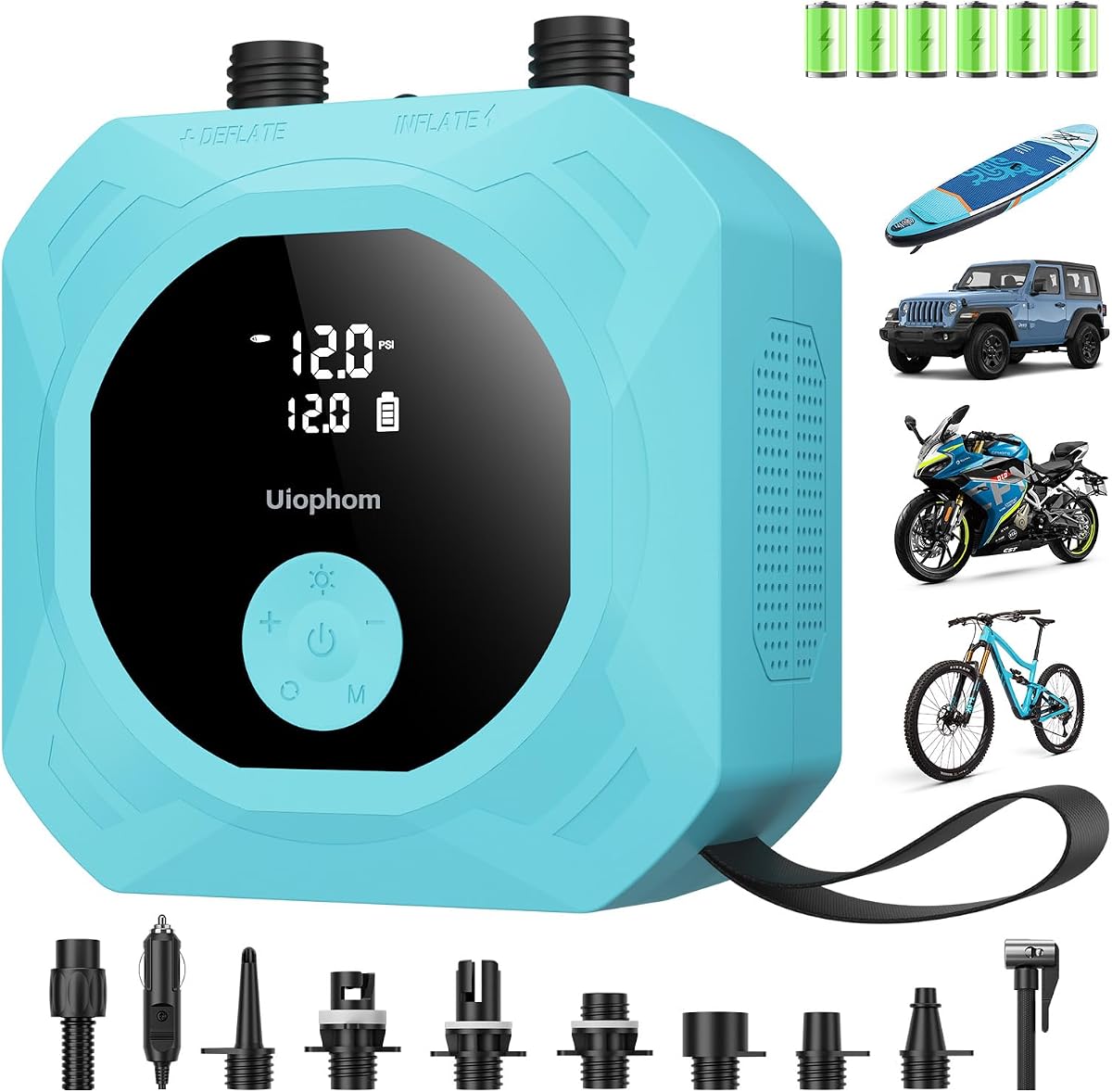
With six 2,600mAh batteries providing 15,600mAh of total capacity, this is the endurance leader in the guide. It is reported to inflate a 10.6-foot SUP to 12 PSI as many as five times or to 15 PSI four times on one charge. For users who travel beyond a vehicle outlet, that reserve offers valuable flexibility.
We may earn a commission when you buy through this link, at no additional cost to you.
The 50 PSI dual-stage system delivers 420 liters per minute during the initial volume-fill stage and 100 liters per minute for high-pressure work, bringing a board to 12 PSI in under seven minutes. Active cooling is included for extended operation, and 12V DC power is available when the battery is depleted. A large LED screen shows current and target pressure, while a multifunctional light supports low-light setup.
At 3 pounds, it is the heaviest pump listed, though its 6.7-by-3.6-by-6.7-inch body remains compact. The 18W charging system requires planning, and the unusually broad range of supported equipment may make the control scheme more involved than a simple SUP pump. The factory-reset procedure is useful if readings become abnormal, but users should consult the manual before resetting the unit.
This pump is best for long camping weekends, guided trips, families inflating several boards, and anyone who values battery capacity over minimum weight. It also handles car and motorcycle tires, mountain bike tires, boats, kites, tents, beds, and pool floats. Buyers who only inflate one board occasionally can likely find a lighter model with ample capacity.
Five 12 PSI board inflations or four 15 PSI cycles per charge give this model unusual endurance. That makes it well suited to locations where finding a car outlet or carrying a separate battery would be inconvenient.
The 50 PSI ceiling and supplied accessories extend the pump to vehicle and bicycle tires as well as recreational inflatables. It can serve as a household and campsite tool rather than a board-specific accessory.
We may earn a commission when you buy through this link, at no additional cost to you.
The Hydrohero pump is built around speed and compactness. Its dual-stage motor is stated to inflate a 10.5-foot SUP board to 12 PSI in five minutes, the fastest clearly stated time among the dedicated 20 PSI models here. At 2.51 pounds, it is also among the lighter units, making it convenient to carry from a vehicle to a launch point.
We may earn a commission when you buy through this link, at no additional cost to you.
Four 2,600mAh batteries provide a combined 10,400mAh, reportedly enough for three 10.5-foot boards at 12 PSI or two at 15 PSI. QC3.0 30W charging helps reduce downtime, and the Type-C port is convenient for travelers who already carry compatible cables. Automatic shutoff, a real-time LED screen, and three selectable modes provide clear pressure control.
The absence of a stated 12V DC connection makes it less suitable as a vehicle-powered unlimited-use option, although the battery is strong enough for several board cycles. Its 20 PSI ceiling is adequate for many inflatable paddle boards but lower than high-pressure pumps intended for car tires. The included waterproof bag also does not include a charging plug, so buyers should plan to supply one.
This model is a good recommendation for solo paddlers and couples who prioritize fast setup, light carrying weight, and a rechargeable cordless experience. It is also suitable for camping because seven nozzles cover SUPs, beds, kayaks, tents, boats, and swimming rings. Those who need vehicle power or 50 PSI performance should look toward the more versatile options.
The stated five-minute inflation to 12 PSI reduces the delay between unloading gear and entering the water. That speed is especially valuable for users who arrive at a launch during a limited daylight window.
A 30W Type-C charging system and included waterproof bag support a modern travel kit. The lightweight body and compact dimensions also reduce the amount of space occupied in a vehicle or gear bag.
We may earn a commission when you buy through this link, at no additional cost to you.
TOPUMP emphasizes genuinely cordless operation in a compact 1.1-kilogram package. The dual-stage motor supplies 400 liters per minute during the first stage and 100 liters per minute during the second, reaching 12 PSI in about five minutes. Automatic shutoff at a target of up to 20 PSI helps make the five-minute setup predictable without manual pressure monitoring.
We may earn a commission when you buy through this link, at no additional cost to you.
The supplied information says one charge can inflate three 10.6-foot SUPs from 0 to 12 PSI, giving this lightweight model meaningful endurance for solo trips and couples. One-touch deflation is also convenient after paddling. Users can long-press the unit-switch control to move among low, high, and automatic modes, which provides flexibility for different inflatable equipment.
The exact battery capacity is not published in the supplied details, making it difficult to compare electrical specifications directly with other models. There is also no listed 12V DC alternative, so users must recharge the pump between extended groups of inflations. At 2.43 pounds, however, it is the lightest unit in the comparison and offsets some of those limitations with easy portability.
This pump is well suited to paddlers who walk a distance from their vehicle, use public transit, or carry their gear by bicycle. It also works for camping and beach trips involving boats, kayaks, or tents. The two-year warranty and stated 24/7 support add reassurance, while the lightweight design makes it a compelling cordless-first choice.
At 1.1 kilograms, this is the lightest listed pump and avoids the bulk associated with larger compressors. That portability can be more valuable than extra pressure capability for users who carry equipment on foot.
Automatic mode lets the pump reach a selected target and stop without constant supervision. Low and high choices add flexibility when switching between large-volume inflatables and items requiring more pressure.
We may earn a commission when you buy through this link, at no additional cost to you.
The dwndpump stands out for a practical memory function that recalls the previous pressure setting. Its dual-stage system delivers 400 liters per minute initially and 100 liters per minute at high pressure, reaching a 20 PSI maximum. A digital display, automatic inflation stop, and active cooling system support hands-free operation and repeated use.
We may earn a commission when you buy through this link, at no additional cost to you.
The supplied information states that the 2,600mAh rechargeable battery can inflate two 10.5-foot boards to 15 PSI, which is a more modest endurance figure than several competitors. It is still suitable for personal outings where the pump can be recharged between sessions. The compact 7.64-by-6.89-by-3.46-inch body and integrated handle make it straightforward to pack and carry.
Unlike models with fully automatic inflation and deflation cycles, this pump requires the user to turn it off manually after deflation. The smaller battery also means it is less attractive for groups or long distances from a charging point. A charging plug is not included, and the manufacturer recommends a 5V/2A or higher adapter for best performance.
Choose this model if remembering a preferred pressure is a priority or if you typically use one board rather than several. The 2.51-pound body, seven adapters, active cooling, and two-year coverage make it a straightforward option for camping and everyday paddling. Buyers planning group outings should consider a higher-capacity pump.
Saving the previous pressure setting reduces repeated button presses on subsequent launches. It is a small feature that can make recurring sessions more convenient and consistent.
The independent cooling system helps the pump continue working without overheating. It complements the lightweight form and makes the unit practical for more than one inflation task in a day.
We may earn a commission when you buy through this link, at no additional cost to you.
The Peakspeak pump offers a balanced combination of quick inflation, modest weight, and useful battery endurance. It can bring a board to 12 PSI in under six minutes, and its 20 PSI dual-stage system uses 400 liters per minute in the first stage and 100 liters per minute in the second. Smart auto-stop adds a layer of protection against overinflation.
We may earn a commission when you buy through this link, at no additional cost to you.
Its four 2,600mAh batteries provide a combined 10,400mAh, reportedly enough for three 10.6-foot boards at 12 PSI or two at 15 PSI. The digital display supports real-time monitoring, target setting, inflation, and deflation, while seven nozzles expand compatibility to beds, kayaks, boats, tents, and swimming rings. A two-year guarantee and stated 24/7 support provide additional confidence.
The 4.2 rating is lower than several higher-ranked alternatives, although the supplied data does not reveal the reasons behind individual feedback. As with the lightest cordless models, there is no stated 12V DC connection, making this more dependent on its internal battery for lengthy group use. Its 20 PSI maximum is also insufficient for some vehicle-tire applications.
This is a versatile recommendation for recreational paddlers, couples, and campers who want one electric pump for boards and common inflatables. It is particularly attractive for users who value a digital control panel, automatic stopping, and lightweight carrying. A buyer who requires 50 PSI performance or continuous vehicle power should choose a more specialized model.
The Peakspeak combines a 2.47-pound body with a stated 12 PSI inflation time under six minutes. That balance makes it practical for regular paddling without requiring the bulk of a heavier multi-purpose compressor.
Digital inflation and deflation controls, together with seven nozzles, keep the pump useful beyond a single board. It is a practical addition to a camping kit containing tents, kayaks, or air mattresses.
We may earn a commission when you buy through this link, at no additional cost to you.
The right rechargeable SUP pump depends on how often you paddle, how far you carry your gear, which other inflatables you own, and how much pressure you need. Comparing the following factors can prevent a basic board pump from becoming an frustrating or inadequate purchase.
A pump's maximum PSI rating should comfortably exceed the pressure recommended for your inflatable paddle board. Most of the dedicated models here reach 20 or 22 PSI, which is generally appropriate for standard recreational boards, while three models extend to 50 PSI. The higher rating creates headroom for demanding inflation tasks and allows the same device to handle certain vehicle or bicycle tires, but it does not mean the pump is required for every board.
Choose based on actual use rather than the largest number available. A 20 PSI model is a sensible choice for ordinary paddle boards and common campsite inflatables. Select a 50 PSI pump if you also maintain car tires, motorcycles, mountain bikes, or higher-pressure equipment and want one tool for every job.
Battery capacity determines how many times a pump can inflate a board without another power source. Published figures range from 2,600mAh to 15,600mAh, although the number of board cycles is often more useful for comparison. Listed performance ranges from two 10.5-foot boards at 15 PSI to as many as five 10.6-foot boards at 12 PSI on a full charge.
Solo paddlers can often manage with a smaller battery, while families, instructors, and remote-trip users should favor larger capacity. A 12V DC connection provides an additional fallback for extended use near a vehicle, so consider that feature if battery endurance is the main concern.
Inflation speed depends on both the pump's airflow and the board's volume. A two-stage motor generally uses high airflow to fill the largest spaces and then shifts to a lower, higher-pressure flow for the final PSI. The fastest stated 12 PSI times range from about five to seven minutes, while larger 15 PSI targets commonly take eight to nine minutes or more.
Look for separate low-pressure and high-pressure stages rather than judging only by wattage or maximum PSI. A 400-to-420-liter-per-minute first stage paired with a 100-liter-per-minute second stage is a strong indication of efficient design. Board construction and starting pressure will also affect real-world timing.
A digital pressure display lets users choose a specific target instead of estimating by sound or hand feel. Automatic shutoff stops the motor at the selected pressure, reducing the risk of overfilling and making the pump suitable for hands-free operation. The best models also show both current and target pressure throughout the cycle.
For repeat users, a memory function is a useful refinement because it recalls the last selected pressure. Basic PSI and BAR switching is also helpful for international users or anyone accustomed to metric pressure readings. Confirm that the display is readable in daylight before relying on it outdoors.
Pump weight matters most when the launch point is far from a vehicle, the route involves stairs, or the pump must fit in a small backpack. Listed weights range from approximately 2.43 to 3 pounds, a narrower difference than the specifications might initially suggest. Handles, compact dimensions, and included carrying bags can matter as much as the raw weight.
For frequent carry-in users, prioritize a model around 2.5 pounds or less. If the pump usually stays in a vehicle and handles several boards, a slightly heavier cooling-focused design may be a worthwhile trade for endurance and repeated use.
A complete SUP pump should at least connect reliably to the valve on your board. Models with seven nozzles or adapters are more useful when the pump will also inflate tents, air mattresses, kayaks, boats, pool inflatables, swimming rings, kites, or tires. Dedicated SUP nozzles and sealing O-rings can be especially helpful when working with unfamiliar valve types.
Check the valve type and included connection before purchasing, and keep the appropriate adapter in the carrying bag. Broader compatibility is useful, but every extra accessory also adds weight and organization. Purchase the broadest kit only if you will realistically use those additional functions.
Type-C charging is convenient because many travelers already carry a compatible cable, while QC or higher-watt charging can reduce turnaround time. A 12V DC lead lets the pump operate continuously near a car and acts as a useful backup when the battery is low. Active cooling is especially relevant for users who will inflate multiple boards or run other demanding inflation tasks.
Match the charging arrangement to your outings. A fast Type-C setup is convenient for travel, whereas 12V DC power is more dependable at remote launch sites with a vehicle. For hot-weather or group use, cooling and a stable power source help reduce the likelihood of thermal interruption.
Quick deflation reduces the time and effort required to fold and pack an inflatable board. Most models provide a dedicated deflation function, though some require the user to stop the pump manually, so the operating procedure is worth checking. Built-in white or emergency lighting can be valuable at dawn, dusk, and campsite locations where conventional lighting is limited.
Warranty and customer support can also influence ownership experience. Coverage ranges from one year for one model to two years for several others, and some include dedicated or 24/7 support. A hose, valve, battery, or connector is more likely to encounter wear over time, so responsive replacement support is a meaningful part of the purchase.
Begin by fully charging the pump before leaving for the lake or beach, especially if the outing will not include a vehicle outlet. Confirm that the correct SUP nozzle is attached and that the connection is clean. Open the board's air valve as directed by its manufacturer, select the recommended pressure rather than the pump's maximum, and keep the hose straight while the pump transitions between low-pressure and high-pressure stages.
Place the pump on a stable, dry surface with its vents unobstructed. Watch the display rather than leaving the device unattended in an unusual position. When the target pressure is reached, confirm automatic shutoff and disconnect the hose only after the reading has stabilized. For deflation, open the board's valve and use the pump's deflation mode; follow the product-specific instruction if manual shutoff is required.
After use, disconnect power, wipe away sand and moisture, and let the pump cool before storing it. Keep the charging port and air hose dry, and avoid inflating a damaged or incompatible device. Recharge before long storage, as some manufacturers specifically recommend keeping the internal battery full. Inspect hoses, nozzles, seals, and connectors periodically, and use the stated warranty or support service if a component cracks or fails.
A 10.5- or 10.6-foot paddle board generally reaches 12 PSI in about five to seven minutes with the faster models in this guide. Reaching 15 PSI commonly takes around eight to nine minutes, and actual time can vary with board volume, starting pressure, pump mode, and environmental conditions.
A 20 PSI pump is generally suitable for many recreational inflatable paddle boards because those boards typically require less than their maximum rated pressure. Always follow the pressure guidance printed by the board manufacturer, and never deliberately exceed that recommendation just because the pump can reach a higher number.
A 20 PSI pump focuses on portable paddle-board and campsite inflation, while a 50 PSI model offers additional headroom for demanding tasks and certain vehicle or bicycle tires. The higher rating adds versatility rather than automatically making inflation faster, so the right choice depends on the equipment you actually need to inflate.
Yes, the dual-stage motors in these products are designed to remove most of the physical effort involved in inflating an inflatable board. A manual pump can still serve as a lightweight emergency backup, but a rechargeable electric model is much more practical for routine setup and for users inflating boards with a firm target pressure.
Published battery performance varies widely by model, ranging from two 10.5-foot boards at 15 PSI to as many as five 10.6-foot boards at 12 PSI. Real results depend on the target pressure, board size, starting pressure, battery condition, and whether the pump is also used for other equipment.
Most models include multiple adapters, but buyers should confirm that the pump's valve style matches the board. Supplied fittings include high-pressure and high-compatibility SUP nozzles on some products, while others provide a larger universal adapter set. Keeping the correct fitting in the carrying bag is important for reliable sealing.
The safest approach is to follow the manufacturer's storage instructions. One product specifically recommends fully charging the pump before long storage and fully recharging it before use again. Keeping the battery away from extreme heat, moisture, and prolonged depletion will help preserve its service life.
It is not necessary for ordinary cordless use, because each listed model has an internal rechargeable battery. The car connection is valuable for group trips, repeated board cycles, or remote launch sites where continuous power is useful. Models without it can still be highly capable, provided their published battery endurance matches your expected use.
The 50PSI Paddle Board Electric Pump with the 10,000mAh battery is the strongest all-around choice because it combines a 50 PSI ceiling, rapid 12 PSI inflation, tire mode, dual power options, and emergency lighting. The Portable Rechargeable Electric SUP Pump offers the most balanced value for typical paddling, while the three-stage 50 PSI model stands out for repeated high-output use, active cooling, and its strong customer rating.
Prioritize the features that affect your actual outings: battery endurance for remote trips, weight for carry-in routes, pressure for mixed tire and inflatable use, and nozzle compatibility for camping equipment. A dedicated 20 PSI pump is usually sufficient for standard paddle boards, while a 50 PSI model earns its additional capability when it can replace several separate inflation devices.
Before buying, verify the board's pressure requirements, valve type, charging cable needs, included accessories, and current product listing. Features, ratings, and prices can change over time, so checking the latest listing and availability ensures the chosen pump still fits your needs and budget.