
GoodBaby 5-Inch Video Monitor
4.5Editor score
No-Wi-Fi private connection
Large five-inch display
Long battery life
An elderly monitor with camera and audio can give caregivers a reassuring way to check in, communicate, and respond when help is needed. The most useful models combine clear video, two-way talk, night vision, accessible call buttons, and dependable operation without requiring the senior to manage a smartphone or complicated app.
We compared the ten products in this guide on the features that matter most for in-home senior monitoring. The list covers dedicated elderly care systems, compact no-Wi-Fi monitors, dual-band app cameras, and versatile baby-monitor-style designs, while noting differences in range, alerts, recording, privacy, and caregiver mobility.
Each review explains what stands out about the product and where its compromises may affect your setup. The top selections reflect the strongest combinations of monitoring, communication, and usability, although household layouts, internet requirements, and individual care needs can change the ideal choice. Current listing details may also vary.
4.5Editor score
4.4Editor score

4.1Editor score
As an Amazon Associate we earn from qualifying purchases.
The table below compares every monitor by connection type, display or camera capabilities, senior-friendly alerts, and primary caregiver benefit. It is designed to make it easier to identify a system that fits a particular home, care routine, and comfort with technology.


The CallToU Baby Monitor for Elderly Monitor with Camera and Audio Call Button carries a 3.9 rating and offers a focused mix of private communication and daily senior prompts. Its standout feature is a dedicated 2.4GHz FHSS connection that operates without Wi-Fi, reducing dependence on an internet connection while keeping the camera and receiver linked through a private system.
We may earn a commission when you buy through this link, at no additional cost to you.
Two-way audio, infrared night vision, and a one-press SOS button form the core monitoring package. The call button can also issue drink-water, movement, toilet, and help reminders, making it more than a basic camera. Meanwhile, a 2.8-inch portable receiver gives caregivers a convenient way to carry the monitor around the home and conduct quick check-ins.
The camera also includes a temperature sensor and 4x zoom on its 720P display. Those details can help a caregiver inspect the room and notice environmental changes, although they are less sophisticated than the 1080P automatic tracking offered by some Wi-Fi models. The modest rating suggests that buyers should focus on the complete feature set rather than expecting a high-end smart-camera experience.
This is a good match for families that want elderly monitoring without cloud dependence, app setup, or a senior-facing phone. It is especially useful in a home where the caregiver wants alerts, night visibility, and a simple call button without exposing the entire care system to the household Wi-Fi network.
The secure FHSS signal makes this a practical option for privacy-conscious households. It can operate as a self-contained camera and receiver system, so the basic monitoring and communication functions do not depend on an internet connection or a family phone's app permissions.
Beyond the emergency SOS function, the dedicated prompts for water, movement, toilet visits, and help can reinforce routines. They give the senior a straightforward way to request a check-in without navigating menus or learning a new application.
We may earn a commission when you buy through this link, at no additional cost to you.
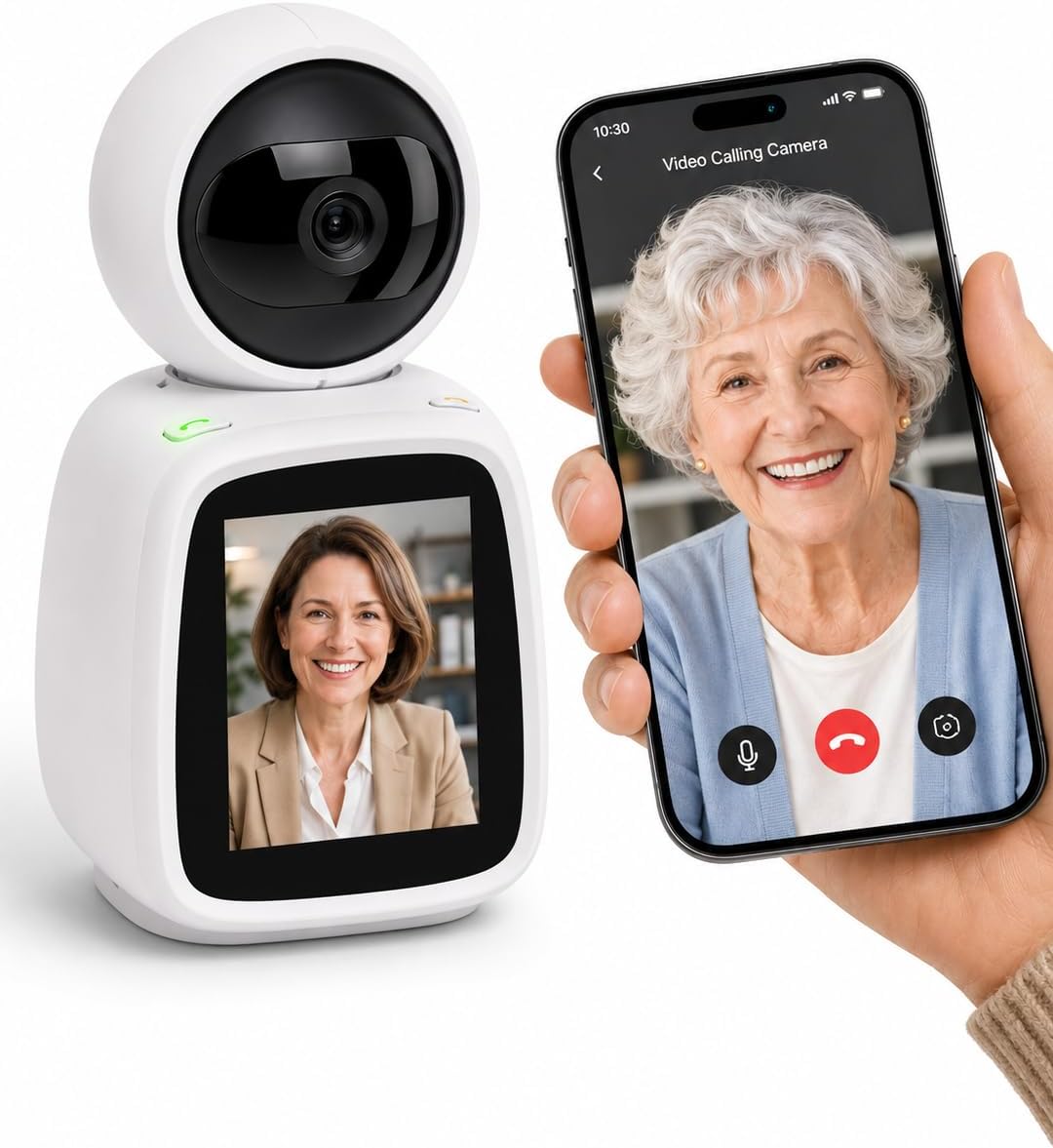
The SYMYNELEC Elderly Monitoring Camera with Screen, One-Touch Video Calling earns a 4.4 rating and stands out as the most feature-rich smart option in this guide. It combines a 2.8-inch screen, 1080P pan-tilt-zoom camera, one-touch calling, and automatic tracking in a system built specifically around communication with aging parents.
We may earn a commission when you buy through this link, at no additional cost to you.
Sound detection can send phone alerts when it identifies loud crashes, falls, or cries for help. The camera automatically tracks a parent within the frame, reducing the need to manually redirect the view. Simultaneous family calling rings all bound phones, while the first person to answer establishes the connection, which is useful when several relatives share caregiving duties.
Physical privacy receives unusual attention in this design. The lens can mechanically rotate backward, and scheduled timers can automatically activate privacy mode. The system also supports local continuous recording with a memory card of up to 128GB, although the card is not included. These features are meaningful because they give the household more control over when the feed is active and where recordings are stored.
The SYMYNELEC is best for families comfortable with a small app on the caregiver's phone and a reliable 2.4GHz Wi-Fi connection. It is less appropriate for someone seeking a completely internet-free system, but for a connected home it provides the strongest combination of calling, smart alerts, privacy controls, and family-sharing features in this roundup.
The camera's ability to detect concerning sounds and track a moving parent makes it more than a passive video display. Caregivers can receive notifications and investigate rather than watching the screen continuously, which is especially useful during sleep, work, or household chores.
A mechanical privacy position is more reassuring than a software-only mute because it physically removes the lens from view. Scheduling that privacy behavior also supports routines where the senior expects privacy during particular parts of the day.
We may earn a commission when you buy through this link, at no additional cost to you.
The Elderly Monitor with Camera and Audio, 2-Way Talk/Call Button/Pan-Tilt-Zoom has a 4.1 rating and offers one of the most complete packages for daily senior care. It combines a portable 2.8-inch screen, camera, one-touch call button, two-way talk, medication reminders, temperature alerts, night vision, soothing melodies, and a stated range of up to 1000 feet.
We may earn a commission when you buy through this link, at no additional cost to you.
Its call button is designed around several distinct needs. A press can trigger SOS or more routine alerts for movement, toilet visits, water, and help, allowing a caregiver to understand the type of assistance needed. Medication and meal reminders can be configured at half-hour, one-hour, two-hour, three-hour, or four-hour intervals, which adds structure for seniors with memory difficulties.
The system also monitors room temperature and can notify the caregiver when conditions leave a preset range. Smart VOX lets the display sleep during quiet periods and wake when sound crosses a threshold, although continuous viewing is possible when VOX is turned off. A 2000mAh battery supports portable use, while the included mounting hardware enables wall or tabletop placement.
This is an excellent choice for a family that values self-contained operation and a broad range of senior prompts. Its lack of internet-based remote access is the main limitation for caregivers who travel or want to check in from outside the home. For use within the residence, however, the feature balance is excellent.
Configurable reminder intervals make this monitor useful for seniors who may forget a dose or a regular meal. The system can create predictable audio cues without requiring the senior to operate a complicated scheduling interface.
The secure no-Wi-Fi setup keeps basic video, audio, alerts, and reminders operational on a dedicated connection. This makes the system easier to deploy in homes with limited internet service and avoids tying essential care tools to a router.
We may earn a commission when you buy through this link, at no additional cost to you.
The No-Wi-Fi Senior Video Monitor holds a 4.3 rating and emphasizes routine support, broad camera movement, and straightforward communication. Its package includes a camera, portable 2.8-inch receiver, emergency call button, and power adapter, providing the main components needed to begin monitoring after setup.
We may earn a commission when you buy through this link, at no additional cost to you.
The camera supports 355 degrees of horizontal and 90 degrees of vertical rotation, which can reduce blind spots in a bedroom, living room, or care space. Infrared night vision and a 720P display with 4x digital zoom help caregivers observe the room in darkness or inspect a small area. A temperature sensor can also issue alerts when the room becomes too warm or cold.
Daily reminders can be customized for hydration, activity, and bathroom visits, while medication reminders add another useful routine. Eight built-in soothing noise options may help create a calmer environment. For communication, the system includes real-time video calls, two-way audio, and a lightly pressed SOS button that is approachable for seniors.
This product is a strong fit for caregivers seeking a self-contained system with more reminder options than a basic video monitor. It may suit a home care room or nursing home room where local staff and family members need simple communication. The absence of off-site internet access limits remote checking, but within the monitored space, the system is capable and approachable.
The generous horizontal and vertical rotation allows the camera to follow activity or cover more of an open room without requiring a second unit. It is especially helpful in care spaces where a fixed narrow view could miss movement near the edges.
Hydration, activity, bathroom, and medication prompts create a dependable schedule around the camera. Repetition can make these reminders more useful than a general-purpose monitor for a senior who benefits from regular audio cues.
We may earn a commission when you buy through this link, at no additional cost to you.
The GoodBaby 5-Inch Baby Monitor with Camera and Audio No WiFi has the highest rating in the group at 4.5. Although marketed as a baby monitor, its large screen, robust no-Wi-Fi connection, two-way talk, infrared night vision, and flexible camera control make it a credible option for monitoring an adult in a bedroom or quiet living space.
We may earn a commission when you buy through this link, at no additional cost to you.
The 355-degree pan, 120-degree tilt, and 2x zoom let the caregiver inspect a broad area, while the five-inch LCD makes the image easier to see than on the compact 2.8-inch senior-focused receivers. A rechargeable 3500mAh battery is rated for up to 30 hours in VOX mode or 10 hours with the screen continuously active.
VOX is particularly relevant to senior monitoring because it powers down the display during silence and wakes when sound is detected. Two-way talk lets a caregiver communicate with the monitored room, and eight built-in lullabies may provide familiar audio. A temperature sensor and feeding alarm can also be adapted to a care routine, although they were not designed specifically for eldercare.
The principal compromise is the absence of a wearable or remote senior call button. A senior must speak to the camera to initiate a conversation rather than press a dedicated assistance button. For independent adults who mainly need a clear view, reliable audio, and a private connection, this remains a straightforward and capable choice.
The five-inch display is larger than most dedicated senior monitor screens included in this roundup. That extra size can make a quick visual check more comfortable, particularly for an adult with aging eyes or a caregiver who wants to recognize movement quickly.
Sound-activated wake-up means the display does not need to remain illuminated during every quiet moment. The long stated VOX battery duration also supports overnight use, although continuous viewing and other active features consume more power.
We may earn a commission when you buy through this link, at no additional cost to you.
The Smart Caregiver Video Monitor for Elderly Care and Caregivers, Portable, Rechargeable, Infrared Night Vision, Secure Connection, No WiFi carries a 3.6 rating but offers a distinctive caregiver-focused design. Both the camera and compact 2.8-inch receiver are rechargeable, and the receiver includes a belt clip for movement around the home.
We may earn a commission when you buy through this link, at no additional cost to you.
Its wireless caregiver call button is more versatile than a single SOS key. It includes separate buttons for general assistance, bathroom help, water, help with moving, and urgent SOS. The senior can keep the remote near the camera and request the type of support needed, giving a caregiver useful context before responding.
The camera has an integrated rechargeable battery, allowing it to move around the house during the day and be plugged in at night for continuous monitoring and charging. Push-to-talk two-way audio is available from the receiver, and the camera microphone remains active. Infrared night vision allows the system to continue functioning in a dark bedroom.
This model is best for a caregiver who wants both the camera and receiver to be genuinely portable. The lower rating indicates fewer advertised features than the higher-ranked systems, so buyers should not expect sophisticated fall detection, automatic tracking, or app-based off-site viewing. Its defining benefit is the combination of rechargeable components, a wearable-style call remote, and no-Wi-Fi operation.
The integrated camera battery removes the need to keep the camera tethered to an outlet throughout the day. A caregiver can reposition it to check another room and return it to a plugged-in setup for overnight use.
Separate bathroom, water, movement, general assistance, and SOS buttons make the senior's request more understandable. A caregiver can respond to a movement request differently from an urgent emergency without needing to ask the senior to explain through a speaker.
We may earn a commission when you buy through this link, at no additional cost to you.
The Baby Monitor 1300ft Range, 1080P HD, Pan-Tilt-Zoom, No WiFi, NO app earns a 4.3 rating and brings a high-resolution, multi-camera approach to elder monitoring. The system is primarily labeled for baby monitoring, yet its two cameras, 350-degree pan, 108-degree tilt, zoom, two-way talk, and private connection are relevant for monitoring two spaces in an adult care home.
We may earn a commission when you buy through this link, at no additional cost to you.
Both cameras feed a single large five-inch IPS display. Users can switch manually or automatically between rooms, which provides more flexibility than a one-camera setup without requiring separate receivers. The stated 1300-foot outdoor range makes the system useful in larger homes, although actual performance depends on walls, floors, placement, and interference.
The no-app, encrypted connection is appealing for households that want a closed network without exposing the monitor to a Wi-Fi router. A VOX mode powers down the screen and wakes it when sound occurs, with up to 20 hours stated in that mode. Two-way talk, room temperature monitoring, and four built-in lullabies round out the features.
This monitor is well suited to monitoring an adult in one room and a second care area, or for a family adapting nursery equipment to eldercare. Its single-view format means audio is heard from the selected camera, which prevents mixed sounds. The main limitation is that there is no dedicated senior call button, so the monitored person must use voice communication to request help.
The dual-camera configuration is particularly useful when an adult needs supervision in more than one location. Automatic or one-touch switching reduces the need to buy and manage two independent monitor systems.
The 1080P image and digital zoom make it possible to inspect details while maintaining a closed, encrypted link. This combination suits caregivers who prioritize visual clarity but do not want the camera to depend on a household internet connection.
We may earn a commission when you buy through this link, at no additional cost to you.
The CIAJIE Dual-Band Video Camera holds a 4.3 rating and is the most app-centered product in the roundup. It supports both 2.4GHz and 5GHz Wi-Fi, includes a 4.3-inch screen, and can actively place a two-way video call to a smartphone, making it a strong option for family members who monitor from different locations.
We may earn a commission when you buy through this link, at no additional cost to you.
Device-initiated calling is particularly important for seniors who may find conventional phone menus difficult. A simple button press can connect the camera with a family member's smartphone, while the app also supports calls between devices. Up to ten family members can receive shared access, allowing relatives and professional caregivers to coordinate without maintaining separate accounts.
The camera provides a wide-angle, 360-degree view, motion detection, and night vision. It can also issue medication or study reminders, making it adaptable to a household where different family members have different needs. The built-in display offers a local option when a caregiver is in the same room as the camera.
Unlike the dedicated no-Wi-Fi models, this system requires a router, compatible app, and smartphone-based account setup. It is therefore best for families that want reliable off-site communication and are comfortable managing connected technology. The dual-band support can also improve connection flexibility in homes where one Wi-Fi band is crowded or has inconsistent range.
Instead of forcing every family member to call a senior, the camera can initiate the conversation. The senior only needs to press the physical control, which is friendlier for many older adults than searching through smartphone contacts.
Shared access for as many as ten family members simplifies collaboration among relatives, live-in caregivers, and other helpers. Everyone with approved access can check the feed or participate in a call, while the physical button keeps the initial interaction simple.
We may earn a commission when you buy through this link, at no additional cost to you.
The CallToU 2-Way Talk Baby Monitors for Elderly with Call Button has a 3.6 rating but includes a senior-friendly design centered on direct communication and simple prompts. The 2.8-inch receiver can be carried in a pocket, while the camera and button provide real-time video, two-way audio, night vision, and one-touch assistance.
We may earn a commission when you buy through this link, at no additional cost to you.
The call button includes options for water, movement, toilet visits, general help, and SOS. These purpose-specific prompts can be useful for adults with dementia or memory impairment because each button communicates a particular need without requiring the senior to select from a menu. The camera also includes a temperature sensor for room-condition alerts.
A 720P image and 4x digital zoom allow basic visual checks, while the dedicated 2.4GHz FHSS connection keeps the system independent of Wi-Fi. That makes it suitable for households where a secure local link is more important than remote access. It also avoids the complexity of creating accounts or learning a new application.
The lower rating warrants checking recent customer feedback carefully for fit, setup, and reliability. Nevertheless, the physical call controls and routine prompts give this model a clear role. It is most appropriate for a senior who benefits from repeated, explicit cues and a caregiver who primarily needs communication inside the home.
Water, movement, toilet, help, and emergency buttons make common requests easy to identify. This direct approach may be easier for a senior with cognitive impairment than a general call that communicates only that something is wrong.
The pocket-sized receiver lets a caregiver carry the screen around while retaining a live view. Because the connection is dedicated and does not require internet access, routine checks remain possible even when the household router is unavailable.
We may earn a commission when you buy through this link, at no additional cost to you.
The Rechargeable Smart Caregiver Video Monitor for Elderly Care and Caregivers, Portable, Rechargeable, Infrared Night Vision, Secure Connection, No WiFi has a 4.2 rating and focuses on a simple, portable monitoring experience. It can serve as either an elderly care monitor or a baby monitor, giving the product broader household utility.
We may earn a commission when you buy through this link, at no additional cost to you.
The 2.8-inch screen is compact and includes a belt clip, so a caregiver can carry it while moving through the home. Push-to-talk audio allows a caregiver to speak directly to the monitored room, while an always-on microphone in the camera supplies the other side of the conversation. This makes it easy to perform a quick check without using a phone.
VOX mode conserves battery life by activating the display when sound is detected. Both the monitor and camera recharge through included USB-C cords, and the camera is designed to remain connected while charging for overnight observation. Infrared night vision supports use in a dark bedroom, and the secure no-Wi-Fi connection keeps the system independent of internet access.
This is a good choice for a family that wants uncomplicated video and audio without app-based access. The primary limitation is the lack of a physical senior call button, medication prompts, temperature alerts, and advanced automatic detection. It is therefore better suited to an independent adult who can speak to the camera than to someone requiring one-touch access to a caregiver.
The compact receiver and attached belt clip make it convenient to carry the monitor from a bedside to another room. It offers enough screen space for basic visual checks without occupying the space of a dedicated monitor or tablet.
VOX reduces unnecessary screen use during quiet periods and wakes the display when a sound occurs. The rechargeable design supports regular use, while the always-on camera microphone ensures the caregiver can still hear activity when the screen is inactive.
We may earn a commission when you buy through this link, at no additional cost to you.
The right elderly monitor should make checking in and requesting help easy for both the senior and caregiver. Connection type, camera coverage, alert features, privacy, display size, and power options should be considered together rather than judging a system by one isolated specification.
A no-Wi-Fi system creates a private local link between the camera and receiver, usually using secure FHSS technology. It can be an excellent choice for households that want essential monitoring to keep working without a router, dislike account setup, or prefer not to place sensitive care footage on a shared network. The trade-off is that the caregiver generally cannot access the feed from a different location. A Wi-Fi model, by contrast, is better for travel, relatives living elsewhere, and coordinated monitoring by several family members, but it depends on router performance, app permissions, and a stable internet service.
Resolution affects how clearly a caregiver can distinguish people, objects, and movement, but the lens, lighting, screen size, and digital zoom all affect the final image. Infrared night vision is essential for overnight checks because it allows the camera to produce a usable view in darkness. A 1080P system may provide greater detail, while a 720P system can still be adequate for basic room monitoring. Automatic tracking can be helpful when a senior moves around, but a stable fixed or manually adjustable view may be easier for caregivers to interpret.
A physical call button can make a major difference for a senior who is uncomfortable with smartphones or apps. One-button systems are quick and easy, while multi-button remotes can distinguish emergency help from water, bathroom, movement, or other routine requests. Push-to-talk and always-on microphone modes serve different needs: push-to-talk prevents unintended background conversation, while an always-on microphone allows a caregiver to listen continuously. Ideally, the senior should not need to navigate menus, remember passwords, or find a small touchscreen control to request help.
An elderly monitor is more useful when it supports a care routine rather than merely providing video. Look for medication prompts, meal reminders, hydration checks, temperature alerts, and distinct assistance requests. Some systems can also detect loud falls, crashes, or cries for help and send notifications to several family phones. Sound detection is valuable, but it is not a medical diagnosis and can generate false alerts. Routine reminders should complement, rather than replace, appropriate caregiving, medication plans, and professional medical advice.
Privacy starts with understanding how the camera communicates and where recordings are stored. No-Wi-Fi systems keep the main feed on a dedicated local connection, while app-based models may offer cloud features that require an account and permissions. A physical privacy shutter or mechanically rotating lens is more reassuring than merely muting the microphone, because it visually confirms that the camera is no longer recording. Scheduled privacy periods can also make the system less intrusive when the senior wants private time. Caregivers should discuss monitoring with the person being monitored whenever possible, especially in a bedroom or private living area.
Signal range matters in homes with several floors, thick walls, or a caregiver moving between the monitored room and another area. The listed range figures generally describe ideal conditions, and indoor performance can be reduced by building materials and interference. A portable receiver with a belt clip gives the caregiver freedom to move while keeping the screen nearby. Rechargeable components are convenient for daytime use, while continuous plug-in power is valuable overnight. Evaluate battery claims according to whether VOX or continuous screen use is intended, because the two modes consume power very differently.
A larger screen can make details easier to recognize and is useful for caregivers with aging eyes, but portability may suffer. Most dedicated senior monitors use a 2.8-inch display, while the larger baby-monitor-style systems use screens around five inches. The senior-facing control should be simpler than the caregiver interface. Large buttons, clear labels, and a short setup process matter more than a sophisticated menu. Family members should test the camera, call function, alerts, and physical remote with the intended user before relying on the system for daily care.
Local recording can provide a way to review recent activity without relying on continuous live viewing, while off-site access lets a caregiver check in while traveling or at work. Some products support memory-card playback without a subscription, whereas others store features in an app. Buyers should determine whether they need continuous recording, event clips, or only live viewing, and verify whether any storage service is required. It is also important to understand how memory cards, shared accounts, and app permissions are managed before inviting several relatives to use the system.
Begin by choosing a camera position that captures the areas where the senior spends time while respecting privacy. Avoid placing the camera in a bathroom or other highly private space, and make sure the call button is within easy reach. Connect the camera and receiver or complete the app pairing, then confirm the image, two-way audio, alerts, and recording or privacy settings before the senior begins using it independently.
Create a simple routine for caregivers. Decide who handles urgent alerts, who checks the room during the day, and how a call will be answered when several family members are available. Test the physical call buttons with the senior and explain the meaning of each prompt in plain language. If the monitor uses sound detection, begin with a sensitivity level that does not create constant interruptions and adjust it based on actual household noise.
Care for the equipment by keeping the camera and receiver charged, cleaning the lens gently, and checking that cables and power connections remain secure. Test the system regularly, including the night-vision view and the path between the call button and receiver. Update any app or firmware when instructed, but also confirm that an update has not changed key settings. If the senior experiences confusion, reposition the controls, simplify the routine, and involve a caregiver who can explain the system patiently.
For local monitoring, a no-Wi-Fi system can offer a strong privacy advantage because its camera and receiver communicate over a dedicated secure link rather than the household Wi-Fi network. It also keeps basic monitoring operational when the internet is unavailable. However, it usually prevents the caregiver from viewing the camera off-site, so families that travel or want coordinated remote access may favor a connected model.
An elderly monitor is useful for communication, observation, and routine support, but it should not be treated as a substitute for a medical alert device or emergency service. Automatic fall and sound alerts can be inaccurate, and the senior may be unable to reach the camera after a fall. Families should consider a suitable medical alert system and establish an emergency response plan alongside the camera.
The easiest system is usually one with a large physical call button, clear audio prompts, and no smartphone or app required from the senior. Multi-button models can be useful when they distinguish bathroom, water, movement, and emergency needs. Setup should still be tested with the individual, because a simple interface can still be confusing if the labels or placement are unfamiliar.
Many of the dedicated senior monitors in this guide work without internet service because they use a direct 2.4GHz connection between the camera and receiver. App-based indoor cameras generally require Wi-Fi and internet access for remote viewing, shared access, and some alerts. Check the product requirements carefully if uninterrupted local monitoring is important.
Infrared night vision is important when the monitored person may need assistance after dark. It allows the camera to display a usable image in a dark bedroom or hallway without adding bright visible light. Image quality can still vary, so it is worth checking the camera angle, viewing distance, and actual nighttime view during setup.
Yes, a baby monitor can work for an independent adult when it provides the needed audio, night vision, range, and power features. The main limitation is that many baby monitors lack a physical senior call button and purpose-specific care reminders. A dedicated elderly monitor is usually better when the senior needs one-touch assistance, medication prompts, or distinct daily requests.
A larger screen is generally easier for caregivers to view, while a smaller receiver is easier to carry. Dedicated senior systems commonly use a 2.8-inch display, and several versatile baby-monitor-style options use a five-inch screen. The best choice depends on whether viewing detail or mobility is more important, as well as the caregiver's eyesight and typical viewing distance.
Position the camera where it can cover the bed, main walking area, or usual activity zone without invading privacy. Keep the call button within reach and test whether the senior can hear the receiver clearly. Avoid directing the camera into a private bathroom, and discuss the placement with the monitored person whenever possible so monitoring feels respectful and transparent.
The SYMYNELEC system is the strongest all-around smart choice because it combines 1080P tracking, one-touch video calls, distress alerts, local recording, and a mechanical privacy mode. The GoodBaby 5-Inch model offers a large display and dependable no-Wi-Fi operation for straightforward monitoring, while the Pan-Tilt-Zoom Elderly Monitor is the most complete dedicated care system with medication prompts, temperature alerts, and multiple call options.
The right monitor should match the senior's abilities and the caregiver's location. A dedicated no-Wi-Fi product is often simpler and more private, while a dual-band Wi-Fi camera is preferable when family members need off-site access. Physical call buttons, clear night vision, reliable audio, and manageable routine prompts matter more than a long feature list or elaborate app design.
Before making a final selection, compare the current product listing, included components, connection requirements, and compatibility with the intended room. Availability and listing details can change, so confirm the latest specifications directly before buying. A short in-home trial of the call function, night view, and caregiver workflow can prevent surprises and make daily monitoring much easier.