
18 x 18 x 5 Inch DVR Security Lockbox
4.4Editor score
Sixteen-gauge steel construction
Removable security cover
Four cable knockouts
Cooling fan and vents
Wall or floor mounting
DVR and NVR lockboxes give valuable surveillance hardware a protected home while preserving airflow, organized wiring, and controlled access. A well-designed enclosure can deter tampering, reduce accidental damage, and conceal the recorder, power supply, PoE switch, or related accessories from casual interference.
The ten products in this guide were compared using their supplied specifications, focusing on steel gauge, exterior and interior dimensions, cooling provisions, cable openings, lock design, mounting options, and intended equipment. The list includes full-size cabinets, compact wall enclosures, fan-equipped models, and installations designed for offices, stores, homes, schools, and other commercial spaces.
Each review explains the strongest reason to consider a particular enclosure, along with limitations that may affect compatibility or installation. The top selections emphasize the strongest combination of protection, access, ventilation, and practical features, but current prices, availability, and product details can change, so shoppers should verify the latest listing before purchasing.
4.4Editor score

4.9Editor score
4.8Editor score
As an Amazon Associate we earn from qualifying purchases.
This side-by-side comparison highlights the differences in enclosure size, steel construction, cooling, cable management, and access design so readers can find a security box suited to their recorder and installation environment.


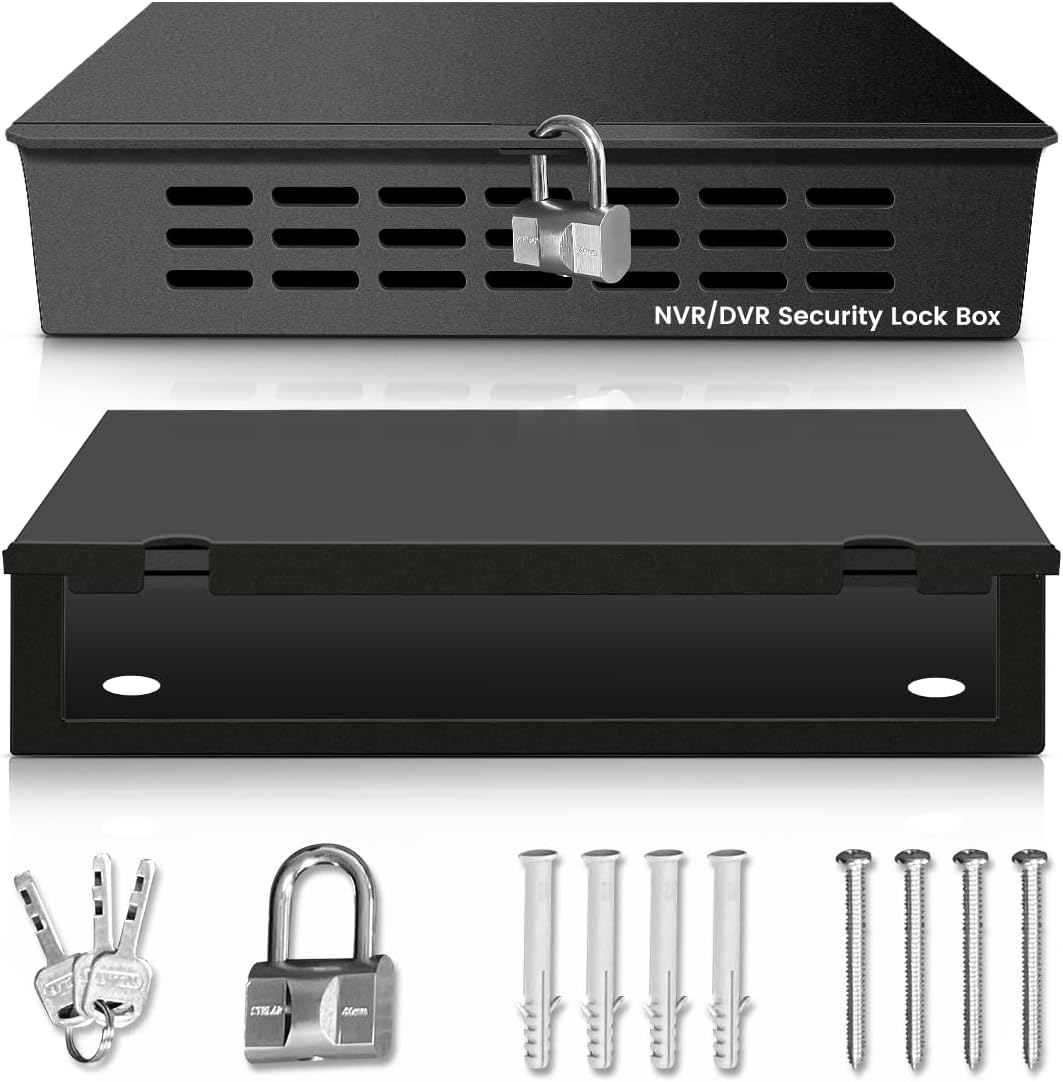

This full-size DVR NVR security lockbox combines 16-gauge heavy-duty steel with an 18 x 18 x 5-inch exterior, creating a practical enclosure for a recorder, PoE switch, video baluns, and related surveillance equipment. Its listed 4.0 rating reflects a generally useful package, while the supplied dimensions, accessories, and ventilation provisions are the most important details for buyers comparing installation space against device capacity.
We may earn a commission when you buy through this link, at no additional cost to you.
The interior measures 17.7 inches wide, 15.7 inches deep, and 4.7 inches high, offering useful room without moving into an oversized cabinet category. An included AC110/220V fan, power cord, keys, fixing screws, rubber feet, and pre-drilled knockouts create a relatively complete installation setup. Those details matter because a lockbox should not simply conceal a recorder; it should support cables, cooling, and routine service without extensive modification.
The main trade-off is its 18-inch-square footprint, which may be inconvenient in a tight utility closet or on a crowded wall. It also uses a fan-based cooling approach, meaning the included fan requires a suitable power source and periodic attention. These considerations are acceptable for a full-size cabinet intended to protect several pieces of equipment, but less ideal for a small installation where space, passive cooling, and simple access matter more.
This enclosure is best for buyers who need a substantial steel cabinet with active cooling and organized cable entry. It suits a home utility room, office, store, or controlled technical space where a larger recorder and supporting hardware are being installed. For those priorities, it is a strong all-around recommendation, provided the buyer confirms that the available shelf or wall area can accommodate its broad dimensions.
The generous interior is designed for a DVR or NVR plus a PoE switch, video baluns, and associated equipment. Buyers should still compare the precise height and depth of their devices with the stated interior dimensions, particularly when the cable bundles or power adapter also need room.
A supplied fan and power cord support continuous operation, while pre-drilled knockouts help route wires without forcing them through sharp openings. Rubber feet add stability at desktop, shelf, or floor installations and can reduce direct contact with the mounting surface.
We may earn a commission when you buy through this link, at no additional cost to you.
This 18 x 18 x 5-inch DVR security lockbox is built around super-strong 16-gauge steel and a two-stage access arrangement: a locking front door with a cam lock and two keys, plus a top cover that can be secured with screws. The supplied 4.4 rating makes it one of the better-established choices in this list, and its additional top cover distinguishes it from standard front-door-only enclosures.
We may earn a commission when you buy through this link, at no additional cost to you.
Cooling is handled through air vents and a powered fan, while a textured powder-coated finish is intended to withstand daily use. Cable routing is unusually flexible for this size, with one 1.75-inch knockout and three separate 1-inch knockouts. The internal layout is listed at approximately 17 inches wide, 4.6 inches high, and 16 inches deep to the fan, giving buyers useful guidance when checking equipment fit.
Its larger proportions and two-part security setup add complexity compared with a simple wall box. The top cover is secure once fastened, but it can also be unscrewed for easier service when the door is unlocked. Buyers should consider whether the added layer is necessary, and they must allow space to remove or reinstall the top when maintaining equipment.
This is the premium pick for installations where protecting and concealing the recorder carries extra importance. It is well suited to offices, retail environments, warehouses, and homes with a dedicated mounting area. The combination of steel construction, a cam lock, an optional secured top, cooling, and multiple knockouts makes it a strong choice when physical access control is a higher priority than minimizing dimensions.
The front cam lock controls normal access, while the screw-fixed top creates an additional barrier against casual removal. This layered arrangement is useful where a basic hinged-door enclosure might not provide sufficient deterrence or control.
A large knockout accommodates thicker cable bundles, while three smaller openings support separated power and network connections. This variety makes the box more adaptable to installations involving several surveillance components and multiple wire types.
We may earn a commission when you buy through this link, at no additional cost to you.
This black metal enclosure takes a slightly different approach to the DVR NVR security lockbox category. Rated 4.6, it is constructed as a 17.72 x 13.90 x 3.86-inch housing for DVRs, NVRs, and security wiring, with an included safety lock, built-in cable ports, and an openable front panel. That access design is particularly useful when technicians need to inspect wiring without working around a separate removable lid.
We may earn a commission when you buy through this link, at no additional cost to you.
Ventilation is provided through multiple cooling vents on the front cover and both side panels. This passive approach is intended to dissipate heat and reduce the risk of overheating cables. The housing also has an anti-stress base plate, while four mounting holes on the back support a straightforward wall installation. Cables can be routed through ports in the top or bottom, helping separate external wiring from the internal components.
The principal limitation is its relatively shallow interior compared with the 18-inch-square cabinets in the guide. It may suit a compact recorder, PoE device, router, or wiring junction, but it is less suitable for large power supplies or equipment with a deep chassis. It also lacks a stated powered fan, so buyers needing aggressive cooling for a densely packed installation should consider a fan-equipped model instead.
This is a strong option for accessible installations in homes, offices, retail spaces, or warehouses where cable organization and quick service are priorities. The lockable front panel provides basic physical protection, and the reinforced hinge allows the cover to open for adjustments and cleaning. It works best for users who want a wall-mounted wiring enclosure rather than the largest possible recorder cabinet.
The adjustable front panel opens for wiring changes, cleaning, and inspections. That layout can reduce maintenance time because cables and smaller components can be reached through the front instead of requiring the entire enclosure to be removed from its mounting position.
Front and side vents promote circulation without relying on a powered fan. This can simplify the installation, although a crowded interior or high heat load may still benefit from active cooling.
We may earn a commission when you buy through this link, at no additional cost to you.
The Tecmojo DVR security lock box pairs heavy-duty cold-rolled steel with a powder-coated finish, built-in fan, side vents, and a screw-fixed removable top. Its 4.9 rating is the highest among the supplied products, giving it a particularly strong position in the comparison. At 18 inches deep by 18 inches wide by 5 inches high, it is designed for a recorder and other equipment rather than a minimal junction box.
We may earn a commission when you buy through this link, at no additional cost to you.
Temperature control is a central strength. The fan moves air through the enclosure while vents on both sides release hot air, helping balance temperatures during extended operation. Three punch-outs in the rear provide convenient cable passage without compromising the main door. A keyed lock helps prevent unauthorized access, theft, loss, and accidental shutdown, while the top cover can be removed during setup and maintenance.
As with other large enclosures, the 18-inch footprint demands adequate shelf, wall, or cabinet space. The fan also introduces a powered component that must be connected reliably; a product with passive cooling may be simpler where power is unavailable. Buyers who want the largest opening for loading equipment should also note that the top is fixed with screws and is intended to be disassembled or reinstalled according to routine use.
This is the most complete recommendation for a buyer who values a high rating and a coherent set of security, cooling, and maintenance features. It works well for an NVR, DVR, PoE switch, documents, or other valuables in a store, office, or home. The result is a versatile enclosure that can serve as both a security cabinet and a more accessible electronics housing.
The built-in fan and exhaust vents work together to reduce heat inside the enclosure. This is valuable for recorders and network hardware that may operate continuously in a closed cabinet.
Screws secure the top during normal use, but authorized users can remove it when equipment needs to be installed or serviced. This provides a larger working opening without sacrificing the locked front access.
We may earn a commission when you buy through this link, at no additional cost to you.
The POCHAR DVR lock box is a 15.45 x 5.3 x 15.35-inch enclosure made from 16-gauge cold-rolled steel with a powder-coated finish. Its 4.8 rating is among the strongest in the guide. The listing also describes it as a versatile option for DVRs, NVRs, CCTV systems, PoE switches, routers, network equipment, and surveillance accessories in homes, businesses, schools, and retail environments.
We may earn a commission when you buy through this link, at no additional cost to you.
A low-noise AC-powered fan and dual-side ventilation grilles form the core of its thermal design. Four 1.8-inch cable knockouts already have protective rubber grommets, reducing the chance of cable insulation being scratched by a raw metal edge. The removable top gives technicians room to install equipment, while the key lock helps prevent unauthorized access and accidental shutdown.
Buyers should pay close attention to the stated dimensions and orientation, since the listing gives the measurements in an order that can be easy to interpret incorrectly. It is also less deep than the 18-inch-deep cabinets in the list, so oversized recorders or deep power supplies may not fit. Even so, the combination of grommets, active cooling, and no-assembly setup is highly practical.
This is an excellent choice for a compact, organized installation where a full-size 18-inch cabinet is unnecessary. It can be mounted on a wall, in a rack, or on a desktop according to the supplied information. The POCHAR is especially appealing to buyers who want finished cable protection and cooling without a complicated cabinet assembly, while still retaining a lockable steel body.
Pre-installed rubber grommets make the cable openings safer for long-term wiring. They also improve the finished appearance of the installation by keeping separated cables organized along the enclosure wall.
The low-noise fan is useful in offices, retail areas, and other locations where a louder cooling unit could be distracting. Dual-side grilles supplement the fan to support continuous airflow.
We may earn a commission when you buy through this link, at no additional cost to you.
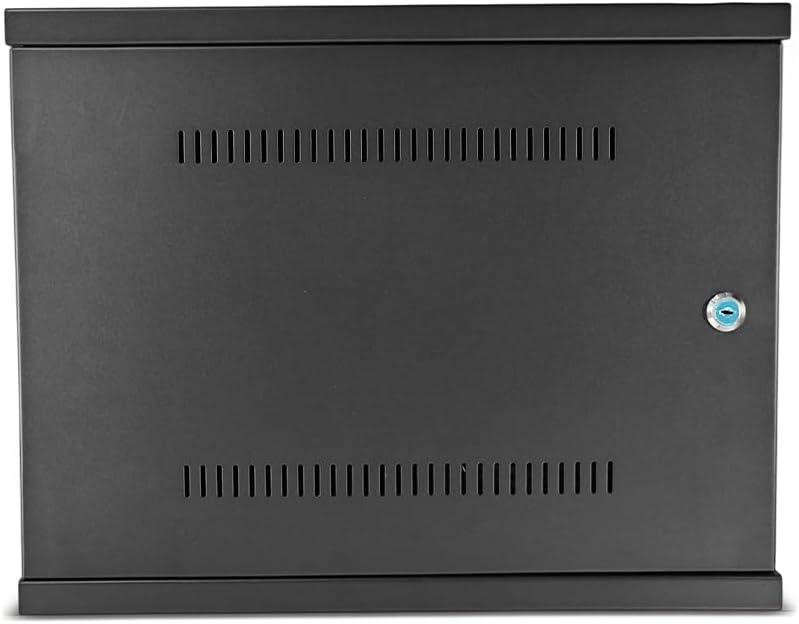
This heavy-duty wall enclosure measures 17.7 x 13.9 x 3.9 inches and provides a compact way to protect a DVR, NVR, router, or CCTV device. Its 4.8 rating places it alongside the highest-rated options here. The enclosure uses a durable metal body, a built-in lock, dual ventilation slots, and ten cable openings to support a tidy, space-saving installation.
We may earn a commission when you buy through this link, at no additional cost to you.
The wall-mount format makes the product particularly useful where floor and shelf space is limited. Passive ventilation avoids the noise and power requirements of a fan-equipped cabinet, making the enclosure straightforward to operate. Ten openings give installers numerous routes for power, network, and camera cables, while the lock helps prevent unauthorized access and casual tampering.
Its 3.9-inch depth is the most significant limitation. Deep recorders, large power supplies, or accessories with protruding connectors may exceed the available depth even if their face dimensions appear to fit. The product data does not list the exact knockout diameters, so installers needing a particular cable size should check the physical openings and current product details before ordering.
This enclosure is best for a small to medium recorder or network device that benefits from concealment and organized wiring without a large cabinet. It is a sensible choice for homes, offices, and retail environments where a compact wall box and passive cooling are the priorities. Buyers should verify the depth of their actual equipment rather than relying only on the enclosure's exterior dimensions.
Dual ventilation slots support airflow without adding a powered fan. This is useful where the enclosure is mounted in an office, shop, or other location where noise and additional power connections would be inconvenient.
Numerous openings allow power, network, and surveillance cables to enter from different positions. That flexibility can reduce cable bending and make individual connections easier to reach during maintenance.
We may earn a commission when you buy through this link, at no additional cost to you.
This 15 x 15 x 5-inch lockbox provides a middle ground between a compact wall enclosure and a large 18-inch surveillance cabinet. It is made from heavy-duty 16-gauge steel, carries a supplied 4.5 rating, and includes an integrated cooling fan, a front key-lock access door, and multiple pre-punched knockouts for cable management.
We may earn a commission when you buy through this link, at no additional cost to you.
The enclosure is designed for more than a recorder. Its stated applications include NVRs, routers, AV equipment, networking devices, and complete camera-system components. That breadth makes it useful in a home media area, office, gym, store, or residential technical room where several related devices need to be secured together without taking up a very large footprint.
The five-inch depth gives it more equipment volume than the slimmer 3.9-inch wall boxes, though less depth than the full-size cabinets. The supplied information does not give exact knockout diameters, and the fan needs access to a suitable power source. Those details are not major drawbacks for a planned installation, but they should be checked against the intended wiring and electrical setup.
This product is a good choice for buyers who want active cooling and robust steel construction without moving to the largest cabinet size. Its front key access supports routine maintenance, while the knockouts help preserve a professional installation. For a medium recorder and a small group of related devices, it offers a more balanced arrangement of capacity, protection, and footprint.
The integrated fan helps protect equipment that generates heat during extended operation. Combining cooling with a 15-inch square body makes the enclosure useful where a full 18-inch cabinet would be excessive but passive ventilation might be insufficient.
The stated use cases extend beyond recorders to routers, AV equipment, and networking hardware. That makes the box suitable for consolidating related electronics as long as the physical dimensions and power requirements are compatible.
We may earn a commission when you buy through this link, at no additional cost to you.
This compact steel DVR NVR lock box is the smallest enclosure in the comparison, measuring 10.8 x 9.6 x 2.5 inches. It has a 4.4 supplied rating and focuses on securing smaller DVR, NVR, PoE switch, and surveillance accessories where a large cabinet would be unnecessary. The powder-coated heavy steel construction is intended to resist rust and daily wear.
We may earn a commission when you buy through this link, at no additional cost to you.
A removable cover provides quick installation and maintenance access, while multiple cable openings in the rear panel allow flexible entry for power and network connections. The key lock adds a physical barrier against theft, damage, and unauthorized access. Its low-profile design makes it appealing for tight wall setups, underspaced shelves, and installations where appearance and footprint matter.
The 2.5-inch depth is the decisive constraint. A unit may fit by width and height but still be too shallow for a standard recorder or power brick, especially once cables bend behind it. The product data also does not specify a cooling fan, so buyers should consider whether passive airflow and limited density are adequate for continuous operation.
This compact lockbox is best for small network devices, compact PoE equipment, or a recorder with a particularly shallow profile. It is also useful as a secondary enclosure for smaller surveillance accessories. It is less appropriate for a large DVR, dense cable bundle, or equipment that generates substantial heat, but it delivers the strongest space-saving option in the guide.
The enclosure occupies considerably less wall or shelf space than the larger cabinets. This makes it useful where the goal is to hide and protect a small device without allowing the cabinet to dominate the installation area.
Multiple rear openings give the installer options for routing power and network cables. Positioning the connections toward the wall side can also help keep the visible front and cover area cleaner.
We may earn a commission when you buy through this link, at no additional cost to you.
This POCHAR security lockbox combines a 15.5 x 15.5 x 5.5-inch enclosure, 1.2mm 18-gauge steel, a built-in AC fan, two locking keys, and a removable lid. Its supplied 3.0 rating is the lowest in the group, so prospective buyers should weigh the product's documented features carefully rather than relying on customer feedback alone. The enclosure is still intended for DVR equipment and broader secure-storage applications.
We may earn a commission when you buy through this link, at no additional cost to you.
Four 1.85-inch knockouts come with pre-installed grommets, providing protected passages for the cables normally found around a surveillance installation. The included fan and ventilation design are intended to cool the enclosed electronics. The removable top supports equipment placement, and supplied screws, washers, and wall plugs allow the box to be mounted on a floor, desk, or wall.
Its steel is 18 gauge, making it slightly thinner than the 16-gauge alternatives in the guide. The low customer rating may reflect variations in fit, finish, shipping damage, or other experiences that cannot be determined from the supplied specifications. It is therefore especially important to check the current listing details and confirm the dimensions of the recorder and power supply before choosing it.
This lockbox suits buyers seeking a moderately sized, deep enclosure with fan cooling and finished cable protection. It can also serve as a security case for other electronics in an office, store, or dorm-like setting. Among the ten products, it is a reasonable feature-rich option, but the lower rating and thinner steel make it more of a targeted choice than the strongest general recommendation.
At 5.5 inches deep, the enclosure offers more depth than many wall boxes in the guide. That additional room can help accommodate a deeper recorder, power supply, or stacked accessories, subject to the dimensions of the specific devices.
Screws, washers, wall plugs, and pre-installed grommets reduce the need for separate accessories. The result is a more finished setup and safer cable entry than relying on unprotected or improvised openings.
We may earn a commission when you buy through this link, at no additional cost to you.
The CCTV DVR lock box and NVR enclosure combines a compact 17.7 x 13.9 x 3.9-inch wall-mount format with a 4.8 supplied rating. It is designed for DVRs, NVRs, routers, modems, switches, and surveillance accessories, making it a flexible option for both camera-system components and general network equipment.
We may earn a commission when you buy through this link, at no additional cost to you.
Two rows of ventilation improve airflow without an external fan, helping reduce heat during continuous operation while avoiding fan noise. Ten cable routing openings organize CCTV wiring, router cables, power cords, and network connections. The durable metal construction helps protect against dust, tampering, unauthorized access, and accidental damage, while the wall format preserves valuable floor space.
The 3.9-inch depth limits compatibility with deeper chassis equipment, and the supplied information does not identify the exact lock type. It is also important to maintain open space around the ventilation areas rather than placing the cabinet against a surface that blocks airflow. A passive design is attractive for its simplicity, but exceptionally dense or heat-sensitive electronics may benefit from a fan-equipped box.
This enclosure is a compelling option for users who want a high-rated, compact cabinet with quiet passive cooling and abundant cable openings. It is well suited to homes, offices, retail stores, and warehouses where wall space is at a premium and the equipment is not too deep. It balances security, organization, and low-maintenance operation without adding a powered cooling component.
The large number of routing openings makes it easier to bring in power, Ethernet, and surveillance cables through separate paths. This supports a neat installation and can reduce strain caused by forcing several cables through one narrow entry.
Dual ventilation rows provide passive cooling without the noise of a powered fan. This can be especially useful in offices and stores where equipment operates near people for long periods.
We may earn a commission when you buy through this link, at no additional cost to you.
The most suitable security lockbox depends on recorder dimensions, heat output, cable volume, mounting space, and the level of physical access control required. Comparing those needs with the enclosure specifications prevents a costly mismatch.
Begin with the exact width, depth, and height of the recorder, power supply, PoE switch, and every other device that must fit. Exterior dimensions alone are not enough because hinges, locks, brackets, ventilation grilles, and mounting hardware can reduce usable interior space. Add the thickness of the rear cable bends and the clearance required around plugs instead of comparing only the published face size of the recorder.
Measure the device, compare it with the interior dimensions, and allow working space.
Passive vents are quieter, simpler, and require no fan power, but they depend on adequate openings and space around the enclosure. A built-in fan is more capable of removing heat from a dense or continuously operating installation, yet it needs a reliable power connection and adds a component that can require maintenance. Match the cooling approach to both the heat generated by the equipment and the conditions of the surrounding space.
Use passive airflow where heat is modest; choose active cooling for dense, continuous setups.
Steel gauge offers a basic indication of enclosure thickness, but construction quality also depends on bends, welds, door alignment, and the security of removable panels. The guide includes 16-gauge and 18-gauge designs, as well as heavy-duty metal enclosures with less specific gauge information. A thicker cabinet may resist impact and deformation better, while a powder-coated finish helps reduce exposure to moisture, dirt, and routine wear.
Prioritize sturdy construction, a sound lock, and corrosion-resistant finishes.
Count the number and thickness of power cords, Ethernet cables, video cables, and any grounding conductors that must enter the box. Multiple knockouts, rubber grommets, and top or bottom entries can make routing easier and protect insulation from sharp edges. The most useful arrangement is often one that separates power from data cables and avoids tight bends near the device connections.
Match knockout count and size to the cable bundle, and retain protective grommets.
A front key lock is the baseline for controlled access, while a removable or screw-fixed top can add another layer of security. The trade-off is serviceability: a complicated opening sequence may slow maintenance, and a removable cover can make a larger opening easier. Confirm whether keys are included, how many are supplied, whether the top is intended to remain fixed, and how the access panels are intended to open.
Balance stronger access control against the speed and ease of routine maintenance.
A wide 18-inch cabinet may be appropriate on a shelf, in a utility room, or inside a larger service cabinet, while a 10-inch model may be better for a tight wall location. Wall mounting can free floor space, but the installation area must provide clearance for ventilation and service access. Some products support wall, floor, rack, or desktop placement and include different forms of hardware for those methods.
Check available space, mounting method, airflow clearance, and service access.
Some lockboxes are described specifically for DVRs and NVRs, while others also support routers, PoE switches, video baluns, documents, AV equipment, or general valuables. This broader compatibility can be useful, but it does not guarantee that every accessory will fit or operate well. Consider the depth of power adapters, the reach of Ethernet connectors, the number of devices, and whether any accessory produces enough heat to require a fan.
List every planned device and accessory before choosing the enclosure.
Ratings can help identify recurring satisfaction or frustration, but they should be interpreted alongside the specific model, manufacturer, and supplied features. Product dimensions, included accessories, and installation details can change between versions or sellers. Review recent customer feedback for fit and quality, then verify the current listing, manual, dimensions, and included hardware immediately before ordering.
Read current reviews, but confirm the latest specifications and physical fit.
Choose a stable, dry location that is accessible to authorized technicians but not exposed to unnecessary impact, flooding, or direct weather. Check the enclosure dimensions before bringing equipment into the installation area, and identify the location of every cable opening. If the box includes a fan, confirm access to a grounded and suitable power source without creating a trip hazard or an overloaded extension connection.
Install the enclosure using the appropriate hardware for its intended surface, and do not block the stated ventilation openings. Route cables through the supplied knockouts, retain the rubber grommets, and separate larger power conductors from sensitive network cables when practical. Secure the equipment inside without forcing connectors or resting heavy components on the door. Fit the lock and any removable top as directed, then test the door, keys, cover, and fan before routing all permanent cables.
During routine maintenance, power down the recorder according to its manufacturer’s instructions before moving equipment or changing wiring. Clean exterior dust and inspect cable grommets, locks, hinges, fan vents, and mounting points. Keep the interior dry and remove any debris that could block airflow. A lockbox protects against casual interference and environmental dust, but it does not replace sensible electrical grounding, surge protection, ventilation clearance, or regular equipment maintenance.
Choose a box whose stated interior dimensions exceed the width, depth, and height of every device you plan to install. Pay special attention to depth because protruding power connectors, Ethernet sockets, and cable bends can require several additional inches. If the enclosure does not publish interior dimensions, measure the equipment and contact the seller before ordering rather than relying on exterior measurements alone.
A fan is helpful when the recorder or network equipment operates continuously, the enclosure is densely packed, or the surrounding area is warm. Passive ventilation can work well for a single low-power device when openings remain unobstructed. Because every installation differs, check the recorder’s thermal guidance and leave reasonable clearance around the enclosure before deciding.
Some metal enclosures are described for outdoor wiring protection, but the presence of a steel body does not automatically make every internal recorder installation weatherproof. Electronics generally need protection from moisture, condensation, direct rain, and temperature extremes. Confirm the product’s stated environmental rating and the requirements of the equipment being protected before placing a recorder outside.
A properly ventilated enclosure can help remove heat and maintain more stable operating conditions, but it cannot guarantee that every device will remain cool. Equipment density, ambient temperature, fan condition, cable placement, and blocked vents all affect performance. Leaving clearance around the enclosure and confirming the recorder’s recommended temperature range remain important.
Several products in this guide include keys, rubber feet, screws, bolts, washers, wall plugs, or a fan power cord. However, the contents can vary by model, and a wall surface may require different fasteners than those supplied. Confirm the package contents and mounting material in the current listing before starting an installation.
Use the provided knockouts and retain any rubber grommets, which reduce the chance of damaging cable insulation on a sharp metal edge. Open only the openings that are needed, route the cables without sharp bends, and keep connectors from being forced against the enclosure wall. Separate power and network wiring where practical to create a cleaner and more serviceable installation.
Many of the listed models are explicitly designed to hold DVRs, NVRs, PoE switches, routers, baluns, and related accessories. The limiting factor is usually physical space and heat rather than the cable type. Measure both the PoE switch and the recorder, then confirm that the combined installation leaves room for their power cords and cable bends.
Inspect it during routine equipment maintenance, paying attention to loose cables, blocked vents, dust, fan noise, damaged grommets, and lock or hinge operation. The best schedule depends on the environment, but a dusty, warm, or high-access location deserves more frequent checks. Any enclosure should be opened only by authorized users and powered equipment should be shut down safely before changes.
The Tecmojo DVR Security Lock Box stands out for its 4.9 rating and balanced combination of cold-rolled steel, active cooling, a removable secured top, and rear cable knockouts. The 18 x 18 x 5-inch DVR Security Lockbox offers an additional premium layer with a cam-locked door and screw-fixed top, while the compact CCTV wall cabinet provides a high-rated, passive-cooling option with ten cable openings.
The right choice ultimately depends on the hardware inside. Full-size cabinets suit deeper recorders and multiple accessories, fan-equipped boxes better address continuous heat, and low-profile wall enclosures conserve space when the equipment profile permits. Before buying, measure the devices, confirm the usable interior space, check ventilation requirements, and make sure the included locks, keys, grommets, and mounting hardware match the installation.
Current prices, stock, package contents, and product details can change, so shoppers should review the latest listing and compare the final dimensions with their own equipment. That final verification is especially important for security enclosures, where even a small difference in depth or the presence of protruding connectors can determine whether a recorder fits safely and operates as intended.