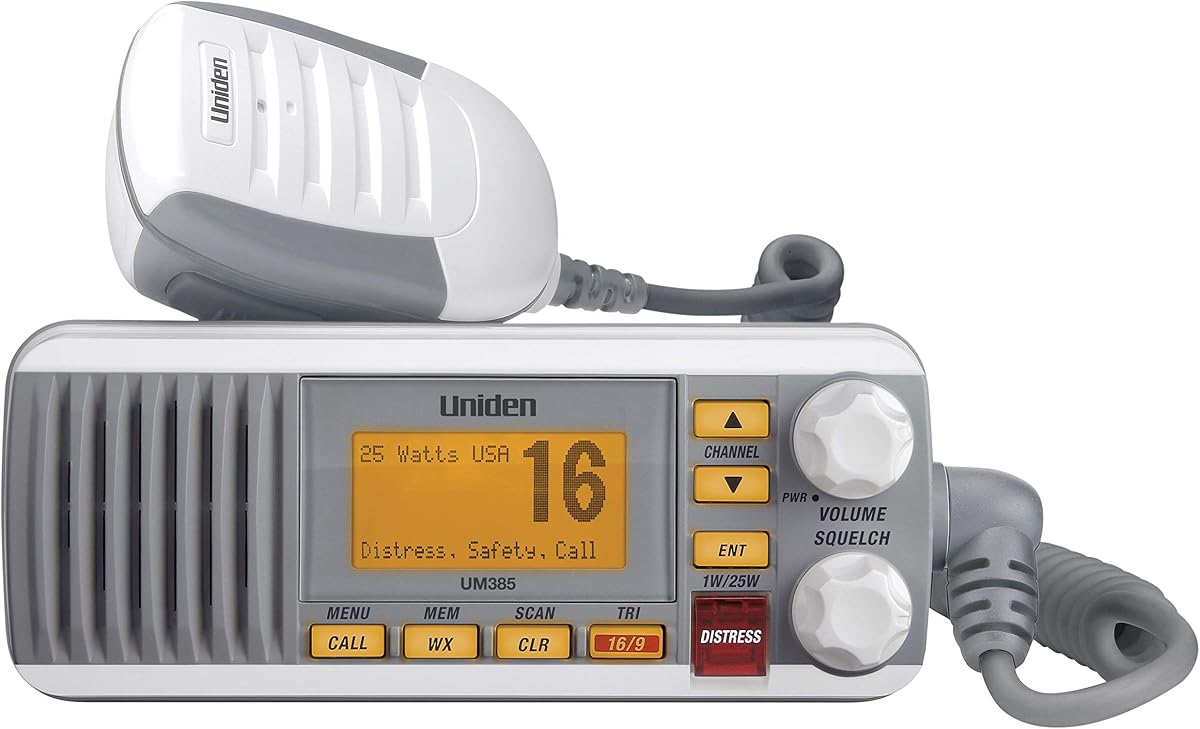
Uniden UM385
4.6Editor score
Full Class D DSC
25-watt fixed transmission
IPX4 splash resistance
Triple-watch monitoring
NOAA weather alerts
Discover the best Dsc VHF Marine Radio options for fixed and handheld use, comparing DSC, GPS, AIS, transmission power, range, and waterproofing.
A DSC VHF marine radio is a core safety tool for boaters, anglers, kayakers, and offshore sailors because it combines voice communication with distress calling and position information. The right model should suit your vessel, mounting space, activity level, and navigation setup while delivering dependable reception and useful emergency features.
This guide compares ten fixed-mount and handheld DSC VHF marine radios from Uniden, Icom, Retevis, and Standard Horizon. We considered transmission power, GPS integration, AIS support, waterproof ratings, display size, charging options, watch functions, emergency features, and practical ease of use rather than treating every specification as equally important.
The selections show that there is no single radio for every mariner: compact handhelds suit emergency use, while fixed-mount units offer stronger transmission and easier helm access. Our picks cover several budgets and priorities, but specifications and availability can change, so readers should verify current details and prices before purchasing.
4.6Editor score

4.4Editor score

4.9Editor score
This side-by-side comparison covers the ten featured radios, separating fixed-mount and portable designs while highlighting their output, positioning, safety, and environmental features. It is designed to make functional differences clear before you account for installation, antenna, and accessory requirements.





The Uniden UM385 is an appealing fixed-mount DSC VHF marine radio for mariners who want meaningful emergency features and stronger transmission than a typical handheld provides. It carries a 4.6 rating and combines full Class D DSC capability, 25 watts of transmit power, triple watch, NOAA weather alerts, and broad channel coverage in a relatively compact unit.
We may earn a commission when you buy through this link, at no additional cost to you.
Its most useful strength is the balance between safety and everyday operation. The distress button, position send, and position request functions are built directly into the radio, while the included rugged microphone is designed for convenient transmission from the helm. Memory channel scanning, access to USA, international, and Canadian marine channels, and triple-watch monitoring help users keep up with traffic without constantly changing channels.
The primary limitation is that the listed IPX4 rating is intended to resist damage from rain and splashing water rather than permit submersion. The radio also does not list an integrated GPS receiver, so a compatible positioning source may be needed to make the most of DSC position information. Fixed installation, an appropriate antenna, and correct electrical connections are additional considerations.
This is a strong recommendation for boaters who prioritize useful DSC features, weather information, and 25-watt output without moving to a more advanced fixed-mount platform. It is especially appropriate for an open helm or cockpit installation that is protected from standing water. Users needing submersion resistance or integrated GPS should examine the UM435BK or UM725GBT instead.
Full Class D DSC operation gives the radio a direct role in emergency communications. One-button distress calling, position sending, and position requests are particularly useful for mariners who want a reachable safety device without adding a separate DSC controller to the helm.
Triple watch allows users to monitor three important channels simultaneously, while NOAA weather alerts add timely hazard information. Together with memory channel scanning and international channel access, these functions make the radio more useful across changing boating conditions.
We may earn a commission when you buy through this link, at no additional cost to you.
The Retevis RM40 is a portable DSC VHF marine radio built around an unusual combination of built-in GPS and emergency positioning tools. It has a 4.0 rating and emphasizes coastal fishing, kayaking, offshore fishing, and other situations where a boater may benefit from a self-contained radio that can transmit its position without a separate GPS unit.
We may earn a commission when you buy through this link, at no additional cost to you.
DSC distress messages can be preset and sent with one button, with the GPS location automatically transmitted for rescue coordination. Its man-overboard feature records and shares the exact location, while dual and tri-watch functions help users monitor distress signals and important shipping traffic. The 5-watt output is suited to a range of coastal and recreational applications.
Marine durability is another major strength. The RM40 has an IP67 waterproof and floating design, and its red flashing LCD is intended to help a user locate it if it goes overboard. These characteristics are meaningful because a handheld radio is most valuable precisely when it has been separated from the main boat during an emergency.
The trade-off is its lower listed transmit power compared with 6-watt handhelds and 25-watt fixed-mount radios. Its rating also trails the stronger customer feedback recorded for most of the list. Nevertheless, buyers who prioritize integrated GPS, MOB location sharing, and flotation may find those capabilities more useful than maximum output.
The integrated GPS updates the radio's position in real time and can attach those coordinates to a distress message. This reduces reliance on a connected chartplotter or phone, which is valuable on small boats and in isolated coastal areas.
A radio that floats and flashes after entering the water can make an overboard recovery far easier. The IP67 construction and red LCD behavior turn that physical feature into a practical emergency advantage.
We may earn a commission when you buy through this link, at no additional cost to you.
The Icom M94D combines a 6-watt VHF radio, DSC capability, an AIS receiver, GPS navigation features, and a high-capacity battery in a handheld format. Its 4.4 rating reflects a well-rounded package, but its defining strength is the amount of marine information and emergency functionality available away from the helm.
We may earn a commission when you buy through this link, at no additional cost to you.
The integrated AIS receiver displays nearby vessel traffic and supports faster setup of DSC individual calls and distress alerts by allowing users to select nearby targets. The radio also stores as many as 50 favorite fishing spots or destinations, supports waypoint navigation, and delivers 1500 mW of speaker audio for intelligibility in marinas, engine rooms, and offshore conditions.
Power is balanced between reach and endurance. The listed 6-watt RF output supports longer-range communication than lower-powered portable models, while the 2400 mAh lithium-ion battery is advertised for up to ten hours of typical operation. Actual runtime depends on transmit power, display use, GPS, and other enabled functions.
The float-and-flash design provides another layer of emergency protection. If the M94D is dropped overboard, it floats and flashes; pressing the distress button while that feature is active can send a precise man-overboard distress signal. This is an excellent pick for offshore anglers and sailors who want more than a basic talk-and-listen handheld.
The AIS receiver lets users see nearby vessel traffic rather than relying only on voice reports. That awareness can make it easier to identify a relevant target and prepare an individual DSC call.
Six watts of output, a large speaker, and waypoint storage create a useful balance between communication range, audibility, and navigation. The result feels more like an integrated marine tool than a basic waterproof handset.
We may earn a commission when you buy through this link, at no additional cost to you.
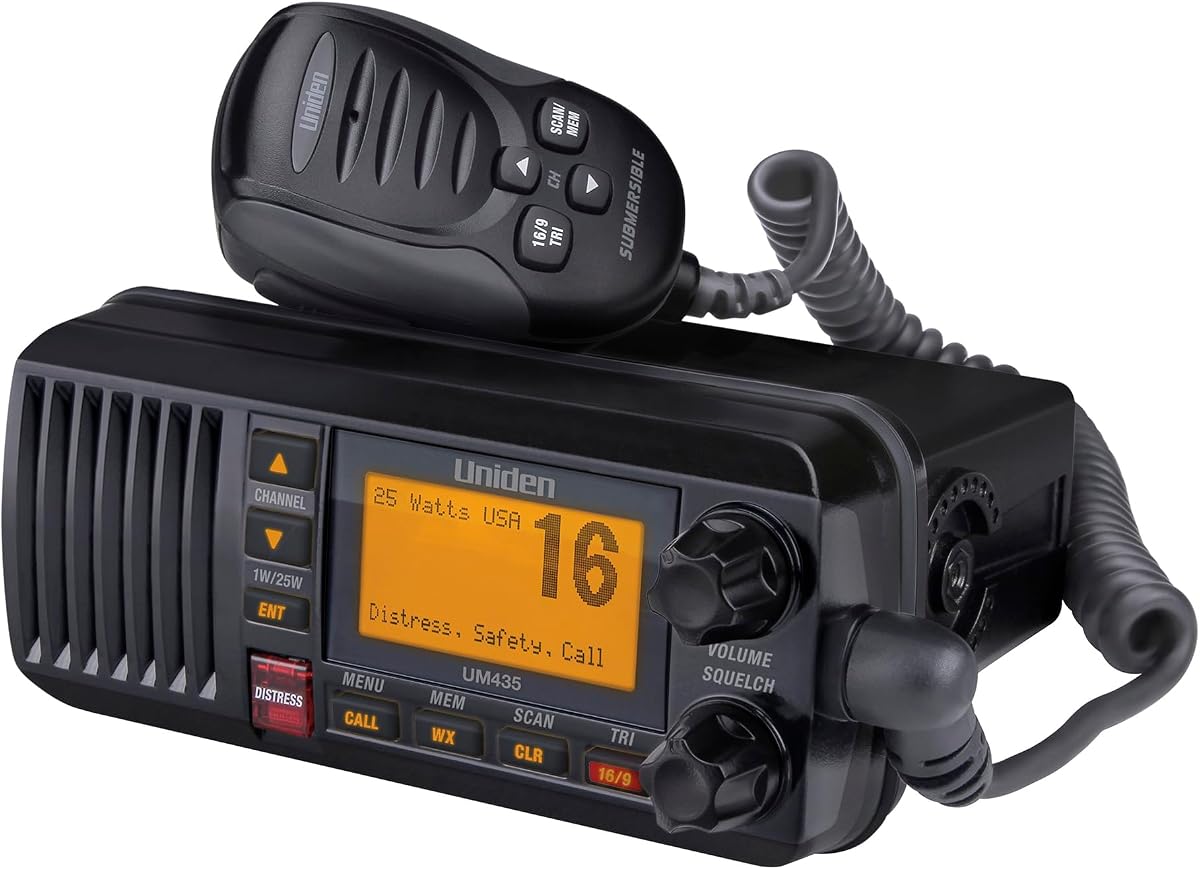
The Uniden UM435BK is built for fixed installations where environmental toughness matters. It has a 4.6 rating, a fully submersible IPX8 design, selectable 1-watt and 25-watt output, and broad channel coverage including four-digit and Canadian B channels.
We may earn a commission when you buy through this link, at no additional cost to you.
Its rugged construction is the central selling point. Rather than only resisting rain or spray, the radio is described as completely submersible and is backed by a three-year water-protection warranty. That makes it a more compelling fixed-mount option for exposed helm areas, center consoles, and boats where occasional immersion or heavy washdown may occur.
Digital selective calling supports position send and position requests, while dual and triple watch improve channel monitoring. Memory channel scanning is also included. The radio's substantial maximum output is useful for communicating over greater distances, and the lower-power setting can provide a more restrained option for close-range use.
There is no listed built-in GPS, so users should verify how DSC position data will be supplied. Permanent mounting, power wiring, an external antenna, and compatibility with the rest of the vessel's equipment also make this less convenient as a grab-and-go radio. It is best for owners who want a permanent, highly durable command station.
IP8 submersibility gives this model a distinct advantage over splash-resistant fixed-mount units. It is a particularly logical choice for an open console where spray, washdowns, and accidental immersion are part of normal ownership.
Switching between one and 25 watts lets users match transmission strength to local conditions. Dual and triple watch add confidence by monitoring important channels simultaneously.
We may earn a commission when you buy through this link, at no additional cost to you.
The Icom IC-M330G is the strongest premium-oriented choice in this guide, combining an extremely compact chassis with integrated positioning and full Class D DSC monitoring. Its 4.9 rating is the highest listed among the ten products, reflecting a particularly well-regarded feature set and installation approach.
We may earn a commission when you buy through this link, at no additional cost to you.
The radio's palm-sized format makes it well suited to small consoles and tight helm spaces. Its receiver provides more than 70 dB of selectivity and strong interference rejection, useful in RF-busy marinas and harbors. A new speaker design produces loud, clear audio with rich bass and crisp treble, while the directional keypad and soft keys streamline common operations.
Integrated GPS, GLONASS, and SBAS support provides position, course, and speed data for DSC calls and enhanced safety. The unit continuously monitors Channel 70 for distress, individual, group, all-ships, safety, position, polling, and test calls. These details make the compact installation more than a space-saving compromise.
The trade-off is that this is a fixed-mount radio rather than a portable emergency handset, and its advanced feature set places it in a higher equipment category. It is most attractive to owners of modern boats with a crowded helm who value receiver performance, integrated positioning, refined controls, and installation flexibility.
Selectivity and interference rejection are especially important where nearby radios create a dense RF environment. The stated performance helps preserve clear reception in marinas and busy harbors.
The integrated multi-system receiver supplies the data required for meaningful DSC communications. Position, course, and speed can be associated with calls without depending on a separate GPS display.
We may earn a commission when you buy through this link, at no additional cost to you.
The Standard Horizon HX210 is a straightforward, well-equipped 6-watt floating handheld. It has a 4.6 rating and includes the radio, antenna, rapid charging cradle, documentation, and charging cables, reducing the number of separate accessories a buyer needs to arrange.
We may earn a commission when you buy through this link, at no additional cost to you.
The radio combines selectable 6-watt, 2.5-watt, and 1-watt output with all USA, international, and Canadian channels. A high-resolution dot-matrix LCD makes information easier to read, while programmable function keys and the Easy to Operate menu system help reduce the learning curve. Weather channels and an FM broadcast receiver add useful listening options.
Its physical safety features are particularly attractive. The HX210 floats and has an IPX7 waterproof rating that allows immersion to 3.3 feet for 30 minutes. A water-activated emergency strobe can help locate the radio after it is dropped into the water. The included 1850 mAh lithium-ion battery and three-hour desktop rapid charger support regular portable use.
The main limitations are the absence of listed GPS and AIS functionality. Users wanting DSC position data or nearby vessel awareness will need another solution. Even so, the HX210 is a strong general-purpose handheld for boaters who prioritize robust construction, readable controls, and easy charging over navigation extras.
An overboard radio is easier to recover if it remains on the surface. Floating construction, an emergency strobe, and a meaningful IPX7 rating give the HX210 a practical safety profile for use away from the main helm.
The included cradle and both household and vehicle charging cables cover common charging locations. A high-capacity battery and selectable output levels let users balance runtime with communication strength.
We may earn a commission when you buy through this link, at no additional cost to you.
The Uniden UM725GBT is a feature-rich fixed-mount radio aimed at modern, instrumented boats. It combines 25-watt output, an integrated GPS receiver, Bluetooth connectivity, NMEA0183 and NMEA2000 input and output, NOAA weather alerts, and an IPX8 waterproof rating in one unit.
We may earn a commission when you buy through this link, at no additional cost to you.
Its integrated GPS means the radio can know its location for DSC distress transmission without waiting for a separate chartplotter to provide position information. NMEA connections allow GPS and DSC information to be shared with other devices and stations, making this a potentially useful centerpiece in a connected helm system.
Bluetooth expands the relationship between the radio and a smartphone, while the large 68-by-38-millimeter LCD is designed to show more information at once. DSC distress send and receive functions, one-watt and 25-watt transmit settings, a speaker microphone, and access to USA, Canadian, and international marine channels round out the package.
Compared with simpler fixed-mount units, this model adds complexity and requires a more deliberate installation. Its 4.3 rating is solid but not the highest in the group, and the benefits of NMEA, Bluetooth, and integrated GPS depend on how the vessel is equipped. It is best for owners who want connected navigation features rather than only basic voice and distress functions.
NMEA0183 and NMEA2000 input and output allow the radio to participate in a broader onboard information system. Sharing GPS and DSC data can make emergency information more visible across compatible displays.
The unusually large screen is useful when users want to view more radio information at a glance. It also complements a modern console setup in which the marine radio remains part of the boat's central navigation interface.
We may earn a commission when you buy through this link, at no additional cost to you.
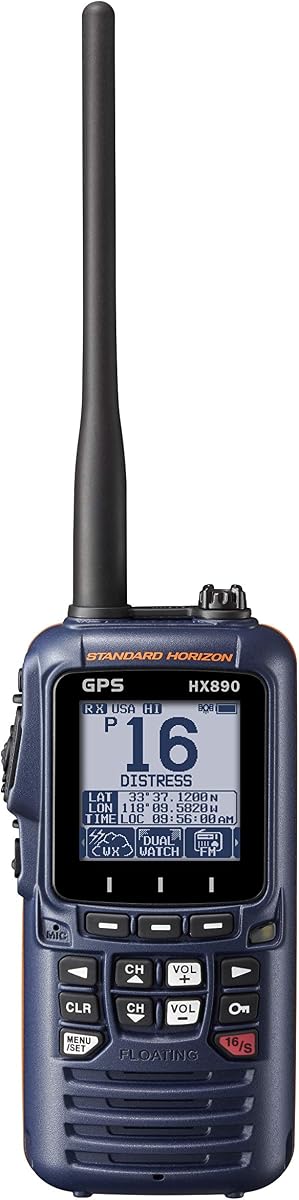
The Standard Horizon HX890 is one of the most capable portable radios in the guide. Its 4.6 rating is backed by a 6-watt floating design, IP8 submersible construction, integrated 66-channel WAAS GPS, Class H DSC operation, waypoint and route navigation, and an 11-hour advertised operating time.
We may earn a commission when you buy through this link, at no additional cost to you.
Navigation is a major strength. The radio can store waypoints, support route navigation, and offer a group monitor function based on DSC group position calls. A large 1.7-inch square full dot-matrix display, selectable day and night modes, and dual or triple watch make the information easier to manage at different times and in changing conditions.
Emergency features include man-overboard operation and a water-activated white strobe. The radio floats, making recovery after an overboard drop more practical. It also includes dual and triple watch, NOAA weather channels with alerts, an FM broadcast receiver, and two built-in scrambler systems, expanding its usefulness beyond standard VHF communication.
The supplied package is extensive, including a rechargeable lithium-ion battery, alkaline battery tray, wall charger, international adapter, cradle, vehicle charger, programming cable, and belt lip with lanyard. Its dense feature list may feel complex to a new user, and PC programming requires the included cable. Offshore and experienced users, however, gain a remarkably self-contained marine tool.
The 66-channel WAAS GPS and route features make the HX890 useful beyond emergency voice contact. Users can save destinations and navigate directly from the handheld, reducing dependence on a fixed chartplotter.
The broad accessory package includes both household and vehicle charging options, a spare battery tray, and a lanyard. That completeness suits owners who may use the radio away from the boat or during extended offshore trips.
We may earn a commission when you buy through this link, at no additional cost to you.
The Standard Horizon HX891BT is a compact handheld marine radio with a strong 4.6 customer rating. Unlike the more extensively documented HX210 and HX890 models, its supplied information focuses on the core two-way-radio format, model designation, quantity, and physical dimensions.
We may earn a commission when you buy through this link, at no additional cost to you.
That makes the HX891BT appealing to buyers who prioritize a straightforward portable unit from an established marine-electronics brand. Its listed dimensions of 5.43 inches high, 2.6 inches wide, and 1.5 inches deep indicate a conventional handheld shape that should be manageable in a pocket, on a belt clip, or inside a grab bag.
As a DSC-equipped two-way radio, it belongs in the category of equipment intended for maritime communication and emergency use. A portable unit is most valuable when it is immediately reachable and carried by people operating away from the helm, making the compact form a meaningful advantage for smaller boats and recreational outings.
The principal drawback is limited information in the supplied listing. There is no detailed confirmation here of battery capacity, waterproof rating, transmit power, GPS, AIS, or included accessories, so buyers should inspect the current product page carefully. Its appeal is primarily simplicity and compactness rather than a clearly documented list of advanced features.
Keeping a compact VHF radio on board or in a personal flotation device can provide a communication layer when a fixed unit is inaccessible. This makes the form factor a practical safety consideration, not merely a matter of convenience.
The HX891BT listing provides less technical detail than most products reviewed. Buyers should confirm waterproofing, power levels, charging requirements, DSC programming, and included accessories before assuming that it matches a more fully documented model.
We may earn a commission when you buy through this link, at no additional cost to you.
The black Standard Horizon HX890 is a rugged, high-output handheld for sailors who want navigation, DSC, and emergency functions in one portable device. It shares a 4.6 rating and a broad feature set with the navy version, including 6-, 2-, and 1-watt output, IP8 submersibility, floating construction, and Class H DSC operation.
We may earn a commission when you buy through this link, at no additional cost to you.
The integrated 66-channel WAAS GPS receiver enables waypoint and route navigation, while the group monitor function uses DSC group position calls to keep track of compatible vessels. An 1800 mAh lithium-ion battery is advertised for up to 11 hours of operation. The full dot-matrix display can be switched between daytime and nighttime modes for better visibility.
Audio performance receives attention through 700 mW output and noise-canceling functions for both transmitted and received audio. The man-overboard feature, water-activated white emergency strobe, dual and triple watch, NOAA weather alerts, and FM broadcast receiver extend the radio's utility. It also includes two scrambler systems and a micro-USB data jack for PC programming.
The supplied package contains a rechargeable battery, alkaline battery tray, wall charger, international adapter, cradle, vehicle charger, programming cable, and belt clip with lanyard. It is a substantial and sophisticated handheld, so new users may need time to learn its controls. Nevertheless, owners who value self-contained navigation and rugged construction will find it especially capable.
The radio conforms to a military-standard-oriented design and floats if dropped into the water. Those construction qualities are joined by meaningful GPS navigation rather than basic communication alone.
Noise-canceling audio, selectable display modes, dual and triple watch, and emergency signaling all support operation in changing marine conditions. These details help a capable radio remain understandable during demanding moments.
We may earn a commission when you buy through this link, at no additional cost to you.
Choosing a DSC VHF marine radio means balancing installation type, transmission range, positioning, emergency behavior, and compatibility with the vessel. The most important first step is deciding whether the primary role will be fixed helm communication, portable emergency use, or both.
A fixed-mount radio normally provides more output, stays available at the helm, and integrates more readily with an external antenna and onboard electronics. It is the better choice for regular offshore or coastal communication when there is room for wiring, mounting, and a compatible antenna. A handheld is more valuable for backup, small craft, and emergency use because it can be carried directly to a person in distress.
Choose a fixed mount for everyday vessel communication. Choose a handheld when portability is your leading requirement.
Higher transmit power generally improves the ability to communicate over greater distances, especially when the radio is operating from a small boat or an antenna mounted close to the water. The fixed models in this guide reach 25 watts, while the handhelds offer varying levels, including 5 watts and selectable 6-, 2.5-, or 1-watt settings.
Match power to range needs. Six watts suits many portable uses, while 25 watts benefits offshore fixed installations.
DSC can send a distress alert, but a position is far more useful to rescuers when it accurately describes where the emergency occurred. Radios with built-in GPS can determine position independently, while units without GPS may need data from a chartplotter or another connected marine instrument through NMEA connections.
Verify how position data reaches the radio. Integrated GPS offers greater independence from other boat electronics.
An AIS receiver displays information from transmitting vessels and can help users identify nearby traffic. In the Icom M94D, AIS information also supports faster setup of individual DSC calls and distress alerts. AIS does not replace VHF communication, and it is not listed for every radio here, so it should be treated as a valuable additional awareness tool.
Choose AIS when situational awareness matters. Understand that only some models include a receiver.
Waterproof standards describe different levels of protection. An IPX4 radio is intended to resist splashing water, IPX7 can withstand temporary immersion under specified conditions, and IPX8 supports deeper submersibility claims. For a handheld, floating construction and an emergency strobe are especially important because the device may fall into the sea during an overboard incident.
Choose IPX7 or IPX8 for exposed use. Add floating and strobe features for emergency portability.
Runtime varies with transmit power, GPS use, display brightness, scanning, and audio volume. The featured handhelds use lithium-ion batteries ranging from 1850 mAh to 2400 mAh, with listed operating times of up to approximately 10 or 11 hours depending on the model. Buyers should also check whether a charging cradle, household adapter, and vehicle cable are included.
Compare battery capacity and included charging options. Carry a backup power strategy for extended trips.
A dot-matrix screen can show more detailed information than a simple numeric display, but control complexity should also be considered. Large screens, soft keys, programmable function keys, and directional keypads improve access to settings, while loud speakers and noise-canceling features help users hear radio traffic in wind, engine noise, and rough conditions.
Prioritize readable information and intuitive controls. Clear audio can be as important as raw transmit power.
Dual and triple watch allow a radio to monitor multiple important channels without abandoning communication on the selected channel. Memory scanning, NOAA weather channels, weather alerts, FM reception, and emergency strobes add further utility. However, users should understand which channels are monitored and avoid assuming that a watch function replaces appropriate radio discipline.
Use watch functions for awareness, not as a substitute for listening. Keep weather alerts enabled where appropriate.
Before the first outing, install the radio with a correctly fused power source, a suitable marine antenna, and a clean ground connection if it is a fixed model. Confirm that the microphone, controls, display, speaker, GPS information, and all selectable power levels work as expected. A fixed installation should be checked for secure mounting and protected wiring, while a handheld should be fully charged before being placed in a grab bag.
Program the radio while stationary and with a clear view of the sky if it has a built-in GPS receiver. Enter and verify the vessel information and emergency details required for DSC operation, then confirm that position information agrees with another reliable navigation display. If the radio connects through NMEA, check both incoming and outgoing data and make sure the chartplotter and marine radio agree on the vessel's identifier and position source.
For routine use, monitor the appropriate channels and use low power when nearby communication permits. Check battery condition, charging contacts, antenna connections, water seals, and microphone condition regularly. After use in salt water or rain, rinse the unit with fresh water where the manufacturer permits it, remove excess moisture from connectors, and let the radio dry before storage. Never transmit an unnecessary distress call, and ensure every real test call follows the applicable licensing and Coast Guard procedures.
DSC stands for Digital Selective Calling, a system that sends digital messages over designated marine VHF channels. It can transmit distress alerts, position information, requests, and other calls more efficiently than voice alone. A DSC-equipped radio also needs accurate vessel and position data to communicate meaningful emergency information.
A handheld can be essential for offshore boating because it provides portable emergency communication away from the helm. Its effectiveness depends on battery condition, antenna performance, terrain, and distance from other stations. Many owners carry a handheld for backup while installing a higher-powered fixed radio for routine communication.
Choose a fixed mount when the radio will be used routinely at the helm and the boat can support an antenna, wiring, and a permanent installation. Choose a handheld for emergency redundancy, smaller craft, or situations where portability is essential. Some owners use both because they serve different operating roles.
GPS is highly useful because an emergency alert with an accurate position is easier for rescuers to act upon. Some radios include GPS, while others receive position data from a connected chartplotter through NMEA. Confirm the source and accuracy of position information before relying on it in an emergency.
IPX4 indicates resistance to splashing water, making it suitable for exposure to rain and spray. IPX7 covers temporary immersion under defined conditions, while IPX8 supports deeper protection. Floating capability and an emergency strobe are separate features that can still prove valuable even when a radio has a strong waterproof rating.
Six watts is a common handheld level and can work well for coastal and offshore communication when the radio has a clear antenna and nearby vessels or stations. Actual range varies with antenna height, weather, terrain, vessel traffic, and the receiving equipment. A 25-watt fixed radio generally provides a stronger link over longer distances.
Use the radio's test mode or follow an authorized test procedure that does not generate an emergency distress transmission. Never transmit a real distress call merely to test the unit. Review the manual and applicable Coast Guard guidance before configuring or testing DSC functions.
Keep the battery charged, inspect connectors and seals, and protect the microphone and charging cradle from moisture. Freshwater rinsing can help remove salt deposits when the manufacturer permits it, followed by careful drying. Periodic function checks are especially important before extended trips or adverse weather.
The Uniden UM385 stands out as a budget-minded fixed mount with 25-watt output, full Class D DSC, triple watch, and weather alerts. The Icom M94D offers one of the strongest portable packages with 6-watt transmission, an AIS receiver, navigation storage, and a large battery, while the Icom IC-M330G delivers a premium, compact fixed-mount experience with advanced positioning and receiver performance.
For most buyers, the right priorities are reliable emergency communication, accurate position data, sufficient output, environmental protection, and an interface that remains understandable under pressure. Large displays and extensive networking features are valuable on equipped boats, but a simpler radio may serve a smaller craft better if it is carried consistently, kept charged, and matched to the antenna system.
Before purchasing, verify the current specification sheet, included accessories, antenna requirements, and compatibility with the rest of the boat's navigation equipment. Prices and product availability change, so compare current offers carefully while keeping safety, durability, and feature fit ahead of a small cost difference.