
HeiyRC 2PCS Drone Strobe Night Light
4.7Editor score
Two-light dual-drone setup
Ten selectable lighting modes
Lightweight 5.8-gram housing
Battery power display
Drone strobe light for FAA night flying guide compares visibility, mounting, runtime, lighting modes, charging, compatibility, and safety features for pilots.
A drone strobe light for FAA night flying is more than a decorative accessory: it can help a remote aircraft remain conspicuous to pilots, ground observers, and nearby traffic. Useful choices balance visible output, low weight, secure mounting, dependable battery life, and easy charging, while also fitting the size and layout of your particular drone.
This guide compares ten products using the information available for each listing, including supported drone models, lighting modes, claimed visibility, battery capacity, charging method, mounting hardware, weight, and safety-focused features. Because specifications and package contents can change, the list distinguishes clearly documented options from listings that require additional verification before purchase.
The top selections show three different ways to approach night visibility: a lightweight two-light set, a varied three-pack with strong visibility claims, and a high-output white unit with simple mounting. Each numbered review also explains the limitations revealed by the supplied data, and readers should confirm current details and prices before ordering.
4.7Editor score

4.6Editor score

4.6Editor score
The comparison below places all ten listings side by side, emphasizing light output, mounting, compatibility, power, and visibility information. Some early listings provide no descriptive specifications, so their entries remain intentionally limited rather than inferring features that are not documented.


This first listing is represented by ASIN B0GHDX34JF, but the supplied product record does not include a title, description, rating, image, or any verifiable performance specifications. As a result, it is impossible to assess its brightness, battery life, mounting system, or suitability for FAA night-flying requirements from the available data.
We may earn a commission when you buy through this link, at no additional cost to you.
A useful comparison still starts with the basics: whether the item is a genuine anti-collision strobe, whether it flashes rather than providing steady illumination, and whether its mounting system can remain secure during flight. The listing would need to state its light colors, flash patterns, battery capacity, charging method, weight, dimensions, and compatibility before it could be considered alongside the documented products.
The lack of details is the central trade-off. A low apparent weight or attractive appearance on a marketplace image cannot safely be assumed, and an unspecified product may use a proprietary connector, lack a rechargeable battery, or lack any way to attach securely to a drone. Prospective buyers should treat the page as a research lead rather than a confident recommendation.
This option suits a shopper who is willing to open the listing and verify every relevant specification before checkout. It is not the strongest pick on the evidence available, but it may become suitable if the live page documents a compact strobe, durable mounting, and a clearly stated night-visibility feature.
Check whether the product actually produces flashing white, red, or green light, and look for specific mounting and battery information. Generic brightness claims without those details are not enough to compare it with the better-documented choices.
The ranking follows the supplied evidence, not an assumption that the product is poor. With no title, image, or specifications available, a confident recommendation would require details that are not present.
We may earn a commission when you buy through this link, at no additional cost to you.
ASIN B096VCKR97 is the second entry whose supplied record contains no descriptive product information. The product name, rating, image, and feature summary are all unavailable, preventing a factual explanation of what distinguishes the item or whether it is intended for drones.
We may earn a commission when you buy through this link, at no additional cost to you.
For a night-flight strobe, relevant information includes output color, flashing behavior, viewing direction, runtime, recharge time, and the method used to attach the unit. Weight matters too, although a small accessory can still be unsuitable if it interferes with a cooling vent, antenna, propeller guard, battery release, or GPS housing.
Because none of those factors can be checked here, it would be misleading to describe this listing as compact, bright, waterproof, or compatible with a particular aircraft. Those are exactly the attributes a buyer should confirm, and the absence of documentation prevents a meaningful strength-versus-trade-off analysis.
Consider this option only after opening the linked page and looking for complete specifications and included mounting hardware. If the listing provides clear evidence of anti-collision flashing, secure attachment, and USB charging, it may suit a pilot seeking another option; otherwise, the better-documented picks provide a much safer basis for comparison.
A marketplace image may show the form factor but not the beam pattern, controls, connector, or included straps. Review the written specification and package details before judging flight suitability.
When essential data is missing, choosing among products with stated visibility, weight, battery, and mounting details is more dependable. Those specifications make it possible to evaluate practical trade-offs.
We may earn a commission when you buy through this link, at no additional cost to you.
The third catalog entry, ASIN B0CRYWVJTH, also has no supplied title, rating, image, or about section. It therefore cannot be evaluated on the core criteria that separate a useful drone strobe from a generic decorative LED.
We may earn a commission when you buy through this link, at no additional cost to you.
Visibility is not simply a matter of having a bright LED. A suitable unit should create an unmistakable flash visible from a meaningful angle, and its enclosure should preserve that output during night operations. Runtime, battery health, charge time, and the security of the attachment all influence whether the device remains useful throughout a flight.
There is no factual basis in the provided record for claiming that this listing supports any DJI model or that it includes adhesive, straps, a charging cable, or multiple lights. Those details should be confirmed on the live listing and compared against the package descriptions of the documented alternatives.
The option is relevant for a buyer who wants to investigate an additional ASIN, but it is not supported as a leading recommendation in this guide. Its ultimate suitability depends entirely on information that must be read from the product page before ordering.
Check how many lights are included, whether the battery is rechargeable, and what mounting pieces accompany them. A single light may be less useful than a two- or three-light arrangement for complete aircraft visibility.
If the strobe is installed near a forward-facing camera, look for information about infrared interference or red-light spill. Good anti-collision visibility should not unnecessarily compromise the flight experience.
We may earn a commission when you buy through this link, at no additional cost to you.
ASIN B0CZ3665RL is the fourth product in the supplied set with an entirely unavailable description. It is not possible to establish whether this is a standalone strobe, a multi-pack, a combined alarm unit, or another type of lighting accessory.
We may earn a commission when you buy through this link, at no additional cost to you.
The most useful details for a pilot would be a stated flashing pattern, white/red/green color capability, viewing angle, operating time, charging interface, weight, and mounting method. A strong daytime appearance does not automatically translate into adequate nighttime conspicuity, so a documented light specification deserves priority.
Because those data are absent, there are no evidence-based advantages to describe beyond the availability of another product page. It would also be speculative to assume the unit is FAA-compliant, although consumers should always review the current official guidance relevant to their operation rather than treating a marketplace label as a substitute for regulations.
This listing may be worth investigating if its live page provides a comprehensive specification sheet. For the present comparison, pilots who prefer a supported buying decision should favor a product with stated visibility, capacity, charging, and attachment details, such as the SYMIK, HeiyRC, or ARC V options.
Look for measurable details such as LED count, flash mode, battery capacity, and physical dimensions. Phrases about visibility are most useful when accompanied by a viewing-distance claim and installation guidance.
Confirm the return terms, included accessories, and compatibility with your exact drone. A product that cannot be mounted firmly should not be carried into a night operation regardless of its stated brightness.
We may earn a commission when you buy through this link, at no additional cost to you.
The HeiyRC 2PCS Drone Strobe Night Light earns a 4.7 rating and stands out as a compact, budget-conscious two-light set. Each lamp weighs only 5.8 grams, includes a rechargeable 170mAh battery, and offers ten lighting modes across white, red, and green output. The included power display is especially useful for avoiding a flight with an unexpectedly depleted accessory.
We may earn a commission when you buy through this link, at no additional cost to you.
Its strongest feature is the balance between weight and functionality. The listing states compatibility with a wide range of Mini, Mavic, Air, Flip, Neo, Avata, FPV, Fimi, Phantom, Holystone, and RUKO models. Loop and hook mounting methods offer more placement flexibility than a fixed adhesive-only design, while the two-light format lets a pilot position flashes on different sides of the aircraft.
The main limitation is that no measurable nighttime visibility distance is provided. The claimed working time of up to seven hours applies to red and green fast-flash mode, so users should not assume the same duration for every setting. Adhesive or loop mounting can also be less secure than a purpose-built bracket if it is not positioned and tightened correctly.
This is the best budget pick for pilots who want more than one tiny light without adding meaningful weight. It is particularly appealing for compact DJI aircraft and mixed-drone use, but buyers should verify their exact model, check the aircraft around every mounting point, and test the selected mode before a full night flight.
A two-light package allows one unit to be placed on an upper surface and another on a lower or side section. That arrangement can make the aircraft easier to distinguish from different observer angles without carrying the combined weight of a larger single unit.
The built-in power display helps a pilot check charge before launching. It is particularly valuable when the same light is used across several flights, because it removes some of the uncertainty involved in estimating remaining runtime.
We may earn a commission when you buy through this link, at no additional cost to you.
The SYMIK Drone Strobe Lights 3 Pack has a 4.6 rating and offers the most complete specification set in the guide. It combines one GS600 with two GS350 lights, giving pilots a large high-output unit and two smaller modules for a balanced installation. Both designs support white, red, and green colors with burst-flash and slow-flash patterns.
We may earn a commission when you buy through this link, at no additional cost to you.
The GS600 uses 15 super-bright LEDs and a 500mAh battery, with a stated visible distance of up to 6 kilometers or 3.7 miles. The GS350 uses three 2-watt LEDs, a 130mAh battery, and a stated range of up to 3.5 kilometers or 2.2 miles. Both are described as visible from above and intended to provide 360-degree awareness for aircraft pilots.
The package is thoughtfully designed for real use: Type-C charging, a stated full charge in approximately 1.2 hours, and up to three hours of operation without a significant reduction in visibility. The trade-off is size and weight, as the GS600 weighs 21 grams and the GS350 weighs 9 grams. Visibility figures also depend on environmental conditions, viewing angle, and other variables, so they should be treated as listing claims rather than guaranteed outcomes.
This is the editor's choice for pilots who prioritize a documented mix of output, placement options, and charging convenience. It works especially well for owners of the many DJI models named in the listing, though actual fit should be confirmed on the airframe and any obstructing antennas or vents should be avoided.
The larger GS600 can serve as the primary high-visibility source while the two compact GS350 modules can be positioned around the aircraft. This mix offers placement flexibility without forcing every light to carry the largest housing and battery.
White, red, and green colors can be combined with burst or slow flashing. That gives pilots a way to select a conspicuous pattern for a particular flight rather than relying on one fixed output.
We may earn a commission when you buy through this link, at no additional cost to you.
The ARC V Drone Strobe Anti-Collision Light carries a 4.6 rating and is the clear high-output option in this roundup. Its most prominent specification is a 1000-lumen white strobe, which is designed to make the aircraft highly visible in darkness and support safer night operations.
We may earn a commission when you buy through this link, at no additional cost to you.
Installation is straightforward. The listing includes three meters of VHB tape and a self-securing closure, allowing a pilot to select an attachment approach without a complicated bracket. Its universal design is intended to work with all drone models, while the lightweight construction is meant to minimize the effect on flight performance and battery use.
The trade-offs are clearer output specialization and missing detail. Only white light is named, with no red or green choices or alternate flash patterns in the supplied data. The listing also does not provide a battery capacity, charging method, operating time, ingress rating, or measured viewing distance, so output should not be confused with a complete endurance specification.
Choose the ARC V when maximum stated brightness and clean installation matter most. It is a sensible premium-style option for a pilot who wants a single conspicuous white light and does not need multiple colors, a multi-light package, or an integrated sound alarm.
The 1000-lumen specification provides a clear advantage for night conspicuity, while the low-profile design avoids the bulk of a large floodlight. That makes the unit more suitable for regular drone use than an oversized stationary lamp.
VHB tape is useful when a clean, flat surface is available, while the self-securing closure offers an alternative when adhesive is undesirable. The pilot should still verify that either method avoids propellers, vents, and sensitive components.
We may earn a commission when you buy through this link, at no additional cost to you.
The QVEVDACAR LED Strobe Drone Lights earn a 4.3 rating and bring the most variety to a four-light package. Each light weighs only 6 grams, uses a 90mAh rechargeable battery, and provides seven colors with 30 operating modes that include static, fast flash, slow flash, SOS, and a civil-aviation-style setting.
We may earn a commission when you buy through this link, at no additional cost to you.
The included accessories make the package flexible. Buyers receive four lights, four USB cables, 16 rubber bands, 16 Velcro stickers, and a user manual. That is enough mounting flexibility to place multiple points around a drone, while the color and mode selection allows pilots to find a conspicuous setting for different environments.
The key limitation is that the listing is broader in appearance than specialized anti-collision strobes and provides no visible-distance claim. Some of the 30 modes are decorative or general-purpose rather than optimized for aviation recognition, and the stated slow-flash runtime of about eight hours will not apply equally to higher-consumption modes.
This set is well suited to a pilot who wants several tiny lights, extensive color choices, and a simple USB-rechargeable setup. It is a practical choice for experimentation and broad compatibility, but a pilot focused specifically on maximum nighttime conspicuity may prefer the SYMIK package with stated visibility figures.
The four-light count is useful for outlining more than one side of an aircraft. At 6 grams each, the set remains small, although the pilot should avoid adding unnecessary units when a single higher-output position is sufficient.
The built-in memory function retains a selected mode, which reduces repeated button presses between flights. It is a small convenience, but useful when the same aircraft and lighting setup are used regularly.
We may earn a commission when you buy through this link, at no additional cost to you.
The STARTRC Drone Strobe Light/Alarm Buzzer has a 4.0 rating and combines a 100-lumen LED with a 120dB horn. Unlike a conventional strobe that only provides visual conspicuity, this device can also function as a siren, giving it a distinct role in locating a downed aircraft at night.
We may earn a commission when you buy through this link, at no additional cost to you.
Its autonomous behavior is the standout feature. According to the listing, powering it on and leaving it stationary for 10 minutes, flying for more than an hour, or sensing a crash can trigger the alarm and flash. The sound is stated to cover a 50-meter range. Mounting uses elastic silicone straps in long and short sizes, which should be easier to remove and reposition than permanent adhesive.
The sound alarm introduces trade-offs that a conventional light does not. A 120dB horn may be excessive near people, buildings, or animals, and pilots should use it in a legal and considerate location. The supplied bullet points repeat the same battery-life passage without giving a clear duration, so endurance is less certain than for the products with explicit capacity and runtime data.
This is a compelling choice for a pilot who values a recovery tool in addition to anti-collision lighting. It is less suitable for routine flights where a silent strobe is preferred, and the uncertainty around runtime makes a pre-flight charge especially important.
A flashing light is useful only when someone can see it. The siren adds an audible cue that can help a pilot locate a downed aircraft in darkness, vegetation, or a location where the aircraft's position is difficult to judge visually.
The described autonomous behavior is valuable for recovery scenarios, but pilots should understand when the alarm is expected to activate. Testing the unit in a clear area prevents a surprise horn from interrupting a flight.
We may earn a commission when you buy through this link, at no additional cost to you.
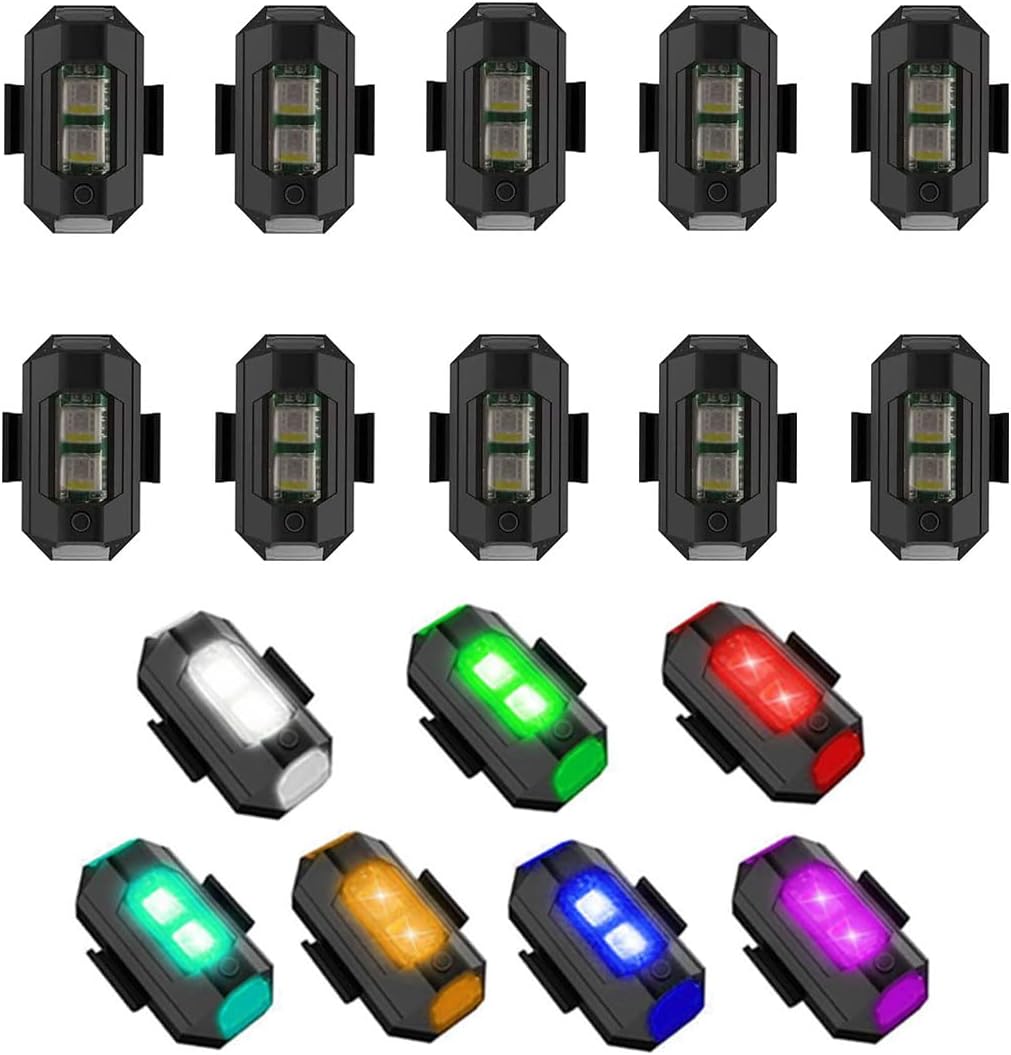
This 10-piece rechargeable drone strobe set has a 4.1 rating and is built for pilots who fly multiple aircraft or want spare units available. Each light measures 39 by 27.2 by 13 millimeters, weighs 6.5 grams, and includes a 90mAh rechargeable lithium battery.
We may earn a commission when you buy through this link, at no additional cost to you.
The package contains one charging cable, 20 Velcro pieces, and 20 rubber rings. That gives a pilot two installation approaches and enough hardware to distribute lights around several drones. The stated visibility of up to one mile is less ambitious than the SYMIK listing's maximum 3.7-mile claim, but it is still a clearly documented distance for this category.
Runtime is the main concern. The listing states charging in approximately 12 minutes and an output of up to about half an hour at full charge, with actual consumption varying by mode. This makes the set better suited to short flights, multiple aircraft, or keeping spares than to a long operation without a recharge. One cable also means recharging ten units may take multiple cycles.
This bundle is most practical for a multi-drone hobbyist or a pilot who prefers abundant spares and simple Velcro installation. For longer flights, a set with a clearly stated multi-hour runtime would be a better fit.
Ten lights, twenty Velcro pieces, and twenty rubber rings provide a generous setup. The extras can support several aircraft, replacement after a damaged unit, or multiple mounting positions without another purchase.
A roughly 30-minute full-charge figure is adequate for many short sorties but should be checked against the intended flight. Charging before departure and keeping spares available helps avoid a last-minute endurance problem.
We may earn a commission when you buy through this link, at no additional cost to you.
A useful drone strobe should be conspicuous, secure, light enough for the aircraft, and dependable for the duration of the flight. The following factors help narrow the field without overlooking differences between compact multi-light sets, high-output single units, and combined strobe-and-siren devices.
Nighttime visibility is the primary requirement, but it is better evaluated through useful evidence than a generic brightness claim. The SYMIK GS600 states a visible distance of up to 6 kilometers or 3.7 miles, while the smaller GS350 states up to 3.5 kilometers or 2.2 miles. The ten-light bundle claims visibility from one mile, and the ARC V is distinguished by 1000 lumens. These figures use different methods, so they should not be treated as perfectly equivalent laboratory measurements. Weather, background lighting, viewing angle, and competing lights can all change real-world conspicuity.
Prioritize a product that states its output, flash behavior, and viewing characteristics. Also consider where the light will be seen: a unit visible from above may be less useful to an observer at ground level, so multiple placement points can help.
White, red, and green are the three colors most commonly represented in this guide. The HeiyRC and SYMIK sets provide all three, the QVEVDACAR package offers seven colors and 30 modes, and the ARC V is documented as white only. A high-intensity white flash can be conspicuous, while red and green may preserve night vision better or provide contrast against certain backgrounds.
Look for a clear burst-flash or slow-flash option, and check whether a memory function retains your last setting. A dedicated aviation-style pattern is useful, but pilots should avoid assuming that every decorative animation is optimized for anti-collision recognition.
Every gram matters more when it is added at the edge of a drone. The documented weights range from 5.8 grams for each HeiyRC light and 6 grams for each QVEVDACAR light to 9 grams for a GS350 and 21 grams for a GS600. The STARTRC and ten-pack products also emphasize compact construction. Larger output is valuable, but placement should avoid adding noticeable drag or disturbing the aircraft's balance.
Choose the lightest unit that still provides the visibility your environment needs, and avoid mounting anything where it could shade a vent, block an antenna, touch a propeller, or sit close to a hot component.
Runtime specifications vary dramatically. The HeiyRC lights claim up to seven hours in red and green fast-flash mode, the SYMIK lights claim up to three hours without a significant visibility reduction, and the QVEVDACAR slow-flash mode is stated at about eight hours. The ten-piece set offers only around half an hour at full charge, while the STARTRC record does not clearly separate runtime from its repeated automatic-alarm description.
Match expected endurance to flight duration and keep a charging method that is practical for your routine. USB Type-C and standard USB charging are convenient, while a battery display or memory function helps reduce uncertainty between flights.
A bright light is not useful if it detaches in flight. The SYMIK package supports installation across almost all drone models, the HeiyRC lights use loop or hook mounting, the ARC V includes three meters of VHB tape and a self-securing closure, and the ten-pack set supplies both Velcro and rubber rings. Silicone straps offer another removable option in the STARTRC unit.
Inspect the mounting surface and test with the aircraft powered down. Pull gently on the light, confirm that straps cannot enter a propeller path, and ensure the closure does not block a button, battery release, sensor, or ventilation opening.
A long compatibility list is only a starting point because airframes differ in shape, available flat surfaces, antennas, vents, and camera geometry. The documented products name numerous DJI Mini, Mavic, Air, Avata, Flip, Neo, and FPV models, while the HeiyRC listing also cites Fimi, Phantom, Holystone, and RUKO aircraft. Compatibility language should still be checked against the exact model and generation.
Pay particular attention to forward-facing camera interference. A powerful LED near a lens can produce glare, reflections, or reduced image quality, even when the light helps another pilot see the aircraft. Position and test the strobe before recording important footage.
Some anti-collision lights do more than flash. The STARTRC combines a 100-lumen LED with a 120dB horn and describes automatic triggering after certain conditions, including sensing a crash. Such a unit can aid aircraft recovery, although the sound may be unsuitable in populated or sensitive environments. Other products focus on visibility, mode selection, and battery status rather than recovery alerts.
Decide whether an audible alarm is necessary for your operation. If it is, consider where sound will travel and whether automatic activation could cause confusion. If not, a silent strobe usually offers a simpler and less disruptive night-flying setup.
Package quantity can improve placement and provide spares, but more units do not automatically create better visibility. The SYMIK set combines one powerful GS600 and two smaller GS350 modules, while the QVEVDACAR and ten-piece bundles provide four and ten lights respectively. The HeiyRC package uses two compact units, and the ARC V is a single-light solution.
For one aircraft, two or three carefully positioned lights may be more practical than a large inventory. For pilots who own several drones, a bulk set can provide flexible replacements and eliminate the need to move one light between aircraft.
Before the first flight, fully charge the strobe using the specified cable and confirm that the selected mode, color, and mounting point are suitable for the aircraft. Read the current official FAA guidance and any local requirements that apply to your operation, because a lighting accessory does not replace airspace authorization, remote identification, or other legal obligations. Test the unit in a dim area and check its position from several angles.
Install the light on a clean, firm surface with the supplied hook-and-loop, rubber ring, strap, or adhesive system. Leave enough clearance from propellers, antennas, cooling vents, camera lenses, and landing gear. Turn the aircraft off while attaching or removing the accessory, then perform a brief stationary check to confirm that the light remains secure and that its flashes do not disrupt the camera or flight controls.
During operation, monitor the strobe for unexpected shutdowns, altered flashing, or loose mounting hardware. After landing, power down the aircraft before servicing the light, inspect the straps or adhesive for wear, and clean the enclosure with a dry or lightly damp cloth rather than abrasive or aggressive liquids. Store the unit somewhere dry and avoid leaving its battery depleted for long periods.
No. A strobe can support anti-collision visibility, but it does not independently satisfy every FAA operating rule or other legal requirement. Pilots should review the current official FAA guidance, obtain any required authorizations, and follow local airspace restrictions before flying at night.
The three colors are common because each is readily recognizable and can provide strong contrast. White is often used for maximum immediate brightness, while red and green can be easier on night vision. The HeiyRC and SYMIK sets provide all three, allowing pilots to compare colors in the actual operating environment.
The correct number depends on the aircraft, environment, and selected unit. Two or three lights placed on different sides can improve the chance that the aircraft is seen from multiple angles. A brighter single light can also work, so placement and viewing angle matter more than simply maximizing the number of units.
Use the mounting method intended for the supplied hardware, beginning with a clean and flat attachment surface. Straps and rubber rings are removable, while VHB tape or Velcro can be convenient but should still be checked for security. Never allow a mounting point to interfere with propellers, antennas, sensors, or cooling vents.
It can, particularly when a bright white light sits close to a forward-facing lens or its filter. Reflections and glare may reduce image clarity. Position the light away from the lens, test several brightness or color modes before recording, and adjust the angle if the image is affected.
Many compact lights can fit many RC drones, but broad compatibility language does not guarantee a secure installation on every airframe. Check the dimensions, weight, available surface, propeller clearance, and camera position. The HeiyRC and QVEVDACAR listings cite a wide range of drone families for this reason.
For longer or repeated operations, carrying a charged spare can be useful, especially when the selected light has a short runtime. However, always follow the manufacturer's charging and battery-handling instructions. Do not assume every light uses the same connector, cell type, or charge protocol.
A sound alarm is optional rather than a general visibility requirement. The STARTRC combines a 120dB horn with a 100-lumen light and can help locate a downed aircraft, but the noise can be excessive near people or animals. Most pilots seeking only anti-collision lighting can choose a quieter dedicated strobe.
The HeiyRC 2PCS set is the best budget option for pilots seeking two extremely light lights, ten modes, and a visible battery indicator. The SYMIK 3 Pack is the editor's choice for the most complete combination of mixed sizes, six modes, strong stated visibility, and Type-C charging, while the ARC V is the premium high-output choice with a documented 1000-lumen white strobe.
Prioritize the features that affect the actual flight: visible output, a secure and unobtrusive mount, sufficient endurance, and compatibility with the exact drone and camera arrangement. Multi-light sets improve placement flexibility, compact lights minimize aerodynamic impact, and an alarm can add recovery value, but each extra feature should be balanced against weight, charging demands, and operational convenience.
The remaining listings require additional verification because their supplied records do not include descriptive specifications or images. Check the live product pages, official FAA guidance, and current package details before buying, and remember that prices and listings can change. Comparing the documented options against your aircraft and typical flight duration will produce the most dependable choice.