
Yamaha YHT-4970U
4.5Editor score
Complete receiver and speaker bundle
Dolby Atmos and DTS Virtual:X
Automatic room correction
A Dolby Atmos home theater system can transform films, television, and games by placing dialogue in the center, action around the listening area, and sound effects above the main stage. The strongest systems combine carefully placed speakers, deep but controlled bass, room-aware calibration, and simple everyday controls rather than relying on channel count alone.
The ten systems in this guide range from compact all-in-one packages to substantial soundbar-based and component-style arrangements. We compared their stated channel configurations, height effects, subwoofer designs, Dolby Atmos support, connectivity, calibration features, dialogue tools, and practical appeal for different room sizes and listening habits.
Each review identifies the features that distinguish its system, while the comparison and buying guide explain where compromises may apply. Product specifications and retailer availability can change, so readers should verify the current model details and accessories before purchasing for their particular room and equipment.
4.5Editor score

4.3Editor score

4.6Editor score
As an Amazon Associate we earn from qualifying purchases.
This side-by-side comparison highlights the major differences among ten Dolby Atmos home theater systems, including their channel counts, speaker arrangements, subwoofer approaches, calibration tools, and connection options.




The Samsung Q990F is a 2025 Q Series package combining a main soundbar, subwoofer, and wireless rear speakers in an 11.1.4-channel configuration. Its 4.3 rating reflects a broad feature set, particularly its four up-firing channels, room calibration, Q-Symphony support, and ability to create overhead and rear sound effects with fewer visible cables than a traditional component system.
We may earn a commission when you buy through this link, at no additional cost to you.
The main attraction is the breadth of the presentation. Eleven front and surround channels, a subwoofer channel, and four height channels give films a broad horizontal stage, while the rear speakers place effects behind the listening position. Q-Symphony can coordinate the bar with compatible Samsung television speakers, potentially making the soundstage fuller without adding another full surround system.
Sensors in the soundbar analyze the room and adjust the output, including bass, while Adaptive Sound is designed to improve clarity against background noise. The package also supports voice assistants and services such as Alexa, Googlecast, and AirPlay 2. These are meaningful conveniences for viewers who want the system calibrated and controlled without navigating a complicated receiver menu.
The trade-off is ecosystem dependence. Q-Symphony and AI TV features naturally work best with compatible Samsung displays, and the substantial channel layout benefits from a room that can accommodate the soundbar, subwoofer, and rear speakers. For viewers who want extensive height effects, wireless placement, and smart television integration without assembling separate components, the Q990F is the most complete all-in-one choice in this guide.
Embedded sensors analyze the listening environment and make automatic adjustments to the sound and bass. This is particularly useful for users who want a consistent result without repeatedly changing equalizer settings after moving furniture or changing the room layout.
The four up-firing channels add overhead presence, while the included wireless rear speakers handle effects behind the sofa. Keeping the main unit near the television and placing the surrounds at the sides of the seating area creates a more convincing cinematic field than a basic soundbar alone.
We may earn a commission when you buy through this link, at no additional cost to you.
The Sony BRAVIA Theater System 6 uses a 5.1-channel physical arrangement comprising three front-firing speakers, two rear speakers, and an included subwoofer. With a 4.4 rating, it stands out for straightforward home theater integration, dedicated dialogue handling, support for Dolby Atmos and DTS:X, and an emphasis on making the system approachable for everyday use.
We may earn a commission when you buy through this link, at no additional cost to you.
Its front stage is organized like a conventional compact theater system, with left, center, and right channels handled by the main unit. The dedicated center speaker helps keep voices focused, while the two rear speakers extend effects into the room. Multi Stereo can play the same sound from all speakers to create a fuller room-filling effect for compatible content and casual viewing.
The system also integrates neatly with compatible BRAVIA televisions. Users can control the soundbar through the television menu and use Voice Zoom 3 for enhanced dialogue, while the BRAVIA Connect app provides access to volume, sound profiles, and advanced settings. Bluetooth streaming and music up-mixing add value when the theater is not being used for video.
Its primary limitation is physical height coverage. Unlike the Samsung Q990F or Nakamichi Dragon, the System 6 does not list dedicated up-firing height channels in its 5.1 layout, so Dolby Atmos height effects depend on the processing approach. It is best for buyers who value Sony television integration, clear dialogue, and a manageable complete package over maximum channel count.
A dedicated center channel keeps voices in a consistent location, reducing the chance that dialogue seems detached from the screen. Voice Zoom 3 and the compatible BRAVIA TV feature add further control when fast-paced scenes make subtitles or spoken narration difficult to follow.
BRAVIA TV users can access theater controls from the television menu, reducing the need to switch between devices. The dedicated app further simplifies volume changes, sound profiles, and advanced configuration after installation.
We may earn a commission when you buy through this link, at no additional cost to you.
The Yamaha YHT-4970U is a complete traditional home theater bundle built around a Yamaha RX300A Dolby Atmos AV receiver. The box contains front and surround speakers, a center channel, a powered subwoofer, the necessary speaker wire, and a subwoofer cable. Its 4.5 rating makes it a persuasive option for buyers who want an established component-based design without selecting every piece individually.
We may earn a commission when you buy through this link, at no additional cost to you.
The receiver decodes Dolby Atmos and DTS Virtual:X, providing dimensional sound processing from the 5.1 speaker arrangement. It also supports 4K at 120 frames per second, 8K at 60 frames per second, Dolby Vision, HDR10+, HDMI eARC, ALLM, and VRR. That combination makes it well matched to modern televisions, streaming boxes, and gaming consoles.
A major strength is the included setup microphone. It measures room acoustics and speaker characteristics so the receiver can optimize performance automatically. Yamaha also supplies a Quick Guide, an intuitive on-screen settings menu, several sound modes, and up to four custom presets for different content types and listening situations.
The package does not include dedicated up-firing speakers, so its overhead presentation is generated through processing rather than physical elevation channels. Wired speaker placement also requires more setup attention than a wireless soundbar package. Even so, the YHT-4970U provides receiver features, discrete speakers, a subwoofer, room correction, and extensive connectivity in a cohesive package that suits first-time home theater owners.
The included microphone measures the room and speaker characteristics, allowing the RX300A to make automatic corrections. This reduces the trial-and-error involved in balancing a new surround system and helps the package deliver a more consistent result in different spaces.
Support for 4K at 120, 8K at 60, Dolby Vision, HDR10+, ALLM, and VRR prepares the receiver for current televisions and consoles. These features are especially useful for buyers who want one receiver to handle immersive video, surround sound, and responsive gaming.
We may earn a commission when you buy through this link, at no additional cost to you.
The ULTIMEA Skywave X70 combines a soundbar, wireless surround speakers, and a 10-inch wireless subwoofer in a 7.1.4-channel system. Its 4.7 rating is the highest among the ten products, reflecting the appeal of wireless freedom, substantial low-frequency output, extensive processing, and a 4K HDR-capable connection design.
We may earn a commission when you buy through this link, at no additional cost to you.
Dual 5GHz transmission is the foundation of the fully wireless approach, with advanced RF and networking protocols intended to maintain stable links and minimize interference. The included subwoofer uses a 10-inch driver with specifications listed as 980W peak output and extension down to 20Hz, giving movies and games more physical low-frequency impact than a compact soundbar package.
Its NEURACORE engine uses triple-core DSP and dual-core processing, supporting 24-bit/192kHz audio and up to 17 channels. The ULTIMEA app adds OTA updates, a 10-band equalizer, and 121 sound presets. CEC synchronization can control television power, volume, and input, while 4K Ultra HD and HDR pass-through support helps the system operate as a convenient central home theater component.
The main caveat is that the specified architecture, large subwoofer, and complete wireless layout call for deliberate room planning. Some users may also find the extensive app and processing options more than they need. Even so, the X70 stands out for delivering the strongest stated rating and a rare combination of wireless placement, 7.1.4 immersion, large-driver bass, and deep customization.
The soundbar, surround speakers, and subwoofer communicate wirelessly, reducing cable runs and simplifying placement. Dual 5GHz transmission is designed to support stable performance in a busy wireless environment, though the final result still depends on room layout and signal conditions.
A 10-inch driver in the wireless subwoofer provides a more substantial low-frequency foundation than many compact systems. The ULTIMEA app's 10-band equalizer and extensive preset library give users useful control over how that bass integrates with films, music, and games.
We may earn a commission when you buy through this link, at no additional cost to you.
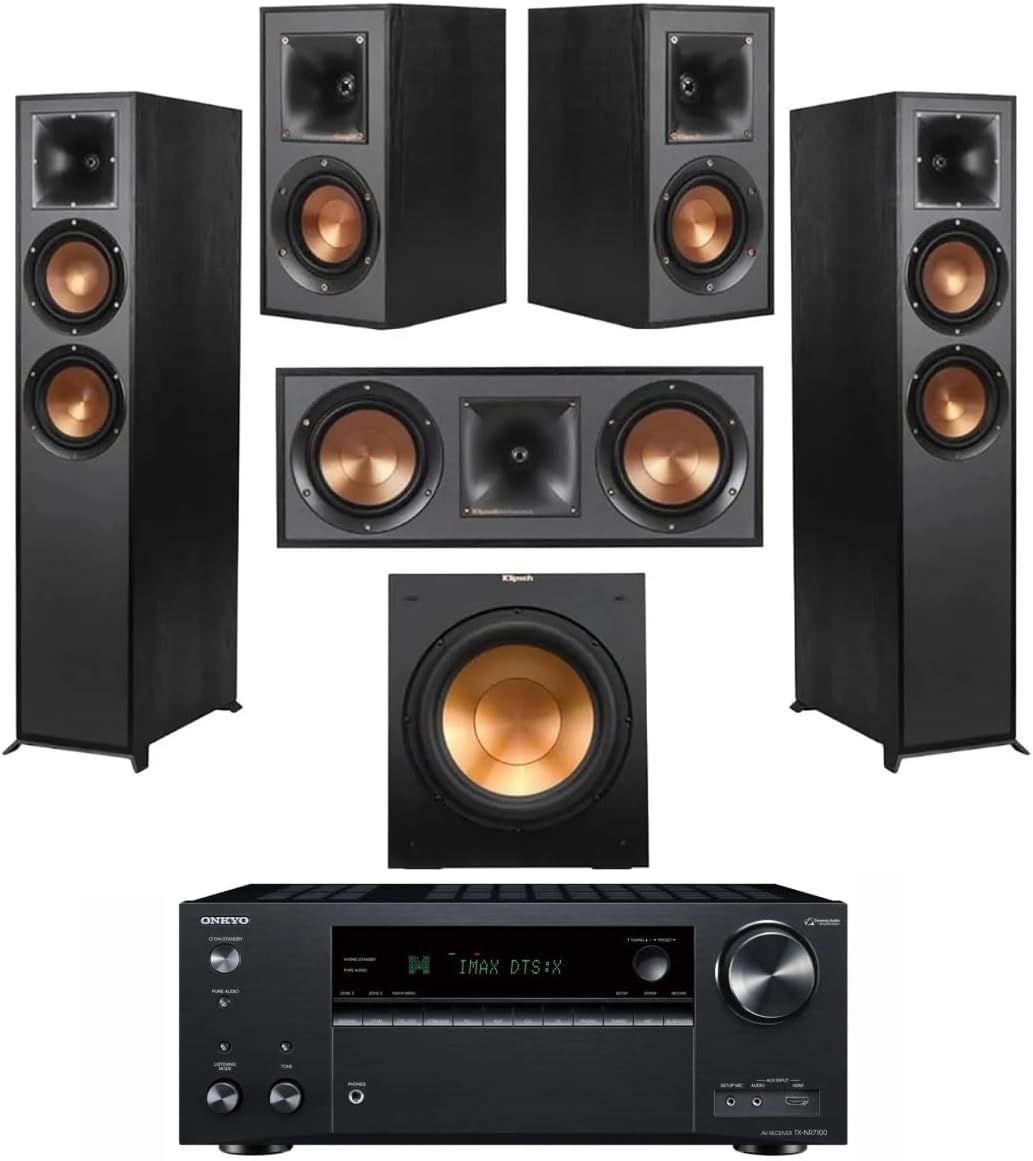
The Klipsch and Onkyo bundle combines traditional discrete speakers with a capable network AV receiver. It includes dual Klipsch R-625FA floorstanding speakers, an R-52C center channel, R-41M bookshelf surrounds, an R-12SW powered subwoofer, and the Onkyo TX-NR7100 9.2-channel receiver. The 4.4 rating reflects a balanced mix of dedicated height channels, strong bass, and home theater flexibility.
We may earn a commission when you buy through this link, at no additional cost to you.
The R-625FA front speakers contain up-firing Dolby Atmos elevation channels, making the overhead effects physical rather than dependent entirely on virtual processing. The dedicated center handles dialogue, the bookshelf speakers provide rear effects, and the 12-inch spun copper IMG driver in the R-12SW adds substantial low-frequency output. This arrangement is particularly attractive to listeners who prefer speakers visibly separated around the room.
The TX-NR7100 provides 220W per channel at 6 ohms, according to the stated specifications, along with Dolby Atmos, 8K video support, automatic room calibration, HEOS streaming, and voice-control support. The 9.2-channel platform also provides more flexible speaker routing options than the compact 5.1 packages featured elsewhere in the guide.
This is not a minimalist installation. The floorstanding speakers need space, the layout involves multiple wired connections, and setup will take longer than a wireless soundbar package. Buyers seeking genuine dedicated height effects, substantial floor speakers, and receiver-based control will find that those demands are justified by the performance-oriented design.
The R-625FA floorstanders use up-firing elevation drivers to place overhead effects above the front stage. This dedicated approach can make the top layer of an Atmos mix feel more grounded and tangible than a system relying entirely on a soundbar's upward-facing channels.
The 12-inch R-12SW provides more physical low-frequency scale than compact bundled subs. At the same time, the 9.2-channel Onkyo receiver offers room calibration, extensive speaker configuration, streaming, voice control, and support for high-resolution video.
We may earn a commission when you buy through this link, at no additional cost to you.
The Samsung HW-Q990H delivers an 11.1.4-channel configuration through a soundbar, subwoofer, and wireless rear speakers. It shares several high-level strengths with the Q990F, including four up-firing channels and Q-Symphony, but its 3.8 rating is the lowest in this comparison. Buyers should therefore focus on fit, features, and compatibility rather than assuming identical performance.
We may earn a commission when you buy through this link, at no additional cost to you.
The system's wide channel layout is designed to place material at the front, sides, rear, and above. SpaceFit Sound Pro uses sensors in the soundbar to analyze the room and adjust the output, including bass. The subwoofer adds AI Dynamic Bass Control intended to optimize low-frequency output while reducing distortion.
Q-Symphony can combine the soundbar with compatible Samsung televisions and as many as five compatible Samsung audio devices. Compatible AI televisions can add further clarity, while Alexa, Googlecast, and AirPlay 2 support cover common voice and music platforms. These integrations make the package attractive inside a Samsung-centered home.
Its rating suggests that some buyers may encounter a less satisfying overall balance between features and performance than the higher-rated alternatives. The system's large physical footprint and ecosystem emphasis can also be limiting. It remains a strong option for Samsung TV owners who value wireless surrounds, broad height coverage, and automated room tuning above the highest rating in the category.
Q-Symphony allows the system to work with compatible Samsung television speakers and additional Samsung audio products. This can produce a larger and more layered front stage for movies, provided the required compatible devices are already part of the household.
SpaceFit Sound Pro analyzes the room and adjusts the soundbar's output to the environment. AI Dynamic Bass Control separately manages subwoofer output, giving the system tools for balancing low-frequency impact in spaces where a fixed bass response could be too forceful or subdued.
We may earn a commission when you buy through this link, at no additional cost to you.
The Nakamichi Dragon is a full-scale 11.4.6-channel home theater system built around a 58.1-inch main unit, dual opposed eight-inch subwoofer enclosures, and omni-motion surround speakers. Its 4.6 rating and extensive processing specifications distinguish it as the most ambitious premium system in the guide, designed for listeners who want substantial physical scale rather than a compact living-room arrangement.
We may earn a commission when you buy through this link, at no additional cost to you.
The Pro Cinema Engine supports Dolby Atmos configurations up to 24.1.10 and DTS:X Pro up to 30.2, with stated maximum output reaching 3000 watts. HiFi Air Motion tweeters support high-frequency detail and dialogue, while the AHD Ultra engine and PerfectHeight mechanism are designed to create focused front staging and properly placed overhead effects.
The opposed subwoofer design places two eight-inch drivers in separate enclosures facing one another. This approach is intended to produce substantial room pressure while offering more placement flexibility than a single subwoofer. The system's scalable bass architecture can also support as many as four sub enclosures when a room requires additional low-frequency coverage.
This scale brings clear trade-offs. The main unit weighs 32.2 pounds, each subwoofer enclosure weighs 34.4 pounds, and the system ships in three boxes. A living room or media room must be able to accommodate the components, and setup is more involved than for a simple soundbar. For a dedicated theater space, however, the Dragon offers the most expansive and specialized hardware in this roundup.
A 58-inch main chassis, two large subwoofer cabinets, and dedicated surround speakers create a system designed to move substantial air. The result is not intended to blend invisibly into a small room; it is built for consumers who want the equipment to serve as part of the theater experience.
HDMI eARC, three HDMI 2.1 inputs, Bluetooth, optical input, and a 3.5mm auxiliary connection provide several paths for source components. The HDMI section supports 4K at 120Hz with Dolby Vision and HDR10+, making it relevant to modern gaming consoles and high-performance televisions.
We may earn a commission when you buy through this link, at no additional cost to you.
The Klipsch Reference Cinema Dolby Atmos 5.1.4 system is a compact dedicated-speaker solution built to place height effects at both the front and rear. Its 4.5 rating reflects an appealing combination of four Atmos-equipped satellite speakers, Klipsch horn technology, and an integrated digital amplifier for the subwoofer. Unlike a component bundle, however, the listed package does not include an AV receiver.
We may earn a commission when you buy through this link, at no additional cost to you.
Because the satellites include Dolby Atmos technology, the system can generate top-layer effects from both the front and back of the room. Tractrix 90-degree by 90-degree horn technology and aluminum tweeters support high-end response and extended treble. The built-in all-digital subwoofer amplifier is designed to provide efficient power and accurate output.
The 5.1.4 arrangement is more focused than many all-in-one soundbars because the individual speakers can be placed around the listening area. Front and rear height capability gives Atmos content room to expand vertically, while the subwoofer handles the main low-frequency effects. This makes the system attractive to buyers who want dedicated speakers but do not need a large floorstanding design.
Because an appropriate receiver is not listed as part of the package, the total setup will be more involved than the all-in-one products. Buyers need compatible amplification, cables, and a home theater processor with Dolby Atmos decoding. In return, the system offers a direct and upgradeable speaker approach that can fit more flexibly than a fixed soundbar architecture.
Placing Atmos-equipped satellites at the front and rear distributes overhead information throughout the room rather than concentrating every height cue near the television. That wider distribution can make effects such as rain, aircraft, or environmental sounds feel more enveloping.
The included all-digital subwoofer amplifier emphasizes efficiency and source accuracy. Combined with the five main channels, it supplies the low-frequency foundation needed to balance movie effects and music without relying on a separate soundbar bass algorithm.
We may earn a commission when you buy through this link, at no additional cost to you.
The Bose Smart Ultra Dolby Atmos home theater bundle combines the Smart Ultra soundbar, Bass Module 700, and two wireless surround speakers. Its 4.2 rating reflects a polished, modular approach to home theater, with the emphasis placed on immersive sound, voice-assisted control, and a cleaner visual presentation than a collection of separate component speakers.
We may earn a commission when you buy through this link, at no additional cost to you.
Dolby Atmos support creates the vertical dimension, while the included bass module gives the low-frequency effects more weight than the soundbar can produce alone. The two wireless surround speakers extend the sound beyond the television, allowing a more room-enveloping presentation for films, shows, and games. The supplied remote, ADAPTiQ headset, optical cable, HDMI cable, and power cord support straightforward setup.
Voice4Video is designed to clarify spoken content and manage voice-assistant functions while watching television. Alexa and Google Assistant are also supported, giving users common options for everyday control. The modular approach allows the main soundbar to be used on its own or expanded with the included bass and surround components.
The product listing supplies fewer numerical channel and processing details than some competing systems, so buyers cannot assess the architecture from a detailed 11.4.6-style specification. It also carries the visual presence of a substantial soundbar, bass module, and two satellite speakers. The bundle is best for buyers who value Bose's integrated design, voice features, and modular wireless expansion over maximum published channel count.
The package includes everything needed to move beyond a basic television speaker: a soundbar, a separate bass module, and two wireless surrounds. This gives home viewers a dedicated theater stage without requiring a rack of separate speakers and an external receiver.
Voice4Video is designed to make spoken content easier to follow and bring voice-assistant functions into the viewing experience. It can be particularly useful for users who watch dialogue-heavy programs or frequently call voice assistants while the television is active.
We may earn a commission when you buy through this link, at no additional cost to you.
The Sonos Arc Ultra is a premium single-soundbar solution with a 4.6 rating, a 9.1.4-channel spatial-audio design, and support for Dolby Atmos. Its new acoustic architecture and Sound Motion technology are intended to distribute precise effects throughout the room, while the restrained physical design minimizes visual distraction.
We may earn a commission when you buy through this link, at no additional cost to you.
AI-powered Speech Enhancement detects human voices to improve clarity, making the system particularly useful for dialogue-heavy content. Trueplay tunes the output to the room through the Sonos app. Setup is guided step by step, and a single HDMI eARC connection provides a straightforward connection to a compatible television.
The system supports control through a television remote, the Sonos app, touch controls, Sonos Voice Control, and Amazon Alexa. For music, Wi-Fi, Bluetooth, Apple AirPlay 2, and Spotify Connect are included. Users can add a Sonos Sub and Era 300 rear speakers to create a more complete surround presentation, while other Sonos speakers can extend listening into additional rooms.
Those expansion speakers and the subwoofer are not included, so the Arc Ultra arrives as the simplest full-system entry here rather than an all-in-one bundle. A buyer who wants immediate left, right, and rear speaker coverage may find the included bundles more convenient. Those who prefer minimal visual clutter, polished app-based control, and the option to expand gradually will find the Arc Ultra especially attractive.
Sound Motion technology is designed to move air across the room more effectively, helping the single enclosure create a wider spatial presentation. The 9.1.4-channel architecture then supports a precise overhead and surrounding image when paired with suitable source material.
The Arc Ultra can be upgraded with a Sonos Sub and Era 300 rear speakers for a fuller dedicated theater stage. This incremental approach lets users begin with one soundbar and add bass and surrounds according to room needs or available space.
We may earn a commission when you buy through this link, at no additional cost to you.
The right Dolby Atmos home theater system depends on room size, speaker placement tolerance, source equipment, and how much daily setup and expansion you want to manage. The most important choices are the physical channel layout, bass architecture, room calibration, and connectivity.
A channel specification describes the maximum sound-stage architecture, but the physical speakers included matter more than the largest number printed on a box. A 5.1.4 package with four dedicated height speakers can create more convincing overhead placement than a high-number soundbar that creates some height effects through processing. Traditional component systems also offer finer control over where each speaker sits around the listening area.
Choose dedicated front and rear height channels when room layout allows it. If placement is restricted, a soundbar with up-firing drivers and wireless surrounds may offer a more practical balance of immersion and convenience.
A wide soundstage cannot create convincing immersion if all speakers are crowded into a shallow cabinet. Measure the distance from the television to the seating area, the width of the room, and the available space beside or behind the sofa. Large floorstanders and dual-subwoofer systems need more clearance than a compact soundbar, while wireless rears still require correct angles and distance from the screen.
Prioritize a system that can be placed for proper separation without crowding the room. A physically smaller solution with well-placed wireless speakers may produce a more convincing result than a more powerful system forced into an unsuitable layout.
The subwoofer establishes the low-frequency foundation for explosions, music, and effects. A large driver can provide greater physical impact, but placement, room boundaries, and calibration determine whether that output sounds balanced rather than boomy. Systems with automatic bass optimization or a detailed equalizer offer additional ways to integrate the subwoofer with the room and main speakers.
Consider driver size, cabinet dimensions, connection method, and available controls together. More output is not automatically better, and a well-calibrated smaller subwoofer may be more satisfying than an oversized model with limited adjustment.
Room correction can measure speakers, set relative levels, and help a system sound more consistent in an imperfect room. Microphone-based receivers offer detailed setup, while sensor-equipped soundbars automate portions of the process. Dialogue enhancement, dedicated center channels, and adaptive sound features can improve intelligibility, though their usefulness depends on content and the user's preferences.
Look for calibration that matches your comfort with setup. Detailed controls benefit enthusiasts who want to adjust the result, while automatic systems are more approachable for viewers who want a strong starting point with minimal effort.
Check the television and source-device connections before choosing a system. HDMI eARC is common for compact systems, while component-based packages need an AV receiver with suitable HDMI inputs. Gaming features such as ALLM and VRR, 4K video support, Dolby Vision, and HDR10+ can matter for modern consoles and televisions. Bluetooth, Wi-Fi, AirPlay 2, Googlecast, and Spotify Connect serve music rather than the core Atmos signal path.
Match the system's input capabilities to the devices you already own. Confirm that the receiver or soundbar supports your preferred resolution, refresh rate, audio format, and smart-platform functions before making the final decision.
Wireless packages can reduce cable clutter and shorten setup, but they still require correct speaker placement and power. Traditional systems demand wire runs, input routing, and receiver configuration, yet they provide direct control over each channel. Soundbars usually offer the simplest installation, with app-based guidance and a single main connection to the television.
Be realistic about the installation process. Choose a system whose setup complexity matches your experience, willingness to route cables, and need to relocate equipment whenever the room changes.
Voice assistants, television synchronization, music streaming, and multi-device functions can make a system more convenient, but they often work best within a particular ecosystem. Samsung Q-Symphony, BRAVIA television integration, Sonos multi-room support, and Bose voice features each suit different households. Buyers should not pay for smart functions they will rarely use or ignore features that depend on devices they do not own.
Map the system's connected features to your existing phones, televisions, speakers, and services. Existing compatible equipment can add more value than a technically impressive feature set that remains unused.
Begin by positioning the front channels at the television, placing the center speaker or soundbar directly in front of the viewing area, and setting surrounds to the sides or behind the primary seats. Place the subwoofer near a wall or corner if the room needs additional low-frequency reinforcement, then run calibration afterward so the system measures its final position. For systems with height speakers, angle them toward the main listening position.
Connect sources through the appropriate HDMI or digital inputs, select the correct source, and enable the applicable surround or Atmos processing. Begin with moderate volume, adjust the subwoofer and dialogue settings, and use the receiver, television menu, or phone app to save profiles for movies, sports, news, gaming, and music. Avoid repeated switching between competing processing modes, as each can change balance and dialogue placement.
Keep vents and driver openings unobstructed, dust the soundbar and satellite speakers with a soft dry cloth, and follow the manual's cleaning instructions for fabric or wood finishes. Do not push objects against the subwoofer, and avoid placing heat-producing electronics in enclosed cabinets. Periodically check cable connections, firmware notices, speaker placement, and calibration settings, especially after moving furniture or changing room use.
It depends on the product. A soundbar-based system processes Dolby Atmos internally, while a traditional speaker package may require an AV receiver with Dolby Atmos decoding and enough channels for all speakers and height effects. Always confirm whether a receiver is included and review the full component list before buying.
No. A higher number can be useful when the system includes real front and rear height channels, but physical placement and calibration still determine the result. A well-positioned 5.1.4 system can sound more immersive than a higher-count model whose speakers are crowded into a small area.
That depends on the brand and model. Some bundles include compatible wireless surrounds from the start, while others allow compatible Sonos speakers or other manufacturer-specific accessories to be added later. Check current compatibility lists and ensure the main unit, television, and firmware version support the intended expansion.
Start near the front or side wall, away from corners if the result becomes excessively boomy. Corner placement can increase low-frequency output, while an open position may sound smoother. Run the system's room calibration after choosing the final location, because moving the subwoofer changes its interaction with the room.
No, but Atmos content can reveal the system's strengths more clearly. Modern films, streaming programs, games, and some music releases include Atmos or other object-based audio mixes. Older stereo and surround content can also benefit, although the height and surround effects are reconstructed rather than originally present.
The main soundbar needs room for its width, ventilation, and connection cables, while the subwoofer and rear speakers require additional floor space. Large systems such as dual-subwoofer configurations may require dedicated cabinetry and careful placement. Measure both the equipment and the intended listening area before ordering.
HDMI eARC provides the broadest pathway for compatible television audio and is usually the best choice for a modern soundbar. Component receivers use their own HDMI inputs to receive video and decode Atmos for the speakers. Optical audio remains a useful fallback but has more limited bandwidth and format support.
Run initial calibration after the speakers and subwoofer are in their permanent positions, and recalibrate if you move them, change the room layout, or add furnishings that significantly affect acoustics. Small preference adjustments to bass or dialogue can be made later without repeating the complete setup process.
The Samsung Q990F stands out as the strongest all-around option for viewers seeking broad height coverage, wireless surrounds, automated calibration, and close integration with compatible Samsung televisions. The Yamaha YHT-4970U is the most practical traditional package, while the Nakamichi Dragon represents the premium extreme with its unusually large main unit, dual subwoofers, dedicated surrounds, and extensive processing.
Your priorities should determine the remaining choice. Samsung TV owners may favor the Q990F or HW-Q990H, BRAVIA users may appreciate the Sony System 6, and buyers wanting a conventional receiver and discrete speakers can consider the Yamaha or Klipsch and Onkyo bundle. The ULTIMEA X70, Bose Smart Ultra, Klipsch Reference Cinema, and Sonos Arc Ultra serve different combinations of wireless freedom, design, expandability, and dedicated-speaker performance.
Before ordering, verify the exact components in the package, current model details, room dimensions, source-device connections, and the availability of any expansion products you may want. Retail listings and product offerings can change, so confirming the latest information helps ensure that the system you select is the right fit for your television, listening area, and long-term entertainment setup.