
XLUX Plant Soil Moisture Meter
4.4Editor score
Battery-free instant moisture reading
Color-coded ten-scale analog dial
Slim stainless-steel needle probe
Suitable indoors and outdoors
Our Digital Soil Moisture Meters guide compares ten indoor and outdoor meters for accuracy, displays, probes, extra sensors, monitoring, and ease of use.
Digital soil moisture meters turn guesswork into measurable plant-care information by reporting the moisture level around a root zone. Useful models combine clear displays, reliable probes, useful secondary sensors, and simple controls. The right choice depends on whether you need a quick spot check, continuous monitoring, professional field measurements, or a wireless garden system.
We compared all ten products by examining their stated measurement functions, probe designs, display layouts, power requirements, monitoring capabilities, weather resistance, and intended indoor or outdoor applications. The list includes compact battery-free readers, multifunction soil testers, leave-in monitors, smartphone-connected sensors, and professional instruments with more substantial probes and measurement specifications.
Each review explains the product's standout capabilities, practical limitations, and most suitable user. Ratings reflect the customer feedback supplied with each product, while technical details come from the listed product information. Prices and availability can change, so compare the current listing, included accessories, and compatibility requirements before purchasing.
4.4Editor score

4.2Editor score

4.4Editor score
This side-by-side comparison covers spot-check testers, multifunction soil analyzers, leave-in monitors, smart sensors, and professional field meters, with special attention to probe type, measurements, power, and connectivity.




The YAMRON 4-in-1 is a versatile digital soil tester with a supplied customer rating of 4.2. It measures soil moisture, pH, temperature, and sunlight, giving ordinary plant owners more information than a dedicated moisture-only reader while remaining approachable enough for beginners.
We may earn a commission when you buy through this link, at no additional cost to you.
Its large backlit LCD is one of the most useful design features. Numerical results and simple graphics can be read in daylight or darkness, while the rotating head lets users adjust the viewing angle by as much as 45 degrees. The stated process is straightforward: insert the probe about 10 centimeters into the soil, wait around 10 seconds, and read the displayed values.
There are trade-offs. Four AAA batteries are required but not included, and the meter is intended for soil rather than direct liquid testing. The instructions also caution against inserting the probe into extremely dry, hard soil; moistening the test area and waiting before taking a reading can help avoid damage. For reliable results, the manufacturer recommends sampling at least five locations and averaging the values.
This is the strongest all-around choice for houseplant owners and mixed indoor-outdoor gardeners who want moisture alongside pH, temperature, and light readings. It is less suitable for someone wanting a battery-free tool or continuous unattended monitoring. For most general users, its combination of readable output, useful measurements, and adjustable screen gives it broad appeal.
Adding pH, temperature, and light measurements helps connect watering decisions with broader growing conditions. Instead of treating moisture as the only variable, users can consider whether the root zone is warm, how acidic the soil is, and how much light the plant receives.
The large white-backlit display remains visible in bright rooms or darker conditions, and the adjustable head reduces the need to bend directly over the pot. That combination makes repeated checks faster and more comfortable.
We may earn a commission when you buy through this link, at no additional cost to you.
The Moisture Meter for Plants is a seven-in-one digital soil tester with a supplied rating of 4.4, the highest rating in this group. It combines soil moisture, pH, temperature, light intensity, fertility, EC, and TDS functions in one large-display instrument.
We may earn a commission when you buy through this link, at no additional cost to you.
The extra-large backlit LCD presents clear numbers and intuitive symbols, making the device approachable even when it offers considerably more information than a basic analog reader. Its stated probe technology is designed for fast measurements, while the screen lets a user select among multiple plant-care parameters. The kit is powered by four AAA batteries, which are not included, and includes a low-battery warning.
Its main drawback is complexity relative to simple moisture meters. Some functions measure water-quality characteristics rather than directly assessing a plant's root zone, so users should interpret each mode according to the listed instructions. As with other probe-based testers, the product must not be used to measure liquids directly, and forcing it into dry, hard soil should be avoided.
The meter is best suited to serious indoor growers, greenhouse hobbyists, and gardeners who want a broad diagnostic tool in one device. It also suits anyone who values EC and TDS information alongside standard soil readings. For a simpler check, a moisture-only or four-function model may be easier to operate, but this kit offers the broadest stated measurement set.
Seven functions let users examine moisture alongside pH, temperature, light, fertility, EC, and TDS. The additional readings can make the meter more useful for troubleshooting a plant's environment rather than simply confirming whether the soil feels damp.
Clear numbers and symbols reduce the learning curve, while the extra-large illuminated screen helps minimize squinting. A quick 10-second measurement process suits users who want more information without a lengthy setup.
We may earn a commission when you buy through this link, at no additional cost to you.
The RAINPOINT Large Display is a digital soil moisture meter designed to remain in a pot, with a supplied rating of 4.1. Its defining advantage is the always-on screen: users can glance at moisture status without repeatedly inserting and removing a probe.
We may earn a commission when you buy through this link, at no additional cost to you.
The display combines an intuitive color-coded gauge with digital moisture percentages, offering a quick qualitative indication and a more precise number. It checks automatically every two hours or manually when the button is pressed. A one-touch power-off helps conserve battery life, while the flat, slim body is easy to store when not in use.
This leave-in approach reduces soil disturbance and is gentler on delicate roots than repeated insertion. However, it does not replace a spot-check meter when several pots need attention at once, and the product is primarily oriented toward houseplants rather than broad agricultural diagnostics. The thin body may also be less suitable for very loose media or large outdoor plots.
Choose this meter for a home collection where you want an at-a-glance moisture indicator that remains in the pot. It is especially useful for people who tend to forget watering checks or want to minimize root disturbance. Buyers seeking pH, temperature, light, or professional specifications should choose a more specialized model.
Keeping the meter in place makes moisture readings available throughout the day and reduces the need to dig into the soil. That can be particularly helpful for pots containing delicate roots or a growing mix that is easily disturbed.
At 0.63 inches thick and 1.1 ounces, the device is portable and easy to store. The ribbed grip supports handling, while the built-in tag slot keeps care notes or plant identifiers close at hand.
We may earn a commission when you buy through this link, at no additional cost to you.
The General Tools DSMM500 is a precision digital moisture meter aimed at commercial, agricultural, and professional applications. It has a supplied rating of 4.2 and focuses on a clearly defined 0-to-50-percent measurement range with a stated accuracy and resolution specification.
We may earn a commission when you buy through this link, at no additional cost to you.
Its heavy-duty eight-inch probe is longer than most household meter probes, allowing readings deeper into the soil. A sampling time of 0.8 seconds supports rapid checks, while minimum and maximum memory plus a data-hold function make it easier to record and compare observations in the field.
The meter is built for practical outdoor conditions, with IP65 water resistance and CE and RoHS approvals. It runs on four AAA batteries, which are not included. Because it measures moisture rather than a broad set of soil and environmental properties, it may feel limited beside multifunction garden testers, but that specialization also keeps the interface focused.
This is a convincing option for landscapers, greenhouse managers, agricultural users, and serious gardeners who need a deeper and more repeatable probe. It is less appropriate for a casual owner of a single houseplant who values battery-free convenience more than professional measurement specifications.
The eight-inch probe can reach deeper into the root zone than a short household needle. Its heavy-duty construction and water-resistant enclosure also suit repeated agricultural and landscaping use.
Minimum and maximum memory lets users retain important readings during a session. Data hold and fast sampling support quicker comparisons without requiring a separate note for every measurement.
We may earn a commission when you buy through this link, at no additional cost to you.
The XLUX Plant Soil Moisture Meter is a battery-free soil reader with a supplied rating of 4.4. Although it appears in a digital-meter roundup because it serves the same core moisture-measurement task, it uses a color-coded analog dial rather than an electronic numerical screen.
We may earn a commission when you buy through this link, at no additional cost to you.
Its ten distinct scales run from dry through moist to wet, making the reading easy to interpret at a glance. The slim 304 stainless-steel needle enters various soil types with minimal displacement, and the absence of batteries eliminates charging, battery replacement, and display dependency.
The main limitation is that users cannot leave it installed continuously. The stated guidance is to insert, read, and remove it within five minutes, wipe the probe clean, and return it to the protective sleeve. It also cannot test liquids, and repeated physical checks still require the user to retrieve the meter.
This is the best budget choice for beginners, renters, and anyone who wants dependable moisture guidance without managing batteries. It is less suitable for monitoring multiple remote zones or recording detailed trends. Its simplicity, low maintenance, and clear dial make it an excellent companion to a more advanced display meter.
The meter is ready whenever it is needed because it has no battery or charging system. That removes one common source of frustration from plant-care tools and keeps the operating process exceptionally simple.
The narrow needle displaces less soil than a bulky dual-probe tester, making it a considerate choice around fine roots. It is designed for quick checks rather than permanent installation.
We may earn a commission when you buy through this link, at no additional cost to you.
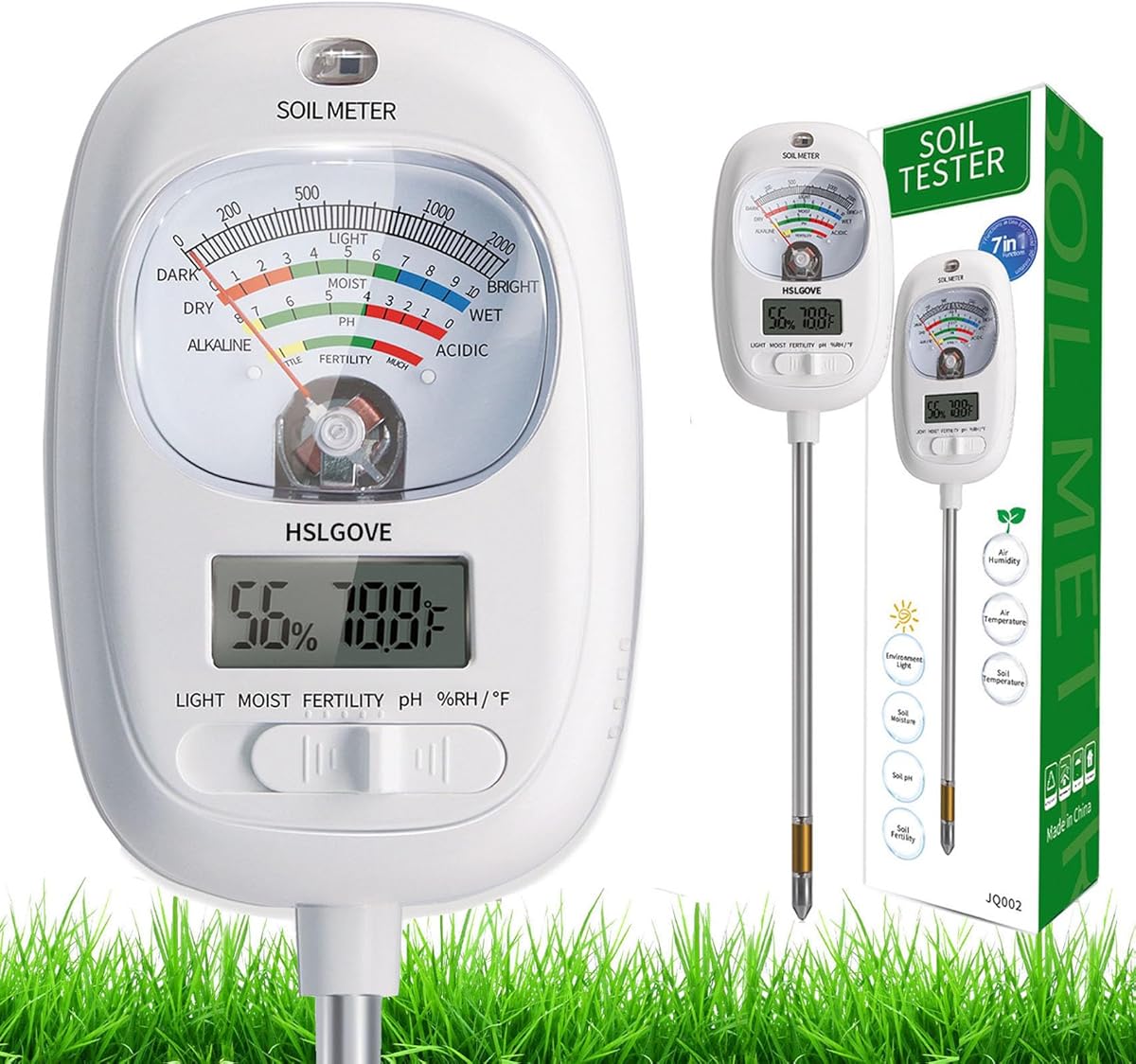
The HSLGOVE Soil Test Kit combines an analog-style dial with an LCD in one instrument, giving it a distinctive place among the digital and multifunction meters listed here. It has a supplied rating of 4.4 and offers seven functions spanning soil moisture, pH, fertility, temperature, light, air temperature, and humidity.
We may earn a commission when you buy through this link, at no additional cost to you.
The split display approach allows fast gauge-based guidance alongside more specific digital values. The soil-related controls provide pH, fertility, temperature, and light readings, while the mini environmental gauge reports air temperature and humidity. A single approximately 6.8-inch probe is made from three metals and is intended for medium-to-large potted plants.
Operation requires replacing or installing three batteries, selecting the desired mode, and waiting roughly three to five minutes for the results. It is explicitly not designed to test liquid moisture directly. The dual interface may also take slightly longer to learn than a model devoted to a single numerical reading.
This kit suits gardeners who want both soil and ambient growing information from one unit. It is especially relevant for seedlings, lawns, flowers, vegetables, and larger pots where temperature and humidity context may influence care. Users wanting instantaneous, leave-in monitoring should choose a dedicated continuous monitor instead.
The dial offers an immediate visual cue, while the LCD provides more specific values. Combining both can make the device approachable for beginners while still giving experienced growers a broader set of readings.
Air temperature and humidity complement the soil measurements, helping users understand conditions around the root zone. That context is particularly useful when raising young plants or managing mixed indoor and outdoor collections.
We may earn a commission when you buy through this link, at no additional cost to you.
The RAINPOINT Smart Digital Wireless meter is a leave-in sensor for users who want to check moisture through an app rather than walk directly to each plant. It has a supplied rating of 4.2 and can take automatic readings every three minutes or display a manual measurement within seconds.
We may earn a commission when you buy through this link, at no additional cost to you.
The LCD provides local status information, while a compatible RAINPOINT Home hub enables remote viewing. The hub is sold separately and must use a 2.4 GHz connection, so buyers should verify compatibility before ordering. A capacitive probe is designed to resist the rust-related accuracy issues associated with traditional resistive probes.
IPX5 water protection supports use in indoor pots, raised beds, and outdoor locations exposed to rain or occasional watering. It should not be submerged, and the capacitive sensing method can be less appropriate in very loose or unusually dry media than in conventional garden soil.
This sensor is ideal for plant owners who travel, manage a remote garden, or want alerts and history through an app. It is less attractive for someone wanting a self-contained purchase because the compatible hub is extra. Buyers should also consider whether their wireless setup and soil type support the stated operating method.
The app connection allows moisture status to be checked away from the pot itself. This is particularly useful during travel or for gardens positioned beyond convenient walking distance.
The capacitive probe is intended to resist corrosion and sustain reliable readings over time. IPX5 protection adds confidence for outdoor placements exposed to rain, dew, or occasional splashes.
We may earn a commission when you buy through this link, at no additional cost to you.
The EVO10 Leave-In Soil Moisture Meter focuses on trends rather than isolated readings, with a supplied rating of 4.2. It stays installed near plant roots and can record soil moisture history for up to six months, showing how quickly the soil dries after watering and whether moisture remains high for extended periods.
We may earn a commission when you buy through this link, at no additional cost to you.
Two separated stainless-steel probes measure across a broader area than a typical single-probe reader. The device also tracks root-zone temperature and applies temperature compensation to reduce related moisture-reading drift. Its light system measures Daily Light Integral and classifies the location as Full Sun, Partial Sun, Partial Shade, or Shade.
Bluetooth is required for initial setup, but the meter records independently afterward without a constant phone, Wi-Fi, or internet connection. Stored daily or monthly trends can be viewed when the device is reconnected. It is rain-resistant but must not be submerged, and the dual-probe installation requires an appropriate container and enough space around the roots.
This is the strongest option for users who want to understand a plant's watering cycle rather than merely receive a current number. It suits dedicated indoor growers, greenhouse hobbyists, and gardeners focused on light placement. People wanting a quick, inexpensive spot check will find it more complex than necessary.
A single reading cannot show how quickly a pot dries or whether it stays wet too long. Historical tracking makes those patterns visible and can help users adjust watering frequency with evidence.
The separated probes sample more than one small location, reducing the influence of an isolated wet pocket or dry patch. That makes the reading more representative of the area around the plant.
We may earn a commission when you buy through this link, at no additional cost to you.
The Extech MO750 is a premium handheld soil moisture meter with a supplied rating of 4.4. It is positioned for gardeners, landscapers, farmers, greenhouse managers, and environmental or soil-research users who want a portable digital instrument with a substantial probe.
We may earn a commission when you buy through this link, at no additional cost to you.
Its eight-inch stainless-steel probe is designed to reach beneath the surface, while the large LCD produces quick, easy-to-read results. The body is lightweight and portable, and standard AAA batteries keep the power system familiar and replaceable in the field.
Its specialized focus means it does not offer the pH, light, humidity, or trend features available on several multifunction alternatives. Users who need a single moisture measurement across agriculture, forestry, landscaping, or research environments may prefer that clarity, while those managing houseplants may find other tools more informative.
The MO750 is an excellent choice for professionals and serious users who value a long, durable probe and a clear digital readout. It is less compelling for casual indoor plant care or for users seeking an app-connected multi-zone system. Its straightforward design makes it dependable rather than feature-heavy.
The eight-inch stainless-steel shaft reaches meaningfully deeper than compact houseplant probes. It also appears more suitable for repeated field use in agricultural, forestry, and landscaping environments.
A large digital display is easier to interpret than a small analog scale, particularly when the meter is used while wearing work gloves or moving between test locations. Results are designed to appear within seconds.
We may earn a commission when you buy through this link, at no additional cost to you.
The Nexuslab Wireless Soil Moisture Meter is a multi-zone monitoring system with a supplied rating of 4.2. It includes two wireless sensors and a central LCD receiver, making it suitable for users who want to track several beds, pots, or plant rows from one indoor display.
We may earn a commission when you buy through this link, at no additional cost to you.
Each sensor uses triple stainless-steel probes and Time Domain Reflectometry, or TDR, to collect soil moisture readings intended to resist interference from salinity and soil composition. It also measures soil temperature and light, then presents per-zone status on the receiver. The system can expand from two included sensors to as many as 12.
The stated wireless range reaches 230 feet in an open area, although walls and other obstacles can reduce it. A default low-moisture threshold of 10% can be customized, and the receiver flashes an alert for a dry zone. IPX5 protection is suitable for rain, sprinklers, and dew, but the sensors are restricted to soil and are not suitable for pure perlite, coco coir, gravel, or other loose media.
This is the best fit for a larger garden or collection that benefits from centralized monitoring. It is less practical for one houseplant, where a single leave-in display would be simpler. The initial hardware count and careful placement of each three-probe sensor also require more consideration than a basic spot-check meter.
The receiver keeps readings from multiple zones on one screen, reducing the need to visit each sensor individually. Expansion to 12 sensors lets the system grow alongside a larger collection or garden layout.
IPX5 protection supports outdoor placements exposed to rain, irrigation, and dew. Custom alerts make the system practical for users who cannot check every planting area throughout the day.
We may earn a commission when you buy through this link, at no additional cost to you.
The right soil moisture meter depends on how you grow, how often you check plants, and whether you want a simple reading, several soil parameters, or a connected monitoring system.
A spot-check meter is inserted when you need information, making it simple for a few indoor pots or occasional garden checks. These devices generally require retrieval, cleaning, and storage after each use. A leave-in sensor stays near the roots and can show current or historical conditions without repeated soil disturbance. The RAINPOINT Large Display, RAINPOINT Smart Wireless, EVO10, and Nexuslab system are better suited to continuous monitoring, while the YAMRON, General Tools, and Extech models emphasize handheld measurements.
Moisture alone answers a narrow watering question, while multifunction meters can also report pH, temperature, fertility, light, humidity, EC, or TDS. More measurements can be valuable in a mixed garden, but they also add complexity. The HSLGOVE and seven-function kit cover broad environmental and soil needs, whereas the General Tools and Extech meters concentrate on moisture. Consider whether you will actually use each extra reading before paying for a larger instrument.
Probe shape affects both root disturbance and the depth of the reading. A slim needle minimizes displacement in delicate potting soil, while a longer probe is more useful for deeper agricultural or landscape checks. Dual or triple probes can sample a wider area and may be less influenced by a single wet pocket. Products with capacitive probes may resist corrosion, but buyers should also consider how the meter behaves in their actual soil.
A large LCD, illuminated screen, or color-coded dial makes readings easier to interpret under different lighting conditions. Digital percentages suit users who want precise comparisons, while a color scale may be more approachable for beginners. Adjustable viewing heads, one-touch controls, and clear status icons improve daily usability. The digital products also vary in how quickly they produce results, with some requiring several minutes for a reading.
Battery-free operation offers immediate readiness and no charging routine, while digital electronics provide more data and automation. Four AAA batteries are common among handheld multifunction models. The EVO10 uses one AA battery for extended recording, and the Nexuslab package includes batteries for its sensors and receiver. App-connected products may require a separate hub, and wireless range can decline around walls and other obstacles.
Outdoor use requires resistance to rain, irrigation, and changing temperatures. The RAINPOINT Smart Wireless and Nexuslab sensors carry IPX5 protection, while the General Tools DSMM500 lists IP65 water resistance. Leave-in products should never be submerged, even when they are weather-resistant. Indoor users should also consider container size, loose growing media, and whether a wired receiver can be placed within effective radio range.
Historical data can reveal a plant's real watering cycle, including how quickly moisture falls after irrigation. The EVO10 stores trends for up to six months, while the RAINPOINT Smart Wireless supports app-based remote monitoring. The Nexuslab receiver supports up to 12 zones with high, normal, and low status indicators. These features are valuable for larger collections but can exceed the needs of a casual indoor gardener.
Before taking a reading, identify a representative area near the active roots and remove surface debris that could affect the probe. For a handheld tester, insert the probe to the depth recommended by the manufacturer, usually about 10 centimeters or 4 inches for multifunction models. Keep the meter stable and wait for the stated reading period rather than interpreting a value that has not settled.
For soil that is extremely dry and hard, do not force the probe into it. Several manufacturers recommend moistening the test area and waiting around ten minutes before measuring. Avoid using these instruments to test liquid moisture directly, and clean the probe after each use. Wipe away soil, rinse only as the instructions permit, and store handheld units dry in their protective case or sleeve.
Leave-in sensors should be positioned where they will not be knocked over or repeatedly disturbed. Check that the container is deep enough for the probe assembly and that the selected soil type is appropriate. Turn off automatic or wireless models when they will not be monitored for extended periods, review battery status, and update any required app or receiver settings. For the most reliable conclusions, compare readings with other signs of plant stress rather than treating a single number as a universal watering threshold.
For a single-pot or small-collection check, the YAMRON offers a useful balance of moisture, pH, temperature, and light readings in an easy-to-read display. The RAINPOINT Large Display is preferable when you want to leave a screen in the pot and check it repeatedly without disturbing roots. The XLUX is the simplest and most economical choice for occasional readings because it requires no batteries.
They are most useful as consistent guides rather than exact scientific instruments. Moisture readings can vary with soil texture, probe depth, nearby water, and the exact spot sampled. For better consistency, take readings in several locations, use the same depth each time, and compare the results with visible plant condition and the growing medium.
Yes, provided the model is intended for outdoor use and its probe is long enough for the planting. The General Tools DSMM500 and Extech MO750 offer deeper probes for field and professional work, while the Nexuslab sensors are designed for multi-zone outdoor monitoring. Rain-resistant electronics should still be handled carefully and never submerged unless the manufacturer explicitly permits it.
Leave-in models are specifically designed for that purpose, while handheld models may suffer wear or corrosion if kept installed. A leave-in sensor is convenient for tracking changes and reduces root disturbance. Make sure the container is stable, the probe has adequate depth, and the meter is compatible with the soil or growing medium.
EC refers to electrical conductivity, which is often used as an indicator of dissolved salts or nutrient concentration. TDS refers to total dissolved solids. These measurements can add context when assessing water and soil-related conditions, but they do not replace a plant-specific watering schedule, and their usefulness depends on following the manufacturer's mode instructions.
Soil moisture is rarely uniform. One side of a pot may dry faster, while a wet pocket can form near the drainage system or the pot wall. A single probe also samples only a small area, so readings can change with depth and insertion angle. Sampling several locations and averaging the results gives a more representative picture.
It depends on the model. The RAINPOINT Smart Wireless includes local display functionality but requires a compatible 2.4 GHz hub for remote app monitoring. The Nexuslab system uses its own LCD receiver and wireless sensors rather than a separate app-based hub. Check the full package contents and ecosystem compatibility before buying.
Several listed products explicitly state that they must not be used to measure liquids directly. Their probes are designed for contact with soil and can be affected by immersion, unusual media, or very dry conditions. Follow the specific product instructions and never place a meter in water unless its manufacturer expressly says that doing so is safe.
The XLUX is the most approachable budget pick because it combines a clear color scale, a slim probe, and battery-free operation. The YAMRON stands out as the best overall option for general users who want moisture, pH, temperature, and light information in one readable device, while the Extech MO750 offers a professional-grade deep-probe alternative.
The right choice depends on your actual routine. Choose a leave-in or wireless model when consistent monitoring and less root disturbance matter most. Select a multifunction tester for broad plant diagnostics, and use a professional field meter when probe depth, sampling speed, and clear numerical moisture readings are priorities. For larger gardens, the Nexuslab system's expandable zones offer centralized control.
Before purchasing, verify the current listing, included accessories, battery requirements, probe depth, soil compatibility, and any hub needed for wireless features. Product prices, ratings, and availability can change, so checking the current listing ensures that the selected meter still fits your plants, growing medium, and monitoring routine.