
My Weigh KD-8000
4.6Editor score
Removable protective display cover
Baker percentage weighing
Four protective covers included
Digital kitchen scale platform
Our digital scale for soap and candle making guide compares 10 models for precision, capacity, tare functions, readability, and ease of cleaning.
A digital scale for soap and candle making should make small-batch formulas easier, more consistent, and less wasteful. Accuracy, a readable display, useful tare controls, and enough capacity for your largest vessel matter because fragrance oils, waxes, lye solutions, additives, and finished batches can all place different demands on a scale.
This guide compares ten scales using the information available for each listing. We examine stated precision, maximum capacity, platform size, unit options, percentage and hold functions, protective features, power requirements, and cleanability, while also considering how each design relates to the containers and ingredients commonly used in home soap and candle workshops.
The picks cover simple scales for small recipes, multipurpose kitchen models, and higher-capacity options for larger batches. Every review explains who each scale suits, where it falls short, and which part of a soap or candle workflow it can improve. Product details and availability can change, so readers should confirm current specifications and prices before buying.
4.6Editor score

4.6Editor score
3.8Editor score
The comparison below organizes all ten products by stated capacity, precision, useful maker functions, and physical design, making it easier to identify the right scale for small formulas, large batches, or compact workspaces.




The Bonvoisin Baking Scale combines 0.1-gram readability with a stated capacity of 11 pounds, giving it one of the more versatile specifications in this guide. Its 4.6 rating reflects a strong overall reception, while the percentage, tare, hold-style recipe support, and multi-unit controls make it particularly relevant to both soap and candle makers who regularly work from measured formulas.
We may earn a commission when you buy through this link, at no additional cost to you.
The slightly tilted display is a thoughtful detail for real workshop use. A large mixing bowl, wax pot, or rectangular mold can obscure a flat screen, but this angled arrangement is designed to keep the reading visible from more positions. Grams, pounds, ounces, and milliliters can be selected as needed, while the percentage function allows a maker to scale ingredients according to a base amount without performing each conversion manually.
There are some practical compromises. The stainless steel weighing platter is fixed rather than removable, which means the complete scale must be cleaned carefully around its edges. The rechargeable battery can provide up to 60 hours of continuous use, but a compatible five-volt adapter is not included. Those limitations are understandable, yet they are minor compared with the balance of precision, capacity, and useful maker-oriented controls.
This is an appealing choice for home makers who want one scale to handle delicate fragrance blends, small test pours, and larger batches. It is less suited to someone who prioritizes a removable platform above all else, but the balance of features makes it one of the most complete options for a dedicated soap or candle workspace.
A readability of 0.1 gram gives room for measured fragrance, oils, wax additives, pigments, and other ingredients used in small quantities. The one-gram minimum capacity also makes it practical for occasional larger additions without requiring a separate scale.
Percentage weighing and tare reduce the mental arithmetic involved in adapting a recipe. Tare removes the vessel weight, while percentage mode shows each addition as part of a defined formula, making both features useful for repeatable small-batch production.
We may earn a commission when you buy through this link, at no additional cost to you.
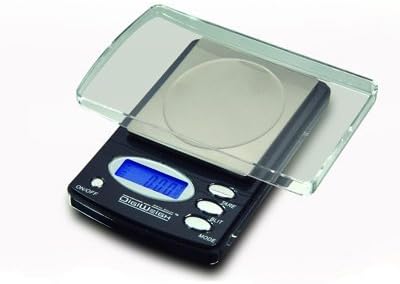
The Kitchen Craft Scale is a compact, purpose-focused option for makers who mostly prepare small quantities of fragrance, oils, waxes, dyes, or other ingredients. It carries a 3.8 rating and is identified as a genuine DigiWeigh 1000BX Deluxe scale with a stated maximum capacity of 1,000 grams and readability of 0.1 gram.
We may earn a commission when you buy through this link, at no additional cost to you.
Its protective crystal-clear cover offers more than splash protection because it can also function as a tray, effectively expanding the platform when a small vessel or delicate ingredient needs additional support. The scale comes pre-calibrated and includes batteries, instructions, and warranty information, reducing the setup required before a first formula can be weighed.
The principal limitation is capacity. A 1,000-gram ceiling is well suited to test batches and small candles, but it may not accommodate a large pitcher of melted wax, a full bucket of soap batter, or a completed container. The product listing also gives no indication of percentage, hold, or count functions, so users who require advanced formula assistance may prefer a more elaborate model.
For a new maker working with small quantities, this scale covers the essential requirements without introducing unfamiliar controls. Its simple design, fine readability, and included cover make it a sensible entry point, especially for anyone who recognizes that 1,000 grams is sufficient for their typical recipes.
The 1,000-gram limit creates a clear operating boundary for fragrance trials, small wax pours, and test portions. It works best when ingredients are added in manageable increments rather than mixed in a large vessel.
Using the clear cover as a tray increases the working area and helps protect the scale from residues during delicate work. That dual purpose gives the basic design more flexibility than its compact format initially suggests.
We may earn a commission when you buy through this link, at no additional cost to you.
The My Weigh KD-8000 is a higher-capacity kitchen scale designed with messy recipe work in mind. Its 4.6 rating, 8,000-gram capacity, baker's math, and percentage weighing make it a strong candidate for makers who alternate between small formula development and substantially larger production runs.
We may earn a commission when you buy through this link, at no additional cost to you.
The defining feature is the removable protective LCD display cover. This allows the screen to be shielded during ingredient preparation and wiped or washed more easily afterward. The product information also mentions three soft protective LCD display covers, giving the user additional ways to protect against recipes, candle-making spills, and general workshop residue.
Unlike a simple kitchen scale, the KD-8000 is explicitly designed to combine formula assistance with physical protection. That makes it useful in a studio where wax, fragrance, colorants, and cleansing agents may be measured near one another. The trade-off is a premium tier and a design that occupies more room than a pocket model, but the removable cover and higher capacity add meaningful utility.
This scale is well suited to an experienced hobbyist or small maker who views a scale as a long-term production tool. It may be more than necessary for someone weighing only tiny test batches, yet for repeated work across varied batch sizes, the combination of protection, capacity, and percentage features is difficult to overlook.
A removable display shield is especially valuable when powder, wax, oils, or colorants could land near the controls and screen. It preserves a cleaner setup without asking the user to measure fragile ingredients in a completely open work area.
The 8,000-gram capacity comfortably handles larger ingredient totals and finished vessels. Combined with 0.1-gram readability and formula functions, it allows one device to support both meticulous formula work and bulkier preparation.
We may earn a commission when you buy through this link, at no additional cost to you.
The My Weigh KD8000 brings together an 8,000-gram capacity, percentage weighing, a stainless steel platform, and a hinged gunk shield. Its 4.6 rating and maker-focused description make it a close alternative to the KD-8000, especially for users who value the physical shield and backlit screen.
We may earn a commission when you buy through this link, at no additional cost to you.
The hinged shield is designed to cover the display during messy applications, which is directly relevant to candle wax, scent blends, powdered additives, and soap ingredients. Percentage weighing helps a maker follow a ratio without independently calculating every ingredient, while the additional weighing modes provide flexibility in grams, kilograms, pounds, pounds and ounces, and ounces.
Its 8,000-gram capacity offers more room than most compact scales in the guide, but it also means the unit may occupy a larger portion of the work surface. The listing supplies fewer accessory details than the related KD-8000 entry, so buyers should confirm what is included before ordering. Even so, the stainless platform and bright backlit display are meaningful benefits for daily use.
Choose this model when formula percentages, spill protection, and a large platform matter more than compactness. It is a practical fit for soap makers working with additives and candle makers who need to measure larger quantities without moving ingredients to another device.
The hinged gunk shield adds an extra layer between the display and the ingredients. It is particularly helpful in a workshop where spills and fine materials are likely rather than exceptional.
Percentage mode lets the scale express an ingredient as a proportion of the recipe. This can reduce calculation errors when reducing a batch or creating several test quantities from one base formula.
We may earn a commission when you buy through this link, at no additional cost to you.
This Amazon listing has a valid product identifier, but the supplied data does not include a product title, rating, image, price, or any descriptive specifications. It is therefore impossible to evaluate its capacity, readability, platform, controls, or suitability for soap and candle making from the available information.
We may earn a commission when you buy through this link, at no additional cost to you.
A digital scale can affect the consistency and safety of a maker's process, so missing specifications should not be treated as a minor inconvenience. A buyer would need to know the maximum capacity, smallest increment, tare behavior, power source, dimensions, platform material, and whether the display remains readable in a busy workspace.
The absence of an image and rating also makes it difficult to compare the listing with the nine documented products. It could duplicate another model, represent a specialized scale, or offer features that are not described in the supplied record. Without factual information, recommending it over a fully specified alternative would not be responsible.
The practical advice is to open the listing and verify that it provides clear capacity, precision, dimensions, and protective information before buying. For a reader ready to make an informed selection now, one of the documented models with transparent specifications is the safer choice than relying on this incomplete listing.
Check the live listing for maximum weight, increment, platform size, tare controls, calibration details, and power requirements. These specifications determine whether the scale can handle the intended vessels and ingredients.
Soap and candle formulas often depend on exact measurements. A listing without a title, readable specifications, or product imagery should not be selected solely because it appears in a roundup.
We may earn a commission when you buy through this link, at no additional cost to you.
The Nicewell Food Scale has the highest stated rating in this guide at 4.7 and combines that strong reception with a 22-pound capacity. Its large platform and readable display make it an attractive option for makers who regularly weigh larger bowls, pitchers, molds, or quantities of wax.
We may earn a commission when you buy through this link, at no additional cost to you.
Four high-precision load sensors support readings in grams, kilograms, pounds and ounces, fluid ounces, and milliliters. The minimum stated weight is 3 grams, while the scale can measure from 0.1 ounce to 22 pounds. Tare and zero functions allow the weight of a plate or container to be removed, which is essential when measuring ingredients directly in a mixing vessel.
Its main limitation is the one-gram graduation. That is adequate for many kitchen tasks and broader production quantities, but it offers less resolution than the 0.1-gram scales elsewhere in the list. A maker adding a very small quantity of fragrance, colorant, or additive may prefer finer increments and a different platform design.
The scale is best suited to makers who prioritize capacity, a large display, and straightforward container support over laboratory-level resolution. Its tempered glass and stainless steel top also offer practical cleaning surfaces, making it a solid general-purpose option for larger candle and soap batches.
A 9-by-6.3-inch weighing area gives broad support for a pitcher, mixing bowl, or mold. The larger footprint can also improve stability when several small components are being measured together.
A 22-pound maximum is useful when a maker is working with a full pitcher of melted wax or a substantial amount of soap batter. It offers room to grow without moving materials to a separate utility scale.
We may earn a commission when you buy through this link, at no additional cost to you.
The Pocket-Size Gram Scale combines a compact body with a stated 3,000-gram capacity and 0.1-gram accuracy. Its 4.3 rating and explicit suitability for soap making make it a sensible choice for mobile work, small test batches, and makers who need a scale that can be stored compactly.
We may earn a commission when you buy through this link, at no additional cost to you.
The M button toggles among nine units, including grams, ounces, pounds, milliliters, and jewelry-related measures. Tare subtracts the weight of a bowl or container, while the counting function can estimate the number of small components. Overload, low-battery, and unstable-weight indications help alert the user when a measurement is not ready.
Platform size is the principal constraint. Because the scale is designed to be pocket-sized, it may not accommodate a full mixing bowl or even a medium pitcher. The two included protective trays improve handling and portability, but the compact format is better for measuring ingredients into a separate vessel than for weighing a whole batch directly.
This model suits experimental makers, traveling instructors, and anyone who values portability and fine resolution. If your work routinely involves large containers, choose a larger-platform scale; if your priority is carrying a reliable gram scale between workstations or measuring small additives, this one is more closely aligned with the task.
The compact stainless steel platform and ABS frame make the scale easier to carry between a kitchen, craft area, or teaching workspace. Protective trays add further convenience for storage and transport.
A 0.1-gram accuracy figure is useful when a formula calls for a small fragrance or colorant addition. The 3,000-gram maximum still provides enough range for many compact test batches.
We may earn a commission when you buy through this link, at no additional cost to you.
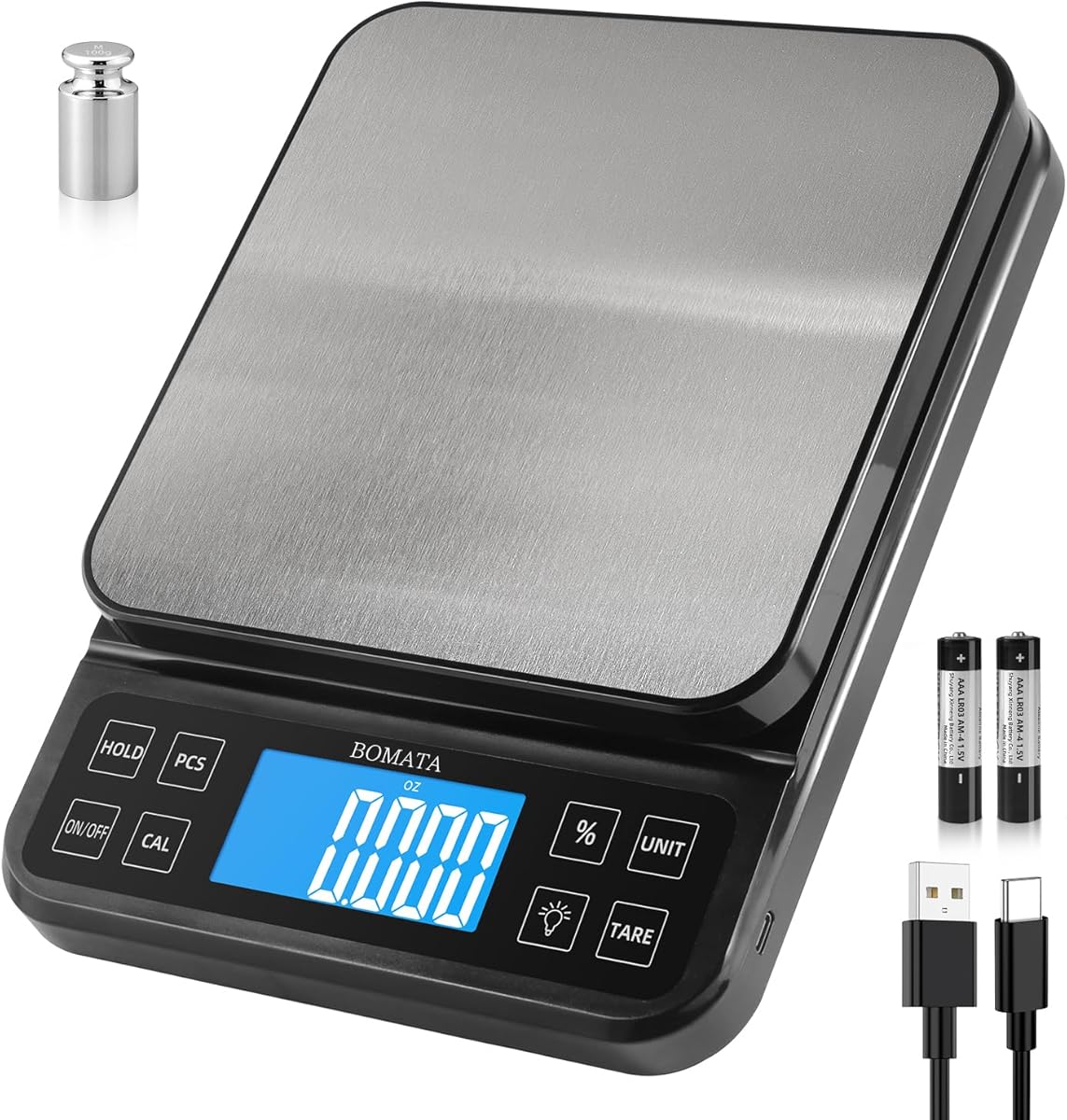
The BOMATA Large Kitchen Scale combines 0.1-gram accuracy with a stated measurement range extending to 5 kilograms. Its 4.4 rating, 7.2-by-7.2-inch platform, and broad set of controls position it as a versatile option for detailed formulas and larger maker projects.
We may earn a commission when you buy through this link, at no additional cost to you.
Percentage mode supports proportional recipe development, while hold can preserve a reading when the item extends beyond the weighing pan. Tare, counting, unit selection, calibration, and a cancellable auto-off function round out the controls. The included 100-gram weight makes it possible to check or perform calibration, and the transparent accessory container helps organize the supplied parts.
Power can come from a built-in rechargeable lithium battery charged through USB-C or from two external AAA batteries. The scale also includes trial batteries, which should be removed while charging. This flexibility is useful for a fixed studio or a portable setup, though it requires a little more care than a model with one power method.
The BOMATA is a good all-around choice for a maker who wants fine precision, a generous platform, and useful formula functions without paying exclusively for display protection. It may be less attractive to someone seeking a simple scale with few controls, but its accessory package and calibration support make it particularly complete for serious home production.
The square stainless steel platform is large enough for useful mixing vessels while remaining manageable in a home workspace. A full-view LCD is also designed to remain legible from several viewing angles.
The included 100-gram calibration weight gives users a way to check the scale when accuracy matters. Maintaining calibration is especially valuable in a workshop where oils, powders, and pigments are measured frequently.
We may earn a commission when you buy through this link, at no additional cost to you.
The YONCON KF-H8U is framed as a commercial-style kitchen scale with a 10-kilogram range and 0.5-gram increment. Its 4.2 rating, backlit display, ratio function, and removable platform make it especially interesting for makers who prioritize cleanup and the ability to handle larger quantities.
We may earn a commission when you buy through this link, at no additional cost to you.
The stainless steel cover can be removed and is described as dishwasher safe, allowing the working surface to be cleaned independently of the scale body. Smooth surfaces and clean lines also reduce places where residue can collect. Tare resets the scale after a dish is placed on it, and the percentage ratio function helps maintain ingredient proportions.
The stated increment is coarser than the 0.1-gram models in the guide. That remains practical for measuring larger ingredient quantities, but it may be a drawback for a formula requiring a very small addition of fragrance, pigment, or additive. Counting is more useful for packaged components than for batch formulas, although it adds flexibility for a shared kitchen.
Choose the KF-H8U if washable parts and a larger capacity matter more than the finest possible resolution. It is well suited to candle makers melting larger amounts of wax and to soap makers who want a removable platform for more thorough cleanup.
A detachable stainless steel platform can be washed independently, which helps makers dealing with sticky waxes, oily fragrance blends, or soap residue. This is a practical benefit when the scale is used for both food and nonfood materials.
The percent ratio function allows ingredients to be managed according to their relationship to the recipe. That is valuable when adapting a formula and keeping each component proportional.
We may earn a commission when you buy through this link, at no additional cost to you.
The Rechargeable Food Scale offers the highest stated capacity in the guide at 33 pounds, with a one-gram graduation and a 7.5-by-5.5-inch stainless steel panel. Its 4.4 rating makes it a practical option for makers who work with sizable batches and prefer a rechargeable design over disposable batteries.
We may earn a commission when you buy through this link, at no additional cost to you.
Four load sensors support measurements in grams, kilograms, pounds and ounces, ounces, and milliliters. A touchscreen and LCD display provide straightforward operation, while the tare button subtracts the weight of a mug, plate, or bowl. The waterproof anti-collision glass panel is intended to make routine wiping and cleaning easier.
Its one-gram resolution is the clearest compromise. It works well for bulk quantities, but it does not offer the 0.1-gram readability found in several smaller or more specialized options. The two-minute auto-off can also interrupt a slow workflow, though the low-power and overload alerts help protect the unit during ordinary use.
This scale fits users who regularly move large bowls or work with substantial quantities of wax, oils, or soap materials. It is less compelling for micro-weighing, but its rechargeable operation, roomy platform, and high maximum load form a useful package for everyday production.
A 33-pound capacity gives the scale substantial headroom for a large pitcher, bucket, or container. That range reduces the need to divide heavier jobs into several smaller weighing sessions.
Rechargeable power is convenient for a scale used frequently throughout the day. It avoids routine battery replacement, while the clear LCD and simple touch controls reduce the learning curve.
We may earn a commission when you buy through this link, at no additional cost to you.
The most useful scale is the one that matches your smallest measured ingredient, largest working vessel, and preferred workflow. Capacity, readability, platform design, protective features, and cleaning requirements should be considered together rather than in isolation.
Readability indicates the smallest increment the scale can display, while minimum weight is the lightest load it can measure. Soap and candle formulas may involve small quantities of fragrance oils, fragrance, colorants, essential oils, or additives, so a scale with 0.1-gram readability offers more room for precise additions than one that changes in one-gram steps. Fine readability is especially useful during testing, when a fraction of a gram can affect the character of a scent blend or the visual result of a pigment.
Choose a fine increment if you work with trace additives, small test batches, or detailed formula development. A coarser scale can still handle larger batches, but check whether its minimum weight is below the amount you need to measure.
Maximum capacity determines the largest vessel or material total the scale can handle. The products in this guide range from 1,000 grams to 33 pounds, which is a major difference for anyone working with a pitcher of melted wax, a large bucket of soap batter, or multiple molds. Consider both the weight of the empty container and the weight of the material inside it.
Match capacity to realistic batch sizes and leave some headroom. A scale that is always pushed to its limit offers less flexibility, while one far beyond your needs may take up unnecessary space.
Platform size determines which containers can sit directly on the scale. A broad surface is useful for bowls, beakers, pitchers, and molds, but it may occupy a large portion of a craft table. Compact platforms are easier to store and carry, yet they usually require ingredients to be transferred into a small dish before weighing.
Look for a platform that supports the vessel you actually use. Stability is also important: a wide base and flat surface are more reassuring when adding liquid or working with a container that is not perfectly centered.
Tare subtracts the weight of a bowl, pitcher, or mold so the display reflects only the ingredient being added. Percentage mode shows an ingredient as part of a formula, which can make scaling and testing easier. Hold keeps a reading visible when an object is moved or extends beyond the pan, while counting can help with repeated small components rather than formula ingredients.
Tare is the most broadly useful function, so confirm that it works with the intended workflow. Percentage and hold are valuable for repeatability and presentation but should be considered added conveniences rather than substitutes for selecting the correct capacity and readability.
A large, illuminated display can make a meaningful difference when the scale sits in a dim craft room or when a large container approaches the screen. Angled or full-view displays are helpful because a level view may be blocked by a bowl or mold. Touch controls are easy to clean, while tactile buttons can be preferable in a workshop where residue or damp fingers may affect operation.
Compare the layout as well as the number of buttons. A maker should be able to see the weight, identify the active unit, tare the container, and reset the scale without navigating a complicated menu.
A scale used for wax, oils, fragrance, powders, lye solution, and soap batter will need regular cleaning. A smooth stainless steel surface is easy to wipe down, while a removable platform or cover can be washed separately. A hinged shield or removable LCD cover protects the display from spills and fine particles, making the unit less vulnerable to workshop residue.
Choose a design that can be cleaned using methods appropriate for its stated materials. Removable parts are convenient, but they also create more pieces to store, and a scale with sealed touch controls may be easier to wipe than one with recessed physical buttons.
Power options affect how a scale fits into a workspace. Rechargeable models are convenient for frequent use and reduce the need to keep spare batteries available. Models that accept both rechargeable and removable batteries offer greater flexibility, particularly for makers who travel or work in locations without a convenient outlet. AAA models are often simple and dependable but require occasional replacements.
Consider how often the scale will be moved, how long it will remain on during a session, and whether a permanently charging position is practical. Auto-off functions save power but can interrupt a slow workflow, so the shutdown delay is worth checking.
Multiple units are useful when a formula mixes metric and imperial measurements, although grams are usually the core unit for small soap and candle ingredients. Calibration support is also valuable because a scale that has been moved, dropped, or exposed to temperature changes may need verification before it is used for a careful formula. An included calibration weight makes this task more convenient.
Look for a product listing that clearly states the available modes and what the package includes. Clear documentation, warranty information, and manufacturer support can make ownership easier, particularly for a tool that will be used frequently.
Begin by placing the scale on a flat, stable surface away from vibration, drafts, and direct heat. Turn it on, confirm that the display reads zero, and check the selected unit. If you are using a large bowl or pitcher, tare the empty container before adding any ingredient, and avoid overhanging the container so its weight can create a balance error.
Add ingredients slowly while watching the display, especially when working with wax, fragrance oils, pigments, or other small additions. Use percentage mode when scaling a formula, but treat it as an aid rather than a replacement for checking the original quantities. If the display shows an overload, unstable-weight, or low-battery indication, resolve the condition before continuing.
After the project is complete, remove the vessel and wipe the platform and display with a soft, damp cloth appropriate for the materials. Do not immerse the entire scale unless the manufacturer explicitly permits it. Allow the platform to dry fully, store the scale away from direct sunlight, and replace the batteries or recharge it according to the product instructions. Periodic calibration, when supported, helps maintain confidence in later measurements.
A scale with 0.1-gram readability is generally the most useful for small fragrance, oil, pigment, and additive measurements. A one-gram scale can work for larger batches, but it offers less control when a formula includes very small quantities. The best choice is the finest increment that still supports the batch sizes and containers you regularly use.
A percentage function is not essential, but it makes a formula easier to scale and helps keep ingredients proportional. It is particularly useful when creating test batches or reducing a larger recipe. For basic one-bowl work with fixed quantities, a scale with accurate weighing, tare, and a clear display may be sufficient.
Many kitchen scales can handle both types of work because soap and candle ingredients are usually measured by weight. The scale should have a platform and capacity appropriate for the vessel, fine enough readability for additives, and surfaces that can be cleaned safely after contact with oils, powders, or other materials.
A removable platform makes deeper cleaning easier because the working surface can be washed separately. It is especially useful around sticky wax, oily fragrance, and soap residue. A fixed platform can still work well, provided the edges and seams are easy to reach and the manufacturer has not prohibited the cleaning method you plan to use.
Capacity should cover both the empty container and the total weight of melted wax. A larger pitcher may require several kilograms even when the finished candles are small, so check the weight of your usual pouring vessel before choosing a model. More capacity adds flexibility but may require more storage and workspace.
A calibration weight is not essential for every user, but it makes periodic accuracy checks more convenient. A scale that has been moved, subjected to a drop, or exposed to significant temperature variation may benefit from calibration. Models that include a suitable weight provide an extra level of ownership convenience and confidence.
Yes, provided the container fits securely on the platform and does not exceed the scale's maximum capacity. Tare the empty container first so its weight is excluded from the ingredient reading. For very light vessels, check the scale's minimum weight and make sure the display has stabilized before adding a small ingredient.
Use a soft, damp cloth and a cleaner approved for the scale's surfaces, testing it discreetly if the material is sensitive. Avoid immersing the scale unless the instructions explicitly allow it, and keep liquid away from the display and buttons. Remove residue promptly, allow the platform to dry, and follow the manufacturer's battery and calibration guidance.
The Bonvoisin Baking Scale stands out for its balanced combination of 0.1-gram readability, useful capacity, percentage weighing, a readable tilted display, and rechargeable operation. The My Weigh KD-8000 is a strong premium alternative for makers who value a removable display cover, while the Kitchen Craft Scale offers a simple, inexpensive route into small-batch weighing.
Prioritize readability for small additives, capacity for your largest vessel, and a platform that supports the containers you actually use. Percentage, hold, and counting functions add convenience, but they cannot compensate for insufficient capacity or a platform that is too small. Cleanability and display protection deserve equal attention in a workshop where spills and residue are likely.
Before purchasing, confirm the current specifications, included accessories, power requirements, warranty information, and current price on the product page. Listings and availability can change, and a detailed scale description should always take priority over assumptions based on a product image or a general category label.