
32 Inch MWE Digital Signage Display
4.6Editor score
Portable foldable mobile design
Real-time remote CMS updates
Automatic media loop playback
Full HD IPS viewing angles
Digital menu boards replace paper menus and static signs with bright, programmable displays that help restaurants, cafés, retailers, hotels, and event teams present changing information. A useful board balances visibility, reliable playback, manageable updates, and a form factor suited to its location rather than maximizing specifications alone.
This guide compares ten digital menu board options by screen size, resolution, brightness, operating system, content-management tools, connectivity, portability, and intended business use. It covers countertop displays, wall-mounted commercial screens, portable signage, illuminated writing boards, and add-on media players without claiming personal hands-on testing.
Each pick reveals what its design is best suited to accomplish, from counter service and menu changes to advertising, temporary events, and centralized multi-location control. Ratings and listed specifications reflect the supplied product information, while availability and commercial terms can change. Check current listing details before purchasing.
4.6Editor score

5.0Editor score

3.0Editor score
As an Amazon Associate we earn from qualifying purchases.
The comparison covers dedicated commercial displays, portable screens, illuminated writing boards, and a cloud-controlled media player. The key differences are display capability, update method, placement flexibility, continuous-operation design, and whether the product includes a screen or serves as an add-on controller.


This 18.5-inch digital signage display is a practical countertop option for cafés, restaurants, reception areas, retail stores, and other commercial spaces. Its supplied rating is 3.8, while the 700-nit screen, Android 12 interface, and lifetime free cloud CMS distinguish it from simple local media players. It is designed for continuous daily business use.
We may earn a commission when you buy through this link, at no additional cost to you.
The strongest feature is remote content management through a PC, tablet, or smartphone. Users can upload content, create playlists, schedule playback, divide the screen, and manage multiple displays without visiting the unit. USB plug-and-play is also available for quick local changes, and HDMI, LAN, TF card, USB 2.0, USB 3.0, and DC connections provide a broad range of installation options.
Its main limitation is the 720p HD resolution, which is less detailed than the Full HD and higher-resolution alternatives in this list. The 18.5-inch size may also feel modest for a room full of customers. Even so, the bright display, sturdy desktop stand, flexible orientation, three-year warranty, and included CMS make the trade-offs reasonable for a compact service counter.
This is a sensible recommendation for a small restaurant, bakery, salon, hotel reception desk, or retail counter that wants remotely maintained menus in a relatively compact footprint. It is particularly attractive to operators who value lifetime CMS access and do not need a large 4K canvas. Confirm that the resolution is sufficient for your design before ordering.
The cloud CMS centralizes uploads, playlists, scheduling, split screens, and promotion changes. That is useful for businesses that regularly alter menus, announce offers, or coordinate messaging across several counters.
The included stand supports landscape and portrait positioning, making it easier to fit menus, welcome screens, and service information into limited countertop areas.
We may earn a commission when you buy through this link, at no additional cost to you.
This entry is associated with Amazon ASIN B0H6Y1ZP3P, but the supplied product record contains no title, rating, image, or descriptive information. It therefore cannot be evaluated as a distinct digital menu board based on the available facts. The listing should be considered unverified rather than assumed to offer any particular size, brightness, operating system, or content-management capability.
We may earn a commission when you buy through this link, at no additional cost to you.
Because no factual specifications are available, comparisons involving this product would be speculative. A shopper should examine the live listing for the screen size, native resolution, brightness, connectivity, included accessories, installation method, CMS access, and warranty. It would also be important to check whether the item is a complete display, a replacement component, or a media player.
The absence of usable information is the decisive trade-off. There is no factual basis for assigning a meaningful rating or recommending this item over the specified displays. Even a strong appearance on a search page would not resolve questions about brightness, continuous-operation support, content scheduling, and physical installation.
This recommendation is limited to verifying the listing before purchase. If the live page provides complete specifications, comparable warranty terms, and clear compatibility information, it may merit reconsideration. Until then, buyers with specific requirements should favor a product whose screen, connectivity, and management functions can be evaluated directly.
Confirm whether the package contains a screen, stand, remote, power adapter, player, or only a limited accessory. Each configuration serves a different part of a digital signage setup.
Do not infer cloud management, continuous playback, brightness, or resolution from the product category alone. Review the published specifications and included components directly.
We may earn a commission when you buy through this link, at no additional cost to you.
The 27-inch desktop digital menu board is the strongest all-around pick in this comparison. It carries a supplied rating of 5.0 and combines a Full HD 1920 x 1080 display with Android-based centralized content management. The desktop format is explicitly designed for milk tea shops, restaurants, and retail counters, where it can display menus and promotions without requiring a wall installation.
We may earn a commission when you buy through this link, at no additional cost to you.
Content can be updated through USB, an app, or remote PC management, while Wi-Fi and LAN connectivity add useful options for a connected setup. Split-screen layouts, scheduled on/off behavior, and support for multiple formats help organize separate menu sections, campaign graphics, and videos. Two USB ports and one LAN port support daily operation and centralized content workflows.
The 27-inch size is more detailed than the compact 18.5-inch model, although it is still better suited to counter-level viewing than a large dining room. Commercial materials, heat dissipation, and support for 24/7 continuous operation address the durability needs of an active business. Buyers should still consider mounting, ventilation, and the supplied protective carton during installation.
This board is a strong recommendation for cafés, beverage shops, quick-service restaurants, and retail counters seeking a balance of resolution, content flexibility, and compact construction. It is particularly appropriate when staff need frequent menu or promotion updates but prefer a desktop unit over a large tiled installation. It earns the Editor's Choice position for its balanced specification set.
USB, app, and PC-based remote updates let the business choose the most convenient method for a given task, from quick local changes to centralized publishing.
The 1920 x 1080 panel provides more visual detail than the compact 720p option, supporting clearer menu typography and more convincing product imagery at typical counter viewing distances.
We may earn a commission when you buy through this link, at no additional cost to you.
This 50-inch 4K UHD display is the pick for buyers who need a large, bright commercial sign rather than a countertop menu panel. Its supplied rating is 3.4, but the specification set is among the most advanced here: 1000 nits, 4K support, a 6.8 mm bezel, a 3.5 cm profile, and a 178-degree viewing angle.
We may earn a commission when you buy through this link, at no additional cost to you.
The narrow bezel and slim housing are designed for visually continuous wall-mounted installations, including tiled arrangements. The display can be divided into two to six zones for videos, social feeds, countdowns, and QR codes, while supporting continuous loop playback and image rotation. An all-metal chassis and intelligent heat dissipation are intended to support stable operation.
Its practical limitations are size and complexity. A 50-inch unit demands a suitable mounting plan, adequate power, and more attention to installation than a desktop display. The 3.4 rating also warrants reviewing customer feedback and current listing details. The specification-heavy design nevertheless provides a clear advantage for large retail, hospitality, and public-information settings.
Buyers should choose this display when visibility, resolution, and multi-zone layouts are more important than a compact footprint. It suits restaurants with larger ordering areas, retail promotions, hotel or building directories, and other wall-mounted signage. Businesses wanting a simple countertop display will likely find one of the smaller Android options easier to deploy.
The large 4K canvas, high brightness, and ultra-narrow bezel improve readability and visual continuity in busy environments where customers view a sign from a distance or at an angle.
Two-to-six-zone layouts allow a merchant to combine video, QR codes, countdowns, and social information within a single large commercial display.
We may earn a commission when you buy through this link, at no additional cost to you.
The VEVOR LED writing board is a manual alternative to a conventional digital display. Its supplied rating is 4.2, and the 32 x 24-inch illuminated panel is intended for menus, promotional messages, and hand-drawn signs. Rather than playing media files, it uses fluorescent markers to create bright, colorful writing with a neon-like effect.
We may earn a commission when you buy through this link, at no additional cost to you.
Users can select from 16 LED colors, four flash modes, and five brightness levels with the included infrared remote. Eight fluorescent markers are supplied, and the writing surface wipes clean without chalk dust. A tempered-glass construction provides impact, bending, and heat resistance, while the writing format allows frequent updates without a CMS or digital media player.
The limitation is fundamental: this is not a screen for automatically playing videos, rotating advertisements, or scheduling remote content. Power options include an AC 110-220V plug or USB and use with a power bank or battery box, which expands indoor and outdoor flexibility, but the product still depends on staff writing and erasing the message.
This is a good fit for cafés, food stalls, small shops, event counters, or temporary signs where a feature change calls for a quick handwritten update and owners do not want to manage a digital platform. It also works well as a supplemental board alongside a true digital menu display. For automated promotions and rich media, choose an Android signage screen or media player instead.
Writing directly on the illuminated surface allows staff to introduce daily specials or alter a message in moments, without uploading files or managing playlists.
A broad selection of colors, flash modes, and brightness levels helps a small board attract attention while preserving the familiar, editable look of a chalk menu.
We may earn a commission when you buy through this link, at no additional cost to you.
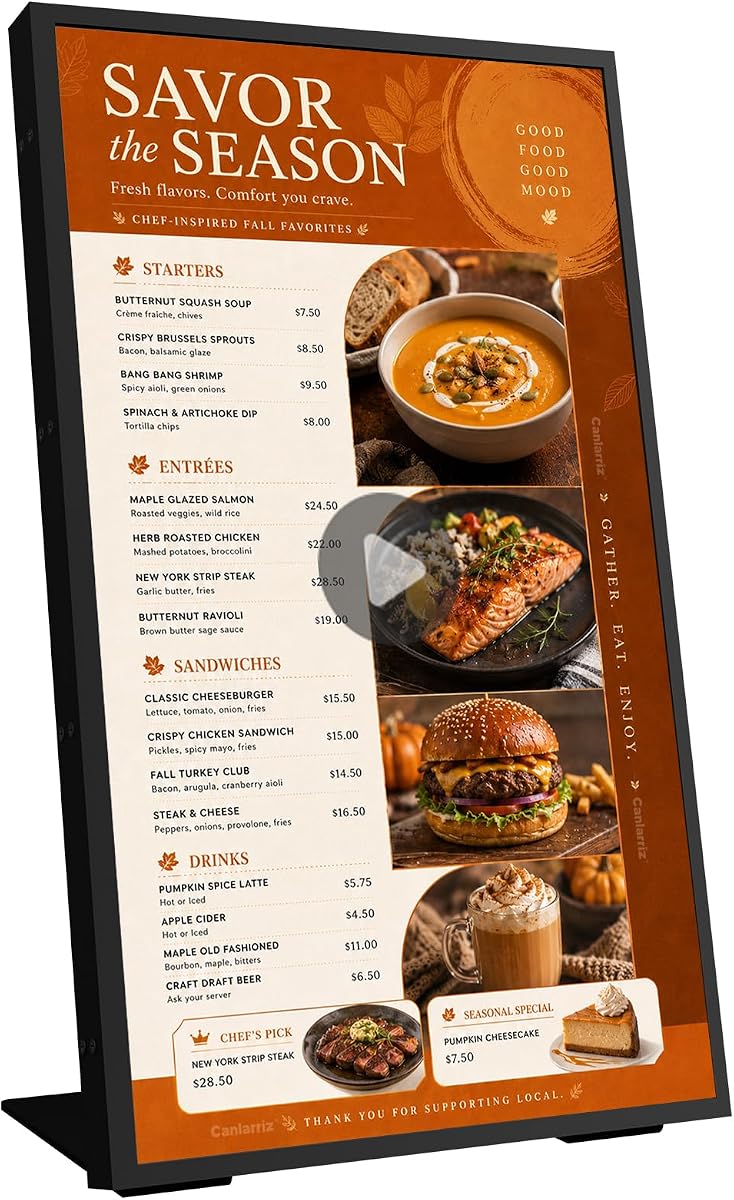
The 32-inch MWE digital signage display is the most versatile portable option in the guide. It has a supplied rating of 4.6 and combines a Full HD IPS screen, Android kiosk functionality, automatic media playback, and a foldable body with built-in wheels. Those traits make it relevant to restaurants, hotels, shopping malls, exhibitions, and temporary promotional setups.
We may earn a commission when you buy through this link, at no additional cost to you.
Content can be loaded through USB for plug-and-play use or managed through the MWE-QIXZOCV CMS for real-time remote publishing. HDMI input and Wi-Fi add further content and connectivity options. Once started, the unit can loop its display automatically, and timed power-on and power-off settings help align operation with business hours or event schedules.
The supplied description specifically calls this an indoor signage display, so it should not be treated as a weatherproof outdoor unit. The foldable wheeled design also prioritizes movement and temporary deployment over the slim, gap-free wall-tiled appearance of dedicated commercial panels. Buyers should confirm transport dimensions and the availability of a suitable power source before an event.
This is a strong recommendation for a business that wants a full-size digital sign but cannot commit to a permanent wall installation. Restaurants can use it for promotions, retailers can deploy it around the floor, and event teams can move it between locations. It combines portability with capable remote management, earning a place among the guide's leading selections.
The foldable body and built-in wheels simplify temporary placement at events, exhibitions, retail floors, and other changing environments.
Automatic media looping reduces the need for staff to restart or manually manage the screen, while scheduled power controls can limit unnecessary operating time.
We may earn a commission when you buy through this link, at no additional cost to you.
The 29-inch Android commercial display combines a 700-nit screen with extensive storage and flexible content features. Its supplied rating is 2.6, the lowest among the products with meaningful product data, so prospective buyers should examine customer feedback carefully. Nevertheless, its specification list targets flexible commercial use across restaurants, retail, hospitality, healthcare, transit, and public buildings.
We may earn a commission when you buy through this link, at no additional cost to you.
The 2GB RAM and 32GB storage are intended to support smooth local content, with the listed capacity equivalent to more than 25,000 high-definition images or 60 hours of 4K video. The screen can be divided into two to six zones and support continuous loops, image rotation, HDMI plug-and-play, and Google Play Store access. Complementary CMS software adds bulk editing, remote scheduling, and menu-period switching.
The low supplied rating is the main reason not to recommend it as the top overall option. Also, the product is described as supporting 2K display, a term that should be checked against the listing's native resolution and supported media formats. The all-metal chassis, narrow bezel, heat dissipation, and stated 50,000-hour lifespan sound useful for commercial duty, but they do not replace review of actual reliability.
This display is most appropriate for a technically confident buyer who values Android app access, local storage, and detailed multi-zone control. It may suit a business standardizing menus across several locations, provided the current customer reviews and installation requirements are satisfactory. Buyers prioritizing a better-supported choice can consider the 27-inch desktop model or portable 32-inch MWE display.
The listed 32GB capacity can hold a substantial library of images and video, useful for organizations that want a dependable local copy of scheduled content.
Google Play Store access and HDMI plug-and-play provide more setup flexibility, although business operators should consider device management, app compatibility, and security.
We may earn a commission when you buy through this link, at no additional cost to you.
The LightningAds signage player is a budget-friendly way to add cloud-managed content to an existing television or monitor. Its supplied rating is 3.0, and it is not a complete digital menu board because no display is included. Instead, the compact media player connects through HDMI and power, joins Wi-Fi, and becomes the content source for another screen.
We may earn a commission when you buy through this link, at no additional cost to you.
Free features include content uploads, scheduling, and remote screen management. A built-in Canvas menu designer lets users create layouts without separate design software, while PowerPoint uploads make it easier to adapt existing business presentations. Premium template-building and AI image-enhancement tools are available through upgrade plans, so buyers should distinguish the free core tools from optional services.
The major trade-off is that the product cannot provide a display, brightness rating, viewing angle, or built-in commercial enclosure. The output capability also depends on the connected screen and its HDMI compatibility. Some users may need paid upgrades for the full template and AI toolkit, which should be considered when assessing ongoing ownership costs.
This player is a good recommendation for a restaurant, shop, office, or salon that already owns a compatible television and wants inexpensive remote content management. It is less suitable for a first-time buyer seeking an all-in-one, freestanding commercial display. The plug-and-play approach and included free scheduling tools make it a practical expansion for an existing setup.
Connecting the player to a television or monitor avoids the need to purchase a complete new digital board, provided the screen has a suitable HDMI input and can remain powered continuously.
The integrated canvas workflow keeps basic menu design and publishing within the same service, while PowerPoint support helps businesses begin with familiar files.
We may earn a commission when you buy through this link, at no additional cost to you.
The 27-inch tempered glass menu board is especially attractive to restaurant chains and businesses operating multiple locations. It has a supplied rating of 5.0 and combines a brightness-adjustable 1920 x 1080 LCD with centralized management, allowing several menu boards to be controlled from one computer.
We may earn a commission when you buy through this link, at no additional cost to you.
Remote updates are available through an iOS or Android application, computer software, or a directly connected USB drive. USB content can be delivered in MP4, AVI, FLV, WMV, JPEG, and BMP formats, and the display is described as compatible with most digital signage creation software. Tempered glass protection and a standard desktop stand make the unit look like a conventional countertop menu board.
Unlike some dedicated signage products, the supplied information does not explicitly state a 24/7 operating rating. That distinction matters for a business considering all-day playback in a hot counter environment. The product also depends on desktop placement and may be less useful for large-room visibility. Buyers should evaluate these constraints before assuming it can replace a wall-mounted commercial panel.
This is a strong recommendation for milk tea shops, beverage stores, and restaurant chains that want synchronized menu updates across multiple counters. The combination of centralized control, several update paths, broad format support, and Full HD resolution addresses common multi-location content problems. It is one of the clearest choices for consistent brand-wide messaging.
Centralized computer control reduces the need to update each board separately, helping chains maintain consistent menus, pricing, and promotional graphics across sites.
Mobile apps, desktop software, and direct USB updates provide several practical routes for introducing new files, whether a manager is on site or working remotely.
We may earn a commission when you buy through this link, at no additional cost to you.
The WeADS 8-inch touch sign is designed for compact tabletop presentations rather than wall-mounted, high-distance advertising. Its supplied rating is 3.5, and it combines a 1280 x 800 TFT LCD, sensitive touch, Wi-Fi, cloud content management, and a large removable battery. The result is suited to restaurant tables, retail counters, exhibitions, and temporary fair displays.
We may earn a commission when you buy through this link, at no additional cost to you.
Content including videos, images, and playlists can be pushed through Amazon or Ali cloud services, giving the device a more convenient remote workflow than a basic USB-only unit. Radar motion detection can activate the display as people approach, potentially reducing unnecessary screen use. The 23,200mAh battery also allows cordless operation for events or retail locations where a fixed power cable is inconvenient.
The compact 8-inch size is the main constraint. It can work well for a small selection, a reservation prompt, a QR code, or a focused table display, but it offers less room for a full menu than the 27-inch and 32-inch options. The resolution is also lower, and the need for cloud-platform availability could be important for some regions or operators.
This sign is a good fit for a restaurant seeking an interactive table display, a retail promotion that needs occasional mobility, or a trade-show setup that benefits from a self-contained battery. It is not the strongest choice for a detailed house menu. For those applications, select a larger countertop display or a screen with stronger continuous-playback specifications.
The high-capacity removable battery and dual-output cell support cordless use, making the sign easier to carry between tables, booths, displays, and event areas.
Sensitive touch and radar presence detection can make a small display feel more like an interactive ordering or information point rather than a static printed card.
We may earn a commission when you buy through this link, at no additional cost to you.
The right digital menu board depends on where customers will view it, how often content changes, who will manage updates, and whether the installation needs to be permanent or portable. Screen capability, CMS access, connectivity, and durability should be evaluated together rather than as isolated specifications.
Choose a screen based on the distance from the display to its audience. Desktop sizes such as 18.5 and 27 inches suit ordering counters and compact service areas, while a 50-inch panel is better for prominent wall-mounted messaging and customers viewed from farther away. The compact 8-inch model is better reserved for table cards, a focused ordering prompt, or a QR-code experience than for a large menu with many items.
Prioritize a size that customers can read without crowding and that fits the available counter or wall area. Larger screens also demand more planning for power, mounting, and transportation.
Brightness determines how readily content remains visible in cafés, stores, reception areas, and other commercial environments. The options range from 700 nits in two Android commercial displays to 1000 nits in the 50-inch 4K model, while lower-resolution models omit brightness figures. A wide viewing angle also helps when customers approach from different sides of a counter.
Match brightness and viewing angle to the environment rather than assuming the highest number is always necessary. The screen should remain legible under the lighting conditions where it will actually operate.
Resolution affects the clarity of small menu text, product photos, and fine promotional graphics. The guide includes 720p HD, Full HD 1920 x 1080, 2K support, and 4K UHD options, as well as an unspecified listing. Higher resolution can improve a large display's detail, but it is only useful when the source artwork and media are prepared appropriately.
For dense menu layouts, 1080p or above is generally the more practical starting point. Smaller displays viewed close-up may look acceptable at lower resolutions, while large wall signs benefit from higher-resolution content.
A useful CMS lets a business upload files, build menus, create playlists, schedule playback, and update multiple displays without handling each unit locally. Several products include cloud CMS access, while others rely primarily on USB, app, or PC updates. The LightningAds player is a separate option that adds cloud scheduling to an existing compatible display.
Prioritize the management method your staff can realistically use. A feature-rich platform has limited value if updates are too complicated or inconsistent, whereas a straightforward USB workflow may be preferable for a single location.
Wi-Fi and LAN connections support networked publishing, while HDMI, USB, and TF card inputs provide useful local and direct content routes. Media-player operation can be simpler and more predictable when files are prepared on a computer and played automatically. Networked control is more valuable for chains or sites where menu changes occur frequently.
Check the supported connection methods against your network and publishing setup. Also verify supported file formats, local storage capacity, and whether the display can loop content unattended after a restart.
Commercial signage may run throughout long service days, so thermal management, chassis construction, and intended operating duration matter. The 27-inch desktop board, 29-inch Android display, and 50-inch commercial panel are specifically described for continuous operation. Other products provide useful features for their use cases but do not make the same continuous-duty claim in the supplied information.
For a counter that never closes, seek an explicit operating specification and suitable ventilation. For occasional or portable use, the operating schedule may make durability requirements less demanding.
A permanently positioned counter board, wall-mounted panel, portable wheeled display, and battery-powered table sign solve different deployment problems. Consider counter depth, wall structure, power access, event movement, and whether the unit must be stored when not in use. The MWE board folds and has wheels, while the WeADS sign includes a removable battery and can operate cordlessly.
Choose the least complicated form that supports the intended location. Portability is valuable for temporary events, but permanent businesses may gain more from an elegant fixed installation and unrestricted power.
Commercial electronics should be supported by clear warranty terms, replacement procedures, and technical assistance. Listed coverage varies: several Android commercial displays include a three-year warranty, the tempered glass 27-inch board lists a two-year display-component warranty, and the 8-inch touch sign lists a one-year quality warranty. These periods describe different scopes and should not be compared without reading the terms.
Review the warranty alongside support availability, shipping protection, and the merchant's return process. Keep packaging and documentation, and confirm the installation remains within the manufacturer's operating guidance.
Begin by measuring the intended location, confirming power access, and deciding whether the display will sit on a counter, mount to a wall, or move between events. Connect the screen or media player, sign in to the applicable CMS, and create a playlist with correctly sized media files. Test the layout at the normal customer viewing distance before making the content public.
Build a publishing routine that assigns responsibility for menu changes, promotions, and schedule maintenance. Use separate playlists for breakfast, lunch, dinner, or campaign periods when supported, and keep a local copy of essential media where storage permits. For a multi-location business, use centralized management and confirm that every board shows the intended version.
Clean the screen with a soft, dry microfiber cloth and avoid spraying liquid directly onto the display. Keep vents unobstructed, route cables safely, and avoid placing the unit where heat, moisture, or impact could interfere with operation. Test the automatic loop, scheduled power controls, network connection, and backup procedure before relying on the board for daily service.
A digital menu board is a complete display system that includes a screen designed to show menus or information. A digital signage player is a smaller device that sends content to a separate television or monitor through HDMI. Buyers who already own a compatible display can use a player to add cloud scheduling, while new buyers generally need an all-in-one screen.
Brightness should be judged against the lighting in the restaurant, especially near windows, reception lights, or other bright fixtures. The products in this guide include models rated at 700 and 1000 nits, which offer clearly specified brightness for commercial use. Consider viewing angle and contrast alongside the brightness number.
A 27-inch display is well suited to ordering counters, front desks, and customers standing within a relatively short viewing distance. It is less suitable for a large dining room where people need to read detailed menus from farther away. Measure the counter and preview the menu layout before choosing a size.
Several products explicitly support centralized or multi-display management, including the 18.5-inch cloud CMS model, the 29-inch Android board, and the 27-inch tempered glass display. The exact workflow varies by platform, so confirm remote publishing, playlist synchronization, user access, and network requirements before deploying multiple locations.
Portability makes event deployment easier, but weather resistance is a separate question from portability. The MWE 32-inch model is described for indoor use, while the VEVOR writing board offers battery-box and power-bank options for outdoor use. Event operators should also verify screen brightness, power duration, and the manufacturer's environmental limits.
Commonly useful formats include MP4 video and JPEG or BMP images, with some products also supporting AVI, FLV, and WMV. The 27-inch tempered glass board explicitly lists several of these formats. Before publishing, confirm the display's supported formats, resolution requirements, and whether the CMS can convert or optimize uploaded files.
Cloud management is convenient when staff need to update promotions without approaching the screen, and it becomes more valuable across multiple locations. A single location with simple daily changes may be adequately served by USB playback. The best choice depends on update frequency, staff access, network reliability, and the value placed on remote control.
Use the supplied stand or a properly rated mounting system, keep the screen away from impacts and moisture, and do not obstruct its heat dissipation. Clean with a soft microfiber cloth and retain the original packaging for transport. Check the warranty's exclusions and confirm that the planned placement, operating hours, and environment meet the manufacturer's guidance.
The 27-inch desktop digital menu board offers the strongest overall balance for restaurant and retail counters, combining Full HD clarity, Android CMS tools, flexible updates, and continuous commercial operation. The portable 32-inch MWE display stands out for movable deployments, while the LightningAds player is a cost-conscious way to add remote management to an existing compatible screen.
Prioritize the needs of your location: a large, bright 4K panel for prominent wall signage, a detailed countertop display for menus, a portable unit for changing events, or a compact touch screen for tables. Before buying, confirm resolution, brightness, CMS access, supported formats, connectivity, continuous-operation claims, warranty scope, and the physical fit of the installation.
Product details, ratings, availability, and commercial terms can change over time, so review the current Amazon listing before purchasing. Compare the complete package rather than focusing on headline resolution or brightness alone, and choose the digital menu board that your team can install, manage, update, and maintain with confidence.