
3PCS Solder Wick Braid with Flux
4.6Editor score
Three useful braid widths
Ten feet per spool
Includes storage box
Discover the best desoldering wick options by comparing braid width, length, flux type, residue, copper construction, and repair versatility for electronics.
Desoldering wick is a woven copper tool that draws molten solder away from a joint, helping electronics repair work become cleaner and more controlled. A useful wick should transfer heat quickly, wick solder consistently, match the joint being serviced, and leave the work area easy to clean without weakening the repair.
The products in this guide were compared using their stated braid construction, width, length, flux configuration, intended repair applications, residue characteristics, and customer ratings. The list covers single spools, multipack assortments, and combined wick-and-flux kits for PCB rework, through-hole component removal, and general electronics maintenance.
Each review explains the product's most useful qualities, limitations, and ideal buyer, while the comparison table makes the differences in size and format easier to scan. Product availability and pricing can change, so check the current listing details before choosing a wick for your next repair.
4.6Editor score
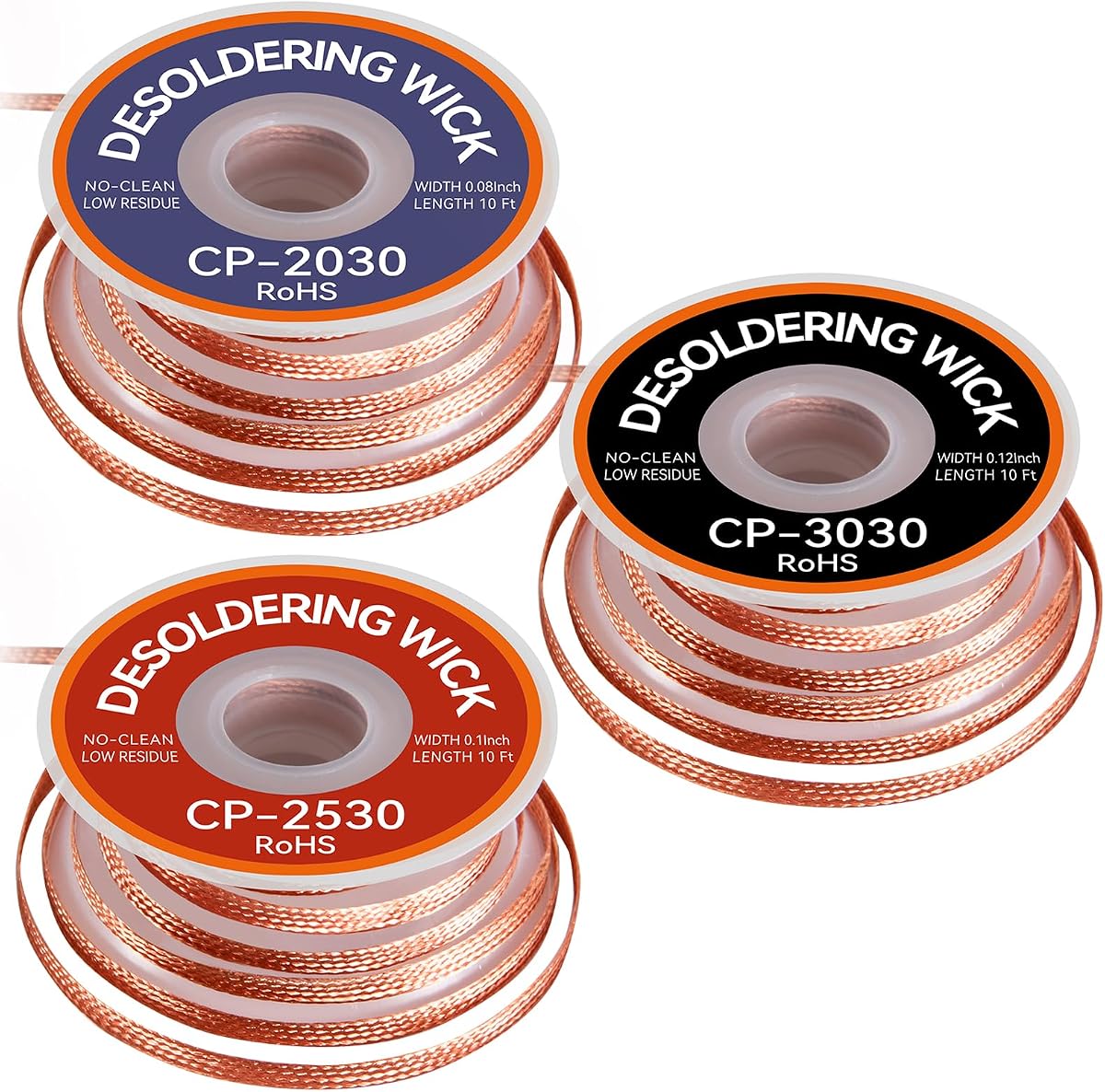
4.7Editor score
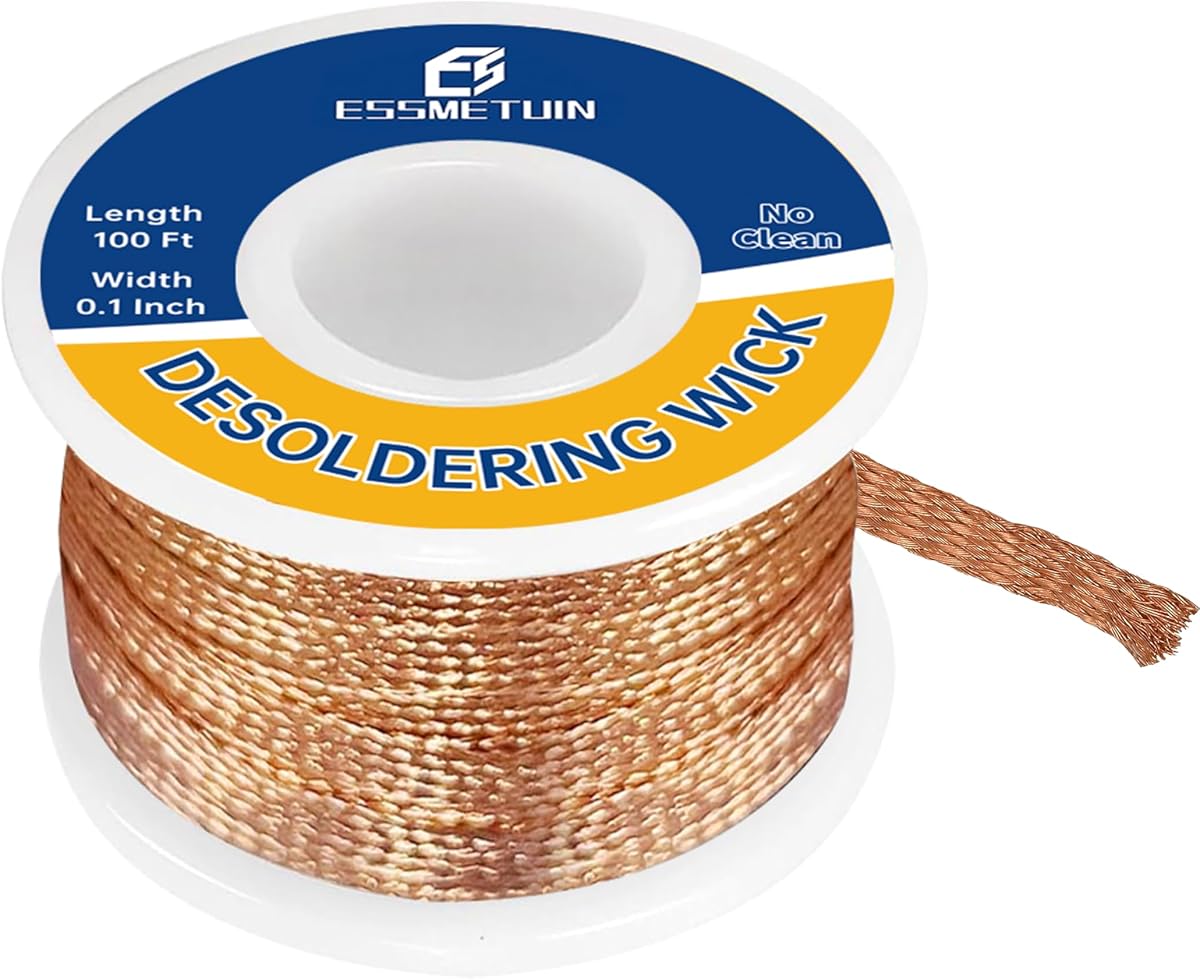
4.5Editor score
This side-by-side comparison highlights the major differences among the ten desoldering wicks, including braid width, available length, flux arrangement, and intended repair applications. It is an at-a-glance buying tool rather than a substitute for checking compatibility with your soldering process and board type.


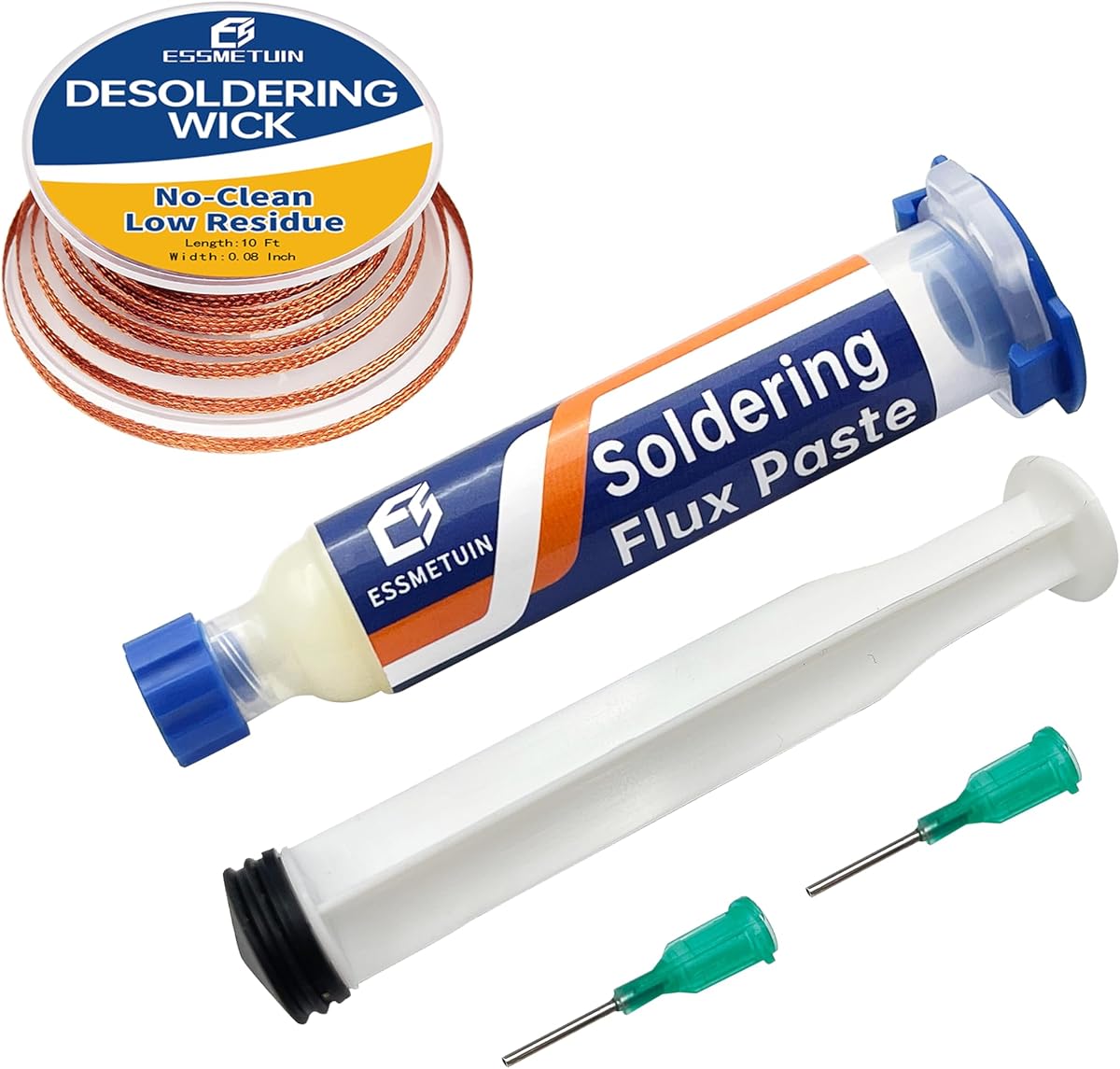


This 10-foot desoldering wick is a flexible general-purpose option for correcting soldered connections and removing components from printed circuit boards. Its 4.7 customer rating reflects a favorable reception, while the stated 0.1-inch width places it in a practical middle ground for many through-hole joints and common rework tasks.
We may earn a commission when you buy through this link, at no additional cost to you.
The product is described as a geometrically precise weave of copper wires. That construction is intended to improve capillary action and provide multiple channels for molten solder to enter. The listing specifically highlights use on small PCB boards, relays, mechanical keyboard switches, old wire, computer parts, and surface-mount areas where excess alloy needs to be cleaned away.
Its principal trade-off is that the package includes just one braid width. That keeps the setup simple and reduces the need to choose between products, but it may limit precision on very small pads or larger through-hole joints. The product information also does not emphasize a storage box or a separately packaged flux applicator, so buyers should consider what else their workbench requires.
This wick is a sound choice for a home technician, student, or electronics hobbyist who wants one broadly useful spool for board cleanup, component removal, and soldering corrections. The 10-foot length offers useful working capacity, and the 0.1-inch width should appeal to users who want more coverage than a very fine braid without moving to the widest option.
A tightly woven copper structure gives molten solder pathways to follow as the heated wick touches a joint. The result is easier removal of unwanted alloy from small working areas, which can be particularly helpful when preparing a pad for a replacement component or separating parts that need to be re-soldered.
The listed applications extend from keyboard switch work to motherboard component removal, giving the wick broad appeal. Its main advantage is convenience: a technician can keep one standard-width spool nearby for routine corrections rather than maintaining several specialized formats.
We may earn a commission when you buy through this link, at no additional cost to you.
The TOWOT 10ft wick combines a finely braided copper construction with flux for solder removal from PCB pads, components, and connections. Its 4.6 rating indicates strong customer feedback, and the stated no-clean format makes it appealing for users who want effective wicking without committing to an extensive post-repair cleaning routine.
We may earn a commission when you buy through this link, at no additional cost to you.
Fine weaving is central to the product's design because it creates strong capillary action and improves heat transfer. Those qualities help the braid draw molten solder away more promptly, which can make controlled removal easier on electronics boards. The product is also positioned as a preparation tool for components that must be replaced, cleaned, or re-soldered.
As with other single-width spools, the main compromise is limited flexibility. A 0.1-inch braid can work well across many conventional jobs, but the listing does not include narrower or wider rolls for close-packed pads and unusually large joints. Users who regularly alternate between very small SMD work and larger through-hole repairs may eventually want a multi-size set.
This product is best suited to electronics repairers, laboratory users, students, and serious DIY hobbyists who value a straightforward 10-foot spool with flux and low-residue characteristics. It combines several functions that are often purchased separately, making it a practical addition to a soldering station without requiring a larger kit.
The copper braid is tightly woven so that heat reaches the joint quickly and molten solder can enter the braid. That balance of heat transfer and capillary action is central to clean desoldering, particularly when a technician needs to remove excess solder before repositioning or replacing a component.
A no-clean, low-residue approach is useful for maintenance benches where thorough chemical cleaning after every repair would be inconvenient. It does not eliminate the need for sensible handling, but it reduces the amount of residue described for normal use.
We may earn a commission when you buy through this link, at no additional cost to you.
This three-piece solder wick kit is built around a simple advantage: access to 0.08-inch, 0.1-inch, and 0.12-inch widths. Each spool measures 10 feet, and the 4.6 rating suggests that buyers appreciate the combination of size choice, manageable packaging, and useful copper braid construction.
We may earn a commission when you buy through this link, at no additional cost to you.
The three widths cover different contact areas. The narrower braid can reach between closely spaced features, the middle width handles many conventional PCB joints, and the wider strip covers larger joints more efficiently. The product listing also identifies surface-mount pads, edge connectors, wire-pack pins, through-hole cleaning, and other terminals as suitable applications.
The included storage box is a meaningful convenience for a kit containing three separate spools. It also helps keep the wicks organized and protected from loose workshop debris. One trade-off is that 10 feet per spool may run out sooner than a single extended roll for a technician performing continuous, high-volume desoldering throughout the day.
The kit is an excellent fit for beginners, students, and mixed-service hobbyists because it avoids committing to one braid width. Buyers who regularly work on tiny electronics can begin with the narrow roll, then move to broader sizes for larger joints without purchasing a separate product for each task.
Using a braid that closely matches the joint makes the heat and solder-removal process more controlled. The 0.08-, 0.1-, and 0.12-inch choices let users select according to pad spacing, joint area, and how much of the surrounding board can safely be contacted.
The sturdy storage box distinguishes this bundle from three loose spools. It keeps sizes together, makes the kit easier to carry, and supports a tidier bench where copper wick is used regularly for electronics repair.
We may earn a commission when you buy through this link, at no additional cost to you.
This rosin-flux-coated wick combines three widths with a ready-to-use design, making it the strongest all-around balance in the roundup. It carries a 4.7 rating and includes 0.08-inch, 0.1-inch, and 0.12-inch spools, each 10 feet long, for a total of 30 feet of copper braid.
We may earn a commission when you buy through this link, at no additional cost to you.
Its defining feature is the pre-applied high-quality rosin flux. That coating removes the need to add flux separately before use, while the tightly woven pure copper braid is designed for fast heat transfer and strong capillary action. According to the product information, the result is rapid solder removal with low residue and reduced risk to sensitive pads and traces.
The three-size arrangement handles a broad range of joints, ranging from micro SMD features to larger through-hole connections. The trade-off is that this remains a wick-focused package rather than a complete bench kit: it does not list a soldering iron, solder, or vacuum desoldering equipment. Users working at high volume may also find 10 feet per size insufficient between restocks.
This is the most versatile option for PCB rework, phone and laptop repair, component replacement, and general DIY electronics. The ready-to-use flux and width assortment reduce setup decisions, while the 4.7 rating supports its position as the editor's choice for a balanced, approachable repair tool.
Beginning with an already flux-coated braid removes a separate preparation step at the repair bench. The rosin coating is intended to improve solder release, support quick wicking, and leave only a small amount of residue after the work is complete.
Micro SMD work and larger through-hole joints benefit from different contact widths. Having all three widths in one package reduces the chance of forcing an unsuitable braid over a delicate pad or using an overly narrow strip on a large joint.
We may earn a commission when you buy through this link, at no additional cost to you.
The Essmtuin 100Ft model is the long-service choice in this guide. It provides a single 0.1-inch-width spool with 100 feet of flux-assisted desoldering braid, enough material for repeated repairs without frequent roll changes. Its 4.5 rating remains favorable, though the shorter 10-foot products receive slightly stronger average feedback.
We may earn a commission when you buy through this link, at no additional cost to you.
The extended length is particularly relevant to technicians, workshops, and repair rooms where desoldering wick is consumed regularly. The 0.1-inch width is broad enough to cover many common joints while remaining useful for PCB cleanup, small component work, and through-hole parts that are being removed, reset, or replaced.
A no-clean design is described as leaving only a small amount of residue, which can streamline routine maintenance. The main limitation is format rather than function: only one width is included, so highly specialized work may still require a finer or broader braid. The 100-foot spool also needs secure storage to prevent tangling, flattening, or contamination.
This wick is best for high-frequency users who value a long supply of standard-width material more than a portable assortment. For occasional users, the length may exceed immediate needs, but for a dedicated electronics bench it offers a straightforward way to reduce interruptions caused by running out of wick.
A 100-foot roll provides substantially more working material than the 5-, 10-, and 30-foot totals offered by other products. That makes it useful for repair days involving multiple boards, repeated component changes, or technicians who dislike frequent spool replacement.
The product information specifically highlights removal of through-hole parts with a soldering iron and vacuum desoldering tool. In such a setup, the wick handles the remaining solder while the vacuum tool removes molten material, producing a cleaner joint for replacement.
We may earn a commission when you buy through this link, at no additional cost to you.
This kit pairs desoldering wick with 10cc of no-clean flux paste, offering a convenient solution for technicians who want both materials ready for a repair. Its 4.7 rating places it among the most favorably reviewed products here, and the combined format supports a more complete removal process than a standalone spool.
We may earn a commission when you buy through this link, at no additional cost to you.
The included paste is described as high-activity rosin that helps remove the oxide layer from a soldering surface. Combined with the wick, this can improve the conditions for molten solder to release and be drawn away from the joint. The product information emphasizes quick removal, low residue, and use in electronics repair settings.
One drawback is that the supplied data does not state the wick's length or width. That makes it harder to judge whether the braid suits especially small or especially large joints. The kit also does not include a soldering iron, solder, or vacuum tool, so it is a focused materials package rather than a complete repair station.
This set is a strong choice for users who already use paste flux and want it packaged with a wick. It is especially convenient for PCB work, general electronics maintenance, and mobile repair tasks where carrying a small number of coordinated consumables is more useful than owning a large assortment of wick widths.
Oxide layers can make solder removal less consistent. The rosin paste is intended to improve the soldering surface before heat is applied, helping the wick draw away molten solder more effectively while preserving the convenience of a no-clean workflow.
Matching the flux and wick in one kit simplifies bench setup and travel. It removes the need to source a separate paste container and is useful for technicians who want both removal materials organized together.
We may earn a commission when you buy through this link, at no additional cost to you.
The Crivon set is designed around a practical bench advantage: flux paste in a dispensing syringe alongside copper desoldering braid. It has a 4.6 rating and targets PCB rework, SMD repair, component replacement, and general electrical maintenance, making it especially relevant to users who value precise application.
We may earn a commission when you buy through this link, at no additional cost to you.
The syringe format is intended to keep the paste stable on traces while allowing controlled dispensing. This helps limit uncontrolled spreading and can make the soldering process more predictable. The rosin formula is described as no clean, with benefits including better heat transfer, smoother solder flow, improved adhesion, and less post-solder cleaning.
The wick handles the removal side of the workflow, while the flux supports the application side. That makes the set more versatile than a wick-only product, but it still does not include a soldering iron or solder. The product data does not provide the braid's length or width, which is a limitation for buyers focused on highly specific joint sizes.
This kit suits beginners working on controlled electronics projects as well as professionals managing repeated board-level repairs. The syringe makes it easy to place a measured amount of flux where needed, and the included braid allows a technician to move from solder application to removal without changing consumable types.
A syringe is particularly useful when working around small pads, traces, and SMD features. Controlled dispensing helps the user apply a small, consistent quantity rather than spreading flux across an unnecessarily large area of the board.
The combination of flux and wick supports a complete cycle. Flux improves solder wetting during assembly, while the copper braid removes excess alloy when a connection needs correction or a component needs replacement.
We may earn a commission when you buy through this link, at no additional cost to you.
The Chemtronics 80-4-5 is a specialist desoldering braid sold as a single five-foot unit. It carries a 4.7 rating and belongs to the Chemtronics Soder-Wick series, using a rosin flux core. For technicians who already recognize the product line, that focused format can be a familiar bench consumable.
We may earn a commission when you buy through this link, at no additional cost to you.
The compact roll is suited to controlled inventory and specific service tasks rather than high-volume consumption. Its core function is straightforward: when heated over a soldered connection, the braid wicks molten solder away from the joint. The rosin flux core assists the removal process and is a conventional choice for many electronics applications.
The main limitation is the short five-foot length. A technician completing a demanding rework session may need a second roll, and the product data supplied here does not explicitly state the braid width. It is therefore less convenient than the three-size kits when quick selection between joint types is essential.
This product is most appropriate for a technician who prefers the Chemtronics Soder-Wick format, has a controlled repair workload, and wants a single sale unit. It also works well for a home workshop that occasionally needs dependable desoldering braid without committing to a larger multipack.
Chemtronics is a focused option for users who know the Soder-Wick product family. The series designation, rosin flux core, and five-foot unit make it easy to add to an established repair inventory without changing the rest of the bench setup.
Five feet is a practical amount for intermittent electronics work. It provides enough material for selected repairs while limiting unused loose braid in a drawer, making it more appropriate for occasional use than for continuous production soldering.
We may earn a commission when you buy through this link, at no additional cost to you.
The Chemtronics 80-2-5 is the narrowest explicitly dimensioned wick in the roundup, with a 0.060-inch braid on a five-foot spool. Its 4.5 rating makes it a sensible fine-width option for electronics repair, particularly where the contact area needs to be more precise than a standard 0.1-inch braid allows.
We may earn a commission when you buy through this link, at no additional cost to you.
The product uses noncorrosive, ultra-high-purity Type R rosin flux and is packaged on ESD-safe static-dissipative bobbins. Those characteristics make it relevant to sensitive electronics work where contamination and electrostatic discharge are legitimate concerns. The manufacturer information also states that it will not leave ionic contamination on boards.
Its narrow format is a strength and a limitation. A fine braid can make sense around compact, closely spaced joints, but it covers less surface area than wider products and may take longer on large joints. The five-foot length is also shorter than the rolls or multipacks designed for extended service.
This wick is best for a careful electronics technician working on smaller connections, particularly within a static-conscious repair environment. It is less compelling for someone who removes large through-hole components continuously or wants a longer roll, but it adds useful fine-size coverage to a mixed repair kit.
The 0.060-inch braid provides a smaller contact area than the common 0.1-inch format. That precision can help when the target joint is compact or neighboring components are close enough to make a wider strip inconvenient to position.
ESD-safe static-dissipative bobbins and noncorrosive Type R rosin flux make this product especially relevant to controlled electronics maintenance. The stated absence of ionic contamination also supports use where residue around sensitive circuitry is a concern.
We may earn a commission when you buy through this link, at no additional cost to you.
The SRA three-pack supplies 30 feet of standard-width desoldering wick across three separate 10-foot spools. Its 4.6 rating and flat woven copper design make it a useful alternative for repairers who prefer multiple ready-to-use rolls rather than a single extended spool.
We may earn a commission when you buy through this link, at no additional cost to you.
The braid contains 3 percent no-clean flux and is described as offering even conductivity at low temperatures. Its gap-weave structure is intended to absorb solder quickly, while the manufacturer claims this approach reduces the likelihood of overheating a joint or lifting a pad. The resulting flux residue is described as non-conductive, non-corrosive, and not in need of cleaning.
All three spools use approximately the same 0.098-inch width, so the set does not provide the size flexibility offered by the 0.08-, 0.1-, and 0.12-inch kits. It also does not list a dedicated storage case. Nevertheless, multiple spools can be convenient for separating work areas, keeping spares in different tool kits, or avoiding the inconvenience of a very long roll.
This product suits workshops and repairers who appreciate low-residue, no-clean performance and want a backup supply on hand. It is also a sensible choice for standard-width work that does not require very fine or very broad braids and whose material is also described as RoHS compliant.
The woven structure leaves openings that help molten solder enter and spread through the braid. According to the product information, this fast absorption can reduce the amount of heat exposure required and lower the risk of lifting a pad during rework.
A no-clean flux coating leaves little residue that is described as non-conductive and non-corrosive. This makes the wick attractive for routine board maintenance where avoiding a separate cleaning stage is valuable, provided the repair area is still handled responsibly.
We may earn a commission when you buy through this link, at no additional cost to you.
Choosing a desoldering wick means balancing joint size, copper construction, flux type, usable length, and the kind of repair work you perform. The most useful product is not necessarily the one with the most material; it is the one that matches your pads, workflow, and handling preferences.
Braid width determines how much of the board contacts the wick and how much solder can be captured at once. Narrow braids around 0.060 inch suit compact joints, while approximately 0.08-, 0.1-, and 0.098-inch options cover many conventional PCB connections. Wider braids can make faster progress over large through-hole joints, but they may be awkward near closely spaced SMD components. A mixed-width kit is often the most flexible choice for an electronics bench that handles many board scales.
Match the braid to the joint geometry and keep it as close to the target connection as practical.
Copper is the central material because it conducts heat and provides channels into which molten solder can travel. A tightly woven or gap-weave construction can improve capillary action, speed up absorption, and reduce the time the soldering iron remains on the board. Look for descriptions that emphasize precise weaving, quick absorption, and reduced overheating, but also avoid treating any wick as completely risk-free on every pad.
Prioritize a well-structured copper braid that transfers heat efficiently and holds together during use.
Flux helps the solder release and improves the wicking result. Rosin flux is common for general electronics work, while a pre-coated wick offers immediate use without adding paste separately. Kits that include a syringe or container of flux can be convenient when you also perform routine soldering and need controlled application. If your preferred workflow already includes applying flux, verify whether the braid is pre-coated or intended for use with separate flux.
Choose pre-coated wick for simplicity or a matched paste-and-wick kit for controlled application.
A five-foot roll may be sufficient for occasional repairs, while 10-foot spools suit regular hobby work and 30-foot sets cover many service tasks. The 100-foot option is intended for high-frequency users who want to reduce interruptions from replacing wick. Do not choose length by storage space alone; also consider whether your joint sizes require one width or several, since three short spools can offer more versatility than one long roll.
Estimate how quickly you consume wick, then balance total length against the number of widths you need.
No-clean wick is designed to leave little residue after use, and rosin options are widely used on ordinary electronic assemblies. Low residue can simplify maintenance, but it does not mean every project requires no inspection or cleaning. Flux type, board sensitivity, and the presence of other contaminants should all influence your cleanup routine. Sensitive or high-value boards may justify a conservative process and careful handling even when the wick is labeled no clean.
For routine work, prefer a low-residue no-clean option and still inspect the repaired area afterward.
General-purpose wick works for correcting bridges, cleaning pads, removing through-hole components, and preparing a joint for replacement. Some products specifically target micro SMD work, while others emphasize larger motherboard joints or mechanical keyboard switches. The more closely a product's stated applications align with your normal work, the more likely its braid width and construction will be useful in practice.
Compare listed repair uses with the devices and boards you actually service most often.
A storage case keeps multiple spools organized, prevents tangling, and helps protect the braid from workshop debris. Separate spools can also be placed in different tool kits, while a long roll should be kept securely on a spool and protected from bending. For portable work, a compact matched set may be more useful than an extended roll, and for a fixed bench, storage capacity may matter less than uninterrupted supply.
Choose packaging that keeps the wick clean, organized, and easy to reach at the repair station.
Ratings can reveal broad satisfaction, but they are most useful when paired with the stated specifications. A highly rated product may be ideal for its intended width and format rather than for every application. Look for recurring comments about heat transfer, residue, copper quality, and ease of use, and treat individual experiences as guidance rather than a guarantee for a different board or joint.
Use ratings and feedback to confirm quality, then verify fit with your own repair requirements.
Prepare the work area before heating the joint. Clean away loose debris, inspect the pad and nearby traces, and apply a small amount of suitable flux if the wick is not pre-coated. Select a braid that matches the joint, lay it directly over the solder to be removed, and press it gently into place with the soldering iron tip.
Heat the wick and solder together rather than holding the iron on one side of the braid. As the solder melts, capillary action should draw it into the copper weave. Keep the tip in contact with the wick long enough for absorption to occur, then lift the wick and iron together to avoid leaving a trail of solder across the board. Repeat from a fresh section if the first pass leaves substantial solder.
Allow the used section of braid to cool before pulling it from the joint, then inspect the pad for remaining solder, residue, or signs of damage. Store the wick in a dry, clean container and keep the braid flat so it does not tangle or crease. Replace a spool when the material becomes frayed, heavily oxidized, or difficult to use, and avoid pulling the wick sideways while it is hot.
Desoldering wick removes molten solder from a connection by using heated copper braid to draw the solder into its weave. It is commonly used to correct solder bridges, clean excess alloy from PCB pads, prepare joints for rework, and help remove through-hole components. The wick is most effective when it matches the joint and is used with compatible flux.
Flux can improve the wicking result by helping solder release from the joint and reducing oxidation. Some products in this guide come with pre-applied rosin flux, while kits that include paste allow the user to apply it directly. If the braid does not include flux, adding an appropriate electronics flux is generally useful, especially on oxidized or previously worked joints.
A narrower braid generally offers more precise contact on compact joints and crowded SMD areas. The Chemtronics 80-2-5 is listed at 0.060 inch, while several multipacks include a 0.08-inch option. The best width still depends on the pad geometry, and the wick should not be forced over neighboring components or traces.
No-clean wick is designed to leave minimal residue and is widely used for routine electronics work, but every board should be evaluated on its own. High-voltage, sensitive, or specialized assemblies may have their own cleaning and safety requirements. Users should also follow appropriate precautions for the soldering equipment, ventilation, lead-containing materials, and flux fumes.
Yes, although wick is usually used as part of a broader removal process. The solder is heated until molten, then drawn away with wick while a vacuum desoldering tool removes the remaining liquid solder from the hole. This combination is particularly useful for resetting, replacing, or removing through-hole parts from a circuit board.
The wick may not be contacting the molten solder directly, the iron may not be hot enough, or the joint may need additional flux. Old oxidation and a cold iron can also reduce capillary action. Try a fresh section of braid, apply compatible flux, increase contact between the tip and wick, and confirm that the solder is fully molten before moving the tool.
Occasional repairs may be well served by a five- or 10-foot spool, while frequent PCB work can justify 30 feet or more. Instead of focusing only on total length, consider how many joint widths you encounter. A three-width pack can be more useful than one long roll if your work regularly varies between micro SMD joints and larger through-hole connections.
The unused tail can usually be kept for later work if it is clean, dry, and undamaged, although each section of the braid will gradually become oxidized and saturated with solder. Many users trim off the used portion and retain the rest on its spool. The wick should not be rewound while hot, and it should be replaced if the weave becomes frayed or contaminated.
The 3PCS Solder Wick Braid with Flux stands out as the best budget option because three useful widths and a storage box provide more flexibility than a basic single spool. The 3 Pack Rosin Flux Solder Wick earns the editor's choice for its ready-to-use rosin coating, pure copper construction, and balanced range of 0.08-, 0.1-, and 0.12-inch sizes.
For high-volume work, the Essmtuin 100Ft wick offers the strongest reason to select an extended roll, while the TOWOT and SRA products are versatile single-width alternatives. The most important buying priorities are joint fit, copper weave quality, flux arrangement, and expected consumption; a mixed-width kit is often the safest choice for varied electronics work.
Before purchasing, confirm the braid dimensions, included accessories, and intended board applications in the current listing. Availability and pricing can change over time, so compare the latest product details rather than relying only on this guide. With a suitable wick, compatible flux, and a controlled soldering process, desoldering can become much cleaner and more predictable.