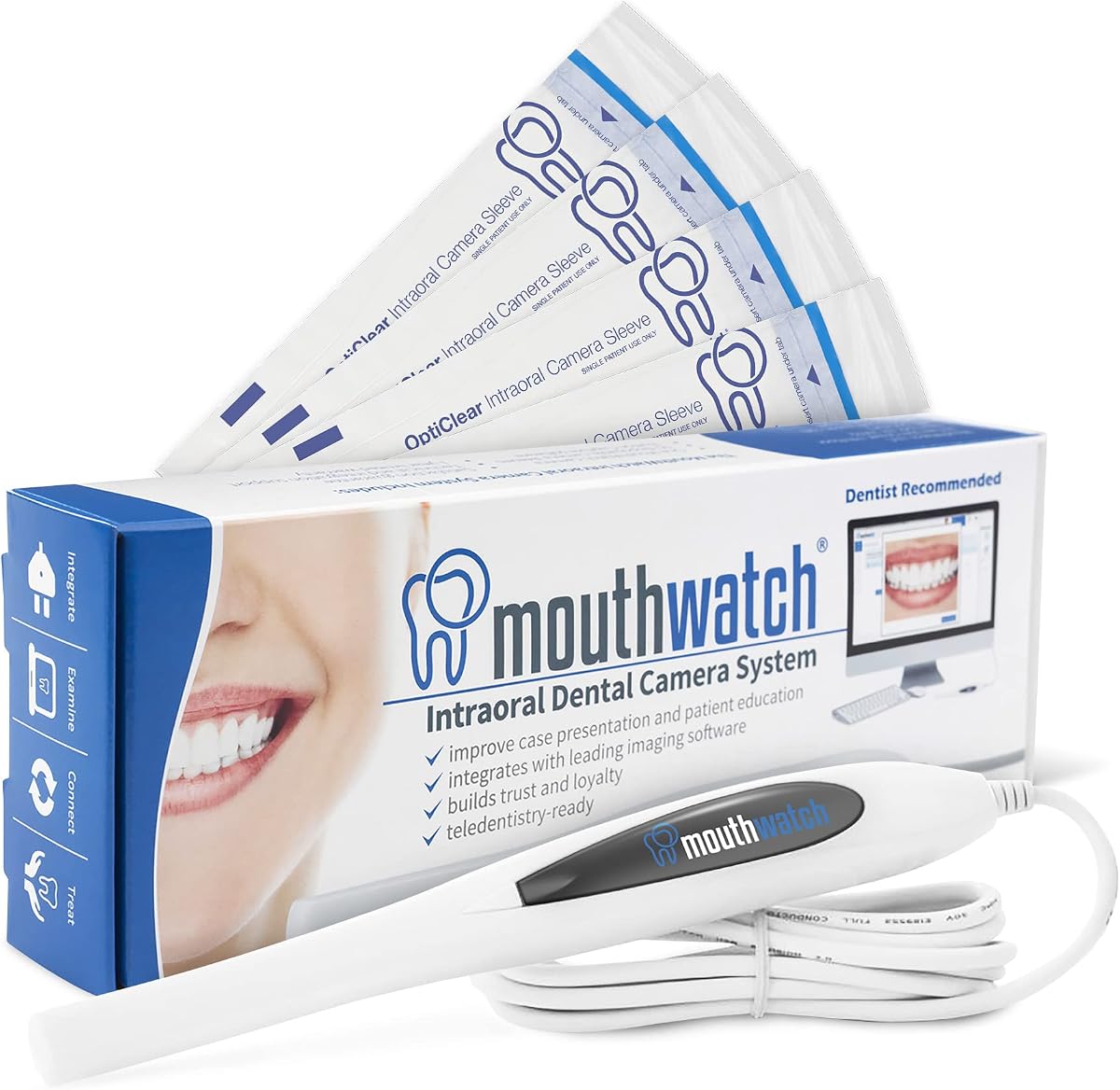
MouthWatch Intraoral Camera
4.4Editor score
One-button image capture
Fixed 4mm-45mm focus
Over 50 software integrations
Lightweight 31-gram handset
A dental camera gives clinicians a clearer way to examine teeth, gums, restorations, and other oral structures while helping patients understand visual findings. The best model combines sharp imagery, dependable illumination, smooth software integration, a comfortable probe, and a workflow that does not interrupt chairside care.
We compared 10 dental cameras using the information supplied about resolution, lighting, focus behavior, connectivity, supported imaging software, lens design, and physical features. The list covers clinical USB systems, a wireless option, and a compact inspection camera for compatible personal devices.
Each review highlights the standouts and trade-offs of its featured model, with special attention to compatibility and image capture. Product availability and pricing can change, so check the current listing, included accessories, and software requirements before making a final purchase.
4.4Editor score

4.5Editor score

As an Amazon Associate we earn from qualifying purchases.
The comparison below places all 10 cameras side by side, focusing on image specifications, illumination, connection style, focus or zoom behavior, and the most important compatibility considerations for clinical or personal use.


The DY-50 earns the Editor's Choice position because it combines a well-defined clinical feature set with one of the broadest software compatibility lists in this roundup. Its 4.5 rating reflects a favorable customer history, while the supplied specifications describe a lightweight 34-gram handset, direct USB operation, and still images at 1600 x 1200 resolution. For a practice that already uses a supported dental imaging application, that combination creates a practical and familiar workflow.
We may earn a commission when you buy through this link, at no additional cost to you.
Its strongest benefit is integration. The listed software support covers major platforms such as Eaglesoft, DEXIS, Apteryx, Carestream, Dentrix Ascend, Sopro, and numerous other systems. A capture-button driver is included so that images can be saved through supported software rather than requiring a separate mouse or keyboard action. The package also includes the camera, holder, USB cable, 50 sheaths, and required software, reducing the likelihood that an additional accessory is needed after unpacking.
There are some limitations to consider. Its 640 x 480 video size is modest beside cameras advertised with higher-definition or 13-megapixel still imaging. The system is also described as working with Windows 10, 8, 7, and XP, which may be less relevant for clinics using newer operating systems or Mac-based workflows. Most importantly, buyers should verify that their exact software appears in the compatibility list and confirm the intended use of the bundled software if it does not.
Despite those caveats, the DY-50 is a strong choice for a Windows-based clinic seeking dependable fixed-focus capture, built-in software compatibility, and direct computer connection without a wireless setup. The included holder, sheaths, capture driver, and software make the package feel complete. It is particularly attractive to users who prioritize a long supported-software list over headline megapixel specifications.
The camera's capture-button driver is designed to save images into a broad range of supported imaging applications. This can reduce the steps between examination, documentation, and patient communication when the clinic's software is on the supplied compatibility list.
The package includes a holder, USB cable, software, and 50 disposable sheaths. Its 34-gram handset and direct USB power also make it suitable for clinics that prefer a permanently connected system over a rechargeable wireless device.
We may earn a commission when you buy through this link, at no additional cost to you.
The MouthWatch camera is the premium pick in this guide because it focuses tightly on the factors that matter during a live appointment. It has a 4.4 rating and an unusually light 31-gram handset, making it easy to handle through extended clinical schedules. Its defining feature is one-button capture, which allows the operator to save an image directly to the patient's chart without reaching for a mouse or keyboard.
We may earn a commission when you buy through this link, at no additional cost to you.
Fixed focus from 4mm to 45mm is another meaningful advantage. Instead of moving through an autofocus sequence, the camera is engineered to maintain sharpness across a broad working distance. That reduces delays and the visual uncertainty that can accompany autofocus hunting. The product information also emphasizes lag-free transmission, clear illumination, and proprietary capture software with support for more than 50 imaging solutions, including Eaglesoft, DEXIS, Schick, and Apteryx.
The main uncertainty is that the supplied information does not state a precise still-image or video resolution, so buyers cannot compare the sensor on that basis. Integration is convenient but not entirely automatic: the included instructions guide users through the connection process, and clinics should verify that their chosen imaging suite appears among the supported integrations. The fact that typical integrations are described as taking less than five minutes does not eliminate the need for setup and testing.
MouthWatch is a compelling recommendation for clinicians who value quick capture, a lightweight handpiece, and a mature software ecosystem. It is less compelling for anyone seeking a published megapixel specification, although the absence of that number does not by itself indicate poor image quality. For a practice seeking an efficient, ergonomic, one-button camera with broad integration support, it offers a focused and polished feature set.
The 4mm-45mm fixed focal distance is designed to keep images sharp without repeated autofocus adjustments. This makes the camera especially convenient for quick examinations, follow-up visits, and patient education.
A single button press can save an image to the patient's chart, eliminating the need for a mouse or keyboard during image capture. The result is a more streamlined sequence from inspection to documentation.
We may earn a commission when you buy through this link, at no additional cost to you.
The DARYOU DY-60 ranks third thanks to its combination of 720P HD imaging, 4X zoom, and compatibility with numerous clinical applications. Its 4.3 rating supports its reputation as a well-regarded alternative to larger dental imaging systems. The camera is aimed at practices that want more detail than a basic inspection tool while retaining a straightforward direct-USB workflow.
We may earn a commission when you buy through this link, at no additional cost to you.
Zoom is the model-specific feature that distinguishes it from many conventional intraoral cameras. The ability to magnify a view up to 4X can help users inspect small areas and capture more closely framed images for documentation. The supplied information also states that the capture button works with Eaglesoft, DEXIS, Carestream, Sopro, CurveHero, Dentrix Ascend, VixWin, and many other platforms, with a driver included for that purpose.
The listing is less comprehensive than some others in the roundup because it does not provide detailed information about lens diameter, focus range, lighting arrangement, weight, or exact video format. It also explicitly says that a foot pedal is not required, which is convenient for some users but may disappoint clinicians accustomed to that control. Buyers relying on the capture button should carefully check the published list of compatible software.
The DY-60 is a sensible middle ground for users who want more magnification and HD capture than an entry-level inspection camera. It should appeal to practices already invested in one of the named software environments, particularly when a supportable direct connection and button-driven charting are priorities. The main purchasing task is confirming compatibility rather than judging the model by its unusually concise specification list.
The advertised 4X zoom allows closer examination of detailed oral surfaces. It can be particularly useful when a clinician needs a tighter view before saving a documentation image.
An included capture-button driver supports one-step saving in the listed dental software suites. A foot pedal is not required, reducing the number of accessories needed for a chairside workflow.
We may earn a commission when you buy through this link, at no additional cost to you.
The Wireless 13MP camera is the most flexible option in the roundup because it removes the cable from the handpiece during use. It uses wireless transmission and comes with a wireless charging base, allowing the camera to be placed on the base for recharging between appointments. Although no customer rating is supplied, the core specifications target clinics that value mobility and modern wireless operation.
We may earn a commission when you buy through this link, at no additional cost to you.
Its imaging system combines a 1/2.8-inch CMOS sensor, smart autofocus, and eight integrated LEDs. The sensor is listed at 13 megapixels, while the eight light beads are intended to provide uniform illumination with fewer dark corners. A stable WiFi connection, an included USB receiver, and compatibility with most dental management software create a practical bridge between a wireless handpiece and a computer-based workflow.
The trade-offs center on the relatively broad compatibility language. The listing says the camera works with most dental management software but does not publish a detailed list of specific integrations. Wireless stability can also depend on the computer, receiver placement, network environment, and software, so a wired alternative may be more predictable in a busy practice. Because no rating is available, prospective buyers should place more weight on testing, support, and a clear return policy.
This model is best for a clinic that wants cordless freedom and can verify its software connection before committing. The included receiver and charging base make the wireless concept more complete than a simple cable-free claim, while the eight LEDs and smart autofocus address the two most common inspection concerns. It is a forward-looking option for buyers who consider untethered operation worth the additional setup considerations.
Wireless transmission lets the clinician reposition without managing a USB cable between the handpiece and computer. That can make examinations and patient conversations feel less constrained.
The included base recharges the camera when it is not in use. Its magnetic or dock-based routine also gives the practice a defined location for the device between appointments.
We may earn a commission when you buy through this link, at no additional cost to you.
The ProDENT PD760 combines a 4.0 rating with one of the broadest operating-system descriptions in the guide. It is specified for Windows 7, 8, 10, and 11 in both 32-bit and 64-bit environments, making it a relevant option for practices running a range of established clinical workstations. Its USB 2.0 connection and quick-connect connector support a familiar desktop setup.
We may earn a commission when you buy through this link, at no additional cost to you.
The included ProDENT CAPTURE application is designed to make the physical capture button function with dental imaging software. The listed examples include DEXIS, Eaglesoft, Carestream, CurveHero, OpenDental, Dentrix, TigerView, and Apteryx. Another practical detail is automatic shutdown when the camera is returned to its holder, which can reduce unnecessary power use and help keep the device ready for the next patient.
The published information provides less detail about image generation than several competing listings. No exact still resolution, video resolution, focus range, or lamp count is given, so image-quality comparisons must rely on the HD designation rather than a full sensor specification. The 4.0 rating is still positive, but it is lower than the ratings of the top three products in this ranking. Software and operating-system compatibility should be confirmed directly against the buyer's current setup.
ProDENT is most appropriate for clinics that value a mature USB workflow, broad Windows support, and button capture across several major imaging suites. Its auto-off holder and quick-connect cable make routine handling straightforward. For a practice that already runs one of the named platforms, the PD760 deserves close consideration, especially when email and phone support is important to the buying decision.
Support for Windows 7 through 11, in both 32-bit and 64-bit versions, gives the PD760 a wider desktop reach than many listings specify. That is helpful for clinics with multiple older and newer workstations.
The quick-connect cable and USB 2.0 interface support direct computer use, while the holder provides a defined storage point and automatically turns the camera off when it is returned.
We may earn a commission when you buy through this link, at no additional cost to you.
The Dual-Button 6mm Camera distinguishes itself with a narrow 6mm lens tip and a 13-megapixel CMOS sensor. It is intended for reaching back molars and interdental areas where a bulkier probe can be difficult to position. The product also offers a 105-degree viewing angle and six adjustable LED lights, combining a broad field of view with controllable illumination.
We may earn a commission when you buy through this link, at no additional cost to you.
Front and back capture buttons support different grip positions, which can reduce awkward finger placement during an examination. Its magnetic holder turns off the LEDs when the camera is hung, a useful power-saving and longevity feature. Direct USB 2.0 power eliminates the need for a separate power supply, and the listing says it works without extra drivers. These features make the camera appealing for simple, portable imaging setups.
Compatibility is described broadly as working with most mainstream dental imaging software. That phrase is less useful than a complete list, so buyers should test the camera with their particular application. There is no published rating to help offset that uncertainty, and the listing positions the device for clinical checks, education, and personal oral monitoring rather than exclusively for a professional dental office. Hygiene and regulatory expectations should be evaluated accordingly.
This camera is a good fit for a buyer who prioritizes a slim probe, easy one-click capture, and a wide illuminated view. It may also interest educators or travelers who need a lightweight USB imaging tool. Before purchase, confirm that the software recognizes the device, that image storage works as expected, and that the intended clinical or personal use aligns with the included features and accessories.
The 6mm lens tip is designed to reach back molars and interdental spaces more easily. Its narrow shape may improve positioning when a patient has a limited opening or difficult access.
Buttons on both sides of the handpiece allow the operator to capture from more than one grip position. This reduces the need to reposition the camera solely to reach a capture control.
We may earn a commission when you buy through this link, at no additional cost to you.
The 13MP USB Dental Camera offers a detailed still-image specification and a clearly defined operating range. Its 1/4-inch CMOS sensor is listed at 13.0 megapixels, and the supplied information states a 10-40mm focus range with a 105-degree viewing angle. Six high-brightness white LEDs illuminate the oral field, while USB 2.0 power provides a straightforward connection without an external adapter.
We may earn a commission when you buy through this link, at no additional cost to you.
A dual-button layout allows capture from either side of the handpiece, which is useful when changing grip or working from different angles. The included magnetic mount turns off the LED lights when the camera is placed on the holder. This detail is practical in a clinic because it avoids leaving the illumination active while the device is not being used and can help extend the light source's service life.
The largest point requiring verification is the statement that the camera is compatible with all dental software. No specific program list or integration mechanism is provided. The smaller 1/4-inch sensor also may produce less light-gathering performance than some larger sensors, although the built-in LEDs and the stated 13-megapixel output can still provide detailed documentation. No customer rating is supplied for this listing.
The camera is most suitable for a buyer who values clear numerical specifications, broad field of view, and immediate USB operation. It could fit a small clinic, mobile setup, educational environment, or personal monitoring kit where portability matters. Confirm software recognition, focus behavior, and image storage before purchasing, but the feature set is competitive among entry-oriented models that advertise high-resolution still capture.
The stated 10-40mm focus range covers common intraoral imaging distances. It gives users a defined area in which to position the probe without relying on an unspecified autofocus behavior.
Six bright white LEDs support consistent visibility, while the magnetic holder switches the lights off when the camera is stored. This combines illumination with a simple energy-saving routine.
We may earn a commission when you buy through this link, at no additional cost to you.
The Built-in Software Camera stands out for its 5mm ultra-thin probe, anti-shake construction, and 5-50mm depth of field. Its 4.4 rating is among the strongest in the guide, and the feature set appears carefully oriented toward clinical use. A narrow probe can improve access in tight spaces, while fixed focus across a 5-50mm range reduces the likelihood of an autofocus delay during an appointment.
We may earn a commission when you buy through this link, at no additional cost to you.
The bundled capture software is described as supporting more than 50 imaging integrations, including Eaglesoft, DEXIS, Schick, and Apteryx. It also includes built-in oral diagnostic software that may analyze captured images, mark conditions, and generate reports. These capabilities could help a practice create a more structured documentation process, provided the software is used as intended and its output is reviewed by a qualified professional.
The buyer should distinguish imaging tools from automated diagnosis. A listing that says software may identify or mark oral conditions does not guarantee the accuracy, regulatory status, or clinical utility of those results in every jurisdiction. Exact sensor resolution is not stated, and no details are provided about video format, operating system requirements, or lighting control. Those omissions make direct image-quality comparisons less precise than they would be with fully specified models.
This camera is a strong candidate for a clinic that values a slender probe, steady imaging, and a deep integration library. It may also suit users who want structured image analysis in addition to conventional photo capture. The included tutorials and support through phone, online chat, and email can help reduce setup friction, but buyers should still confirm their software, review the diagnostic features, and validate image quality within their own workflow.
A 5mm probe can make it easier to navigate confined oral spaces and work with limited patient access. The anti-shake design also supports steadier framing during close inspection.
The built-in diagnostic tools may mark oral conditions and help generate reports. These features can support organization, although they should complement rather than replace professional assessment.
We may earn a commission when you buy through this link, at no additional cost to you.
The 4.8mm Thin-Lens Camera combines one of the narrowest probe designs in the roundup with a 13-megapixel CMOS sensor. Its ultra-thin profile is intended to improve access when a patient opens their mouth only slightly, which may be useful for children, anxious patients, or users working in tight posterior areas. Eight integrated high-brightness LEDs support imaging of teeth and gums in low-light conditions.
We may earn a commission when you buy through this link, at no additional cost to you.
Images and real-time video are listed as output formats, and the camera offers dual capture buttons on the front and back of the handpiece. That arrangement supports flexible operation with either hand or a change in grip. The supplied USB 2.0 controller connects directly to a computer or compatible device without complex settings, while the magnetic bracket turns off the lights when the camera is stored.
Exact focus distance, video resolution, and the identities of supported dental applications are not provided. Compatibility is described as applying to most dental imaging software, so a buyer should test the camera before relying on button capture or direct chart integration. There is also no published rating, making hands-on verification and the availability of support especially important. The thin probe should not be confused with a waterproof or sterilizable device unless the listing documents that protection.
The model is a good option for users who prioritize maneuverability, detailed stills, and straightforward USB viewing. It can support examinations, education, and patient communication where a narrow probe makes the experience more comfortable. For professional deployment, confirm software recognition, cleaning procedures, and the intended level of clinical protection before adding it to a treatment workflow.
The 4.8mm probe can enter the mouth with a smaller opening and reach confined areas more easily. That makes it useful for examinations involving limited access or heightened patient sensitivity.
Eight built-in high-brightness lights are designed to illuminate teeth and gums evenly. The magnetic holder shuts the lights off when the camera is returned, supporting a more controlled operating routine.
We may earn a commission when you buy through this link, at no additional cost to you.
The 3-in-1 Oral Endoscope is the Best Budget selection because it provides a portable inspection tool with a connector designed for several device types. Its 1920P HD output, adjustable high-intensity LEDs, and magnified real-time viewing make it useful for examining hard-to-reach surfaces on compatible Android phones, tablets, and Windows computers.
We may earn a commission when you buy through this link, at no additional cost to you.
The integrated connector supports USB, Type-C, and Micro USB, reducing the need to carry separate adapters. The tool is specifically designed for Android devices with OTG functionality and Windows environments. It is not compatible with iPhone or iPad systems, making the device check especially important. Users should also confirm that their specific computer or phone accepts the appropriate connection before relying on the camera for regular use.
Six adjustable LEDs provide shadow-free illumination for inspecting dark areas, while the IP67 rating allows safe surface rinsing after use according to the manufacturer's instructions. This model is fundamentally different from the chart-integrating dental cameras above it: it provides visual inspection on a display rather than direct integration with major dental imaging suites. It is therefore more suitable for personal oral care, education, travel, or simple visual documentation than for a full clinical imaging system.
Despite those limits, the camera is a practical entry point for someone who wants a detailed visual inspection tool without committing to a dedicated software-integrated dental camera. Its multi-device connector and water-resistant design make it especially convenient for travel or household routines. Confirm operating-system compatibility, understand that it is not intended for iOS, and follow all cleaning and safety instructions.
The integrated USB, Type-C, and Micro USB connector expands the range of compatible Android and Windows devices. It is a convenient option for users who switch between a phone and a computer.
Six adjustable high-intensity LEDs help illuminate confined spaces and reduce shadowed regions. The camera's magnified live view makes small surface details easier to inspect.
We may earn a commission when you buy through this link, at no additional cost to you.
Choosing a dental camera involves balancing image quality, software compatibility, illumination, probe size, connection method, and intended setting. The most important first step is to match the device to the computer, imaging application, and workflow you already use.
Choose a model whose compatibility list includes the software you already use. If your platform is absent, contact the seller or manufacturer before ordering and obtain a clear answer about workflow limitations.
Prioritize a clear focus range and reliable illumination. Use resolution as a supporting specification rather than the sole basis for a decision.
Look for multiple LEDs, even illumination, and anti-fog protection. These details can be as important to image consistency as the stated resolution.
For difficult access, prioritize a slim probe and anti-shake handling. For routine use, ensure the shape remains comfortable through a full clinical session.
Choose wired capture for predictable charting or wireless operation for mobility. Confirm that the included receiver, cable, and computer are compatible.
For a streamlined workflow, prioritize one-button or dual-button capture. Verify that the button saves into the intended software and whether a foot pedal is preferred.
Look for a usable cable or receiver, a storage holder, software, and installation guidance. Confirm the availability of integration help and any consumables you will need.
Use a chart-integrated model for a professional clinical workflow and a portable endoscope for personal inspection. Match the device to the setting and intended user.
Begin by confirming operating-system and imaging-software compatibility. Install any required capture application or driver, connect the camera by USB or through the included receiver, and complete a test image in the intended charting program. Confirm that the image appears, can be assigned to a patient record, and can be retrieved after the device is disconnected and reconnected. This early test prevents a compatibility problem from becoming apparent in the middle of an appointment.
For each examination, switch on the camera, activate its LEDs, and allow the lens to clear any condensation before positioning it. Use a clean, appropriate sheath or follow the manufacturer's cleaning and infection-control instructions. Hold the probe at a comfortable working distance, keep the lens free of debris, and capture when the area is illuminated and in focus. Return the camera to its holder afterward so models with automatic light or power shutoff can conserve energy.
Clean only as directed by the manufacturer, using suitable materials for the housing, cable, and lens. Avoid immersing a camera or controller unless the documentation specifically permits it, and do not use harsh chemicals that could damage coatings. Store the device in its holder, keep the cable free from sharp bends, and inspect the tip and buttons for damage. Before a software update or a new computer setup, save existing images and test a fresh capture in the patient chart.
No. A camera may display images on a computer without saving them into a dental imaging application. Compatibility depends on the camera's capture software or driver, the exact dental platform, its version, and the computer's operating system. Use the manufacturer's named integration list when possible, and test a full save-and-retrieve cycle before relying on a new camera in clinical documentation.
A one-button camera can save an image directly to the patient's chart without requiring a mouse or keyboard during the examination. That reduces workflow steps and makes it easier to capture images while still speaking with the patient. The button must be supported by the camera's software or driver, so compatibility remains essential even for a model described as one-button operated.
Not necessarily. Resolution can influence fine detail, but sensor size, lens quality, lighting, focus, and distance also shape the final image. A camera with a lower stated resolution may still perform well if its optics and illumination are consistent, while a high-resolution model may produce limited results in poor lighting. Compare focus behavior and lighting alongside the pixel count.
Wireless cameras offer greater movement around the chair and may be convenient with multiple operators, but they add receiver, WiFi, charging, and network considerations. Wired USB systems are often more predictable for fixed workstations and direct chart capture. The better choice depends on the practice layout, software integration, and how often the camera will move between rooms.
A thin probe can make it easier to photograph back molars, interdental spaces, and other confined areas, especially when the patient opens their mouth only slightly. It may also improve comfort for anxious or younger patients. The trade-off can be more precise handling, so image stability and grip ergonomics remain important.
Usually not when direct integration with professional dental imaging software is required. The 3-in-1 Oral Endoscope in this guide is designed for real-time viewing on compatible Android OTG devices and Windows systems, and it is not compatible with iPhone or iPad systems. It is better suited to portable inspection, education, or personal visual routines than automated charting and a professional clinical workflow.
Follow the manufacturer's instructions for the exact model, because materials and water-resistance levels vary. Use a clean sheath where appropriate, clean the lens and housing with approved methods, and avoid harsh chemicals. Store the camera in its holder, route the cable without sharp bends, and use the automatic shutdown function when available. The IP67 rating on the 3-in-1 Oral Endoscope applies to that specific product and should not be transferred to other cameras.
Confirm that the camera connects to your computer, that supported dental software recognizes it, and that images save into a patient record. Test both still capture and any live-view function, then check illumination, focus, image sharpness, and button placement in a realistic clinical position. If the seller offers support or a return period, use that period to complete the evaluation rather than assuming compatibility from the product title alone.
The DY-50 stands out as the most broadly integrated conventional option, with an extensive named software list, direct USB operation, a complete accessory package, and a 4.5 rating. The MouthWatch camera is the premium choice for clinicians prioritizing one-button capture, fixed focus, low weight, and support across more than 50 imaging solutions. The 3-in-1 Oral Endoscope is the budget pick for portable inspection on compatible Android and Windows devices.
Most buyers should prioritize the same core factors: exact software compatibility, a reliable connection, clear illumination, and a focus range suited to the intended work. Narrow probes can improve access, wireless operation can improve movement, and higher-resolution sensors may support detailed documentation, but each advantage should be balanced against setup complexity and the specific clinical workflow. Buy the device that fits the practice's existing systems rather than choosing only by headline specification.
Before ordering, check the current product listing for package contents, operating requirements, supported software, warranty information, and available support. Product features, included accessories, availability, and pricing can change, so confirm the current details directly. Taking the time to test the camera in the intended application is the most reliable way to avoid a costly mismatch.