
Surecom SR-629
4.1Editor score
Real-time duplex repeater control
DTMF password-protected activation
Built-in rechargeable battery
A cross band repeater radio links VHF and UHF traffic through a central unit, helping groups communicate beyond ordinary handheld range. The best model depends on whether you need a simple controller, a portable radio, a mobile installation, or advanced digital and APRS functions.
We compared all 10 products using the supplied specifications, focusing on cross band capability, supported radio bands, control options, GPS and APRS functions, power requirements, display design, and likely installation demands. The guide includes budget repeater controllers, handheld transceivers, and higher-power mobile radios.
Each review explains the product's strongest features, practical trade-offs, and ideal user. Ratings reflect the available customer feedback rather than personal testing. Product availability and pricing can change, so confirm the current listing, regulations, and compatibility before purchasing.
4.1Editor score

5.0Editor score

3.8Editor score
As an Amazon Associate we earn from qualifying purchases.
The table below compares all 10 options by product type, cross band implementation, navigation features, and practical usability. It shows how inexpensive repeater controllers differ from self-contained handheld radios and vehicle-mounted transceivers.




The Surecom SR-629 is a dedicated 2-in-1 duplex repeater controller rather than a conventional self-contained radio. Its 4.1 rating reflects a practical approach to extending communications through two connected transceivers. The main appeal is its ability to combine radio control and repeater operation without requiring a large mobile installation.
We may earn a commission when you buy through this link, at no additional cost to you.
The controller supports real-time duplex linking and is designed to work with most popular handheld radios. Multi-LED indicators show the status of both connected radios and the controller battery, which makes troubleshooting more approachable. DTMF remote control adds password protection, allowing an authorized user to turn the repeater on or off remotely.
Its built-in lithium-ion battery is listed for up to 72 hours of operation, while external five-volt power is available for longer or fixed deployments. The package includes two two-pin 46-K connection cables. The important limitation is that the SR-629 does not contain radios itself, so successful operation depends on compatible equipment and correct wiring.
This is the best budget choice for a club, search-and-rescue group, property team, or outdoor organization that already owns suitable handheld radios and wants an inexpensive central relay. It is less suitable for someone seeking an all-in-one handheld or a high-powered vehicle station. For those circumstances, the Iradio UV-98PLUs or Retevis MA1 offer a more integrated solution.
By connecting a VHF radio and a UHF radio, the SR-629 can relay traffic between different bands in real time. This makes it useful where members carry different radio types but need one coordinated communications path.
Separate status indicators reduce uncertainty when checking the linked radios, and DTMF password control allows authorized users to manage the repeater remotely. The result is a controller designed to remain out of sight while still being accessible.
We may earn a commission when you buy through this link, at no additional cost to you.
The Iradio UV-98PLUs combines a 10-watt handheld radio with cross band repeater functionality, making it one of the most self-contained options in this guide. Its 5.0 rating is the highest supplied rating among the listed products. It removes the need to purchase a separate controller and two radios for a basic portable cross band setup.
We may earn a commission when you buy through this link, at no additional cost to you.
The radio supports 1024 channels, three VFO channels, triple frequency standby, and a cross band repeater function. That combination suits users who need to monitor several frequencies or coordinate traffic across VHF and UHF. The product also provides 11 NOAA weather forecast channels in the United States, with the listed FCC identifier Y23UV-98PLUS.
The included package contains the radio, antenna, back clip, power adapter, charging base, Type-C cable, and programming cable. Although this creates a convenient starting point, advanced functions still depend on correct programming. The 10-watt output should also be planned around battery consumption, heat management, and local rules governing portable power.
Choose the UV-98PLUs for outdoor security, event staff, emergency preparedness, or a team that needs a portable repeater without assembling separate components. It is especially attractive as a field-capable unit. Operators needing a fixed high-power station may prefer the TH-9800D, while those wanting GPS and APRS should examine the similarly styled UV-98PLUS or GD-88.
The antenna, charging equipment, power adapter, and programming cable are included, reducing the number of separate accessories required for initial setup. Buyers can focus on programming compatible channels and testing their local coverage.
Three VFO channels and triple frequency standby let operators keep track of more than one communication path. This is useful when a group alternates between tactical, program, and coordination frequencies.
We may earn a commission when you buy through this link, at no additional cost to you.
The Retevis MA1 is a dual-band mobile transceiver with an integrated cross band relay, positioning it as the premium vehicle-oriented option. Its 3.8 rating is the lowest among the products reviewed, so buyers should weigh its advanced feature set carefully against its available customer feedback.
We may earn a commission when you buy through this link, at no additional cost to you.
The supplied information highlights advanced receiver filtering, a reversible panel that protects ports from bumps, and transmit noise cancellation designed to reduce engine and siren noise. Firmware V2.39 reportedly improves volume adjustment and PTT delay, while the upgraded radio bracket is intended to make installation easier and more stable.
The MA1 also includes FM and AM reception plus flight tracking on a dedicated A channel. These additions make it more than a basic cross band unit, although its core value remains extending communication beyond direct reach. The trade-off is that a mobile installation is less convenient for hiking or rapid field deployment than a handheld model.
This is the best premium choice for operators who want a sophisticated vehicle station and prioritize filtering, noise cancellation, and installation hardware. It makes particular sense for mobile teams working around traffic, machinery, and noisy environments. A simpler controller can serve users who only need basic VHF-UHF relaying, while the GD-88 stands out for digital-to-analog bridging.
Advanced receiver filtering is intended to reduce unwanted signals, while TX noise cancellation helps keep engine and siren noise from degrading transmitted speech. These features distinguish the MA1 from basic link controllers.
The reversible protective panel helps shield connection ports, and the upgraded bracket is intended to improve installation durability and stability. The design favors organizations that permanently mount equipment in a vehicle.
We may earn a commission when you buy through this link, at no additional cost to you.
The TYT TH-9800 is a quad-band mobile radio designed for high-output cross band operation, with a listed rating of 4.0. Unlike a repeater controller, it contains the radio electronics needed for mobile communication, making it a more substantial solution for vehicle-based teams.
We may earn a commission when you buy through this link, at no additional cost to you.
It transmits on the 10-meter, 6-meter, 2-meter, and 70-centimeter bands. The listing specifies 50W/40W output, additional receive coverage, selectable AM reception on VHF frequencies for air band monitoring, 800 memory channels, and a remote-mountable faceplate. A full direct-entry keypad microphone provides convenient on-panel control.
Proper operation depends on using a compatible four-band antenna rather than a dual-band antenna. The listing also notes that CTCSS settings should match on linked radios to reduce unwanted noise during transmission, and it includes a backup fuse. These details matter because a high-power mobile installation involves more variables than a handheld setup.
The TH-9800 suits amateur radio operators, travel groups, and organizations needing a powerful fixed or vehicle-mounted cross band station. It is less appropriate for lightweight portability or low-power emergency deployments. Compared with the TH-9800D, this model has a 4.0 rating, while the newer listing offers explicit cross segment relay and programming software details.
Four transmit bands extend the radio beyond ordinary VHF-UHF operation. The additional 10-meter and 6-meter coverage can be valuable for amateur operators with broader frequency interests.
A remote-mountable faceplate can be placed where it remains easy to see and operate. This is especially helpful when the transceiver body is mounted out of immediate reach.
We may earn a commission when you buy through this link, at no additional cost to you.
The Surecom Mcbazel SR-628 is a cross band duplex repeater controller with a 4.2 rating. Like the SR-629, it acts as the linking brain between external radios, but its support for VHF-to-VHF, UHF-to-UHF, and cross-band combinations makes it the more flexible controller in this guide.
We may earn a commission when you buy through this link, at no additional cost to you.
When two radios are connected, a signal received on one is transmitted in real time by the other. Two audio input and output ports handle the radio connections, while multi-LED indicators show the status of both units and the built-in battery. DTMF remote control with password protection allows authorized users to switch the repeater on or off.
The supplied K-plug 46-K cables are intended for compatible Kenwood, Puxing, Wouxun, and Quansheng radios. Actual compatibility should still be verified because connector layouts and wiring can differ. As with any controller, the product does not provide the radios, audio output power, or antenna system needed for a complete installation.
The SR-628 is a strong choice for clubs using more than one band or radio type, especially when a VHF-to-VHF or UHF-to-UHF link is occasionally needed. It suits users who understand radio connections and want flexible control at a reasonable entry point. Those wanting a ready-to-carry package should favor the Iradio UV-98PLUs instead.
The controller can arrange VHF-to-VHF, UHF-to-UHF, or VHF-to-UHF relationships. That flexibility helps organizations adapt a relay to different radio inventories.
Password-protected DTMF control lets an authorized operator activate or deactivate the repeater without physical access. The feature is useful for a fixed base, trail cache, or temporary event location.
We may earn a commission when you buy through this link, at no additional cost to you.
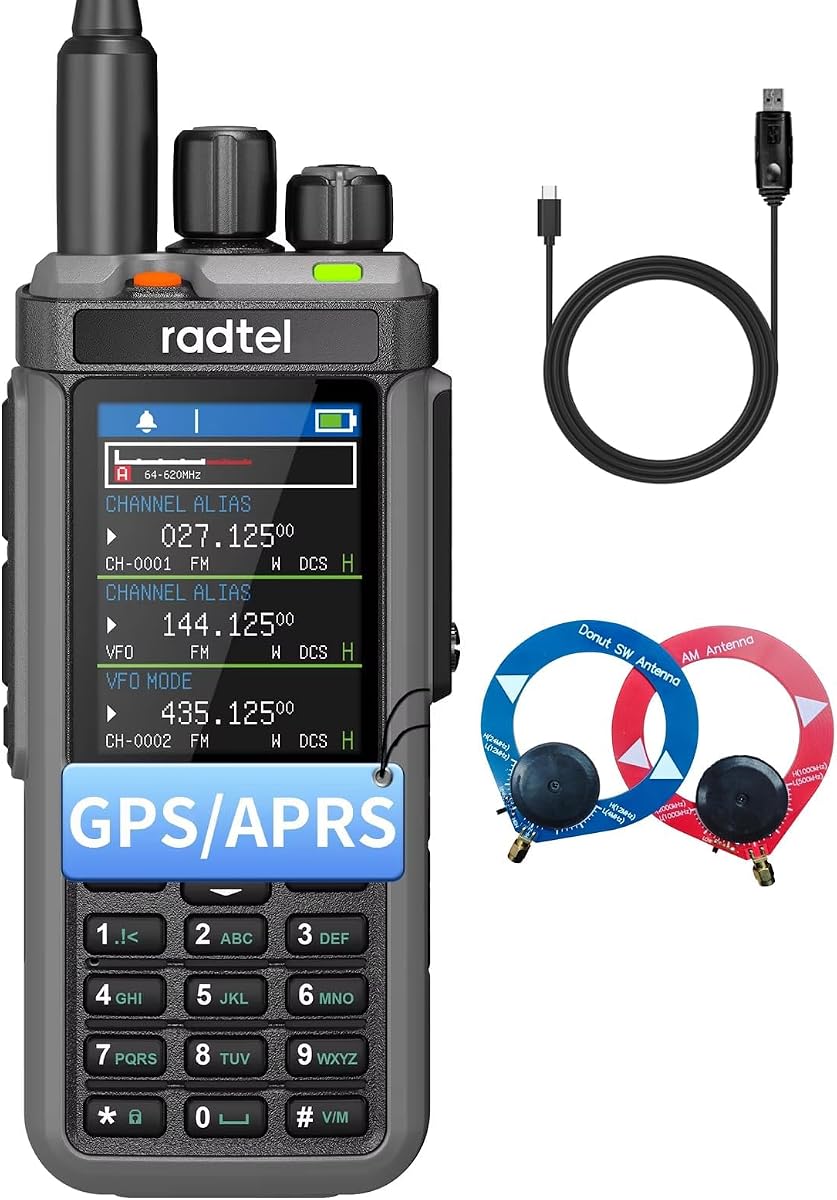
The UV-98PLUS is a 10-watt portable radio that combines cross band operation with GPS, APRS, a color display, and broad receive coverage. Its 4.2 rating reflects a feature-rich design aimed at hikers, search-and-rescue teams, and amateur radio users who want more than a basic handheld.
We may earn a commission when you buy through this link, at no additional cost to you.
GPS positioning supports distance and direction calculations, while APRS encoding and decoding allows position data and related information to be exchanged. The radio stores 1024 channels, provides three VFO channels, and supports triple PTT and triple frequency standby. A dedicated port accepts a shortwave antenna, improving reception flexibility.
Its 2400mAh battery is recharged through USB-C, which makes repeated field use more convenient. The supplied information notes that transmission is limited to the FCC-authorized 144–148 MHz and 420–450 MHz bands. The large number of settings can feel complex, so operators should program and test the radio before relying on advanced features during an event.
This model is ideal for outdoor groups that need location awareness alongside cross band communications. It also serves users who want a portable center for a larger net. The trade-off against the Iradio UV-98PLUs is that the listing for this model prominently highlights GPS and APRS, making it the more compelling choice when position reporting matters.
Built-in GPS and APRS allow a team to exchange location information and measure direction or distance from a selected point. These functions improve awareness when group members are spread across difficult terrain.
Three VFO channels, triple frequency standby, and triple PTT allow operators to organize several communication paths. Programmable side keys can place frequently used features within quicker reach.
We may earn a commission when you buy through this link, at no additional cost to you.
The Iradio UV-98PLUs stands apart with a 5.0 rating, the strongest customer rating supplied in the product data. It is a compact, self-contained cross band repeater radio that includes the accessories needed for charging, carrying, and programming, making it especially approachable for field organizations.
We may earn a commission when you buy through this link, at no additional cost to you.
Its 1024 channels and three VFO channels support organized programming, while triple frequency standby helps users monitor multiple paths. The cross band function links VHF and UHF frequencies, and the package includes an antenna, back clip, power adapter, charging base, Type-C cable, and programming cable.
Eleven NOAA weather forecast channels are available in the United States, providing convenient access to local forecasts. The radio does not replace the installation flexibility of a high-power mobile transceiver, and users must program it correctly to benefit fully from the multi-VFO and repeater features.
This is the most straightforward recommendation for a portable all-in-one unit, particularly for outdoor security, event operations, or emergency-preparedness groups. It also serves as a useful backup repeater. Operators who need a permanently mounted station may favor the TH-9800 or TH-9800D, while APRS users may prefer the UV-98PLUS.
A dedicated charging base, power adapter, Type-C cable, back clip, antenna, and programming cable are supplied. This reduces setup friction for a team building a portable repeater station.
The 11 NOAA forecast channels provide quick access to weather reports in the United States. This is useful when conditions become important to the safety of outdoor teams.
We may earn a commission when you buy through this link, at no additional cost to you.
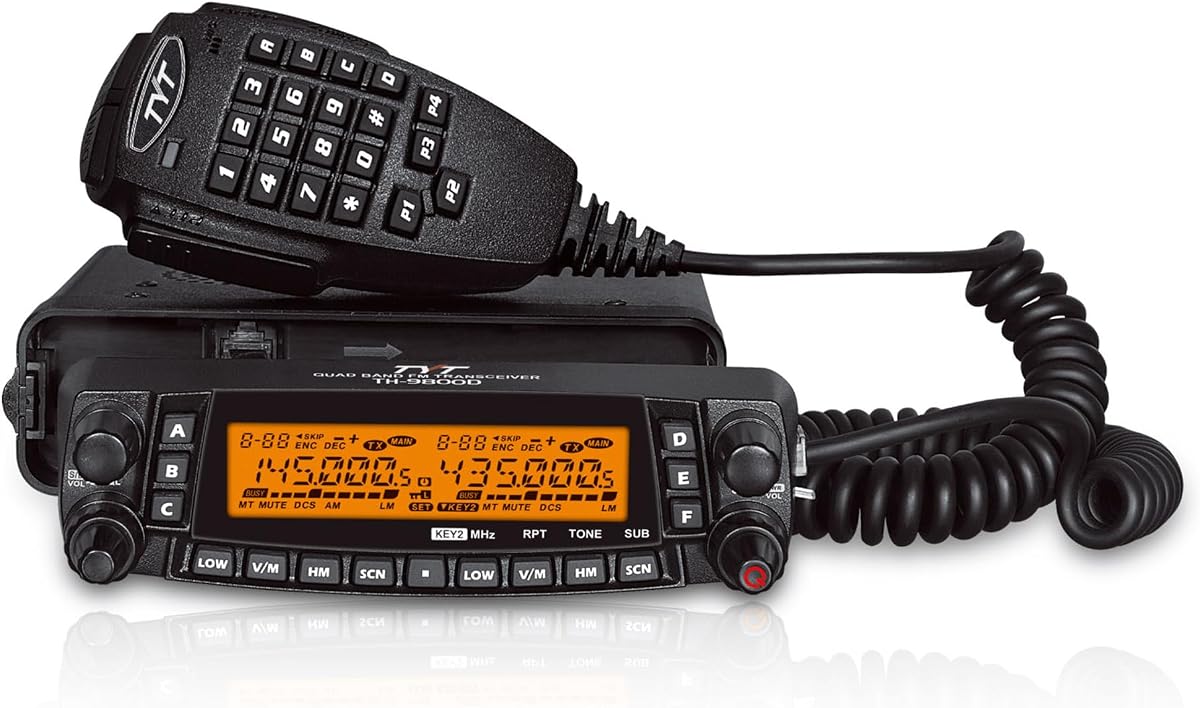
The TYT TH-9800D is a high-power mobile transceiver with explicit dual-frequency display and cross segment relay support. Its 4.0 rating places it alongside the established TH-9800, but the newer listing provides clearer details about programming software and its cross segment relay function.
We may earn a commission when you buy through this link, at no additional cost to you.
Transmission ranges cover 28–29.7, 50–54, 144–148, and 420–450 MHz. High, medium, and low power settings allow operators to match output to their operating circumstances. The radio displays two frequencies simultaneously, stores up to 800 alphanumeric memory channels, and offers a remote-mount faceplate for vehicle installation.
A programming cable and software are included, and the listing states compatibility with free CHIRP software. This is valuable for users who want repeatable configuration rather than relying entirely on manual controls. As with the TH-9800, the antenna must be appropriate for the selected bands, and high-power operation calls for careful attention to installation and power requirements.
The TH-9800D suits amateur radio operators, traveling clubs, and mobile command teams that need substantial output and broad band access. It is less suitable for users seeking a lightweight handheld repeater. Compared with the MA1, it provides clearer cross segment specifications and software support, while the MA1 offers more prominent receiver filtering and transmit noise cancellation.
The dual display can show two frequencies simultaneously, helping operators monitor linked channels without cycling through menus. This visibility is valuable in active cross band nets.
Included software and CHIRP compatibility simplify the setup of memory channels and operating parameters. Standardized programming also makes changes easier to reproduce across multiple units.
We may earn a commission when you buy through this link, at no additional cost to you.
The Radioddity GD-88 is the most digitally focused radio in the guide, supporting DMR Tier II as well as conventional analog operation. Its 4.0 rating reflects a specialized device for users who need to bridge different radio modes rather than simply link VHF and UHF channels.
We may earn a commission when you buy through this link, at no additional cost to you.
Two independent VFOs permit VHF and UHF operation, and dual-standby allows two channels to be monitored simultaneously. Most importantly, the cross band repeater can carry traffic from an analog band to a digital band or from digital to analog. That makes it valuable for connecting members using different radio technologies.
The same-frequency repeater function uses DMR TDMA timeslots in a different arrangement and allows multiple GD-88 units to create mesh-like coverage. Built-in GPS supports APRS position beacons, while analog DTMF codes and four customizable keys add conventional flexibility. Its 7-watt output is lower than the 10-watt portable radios and 50-watt mobile units in this list.
Choose the GD-88 for emergency organizations, amateur groups, or mixed analog-digital deployments. It is particularly compelling when a conventional team must communicate with DMR users. The trade-off is more complex configuration and less raw output than the full-size mobile radios, but the cross mode bridging capability is distinctive.
The ability to cross repeat from analog to digital or digital to analog lets separate teams communicate through one unit. This can preserve older equipment while introducing modern DMR capability.
Built-in GPS and APRS provide position reporting, while same-frequency repeater mode can extend coverage through multiple linked GD-88 radios. Together, these features support larger and more distributed emergency nets.
We may earn a commission when you buy through this link, at no additional cost to you.
The Y23UV-98plus is a 10-watt portable radio that combines cross band operation with broad receive coverage and a 2.4-inch color display. Its 4.2 rating places it among the stronger-rated handhelds in the guide, and its stated 136–520 MHz range gives it a wide operating envelope.
We may earn a commission when you buy through this link, at no additional cost to you.
The radio supports AM, FM, USB, LSB, CW, CB, LW, MW, SW, SSB, and air-band reception. A shortwave antenna and donut antenna are included, while a 2.4-inch color screen provides a more detailed interface. Cross band operation links UHF and VHF frequencies, and triple standby allows monitoring of three frequencies.
The 2400mAh battery uses USB-C charging, supporting convenient replenishment between field activities. Customizable side keys and keyboard functions can be assigned to common tasks. The extensive feature set is a strength for experienced users but may require more careful programming than a straightforward handheld.
This is a good fit for portable amateur operation, hiking, camping, and communications teams that want one radio to cover several receive modes. It is a less natural choice for a dedicated digital network or fixed high-power station. Compared with the UV-98PLUS, the supplied information emphasizes the included antennas and wide receive range; the other listing places greater emphasis on GPS and APRS.
Support for multiple AM, FM, sideband, CW, shortwave, and air-band reception modes gives the radio value beyond VHF-UHF voice communication. Included antennas improve the likelihood that users can begin exploring those features immediately.
Triple standby and the color display make it easier to track several frequencies in the field. Customizable keys also reduce the need to navigate deeper menus for frequently used settings.
We may earn a commission when you buy through this link, at no additional cost to you.
The right cross band repeater radio depends on radio compatibility, deployment style, transmission power, and whether you need navigation or digital features. These factors separate a simple controller from a self-contained handheld or a mobile station.
A repeater controller does not include the radio transceivers. It sits between two compatible radios and relays received audio from one to the other, making the SR-629 and SR-628 useful for organizations that already own suitable equipment. A self-contained handheld combines the radio and repeater functions in one enclosure, which is easier to carry and quicker to deploy. Mobile transceivers provide greater output but require a vehicle installation and a more permanent operating arrangement.
The defining function of a cross band system is linking VHF and UHF traffic, but the implementation varies. Some devices support only UHF-to-VHF operation, while the SR-628 also describes VHF-to-VHF and UHF-to-UHF configurations. The GD-88 goes further by bridging analog and digital bands. Confirm that both linked radios, connectors, tones, and programmed frequencies work with the repeater before making a purchase.
Power is one of the clearest distinctions among these products. Portable models are listed at 10 watts, the GD-88 at 7 watts, and the TYT mobile radios at up to 50 watts with lower settings. Higher output can extend a communication path, but actual range also depends on terrain, antenna height, antenna tuning, and interference. Portable power also affects battery life and heat, so maximum output is not automatically the best choice.
GPS positioning and APRS support are most relevant to mobile teams that need to exchange locations. The UV-98PLUS and GD-88 explicitly support APRS, while the RT-880G combines GPS positioning with APRS encoding and decoding. These features can help a coordinator understand the location and direction of team members, but they require programming and a working data channel to be useful.
Most of the listed handhelds focus on conventional FM voice communication, while the GD-88 supports analog FM and DMR Tier II. Its cross band repeater can connect an analog channel to a digital channel, making it a strong choice for mixed fleets. Digital capability adds complexity, so organizations without DMR users or compatible infrastructure may gain little from those advanced features.
The handhelds in this guide use color displays, while the mobile radios offer larger control heads and frequency visibility. Color screens can make menus and status information easier to read, especially for users wearing gloves or working in changing light. Remote-mount faceplates are useful in vehicles, whereas a handheld should have easily reachable keys, clear status indicators, and programmable controls.
The Surecom controllers include internal batteries and external five-volt power options, allowing either portable or fixed operation. The listed handhelds use 2400mAh rechargeable batteries with USB-C charging, while high-power mobile radios draw substantially more power from a vehicle installation. Match available power infrastructure to the radio and keep spare batteries or reliable charging equipment available for long operations.
A radio cannot realize its advertised range without a suitable antenna. The TYT TH-9800 explicitly requires a compatible four-band antenna, while the portable models include antennas and some support external shortwave connections. Fixed installations should also consider antenna height, grounding, weather protection, and separation from other transmitting equipment. Verify the supplied connectors and the required antenna impedance before installation.
Begin by identifying the two radio paths you want to link and confirm that both radios are compatible with the repeater. For a controller, match the wiring and connector arrangement carefully. For a handheld or mobile radio, install the appropriate antenna, enter the licensed channels, and confirm that the cross band function uses the intended transmit and receive bands before enabling it.
Program the repeater with separate operating frequencies, matching tone settings, and appropriate identification where required. Test with low output power where possible, begin with a short-range conversation, and increase coverage gradually. A dual-frequency display, multi-LED indicators, or audible relay tones can help operators confirm that traffic is moving correctly through the system.
During use, monitor battery level, heat, and signal quality. Do not operate a mobile unit without a suitable antenna, and avoid transmitting beyond locally authorized bands. Clean controls and connectors with suitable care, keep ports dry, inspect mounting hardware, and keep spare batteries charged. Before every major event, perform a complete end-to-end test with representative users and the actual antennas.
A cross band repeater receives radio traffic on one band and retransmits it on another, commonly linking VHF and UHF. This can help members using different radios communicate through one coordinated network. A controller requires two compatible external radios, while an all-in-one handheld contains the necessary radio functions internally.
Yes, a dedicated controller requires two connected transceivers because it relays traffic between them. The Surecom SR-629 and SR-628 are designed for this arrangement. Self-contained handhelds such as the Iradio UV-98PLUs include their own radio and do not require a second external transceiver for basic cross band operation.
It depends on the controller, radio model, connector, and wiring arrangement. The SR-629 is described as working with most popular handheld radios, while the SR-628 includes K-plug 46-K cables for listed brands. Confirm connector type, audio behavior, and supported frequency bands before connecting any equipment.
A handheld is portable, uses a rechargeable battery, and is convenient for hiking or field operations. A mobile radio is designed for vehicle installation, usually offers greater output, and may include a remote control head and programming software. The right choice depends on portability, power, and installation requirements.
Yes, when members are spread across a large area. GPS and APRS can share positions, calculate direction and distance, and help coordinators track resources. Products such as the UV-98PLUS, RT-880G, and GD-88 provide these capabilities, but users must configure the relevant channels and data settings correctly.
No. Most of the listed products emphasize conventional VHF and UHF FM voice operation, while the Radioddity GD-88 supports DMR Tier II alongside analog mode. Its cross band repeater can bridge analog and digital traffic, making it more appropriate for a mixed analog-digital organization.
Range depends on more than the advertised wattage. Terrain, buildings, antenna placement, antenna tuning, frequency, interference, and the radios used in the link all affect performance. A controller cannot exceed the practical performance of its connected radios and antennas, so compare real-world coverage rather than relying on output power alone.
Yes, every radio needs an antenna suited to the frequencies and power level in use. The TYT TH-9800 specifically requires a compatible four-band antenna, while portable models include antennas and some offer additional connection ports. Install antennas carefully, observe grounding and clearance requirements, and never operate a high-power radio without an appropriate antenna.
The Surecom SR-629 is the most budget-friendly route for teams that already own compatible handheld radios, while the Iradio UV-98PLUs is the most convenient portable all-in-one choice. The Retevis MA1 stands out for advanced mobile communications, filtering, and noise cancellation, making it the premium pick for demanding vehicle installations.
Prioritize compatibility before features. Confirm connector styles, supported modes, frequency restrictions, tone settings, and antenna requirements. GPS, APRS, DMR bridging, triple monitoring, and programmable controls are valuable when your operation genuinely needs them, but a simpler configured system is usually more reliable than an advanced but poorly understood one.
Check the current listing before purchasing because product configurations, included accessories, regulations, and prices can change. Also verify licensing requirements and operating limits for your location. A final field test with the intended radios, users, and antennas will provide more confidence than any specification sheet alone.
