
Cosmo Mini 100
4.3Editor score
Compact folding-style baseboard
Floating magnetic board included
Smartphone holder included
Compare the best copy stands for film scanning and photo digitizing, including phone and camera models for negatives, slides, prints, and documents.
Copy stands for film scanning and photo digitizing provide a repeatable way to position originals directly beneath a camera or smartphone. A useful model combines a rigid support, an adjustable camera arm, a flat working surface, and features that keep photographs, negatives, slides, and documents steady during exposure.
The products in this guide range from simple magnetic desktop holders to purpose-built camera stands and more substantial copy-stand systems. We compared their stated dimensions, adjustment ranges, device support, magnetic working surfaces, stability features, portability, and intended uses to identify the strongest option for different digitization workflows.
Each review explains the stand's most useful features and practical limitations. The list includes options for phone photography, compact cameras, DSLRs, mirrorless cameras, film negatives, and ordinary prints, while noting that ratings and prices can change and that availability should be checked before purchase.
4.3Editor score

4.8Editor score

4.2Editor score
This side-by-side comparison covers ten stands ranging from a simple magnetic holder to dedicated film and professional camera-copy systems, with differences in working area, stability, camera support, and portability.


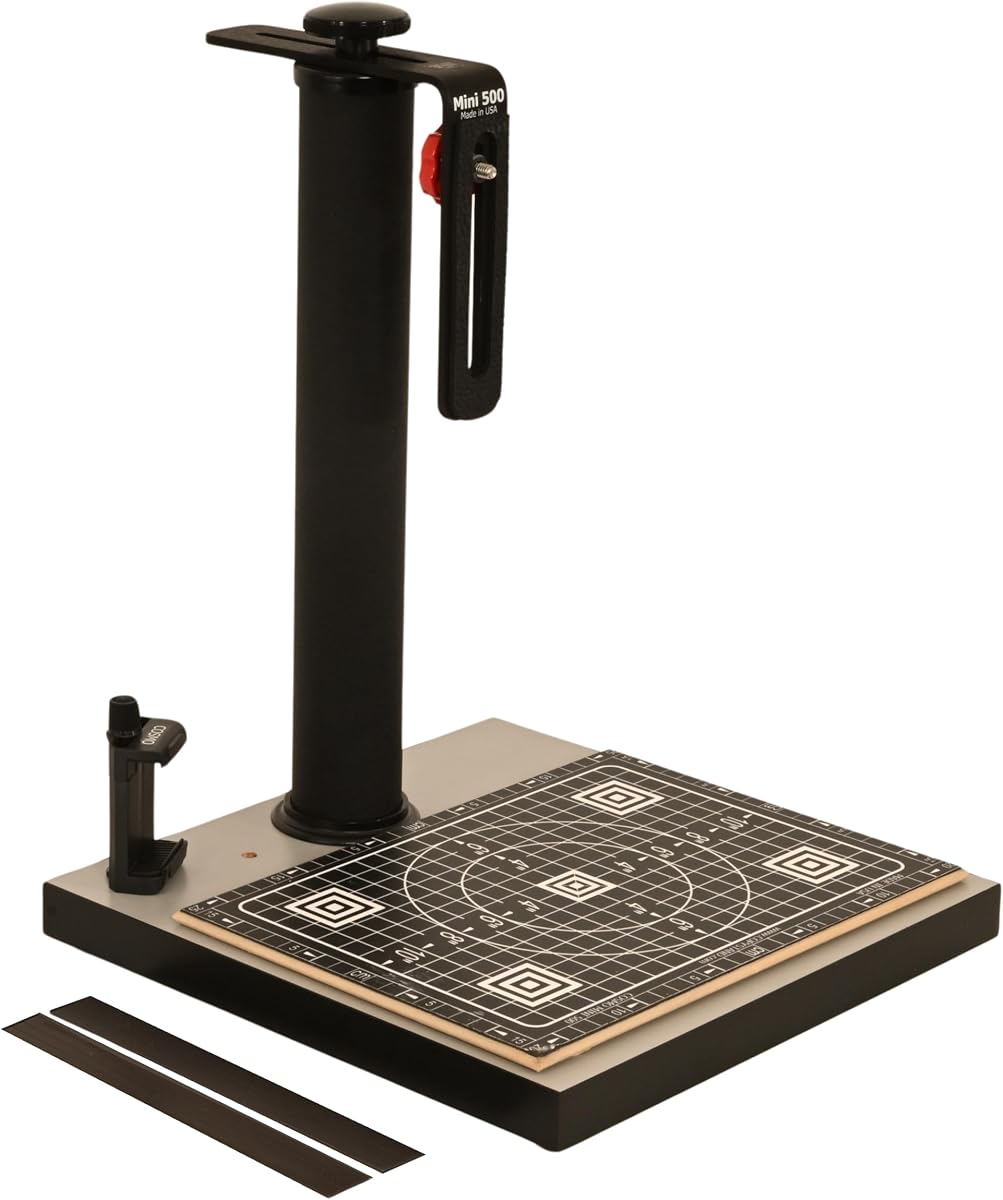
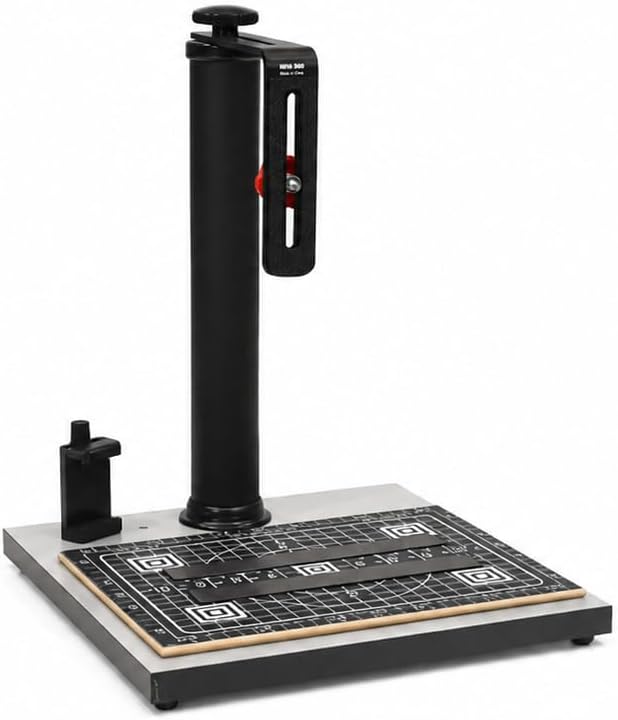
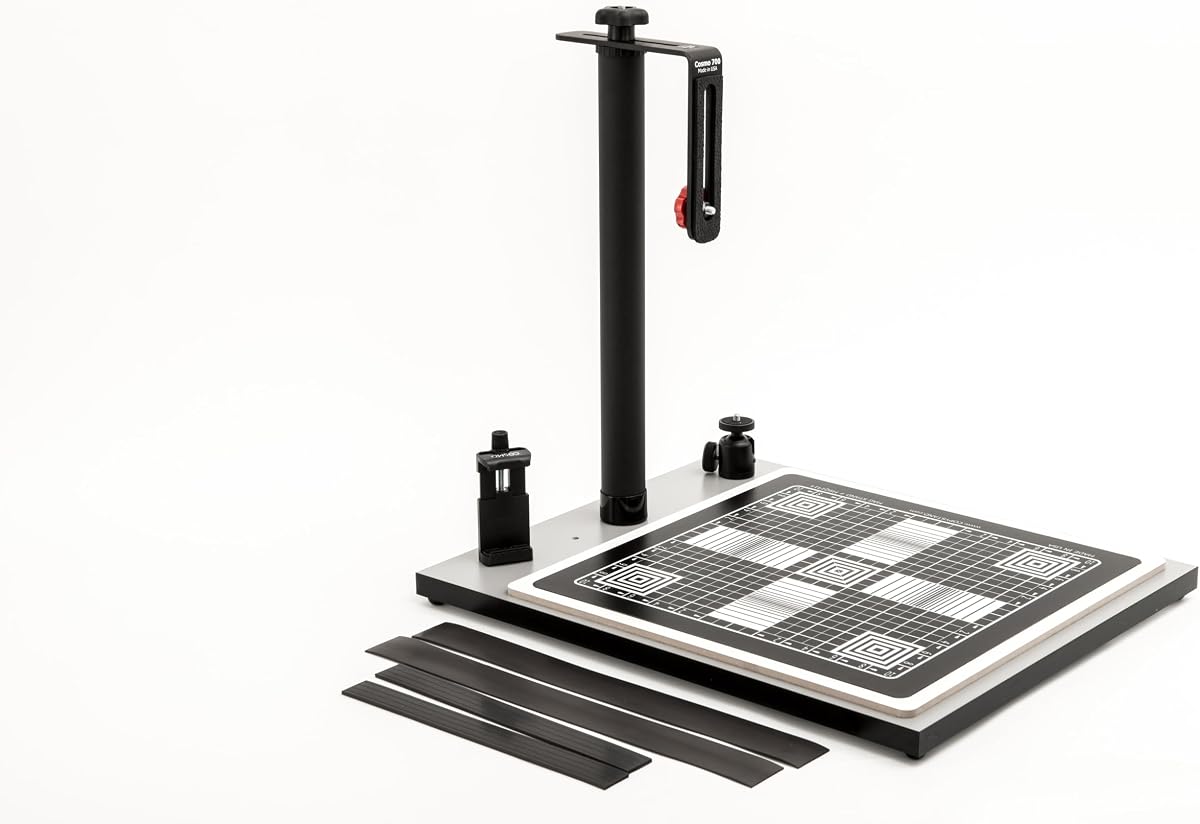

The Cosmo Mini 100 is a compact copy stand intended for smartphone-based digitizing, and its 4.3 rating reflects a practical balance of portability, alignment features, and ease of assembly. It is especially relevant to anyone beginning a family-photo archive, scanning small documents, or photographing jewelry, coins, checks, and other compact objects without investing in a full-size studio system.
We may earn a commission when you buy through this link, at no additional cost to you.
Its 10.5-by-8.5-inch melamine baseboard includes a center mounting hole for a light camera and a side hole intended to help position a smartphone over the working area. The included 9-by-7-inch Floating Magnet Board includes magnetic strips and half-inch grid lines, giving users a useful reference for focusing, sizing, and positioning originals without allowing the sheet to curl upward.
The support system uses a one-inch aluminum column that adjusts from 11 to 16 inches, while the L-bracket permits several vertical and horizontal positions. A holder accommodates most smartphones between 2.25 and 3.5 inches wide. Its main limitation is the center-hole camera allowance: the stand is specified for cameras under one pound, making it less appropriate for larger DSLRs or substantial macro lens combinations.
This is a strong choice for casual users, students, hobbyists, and travelers who need a small, complete setup. It is less compelling for professional film scanning or large-format originals, but within its stated category, it offers an unusually portable way to create consistent overhead images with almost nothing more than a compatible phone.
The Mini 100's small footprint makes it easy to move between a desk, kitchen table, or shared workspace. That portability is valuable when digitizing a box of family photographs in short sessions rather than creating a permanent photographic station.
The side mounting hole, phone cradle, and printed grid help place a phone consistently above an original. Users can also fine-tune framing in the camera app and make small support adjustments when working with very small prints.
We may earn a commission when you buy through this link, at no additional cost to you.
The Cosmo Mini 300 is a compact, US-made stand with a 4.2 rating, and it serves as a practical middle ground between a small phone-oriented rig and a more substantial professional copy stand. It supports smartphones and cameras weighing as much as three pounds, making it useful for hobbyists who want more than a simple desktop holder.
We may earn a commission when you buy through this link, at no additional cost to you.
The 12-by-9.5-inch gray melamine baseboard provides a stable foundation, while center and side holes offer different camera-mounting arrangements. Its 10-by-7.5-inch Floating Magnet Board has half-inch alignment grids and two magnetic strips. These features help flatten ordinary photographs and documents while giving the operator a reference for centering and resizing the image.
A reversible anodized aluminum bracket adjusts vertically from seven to 17 inches, and two horizontal positions are spaced one inch apart. The column uses a 1.5-inch steel tube with a durable black wrinkle finish. At eight pounds, the Mini 300 is still portable, although it occupies more desk space and is heavier than the Mini 100.
The stand is explicitly aimed at amateur and hobbyist users, not professional work. Its relatively limited horizontal adjustment may also make it less convenient for unusually large originals. Even so, it is a versatile option for print collections, checks, documents, and small flat objects photographed with a phone or compact camera.
The three-pound camera allowance gives the Mini 300 more flexibility than stands limited to very light devices. That makes it a sensible middle tier for photographers experimenting with dedicated camera-based digitization.
The magnetic strips restrain curled paper while the grid assists with initial placement. Combined with the rigid board, this is especially helpful when photographing large print collections where every sheet must be framed consistently.
We may earn a commission when you buy through this link, at no additional cost to you.
The Copy Macro Stand is the most purpose-specific option in the list for film digitization, with construction and adjustment features aimed specifically at negatives and slides. No customer rating is supplied, so its evaluation rests on the stated engineering details rather than a numerical feedback history. It is designed for photographers who want more control over camera geometry than a phone cradle offers.
We may earn a commission when you buy through this link, at no additional cost to you.
Its aluminum alloy frame and 240-by-200-millimeter base provide a dedicated platform, while adjustable leveling feet compensate for uneven desktops. A built-in bubble level and locking knob help maintain camera alignment, reducing the chance that a lens will sit at an angle and distort the relationship between the film frame and the sensor.
The camera support uses a quick-release plate, allowing vertical changes to the mounting height so users can frame different negative formats. The quick-release clip is described as compatible with DSLRs, mirrorless cameras, and L-brackets. This broader mounting approach is a major advantage over stands designed primarily around a smartphone cradle.
The main uncertainty is that the supplied information does not specify a dedicated negative carrier or its format compatibility, even though the stand is marketed for 135 and 120 negatives. Buyers should confirm that their film can be held separately and evenly. Within that limitation, the stand is a compelling choice for controlled, dedicated film-scanning work rather than casual phone photography.
The leveling feet and bubble level are particularly important when a film frame must remain square to the sensor. Leveling helps reduce keystone distortion and makes small camera-height changes more repeatable.
The quick-release plate simplifies moving among compatible camera bodies or mounting configurations. Users can switch between camera and macro work without repeatedly tightening a conventional threaded plate.
We may earn a commission when you buy through this link, at no additional cost to you.
The Kaiser RS 2-XA has a 4.6 rating and follows the familiar copy-stand format used for camera-based reproduction. Its matte gray board, printed grid, and scale-marked column offer traditional, understandable positioning aids for photographers who want more control than a phone-oriented compact stand provides.
We may earn a commission when you buy through this link, at no additional cost to you.
The camera arm is height adjustable, and the column rotates 180 degrees. The arm also offers approximately 2.7 inches of horizontal adjustment from the column, a modest range that must be considered for large originals. A quarter-inch mounting thread supports the many cameras and accessories that use that standard.
Its maximum stated load is 3.3 pounds, which accommodates smaller SLR cameras and digital, CCD, or CMOS cameras but may not suit a heavier modern DSLR paired with a large lens. Optional lighting kits are available, though they are not included. Users may therefore need to budget for proper copy lighting rather than relying on ambient room illumination.
For a photographer who values a straightforward, established stand design and works with smaller cameras, the RS 2-XA is a refined and compact choice. Its limited load and relatively short horizontal reach make it less appropriate for oversized archival collections or heavy macro systems.
Fine grids on the baseboard and inch and centimeter markings on the column reduce guesswork when matching framing to physical dimensions. These references are useful when creating consistently sized copies.
The 180-degree column rotation changes where the camera sits relative to the base. That flexibility can improve access around a subject or allow the camera to move out of the way of a lighting fixture.
We may earn a commission when you buy through this link, at no additional cost to you.
The Cosmo Mini 500 combines a 4.2 rating with one of the broadest lists of creative uses in this roundup. It is designed for digitizing slides, negatives, artwork, calligraphy, sketches, tattoos, restorations, presentations, and video projects, making it more than a basic document-copying accessory.
We may earn a commission when you buy through this link, at no additional cost to you.
Its heavy-duty 12-by-12-inch gray melamine baseboard includes a center camera hole and a side smartphone-alignment hole. The 8.5-by-11.5-inch Floating Magnet Board has half-inch grid markings and two magnetic strips, offering enough working room for standard-size paper originals while keeping them flat.
The reversible anodized aluminum L-bracket adjusts from nine to 19 inches vertically and provides about four inches of horizontal travel. A fixed two-inch steel column supplies rigidity, and the stand supports cameras up to three pounds plus compatible phones. Some applications, particularly with transparencies, may require an LED light box that is not included.
The Mini 500 is not positioned as a professional copy stand, and that qualification matters for high-volume archival work. Even so, it is a highly flexible choice for creative professionals, educators, and hobbyists who need one station to handle prints, drawings, small objects, and video framing.
The unusually broad application list makes the Mini 500 useful beyond archival photographs. Art students can capture sketches, restoration workers can document surfaces, and sellers can build repeatable product images with the same support.
Approximately four inches of horizontal travel helps accommodate the 8.5-by-11.5-inch magnetic board. The wider adjustment is more useful here than on smaller phone-first stands when recording a full sheet of artwork.
We may earn a commission when you buy through this link, at no additional cost to you.
This Cosmo Mini 500 variant offers a slightly wider 13-by-12.5-inch baseboard than the standard Mini 500, providing more surrounding support while retaining the same core copy-stand design. No numerical rating is provided in the source data, so buyers should assess its specifications and current customer feedback independently.
We may earn a commission when you buy through this link, at no additional cost to you.
The gray melamine board includes the familiar center hole for supported cameras and a side hole for smartphone alignment. At 8.5 by 11.5 inches, the Floating Magnet Board gives users a letter-sized surface with a half-inch grid and two magnetic strips for holding photographs, documents, or small objects flat.
Its reversible anodized bracket offers nine to 19 inches of vertical adjustment and approximately four inches of horizontal travel. A two-inch powder-coated steel column anchors the support, and compatible cameras up to three pounds or phones between 2.25 and 3.5 inches wide can be mounted.
The larger footprint and nine-pound weight make this model less attractive for travel, but they can be advantages in a permanent workspace. It is a practical choice for users who want more room around the magnetic board than a standard compact stand provides while still avoiding the bulk of a full professional system.
The wider baseboard gives the operator more space to reposition the magnetic board and camera. That margin can make edge lighting and repeated framing adjustments less awkward.
At nine pounds, the stand is substantial enough to remain in one location as a dedicated digitization station. Users who repeatedly process collections may find that stability more valuable than easy carrying.
We may earn a commission when you buy through this link, at no additional cost to you.
The Cosmo Mini 700 is built around a large working area, making it well suited to large pictures, documents, plated food, and three-dimensional objects. No customer rating is supplied, but its dimensions and included support hardware distinguish it as a roomy hybrid for digital capture, product imagery, and archival work.
We may earn a commission when you buy through this link, at no additional cost to you.
The 15.5-by-18.5-inch gray melamine baseboard provides a broad stable platform. A center hole accepts a camera, while a side hole supports smartphone alignment. The included 15-by-15-inch Floating Magnetic Board creates a 14-by-14-inch magnetic working area, with four strips securing originals and half-inch grid lines supporting focus, sizing, and positioning.
A 1.5-inch powder-coated steel column rises 16 inches, supporting an aluminum L-bracket with multiple vertical and horizontal positions. The included ball head permits smoother angle adjustments than a basic fixed joint, while the phone holder fits devices between 2.25 and 3.5 inches wide. Cameras under three pounds are also supported.
The overall size is 15.5 by 18.5 by 17 inches, and the weight is 14 pounds. That makes it a dedicated tabletop system rather than a portable one. It is best for users who value a large magnetic surface, flexible camera positioning, and the ability to move between archival and commercial-style overhead photography.
The fourteen-by-fourteen-inch magnetic area can accommodate large prints, documents, and broader arrangements. Four strips provide more holding points than designs with only two, which is helpful for wide or curled originals.
The ball head allows smoother changes to camera angle than a rigid bracket. Although the device is not a professional copy stand, this adjustment adds useful flexibility for objects with different heights and compositions.
We may earn a commission when you buy through this link, at no additional cost to you.
The Cosmo Mini 700 represented by ASIN B0B124C4XW has the highest listed customer rating in the group at 4.8. It combines a large magnetic platform with a strong support system, making it an especially attractive all-purpose choice for phone-based digitization, large documents, food photography, and three-dimensional product imagery.
We may earn a commission when you buy through this link, at no additional cost to you.
Its 15.5-by-18.5-inch melamine baseboard creates a substantial foundation, with a center camera hole and side smartphone-alignment hole. The 15-by-15-inch Floating Magnetic Board provides a 14-by-14-inch working area. Four magnetic strips hold originals flat, while half-inch grid lines help with focusing, sizing, and placement.
A 16-inch powder-coated steel column supports an aluminum L-bracket with multiple vertical and horizontal positions. The included ball head enables smooth camera-angle adjustment, and the phone cradle accommodates most modern phones. Cameras weighing under three pounds can also be used, giving users a choice between convenience and image quality.
The stand weighs 14 pounds and measures 15.5 by 18.5 by 17 inches, so it is best treated as a permanent tabletop system. It is explicitly not intended for professional copy-stand work. Even with that limitation, the combination of rating, working area, and flexible support makes it the strongest general pick for home studios, small businesses, and serious hobbyists.
The large grid-lined board gives phone users a consistent reference while retaining enough space for complete prints and documents. Its size also makes it practical for online food sellers, art students, and collectors photographing small objects.
Multiple bracket positions and a ball head let users balance centering, angle, and working distance. These controls are particularly useful when moving between flat documents and objects with substantial height.
We may earn a commission when you buy through this link, at no additional cost to you.
The Kaiser RS1 is the most substantial traditional copy-stand system in the list, pairing an extra-wide, vibration-resistant aluminum column with a height-adjustable camera arm. Its 4.2 rating indicates a positive customer history, while the RA1 arm and spring compensation point toward repeatability and dependable camera positioning.
We may earn a commission when you buy through this link, at no additional cost to you.
The non-reflective matte gray baseboard carries a printed fine grid, and the anodized column includes inch and centimeter scales. The arm uses interchangeable threaded one-quarter-inch and three-eighth-inch bushings, accompanied by a camera adjustment tool. These mounting options provide more compatibility than a stand with one fixed threaded interface.
A roll-off spring mechanism compensates for the weight of the camera assembly. That support can make fine vertical positioning easier and helps the arm remain stable while a photographer reframes an original. The wide column is also intended to limit vibration, an important consideration for high-magnification film capture and detailed copy work.
This stand is best suited to a permanent workspace, serious photographers, and institutions that prioritize stability over portability or simplicity. Its specialized hardware and substantial construction explain why it occupies the premium end of the group. Buyers should confirm their camera support requirements and available desk area before selecting it.
The extra-wide aluminum column and rigid arm are designed to resist movement. Lower vibration is valuable when using long focal lengths, high magnification, or exposure settings that are sensitive to camera shake.
The spring mechanism makes a heavier camera easier to support and adjust. It also helps maintain a consistent position while the photographer changes framing or reaches around the board.
We may earn a commission when you buy through this link, at no additional cost to you.
The Photography Mag Stand is the simplest product in the guide, but its 5.0 rating shows the appeal of a focused accessory rather than a complicated machine. It is a desktop magnetic document holder that can be used with a phone or digital camera and can also sit on the base of a separate copy stand.
We may earn a commission when you buy through this link, at no additional cost to you.
The 16-by-12-inch platform is built from three layers of wood base, rubber steel, and laminated car-wrapping film. Its laminated surface carries printed half-inch grids and squared corners, providing references for initial setup, focusing, alignment, adjustment, sizing, and consistent copies.
Two magnetic strips hold originals in place, and the entire holder can move across the base to find a better shooting angle. That mobility is useful for panning in videography or repositioning a document beneath a fixed overhead camera. However, there is no integrated column, arm, camera mount, or lighting system.
The Mag Stand is ideal for a photographer who already owns a suitable overhead support or wants a portable flat-copy surface without the bulk of a complete stand. It is less appropriate for beginners seeking a ready-made station, but it can be an economical, adaptable component in a carefully arranged digitization workspace.
By concentrating on the board and alignment aids, the Mag Stand avoids unnecessary hardware. It can serve as a dedicated surface for phone photography or as a movable target beneath an existing copy-stand camera.
Because the magnetic holder can be repositioned while the camera remains fixed, it supports controlled panning and reframing. This makes it relevant to creators producing overhead video rather than only still images.
We may earn a commission when you buy through this link, at no additional cost to you.
The right copy stand depends on the originals, camera system, available space, and required precision. Paying attention to capacity, adjustment, working area, and stability prevents an inexpensive basic model from becoming frustrating during a long digitization project.
Begin with the imaging device you already own or intend to buy. Several stands in this roundup accommodate phones between 2.25 and 3.5 inches wide, while others support cameras weighing one to three pounds or use standard quarter-inch mounting hardware. A phone holder is convenient for quick archives, but a camera mount usually provides better control over exposure, focus, and perspective. Verify the device width, weight, connector needs, and whether the supplied bracket can carry the complete body-and-lens combination.
The usable area should comfortably hold the largest original you expect to digitize. A nine-by-seven-inch magnetic board is sufficient for many snapshots, while a fifteen-inch board better accommodates large prints, documents, food plates, and broader compositions. Remember that the board is not always the same size as the full baseboard, and the camera arm must be able to travel far enough to frame the entire working surface.
Height adjustment controls framing and the camera-to-subject distance needed for focus. A limited range may prevent the camera from reaching a comfortable angle or fitting a particular device, while generous vertical and horizontal movement makes the stand more adaptable. Look for clearly stated ranges rather than a generic claim that the arm is adjustable. A rotatable column or ball head can further improve access around a subject.
Film and small negatives magnify camera shake, while long exposures magnify even subtle movement. Look for a rigid base, wide column, locking controls, and feet that can correct an uneven desk. Dedicated film stands add leveling features, while premium systems use wider columns and spring-compensated arms. For ordinary phone scans of larger prints, these features may be less important, but they become valuable as image resolution and magnification increase.
A copy stand does not automatically make it suitable for every film format. The dedicated macro stand mentions 135 and 120 negatives, but the supplied information does not identify a dedicated negative carrier. Transparent film also requires suitable transmitted light, often from an LED light box that may not be included. Confirm that a separate carrier keeps the film flat and that an appropriate light source provides even illumination without heat or glare.
Portable stands can be moved between sessions and stored away when not in use. Compact models such as the Mini 100 are easier to carry, while large systems offer broader working areas and greater rigidity. Consider both the assembled dimensions and the weight, especially if one person will transport the unit. A dedicated station can justify more space, whereas occasional users may prefer a magnetic desktop holder that requires a separate camera support.
Grid lines help users match physical dimensions to digital framing, while magnetic strips keep paper from curling and sliding. Larger surfaces with more strips are useful for broad originals, and laminated grids are easier to clean than exposed printed markings. A good holder should hold the original flat without obscuring important content. Make sure the grid and reference marks remain useful with the device and orientation you plan to use.
Several products are explicitly described as hobbyist or amateur devices rather than professional copy stands. That distinction matters for warranties, material thickness, load limits, and long-term consistency, but it does not make them unsuitable for careful home archiving. Professional users should consider the dedicated macro stand or the Kaiser systems, while casual users can get excellent results with the Cosmo models and a smartphone.
Begin on a level, clean surface and assemble the support fully before placing an original. Lock the column, bracket, and camera connection, then use the printed grid to establish the approximate framing. If the stand has leveling feet or a bubble level, adjust those before the camera is positioned. Mount the camera or phone centrally, disable unnecessary digital stabilization if it introduces movement, and use manual focus for repeatable results.
Place the original flat on the magnetic board or base and secure it with the supplied strips. Keep fingers, sleeves, and other objects outside the frame. For film, use a confirmed compatible negative carrier, close the film gate or sleeve carefully, and provide even transmitted illumination when required. For prints and documents, use diffuse reflected light with equal illumination on both sides to reduce shadow and color imbalance.
After the session, release any camera tension, loosen locks only when necessary, and remove the device before collapsing or disassembling the stand. Wipe the board and magnetic strips with a soft dry cloth, and use a lightly damp cloth only if the laminated surface permits it. Keep grit away from the column, because particles can create binding or alignment problems. Check the hardware periodically and store films and originals separately from the equipment.
Yes, a copy stand can photograph film with a camera, although the stand must be stable and the film must be held in a suitable carrier. A dedicated macro stand may offer better leveling and height adjustment for 135 or 120 negatives. Transparent film also needs an appropriate light source, such as a compatible LED light box, which is not included with every stand.
A copy stand can preserve the look of photographs, artwork, and three-dimensional objects while producing a digital image with adjustable perspective and lighting. A flatbed scanner may offer more automatic, consistent handling for flat pages. The best choice depends on whether you need flexible camera control, non-contact capture, film support, or simple automated document scanning.
A smartphone holder is convenient because it keeps the phone at a consistent distance and angle, reducing the need to hold or reposition it manually. The stands reviewed provide various phone-holder arrangements and side holes for alignment. If you already own a rigid overhead mount, a magnetic holder or more basic platform may be sufficient.
Capacity varies considerably across this list. The Cosmo Mini 100 is specified for cameras under one pound, the Mini 300 and Mini 500 support cameras up to three pounds, and the Kaiser RS 2-XA lists a 3.3-pound maximum. Always account for the complete body-and-lens assembly and avoid exceeding the stated limit.
The magnetic strips hold photographs and documents flat, reducing curling and unwanted movement. Grid lines provide visual references for aligning, sizing, focusing, and positioning originals. Together they make successive images more consistent and help users reproduce a particular crop or physical scale.
Even, diffused illumination is most important, with shadows kept away from the print. A dedicated copy light can provide consistent results, while ambient light may produce glare, color shifts, and uneven exposure. Avoid direct sunlight and mix warm room lamps with cooler sources, since changing light color makes color correction harder.
They are best described as portable or movable tabletop systems rather than travel equipment. Each has a broad base, a large magnetic board, and a weight of 14 pounds. It can be carried between rooms, but a permanent workspace will make setup and storage easier.
You will need a compatible camera or smartphone, a way to hold the film flat, suitable lighting, and software for capturing and processing images. Some copy stands include a phone holder or magnetic board, but negative carriers and LED light boxes are generally separate purchases. Check the full kit before ordering additional accessories.
The Cosmo Mini 700 stands out as the strongest general-purpose option in this group because they combine a large magnetic surface, flexible bracket positioning, a ball head, and a strong customer rating. The Mini 100 is the leading compact and budget-conscious choice, while the Kaiser RS1 serves photographers who value a heavy, vibration-resistant, professionally oriented copy-stand system.
The most important purchase decision is the one that matches your workflow. Phone users should prioritize a fitted holder and side-alignment hole, casual photographers can find ample capability in the Mini 300 and Mini 500 models, and dedicated film scanners should emphasize leveling, camera height control, a proper negative carrier, and transmitted lighting.
Finally, compare the complete kit, current dimensions, device limits, and available desk space before ordering. Ratings and prices can change over time, and accessories such as lighting or a negative holder may be separate. Checking those details at the time of purchase will help ensure the selected stand supports the originals and camera system you actually intend to use.