
Clear Silicone PCB Coating 100ml
5.0Editor score
Clear flexible silicone protection
Designed for diverse PCB assemblies
Direct clean-surface application
This guide compares the best conformal coating for electronics, comparing protection, curing, adhesion, temperature resistance, application methods, and
Conformal coating for electronics creates a thin protective layer over circuit boards, sensors, control modules, and other assemblies exposed to moisture, dust, corrosion, and temperature changes. A useful coating must adhere well, insulate reliably, remain flexible, and preserve the ability to inspect or service the components it protects.
We compared ten silicone, acrylic, and rubber-based options by examining their stated barrier properties, dielectric performance, curing behavior, temperature limits, application method, reworkability, and intended electronics applications. The list includes brush-applied bottles, aerosol coatings, and a fast-drying spray format, giving repairers and hobbyists several practical options.
Each review highlights the strongest reason to consider the product, along with any limitations suggested by its specifications. The top picks represent the most compelling options for different priorities, including affordability, proven performance, and professional-grade features. As with all marketplace listings, availability, ratings, and prices can change over time.
5.0Editor score

4.7Editor score

4.7Editor score
The comparison below organizes all ten coatings by material, application method, key protection claims, and practical features. It is designed to make it easier to identify the right balance of coverage, cure time, inspection visibility, and environmental resistance for a particular electronics project.

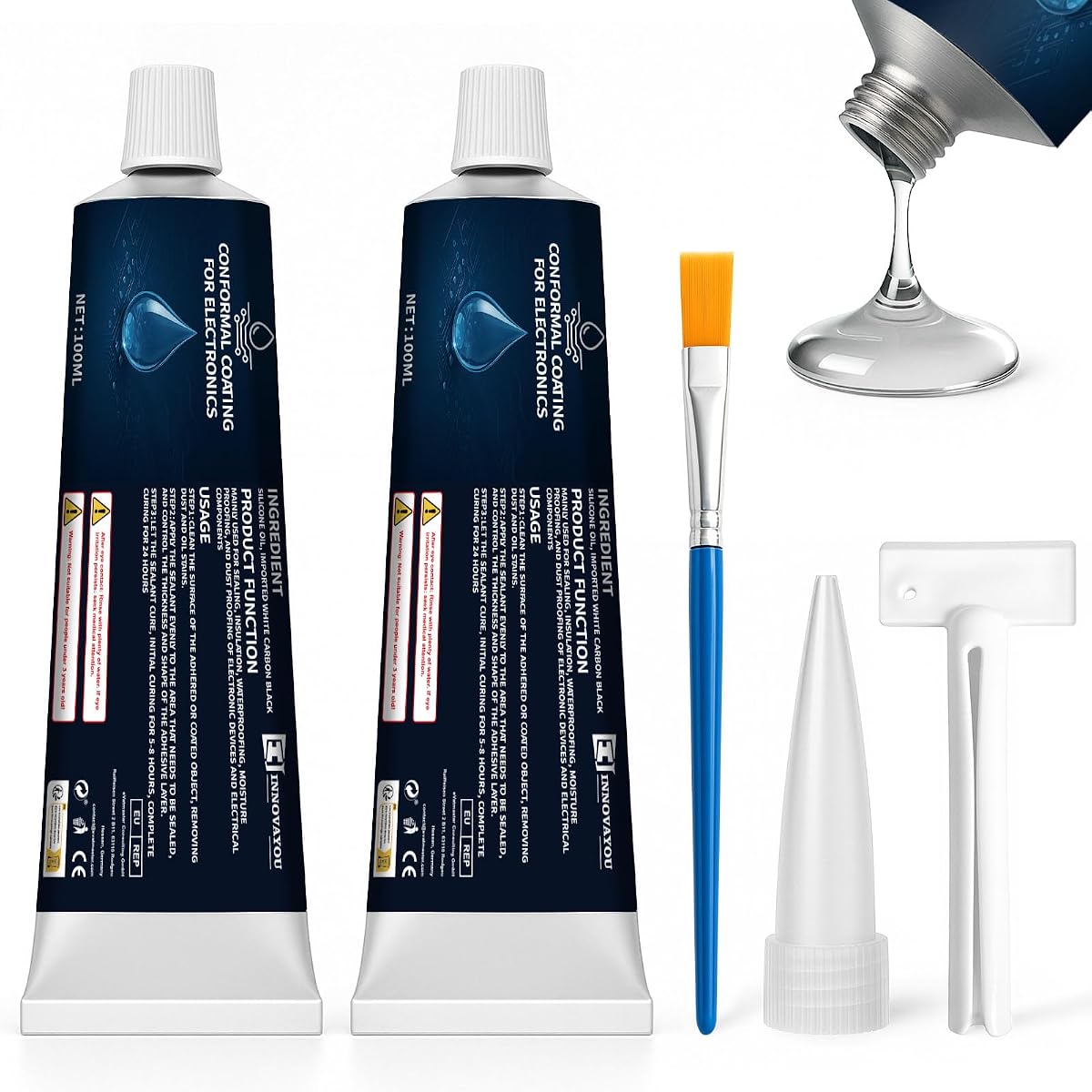


The Clear Silicone PCB Coating 100ml is a straightforward protective coating designed for PCB assemblies, control boards, LED modules, sensors, power supply boards, and other electronic assemblies. Its 5.0 rating makes it the highest-rated product in this guide, while the transparent silicone formula serves an important practical purpose: protected components remain visible during inspection.
We may earn a commission when you buy through this link, at no additional cost to you.
The product is described as forming a flexible insulating layer that conforms closely to the assembly while maintaining adhesion during normal operating temperature variations. That combination is valuable for a repair coating because rigid or poorly conforming finishes can become vulnerable when a board flexes or contracts. Clear visibility also makes the finish more approachable for maintenance work, where technicians need to identify solder joints, connectors, and signs of damage without stripping away the entire coating.
The main limitation is that the supplied product information does not state a specific drying or full-cure time, nor does it list formal safety, flammability, or equipment-validation certifications. Those details matter when a coating will be used in a controlled production process rather than a small repair. A prospective user should therefore confirm the manufacturer's technical documentation and verify compatibility with the specific PCB materials before beginning a larger project.
This coating is a compelling choice for electronics hobbyists, repair technicians, and builders working on LED assemblies, sensors, or control modules. It combines a flexible clear finish, a simple application process, and an unusually strong customer rating without adding specialized application equipment. For a straightforward protective layer that preserves visual access, it is an excellent starting point.
The transparent cured finish allows cables, solder joints, and components to remain visible, making it easier to check for damage or poor connections. This is particularly useful for LED modules and control boards that may require visual inspection after installation.
The silicone layer is described as remaining flexible and adherent through normal temperature variations. That makes it suitable for assemblies that may experience modest movement, thermal cycling, or repeated handling.
We may earn a commission when you buy through this link, at no additional cost to you.
The 1DFAUL 200ml Clear is a silicone conformal coating and insulating sealant intended to protect electronic components from moisture, dust, and humidity. Its 200ml capacity distinguishes it from many smaller bottles, making it more practical for multiple boards, repeated maintenance work, or applications that require a generous amount of coating.
We may earn a commission when you buy through this link, at no additional cost to you.
Once cured, the product is described as a flexible, invisible layer with waterproof, corrosion-resistant, and wear-resistant properties. It is intended to adhere closely without cracking during temperature fluctuations and to work on both metal and non-metal materials. The application process is uncomplicated: clean the surface, apply an even layer, allow five to eight hours for the initial stage, and wait the full 24 hours for complete curing.
Those curing times are the main practical drawback. A repair that can be handled after the initial stage may still be sensitive before full cure, so schedule downtime accordingly and avoid treating the surface as finished during the remaining period. The product information also does not mention formal flame-rating or automated-coating validation, which may matter for production work.
This option suits users who want a larger container of a versatile clear sealant for circuit boards, control boards, and general electronics maintenance. It is less convenient for very small projects, but the larger capacity makes it a sensible choice when one bottle needs to cover several assemblies or repeated touch-up jobs.
The 200ml format provides more material than a typical 100ml bottle, making it useful for batch maintenance or several small electronics projects. It reduces the need to purchase multiple containers when several boards need the same protective treatment.
The cured barrier is listed as waterproof, corrosion-resistant, and wear-resistant. These combined properties are appropriate for components exposed to humidity, dust, and ordinary handling conditions.
We may earn a commission when you buy through this link, at no additional cost to you.
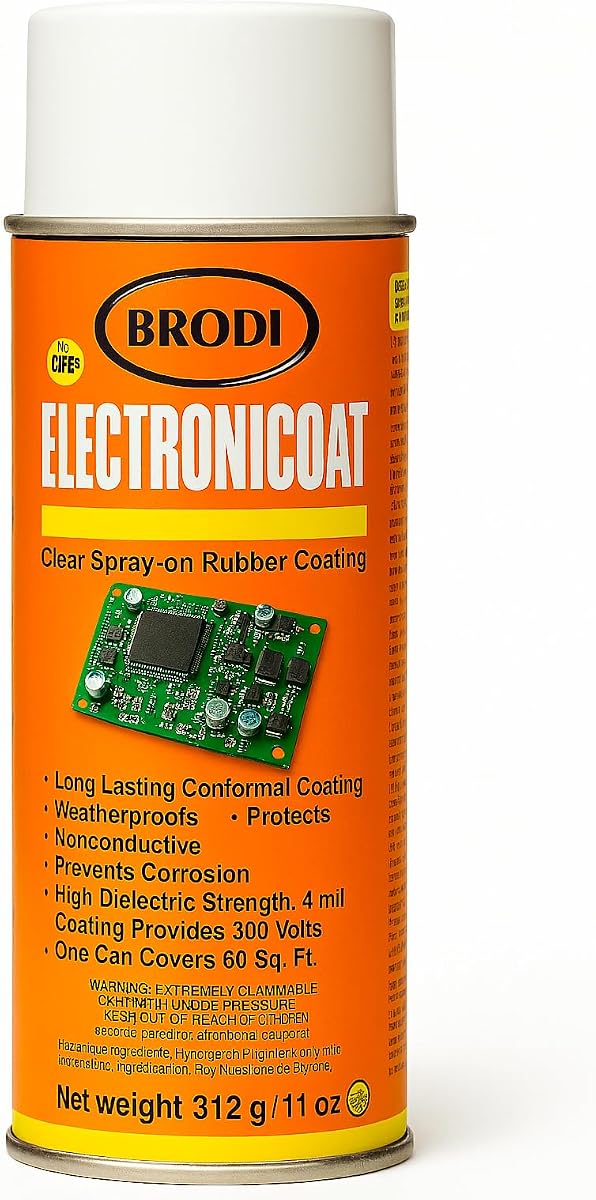
ElectroniCoat is a clear, rubber-style conformal coating spray built around fast application and strong electrical isolation. It carries a 4.4 rating and claims dielectric strength up to 9,500 volts. Its main attraction is convenience: the shake-and-spray format can cover intricate assemblies without brush marks, while the stated 15-minute drying time is useful for quick repairs.
We may earn a commission when you buy through this link, at no additional cost to you.
The coating is advertised as a permanent barrier against moisture, salt spray, rust, and corrosion, with bonding to metals, plastics, and insulation materials. Its transparent finish allows visual inspection of wires and connections after protection is applied. The combination of an elastomeric barrier and rapid drying is particularly relevant to marine, industrial, and outdoor electronics where exposure to weather and contamination is a concern.
Aerosol application is not automatically easier than brushing. Achieving consistent thickness requires controlled spraying, adequate distance, and attention to overlap and pooling. Ventilation and masking are also important because overspray can reach nearby components or surfaces. Users should follow the supplied safety directions and confirm the coating's compatibility with the materials in the assembly.
This product fits repairers who need a quick clear barrier and value spray coverage over a brush-applied finish. It is particularly compelling for terminal boxes, circuit connections, and exposed assemblies in demanding environments, provided the user can apply it carefully and allow the coating to reach its full cure.
A stated 15-minute drying time reduces the wait before an assembly can be handled or placed back into service. The surface-dry figure should not be confused with a full cure, so protection should be finalized according to the product instructions.
The stated 9,500-volt dielectric strength makes this coating appealing for protecting terminals, junction boxes, and circuit connections. Dielectric performance is especially important where condensation, contamination, or conductive debris could create a short circuit.
We may earn a commission when you buy through this link, at no additional cost to you.
MG Chemicals 422C is a professional-oriented silicone conformal coating in a 55ml bottle. It earns a 4.7 rating and combines broad protection with practical inspection features. The listed benefits include resistance to moisture, corrosion, dirt, dust, thermal shock, short circuits, high-voltage arcing, and static discharge.
We may earn a commission when you buy through this link, at no additional cost to you.
Its maximum service temperature of 200°C gives it a strong advantage for assemblies exposed to meaningful heat. Under UV-A light, the coating fluoresces, which helps users inspect coverage and identify missed areas. It can be handled in only ten minutes and has been validated for selective robotic coating equipment, showing that it is designed to bridge the gap between careful manual work and controlled production processes.
The 55ml bottle is small, so frequent production runs or extensive board coverage may require several units. Solvent-based or silicone-based cleanup and rework procedures may also be necessary, depending on the board and the materials used. Users should confirm whether a particular connector, adhesive, or repair compound is compatible before applying the coating over it.
This is a strong all-around choice for technicians, repair specialists, and serious hobbyists who want more than a basic clear sealant. The combination of thermal endurance, UV fluorescence, short handling time, and robotic validation makes it especially appropriate for quality-conscious work where coverage and inspection matter.
The coating's fluorescence provides a practical way to check application coverage under UV-A illumination. This can help reveal thin spots or missed regions during rework and quality-control workflows.
Validation for selective robotic coating equipment is a meaningful distinction for manufacturers. It indicates that the formulation has been assessed for use in established automated coating systems rather than being limited exclusively to hand-applied repairs.
We may earn a commission when you buy through this link, at no additional cost to you.
The Electronics Components Coating Kit is a 100ml clear insulating varnish supplied with an application brush. It offers a practical package for users who want direct control over coverage on circuit boards and individual components. Its 4.2 rating reflects a more general-purpose profile, but the included brush and simple three-step process make it approachable for maintenance projects.
We may earn a commission when you buy through this link, at no additional cost to you.
The fluid formula is described as flowing into gaps and producing consistent adhesion without streaks. Once cured, it forms a high-density electrical-insulation barrier that blocks moisture and reduces the risk of short circuits. The listed applications include aerospace boards, industrial boards, automotive electromechanical assemblies, and commercial or household circuit boards, giving it broad potential coverage.
The listed temperature range appears as “-40130,” which is ambiguous and should be confirmed with the manufacturer before use in a demanding environment. A full room-temperature cure takes 24 hours, and the product data does not list formal safety or flame-rating certifications. Those limitations make it better suited to established applications than tightly regulated production work unless supporting documentation is available.
This kit is a useful choice for electronics repairers, industrial maintenance teams, and hobbyists who prefer brush control and need a complete basic application setup. The included brush, smooth flow, and clear high-density barrier are its most attractive qualities, while careful attention to cure time and material compatibility is essential.
The package includes both 100ml of coating and a brush, removing the need to source an applicator separately. This makes the kit convenient for a first repair or for a technician who wants a straightforward brush workflow.
Good fluidity and automatic gap filling are intended to produce even coverage around closely spaced components. That helps reduce missed edges and streaks compared with a thicker, less mobile coating.
We may earn a commission when you buy through this link, at no additional cost to you.
The 100ml Clear Silicone Sealant combines a high-viscosity formula with the ability to spread across component surfaces. It carries a 4.6 rating and is intended for the protection, sealing, and insulation of electronic and electrical materials. Its listed uses include circuit boards, electronic components, LED lamps, and household-appliance control boards.
We may earn a commission when you buy through this link, at no additional cost to you.
The product is described as bubble-free, waterproof, dustproof, and resistant to expansion after curing. Good adhesion to most metals and non-metals is a valuable feature for assemblies made from mixed materials. Its high fluidity allows it to spread over the surface without leaving accumulated residue, helping create a more uniform protective layer.
The stated ability to dry within 15 minutes should be understood as a surface or product-specific drying claim, not necessarily a complete cure for every film thickness or ambient condition. The listing also provides no numerical service-temperature limit or formal certification. Those omissions matter for high-temperature, regulated, or safety-critical applications.
This sealant is a good general-purpose option for LED assemblies, control boards, and everyday electronics repair. It is especially attractive for users who value smooth application and strong adhesion, while its 4.6 rating indicates solid customer reception without claiming the same level of documented professional validation as the MG Chemicals products.
The formula is described as highly fluid despite its high viscosity, allowing it to spread evenly over components without heavy residue. That combination can help simplify manual coverage and reduce uneven-looking areas.
Compatibility with most metal and non-metal substrates makes the sealant versatile for boards containing connectors, plastic housings, and metallic components. Clean, dry surfaces remain essential for predictable adhesion.
We may earn a commission when you buy through this link, at no additional cost to you.
The Clear Silicone PCB Coating 100ml stands out for its 5.0 rating, the highest customer score among the ten products. It is explicitly designed for PCB assemblies, control boards, LED modules, and electronic components that need a flexible silicone insulating layer, making it one of the most focused choices for typical electronics maintenance.
We may earn a commission when you buy through this link, at no additional cost to you.
The transparent formula cures into a layer that conforms closely to the assembly and keeps components visible. It is described as maintaining flexibility and adhesion during normal operating temperature variations. That is an important balance: the finish must adhere well, but it should also tolerate the dimensional changes associated with heating and cooling instead of becoming a brittle shell.
Compared with the MG Chemicals choices, this product offers much less documentation in its listed specifications. It does not state a precise cure time, maximum service temperature, or formal flammability rating, and it has not been presented as validated for robotic application. Those details should be confirmed before the coating is used in regulated production or exposed to severe thermal conditions.
For DIY builders and repairers, the benefits are clear: a useful 100ml quantity, a transparent result, simple application, and applicability across a wide range of assemblies. It is also the most highly rated listing in this guide. Those strengths make it a sensible budget pick for everyday protection, inspection-friendly finishes, and small-to-medium maintenance projects.
Because the cured layer remains transparent, it is easier to examine solder joints, connectors, and component placement after coating. This is valuable for maintenance work where recurring visual checks are necessary.
The listed range includes PCB boards, LED lighting systems, control modules, sensors, and power supply boards. That versatility helps justify the bottle size for users who work on more than one kind of electronics.
We may earn a commission when you buy through this link, at no additional cost to you.
The 120ml Fast-Dry Coating is a clear silicone sealant positioned for rapid repairs and demanding environmental conditions. Its 4.4 rating is supported by an extensive list of practical claims, including a surface-drying time of 15 minutes, dielectric resistance above 10¹⁵Ω·cm, and operation from -60°C to 250°C.
We may earn a commission when you buy through this link, at no additional cost to you.
The self-leveling formula is intended to flow into gaps and complex component arrangements, providing even and bubble-free coverage without heavy buildup. The cured layer is advertised as flexible, waterproof, resistant to oxidation, and suitable for immersion. Listed applications include circuit boards, sensors, LED modules, power supplies, appliance controls, and RC electronics.
Some of these performance claims are unusually specific for a general marketplace listing, and the product information does not cite independent test standards or identify a formal certification. Users with safety-critical, regulated, or mission-dependent assemblies should request technical documentation before relying on the stated figures. A 15-minute surface-dry time also does not specify the full cure schedule.
Despite that need for verification, the product is attractive for users who want a large, fast-drying container and a broad operating-temperature claim. It is particularly relevant to RC electronics, LED lighting, and control boards that may encounter heat, cold, vibration, moisture, or industrial contaminants.
The low-viscosity flow is designed to move into spaces and around closely packed parts before leveling. This can produce a more uniform film and reduce visible buildup during manual application.
The stated -60°C to 250°C range is one of the broadest among the silicone products in this guide. It makes the coating a candidate for assemblies exposed to severe cold, heat, vibration, or industrial conditions, subject to technical verification.
We may earn a commission when you buy through this link, at no additional cost to you.
MG Chemicals 422B is the premium production-oriented option in this guide. The clear silicone aerosol carries a 4.7 rating and includes formal credentials that are not present in most competing listings: UL 94 V-0 certification, a maximum constant service temperature of 200°C, and testing in a salt-spray environment with no oxidation or coating damage.
We may earn a commission when you buy through this link, at no additional cost to you.
The product fluoresces under UV-A light, which assists with visual inspection of coverage. It has also been validated for selective robotic coating equipment, including PVA and Nordson ASYMTEK systems. These features are particularly relevant to manufacturers that need repeatable application, traceability, and a coating that can withstand demanding service environments.
Reworkability is another significant advantage. The coating can be soldered through or removed with MG Cat. No. 8309 Liquid or 8310A Gel stripper formulations. Aerosol application does require ventilation, masking, and careful control of overspray, and users should follow the product's safety and application instructions. The 340-gram container is also larger than a typical brush bottle.
This coating is the strongest choice for professional electronics manufacturing, industrial maintenance, and high-reliability assemblies where certification and rework procedures matter. Its combination of corrosion testing, flame classification, robotic validation, and service temperature makes it the most formally documented premium option here.
UL 94 V-0 certification and salt-spray testing provide a clearer technical basis than general moisture-resistance claims. These attributes are especially useful for industrial, automotive, and outdoor electronics where coating performance must withstand more than routine indoor handling.
The ability to solder through the coating or remove it with specified strippers makes repairs more practical. UV-A fluorescence also helps users locate coverage and inspect the finished assembly, reducing uncertainty during maintenance.
We may earn a commission when you buy through this link, at no additional cost to you.
MG Chemicals 419D is a premium acrylic conformal coating in a 55ml bottle. It has a 4.8 rating, the highest score among all ten products, and combines a smooth crystal-clear finish with formal IPC 830 listing and UL 94 V-0 certification under file E203094.
We may earn a commission when you buy through this link, at no additional cost to you.
The coating protects electronics from moisture, corrosion, and static discharge. It fluoresces under black light, helping users inspect coverage and identify missed areas, while its clear finish preserves the visibility of the underlying assembly. It is also formulated without hazardous air pollutants associated with toluene and xylene, which can be meaningful in occupied or production environments.
As an acrylic rather than a silicone coating, it may be less flexible when compared with the rubber-like and silicone options in this guide. That difference matters for boards exposed to repeated flexing or severe thermal cycling. The container is also only 55ml, so larger production runs may require multiple bottles. Rework requires compatible thinner, cleaner, or coating-stripper products.
This is a strong choice for users who value certification, inspection visibility, and a smooth professional finish. It is particularly appropriate for electronics repair and manufacturing where acrylic coating standards and rework procedures are already familiar.
The smooth, homogeneous clear finish supports visual inspection of the protected assembly. Black-light fluorescence adds another layer of coverage checking, helping identify uneven application during rework or process control.
Being free of toluene and xylene makes this coating more attractive for facilities where reducing hazardous air pollutants is a priority. It is formulated for professional use and carries both IPC 830 and UL 94 V-0 credentials.
We may earn a commission when you buy through this link, at no additional cost to you.
Choosing conformal coating for electronics requires matching the material and curing process to the assembly, environment, and inspection requirements. The most important factors are substrate compatibility, electrical insulation, environmental resistance, application control, and whether the finish must remain serviceable.
Choose the material according to the mechanical and thermal demands of the assembly, not just by appearance. Flexible silicone is often sensible for temperature variation, while acrylic may suit controlled production environments with established rework procedures.
Prioritize the full-cure schedule rather than the fastest advertised dry time. If a device must be shipped or energized quickly, confirm that the selected coating is genuinely ready for that workflow.
Look for protection that addresses both the environment and the electrical risk. A coating that blocks water but has weak insulation is incomplete, and strong insulation without chemical or moisture resistance may still allow long-term corrosion.
Select a coating whose verified range comfortably covers the assembly's normal and worst-case temperatures. Wide published ranges are useful, but documented operating limits are more valuable than an unsupported claim.
Practice on a scrap board before coating a valuable assembly. Consistent pressure, speed, distance, and layer thickness matter more than the novelty of a faster application method.
Balanced inspection and rework features are valuable for maintenance teams. A permanent-looking barrier is useful only when the assembly can still be opened and repaired when a component fails.
For commercial production, prefer documented standards and validated equipment compatibility over vague performance language. For personal projects, a well-matched clear sealant may be sufficient.
Test compatibility on a hidden area or representative scrap assembly. Good adhesion is valuable only if the coating can be applied and later removed without harming the finished product.
Begin by disconnecting the electronics from power and identifying components that must remain unmasked, including connectors, switches, buttons, sensors, heat-dissipation surfaces, and test points. Clean and dry the board thoroughly, removing dust, flux residue, fingerprints, and oils. Masking before application helps keep coating out of mating surfaces and preserves access to serviceable points. Work in a clean, ventilated area and follow the product-specific safety directions.
Apply a thin, even layer using the specified brush, bottle, or spray method. For brush coatings, use consistent strokes and avoid flooding small parts. For aerosols, shake the container, hold it at the recommended distance, and overlap passes evenly while controlling overspray. Allow the product to cure on clean, undisturbed surfaces for the full time stated by the manufacturer; a quick surface dry does not necessarily indicate complete electrical or environmental readiness.
After curing, inspect the coated assembly under normal light and, when the coating fluoresces, under UV-A or black light. Check for thin spots, bubbles, buildup, exposed connectors, and unexpected coverage. Reapply only as directed, allowing the additional layer to cure properly. For maintenance, protect the coating from abrasion, use compatible cleaning agents, and keep repair work within the coating system's rework guidelines so components and board surfaces are not damaged.
Conformal coating for electronics is a thin liquid material applied over circuit boards and electronic assemblies to create a protective barrier. After curing, it can resist moisture, dust, corrosion, chemicals, and static discharge while adding electrical insulation. Its thin profile allows it to follow component contours without changing the assembly's overall dimensions significantly.
A properly formulated conformal coating is intended to provide electrical insulation between protected components and the surrounding environment. Performance depends on the coating's dielectric properties, film thickness, coverage, and cure quality. Always verify the stated dielectric rating and avoid creating an unintended insulating bridge between contacts that must remain electrically separated.
Many products in this guide are specifically listed for LED modules, control boards, sensors, and appliance electronics. However, power components, connectors, switches, heat-dissipation surfaces, and adjustment points may need masking. Confirm the board materials, operating temperature, and any manufacturer-specific coating instructions before application.
Cure time varies considerably by product, film thickness, temperature, humidity, and application method. Some options in this guide are touch-handle-ready in 10 or 15 minutes, while others require 24 hours for full room-temperature curing. Follow the complete cure schedule from the manufacturer rather than relying on a surface-dry indication.
That depends on the coating system. MG Chemicals 422B can be soldered through or removed with specified MG strippers, and 419D supports rework with compatible thinners, cleaners, and strippers. Other coatings may require different removal methods, so verify compatibility with the board, components, labels, and enclosure materials before application.
Silicone is generally favored for flexibility, conformal adhesion, and temperature stability, while acrylic can provide a smooth, clear finish and established production standards. The right choice depends on flexing, heat, rework, application equipment, and inspection requirements. A high-performing coating is not automatically the best option if it does not suit the assembly's mechanical demands.
UV-A inspection is optional for many clear coatings, but it is valuable when the product fluoresces. MG Chemicals 422C, 422B, and 419D feature fluorescence that can help reveal coverage inconsistencies. Normal visual inspection is still necessary for exposed areas, masking errors, bubbles, and mechanical damage.
No. Conformal coating protects a functioning assembly and can reduce future contamination-related failures, but it does not repair damaged traces, cracked components, weak solder joints, or overheating. Diagnose and repair the underlying fault first, then apply coating to protect the corrected assembly from moisture, dust, and corrosion.
The Clear Silicone PCB Coating 100ml is the strongest budget-oriented choice, combining a 5.0 rating with a flexible, transparent finish and broad suitability for common electronics. MG Chemicals 422C is the editor's selection because it blends broad protection, a 200°C service temperature, UV fluorescence, quick handling, and robotic validation. For professional production environments, MG Chemicals 422B offers the most comprehensive formal credentials, including UL 94 V-0 certification and salt-spray testing.
The right choice depends on the project. Use a flexible silicone when temperature variation and adhesion are primary concerns, consider acrylic when clear inspection and established standards matter, and select a spray format when fast coverage of complex assemblies is more important than precise brush control. Cleaning, masking, consistent film thickness, and full curing are as important as the coating chemistry itself.
Before purchasing, compare the current product details, availability, ratings, and prices on the linked listings. Specifications and formulations can change, and manufacturer documentation should take priority where an application is technical or safety-sensitive. Checking the latest information helps ensure that the selected conformal coating still matches the board, environment, and service expectations of your project.