VIVOSUN 43 Gallon Black Door
4.3Editor score
Dual 43-gallon chambers
360-degree rotating design
Included waterproof garden gloves
Explore our Compost Tumblers guide comparing ten dual-chamber models for capacity, aeration, durability, ease of rotation, and continuous composting at home.
Compost tumblers make organic waste management more convenient by combining two rotating chambers, internal mixing features, and ventilation in an enclosed outdoor design. The best unit balances usable capacity, smooth rotation, effective aeration, durable construction, and convenient access while helping turn kitchen scraps and yard debris into useful compost.
This guide compares ten dual-chamber compost tumblers by considering chamber capacity, rotating design, airflow controls, door access, frame strength, assembly, and included accessories. The list covers compact options for smaller gardens, larger systems for serious growers, and feature-rich bundles that add gloves, monitoring equipment, or complementary composting supplies.
Each review explains where a tumbler stands out, identifies practical trade-offs, and clarifies which type of gardener it may suit. Ratings and specifications reflect the supplied product information, while availability and prices can change. Always verify the current listing and included accessories before making a purchase.
4.3Editor score

4.2Editor score

4.4Editor score
The table below compares all ten models by capacity, chamber layout, rotation system, ventilation, construction, and practical features, making it easier to identify the right tumbler for your garden.




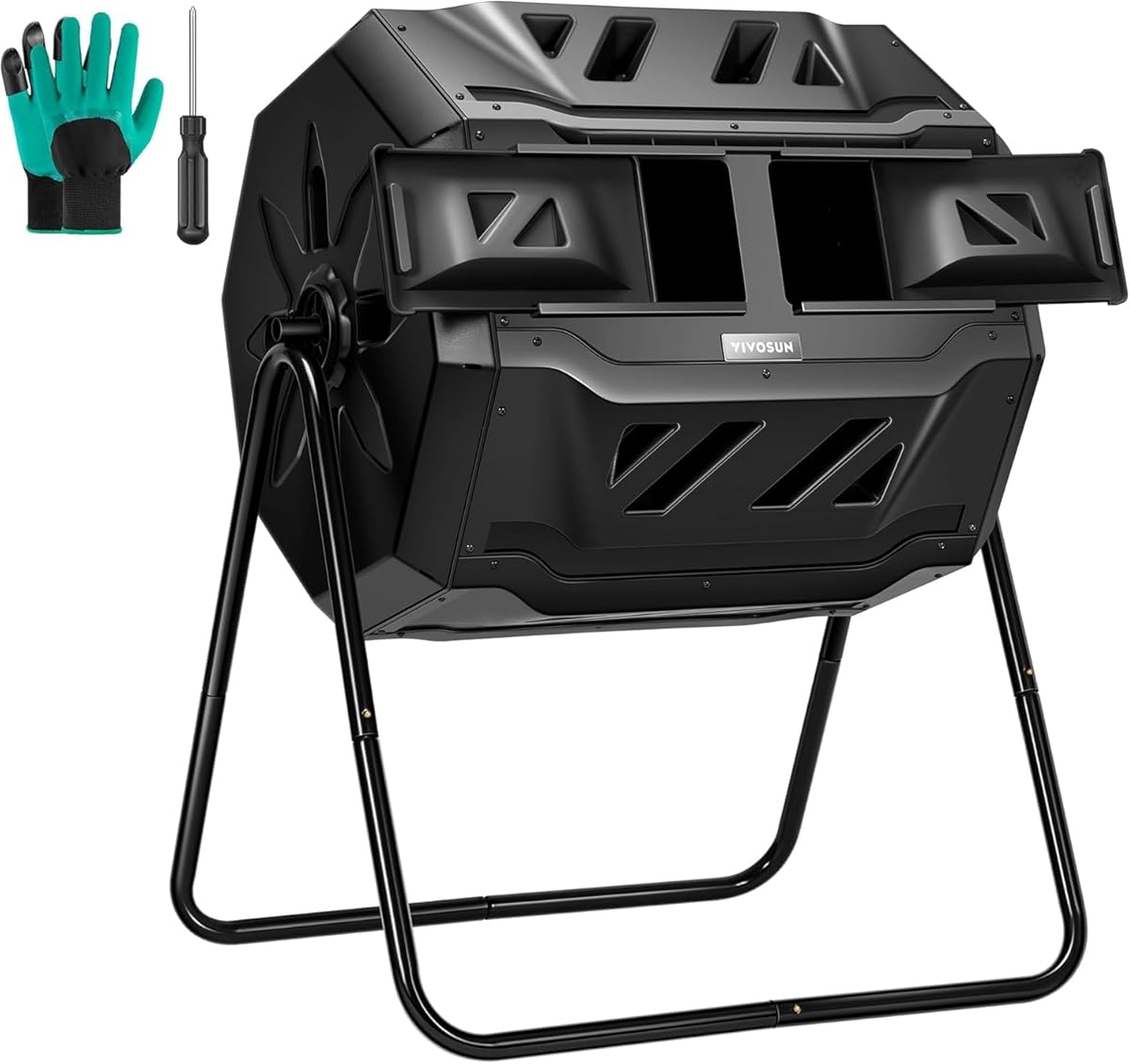
The VIVOSUN 43 Gallon Black Door is a dual-chamber outdoor tumbler that combines rotating batch composting with a ventilated, weather-resistant body. Its 4.3 rating reflects a broadly practical design, and the strongest qualities are the separation of active and curing material, the 360-degree tumbling action, and the included gloves for handling garden debris.
We may earn a commission when you buy through this link, at no additional cost to you.
The two chambers support continuous use: one side can process fresh waste while the other finishes composting. Deep fins on eight panels help break up clumps and move material when the barrel rotates, while vents circulate air through the chamber. A metal frame and polypropylene body provide a combination of structural support and corrosion and weathering resistance.
The main limitation is scale. A 43-gallon system is substantial for a modest garden, but it may hold less than some higher-capacity models. The rotating action and deep fins require occasional manual effort, and glove fit will vary among users. These are manageable trade-offs for a straightforward, versatile tumbler.
This is a strong choice for households that regularly generate kitchen scraps and yard waste but do not need the largest possible drum. It is especially appealing for gardeners who value continuous composting, simple access, and useful bundled accessories. Among practical mid-capacity options, it offers a balanced package.
The split chamber design lets you add fresh material without disturbing the batch already decomposing. Alternating between the two sides can create a steadier supply of finished compost for beds, containers, and ornamental gardens.
Deep internal fins aid mixing, while vents introduce airflow needed by decomposing organisms. The metal frame and polypropylene body are designed to resist corrosion, weathering, and the normal wear associated with outdoor composting.
We may earn a commission when you buy through this link, at no additional cost to you.
This 43-gallon dual-chamber tumbler is built around a simple goal: keep one compartment working while the other matures. It carries a 4.4 rating and includes Pearson's latex rubber gardening gloves. Its insulated compartments, internal paddles, and rotating structure make it a practical option for households seeking a continuous compost workflow.
We may earn a commission when you buy through this link, at no additional cost to you.
Rotation introduces oxygen to the center of the material while paddles help mix the waste. The side-by-side chambers are described as insulated, helping conserve heat generated by decomposition. Sliding doors provide direct access for loading ingredients and removing finished compost, and the tumbler accepts kitchen scraps, grass clippings, and other organic yard material.
Unlike some competing designs, this model does not advertise adjustable vents or a brake-locked handle. Its ventilation is built into the overall tumbler design, so users who want precise control over airflow may prefer a model with explicit vent settings. It is also worth distinguishing this listing from the closely related 43-gallon model in another position.
Choose it if you want an uncomplicated rotating composter with heat-retentive chambers and no need for extensive monitoring equipment. It is well suited to regular kitchen waste and garden clippings, particularly when a gardener values a ready supply of compost and included gloves.
Turning the drum mixes organic matter with oxygen, helping the organisms responsible for decomposition remain active. Internal paddles increase the chance that material moves throughout the chamber instead of remaining compacted in one area.
The bundled latex rubber gloves are intended for digging, planting, and general garden work. They provide a convenient way to begin handling compost-related materials without making gloves a separate purchase.
We may earn a commission when you buy through this link, at no additional cost to you.
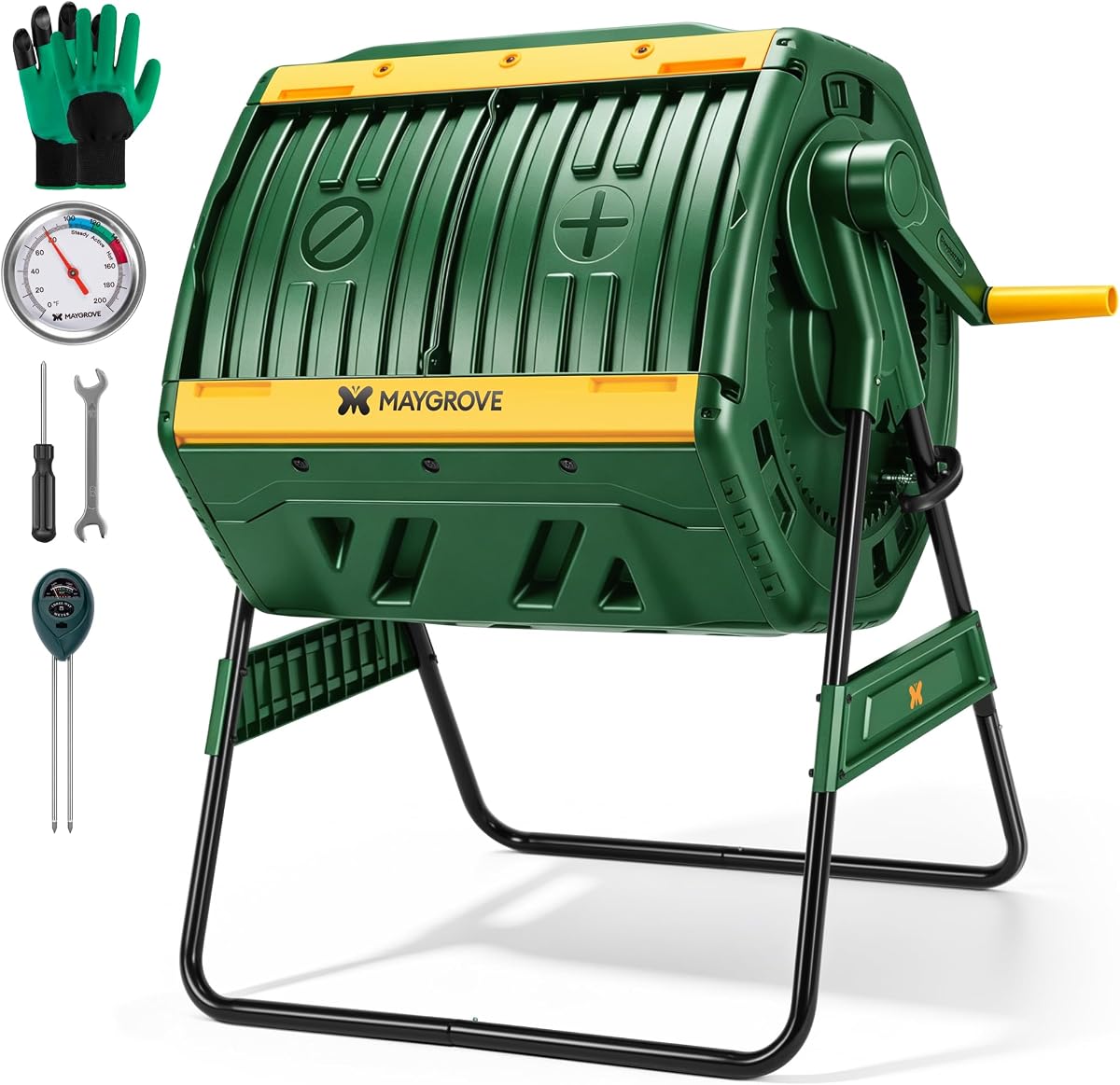
The Maygrove 53 Gallon is a large outdoor compost tumbler for gardeners who want generous capacity and more control over the decomposition environment. Its 4.2 rating is supported by a 360-degree rotating design, built-in mixing bars, adjustable air vents, large sliding doors, and a gear-assisted handle.
We may earn a commission when you buy through this link, at no additional cost to you.
The dual chambers allow fresh kitchen scraps to be added to one side while the other finishes decomposing. Adjustable vents give the user control over airflow, moisture, and temperature, while mixing bars help distribute contents during rotation. Extra-large sliding doors simplify loading and harvesting, and dual-direction brake locks keep the drum stationary while it is being used.
Its large size requires adequate space and a level outdoor location. The 53-gallon format is more than a small household may need, particularly if waste generation is modest. Assembly uses snap-together construction with minimal screws, which helps offset the more involved structure of a large tumbler.
This is a strong recommendation for serious backyard growers, landscapers, and households producing substantial organic waste. The combination of capacity, ventilation control, loaded rotation assistance, and stable braking makes it a well-rounded choice for users who want more control than a basic tumbler provides.
Adjustable vents let the user respond to changing conditions inside the drum. This is useful when material seems too dry, too damp, or insufficiently aerated, and it provides more oversight than a fixed-vent design.
The ergonomic gear-assist handle supports smoother turning, including when the drum is loaded. Dual-direction brake locks hold the barrel in position, reducing unwanted movement while loading, checking, or emptying the chambers.
We may earn a commission when you buy through this link, at no additional cost to you.
The 45 Gallon Large Compost Tumbler is a dual-chamber outdoor model offering a strong balance of capacity, airflow control, and straightforward construction. Its 4.6 rating is the highest among the listed products, making it a notable option for gardeners who prioritize useful adjustment features without moving to the largest drum size.
We may earn a commission when you buy through this link, at no additional cost to you.
Two independent 22.5-gallon chambers support the familiar workflow of loading fresh waste on one side while the other decomposes. A 360-degree system eliminates the need to dig or hand-mix the pile, and mixing ribs plus deep fins help break up clumps. Multiple adjustable vents support airflow and odor reduction, while a reinforced steel frame and weather-resistant polypropylene body add structural confidence.
The tumbler is designed to snap together without a complicated setup, and installation videos are provided. One drawback is that it does not include temperature or soil-monitoring tools. Its dimensions are also presented with approximate unit conversions, so buyers needing exact measurements should check the listing and available space before ordering.
This model is a persuasive choice for new and experienced composters who want a clear four-to-five-week decomposition goal, generous openings, and adjustable ventilation. It suits medium-to-large gardens without requiring the largest available system.
Multiple adjustable vents are the defining feature of this model. They provide a way to increase or reduce airflow as the material changes, helping limit clumping and unwanted odors during active decomposition.
The 45-gallon capacity, divided into two equal chambers, offers useful room for kitchen scraps and yard waste. It is a middle ground between compact household tumblers and the largest multi-accessory systems in the guide.
We may earn a commission when you buy through this link, at no additional cost to you.
The MAYGROVE 53 Gallon adds monitoring equipment to an already capable dual-chamber tumbler. It has a 4.4 rating and stands apart through the inclusion of an IP55 waterproof compost thermometer and a 3-in-1 soil tester for measuring moisture, pH, and light levels.
We may earn a commission when you buy through this link, at no additional cost to you.
The rotating 360-degree design uses built-in mixing bars, and adjustable vents provide control over airflow, moisture, and temperature. A gear-assisted ergonomic handle supports rotation when loaded, while sliding doors make loading and harvesting easier. Brake locks secure the drum in either direction, and the UV-resistant plastic body sits within a heavy-duty steel frame.
The monitoring tools may be more than a casual composter needs, but they make this a thorough package for someone trying to understand pile conditions rather than simply rotate on a schedule. The large 53-gallon size also demands sufficient space, and a gardener with only occasional kitchen scraps may not fill it efficiently.
Buy this model if you want substantial capacity, adjustable aeration, and objective tools for checking compost and soil conditions. It is especially relevant to methodical gardeners who plan to monitor moisture, pH, light, and internal temperature as part of their routine.
The waterproof thermometer helps identify internal pile temperatures and when turning may support stronger microbial activity. It gives composters a more informed way to judge whether the batch is progressing as expected.
The 3-in-1 soil tester measures moisture, pH, and light levels. That makes it useful both for evaluating finished compost and for checking the growing area where the finished material will eventually be used.
We may earn a commission when you buy through this link, at no additional cost to you.
The Miracle-Gro Large Dual Chamber Compost Tumbler is designed for high-volume composting, offering 55.4 gallons across two 27.7-gallon chambers. Its 4.2 rating fits a dependable traditional tumbler with a galvanized steel base, side-locking mechanisms, tight seals, and UV-protected, food-grade plastic.
We may earn a commission when you buy through this link, at no additional cost to you.
The dual-chamber format supports constant production by allowing ingredients to be added to one side while the other cures. A sliding-door design makes loading and unloading more accessible, and the rotating barrel removes the need to dig, turn, or mix by hand. The manufacturer also describes a target of ready compost in approximately four to six weeks.
This is a large appliance rather than a compact garden accessory. Users need to consider both footprint and whether they can generate enough material to use the capacity well. It does not include adjustable monitoring equipment or the extensive accessory bundle offered by some competing listings.
It is a good fit for established vegetable gardeners, landscape projects, and households with substantial compostable waste. The emphasis is on high capacity, familiar rotating operation, durable construction, and pest-resistant seals rather than advanced controls.
Two 27.7-gallon compartments provide considerable working volume, which is useful for seasonal yard waste and frequent kitchen scraps. The larger capacity can reduce how often material must be transferred to another container.
A galvanized steel base supports the plastic drum, while side-locking mechanisms help secure the rotating sections. Tight seals and UV-protected, food-grade plastic are intended to support dependable, all-season operation.
We may earn a commission when you buy through this link, at no additional cost to you.
The Miracle-Gro 37 Gallon offers a more moderate version of the brand's dual-chamber tumbler design. It provides 37 gallons divided into two 18.5-gallon chambers and carries a 4.2 rating. Its sliding doors, galvanized steel base, side locks, and UV-protected plastic make it a familiar, straightforward outdoor composter.
We may earn a commission when you buy through this link, at no additional cost to you.
One side can hold new ingredients while the other is treated as the curing side, helping a gardener maintain a steady compost supply. Rotation mixes the pile and reduces the need for manual digging. A few turns every few days are enough to operate the system, according to the product information, and the intended decomposition period is four to six weeks.
Its smaller capacity than the 55.4-gallon Miracle-Gro model may be a positive for limited spaces, though it will fill more quickly during periods of heavy waste generation. It lacks the extra monitoring tools, brake locks, and adjustable vents found in some newer competing models.
This tumbler is well suited to gardeners who want a recognized dual-chamber system without the largest footprint. It is a practical choice for routine kitchen scraps, grass clippings, and a moderate flow of organic garden waste.
Each 18.5-gallon compartment provides a distinct working and curing space. This arrangement makes it easier to add new material without prematurely disturbing compost that is already farther along.
The user only needs to rotate the tumbler periodically rather than mix the material with a fork. Sliding doors streamline both loading and harvesting, and the side-locking mechanisms help keep the sections secure.
We may earn a commission when you buy through this link, at no additional cost to you.
This 43-gallon dual-chamber tumbler pairs rotating composting with insulated compartments and bundled Pearson's gardening gloves. It has a 4.4 rating and is designed for users who want to process kitchen throwaways, grass clippings, and organic yard waste without manually turning a conventional pile.
We may earn a commission when you buy through this link, at no additional cost to you.
The side-by-side chambers are described as insulated, helping retain the heat produced by decaying material. Internal paddles mix and aerate the contents when the drum is turned. Sliding doors allow the same opening to be used for filling the tumbler and removing the finished compost once it has matured.
The design does not advertise adjustable ventilation, a geared handle, or brake locks, so it offers fewer active controls than premium alternatives. It also closely resembles another listed 43-gallon Pearson's Gloves product, making the distinction between the two listings important when comparing the set of features.
Choose it for a compact continuous-composting setup with a focus on heat retention and simple access. It is appropriate for gardeners who value simple rotation over sophisticated monitoring or granular control over airflow.
The insulated compartments help conserve heat generated during decomposition. Retaining warmth supports the organisms and processes that turn mixed organic material into finished compost.
Sliding doors remove the need to reach into a conventional open pile. The same accessible opening supports adding raw material at the start and retrieving cured compost when the batch is ready.
We may earn a commission when you buy through this link, at no additional cost to you.
The MAZE Two Stage 65-gallon system is the most extensive package in the guide. Its 4.4 rating is backed by a large rotating drum, extra-large double doors, a geared locking handle, adjustable built-in vents, and an open frame that makes unloading easier. The bundle also includes a 12-gallon compost cart, a 1.85-gallon kitchen caddie, sixty compostable corn bags, and a retractable plant caddie.
We may earn a commission when you buy through this link, at no additional cost to you.
The drum uses UV-resistant, high-impact plastic and a framework designed not to rust. Its geared handle is intended to make turning easier when the composter is fully loaded. Sliding loading and unloading doors open into a large opening, while the open-frame base provides clearance for collecting the finished material below.
This package requires meaningful storage space and is more complex than a standard tumbler alone. Some buyers may not need the kitchen caddie, plant caddie, or numerous corn bags, and the plant caddie's listed eight-pound holding capacity should be considered carefully. The large dimension also calls for deliberate placement before assembly.
It is the premier option for a dedicated composter who wants a complete collection and handling system rather than only a barrel. Serious gardeners, landscapers, and households with multiple compost-related tasks can gain the most from the coordinated accessories.
The included cart, kitchen caddie, corn bags, and plant caddie extend the system beyond the tumbler itself. This makes it attractive to users who want a coordinated approach to collecting, moving, and using compost around a garden.
The open frame beneath the drum gives room to position a container or cart under the large doors. The geared locking handle supports easier rotation, and the sliding openings reduce the physical work involved in transferring material.
We may earn a commission when you buy through this link, at no additional cost to you.
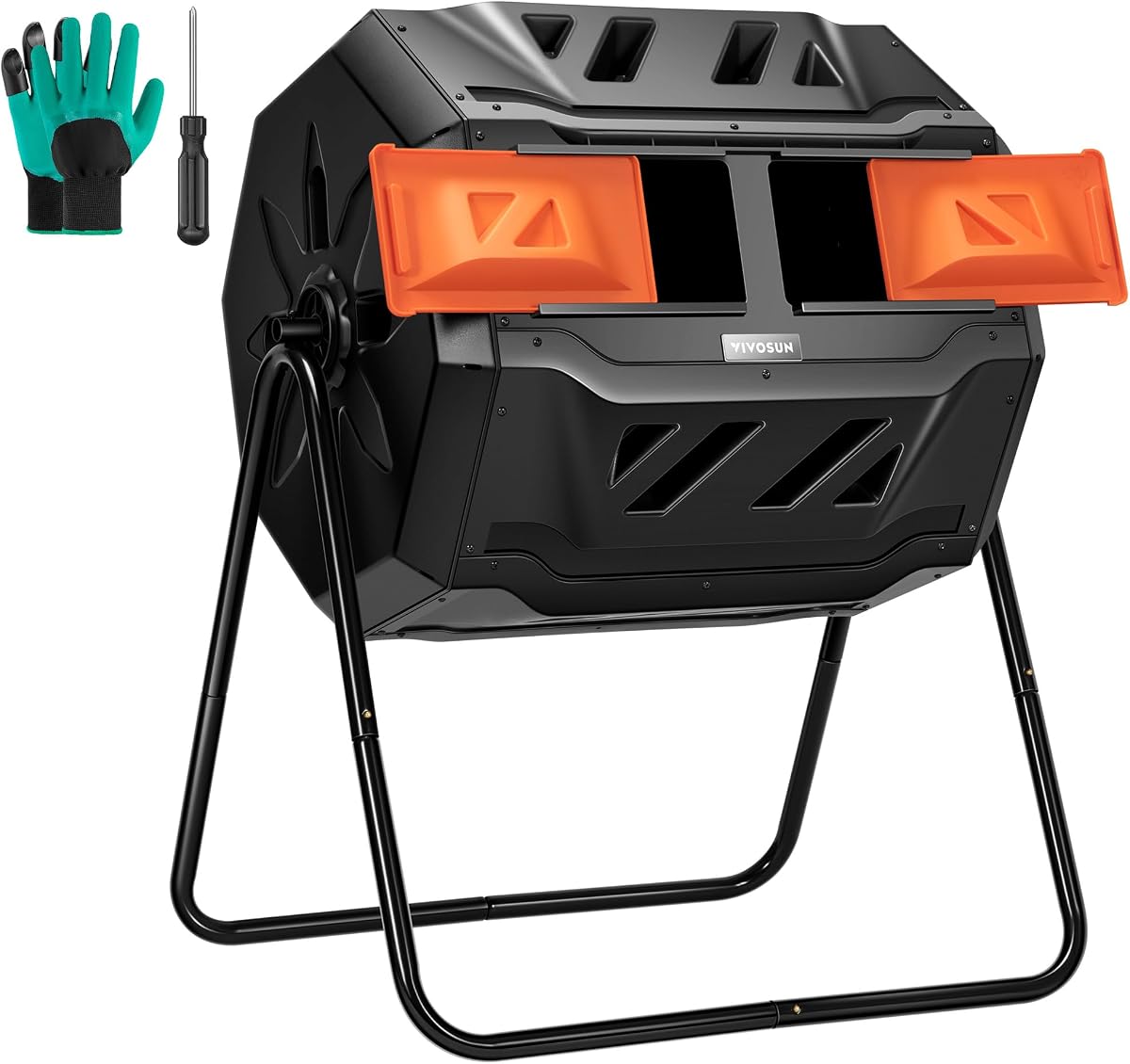
The VIVOSUN 43 Gallon Orange Door shares the core operating concept of the black-door model while providing a distinct listing and door color. It has a 4.3 rating and combines twin chambers, 360-degree tumbling, deep fins, air vents, and a corrosion- and weathering-resistant frame and polypropylene body.
We may earn a commission when you buy through this link, at no additional cost to you.
The two chambers make it possible to keep decomposing material separate from a fresh batch. As the drum rotates, the deep fins on eight panels help move and break apart clumps. Air vents support circulation through the contents, while the enclosed rotating design avoids the need to dig or mix a stationary pile by hand.
Its main limitation is that the underlying design is very similar to the other VIVOSUN model in the guide, so the distinction may come down to listing preference, appearance, or current availability. The 43-gallon capacity is also moderate compared with the 53-, 55.4-, and 65-gallon options.
This model is well suited to users who want the VIVOSUN rotating format and value the included waterproof gloves with four ABS plastic claws. It is a practical choice for routine kitchen and yard waste, especially where moderate capacity is easier to manage.
The included waterproof gloves are designed to protect hands while handling wet compost and garden material. Four durable ABS plastic claws add support for digging and planting tasks.
The internal fins break up clumps and help move material as the barrel turns. Combined with ventilation, this design supports a more evenly mixed and aerated composting batch.
We may earn a commission when you buy through this link, at no additional cost to you.
A useful tumbler should make composting easier rather than simply add another large container to your yard. Consider capacity, airflow, rotation, access, construction, and the amount of waste your household actually produces.
Capacity ranges from 37 gallons to 65 gallons in this guide, with most models using two equal chambers. Larger drums can accept more grass clippings, leaves, and kitchen scraps before becoming difficult to rotate. However, excess empty space can reduce the contact between material and make a batch less efficient. Match the tumbler to your typical weekly waste output rather than choosing the largest option by default.
Two independent chambers are central to continuous composting. One side can hold a fresh batch while the other finishes curing, preventing the need to combine immature and nearly finished material. Models with insulated compartments may also retain decomposition heat. Look for doors that give direct access to each side so adding scraps and harvesting compost remain separate tasks.
A smooth rotating action matters because a full tumbler can be heavy. Geared handles, gear-assist systems, deep fins, and internal paddles all help move the contents and distribute oxygen. Dual-direction brake locks can keep the drum stable while loading or unloading. The best design is one you can turn regularly without excessive force.
Active decomposition depends on oxygen, so every tumbler needs adequate airflow. Fixed vents are common, while adjustable vents give users greater control as moisture and temperature change. Insulated chambers may retain heat well but benefit from ventilation that prevents excessive pressure and unwanted odors. Consider the local climate and how often you can monitor the contents.
Look for a sturdy metal frame combined with UV-resistant or otherwise weather-resistant plastic. Reinforced legs help prevent barrel sagging, while a corrosion-resistant base is important in damp environments. Secure side locks and tight seals improve structural stability and may help exclude pests. No tumbler should be expected to remain in poor condition indefinitely outdoors.
Sliding doors are convenient because they open directly into the chamber without requiring removable panels. Wider openings make bulky yard waste easier to insert and finished compost easier to collect. An open frame beneath the drum can also create space for a cart or container. Match door size and unloading clearance to the tools you plan to use.
Some tumblers use snap-together construction and minimal screws, while others require more involved assembly. Instructions and installation videos are useful, but a clear understanding of the parts before starting can prevent frustration. Larger and more complex systems also need adequate space during assembly, so check the packaging dimensions and intended operating location.
Bundled gloves are useful for handling wet compost, while a thermometer and soil tester can help monitor temperature, moisture, pH, and light. The MAZE package also provides a cart, kitchen caddie, compostable corn bags, and a plant caddie. Accessories add convenience, but they do not replace good capacity, ventilation, and a sound rotating mechanism.
Start by placing the tumbler outdoors on stable, level ground with enough clearance to rotate the drum and open the doors. Keep the base away from standing water and allow room to access the loading side. Before adding material, confirm that the frame is secure, the doors slide properly, and the locking or brake mechanisms hold the barrel in position.
Load kitchen scraps, grass clippings, and other suitable organic material into one chamber while leaving room for the drum to turn. A balanced mixture of green and brown waste is important because the different materials contribute different needs during decomposition. Rotate the tumbler periodically so contents mix and receive fresh oxygen, using the geared handle or assist system rather than forcing the barrel.
Monitor the contents for moisture, odor, and decomposition progress. If the pile is excessively dry, add suitable material; if it is very wet or compacted, improve mixing and airflow. Use a thermometer when checking internal conditions, and harvest compost when it appears finished. Afterward, clean the chamber, inspect the frame and vents, and leave the tumbler ready for the next batch.
Turn it often enough to keep the contents mixed and aerated, commonly every few days or whenever the material appears compacted. The exact schedule depends on how much you add, the moisture of the waste, and the weather. Consistent rotation is generally more useful than waiting long periods between turns.
Kitchen scraps, grass clippings, leaves, and other suitable organic garden waste are common inputs. Build a balanced mixture rather than filling one chamber with only a single type of material. Avoid putting meat, dairy, oily foods, and other materials that are unsuitable for a basic outdoor compost system into the tumbler.
A tumbler makes mixing and aeration easier because you rotate the barrel rather than digging into a pile. Its enclosed structure can also help contain odors and keep pests out. It is especially useful when a gardener wants a cleaner handling process and can rotate the drum regularly.
A dual-chamber design is convenient when you want fresh material to decompose separately from a nearly finished batch. You can alternate between sides and keep a more continuous supply of compost. If you only compost occasionally or produce very little material, a single chamber may be sufficient, but all models in this guide use two chambers.
No. A larger model is useful for substantial waste, but it also requires more space and may be harder to rotate if underfilled. A smaller tumbler can process material more efficiently when it is filled at an appropriate level. Capacity should be matched to your waste volume and available space.
Ease of rotation depends on the load, internal paddles, handle design, and barrel balance as much as on total capacity. A geared or gear-assisted handle can help, and shallow internal ribs may make a full drum more manageable. A smaller model may feel easier to turn, while a larger system is better when the material must be spread among multiple chambers.
Finished compost should look dark and crumbly, with much of the original material no longer easily recognizable. It should have an earthy smell rather than a sharp odor. A thermometer or soil tester can provide additional information, but appearance, texture, and smell remain useful practical checks.
They are designed for outdoor use, where the material can receive changing conditions and the enclosed drum can work as intended. Choose a location with good drainage, stable ground, and clearance for rotation and door access. Protect the unit from extreme impacts and verify that local conditions suit outdoor plastic and metal components.
The VIVOSUN 43 Gallon Black Door stands out as a balanced, budget-conscious choice, while the Maygrove 53 Gallon offers greater capacity, adjustable vents, and easier rotation. For gardeners seeking a complete system, the MAZE 65-gallon bundle adds a cart, kitchen caddie, compostable bags, and a retractable plant caddie to its large, accessible tumbler.
Prioritize the features that match your routine: ample capacity for heavy waste, two chambers for continuous batches, easy rotation for frequent maintenance, and adjustable airflow if you want closer control. Accessories and monitoring tools are useful, but a stable frame, effective mixing, and straightforward access to both chambers form the foundation of a successful system.
Before ordering, check the current listing, dimensions, assembly instructions, and included components because product details and prices can change. Also consider where the tumbler will sit throughout the year and how much organic waste you realistically generate. Those checks will help you choose a compost tumbler that remains convenient to use rather than simply occupying outdoor space.