
ACMER S1
4.3Editor score
Compact 2.5-watt laser system
Nearly complete factory assembly
Broad desktop software compatibility
A cheap laser engraver can turn personalized gifts, labels, signs, prototypes, and decorative pieces into practical projects, but low purchase cost does not guarantee dependable results. Important differences in laser power, working area, precision, safety systems, software, and included accessories can substantially affect your experience.
This guide compares ten affordable laser engravers across essential buying considerations, including engraving and cutting capability, material compatibility, control options, setup requirements, and protection features. It covers compact open-frame models, enclosed machines, touchscreen systems, and portable designs for different budgets and project volumes.
Each review explains the strongest reasons to consider a particular model while also noting meaningful limitations. The selections show how a budget engraver can suit a first-time hobbyist, a classroom, a home workshop, or a growing customization business. Product availability and prices change, so confirm current details before buying.
4.3Editor score

4.5Editor score

4.4Editor score
As an Amazon Associate we earn from qualifying purchases.
The table below compares the ten shortlisted machines by laser configuration, working area, control options, and key production features, making it easier to identify the model that matches your materials, workspace, and experience level.



The xTool M2 is the strongest all-around choice for buyers seeking a cheap laser engraver that does not feel like a basic workshop machine. It combines a 10-watt diode laser with a fully enclosed Class 1 housing, two integrated cameras, and xTool Studio software. Its listed rating is 4.5, reflecting a well-rounded package for new and experienced makers.
We may earn a commission when you buy through this link, at no additional cost to you.
The dual-camera arrangement is the feature that sets the M2 apart from most entry-level alternatives. A real-time workspace view, paired with ACS-assisted positioning and motion control, helps users place materials accurately and reduces guesswork. This is especially valuable for small items, irregular shapes, and designs that must be centered precisely. The enclosed design also provides a more reassuring option for homes, classrooms, and shared creative spaces.
xTool Studio lowers the learning curve with ready-made templates and an integrated AI image generator, while the underlying architecture allows more advanced workflows when needed. The standard machine supports 10-watt diode engraving and cutting, and the dual-mode design can accept a separate CMYK inkjet module or 3-watt infrared laser. Those add-ons are not included, and the supplied information does not suggest that the basic diode configuration handles every metal-plastic task as effectively as a dedicated infrared module.
The M2 is especially appropriate for beginners, gift makers, educators, and home businesses that value placement accuracy, enclosure safety, and simple software. It is less ideal for buyers whose main goal is maximum cutting power in a large-format machine. Overall, its combination of approachable controls, visual guidance, and flexible expansion makes it the most complete general-purpose option in this guide.
The built-in cameras give makers a clear view of the working area before the laser begins. That visibility is especially useful when positioning small parts, batch templates, or designs on uneven materials without relying entirely on manual measurements.
The fully enclosed housing and template-driven xTool Studio interface make the M2 approachable outside a dedicated workshop. Optional printing and infrared modules can broaden its capabilities when the initial project mix calls for more versatility.
We may earn a commission when you buy through this link, at no additional cost to you.
The ACMER S1 is a compact entry point for simple personalization, labels, prototypes, and light cutting tasks. It uses a 2.5-watt diode laser and has a listed rating of 4.3. While it is not the most powerful model here, it offers a useful combination of fast engraving, high repeatability, broad operating-system support, and simple setup.
We may earn a commission when you buy through this link, at no additional cost to you.
Most importantly for a first-time buyer, the S1 arrives 99 percent preassembled and only requires installation of the laser head. Free Acmerstudio software is included, while compatibility with LightBurn and LaserGRBL gives users alternative workflows. It accepts NC, DXF, BMP, JPG, and PNG files and works with macOS, Windows, and Linux, which reduces the likelihood of being locked into one particular design environment.
The main compromises are physical rather than software-based. Its 130 by 130mm work area is the smallest in the group, so it cannot accommodate signs, larger blanks, or multiple pieces at once. The 2.5-watt laser is best suited to engraving and cutting thinner woods, bamboo, leather, plastics, and other suitable materials rather than demanding thick-material fabrication. It is also listed as Class 4, making careful operating procedures and appropriate laser-safety practices especially important.
The S1 is a compelling choice for a student, hobbyist, or occasional maker who needs a capable desktop engraver without a complicated assembly process. Its compact 2kg aluminum body is easy to store and carry. Buyers who need a larger bed, stronger cutting ability, or a fully enclosed housing should save up and consider one of the midrange alternatives, but for small affordable projects the S1 makes a persuasive first machine.
A one-minute laser-head installation and largely preassembled frame make the S1 convenient for new users. It can be introduced to basic engraving without first navigating belt tensioning, frame alignment, or a lengthy build process.
The small work area and light 2kg frame make this engraver easy to store between sessions. It is most effective for individual tags, keychains, small decorations, jewelry components, and other compact pieces.
We may earn a commission when you buy through this link, at no additional cost to you.
The BlazeX M3 combines a 10-watt laser with an enclosure, honeycomb bed, tool kit, and 13 sample engraving materials. Its listed rating is 4, which places it below several competitors, but the package offers considerable value for a beginner who wants a ready-made desktop setup rather than assembling a frame and sourcing every accessory.
We may earn a commission when you buy through this link, at no additional cost to you.
The stated 0.01mm ultra-fine accuracy is particularly attractive for personalized jewelry, logos, and detailed patterns. BlazeX says the machine can engrave more than 300 kinds of materials, including wood, leather, glass, and coated metal, while also cutting wood and acrylic. Compatibility with LightBurn, LaserGRBL, and CutLabX across Windows, macOS, iOS, and Android gives users several paths for preparing and controlling projects.
Safety and convenience are central strengths. The machine is listed as Class 1, includes a protective enclosure, and has sensors that automatically stop operation if the unit tilts or its lid opens. An integrated fan is intended to exhaust smoke and reduce noise. The honeycomb bed supports the workpiece while improving airflow and protecting the work surface. Optional rotary, riser, air-assist, and purifier accessories could extend the system later.
The M3 is a strong option for home crafters, educators, and small-batch creators who want an enclosed 10-watt machine with accessories already supplied. Its lower rating and the broad range of supported materials mean users should still test settings carefully, especially with glass, coated metals, and unfamiliar plastics. Even with those caveats, it is one of the most complete packages for the money.
The protective housing and automatic lid and tilt shutoffs create a more controlled workspace than an open frame. These protections are particularly useful in busy homes, classrooms, and small studios where fumes, moving parts, and access by children or pets require attention.
The included honeycomb platform helps hold thin materials above the base and promotes airflow beneath the workpiece. That design can reduce heat buildup and support more consistent cutting when the machine is configured properly.
We may earn a commission when you buy through this link, at no additional cost to you.
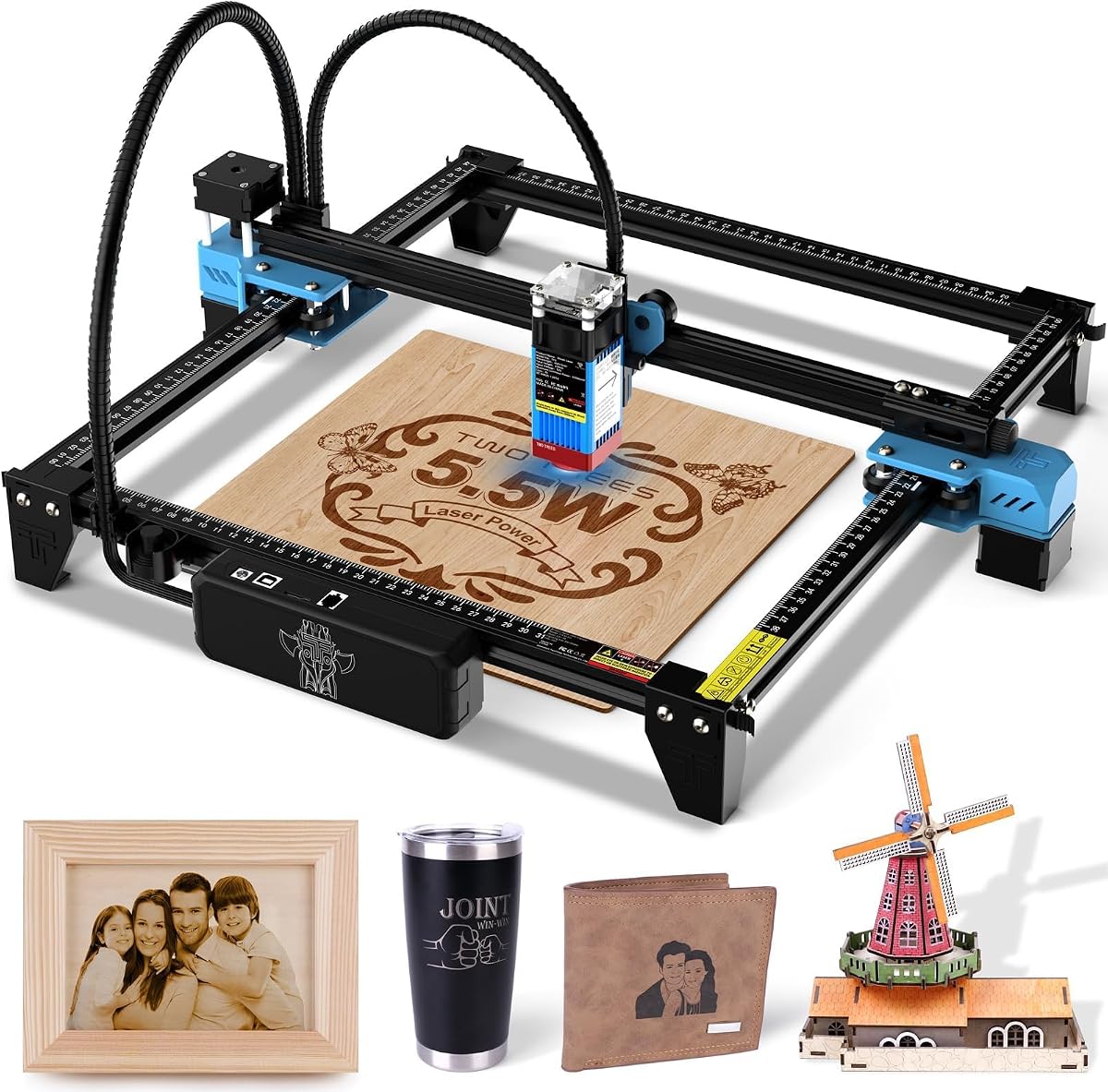
The Twotrees TTS-55 Pro sits between small starter engravers and higher-output enclosed systems. Its 5.5-watt diode laser, 300 by 300mm work area, and listed 4.3 rating make it a balanced choice for makers who want more cutting capability and project capacity without moving to a full enclosed machine.
We may earn a commission when you buy through this link, at no additional cost to you.
Its standout detail is the included metal air-assisted nozzle and red laser shield, which improve the machine's suitability for cleaner, deeper cuts. LD+FAC+C-Lens compression technology and a short 23mm focal length are also intended to strengthen cutting performance. The listed engraving accuracy is 0.1mm, while a fast dual-core 32-bit control board supports speeds up to 30,000mm/min.
Control options are unusually flexible for this category. The engraver can operate online, by Wi-Fi through a mobile app or computer web interface, or offline from a TF card. LaserGRBL and LightBurn support covers common creative workflows, while the included tools and guides reduce the setup learning curve. The stated cutting capabilities include 5mm plywood, 3mm acrylic, and 0.7mm leather, though actual results depend on the material and settings.
This model fits hobbyists and small-business makers who need a larger bed, high engraving speed, and flexible control. The open frame requires more care around moving components, smoke, and direct eye exposure than an enclosure, and the supplied information contains a naming inconsistency between TTS-55 Pro and TTS-50 Pro. Even so, the useful nozzle, fast controller, and practical work area make it an attractive mid-budget option.
The supplied metal nozzle is designed to direct airflow toward the cutting area. Air assist can help move debris away, cool the active zone, and support cleaner edges, particularly when paired with suitable extraction.
Wi-Fi access and TF-card offline operation make it easy to move between mobile-assisted and computer-controlled workflows. LightBurn and LaserGRBL support ensure that standard vector and raster design files remain practical to use.
We may earn a commission when you buy through this link, at no additional cost to you.
The xTool F2 is the premium choice for buyers who want a versatile desktop system capable of engraving, cutting, shallow embossing, and detailed metal marking. It combines a 15-watt diode laser with a 5-watt infrared laser and has a listed rating of 4.4. The dual-laser arrangement is more versatile than a standard single-module budget machine.
We may earn a commission when you buy through this link, at no additional cost to you.
The infrared module is designed for deep, dark, vivid color marking on metal, while the diode module handles engraving, cutting, and three-dimensional embossing. A built-in 50-megapixel camera supports workspace visualization, alignment accuracy up to 0.1mm on small pieces, and a stated motion accuracy of 0.00199 inch. The camera is particularly useful when small products, accessories, or batch layouts need precise registration.
Speed is another major strength. The machine can engrave at up to 6000mm/s, and the listed specification says a card engraving can be completed in approximately three seconds. The fully enclosed, leak-proof housing includes a fan, while an optional purifier can improve indoor air handling. At 4.6kg, the unit is also portable enough for workshops, stores, fairs, and pop-up customization events.
The F2 is best suited to serious hobbyists, professional personalization businesses, and makers who regularly work with both plastics or wood and marked metals. It arrives assembled, includes a base plate and material kit, and supports accessory expansion. The trade-off is its higher purchase tier and Class 4 classification, which calls for proper laser-safety procedures. For buyers who need both diode and infrared capability, however, it is exceptionally well equipped.
Using separate diode and infrared modules lets the F2 address both conventional engraving and infrared-compatible metal marking. This avoids forcing every material into a single laser configuration and makes the machine more adaptable to a varied product catalog.
The 50-megapixel camera improves placement and inspection, while the stated 6000mm-per-second maximum supports efficient production of repeated items. The slide extension mentioned for the system can further assist with larger batches.
We may earn a commission when you buy through this link, at no additional cost to you.
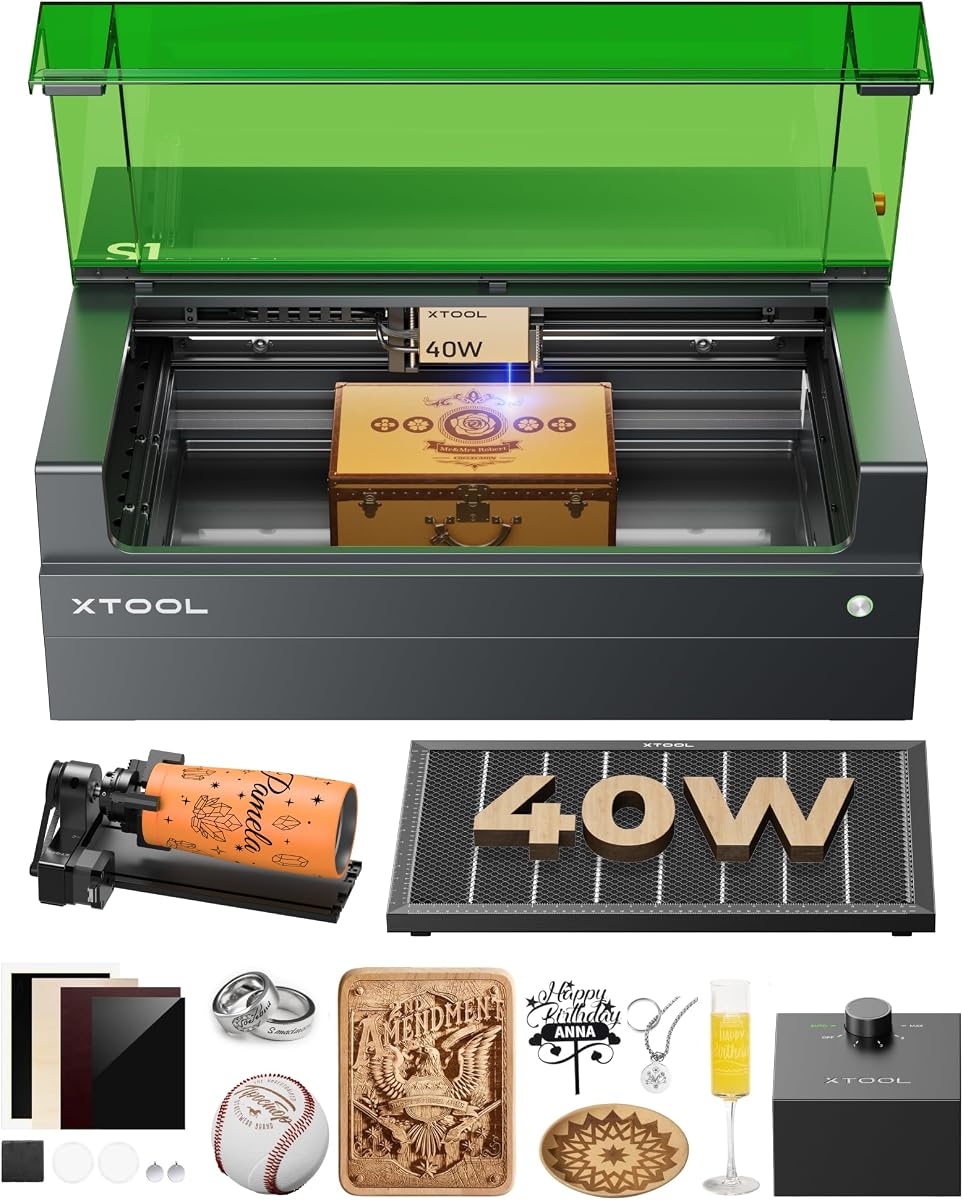
The xTool S1 is built for larger workpieces, stronger cutting, and production-oriented engraving rather than lightweight hobbying. It combines a 40-watt diode laser with a spacious 23.93 by 15.16-inch bed, a rotary bundle, and a listed rating of 4.6—the highest customer rating among the machines in this roundup.
We may earn a commission when you buy through this link, at no additional cost to you.
The high output is intended to handle demanding jobs. The supplied information states that the laser can cut 18mm cherry wood in a single pass and that the large bed can accommodate projects such as door signs or as many as 119 dog tags. At up to 600mm/s, it is also positioned for faster production than many entry-level systems. Pin-point positioning and AutoPassthrough technology support precise work and projects up to 3000mm.
Ease of use comes through auto-focus, xTool Creative Space software, material presets, AI-assisted design generation, and more than 1,000 project tutorials. The protective cover filters 99 percent of laser light according to the supplied information, while the enclosure helps block smoke and noise. Five flame sensors, an emergency stop, and a lid-open stop function provide additional safeguards.
The S1 is a compelling recommendation for a growing business, educational fabrication lab, or experienced maker with room for a larger machine. Its advantages are power, bed size, automation, and production focus. It is naturally less attractive to someone wanting a small tabletop unit or a minimal first hobby machine, because those needs favor smaller and less advanced models. Within a high-output category, the feature set is exceptionally complete.
The wide platform can hold larger blanks and a meaningful number of smaller items at once. That reduces repositioning during batch jobs and makes the system more practical for signs, tags, and repeated products.
Auto-focus, material presets, positioning technology, and step-by-step tutorials reduce the amount of setup knowledge required for repeatable jobs. These features are particularly valuable when the operator is not working on the machine every day.
We may earn a commission when you buy through this link, at no additional cost to you.
The LONGER Ray5 offers a rare combination of a 10-watt laser, a 400 by 400mm bed, and a built-in 3.5-inch touchscreen at a relatively accessible purchase tier. Its listed rating is 4.3, and its major appeal is the flexibility of a relatively large work area combined with direct on-device control.
We may earn a commission when you buy through this link, at no additional cost to you.
The 240MHz ESP32 multi-core controller is designed for fast response and the ability to control multiple engraving machines from one device. The dual-beam system is listed at a maximum engraving speed of 10,000mm/min, with a 0.06 by 0.06mm spot and 0.01mm precision. The manufacturer also states that it can cut wood up to 20mm and acrylic up to 30mm, though actual capability depends on material, settings, and pass count.
Users can connect through USB, TF card, Wi-Fi, or an app, and can use LaserGRBL or LightBurn for design preparation and control. Offline operation is useful when working in a location without a network connection. Safety features include an emergency stop, motion protection that responds to abnormal vibration, heat protection, a protective cover, safety goggles, and hidden active cooling intended to extend laser life.
The Ray5 is a strong fit for makers who need more bed area than compact models offer but do not require a fully enclosed system. It works across wood, acrylic, glass, leather, fabric, cotton, and stainless steel, within the material limitations that apply to diode lasers. The lack of a camera means placement is less automated than on the xTool M2 or F2, but the large bed, touchscreen, and broad connection options compensate for that in many workflows.
The 3.5-inch display gives users a direct way to manage machine functions without relying entirely on a computer. It is especially convenient for routine jobs and for users who want standard computer software as an optional rather than mandatory workflow.
The 400 by 400mm platform offers meaningful room for signs, coasters, multiple blanks, and other medium-sized items. It is a practical middle ground between a tiny desktop engraver and a full production cabinet.
We may earn a commission when you buy through this link, at no additional cost to you.
The ELIDOR Z6 is a compact 6-watt laser engraver that stands out for its listed 5.0 rating, portability, and focus on straightforward results. It uses a 0.04 by 0.14mm laser spot, offers engraving accuracy up to 0.01mm, and reaches speeds of up to 10,000mm/min. That makes it a credible option for crisp text, portraits, logos, and personalized crafts.
We may earn a commission when you buy through this link, at no additional cost to you.
The machine can engrave wood, leather, acrylic, cardboard, ceramic, glass, and metal, subject to the usual compatibility and preparation rules for diode lasers. Its 300 by 300mm area is larger than the ACMER S1 but smaller than the 400mm-square models from LONGER and AlgoLaser. That middle-sized platform accommodates common craft blanks without taking up as much desk space as a full-size system.
At 2.13kg, the Z6 is easy to move between a home workshop, craft fair, classroom, or mobile project. Compatibility with LaserGRBL and LightBurn covers Windows, macOS, and Linux, while NC, DXF, BMP, JPG, and PNG files provide a conventional design pipeline. That makes the system approachable for users who already have design software and for those learning standard engraving workflows.
The Z6 is a good match for a hobbyist who values a highly rated machine, compact construction, and detailed output without needing an enclosure or integrated camera. Its open frame calls for careful setup, ventilation, and safe operating habits. Buyers prioritizing automatic placement, enclosed smoke containment, or large-batch speed should look toward the xTool M2, LONGER Ray5, or xTool F2. For a portable general-purpose engraver, however, the Z6 is highly compelling.
The 2.13kg body and 300mm work area offer a practical balance for makers who work across different locations. It can support craft-fair demonstrations or personal projects without the footprint and complexity of a production machine.
The narrow laser spot and stated 0.01mm engraving accuracy are useful for portraits, fine text, and intricate patterns. Material preparation and parameter selection remain important for consistent results.
We may earn a commission when you buy through this link, at no additional cost to you.
The AlgoLaser MK3 is designed for buyers who want to create directly from a touchscreen rather than treating a computer as a requirement. Its 3.5-inch HD display runs AlgoOS, allowing users to sketch, type, and import designs. It also supports LightBurn and LaserGRBL through a computer, the AlgoLaser phone app, Wi-Fi, USB, or an SD card, giving users both simple and advanced paths.
We may earn a commission when you buy through this link, at no additional cost to you.
The machine is 95 percent preassembled, with belts, limit switches, cable routing, and core modules already installed and factory-aligned. A flip-down focus column helps establish working height without a loose focus block, while the supplied information indicates that a typical setup can be completed in around 10 minutes. This is a strong convenience advantage for schools, craft events, gift businesses, and occasional users.
The 8-watt diode laser is listed at speeds up to 15,000mm/min across a 400 by 400mm work area. AlgoOS includes more than 400 material presets, visual drag-and-drop positioning, and repeat-processing mode. Supported uses include text, photographs, logos, patterns, wood, leather, dark opaque acrylic, coated or anodized metal, prepared glass, and laser-safe plastics.
The MK3 is ideal for users who want independent touchscreen operation without giving up professional software. It has a listed 5.0 rating and includes flame detection, overheat alerts, a large emergency stop button, laser safety goggles, a two-year warranty, and lifetime technical support. Its main limitation is that 8 watts provides less cutting headroom than a 10-watt system, while the touchscreen still takes time to learn. As a convenient, preset-driven option, it remains one of the strongest choices in the guide.
Creating a simple design directly on the built-in screen makes the engraver much easier to use at markets, in classrooms, or during a break from a computer. Standard file formats and multiple transfer options preserve a path to more advanced work.
With more than 400 calibrated material presets, users can select a material and apply appropriate starting parameters. This is helpful for beginners, although each material and combination of settings should still be tested before a full production run.
We may earn a commission when you buy through this link, at no additional cost to you.
The LaserPecker LP1 Plus is a miniature engraver for buyers who prioritize portability, quick setup, and spontaneous projects over heavy cutting or large production runs. Its listed rating is 4.2, and its defining advantage is a pocket-sized format that can travel in a backpack and operate from a power bank.
We may earn a commission when you buy through this link, at no additional cost to you.
The product information states that it can move from unpacking to a first engraving in under two minutes. Its cross-platform app allows users to import photographs or doodles and prepare a design with minimal complexity. The adjustable stand supports 360-degree engraving, which can be useful for decorating sides and curved surfaces, and a magnetic base helps secure small objects.
Material selection is intentionally limited. The supplied guidance says to set the distance between the laser lens and the material surface to 200mm using the included ruler, and explicitly states that metal engraving is not supported. Compatible non-metal materials include wood, leather, acrylic, and paper. This makes the LP1 Plus better suited to lightweight personalization and portable demonstrations than heavy fabrication or metal-focused services.
The LP1 Plus is an appealing first machine for travelers, students, and crafters who need a compact engraving tool for occasional use. Its limitations are substantial for production: the work area is small, cutting performance is modest, and metal is excluded. Buyers planning frequent batches, thick-material cutting, or advanced production should choose a larger 8W, 10W, 40W, or dual-laser system. For truly mobile engraving, though, the LP1 Plus delivers a distinctive and convenient experience.
The compact, lightweight machine can be carried in a backpack and powered by a compatible power bank. That makes it practical for travel, workshops away from home, demonstrations, and quick personalization sessions.
The adjustable 360-degree stand and magnetic holder help position small pieces at useful angles. These mechanical features make the system more flexible than a fixed, flat-bed design for lightweight craft work.
We may earn a commission when you buy through this link, at no additional cost to you.
Choosing a cheap laser engraver requires balancing power, precision, safety, working area, software, and the types of products you expect to make. The cheapest machine is not necessarily the best value if it cannot handle your materials, fit your workspace, or provide a repeatable workflow.
Laser power is one of the clearest differences between compact and production-oriented machines. A 2.5-watt system such as the ACMER S1 is primarily suited to engraving and light cutting of small materials, while 5.5W and 6W models offer more flexibility. The 8W and 10W selections are better choices for a broader mix of engraving and cutting, and the 40W xTool S1 is intended for considerably more demanding jobs. Diode lasers are especially effective on suitable wood, acrylic, leather, paper, and some plastics, while infrared capability expands options for certain metals.
Choose enough power for your materials, not simply the highest advertised number. Consider thickness, whether you expect single-pass cuts, and how much finishing or repeated passes are acceptable.
The bed determines the largest item that can be placed in the machine and the number of pieces that can be produced per batch. The ACMER S1 offers a 130 by 130mm area, which is appropriate for individual keychains, tags, and tiny components. A 300 by 300mm bed accommodates more common craft blanks, while the LONGER Ray5 and AlgoLaser MK3 offer 400 by 400mm platforms. The xTool S1 goes much further with a 23.93 by 15.16-inch work area for signs, production runs, and oversized workpieces.
Choose a bed that fits your typical products while leaving enough clearance for the frame and accessories. A slightly larger work area can also reduce repeated setup and improve batch efficiency.
Open-frame machines are usually lighter, smaller, and less expensive, but they provide less containment around smoke, moving components, and laser light. Enclosed models such as the xTool M2, BlazeX M3, xTool F2, and xTool S1 are more suitable for shared homes, classrooms, and active workspaces. Their stated safety features include covers, flame sensors, emergency stops, lid detection, or automatic shutoffs. Products in this guide include Class 1, Class II, and Class 4 classifications, so safe operation requires following the exact instructions and applicable protective measures.
Prioritize a design with accessible stops, protective shielding, reliable ventilation, and clear operating procedures. Never assume that a touchscreen or automatic feature replaces safe handling.
Precision determines how faithfully a machine can reproduce fine lettering, small logos, portraits, and intricate linework. The ACMER S1, LONGER Ray5, and ELIDOR Z6 list accuracy or repeatability figures of 0.01mm, while the BlazeX M3 highlights 0.01mm positioning accuracy. The Twotrees TTS-55 Pro lists 0.1mm engraving accuracy, and the xTool F2 combines a 50-megapixel camera with 0.1mm alignment on small pieces. These numbers are useful comparisons, but actual results also depend on optics, focus, materials, artwork preparation, and machine calibration.
Look for both numerical accuracy and workflow features that help maintain consistency, such as cameras, autofocus, material presets, repeat mode, and stable file placement.
A good laser should accept artwork from the software you already use or provide a capable alternative. LaserGRBL and LightBurn appear across many selections, while ACMER includes free Acmerstudio software and xTool machines use their own ecosystems. The xTool M2 provides hundreds of templates and an integrated AI image generator, and the AlgoLaser MK3 supports touchscreen design creation through AlgoOS. Compatibility across Windows, macOS, and Linux is useful for users who do not want to change computers.
Consider both preparation and machine control. A computer-based package offers deeper editing, while a touchscreen can make quick jobs and shared-shop use more convenient.
Maximum speed is most important when engraving many similar pieces. The xTool F2 is listed at up to 6000mm/s, the xTool S1 at 600mm/s, the Twotrees TTS-55 Pro at 30,000mm/min, and the AlgoLaser MK3 at 15,000mm/min. These figures use different testing conditions and should not be treated as direct job-completion guarantees. Actual throughput includes design loading, positioning, focusing, extraction, material preparation, and the number of passes required.
For occasional gifts, speed matters less than ease of use. For batch production, assess the entire workflow rather than focusing only on the headline engraving rate.
A machine that is frustrating to assemble can be a poor choice for a first-time buyer. The ACMER S1 is 99 percent preassembled, the AlgoLaser MK3 arrives 95 percent assembled with aligned modules, and the xTool F2 arrives fully assembled. Bundled equipment also affects immediate usefulness: the BlazeX M3 includes an enclosure, honeycomb bed, tool kit, and sample materials, while the xTool S1 bundle includes rotary capability. Look for clear guides, software support, responsive technical assistance, and a warranty that fits your needs.
Confirm that the essentials you expect are included. Optional rotary tools, air-assist equipment, purifiers, extensions, and specialized laser modules may add considerable cost later.
Before the first cut, read the machine's manual, identify its laser classification, and inspect the work area, lens, cables, ventilation path, and emergency controls. Confirm the correct focus distance, install the appropriate safety measures, and test the exhaust system. Prepare the material by confirming that it is laser-compatible, removing non-laser-safe finishes or adhesives, and securing it flat without obscuring the beam path.
Load a design using the supported software, select the correct material and settings, and inspect the placement carefully. On models with a camera, use the preview to confirm orientation and clearance; on other models, check dimensions and origin points manually. Begin with a small test pattern, then adjust power, speed, passes, focus, and material settings based on the result. Never leave a running engraver unattended, and keep the enclosure closed or the operating area secured as required by the manufacturer.
After the job, switch off the machine according to its instructions and allow the laser module and cooling system to cool. Clean the lens with the approved method, remove residue from the bed and honeycomb surface, and clear chips or dust that could obstruct airflow. Empty the exhaust collection system when needed, inspect moving parts and cables, and keep the machine covered in a dry environment. Test new materials in small batches, document successful settings, and service or replace consumable parts according to the manual.
The least expensive category generally includes compact, open-frame diode engravers with limited working areas. These machines are useful for small wood, leather, acrylic, and paper projects, but they are not ideal for thick cutting or production batches. A slightly higher-tier 6W to 10W model often provides more useful capacity, speed, and material flexibility.
Yes, when the machine has sufficient laser power and the acrylic is suitable for laser processing. Thin acrylic is generally more manageable than thick material, while dark or colored acrylic can behave differently because pigments absorb light differently. Use the manufacturer's material guidance, secure the sheet, provide adequate ventilation, and make a small test cut before processing a full piece.
The xTool M2 and AlgoLaser MK3 put the most emphasis on simplified starting points. The M2 includes ready-made templates and an integrated AI image generator, while the MK3 allows direct touchscreen design work and provides more than 400 material presets. Both also support conventional professional software for users who want more control later.
It depends on the model. The AlgoLaser MK3 can operate directly through its touchscreen, and the LaserPecker LP1 Plus uses a cross-platform app. Most other machines in this guide rely on a computer for design preparation and control, even if they can also transfer files through USB, Wi-Fi, TF cards, or other methods.
An enclosed machine generally provides more containment for smoke, noise, moving parts, and laser light than an open frame. Models such as the xTool M2 and BlazeX M3 also list automatic stops and other protective systems. Enclosure does not eliminate every risk, so you should still follow the manual, maintain ventilation, use the correct class of protective eyewear where required, and keep children and pets away from the operating area.
A standard diode laser may mark some prepared, coated, or anodized surfaces, but it does not engrave bare metals in the way an infrared laser can. The xTool F2 pairs a 15-watt diode with a 5-watt infrared module, making it a stronger choice for projects specifically involving compatible metal marking. The LaserPecker LP1 Plus explicitly does not support metal engraving.
Software strongly affects placement, artwork preparation, control, and material settings. LightBurn and LaserGRBL are widely supported across the field, while systems such as Acmerstudio, xTool Studio, and AlgoOS add manufacturer-specific convenience. Using the correct origin, dimensions, speed, power, passes, and focus can make a substantial difference in the finished result.
Choose based on the larger bottleneck in your work. A larger bed helps when you need oversized pieces or more items per batch, while greater laser power helps with thick materials, faster cutting, and more demanding engraving. A machine with a large bed but modest power may spend too long processing items, while a powerful machine with a tiny bed may require frequent repositioning.
The xTool M2 is the best overall pick because it combines an enclosed 10-watt system, dual cameras, approachable software, and expansion options. The ACMER S1 represents the strongest low-cost route into engraving, particularly for compact projects and beginners who value fast setup. The xTool F2 earns the premium position through its 15-watt diode and 5-watt infrared combination, 50-megapixel camera, and strong production speed.
Prioritize the constraints that matter to your actual workflow: adequate power for your materials, a bed that fits your products, safe operation in your location, and software you can comfortably use. The BlazeX M3 is a feature-rich enclosed starter bundle, the AlgoLaser MK3 is ideal for touchscreen-first creation, and the LONGER Ray5 offers a large bed with flexible control. Larger-output systems such as the xTool S1 suit users who regularly work with thick materials or production quantities.
Finally, check the current listing, included accessories, compatibility details, safety classification, warranty, and price before placing an order. Engraver specifications can be difficult to compare because manufacturers use different definitions for speed and accuracy, and current bundle contents may change. A careful material test on the exact machine you buy will provide the most useful confirmation that it fits your workflow.