
WVL 7400mWh Emergency Weather Radio
4.6Editor score
7400mWh internal capacity
Three backup charging options
Compact 231g housing
Explore the best cheap crank radio options, comparing reception, battery capacity, charging methods, lighting, portability, and emergency features for
A cheap crank radio is most useful when ordinary electricity and cellular service are unavailable. The right model combines dependable AM, FM, and NOAA reception with a rechargeable battery, solar charging, a hand-crank generator, and bright emergency lighting. These features can provide information, illumination, and limited phone power during storms, outages, camping trips, and roadside emergencies.
The products in this guide were compared using the supplied specifications, focusing on radio bands, power options, battery capacity, charging connections, lighting, portability, water resistance, and alert capabilities. The list includes compact models for backpacks, higher-capacity radios for household kits, and feature-rich units with automatic warnings, shortwave reception, headphone jacks, or multiple charging options.
Each review highlights the most useful strengths and the practical limitations, so the ranking reflects more than a low purchase cost. The top selections show how a budget model can serve basic preparedness needs, while premium designs add larger batteries, stronger lighting, clearer displays, or automatic weather alerts. Product prices and availability can change, so compare current listings before buying.
4.6Editor score
4.7Editor score

4.8Editor score
This side-by-side comparison covers the supplied radio bands, battery capacities, charging choices, lighting, portability, and notable limitations of all ten models, helping readers identify the most suitable unit for a household kit, vehicle, camping bag, or emergency go-bag.


This 12000mAh hand-crank radio is our Editor's Choice because it balances several emergency functions without becoming difficult to operate. It receives NOAA, FM, and AM broadcasts through a high-sensitivity chip, noise-reduction circuitry, and an extended antenna. Its large internal battery also makes it more versatile than a lightweight radio intended primarily for listening and basic lighting.
We may earn a commission when you buy through this link, at no additional cost to you.
The standout feature is the 8500mm² monocrystalline solar panel, which is considerably larger than the decorative panels commonly found on compact emergency radios. Solar charging is not a substitute for planning, but the larger surface can gather useful energy in daylight. The upgraded hand-crank generator is designed to reduce the effort required to restore power, while the radio can also charge a phone.
For lighting, the main LED produces a focused beam reported to reach 260 feet. A flip-up frosted reading lamp provides softer illumination for maps, supplies, or household tasks, and both lights have two brightness levels. The 6.8-by-2.9-by-4.7-inch body, large tuning knob, responsive buttons, clear labels, and non-slip grip are especially relevant when the user is nervous, tired, or working in darkness.
The main trade-off is that automatic NOAA alerts are not mentioned, so users may need to tune the weather band manually. Phone-charging performance will also depend on the device, its battery condition, and how the radio is used. Even so, this is a strong choice for a household emergency kit because its battery, solar surface, lighting, and comfortable controls address several real outage needs.
The 12000mAh battery powers the radio, lights, and charging functions, making this model more useful than a basic alert-only device. The large solar panel and upgraded generator offer meaningful ways to restore charge when household electricity is unavailable.
Large knobs, clearly marked buttons, a non-slip grip, and a compact but substantial housing reduce confusion. Those ergonomic details matter during a blackout, evacuation, or nighttime roadside incident when selecting the wrong function is easy.
We may earn a commission when you buy through this link, at no additional cost to you.
The Leaton Hand Crank Emergency Radio pairs a 10000mAh battery with NOAA, AM, and FM reception in a package aimed at families, travelers, and households. It is less specialized than some premium models because its NOAA band is manually tuned, yet it combines radio reception, lighting, solar charging, a hand crank, USB-C input, phone output, and a compass in a relatively compact body.
We may earn a commission when you buy through this link, at no additional cost to you.
Its charging design gives users several restoration options. USB-C is the primary input, while the solar panel and internal hand crank provide backup paths when wall power is inaccessible. The manufacturer estimates that one minute of steady cranking can support approximately 15 to 20 minutes of radio listening, although actual results depend on cranking speed and what the radio is doing.
The IPX6 rating is appropriate for splashes and spray rather than immersion or heavy rain exposure. At approximately 6.3 by 3.5 by 3.1 inches and about one pound, the radio is portable without being as tiny as the lightest models. A three-mode flashlight includes high, low, and SOS signaling, while a separate 1.3-watt reading lamp provides broad illumination for maps and emergency supplies.
The biggest limitation is automatic warning support: the radio does not support SAME technology, location-based alerts, or automatic NOAA notifications. It also lacks a headphone jack and cannot charge multiple devices simultaneously. Those constraints make it less attractive for private overnight listening, but its 10000mAh capacity, simple controls, compass, and splash resistance remain useful for a broad range of preparedness needs.
Large controls, a simple SOS flashlight mode, a reading lamp, and a built-in compass make the radio approachable for a wide range of users. The 5V/1A output can provide emergency phone power, though the stated battery capacity translates to roughly one to one and a half iPhone 14 charges.
USB-C provides the most convenient routine charging method, while solar and cranking preserve the radio's usefulness during outages. Users should still maintain the battery regularly because none of these backup methods is as dependable as planned access to wall power.
We may earn a commission when you buy through this link, at no additional cost to you.
The Emgykit Hand Crank Radio is a compact option for people who want NOAA, AM, and FM reception without carrying a large household unit. At 5.1 by 2.1 by 2.4 inches and approximately 0.51 pound, it fits easily into a day pack, small emergency pouch, or vehicle storage compartment. Its 2000mAh battery is modest but supports the core functions described in the product data.
We may earn a commission when you buy through this link, at no additional cost to you.
Charging can be handled through the hand crank, solar panel, or Type-C connection, giving the radio three ways to remain usable away from mains electricity. This three-source approach is valuable for hikers and campers who may encounter several hours without a convenient outlet. The radio can also provide emergency charging for a phone, although its capacity means users should treat that as a limited reserve rather than a full everyday power bank.
The upgraded 3W three-LED flashlight produces 140 lumens, which is a useful amount of light for a blackout, tent, or evacuation path. A press-and-hold SOS control activates a siren reported to exceed 80 decibels. That audible signal may help attract attention, although it should never replace an emergency radio, satellite communicator, first-aid supplies, or other essential safety equipment.
This radio makes the most sense for travelers and light packers who prioritize low weight over battery capacity. Larger households may find the 2000mAh cell inadequate for extended listening, repeated lighting, and several phone charges. Within its compact class, however, the combination of radio reception, a bright flashlight, an alarm, and three charging methods is notably complete.
The compact housing keeps radio, alarm, flashlight, and charging functions together without adding much pack weight. It is a practical fit for travelers who need a small device for weather information and short-term illumination.
Solar, hand-crank, and Type-C charging reduce dependence on any single energy source. The internal battery should still be charged before trips and maintained regularly so that each backup option begins with a useful reserve.
We may earn a commission when you buy through this link, at no additional cost to you.
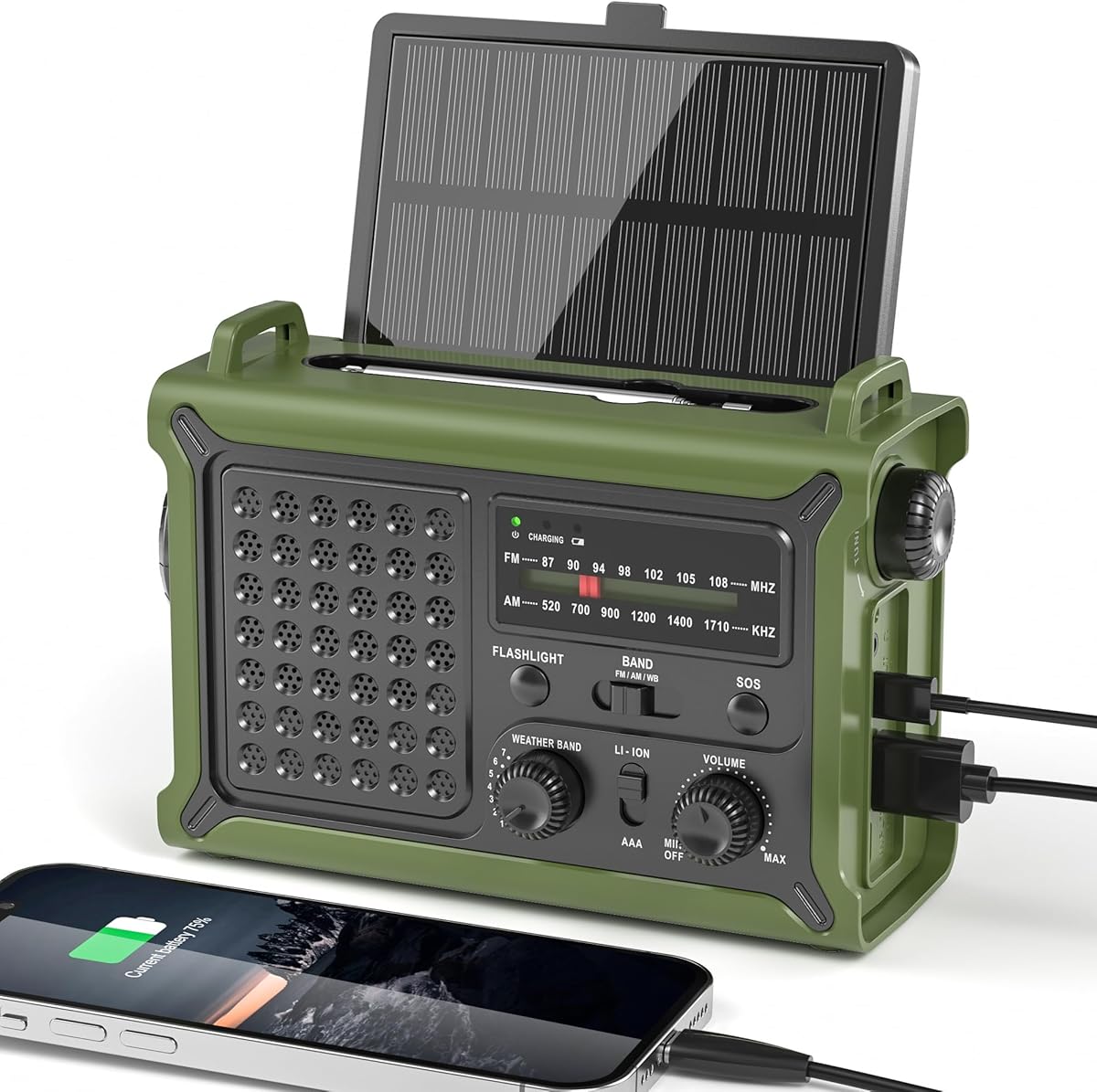
The WVL 7400mWh Emergency Weather Radio is our Best Budget pick because it combines a useful battery, NOAA and standard broadcast reception, three lighting-related features, phone charging, and multiple power options in a compact housing. The 7400mWh rating is more substantial than the small 2000mAh cells used by several competing models, while its 231-gram weight remains convenient for travel.
We may earn a commission when you buy through this link, at no additional cost to you.
Its three power routes are the hand crank, solar panel, and built-in rechargeable lithium-ion battery. This is a straightforward version of the common emergency-radio design, but it allows the unit to be recharged in several environments. The battery can also supply emergency power to a small phone or tablet, making it more useful than a radio that only receives broadcasts and lights the room.
Lighting includes an upper-bright 1.5W LED flashlight and a motion-sensor reading lamp. The motion sensor is convenient when hands are occupied or when someone wants illumination without fumbling for a control. The radio also includes an SOS alarm, while analog tuning provides access to AM, FM, and preset NOAA weather channels for information about hurricanes, tornadoes, rainstorms, fires, and other hazards.
The product data does not specify water resistance, shortwave reception, automatic weather alerts, or a headphone jack. That makes it less versatile than models with those features, but it remains a well-rounded option for a basic go-bag, vehicle kit, or inexpensive second radio. Its mix of capacity, compact size, charging choices, and emergency lighting is particularly compelling for value-focused shoppers.
The 7400mWh battery gives this model a meaningful advantage over the smallest emergency radios while the 130-by-50-by-60-millimeter body remains packable. It is a sensible middle ground for users who want emergency reserves without a bulky tabletop design.
The directional flashlight is suited to paths and outdoor work, while the motion-sensor reading lamp is helpful over maps or supplies. Having both avoids forcing one lighting mode to handle every emergency task.
We may earn a commission when you buy through this link, at no additional cost to you.
The Midland ER310 is a recognizable red-and-black emergency crank weather radio, and it is included here based on the supplied product identity and 4.6 customer rating. Its format fits a common preparedness niche: a portable radio designed to receive standard AM and FM broadcasts as well as emergency weather information when normal media access is disrupted.
We may earn a commission when you buy through this link, at no additional cost to you.
One advantage of a well-known model is that buyers can approach it as a recognizable piece of emergency equipment rather than an unfamiliar generic device. The red-and-black enclosure also provides a visible, purposeful appearance that is easy to identify inside a go-bag, vehicle trunk, or household preparedness box. It could serve as a primary radio or a supplementary unit alongside a more specialized model.
The available product data is limited, however, and does not document battery capacity, exact charging inputs, flashlight output, water resistance, alert behavior, dimensions, or included accessories. Those omissions make it difficult to compare the ER310's travel convenience and feature depth with the other models on battery size, charging flexibility, display quality, and automatic warnings.
The ER310 is best considered by a buyer who values the Midland name and the straightforward emergency-radio format, while still checking the current listing for full specifications. It may suit a general household kit, but consumers who require a particular connector, water rating, phone-charging output, or automatic alert system should confirm those details before ordering. Its 4.6 rating is encouraging, but it does not replace feature-by-feature evaluation.
The ER310's focused identity as an emergency crank weather radio makes it easy to understand at a glance. Buyers can use the current product page to confirm battery, charging, and lighting details that were not included in the supplied information.
Emergency radio features vary significantly, even among models with similar names. Checking the live listing helps ensure the selected model includes the NOAA operation, charging methods, and accessories required by the intended kit.
We may earn a commission when you buy through this link, at no additional cost to you.
This 7400mWh hand-crank emergency radio stands out for its three built-in charging cables and broad selection of power inputs. The Lightning, USB-C, and Micro USB leads allow common phones and small devices to be connected without searching through a bag for a separate cable. That convenience is especially relevant when a kit is being assembled for travel or stored where accessories could easily become separated.
We may earn a commission when you buy through this link, at no additional cost to you.
The radio offers four sources of power: USB-C charging, the hand crank, the solar panel, and AAA batteries. The final option gives the design an unusual degree of flexibility because it can operate when the rechargeable cell is depleted and external charging is unavailable. The listed package includes the radio, a user manual, and a lanyard; AAA batteries are not included.
A DSP chip and extended antenna support reception of NOAA weather broadcasts and local AM and FM stations. The lighting system includes a main flashlight with low, medium, and high brightness settings, plus six reading lights. An SOS alarm provides an additional way to attract attention. Together, those functions make the radio a multi-purpose hub rather than a basic weather receiver.
The 7400mWh label corresponds to a 2000mAh battery, and actual device charging will depend on conversion losses and the connected equipment. The radio is also not a substitute for a certified life-safety receiver. Nevertheless, the built-in cables, four power options, adjustable lighting, and substantial capacity make this an attractive choice for households that want emergency connectivity without carrying a separate cable pouch.
Three built-in leads eliminate the need to carry separate charging cables for the most common connector types. They also reduce the chance that a cable will be missing at the moment a phone needs emergency power.
USB-C, solar, hand-crank, and AAA power create a layered charging strategy. Users should buy suitable batteries in advance and remember that their inclusion is not stated in the package information.
We may earn a commission when you buy through this link, at no additional cost to you.
This 12000mAh emergency radio is the strongest all-around choice for readers seeking a high-capacity unit with extensive lighting and power features. It has the highest listed rating in the group at 4.8, and its specification sheet combines seven NOAA weather channels, AM and FM reception, a large solar panel, a hand crank, Type-C charging, a five-watt flashlight, a reading lamp, and an SOS alarm.
We may earn a commission when you buy through this link, at no additional cost to you.
The 8500mm² solar panel and 12000mAh battery make the radio suitable for placement in a hurricane kit, RV, garage, kitchen drawer, or vehicle emergency box. DSP signal processing is intended to reduce noise and improve reception, while the 57-millimeter speaker provides room-filling audio. Phone and small USB-device charging is included, although it should be treated as an emergency reserve rather than regular power-bank use.
The five-watt LED flashlight is a major differentiator, especially for blackouts, campsites, garages, and roadside work. A 12-LED reading lamp provides softer illumination, and the stated 120dB SOS alarm can help signal for attention. An IPX6 design adds useful protection against rain, splashes, and general outdoor conditions without implying that the radio can be submerged.
NOAA stations must be tuned while the radio is powered on, so this is not an automatic-alert design. The large battery and numerous features may also make it bulkier than the smallest models. Even so, the 4.8 rating, generous power reserve, strong lighting, and broad range of backup methods make this an excellent premium-preparedness option.
A 12000mAh battery supports the radio, both lights, SOS functions, and limited device charging. The large solar surface provides an additional daytime restoration route, while the hand crank and Type-C input cover changing conditions.
The five-watt flashlight handles broad area and path lighting, the reading lamp handles closer tasks, and the 120dB alarm provides an audible signal. This combination reduces the need to pack separate lighting and signaling tools.
We may earn a commission when you buy through this link, at no additional cost to you.
The RunningSnail Hand Crank Radio is built for simple, portable preparedness. It supports NOAA, AM, and FM reception, uses a 2000mAh rechargeable battery, and includes a retractable antenna intended to improve reception in remote or weak-signal locations. At 5 by 1.8 by 2.4 inches and approximately half a pound, it is easy to place in a backpack or carry on a short outdoor trip.
We may earn a commission when you buy through this link, at no additional cost to you.
Three operating modes are available: hand crank, solar panel, and the built-in rechargeable battery. The radio can also charge compatible USB devices, which makes it useful for a limited emergency call or message. As with other 2000mAh models, it should be treated as a short-term reserve rather than a dependable full-day power source.
Its 1W LED flashlight supplies basic illumination for an outage, tent, or evacuation path. The product data does not mention a reading lamp, SOS siren, automatic weather alerts, water resistance, shortwave reception, or a headphone jack. That simpler feature set is appropriate for a lightweight secondary radio, but users seeking broader emergency functions may prefer one of the higher-capacity models.
The RunningSnail is most attractive to campers, hikers, and travelers who need a dependable radio and flashlight without extra weight. Its 4.5 rating suggests generally positive reception, though actual signal quality depends on location and antenna placement. For a compact emergency radio, its combination of three power modes, standard broadcast bands, and phone charging is practical and easy to understand.
The narrow 5-by-1.8-by-2.4-inch housing takes up little room in a pack. Its roughly half-pound weight also makes it easier to keep accessible instead of leaving it buried in a larger emergency container.
The retractable antenna can be extended for better reception, particularly in remote locations. Users should tune slowly and move away from obstructions when signal quality is poor.
We may earn a commission when you buy through this link, at no additional cost to you.
The NOAA Weather Hand Crank Radio is notable for two features that many competing emergency radios omit: automatic weather alerts and shortwave reception. It is certified by the National Weather Service and can scan for emergency warnings, activate a nine-second SOS-style alarm, and flash a red indicator. That makes it particularly suitable for overnight severe-weather awareness when a person may not be continuously listening to a broadcast.
We may earn a commission when you buy through this link, at no additional cost to you.
Its 5000mAh internal battery is supported by solar charging, a hand crank, a wall-plug adapter at 5V and 2A, an included USB cord, and a compartment for three AAA batteries. The power adapter is not included, and the stated radio runtime is up to 13 hours when fully charged and playing FM. Runtime will differ when the flashlight, reading lamp, or phone charging is used.
The radio covers AM from 520 to 1710kHz, FM from 87 to 108MHz, shortwave from 7 to 19MHz, and seven NOAA weather channels. A telescopic antenna and large volume knob support tuning, while the 3.5-millimeter headphone jack allows private listening. The flashlight reaches 80 meters, and a six-LED reading lamp can illuminate a room or campsite.
It also includes a USB output for charging more than one cellphone, a compass, a hand strap, and a one-year warranty. The radio is not small or minimal, and AAA batteries must be supplied separately. Nevertheless, automatic warnings, shortwave coverage, private audio, and a wide selection of power sources make it a distinctive option for campers, travelers, and dedicated emergency-kit owners.
Automatic scanning can sound a nine-second alarm and flash a red light when the National Weather Service issues a warning. This is especially valuable overnight, although users should still maintain a broader emergency plan.
Shortwave expands the radio beyond local AM and FM stations, while the headphone jack supports private listening at night. These features make the unit more useful for travel and camping as well as emergency communication.
We may earn a commission when you buy through this link, at no additional cost to you.
The Raynic Emergency Weather Radio is the most display-oriented model in the group. A large HD LCD shows the battery level and current tuning frequency, while digital Tune+ and Tune- controls scan for stations. That interface gives users a more precise alternative to small analog dials, particularly when checking the NOAA band or comparing available broadcasts during an emergency.
We may earn a commission when you buy through this link, at no additional cost to you.
The radio automatically scans for emergency and weather alerts when switched on or placed in standby mode. It receives AM, FM, shortwave, and NOAA broadcasts and can remain ready to notify the user without requiring continuous attention to a speaker. Pressing and holding the dimmer control turns off the backlight to conserve power, which is useful at night or during long monitoring periods.
A 5000mAh battery, six charging options, a 3W flashlight, 2.5W reading lamp, USB connector, and flashing SOS alarm make it a broad emergency hub. The supplied description calls out six charging options, while also identifying a built-in rechargeable backup battery, solar capability, and hand-crank functionality. The exact balance among all six methods should be confirmed on the current listing.
At 6.8 by 3.7 by 2.9 inches and 1.2 pounds, the Raynic is more substantial than the smallest units. Its IPX3 rating provides basic splash resistance but less protection than IPX6 designs. The headphone jack is a notable benefit for private listening. Overall, the combination of automatic alerts, a readable digital display, shortwave reception, lighting, and device charging makes this a strong feature-rich alternative for households that value a clear screen.
The LCD provides visible frequency and battery information, reducing the need to estimate a station position on an analog dial. Digital scanning also makes it easier to move among AM, FM, shortwave, and NOAA bands.
The radio can scan for alerts when powered on or in standby, which helps it function as an unattended warning device overnight. It should still be paired with official alerts and appropriate emergency planning.
We may earn a commission when you buy through this link, at no additional cost to you.
A useful crank radio should be judged by more than its initial cost. Battery reserves, reception, alert behavior, charging methods, lighting, controls, portability, and environmental resistance determine how effectively it can support a household or outdoor user when regular services are unavailable.
A larger internal battery supports longer listening, brighter lighting, and more useful phone charging, but it can also make a radio heavier. Capacities in this group range from 2000mAh to 12000mAh, with some products expressing energy in mWh. Compare like-for-like figures and review the claimed device-charge output, because battery ratings, conversion losses, and the phone being charged affect real results.
Prioritize a model with several charging paths. USB-C is the most convenient for routine charging, solar provides a passive daytime option, and a hand crank is useful when no power source is available. Recharge the radio before an emergency and maintain the battery regularly, because backup charging methods are most helpful when the internal reserve is already full.
NOAA reception provides access to weather information in the United States, while AM and FM stations offer news, music, and local emergency broadcasts. Shortwave can be useful for international or long-distance listening, but NOAA and standard broadcast bands are the priorities for most household preparedness kits. A retractable or extended antenna can improve reception in weak-signal areas.
Check whether the radio receives seven NOAA channels, whether they are preset, and whether alerts are automatic. Manual tuning offers less convenience, while automatic scanning can provide warnings while the device is in standby. Local terrain, building materials, and distance from transmitters still affect reception, so the radio should be tested in the locations where it is likely to be used.
Automatic NOAA alert systems scan for official warnings and can sound an alarm with a flashing indicator, making them valuable for overnight monitoring. Radios that require manual tuning still provide weather broadcasts, but someone must listen and adjust the station. This distinction can be more important than a long list of secondary features for households located in tornado, wildfire, hurricane, or flood zones.
Decide whether the radio will serve as an always-ready warning device or simply as a backup receiver. Automatic models are generally more convenient, although users should never rely on one consumer radio as their only source of emergency information. Keep a phone with current alerts, follow official authorities, and maintain a separate evacuation plan.
A bright flashlight is useful for power outages, campsites, garages, and roadside incidents, while a softer reading lamp helps with maps, instructions, and household tasks. Flashlight output in lumens or watts provides a rough comparison, although beam distance and runtime also matter. Models with several brightness levels are more flexible than single-mode lights.
Look for separate SOS signaling modes when possible. An audible alarm and flashing red light can attract attention, while a focused beam is better for navigation. Whichever lighting you choose, test it in a dark area and check the controls with gloves on, since emergency use rarely happens under ideal conditions.
Phone charging can be invaluable for emergency calls and messages, but it is only a backup function. Output ratings, battery capacity, cable compatibility, and device age all influence results. A radio with built-in cables is especially convenient because it reduces the number of loose accessories required in a go-bag.
Match the charging connector to the devices in your household. Also consider the radio's output current and whether it can charge more than one device at once. Avoid planning around a specific number of full phone charges unless the manufacturer supports it, and preserve radio power for reception and lighting when the emergency becomes more serious.
Compact radios are easier to carry during camping, hiking, and evacuation, while larger models can offer bigger batteries, stronger speakers, and more prominent controls. The supplied models range from a 0.51-pound pocket radio to a 1.2-pound feature-rich unit. A radio that stays in a closet because it is awkward to carry offers less practical value than one kept accessible in a go-bag.
Large tuning knobs, clearly labeled buttons, and readable displays are particularly helpful for children, older adults, and anyone operating the device under stress. Digital screens can improve frequency visibility, while analog controls may remain usable after a display or backlight fails. Select the interface that your intended user can comfortably operate.
Water-resistance ratings should be interpreted carefully. IPX3 indicates protection against spraying water, while IPX6 withstands powerful water jets and heavy splashes; neither rating means the radio is suitable for submersion. Outdoor users should keep the device in a protective bag when conditions exceed its rating, regardless of how rugged it appears.
A non-slip grip, robust housing, and protected controls can matter as much as a formal rating. Check the stated dimensions, weight, antenna design, and included lanyard or strap. The best emergency radio is one that can survive handling, moisture, and storage in a vehicle or garage long enough to be useful when needed.
Before relying on a new crank radio, remove any packaging restrictions, check the battery level, and fully charge it through the primary wired connection. Learn the location and function of every control while normal power is available. Tune to a strong local AM or FM station and then locate the local NOAA frequency, taking notes on the settings you need during an emergency.
Treat the hand crank and solar panel as backup restoration methods rather than the main way to keep the device charged. Solar performance depends on sunlight, panel angle, weather, and time spent charging, while cranking output depends on effort and consistency. Before a storm or trip, place the radio in sunlight, crank it as needed, and verify that the battery indicator and radio functions remain normal.
For long-term readiness, recharge the internal battery every three to six months, inspect cables and connectors, and replace disposable backup batteries as recommended. Store the radio in a dry, accessible location away from extreme heat and direct window sunlight. During use, extend the antenna, tune slowly, preserve battery power for alerts, and follow official weather instructions rather than relying on a consumer radio alone.
A hand-crank emergency radio provides local information, emergency lighting, and sometimes limited phone power when conventional charging options are unavailable. It can receive AM, FM, and NOAA broadcasts while using a rechargeable battery, solar panel, wired connection, or hand-crank generator. Its role is to support a broader emergency plan rather than replace official alerts, first-aid supplies, or professional rescue services.
Several models in this guide include USB outputs for charging phones or other small devices. The number of charges varies with battery capacity, output rating, conversion loss, and the device being charged. A 2000mAh radio should be considered an emergency reserve, while a 10000mAh or 12000mAh model offers more capacity. Radio reception and lighting should be prioritized during severe emergencies.
It depends on the radio and how long or vigorously it is cranked. One Leaton model is described as providing about 15 to 20 minutes of radio listening from one minute of steady cranking, but actual results vary. Solar and wired charging remain useful complements, and no hand crank should be assumed to replace a fully charged internal battery.
NOAA capability is highly useful in the United States because it provides official weather and hazard broadcasts. Automatic alert models are more convenient for overnight monitoring, while manual NOAA tuning still offers valuable forecasts and warnings. A radio with AM and FM reception can supplement NOAA information with local news, but it may not deliver dedicated official weather coverage.
Store it fully charged in a dry, accessible location at a moderate temperature, away from prolonged direct sunlight and extreme heat. Recharge it every three to six months, inspect the battery for swelling or damage, and keep the solar panel clean. It is better stored where family members can find it quickly than buried in a closet or vehicle trunk.
That depends on its water-resistance rating. The Leaton and 12000mAh emergency radio are rated IPX6 for strong water jets and splashes, while the Raynic is rated IPX3 for spraying water. Even water-resistant models should be protected during immersion or severe weather. Use a sealed bag or dedicated protective case when conditions exceed the manufacturer's stated limits.
The best capacity depends on the intended use. Small 2000mAh batteries suit lightweight travel kits, while 5000mAh to 10000mAh models offer a better balance for households, and 12000mAh radios support more listening, lighting, and phone charging. Choose the smallest capacity that meets the user's needs, then keep it fully charged and ready for repeated use.
A headphone jack is useful for private listening, especially at night or in a shared campsite. It can also reduce speaker disturbance while someone monitors weather information. However, it is a secondary consideration compared with battery life, alert behavior, radio reception, lighting, and charging access. Only the Raynic and NOAA Weather Hand Crank Radio in this list are explicitly documented as including headphone jacks.
The Solar Radio Emergency Hand Crank 12000mAh is the most balanced overall pick because it combines a large battery, an expanded solar panel, strong reception features, and an effective flashlight with comfortable controls. The WVL 7400mWh Emergency Weather Radio stands out as the value choice, while the 12000mAh Emergency Radio with Hand Crank and Solar offers the highest listed rating and a particularly broad feature set.
Prioritize the functions that match the actual use case. Travelers may prefer the Emgykit or RunningSnail for low weight, households may favor a 10000mAh or 12000mAh reserve, and users seeking overnight warnings may want a model with automatic NOAA scanning. Include a flashlight, phone-charging capability, multiple inputs, easy controls, and suitable water protection in the decision rather than relying on a single headline feature.
Finally, check the current listing, included accessories, battery details, and alert capabilities before ordering. Product prices, availability, and configurations can change, and responsible preparation depends on maintaining the selected radio. Keep it charged, exercise the controls periodically, and treat it as one component of a broader emergency plan.