Cell Phone Signal Booster for Home
4.5Editor score
Up to 5,000 square feet
Directional indoor panel antenna
Broad U.S. carrier support
Compare 10 cellular boosters for off grid cabins, including coverage, carrier support, antenna setup, power options, and the features that improve rural
A cellular booster for an off grid cabin can restore useful reception when terrain, trees, metal walls, or distance from a tower leave phones struggling to make calls or load data. The right system must capture a usable outdoor signal, amplify it, and distribute it through the cabin without creating feedback or interfering with the carrier network.
The products in this guide were compared using their stated coverage area, supported carriers and frequency bands, antenna options, display or app features, installation requirements, and suitability for cabins, RVs, metal buildings, and remote homes. Because a booster cannot create a signal where none exists, outdoor reception and compatible tower access remain decisive.
The list reveals which models prioritize budget coverage, broad carrier compatibility, mobile versatility, or extended reach. It also highlights practical limitations involving Verizon Band 13, antenna separation, power requirements, and the need to verify service before installation. Product availability and pricing can change, so readers should confirm current details before buying.
4.5Editor score

4.3Editor score

2.9Editor score
This side-by-side comparison evaluates the ten boosters by their intended setting, stated indoor coverage, antenna configuration, carrier compatibility, and key installation features. It is designed to help cabin owners balance coverage potential with the importance of receiving a viable outdoor cellular signal.


The weBoost Cabin is the most purpose-built option in this guide for an isolated property. It is designed to help cabin owners find a usable cellular source through trees, place the receiving antenna high on a 24-foot telescoping pole, and then distribute an amplified signal throughout the living space. Its listed rating is 2.9, so buyers should weigh the specialized hardware against limited customer feedback.
We may earn a commission when you buy through this link, at no additional cost to you.
Its most useful feature is the combination of a directional outdoor antenna and a tall mounting pole. A directional antenna can concentrate reception toward a specific tower, which is useful when a cabin sits in a valley, behind ridges, or within a dense patch of woodland. The included stabilizing bracket and telescoping pole provide more placement flexibility than a short rooftop antenna. The system offers up to 65 dB of gain and a stated indoor area of up to 5,000 square feet.
The trade-off is that the directional approach requires more deliberate setup. If the selected tower is blocked, misaligned, or incompatible with the supported network, merely increasing amplification will not produce a result. The fabric-covered panel antenna also looks less conspicuous than a typical exposed indoor panel, but the exterior pole and hardware may still be conspicuous in a remote setting. Its 2.9 rating is the lowest among the ten products listed.
This is still a compelling match for owners who understand antenna placement and need a dedicated system rather than a compact travel booster. It is best suited to a permanent cabin with clear access to the best tower direction and enough space for an elevated outdoor installation. For those who can establish a stable outdoor signal and align the antenna carefully, it remains the clearest premium option for remote living.
The directional exterior antenna and 24-foot pole give the installer meaningful height and aiming control. That control is especially valuable at wooded cabins where moving the antenna a few feet can change access to a distant tower.
The fabric-covered panel is intended to provide useful indoor coverage without the appearance of a bare communications panel. Combined with the stated 5,000-square-foot capacity, it is best placed where phones and connected devices need dependable service.
We may earn a commission when you buy through this link, at no additional cost to you.
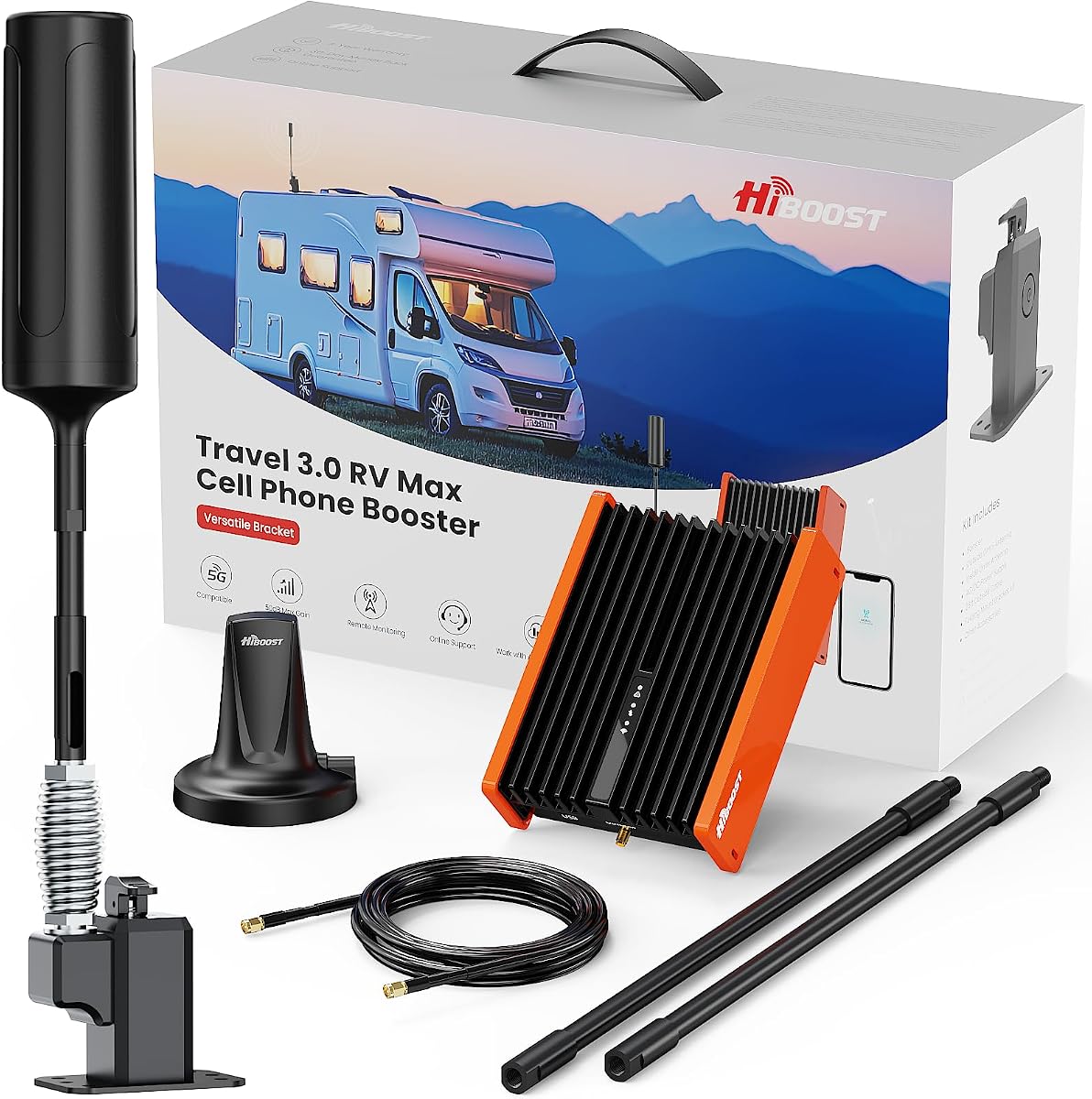
The HiBoost Travel 3.0 RV Max is designed for people whose off-grid cabin may be reached by RV, van, or trailer, or who want a system that can move with them. It carries a 4.4 rating and focuses on flexible placement, mobile power, and whole-vehicle signal distribution rather than a stated cabin square-footage target.
We may earn a commission when you buy through this link, at no additional cost to you.
The 180-degree foldable outdoor antenna can improve clearance near garages, covered lots, and areas with low roof clearance. It can be mounted on a roof rack, pole, or another RV setup, while the magnetic 360-degree indoor antenna spreads signal through the living space. The booster also accepts both 12V vehicle power and standard AC power, making it suitable for a permanently parked cabin as well as a traveling setup.
The HiBoost app adds installation guides, setup videos, performance monitoring, and troubleshooting support. Carrier compatibility includes Verizon, AT&T, and T-Mobile, with support for 5G and 4G LTE across major bands. The stated U.S.-based support, 30-day money-back guarantee, three-year warranty, FCC certification, and absence of a subscription fee add confidence. However, no indoor coverage area is listed, which makes it harder to compare directly with cabin-focused models.
This is a strong option for cabin visitors who split time between a remote property and the road. It is less compelling for someone seeking a permanent, multi-room cabin installation unless the RV format matches the property. Its combination of AC and vehicle power gives it unusual flexibility, while the foldable antenna and app support reduce the practical burden of setup.
Dual 12V and AC power lets the same system serve a parked RV and a cabin supplied by ordinary wall power. That flexibility is particularly valuable for owners whose access to electricity or equipment changes through the season.
The folding exterior antenna and magnetic indoor unit suit vehicles better than a permanent building installation. The 360-degree indoor antenna can cover the occupied living area without requiring a carefully aimed panel position.
We may earn a commission when you buy through this link, at no additional cost to you.
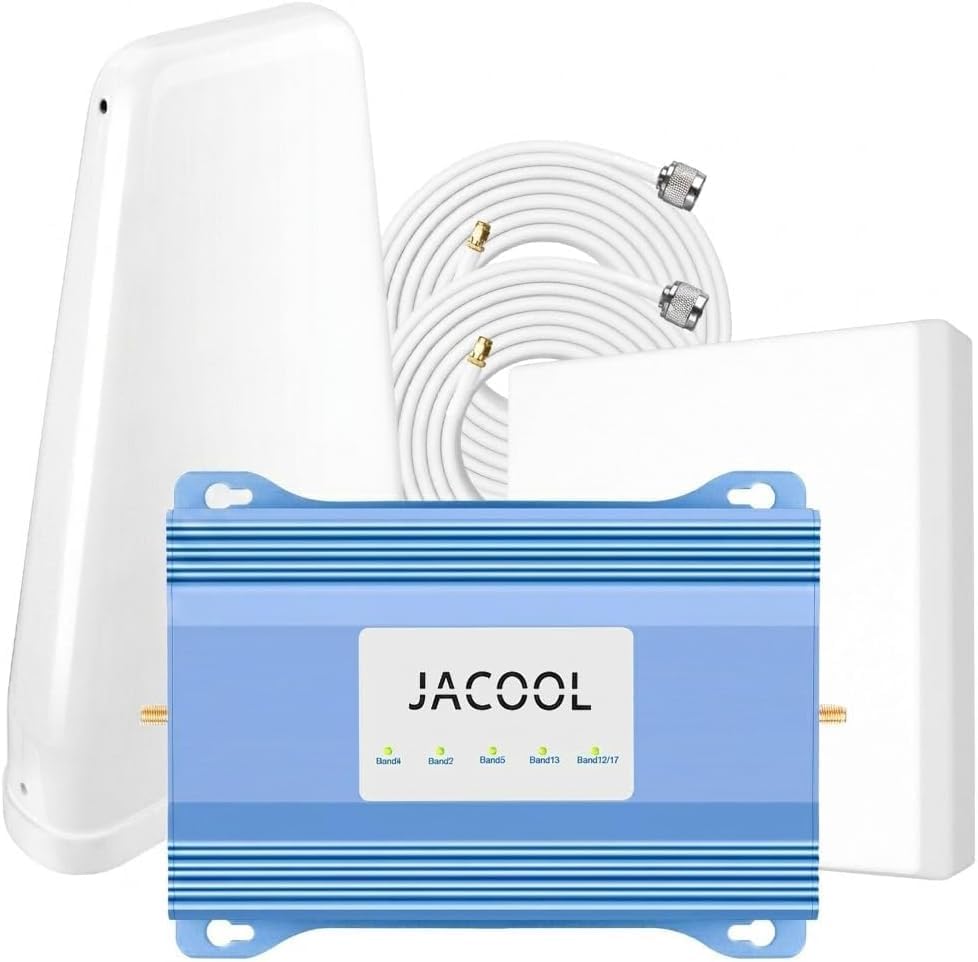
This home cell phone signal booster offers the strongest listed customer rating in the group at 4.5, while giving cabin owners a practical 5,000-square-foot coverage target. It is explicitly listed for houses, offices, cabins, basements, garages, and metal buildings, making it one of the most straightforward choices for a permanent remote residence.
We may earn a commission when you buy through this link, at no additional cost to you.
The kit includes an outdoor antenna, an indoor panel, and coaxial cables. Its directional indoor panel can be aimed toward the rooms that need better service, while the outdoor antenna should be placed where usable cellular reception exists and aimed toward a compatible tower. Verizon, AT&T, T-Mobile, U.S. Cellular, and other major U.S. carriers are supported across Bands 2, 4, 5, 12, 13, 17, 25, and 66.
The main installation challenge is avoiding oscillation between the two antennas. The stated guidance calls for at least 20 feet of vertical or 50 feet of horizontal separation, which may require creative placement in a small cabin or compound. Also, 5G compatibility applies only when the active service uses a supported frequency. The product cannot create carrier service where the exterior location has no usable signal.
For a cabin owner seeking broad carrier support, multiple devices, and a directional indoor panel without moving to a vehicle-specific system, this is the most balanced budget-oriented pick. Its high rating and complete package make it a sensible starting point. Confirm your carrier and band, test outdoor reception, and map the available antenna locations before installation.
The included outdoor antenna, indoor panel, and coaxial cables make this a more self-contained cabin option than systems intended only for vehicles. It is designed to bring service to several phones, tablets, hotspots, and other connected devices at once.
Support for major U.S. carriers and numerous low- and mid-frequency bands makes it a flexible choice, but 5G is conditional on the band used by the active carrier. Field testing can prevent an expensive mismatch.
We may earn a commission when you buy through this link, at no additional cost to you.
The 6,000-square-foot rural booster is built for weak-signal buildings that need service in several rooms or across multiple floors. Its 4.2 rating is solid, and two independent indoor output ports are a notable advantage over systems that require added splitters or couplers for a similar distribution goal.
We may earn a commission when you buy through this link, at no additional cost to you.
The system targets AT&T, T-Mobile, and U.S. Cellular across Bands 2, 4, 5, 12, 17, 25, and 66. It can improve weak 5G, 4G LTE, or 3G reception indoors for calls, streaming, and data. A high-definition LCD displays outdoor signal strength and frequency data, while automatic gain control adjusts output in real time and is designed to limit tower interference.
The most important limitation is explicit Verizon Band 13 incompatibility. This matters because Band 13 is common on rural Verizon towers, while the product's Verizon support is limited to Bands 2, 4, and 5 in urban areas. A cabin owner on Verizon should check the active phone band through Field Test Mode before buying. The stated 6,000-square-foot area is also a maximum, not a guarantee for every signal environment.
This booster is a good fit for rural homes, barns, workshops, metal buildings, and campsites occupied by AT&T, T-Mobile, or U.S. Cellular subscribers. The two output ports make it especially useful when signal needs to reach separate floors or wings. It is less suitable for rural Verizon users unless their local tower avoids Band 13.
Independent indoor outputs let the system serve different areas without the extra splitters and couplers that can introduce loss. That makes the booster practical for cabins with separated rooms, multiple floors, or an adjacent workshop.
The LCD gives the installer real-time outdoor strength and frequency information. That data helps identify a better antenna position and confirms whether a tower is using a band the booster can support.
We may earn a commission when you buy through this link, at no additional cost to you.
The Truck RV Off-Road Booster is aimed at travelers who reach cabins by road, overland route, or remote campsite. Its 3.9 rating is respectable, while the compact, vehicle-oriented design and durable omnidirectional exterior antenna make it relevant to both mobile users and owners of cabins reached by rugged routes.
We may earn a commission when you buy through this link, at no additional cost to you.
The stated maximum gain is 70 dB, and the product supports 5G, 4G LTE, and 3G service for AT&T, T-Mobile, Sprint, and U.S. Cellular. It is also described as supporting all U.S. networks, although Verizon Band 13 is explicitly excluded. The exterior antenna is waterproof, shockproof, wear-resistant, and mounted on a flexible spring base intended to withstand movement.
The booster is most effective where at least one bar of outdoor service, approximately -110 dBm, is available. Its stated maximum communication range of 5 to 8 miles should not be interpreted as guaranteed tower-finding distance; terrain, tower congestion, band support, and starting signal all affect the result. A high gain specification cannot compensate for a location with no usable outdoor signal.
This is a good choice for overlanders, RV travelers, and remote-cabin visitors who need durability and multi-device service. It may also work for a fixed installation if the antenna can be placed securely outside. Verizon users should verify the band in use, while anyone considering installation in a true signal dead zone should look for a location with stronger baseline reception.
The shockproof, wear-resistant exterior antenna and flexible spring base are designed for vehicle movement. That durability is more relevant to a rocky access road than a permanently mounted cabin setup.
The product's guidance highlights the need for a minimum baseline outdoor signal. Starting with one or two bars gives the amplifier a usable source and generally produces more dependable results than attempting to work from no signal.
We may earn a commission when you buy through this link, at no additional cost to you.
The HiBoost Off-Road Booster takes a rugged, travel-oriented approach to weak cellular coverage. Its 4.2 rating reflects a well-regarded product, and the design is intended for remote trails, mountains, deserts, and other places where dependable reception is difficult.
We may earn a commission when you buy through this link, at no additional cost to you.
A rotating mount allows the exterior antenna to fold down for garages, parking structures, and low-clearance locations. The metal booster body receives additional protection from a silicone cover designed to resist bumps, scratches, and outdoor conditions. It supports 4G LTE and 5G and is compatible with major carriers such as AT&T, Verizon, and T-Mobile.
The app provides signal detection, installation guidance, and setup assistance, while three years of dedicated support adds a useful service layer. A key limitation is the absence of a stated indoor coverage area, so it cannot be compared numerically with products claiming 2,000 to 7,000 square feet. Its strengths are more about rugged construction, compact mobile use, and support than about large-building distribution.
This model is best for off-road travelers, RV users, and people visiting cabins in remote terrain. It can be a practical travel companion even if the permanent cabin has separate internet service. For a fixed multi-room installation, a model with clearly specified panel antennas and coverage would usually offer a clearer path to distributing service.
The rotating antenna mount helps the system fit beneath roof racks, inside parking structures, or in other constrained locations. That is especially useful when the vehicle is the operating base rather than a permanent building.
A metal booster body and silicone outer cover provide an added layer against bumps and scratches. The protective approach makes more sense for a mobile installation that may encounter dust, branches, and frequent handling.
We may earn a commission when you buy through this link, at no additional cost to you.
The HiBoost Home Office Booster combines a 4.3 rating with a particularly helpful setup experience. It is rated for spaces up to 2,000 square feet, making it more compact than many cabin systems, but its color LCD and Signal Supervisor app reduce the difficulty of finding a workable outdoor antenna position.
We may earn a commission when you buy through this link, at no additional cost to you.
The product supports Verizon, AT&T, Sprint, T-Mobile, Straight Talk, and U.S. Cellular. Its stated bands include 12, 13, and 17 from 700–750 MHz, Band 5 from 800–850 MHz, Bands 2 and 25 from 1900 MHz, and Band 4 from 1700–2100 MHz. Low-frequency band support can be valuable in rural areas, although the tower and phone must both use a supported band.
The LCD displays real-time signal strength, while the app helps locate the best installation point. A professional directional outdoor antenna can receive signals from farther away and with more gain than an omnidirectional option. Low-noise automatic gain control adjusts the system to maintain performance. The trade-offs are its smaller 2,000-square-foot target and the need for at least one bar of outdoor signal before the booster can enhance it.
This is an excellent choice for a compact cabin, home office, or workshop where guided installation is more important than maximum floor area. It is also a good match for owners who want to locate the tower direction before committing to a permanent mounting position. The three-year warranty, 30-day money-back guarantee, and no-subscription model make it a balanced permanent installation.
The app and color LCD turn antenna placement into a more measurable process. Seeing the signal change while repositioning the outdoor unit can be more valuable than a broad coverage claim when a cabin is surrounded by hills or trees.
Support for Bands 12, 13, and 17 is valuable where lower-frequency signals travel farther. Actual improvement still depends on the carrier's tower, the local terrain, and whether the active phone is using one of those supported frequencies.
We may earn a commission when you buy through this link, at no additional cost to you.
The HiBoost Hero offers a balanced 3,000-square-foot coverage target and a 4.4 rating. Its defining feature is a choice of two indoor antenna options: an extended-range panel for a larger space and a compact whip antenna for mobile applications.
We may earn a commission when you buy through this link, at no additional cost to you.
It is designed for homes, offices, garages, farms, remote areas, warehouses, and metal buildings, making it relevant to a wide range of cabin properties. Maximum gain is listed at 65 dB, and the supported bands cover 12, 13, 17, 5, 2, 25, and 4. The HiBoost app helps install and aim a high-gain directional outdoor antenna and provides live technical support for setup.
The system's stated operating target is an outdoor signal between approximately -100 dBm and -120 dBm, roughly one to two bars, with a compatible tower within 3 to 5 miles. These are useful planning benchmarks, but they are not guarantees. Hotspot devices cannot be boosted according to the supplied information, and the outdoor antenna plus cable routing must be installed for full performance.
The Hero is an excellent all-rounder for a cabin that may need both a fixed and a mobile antenna arrangement. It is particularly useful if the owner wants a panel for broad room distribution but occasionally takes the system to an RV, truck, or temporary location. The choice of antennas and strong support package reduce the need to purchase separate components for different use cases.
The included panel antenna is intended to cover a larger area, while the compact whip offers flexibility for vehicles and temporary setups. This dual approach makes the kit easier to adapt as the owner's use pattern changes.
The suggested one-to-two-bar outdoor baseline helps prevent disappointment before installation. Checking the signal and band at the proposed antenna location is the most reliable way to determine whether the system can work as intended.
We may earn a commission when you buy through this link, at no additional cost to you.
The 7,000-square-foot home booster has the largest stated indoor coverage area in this guide and comes with two indoor panel antennas. Its 4.2 rating makes it a credible option for large cabins, rural homes, offices, and any property where service must reach several rooms.
We may earn a commission when you buy through this link, at no additional cost to you.
The system supports 5G and 4G LTE for North American carriers, including Verizon's 5G nationwide data signals, and provides maximum gain of 70 dB with maximum output power of 17 dBm. Importantly, the product description explains that indoor coverage depends on exterior signal strength: one or two bars may support about 800 square feet, three or four bars about 3,000 square feet, and five bars up to 7,000 square feet.
The installation requirement is substantial. The outdoor log-periodic antenna and booster must be placed at least about 32 feet apart, and power should remain off while installing or adjusting the antennas. The unit is FCC and IC certified and is designed not to interfere with signals traveling to and from the tower. Even with 70 dB of gain, the system cannot operate without a signal available at the exterior antenna location.
This model is a good match for owners with a large cabin, multiple guest buildings, or a substantial rural home that already has strong outdoor service. It is less suitable for a small cabin or a cramped property that cannot provide the recommended antenna separation. Its detailed coverage guidance is a major strength because it sets realistic expectations instead of presenting the maximum as a guarantee.
The outdoor signal determines the realistic indoor result. This scaling is useful because it lets buyers estimate expectations based on bars at the antenna site instead of treating 7,000 square feet as a guaranteed figure.
Two indoor panel antennas can distribute service across a broad footprint or focus on separate wings of a property. Placement should reflect where phones, smart devices, and hotspots are actually used.
We may earn a commission when you buy through this link, at no additional cost to you.
The SureCall Fusion4Home Max is a home system built around a different strategy: amplifying the cellular signal outside before distributing it indoors. Its 4.3 rating and extended-range technology make it a strong option for a cabin located farther from a tower or behind terrain that weakens reception.
We may earn a commission when you buy through this link, at no additional cost to you.
By capturing the strongest usable signal at the point outside the building, the system is designed to reach a more distant cell tower and provide a larger indoor area. It supports 5G and 4G LTE, with stated compatibility for AT&T, T-Mobile, Verizon, U.S. Cellular, Mint Mobile, Boost Mobile, and more. Phones, tablets, hotspots, and other cellular-enabled devices can be supported simultaneously.
No specific indoor square-foot figure is included, so buyers cannot compare its room coverage directly with the 5,000-, 6,000-, or 7,000-square-foot claims in the guide. The outdoor-first approach also requires suitable exterior antenna placement and likely a routed cable into the cabin. Carrier compatibility does not guarantee service on every local band or tower, and the system still needs a usable source signal.
The Fusion4Home Max is a good candidate for a permanent cabin where the tower is far away and the owner prioritizes extended reach over a published room-area estimate. It is also backed by a three-year warranty and lifetime U.S.-based support, with no recurring subscription requirement. For cabins where outside signal is weak but detectable, its extended-range concept is a meaningful advantage.
Amplifying the signal outdoors can give the system a stronger source before it enters the building. That approach is especially relevant to cabins separated from a tower by a long stretch of open land, hills, or forest.
Compatibility with several major and resale carriers makes it practical for families or rental cabins where device providers differ. Each user still benefits only when the local tower exposes a compatible signal.
We may earn a commission when you buy through this link, at no additional cost to you.
The most important buying decision begins outside the cabin: identify a carrier, test the existing signal, confirm the active frequency band, and determine the direction of a usable tower. After that foundation is in place, compare antenna flexibility, indoor distribution, installation requirements, power, and support.
A cellular booster amplifies an existing signal; it does not create cellular service from nothing. Before purchasing, place a phone where the outdoor antenna will go and check the signal in the phone's Field Test Mode. A stronger baseline gives the amplifier more to work with, while a location with no signal or an unsupported band will produce disappointing results regardless of the stated gain.
Aim for at least one or two usable bars whenever possible. Note the carrier, current signal strength, and frequency band at several potential mounting points. If the signal varies sharply by direction, a directional antenna and a way to raise or reposition the unit will be more valuable than simply buying a higher-gain specification.
Coverage claims describe the maximum area a system may handle under favorable conditions, not a guaranteed square-foot result. The 7,000-square-foot model is intended for properties with very strong outside reception, while more compact systems can serve smaller cabins where the outside signal is moderate. Consider the number of floors, wall materials, and whether nearby rooms need separate coverage.
Choose based on realistic signal conditions rather than the largest number available. Two panel antennas may be more useful than one very broad claim if the cabin has separate wings. Conversely, a modest 2,000-square-foot system with good placement may outperform a larger kit installed where no usable signal reaches the outdoor antenna.
Carrier logos alone do not guarantee local compatibility. A booster must support the frequency band used by the local tower, and rural carrier networks can use different bands from urban networks. This is especially important for Verizon Band 13, which is explicitly excluded by two products in this guide and is common on rural Verizon towers.
Use Field Test Mode to identify the active band, then compare it with the manufacturer's supported list. Low-frequency bands such as 12, 13, and 17 can be useful over distance, but support for one band does not mean every tower in the region is compatible. If a cabin hosts visitors from several carriers, broad multi-carrier and multi-band support becomes more valuable.
Directional antennas are useful when the tower is in a known direction and the goal is to reach it from a weak location. Omnidirectional antennas are easier when the tower direction is uncertain or the system must work in different directions. For indoor distribution, a panel can focus energy into selected rooms, while a whip or magnetic antenna may be more convenient in a vehicle.
Consider both the outdoor and indoor sides of the system. A cabin near a tower may need a powerful indoor panel, whereas a remote property may benefit more from gain and a sensitive directional exterior antenna. Also check whether mounting hardware, coaxial cables, and appropriate indoor antennas are included.
Outdoor and indoor antennas must be separated enough to prevent oscillation, which can create interference, unstable amplification, or system shutdown. Recommendations among the listed products range from at least 20 feet vertically or 50 feet horizontally to about 32 feet, depending on the model and setup. The cabin's floor plan, exterior wall options, and cable length should be considered before purchase.
Power the system down while connecting and adjusting antennas. Begin with a basic setup, then turn it on and monitor signal behavior. If performance fluctuates, move the outdoor antenna, adjust its direction, or increase separation. Correct placement is often more influential than a small difference between two advertised gain figures.
Permanent cabins generally favor a standard indoor power source, while RVs and trucks need 12V vehicle power or a dual-power arrangement. The HiBoost Travel 3.0 RV Max explicitly supports both 12V and AC power, which makes it adaptable to a cabin that is also traveled in by RV. Other systems may require separate power planning and an appropriate connection.
Installation time is another practical factor. A whip antenna can be easier to deploy, while an elevated directional antenna and two indoor panels may need more planning. The HiBoost Hero states that guided installation commonly takes one to two hours, but actual time depends on the building, roof access, cable routing, and how much antenna positioning is needed.
A color LCD or app can make a remote installation much less frustrating because it shows signal changes as the exterior antenna moves. Automatic gain control can stabilize output and reduce manual tuning, while customer support can help diagnose a poor tower direction or incorrect band. These features do not replace realistic signal testing, but they make the process more understandable.
Look for a warranty and support terms that match the intended use. Several products in the guide provide a three-year manufacturer warranty, and some include a 30-day money-back guarantee. Local technical support is valuable when a cabin owner cannot easily visit a retailer or installer and the system is operating far from the manufacturer.
Begin with a carrier and signal survey before mounting anything. Use Field Test Mode at several outdoor locations, record the carrier, signal strength, and active band, and identify the direction that consistently provides the strongest usable signal. Test the location during different times of day if the tower or surrounding land use may change. Do not purchase or install the system with the expectation that it will work where your ordinary phone has no detectable service.
Install with the power disconnected. Mount the outdoor antenna securely, aim it toward the compatible tower, connect the coaxial cable, and maintain the separation recommended for the model. Position the indoor panel or whip where connected devices are most often used, then connect the booster and power it on. Use the LCD or app to compare readings before and after adjustments, and change only one variable at a time so you can identify what improves reception.
For ongoing care, inspect external mounts, weather seals, cables, and connectors after storms, heavy snow, or seasonal tree growth. Keep the outdoor unit firmly secured and the cable route protected from animals, vehicles, and UV exposure. Do not open the electronics while connected to power, and follow the manufacturer's grounding and installation guidance. Recheck signal performance when the carrier changes equipment, software updates occur, or nearby construction alters the line of sight.
No. A booster amplifies a cellular signal that is already available at the outdoor antenna location. If that location has no detectable signal, no legitimate booster can manufacture usable carrier service. Moving the antenna higher, finding a clearer line of sight, or choosing a location near a tower can sometimes reveal a signal that was hidden at ground level.
Not necessarily. A booster must support both the carrier and the frequency band used by the local tower. Some products cover every major carrier, but others exclude specific bands, including Verizon Band 13 in two of the systems listed here. Checking the active band in Field Test Mode is the safest way to avoid buying an incompatible system.
It can be an effective alternative when a cabin has a usable cellular signal outdoors but poor indoor reception. It may provide calls, messaging, navigation, and data without a separate subscription. It is not a solution for a property with no compatible tower coverage, and actual internet speed still depends on the carrier, tower load, signal conditions, and device.
The stated area is a maximum rather than a guarantee. Actual performance depends on outdoor signal strength, building materials, antenna placement, supported bands, and how the indoor antenna is arranged. Products in this guide range from 2,000 to 7,000 square feet, with some systems providing more realistic estimates based on the number of outdoor bars.
A directional antenna is usually better when you know the tower's direction and want maximum gain from a specific location. An omnidirectional antenna is easier to install and works from multiple directions, making it convenient for moving vehicles or uncertain tower locations. The best choice depends on terrain, obstruction, and whether the system must be portable.
The most common causes are inadequate separation between the outdoor and indoor antennas, incorrect antenna direction, or an outdoor location with an unstable signal. Turn off the power while adjusting connections, increase separation, and reposition the outdoor antenna toward the strongest compatible tower. A system display or app can help identify changes during the process.
Yes, if the booster supports each person's carrier and the local tower bands. Multi-device support is common among the products listed, but a particular visitor's carrier will not work if the system does not support its network or if the nearby tower uses an excluded band.
The listed products do not require monthly booster subscriptions, although the cellular service itself is still provided by the user's carrier. A one-time equipment purchase covers the amplification system, while normal carrier data, voice, and messaging charges still apply according to the customer's plan.
The 5,000-square-foot home booster stands out as the best balanced pick because it combines a 4.5 rating, a complete antenna package, broad carrier support, and a permanent-building focus. The HiBoost Home Office Booster is the editor's choice for cabins where guided setup and low-frequency band support are especially valuable, while the weBoost Cabin offers the most purpose-built remote-property package with its elevated directional antenna.
Prioritize the signal outside the cabin over maximum amplification or a large square-foot claim. Confirm the active carrier and band, compare readings from several possible antenna positions, and make sure the building can provide the recommended antenna separation. After that, select an indoor antenna arrangement that serves the actual rooms you use and choose a power method suited to a permanent cabin, RV, or combination of both.
Product configurations, availability, and pricing can change, so verify the current specifications and terms before making a purchase. The most valuable investment is a system matched to a real, measurable outdoor signal rather than one selected solely by the largest advertised coverage number.