
Hot Shot MaxAttrax Ant Bait
4.1Editor score
Eight child-resistant stations
Indoor and outdoor placement
Targets visible and hidden ants
Carpenter ant traps compared for carpenter ant control, indoor or outdoor placement, colony targeting, ease of use, and value.
Carpenter ant traps are designed to attract foraging workers, deliver an active bait formulation, and help eliminate the colony rather than merely removing visible ants. Because carpenter ants may forage through structural cracks, trees, patios, and utility openings, the best option depends on placement, bait format, and the locations where ants are active.
We compared the ten products in this guide by examining their stated target species, colony-control approach, bait format, indoor or outdoor suitability, pack size, and ease of placement. The list includes liquid stations, gel stations, granules, and outdoor stakes, with two products specifically identifying carpenter ants as a target.
Each review explains where the product is most useful, what sets it apart, and where buyers should be cautious. Our top recommendations range from a budget-friendly bait station to a broad-coverage gel set and a dedicated granular carpenter ant treatment. Product prices and availability can change, so compare current listings before purchasing.
4.1Editor score
4.6Editor score

4.1Editor score
The comparison below covers every product in the guide, emphasizing formulation, intended placement, colony-control method, package size, and whether carpenter ants are explicitly included in the stated target list.


This 12-pack of TERRO liquid bait stations combines a well-established bait-station format with a 4.6 customer rating. Its stated attraction and killing approach is designed to reduce visible activity while allowing worker ants to carry consumed bait back to hidden colony members, making it a practical starting point for households dealing with common indoor ants.
We may earn a commission when you buy through this link, at no additional cost to you.
The borax-based liquid formulation is placed in ready-to-use stations, eliminating complicated assembly. Buyers can position units along baseboards, in corners, on countertops, and other places where ants travel. Its listed target species include acrobat, crazy, ghost, little black, odorous house, and pavement ants, while the colony-sharing action is intended to reach ants that are not visible.
The primary limitation is that carpenter ants are not explicitly named in the supplied product information. It should therefore be viewed as a versatile indoor ant trap rather than a dedicated carpenter ant treatment. In addition, the stated complete-control period may be as long as two to four weeks depending on infestation size, so buyers should not expect every foraging ant to disappear immediately.
This is an appealing choice for homeowners who want an easy-to-use liquid bait, a generous 12-station pack, and strong feedback for general indoor ant control. It works particularly well when the active trail runs through accessible indoor areas. For a confirmed carpenter ant infestation, verify the current label and consider a product specifically formulated for that species.
The stations require no setup and are intended for high-traffic ant routes such as baseboards, corners, and countertops. Placing them directly along an observed trail can make the bait easier for worker ants to discover.
Worker ants consume the liquid bait and carry it back toward the colony. This transfer mechanism allows the treatment to reach hidden nest populations, although results depend on continued bait visitation and infestation size.
We may earn a commission when you buy through this link, at no additional cost to you.
This 18-count TERRO package is a strong alternative for indoor ant control where several rooms, cabinets, or activity areas need simultaneous bait placement. It shares a 4.6 rating with the smaller TERRO option and follows the same basic principle: attract foraging workers, allow them to consume bait, and support colony-wide effects through food sharing.
We may earn a commission when you buy through this link, at no additional cost to you.
The larger station count is the main practical distinction. Buyers can distribute traps among multiple hotspots instead of relying on a smaller number of units. Suitable locations include baseboards, room corners, and counters, while the ready-to-use design removes the need for setup. The formulation is described as effective against common household and sweet-eating varieties of ants.
Carpenter ants are not specifically named among the stated targets, which limits its relevance as a confirmed-species solution. Its effectiveness also depends on ants continuing to visit the bait. As with other liquid bait approaches, fewer visible ants may indicate that workers are carrying bait back to the colony, but complete results may take longer than the initial reduction in activity.
Choose this product when breadth of indoor placement and a larger count matter more than outdoor use. It is particularly useful for apartments, kitchens, bathrooms, and other areas where multiple trails are visible. Buyers handling carpenter ants specifically should check the current product label rather than assuming all ant types are covered.
The 18-station format allows a more distributed placement strategy. This can be useful when several rooms, cabinet runs, or travel corridors show ant activity.
The stated action relies on workers carrying the liquid bait back to the colony. This colony-oriented method is more useful than simply killing a few visible workers at the station.
We may earn a commission when you buy through this link, at no additional cost to you.
This outdoor stake system is designed for intercepting ants around the exterior, particularly where trails approach a home. Its 4.5 rating, 12-pack format, and visible bait chamber make it a useful complementary tool for managing foraging activity before workers enter living spaces.
We may earn a commission when you buy through this link, at no additional cost to you.
Installation follows an insert-and-cut process. Push the stake into the ground where ants are active, cut the tab, and allow the liquid bait station to remain active. The see-through chamber makes it possible to monitor ant visits and bait consumption, which helps indicate when a station needs replacement. The listed targets include acrobat, crazy, ghost, and little black ants.
The product is built for outdoor conditions and focuses on interception rather than interior placement. Although that makes it valuable for entry-point control, carpenter ants are not explicitly listed in the supplied information. The stakes also need ground where they can be inserted securely, so they may not be convenient for hardscape edges unless the current instructions allow an alternative placement.
This is a practical pick for homes dealing with recurring exterior trails or ants approaching doors, patios, and other access points. It can be used alongside interior baiting for a broader perimeter strategy. For carpenter ants, verify the active trail and confirm that the product is labeled for the species found on the property.
The see-through station helps buyers observe workers and see how much bait remains. This visibility makes monitoring more direct than with an opaque indoor station.
Placing stakes along an active outdoor trail targets ants at the perimeter. This is especially helpful when workers enter through doors, utility penetrations, or nearby vegetation.
We may earn a commission when you buy through this link, at no additional cost to you.
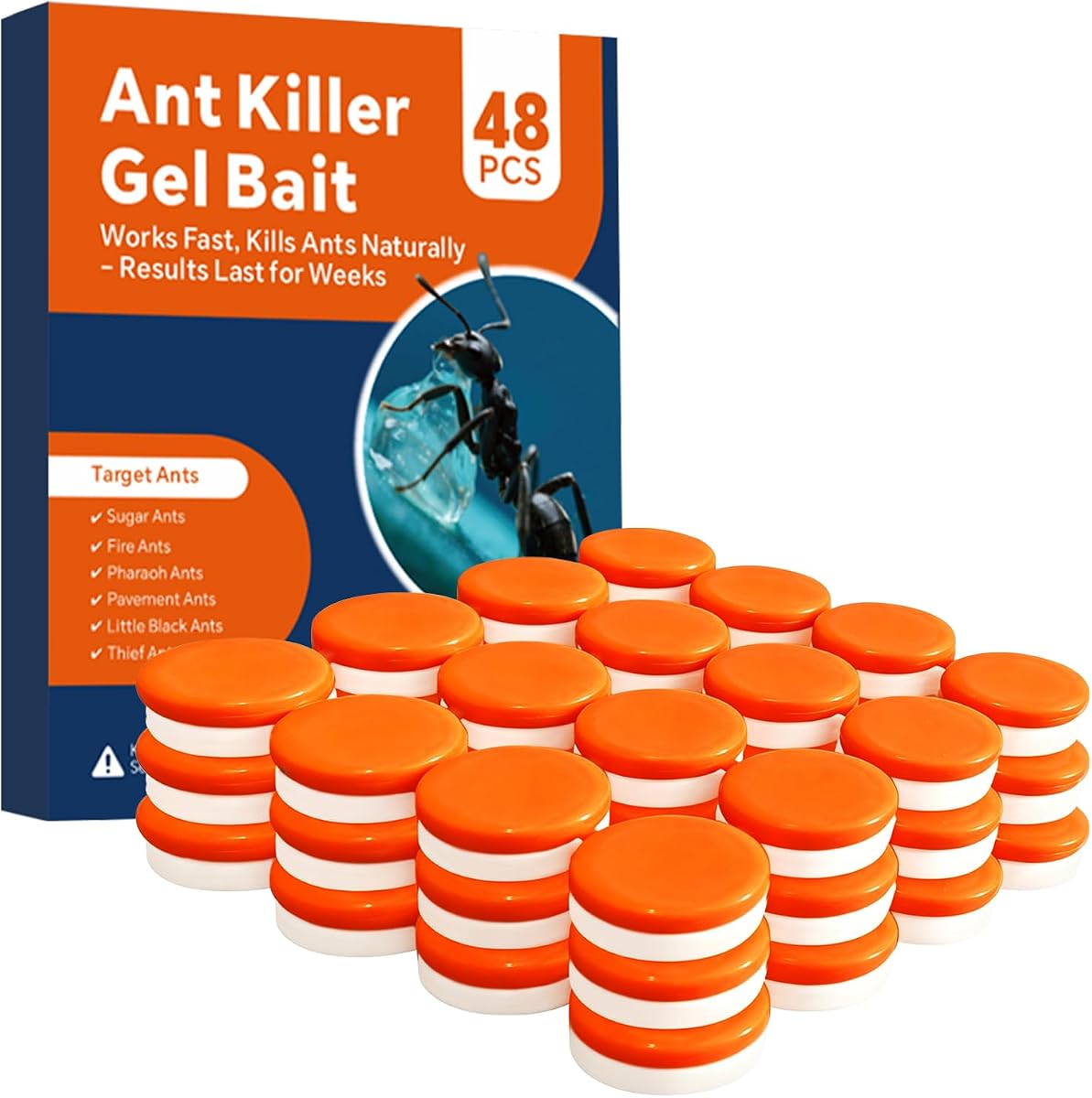
This 48-pack of slow-acting ant gel bait is the clearest dedicated match for the carpenter ant keyword in the list. It carries a 4.6 rating and explicitly names carpenter ants among the target species, while also addressing sugar, grease, pavement, odorous house, and other common household ants.
We may earn a commission when you buy through this link, at no additional cost to you.
The prefilled gel stations use adhesive mounting rather than a loose-pour application. Buyers open the lid, peel the included double-sided tape, and attach the station to a floor, wall, or cabinet base. The product is intended for kitchens, bathrooms, living rooms, basements, patios, porches, garages, lawns, and other indoor or outdoor areas.
Its slow-acting design is meant to give workers time to consume the gel and return it to the nest, where it can be distributed to queen, larvae, and other colony members. This approach targets the source rather than only the visible trail. The tradeoff is that a mounted gel station occupies visible space and may need replacement when consumed or dried out.
This is the most comprehensive choice for a homeowner who specifically wants carpenter ant coverage and enough stations to distribute throughout a large property. The adhesive method is convenient, and the broad placement claims make the product useful indoors and outdoors. Confirm the current label, especially around children, pets, food surfaces, and water.
Carpenter ants are explicitly included in the stated target list, unlike several general ant traps in this guide. That makes this product more directly aligned with the requested pest type.
The double-sided adhesive system keeps prefilled stations in position without squeezing gel onto surfaces. Buyers can still choose where to deploy them based on visible traffic and structural access points.
We may earn a commission when you buy through this link, at no additional cost to you.
BASF Advance Carpenter Ant Bait Granules is a purpose-built granular option with a 4.1 rating. Its name, target list, and delayed-action approach make it one of the most directly relevant products for carpenter ant control in this roundup.
We may earn a commission when you buy through this link, at no additional cost to you.
The formula contains abamectin at 0.011 percent and uses the social behavior of ants, particularly food sharing, to reach colony members. Larger grit sizes help many ant species pick up the bait. The stated target list includes carpenter ants along with acrobat, Argentine, bigheaded, crazy, field, fire, harvester, little black, odorous house, pavement, pharaoh, and thief ants.
Granular bait provides placement flexibility but also makes label compliance especially important. The product information warns that it is hazardous to humans and domestic animals, toxic to fish and wildlife, and subject to state restrictions. These cautions are substantial, so this option is best for informed buyers who will read and follow the complete label rather than improvise application methods.
For a confirmed carpenter ant problem, this is the most specialized premium pick. Its delayed action is designed to give workers time to carry bait between the source and colony, which is central to the intended elimination process. It is less convenient than prefilled stations because placement and cleanup depend on the product's granular format.
This product is explicitly labeled for carpenter ants and offers granular placement options. It is a strong fit for buyers who need a dedicated treatment rather than a general-purpose household ant station.
The delayed formula gives workers time to return to the colony and share bait. This is the central mechanism behind the stated whole-colony control approach.
We may earn a commission when you buy through this link, at no additional cost to you.
Ortho Orthene Ant Killer Ant Bait provides 12 prefilled stations for indoor use and carries a 4.1 rating. It is straightforward to deploy: break the stations apart and place them label side down where ants have been observed.
We may earn a commission when you buy through this link, at no additional cost to you.
The stated mechanism relies on foraging workers finding the bait and sharing it with the colony. Product information says users may see fewer ants within three to seven days, and the package contains 12 stations. Suggested locations include baseboards, room and cabinet corners, around pipes, pantry areas, window sills, doorways, and garbage cans.
Most importantly for this guide, the product is specifically not labeled for carpenter ants, as well as fire or harvester ants. That makes it a general indoor ant solution rather than a responsible choice when carpenter ants have been positively identified. It can still be useful for other household ants encountered in the same home, but the label should guide expectations.
This product suits buyers seeking a simple, prefilled station with multiple indoor placement options. It avoids loose pesticide handling and is convenient for pantries, cabinets, and utility areas when used according to the label. For a carpenter ant issue, select a product that explicitly includes the species instead.
Prefilled stations make treatment more controlled than pouring or spraying pesticide. The simple break-and-place format also makes it easy to cover several indoor hotspots.
The supplied information explicitly says this bait is not labeled for carpenter ants. Buyers should not interpret broad household-ant language as covering every species they encounter.
We may earn a commission when you buy through this link, at no additional cost to you.
This listing is included to preserve the complete ten-product comparison, but the supplied data contains no usable title, rating, image, or product description. As a result, there is no factual basis for evaluating its bait type, species coverage, placement method, or colony-control mechanism.
We may earn a commission when you buy through this link, at no additional cost to you.
A product page can still be useful for checking current packaging, manufacturer information, registration details, warnings, and directions. Buyers should verify whether the item is a carpenter ant bait, a general ant station, or an entirely different product. Any selection should be based on the current label rather than on its place in this ranking.
There is no basis here for recommending this listing or warning against it in technical terms. Its main limitation is transparency. Without confirmed specifications, it cannot be compared fairly with products that identify active ingredients, target species, pack counts, and installation methods.
This entry should be considered a research lead rather than a purchasing recommendation. If the current listing confirms a suitable formulation, clear directions, and appropriate labeling for the identified pest, it may be worth considering. Otherwise, one of the fully documented options offers a much stronger basis for an informed decision.
Because the supplied title and description are unavailable, check the current packaging and listing details. Confirm the manufacturer, formulation, target species, and intended placement before use.
For a purchase requiring a clear decision, products with stated ingredients and directions are easier to evaluate. This listing cannot be recommended on the available information alone.
We may earn a commission when you buy through this link, at no additional cost to you.
Ortho Home Defense Ant Traps offer four stations with metal housing, food-based bait, and a 4.1 rating. The protective casing is a distinctive feature intended to reduce the risk of bait spillage while the station is punctured and placed.
We may earn a commission when you buy through this link, at no additional cost to you.
The stated activation process is straightforward: remove the station from its packaging, puncture the metal housing, identify affected areas, and place the bait where ants are active. Product information says workers feed on the bait and return to contaminate the nest, with the goal of reaching the queen and colony. The listed replacement guidance is 30 days when an immense incursion persists.
The four-pack is smaller than most competing station packs, which could limit coverage in a large home or across multiple structures. Carpenter ants are also not explicitly included in the supplied species list, which covers pavement, acrobat, pyramid, white-footed, little black, and Argentine ants. The protective housing should not be treated as proof that the product is appropriate for every household situation.
This pick is best for buyers who value a sturdy enclosure and straightforward setup in a limited number of locations. It may suit small problem areas, exterior entry points, or homes that also deal with the listed general ant species. For confirmed carpenter ants, select an option with explicit carpenter ant labeling.
The metal station contains the bait during activation and placement. This enclosure adds a physical barrier around the pesticide, though it does not eliminate the need for careful handling.
With four units, the package is most practical where activity is concentrated. Buyers needing broad placement across a larger property may prefer a higher-count option.
We may earn a commission when you buy through this link, at no additional cost to you.
Hot Shot MaxAttrax Ant Bait is a budget-friendly eight-station option with child-resistant housings and a 4.1 rating. It is designed for both indoor and outdoor use and states that it can work for up to six months indoors when stations remain in place.
We may earn a commission when you buy through this link, at no additional cost to you.
Suggested locations include walls, closets, cabinets, under sinks, and behind refrigerators. For exterior use, the product guidance recommends placing one station along each trail around the outside of the home. This makes the eight-unit pack more versatile than an indoor-only product and allows a combined perimeter and interior strategy.
The central limitation is species specificity. Carpenter ants are not explicitly named in the supplied information, so the product should not be assumed to be labeled for them. In addition, child-resistant packaging does not make the bait safe for children or pets; it simply adds a protective closure that can slow access. The current label must still be followed carefully.
This is the top budget pick for shoppers who want simple stations, flexible placement, and a protective enclosure at a comparatively accessible entry point. It is a sensible general ant solution when the species has not been confirmed. If carpenter ants are the known target, choose a product with explicit species labeling instead.
Child-resistant bait stations provide an added physical barrier around the product. They should still be kept away from children, pets, food, and other unintended access points.
Using stations along outdoor trails and near indoor hotspots can create a more consistent treatment area. The eight-unit count makes this approach feasible without a large pack.
We may earn a commission when you buy through this link, at no additional cost to you.
Raid MAX Liquid Ant Killer Baits provide eight prefilled liquid stations for indoor and outdoor placement. The product has a 4 rating, the lowest numerical rating in this comparison, but it offers a straightforward bait-transfer method and covers a broad list of general household ant species.
We may earn a commission when you buy through this link, at no additional cost to you.
The liquid bait works by being consumed by foraging ants, which then return to the colony and transfer it to the queen, other workers, and larvae. Listed targets include foraging ants, sweet-feeding ants, pavement ants, moisture ants, little black ants, Argentine ants, crazy ants, acrobat ants, bigheaded ants, cornfield ants, ghost ants, and odorous house ants.
Most significantly, the product expressly excludes fire ants, carpenter ants, harvest ants, and pharaoh ants. It therefore does not meet the core target of this guide when carpenter ants have been identified. The 4 rating may also leave buyers more cautious about expectations, although individual results can vary with placement and infestation severity.
Raid MAX is best considered a compact general-ant solution for homes dealing with one of the listed species. Its prefilled liquid format and indoor-outdoor flexibility are useful, but a carpenter ant buyer should move to the dedicated gel or granular choices. In either case, proper identification remains the most important first step.
The station removes the need to measure or pour liquid bait. That simplicity makes the product convenient for placement near known feeding and travel areas.
Carpenter ants are explicitly excluded in the supplied product information. This is a clear species limitation rather than a minor caveat.
We may earn a commission when you buy through this link, at no additional cost to you.
The right carpenter ant trap depends on confirmed species, active trails, treatment location, bait format, and the amount of property that needs coverage. Product labels and active ingredients should take priority over broad marketing claims.
Carpenter ants are only one of many ant species that can enter homes, and several products in this guide are not labeled for them. Correct identification narrows the choice immediately and prevents spending time on a bait that cannot address the target colony. Look for a product that explicitly names carpenter ants, or verify the current label with a pest professional if identification is uncertain.
Choose explicit carpenter ant labeling whenever possible. General household ant language is not equivalent to species-specific coverage.
Carpenter ants may forage inside and remain connected to colonies hidden in wood, wall voids, trees, or underground spaces. An indoor station is useful along visible trails, while outdoor stakes or granules can address activity around soil, vegetation, patios, and structural access points. Products labeled for both locations provide more flexibility but may require several complementary placements.
Match the bait to the location where workers are active. Exterior control cannot replace an interior trail station, and vice versa.
Liquid stations are ready to use and easy to position near trails. Gel stations offer adhesive mounting and broad room coverage, while granules can be placed into suitable cracks, voids, or other label-approved locations. Each format has different handling requirements, and no format automatically guarantees faster results. Select the one that matches the property and that you will be able to use according to its directions.
Prefer a prefilled format for convenience; choose granular bait when label-directed placement is appropriate.
Effective colony treatment depends on a worker carrying bait back to the nest. Products using delayed action or bait sharing are designed to give ants enough time to transport the formulation and expose other colony members. This is different from a product that simply kills ants at the station. Check the active ingredient, stated mechanism, and directions to understand how the product is expected to work.
Prioritize products whose stated mechanism includes transfer or sharing within the colony.
A small pack may be sufficient for a small, concentrated problem, but a larger property can require stations along multiple trails, around separate access points, and in several rooms. The 48-pack gel option offers the broadest station count, while an eight-count pack may be more practical for targeted treatment. Estimate the number of active routes before choosing quantity.
Buy enough units to cover every visible route and keep replacements available if bait is consumed.
Ready-to-use stations are generally the simplest option. Some require only lid removal or puncture, while outdoor stakes must be inserted into soil and gel stations must be adhered to a surface. Monitoring features such as a see-through chamber can help indicate whether ants are visiting and whether replacement is needed. Choose a format you can inspect without opening the bait or disturbing the trail.
Favor simple activation and visible monitoring when deciding between similar products.
Bait products are pesticides and should be handled according to the label. Some warnings apply to humans, domestic animals, fish, wildlife, food-contact surfaces, or particular state uses. Child-resistant housings reduce accidental access but do not make a product harmless. Keep stations away from children, pets, utensils, exposed food, and areas where runoff could occur, and follow disposal directions.
Read the complete label before purchase and use. A specialized product is only suitable if you can follow its restrictions.
Colony control is rarely as immediate as killing the first visible ants. Some products reduce activity within days, while broader elimination may require weeks and continued bait visitation. Check stations, rotate or replace them as directed, and address moisture, food, damaged wood, and entry points that may be attracting ants. Persistent or structural damage may require professional diagnosis.
Treat the full activity period and investigate conducive conditions rather than expecting one placement session to solve every problem.
Begin by confirming the ant species and locating as many active trails as possible. Look for workers moving in a line, where they enter the structure, and where they travel after emerging from hidden nest areas. Clean nearby food and water sources before placing bait, but avoid disrupting the trail immediately beforehand because worker traffic helps workers locate the new station.
Follow the product-specific label for activation, orientation, amount, and placement. Liquid stations generally go directly along trails or in designated corners, while adhesive gel stations need a clean, dry mounting surface. Insert outdoor stakes only where the instructions permit and granule products must be placed exactly as directed. Keep bait away from children, pets, exposed food, utensils, and surfaces where accidental contact is likely.
Monitor activity without repeatedly opening or moving the stations. Replace consumed, dried, or damaged units according to the label and the product's activity period. Continue sanitation, moisture control, and entry-point repairs, and reassess the infestation if worker activity does not decline. For suspected structural carpenter ant damage or a persistent colony, seek professional pest identification and treatment.
The best option is one whose current label explicitly identifies carpenter ants and matches the treatment location. Dedicated gel or granular products in this guide offer more direct species relevance than general household ant baits. Place the bait along active worker routes and follow all label directions, especially for placement around children, pets, food, and water.
Many bait products are designed to reach the colony through food sharing, allowing workers to carry consumed bait back to the nest. The supplied product descriptions make colony-wide claims for several options, but the result depends on ants visiting the bait and the treatment reaching the nest. No trap should be assumed to work instantly on every colony.
Visible activity may decline within days for some products, while complete control can take several weeks. The 12-pack TERRO information notes that complete control may require two to four weeks depending on infestation size. Continued station placement, correct identification, and treatment of conducive conditions all influence the timeline.
Use indoor bait where workers are entering or traveling through the home, and use outdoor treatment where trails appear near soil, vegetation, patios, or structural openings. In many cases, a combined approach is more effective than relying on only one location. Always follow the label's permitted placements.
That depends on the product. TERRO's 12-pack and 18-count liquid stations are described for indoor use, while its outdoor stake product and Raid MAX liquid bait allow outdoor placement. Do not assume that indoor liquid bait can withstand weather or be installed in soil; check the current label.
Place them directly along active trails whenever possible. Other suggested locations include baseboards, corners, under sinks, behind appliances, near pipes, window sills, cabinet edges, and outdoor entry points. Avoid placing stations in areas where children, pets, or food can contact the bait, and do not spray other products over bait unless the label permits it.
Visible workers may continue returning because they have not yet consumed enough bait or because the stations are not positioned on the primary trail. Workers can also carry bait back to the colony before mortality occurs, so activity does not always fall immediately. Check placement, keep stations stocked, and allow the label-directed treatment period to continue.
Yes, because accessible moisture, food, gaps, and damaged wood can support repeated ant activity and conceal nesting areas. Bait addresses foraging ants, but it may not fully solve the conditions that attract them. Seal suitable gaps, eliminate water sources, remove accessible food, and have significantly damaged structural wood evaluated when carpenter ants are confirmed.
The leading choice is the 48-pack slow-acting gel bait because it explicitly targets carpenter ants, supports indoor and outdoor placement, and offers enough stations for broad distribution. BASF Advance is the strongest specialized alternative for buyers comfortable with granular bait and label-based safety restrictions, while Hot Shot MaxAttrax is a practical budget option for general household ants.
Prioritize species labeling first, followed by the location of active trails and the treatment format you can use correctly. A larger pack is useful for wide coverage, but the best station is one positioned where workers can actually find it. Sanitation, moisture reduction, entry-point repairs, and patience remain essential parts of a complete strategy.
Before buying, compare the current listing, package contents, ingredients, directions, and customer feedback. Prices, formulations, and labeling details can change, so shoppers should verify that the product still matches the information presented here and that current availability is suitable for the affected property.
