
XIIXMASK USB 3.0 HDMI Capture Card
4.2Editor score
4K60 capture and passthrough
1080p120 high-frame-rate capture
3.5mm audio input and output
Driver-free cross-platform design
Our capture card for streaming high FPS gameplay guide compares 10 options for high-frame-rate capture, passthrough, latency, audio, compatibility, and setup
A capture card for streaming high FPS gameplay must preserve fast motion while keeping the game view and broadcast in sync. The most important capabilities include high-frame-rate capture, low-latency passthrough, dependable computer connectivity, and audio support. The right device depends on your console, PC, display, recording resolution, and preferred production workflow.
This guide compares ten external and internal capture options using their stated resolution, refresh-rate, HDR, VRR, passthrough, latency, audio, operating-system, and software-support features. The selections range from straightforward USB devices for 1080p60 streams to enthusiast cards supporting 4K144 passthrough, 1080p240 capture, or internal PCIe installation.
Each review identifies the strongest use case, important limitations, and compatibility considerations based on the supplied product information. The table offers a quick technical comparison, while the buying guide explains how to match a card to your hardware. Product specifications and availability can change, so verify current details and pricing before purchasing.
4.2Editor score
4.5Editor score

4.5Editor score
This side-by-side comparison highlights capture ceilings, passthrough capabilities, installation type, latency features, audio options, and platform support. It is designed to make it easier to identify the right card for high-FPS consoles, competitive gaming PCs, and multi-resolution streaming setups.



This compact USB 3.0 capture card offers a straightforward route into 1080p60 game recording, and its stated 4.4 rating reflects a generally favorable user reception. It targets beginners who want a portable card that works with a console, laptop, or desktop without a complicated installation process. Its central attraction is the combination of 1080p60 capture, HDMI passthrough, and broad compatibility.
We may earn a commission when you buy through this link, at no additional cost to you.
The strongest feature is its plug-and-play approach. Once connected to a computer, the device is designed to work with OBS Studio, Streamlabs, and XSplit without additional drivers. Its stated support for PS5, Xbox Series X, Nintendo Switch, cameras, and PCs makes it useful for creators who do not want a device locked to one type of source. The portable shell also suits travel, events, and changing gaming locations.
Low-latency passthrough is another practical strength because it allows the player to continue using the source device while the computer receives a capture feed. However, the advertised capture target is 1080p at 60 frames per second, which may be limiting for competitive players who want to preserve 120fps or higher in their recordings. The product information also does not state exact 4K passthrough behavior, so buyers with 4K60 displays should confirm the full signal path first.
This card makes the most sense for a first streaming setup, console creator, or user who values simplicity over maximum frame rates. It is a practical choice when 1080p60 is your intended final resolution and you want broad device support. For 4K144 capture, 1080p240 recording, or advanced display features, move up to one of the more specialized high-refresh options.
The driver-free design removes much of the friction associated with adding a capture device to a live-production computer. After connecting the HDMI source and USB port, a creator can configure the device in familiar streaming software rather than troubleshooting a separate installation utility.
Compatibility with modern consoles, PCs, cameras, and other HDMI sources makes this card a flexible choice for creators who switch between gameplay, demonstrations, and live-event coverage.
We may earn a commission when you buy through this link, at no additional cost to you.
This Rybozen USB 3.0 capture card combines 1080p60 recording with support for demanding input signals, and its 4.3 rating indicates a solid overall reception. It is particularly interesting for gamers whose consoles or PCs can output 1080p120 or 1080p144, even though the captured file itself is listed at up to 1080p60.
We may earn a commission when you buy through this link, at no additional cost to you.
Its input capabilities are broader than the basic capture specification suggests. The listed support for 4K30/60Hz and 1080p120/144Hz provides room for high-refresh sources, while HDMI loop-out lets the player view the source locally without capture delay. Automatic input detection and webcam-style recognition simplify setup on both Windows and Mac systems.
The integrated 3.5mm TRS microphone input is especially useful for commentary. A creator can mix game audio and a headset microphone without relying exclusively on system audio routing. The main limitation is the stated output ceiling of 2K30Hz, along with the absence of 4K120Hz or 4K144Hz support. Users expecting 4K60 capture should therefore inspect the supplied specifications carefully before purchasing.
Choose this card when high-refresh HDMI input, automatic setup, and microphone integration matter more than 4K60 recording. It works well for console streams, camera feeds, and legacy or current HDMI sources, including PS4, PS5, Xbox models, and Nintendo systems. It is less suitable for creators whose primary objective is top-tier 4K capture or 1080p240 recording.
The ability to accept 1080p120 and 1080p144 input gives high-refresh gaming PCs and compatible displays more room to operate. Creators can still produce 1080p60 files while taking advantage of faster source timing where their software and platform allow it.
A dedicated 3.5mm TRS microphone input simplifies adding spoken commentary to a game feed. It is especially handy for creators using a headset that already provides a standard analog microphone connection.
We may earn a commission when you buy through this link, at no additional cost to you.
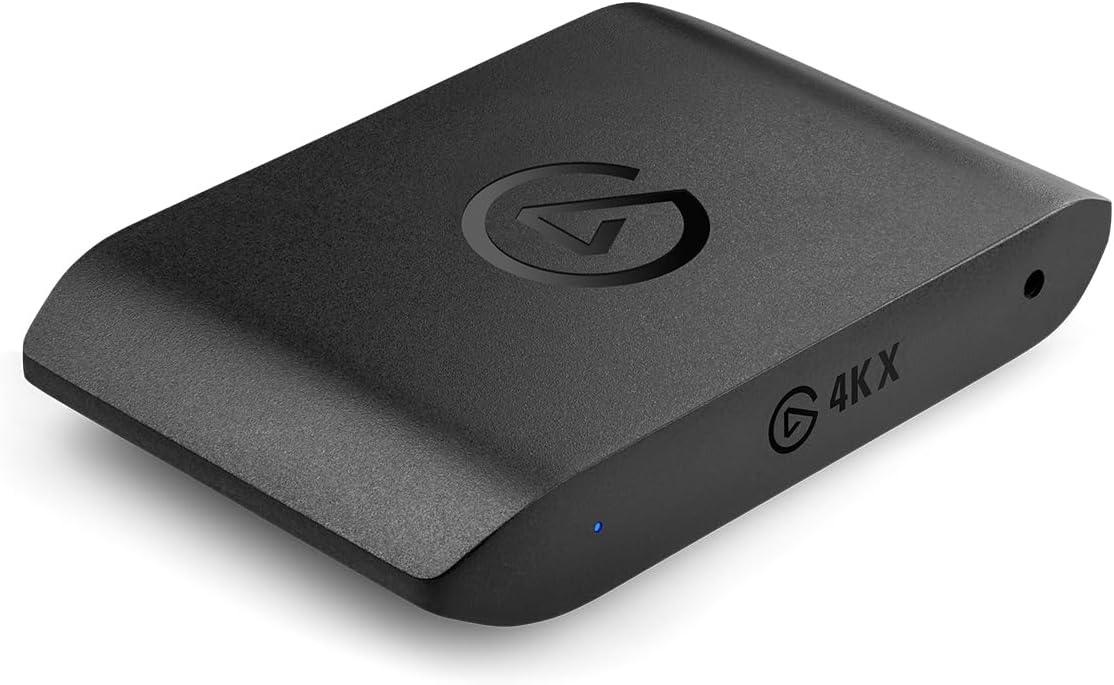
The Elgato 4K X is built for creators who want to take high-refresh gaming seriously, and its 4.5 rating makes it one of the strongest-reviewed products in this guide. It combines HDMI 2.1, 4K144 capture, 1080p240 support, ultra-low latency, and VRR passthrough in an external package designed to work with modern gaming systems.
We may earn a commission when you buy through this link, at no additional cost to you.
Its most impressive feature is the breadth of the high-frame-rate path. Capture can reach 4K at 144 frames per second, while HDMI 2.1 connectivity supports recording up to 240fps in 1080p. This makes it a natural match for competitive PC players and modern consoles that can deliver high-refresh output. VRR passthrough helps maintain smooth, tear-free visuals on the local display while the computer handles the broadcast feed.
USB 3.2 Gen 2 provides the stated foundation for ultra-low-latency performance. The card integrates neatly with OBS, Streamlabs, Twitch Studio, Restream, Zoom, Teams, and other broadcasting workflows, which reduces the need for specialized capture software. As an external device, it is also easier to move between production PCs than an internal PCIe card, although it still asks the host computer to handle demanding high-frame-rate processing.
This is the most compelling option in the list for a creator who values maximum frame-rate headroom and advanced display support. It is a better fit for a modern gaming PC with a fast CPU, capable USB port, and compatible display than for a basic office computer. If the goal is 4K144, 1080p240, VRR, and low-latency passthrough in one external device, this is the standout selection.
Support for 4K144 capture and 1080p240 recording gives fast-paced games the headroom they need to remain fluid. That makes the card especially relevant to creators recording motion-heavy shooters, racing games, and high-refresh PC play.
VRR passthrough and ultra-low latency help the player's monitor and the captured broadcast remain responsive. The result is a more synchronized setup for viewers who value reaction speed and visual continuity.
We may earn a commission when you buy through this link, at no additional cost to you.
The XIIXMASK USB 3.0 capture card provides an unusually strong feature set for value-oriented creators, earning a 4.2 rating. It supports 4K60 capture and passthrough, 1080p120 high-frame-rate capture, several common video formats, and both audio input and microphone output. That combination makes it a credible choice for creators who need more than basic 1080p60 recording.
We may earn a commission when you buy through this link, at no additional cost to you.
The 4K60 capture and passthrough capability is the primary attraction. It allows a creator to capture 4K footage while sending a 4K signal to a local display, and the 1080p120 mode gives competitive PC games an option for smoother recorded motion. MJPEG, YUY2, NV12, and XRGB support also provides useful flexibility when configuring the card in different software environments.
Setup is designed around plug-and-play operation without drivers or external power. The listed operating-system coverage is broad, spanning Windows, macOS, Linux, Android, and iPadOS, while the product is compatible with OBS Studio, Streamlabs, VLC, PotPlayer, Zoom, YouTube, and Twitch. A 3.5mm audio input and mic output make commentary integration more convenient. The card does not advertise VRR or ALLM, however, so advanced display synchronization may be less comprehensive than on premium alternatives.
This is a strong selection for a creator who wants 4K60 and 1080p120 capability without moving to an internal installation or the highest-priced external model. It works particularly well for console and PC gameplay, meetings, live events, and general-purpose recording. Choose it when format flexibility and broad software support are priorities, but check your computer's USB and operating-system behavior if you depend on specialized console features.
The card supports both 4K60 and 1080p120, giving creators two practical routes depending on the source and final platform. That flexibility is valuable when one project needs detailed 4K footage and another benefits from a faster 1080p frame rate.
Separate 3.5mm audio input and microphone output connections simplify the addition of commentary, music, or game sound. These ports reduce reliance on computer-level routing while keeping the external setup compact.
We may earn a commission when you buy through this link, at no additional cost to you.
The acer USB 3.0 HDMI capture card is a clean, straightforward option for creators whose priority is dependable 1080p60 streaming, and it holds a 4.4 rating. It accepts 4K HDMI input, sends that signal through a loop-out, and uses YUY2 to deliver 1080p60 output. The result is aimed at users who want modern console support without a complex setup.
We may earn a commission when you buy through this link, at no additional cost to you.
YUY2 is the standout technical detail. The product information describes it as delivering richer colors than MJPEG, which can help maintain detailed, lifelike image output for live broadcasts and recordings. A low-latency mode keeps the captured feed close to the source, while HDMI loop-out allows the player to continue using the console or camera feed on a local display.
For commentary, a 3.5mm headset or microphone input connects directly to the card. The product information emphasizes synchronized voice and video, which can reduce friction when adding narration to a stream. Installation is also refreshingly simple: no extra drivers or external power are required, and the card is small enough for mobile or temporary production setups.
The principal limitation is that the stated capture output is 1080p60, with no advertised 120fps or 240fps capture mode. It also does not highlight HDR or VRR in the supplied information. This card is best for standard-definition streaming output, online classes, presentations, and ordinary gameplay capture. Creators who need 1080p120 or 4K60 files should choose an option with those specifications stated explicitly.
YUY2 is designed to preserve more color information than a compressed MJPEG workflow. For creators who want clean 1080p60 output without moving to a more advanced external card, that distinction is worth considering.
The integrated 3.5mm input makes a headset microphone easy to add to the source chain. It provides a direct path for voice commentary while the card handles the visual capture.
We may earn a commission when you buy through this link, at no additional cost to you.
The PORTTA DX20R is a feature-rich external card aimed at creators who want high-refresh passthrough and detailed control over the signal. Its 4.2 rating reflects a capable package that combines 4K60 capture, 2K144 and 1080p240 passthrough, HDR, VRR, and a dedicated configuration utility.
We may earn a commission when you buy through this link, at no additional cost to you.
Its passthrough ceiling is among the most notable in the guide. A 2K144 or 1080p240 passthrough can suit a high-refresh gaming PC that needs to remain responsive locally while the computer handles capture. At the same time, the card records in 4K at 60Hz, creating a useful combination of detailed files and an exceptionally fast local signal path.
The PORTTA CapHub Utility expands the experience beyond automatic capture. Users can customize video settings, adjust audio mixing, update firmware, and manage EDID and VRR modes from the supplied Windows or macOS application. A smart display and control feature, including a ring-light control, adds further control for dedicated production environments. This flexibility is useful but also means the card may take longer to configure than a simple plug-and-play model.
The DX20R is a good fit for a creator with a capable PC who values 4K60 files, extremely high-refresh local gaming, and direct control of display and audio behavior. It supports Windows, macOS, and Linux without driver installation and is positioned for PS5, Xbox, and OBS workflows. It is particularly attractive when you want advanced capabilities but prefer an external card over opening a desktop for PCIe installation.
CapHub gives creators direct access to video configuration, audio mixing, firmware updates, and EDID or VRR modes. That control can help align the capture path with a specific display, source, and production setup.
The combination of 4K60 capture and high-refresh passthrough supports two different goals: detailed stored footage and a responsive local play experience. It is a balanced design for creators who refuse to compromise either the archive or the live experience.
We may earn a commission when you buy through this link, at no additional cost to you.
The ASUS TUF Gaming CU4K30 is an external capture card with a distinctive gaming identity and a 4.2 rating. It supports 4K30, 2K60, and 1080p120 capture, along with 4K60 HDR passthrough. Its OBS Studio certification and near-zero-latency positioning make it a practical choice for creators who value dependable compatibility over headline frame-rate extremes.
We may earn a commission when you buy through this link, at no additional cost to you.
The card's resolution ladder is well suited to several gaming scenarios. A 4K60 HDR signal can pass through to a local television or monitor while the computer receives a 4K30 capture feed. Competitive PC gamers can instead record in 1080p at 120fps, retaining a high frame rate in the stored footage while continuing to play without the same delay associated with capturing and displaying the source through software.
Plug-and-play UVC operation means a PC with USB 3.2 Type-C can begin streaming and recording without additional drivers or utilities. Its OBS Studio certification gives creators additional confidence that the device is suited to a common production environment. The durable alloy outer shell is also appropriate for a frequently handled desktop accessory, while controller and headset connections allow team communications to be shared with viewers.
This is a strong recommendation for a console or PC creator who wants 1080p120 capture and 4K60 HDR passthrough with a straightforward, OBS-friendly setup. It is less appropriate for 4K60 recording or 1080p240 capture, because those higher throughput targets are not among the stated capabilities. The product is therefore best when 120fps Full HD capture is the priority and local 4K viewing is the goal.
Recording at up to 1080p120 is valuable for fast PC games where frame rate matters as much as resolution. It allows a creator to preserve smoother motion in the captured file while maintaining a practical high-refresh workflow.
The alloy exterior adds durability without abandoning a slim form factor. That makes the card suitable for a permanent desk installation, an event setup, or a regularly transported streaming kit.
We may earn a commission when you buy through this link, at no additional cost to you.
The BlueAVS 4K HDMI capture card supports one of the broadest combinations of capture and passthrough rates in this guide, earning a 4.4 rating. It can capture 4K60, 1440p144, and 1080p240, while passing through matching high-resolution and high-refresh signals. This makes it an appealing option for creators who move between cinematic console footage and competitive high-FPS PC gameplay.
We may earn a commission when you buy through this link, at no additional cost to you.
The product information emphasizes that both capture and passthrough can preserve the original frame rate and full screen ratio. Lossless passthrough is particularly valuable for ultrawide monitors, unusual aspect ratios, and very fast gaming displays. Supporting HDR, VRR, and ALLM broadens the feature set further, helping the card integrate with modern consoles, high-refresh PCs, and compatible displays.
A dedicated 3.5mm port supports both line-in audio and headset audio, allowing the creator to mix voice chat and commentary into the stream. The card also operates as a true UVC/UAC device without additional drivers or external power and is recognized across Windows, macOS, and Linux. OBS Studio and other UVC-compliant software form the core application layer, so setup remains familiar to experienced streamers.
BlueAVS is most appropriate for users who need 1080p240 or 1440p144 capture rather than a simple 1080p60 workflow. It also works for 4K60 console streams with a modern high-refresh display. The host computer must be capable of handling the selected format over USB 3.0, and the card remains external, so there is no requirement to install it inside a desktop.
The ability to capture 4K60, 1440p144, and 1080p240 lets a creator tailor the recording format to each project. Higher resolutions suit detailed console footage, while the faster modes are designed to preserve competitive PC motion.
HDR, VRR, and ALLM help the card keep pace with contemporary gaming environments. These features are especially relevant when a console or PC drives a high-refresh television or monitor.
We may earn a commission when you buy through this link, at no additional cost to you.
The AVerMedia GC575 Live Gamer 4K 2.1 is an internal PCIe capture card intended for creators who want a direct, high-bandwidth path between a gaming source and a desktop streaming system. Its 4.3 rating reflects a capable design with 4K60 capture, ultra-low latency, and support for refresh rates up to 240Hz.
We may earn a commission when you buy through this link, at no additional cost to you.
Internal installation differentiates the GC575 from the USB cards in this list. Rather than relying on a USB connection between the console and computer, the card sits inside the desktop and communicates through PCIe. That arrangement can be attractive to a creator building a dedicated streaming PC because it reduces cable clutter and keeps the capture path close to the motherboard.
The stated support for PS5, PS4 Pro, Xbox Series X/S, Xbox One X, and Nintendo Switch makes it relevant to a broad console audience. Ultra-low-latency operation helps preserve responsiveness during live capture, while the high-refresh capability gives fast games more room to display fluid motion. As an internal card, however, it requires an open desktop case and a compatible PCIe slot.
This is a strong option for a permanent or semi-permanent streaming rig, particularly when 4K60 capture is the goal and a desktop is already dedicated to production. It is unsuitable for a laptop and less convenient for creators who travel frequently or need to change computers. Confirm case clearance, slot compatibility, source format, and driver requirements before committing to an internal installation.
PCIe installation keeps the capture hardware inside the production computer instead of adding another external USB device. This can produce a tidy, purpose-built streaming setup with fewer external connections.
Explicit support for current and previous high-end PlayStation and Xbox systems makes the card a natural fit for console streamers. Its 4K60 capability and high-refresh support align well with modern television and gaming-monitor standards.
We may earn a commission when you buy through this link, at no additional cost to you.
The Elgato 4K Pro is the premium option in this guide, combining 4K60 internal capture with 8K60 passthrough, 1080p240 support, VRR, and ultra-low latency. Its 4.5 rating places it alongside the strongest external model, while the internal PCIe design gives it a distinct role within a high-end desktop streaming rig.
We may earn a commission when you buy through this link, at no additional cost to you.
The headline capability is the ability to capture in 4K60 while passing through 8K60 to the local display. This lets a creator drive an exceptionally high-resolution screen for personal viewing while still producing a 4K60 recording for the broadcast. The card can also record high-frame-rate 1080p footage up to 240fps, giving competitive PC players a dedicated option for smooth motion.
HDMI 2.1 connectivity, VRR passthrough, and ultra-low-latency operation support a modern, responsive display chain. The design also integrates with OBS, Streamlabs, Twitch Studio, Restream, Zoom, Teams, YouTube, Twitch, Discord, and Facebook Gaming, so a creator can build a familiar broadcasting workflow around the hardware.
Choose the 4K Pro for a dedicated, high-end desktop where internal capture, 8K60 local passthrough, and 4K60 recording are priorities. It is less appropriate for laptops, compact systems without a usable PCIe slot, or creators who need a portable card. Because the full 8K60 feature belongs to passthrough rather than the stated capture output, make sure your monitor, source, and production workflow benefit from that distinction.
The separation between 8K60 passthrough and 4K60 capture allows the player to enjoy a very high-resolution display while the stream receives a manageable 4K feed. That balance is useful for creators with premium screens and demanding local setups.
A creator can select 4K60 for detailed footage or 1080p240 for ultra-fluid motion. Having both options makes the card suitable for cinematic console content, high-refresh PC gaming, and mixed production schedules.
We may earn a commission when you buy through this link, at no additional cost to you.
The right capture card depends on the exact source, final recording resolution, desired frame rate, computer configuration, and display features. Review the signal path as a whole rather than looking only at the largest advertised number.
A capture card's maximum capture resolution determines the quality of the file sent to the recording software, while its passthrough resolution determines what the local display receives. A 1080p60 card may accept modern console signals but still record at Full HD, so match the capture specification to your final streaming or editing resolution. If your goal is detailed 4K footage, look for a product that explicitly states 4K60 capture rather than merely 4K input or passthrough.
High-FPS gameplay should remain visibly smooth in the recorded file, especially for fast camera movement, competitive shooters, and racing games. Cards offering 1080p120 or 1080p240 capture are better aligned with those goals than a 1080p60 model. Confirm the supported resolution and refresh-rate combination rather than assuming that a high-refresh input mode is also captured at that same rate.
Passthrough sends the source directly to a local monitor or television while the computer receives a separate capture feed. High-refresh passthrough, HDR, VRR, and ALLM can improve the player's experience, particularly with a modern console or high-performance gaming PC. These features are separate from recording capabilities, so prioritize the features your display and source can actually use.
Latency affects the relationship between an action on screen, the captured feed, and the broadcast. Ultra-low-latency and near-zero-latency designs are particularly important for competitive gaming, live interaction, and creators who cannot tolerate a visible delay. Low-latency passthrough helps the local experience, but the complete workflow also depends on the capture card, computer, software, encoder, and display.
External USB cards are easy to move between computers and are generally easier to add to an existing setup. Internal PCIe cards suit a dedicated desktop and can provide a direct connection to the motherboard, but they require case access, slot compatibility, and careful installation. Laptops and small-form-factor systems generally favor external devices because they cannot accommodate an internal capture card.
Game audio and commentary must be mixed correctly for a professional result. A 3.5mm audio input can simplify adding a headset microphone, line-level sound, or commentary feed directly to the capture path. Some cards also support microphone output or headset integration. Check whether your operating system, broadcasting software, and console already provide adequate audio routing before paying for separate ports you may never use.
A capable host computer is as important as the capture card. Verify USB port speed, available bandwidth, processor performance, operating system, and the requirements of your recording software. UVC and plug-and-play support simplify configuration, while cards with companion utilities may offer deeper EDID, firmware, VRR, and audio controls. The supplied compatibility lists include OBS, Streamlabs, VLC, PotPlayer, XSplit, Zoom, Twitch, and other common applications across different products.
Modern consoles, PCs, cameras, and set-top boxes use HDMI but may present different format and feature limitations. Check whether the source supports the desired resolution, refresh rate, HDR, VRR, and audio format. The reviewed products list support for combinations of PS5, PS4, Xbox Series, Xbox One, Nintendo Switch, Switch 2, Quest headsets, DSLRs, webcams, TVs, and other HDMI devices.
Begin by identifying the intended signal path. Connect the console, gaming PC, or camera to the card's HDMI input, then connect the card's HDMI output to the display. For an external device, use the specified USB connection to the streaming computer; for an internal card, install it in a compatible PCIe slot and connect the HDMI cables directly. Connect a headset or microphone to the available audio ports if commentary or game sound must be captured separately.
Power on the source and confirm that the local display receives the expected picture before opening the recording application. In OBS, Streamlabs, or another compatible program, select the card as the video capture device and set the desired resolution and frame rate. Avoid requesting a mode above the card's stated capture specifications. Once video appears, configure audio sources, add a microphone or line input if needed, and test the latency and synchronization before beginning a live broadcast or important recording.
Protect the card and cables by avoiding sharp bends, excessive heat, and repeated unplugging while a stream is active. Keep ventilation openings clear, particularly for an internal card installed in a crowded case. Firmware and utility updates should be completed through the manufacturer's supplied tools when available. For travel, remove an internal card safely before moving the computer, and pack external cards with their cables in a protected case. Periodic test recordings help identify frame drops, audio imbalance, or changing display behavior before a live session.
Choose the highest frame rate that your source, capture card, computer, and recording software can sustain without dropped frames. 1080p120 is useful for competitive PC games, while 1080p240 offers even smoother motion for exceptionally fast content. A 4K60 workflow is often more practical for console streaming and general-purpose video.
No. Passthrough and capture are separate functions. A card may pass 4K to a local monitor while recording at 1080p60, or it may capture 4K60 and provide a different passthrough mode. Always check the dedicated capture resolution and frame rate rather than relying on the largest resolution mentioned in the product title.
An internal card can be better for a dedicated streaming desktop because it provides a direct motherboard connection and reduces external cable clutter. An external USB card is easier to install, move between systems, and use with a laptop. The better choice depends on your computer case, available slots, portability needs, and production workflow.
No. Those rates benefit fast motion, competitive shooters, racing games, and detailed slow-motion editing. Many creators are well served by 1080p60 or 4K60, especially when their internet upload, encoder, and platform can comfortably handle the chosen output. Match the rate to the content instead of chasing the highest number available.
Use a card with low-latency or ultra-low-latency operation, keep the source and local display on compatible formats, and avoid unnecessary processing in the capture path. The total delay also depends on the computer, encoder, streaming software, and platform. Test the complete setup before going live because a capture card cannot remove latency introduced elsewhere.
Many of the listed cards include a 3.5mm audio input, and some also offer microphone output or headset support. This allows game audio, voice chat, music, and commentary to be mixed in software or at the card. Check the exact port type and your operating system's audio behavior, because connector standards and routing methods can differ.
Most of the reviewed products explicitly list OBS or OBS Studio compatibility, and many are designed as plug-and-play UVC devices. Nevertheless, confirm the product's operating-system requirements, the resolution and format you plan to use, and any utility setup before a live session. A successful software connection also depends on adequate USB or PCIe bandwidth and host-computer performance.
Check the exact capture resolution and frame rate, passthrough limits, supported input formats, latency claims, HDR and VRR support, audio connections, and host-computer compatibility. Also consider whether you need an external or internal design and whether your console or PC can output the desired signal. Checking these details prevents a mismatch between a headline feature and the part of the workflow you actually need.
The Elgato 4K X stands out as the strongest high-refresh external choice, offering 4K144 capture, 1080p240 support, HDMI 2.1, and VRR passthrough. The XIIXMASK provides a more value-oriented route into 4K60 and 1080p120, while the Elgato 4K Pro is the premium internal model for a dedicated desktop with 8K60 passthrough and 4K60 capture.
Prioritize the part of the signal chain that matters most. A competitive PC creator may need sustained 1080p120 or 1080p240 capture, while a console streamer may value 4K60 files, 4K60 HDR passthrough, and simple OBS integration. Ensure that the host computer, source device, display, software, and internet connection can all sustain the selected format before making a purchase.
Specifications and product availability can change, so review the current listing and manufacturer details before buying. Also check the latest cost and availability at the time of purchase. With the right combination of capture rate, latency, passthrough, audio, and compatibility, you can build a smoother live or recorded gaming setup suited to your exact production needs.