
Sennheiser MKE 600 Shotgun Microphone
4.8Editor score
Highly directive shotgun design
Phantom or battery powering
Switchable low-cut filter
Our expert guide compares the best Boom Mic for Filmmaking, evaluating directionality, power options, wind protection, mounting, and complete kit value.
A boom microphone gives filmmakers a practical way to capture focused dialogue while keeping the microphone visually and physically separate from the camera. The right model should combine strong off-axis rejection with reliable powering, useful wind protection, adaptable mounting, and a form factor suited to documentary, narrative, interview, and location work.
This guide compares ten shotgun microphones and boom-ready bundles using only the supplied product information. We evaluated directionality, power sources, filters, included accessories, mounting hardware, compatibility, and intended production use. The list covers traditional XLR studio microphones, compact battery-powered camera microphones, and complete boom-pole systems.
Each review highlights the most useful features and the compromises that may affect a production. The Movo bundles stand out as complete all-in-one options, the Sennheiser and RØDE models serve traditional XLR workflows, and the BOYA and COMICA choices suit more compact or mobile arrangements. Product availability and prices can change, so check current listings before purchasing.
4.8Editor score

4.1Editor score

4.4Editor score
The comparison below places all ten options side by side, with particular attention to connection method, power options, directional pattern, included mounting hardware, and wind protection. The differences make it easier to separate traditional location-sound tools from compact camera microphones and complete boom-pole bundles.




This Movo bundle combines a shotgun microphone, adjustable boom pole, shock mount, foam windscreen, and furry windscreen in one location-sound package. Its 4.1 customer rating reflects a mixed reception, but the breadth of the bundle is immediately useful for filmmakers who want to move from dialogue recording to a basic overhead boom setup without assembling every component separately.
We may earn a commission when you buy through this link, at no additional cost to you.
The microphone uses a supercardioid polar pattern to emphasize sound directly in front while reducing pickup from the sides. Its boom pole extends to 9.8 feet and uses telescopic locks for controlled positioning. An integrated XLR cable runs through the pole, reducing the visual clutter associated with a loose cable and simplifying deployment on documentary, interview, and broadcast-style shoots.
The tradeoff is that a complete boom kit creates more ways for handling noise to enter the recording. A telescoping pole can transmit movement, and the bundled microphone may not offer the same refinement as a dedicated premium shotgun. The included foam and furry windshields are useful, but outdoor work still requires careful placement, monitoring, and control of the recording environment.
This is a strong recommendation for new filmmakers, student crews, and small production teams who need a ready-to-deploy boom solution. Choose it when package completeness and immediate usability matter more than minimizing the number of separate components. More experienced sound recordists may prefer a standalone premium microphone and a separately selected pole.
The bundled pole, shock mount, and microphone remove the need to source several basic accessories before the first shoot. That convenience is particularly valuable for student films, web productions, and documentary teams working with limited equipment budgets.
The internal XLR cable follows the length of the telescoping pole, making boom use cleaner than routing a separate cable. The 9.8-foot extension also provides useful reach when the camera and talent cannot share the same position.
We may earn a commission when you buy through this link, at no additional cost to you.
This four-item Sennheiser package centers on the MKE 600, a highly directional shotgun microphone designed for video cameras, camcorders, and demanding filmic environments. Its 4.7 customer rating makes it one of the strongest-rated options here, while the added universal shockmount and twenty-foot XLR cable make the package especially practical for a new location-sound setup.
We may earn a commission when you buy through this link, at no additional cost to you.
The microphone concentrates its pickup on the direction in which the camera points while attenuating sound arriving from the sides and rear. A switchable low-cut filter helps reduce unwanted low-frequency noise, and the microphone can operate from phantom power or a battery. That dual-power design matters because not every camera or field recorder provides phantom power.
The bundle includes the MKE 600, an MZS 600 shockmount, an MZW 600 foam windshield, a universal shockmount for camera shoes and boom poles, a twenty-foot XLR male-to-male cable, and a microfiber cleaning cloth. The length of that cable is helpful for boom placement, although users should still secure it properly to prevent movement from reaching the microphone.
This package is an excellent choice for filmmakers who want the MKE 600 without separately finding a shockmount, cable, and basic protection. It suits both on-camera use and boom operation, but it does not include a boom pole. Pairing it with a compatible pole and a furry windshield for demanding exterior work would create a more complete field package.
The universal shockmount gives the package flexibility beyond a fixed camera-shoe setup. Because the same microphone can operate on a camera, stand, or boom pole, it can cover interviews, dialogue scenes, and wider observational footage without changing the primary microphone.
Phantom or battery operation broadens compatibility with recorders and cameras that differ in power options. The switchable low-cut filter adds another layer of control when low-frequency rumble or wind noise needs to be reduced.
We may earn a commission when you buy through this link, at no additional cost to you.
The Sennheiser MKE 600 is a compact XLR shotgun microphone built for camcorders and video DSLRs. It carries a 4.8 customer rating, the highest numerical rating in this list, and its defining qualities are high directivity, a compact body, switchable low-cut filtering, and the ability to run from phantom power or a battery.
We may earn a commission when you buy through this link, at no additional cost to you.
Its directional design favors sound coming from the camera-facing axis while reducing unwanted sound from the sides and rear. A low battery indicator gives battery-powered users a useful operational cue, while phantom power integrates naturally with professional mixers and recorders. The included camera-shoe shockmount supports a straightforward on-camera configuration for documentary and run-and-gun work.
One limitation is that the package does not include a boom pole or XLR cable, so a user interested in overhead boom work must source those separately. The camera-shoe mount is also not the same as a full boom-pole suspension, and the supplied windshield may be less capable than a furry outer layer in sustained wind.
The MKE 600 is a strong recommendation for filmmakers who prioritize a proven directional microphone, broad power compatibility, and compact handling. It is particularly attractive for users who already own a field recorder, boom pole, and suitable cables and simply need a capable shotgun microphone to complete the chain.
High directivity allows the microphone to prioritize the intended source when the camera and performer share a defined axis. That makes it well suited to controlled interviews, scripted scenes, and camera-mounted production work where background sound is less desirable.
The low battery indicator removes some uncertainty during a battery-powered shoot. It is a small feature, but one that helps crews plan power changes before an interruption occurs.
We may earn a commission when you buy through this link, at no additional cost to you.
The BOYA BY-BM6060 is an XLR supercardioid shotgun condenser designed for video production and broadcast acquisition. Its 4.4 customer rating, broad application range, and flexible power options make it a practical entry point for filmmakers who need a conventional shotgun microphone without committing to a full location-sound package.
We may earn a commission when you buy through this link, at no additional cost to you.
The three-pin XLR output accepts 24–48V phantom power, allowing direct connection to many professional mixers and recorders. When a connected device cannot supply phantom power, an AA battery provides an alternative. Its supercardioid pattern focuses on the frontal source while resisting low-frequency circuit noise, making it appropriate for interviews, independent films, television, documentaries, and promotional work.
The package includes the microphone, suspension shockmount, furry windshield, and foam windshield. A cold-shoe mount with a one-quarter-inch thread expands the available attachment options, including use with a DSLR or stand. Although the kit is well equipped for its category, it does not include a pole, and the included suspension differs from a complete professional boom configuration.
This microphone is recommended for students, emerging filmmakers, and independent producers who need a straightforward XLR solution. It is particularly attractive when the chosen recorder provides phantom power or when battery operation is useful for mobility. Confirm your recorder's power and input requirements before ordering, and plan to obtain a proper boom pole and XLR cable if the production requires overhead placement.
Phantom-power compatibility integrates with conventional field recording equipment, while AA battery operation provides an alternative when the recorder cannot supply power. This flexibility makes the microphone adaptable to more than one production setup.
The included shockmount and two levels of wind protection make the package more useful than a microphone alone. The cold-shoe and thread mounting options also give filmmakers several ways to position the microphone around a camera support.
We may earn a commission when you buy through this link, at no additional cost to you.
This second Movo offering provides the same general combination of a supercardioid XLR shotgun microphone and a 9.8-foot telescoping boom pole with internal XLR wiring. It is aimed at filmmakers, documentary crews, and content producers who want a complete setup for dialogue, ambient sound, interviews, and field production. Its 3.9 customer rating is the lowest among the listed products, so expectations should be grounded in the bundle value.
We may earn a commission when you buy through this link, at no additional cost to you.
The boom pole collapses for transport and storage, while its telescopic locks allow controlled extension. A supercardioid microphone pattern emphasizes sound ahead of the microphone and reduces pickup from the sides. The internal cable creates a cleaner physical setup than a separate cable draped along the pole, and the included shockmount provides the interface between the microphone and boom hardware.
A long boom is most effective when the operator uses smooth movement and keeps the microphone out of obvious frame. Extending the pole toward a source can reveal operator handling, and the wider reach may be unnecessary for seated interviews or small indoor sets. The package also leaves the user without the specialized pole accessories and monitoring workflow of a fully professional sound department.
The bundle is most suitable for budget-conscious filmmakers, students, and small crews who want the visual and practical benefits of a boom without assembling a microphone, pole, and cable separately. For demanding narrative work or noisy exterior recording, careful technique and a suitable furry windshield remain important. Experienced users should compare the lower rating and overall microphone specification before committing.
The microphone, pole, shockmount, and windshields cover the fundamental components of a basic boom setup. That bundled approach is efficient for crews that need to begin location recording quickly.
The telescoping pole reduces to a more manageable size for vehicle transport and storage. This makes the bundle practical for crews moving between locations rather than working from a permanent sound room.
We may earn a commission when you buy through this link, at no additional cost to you.
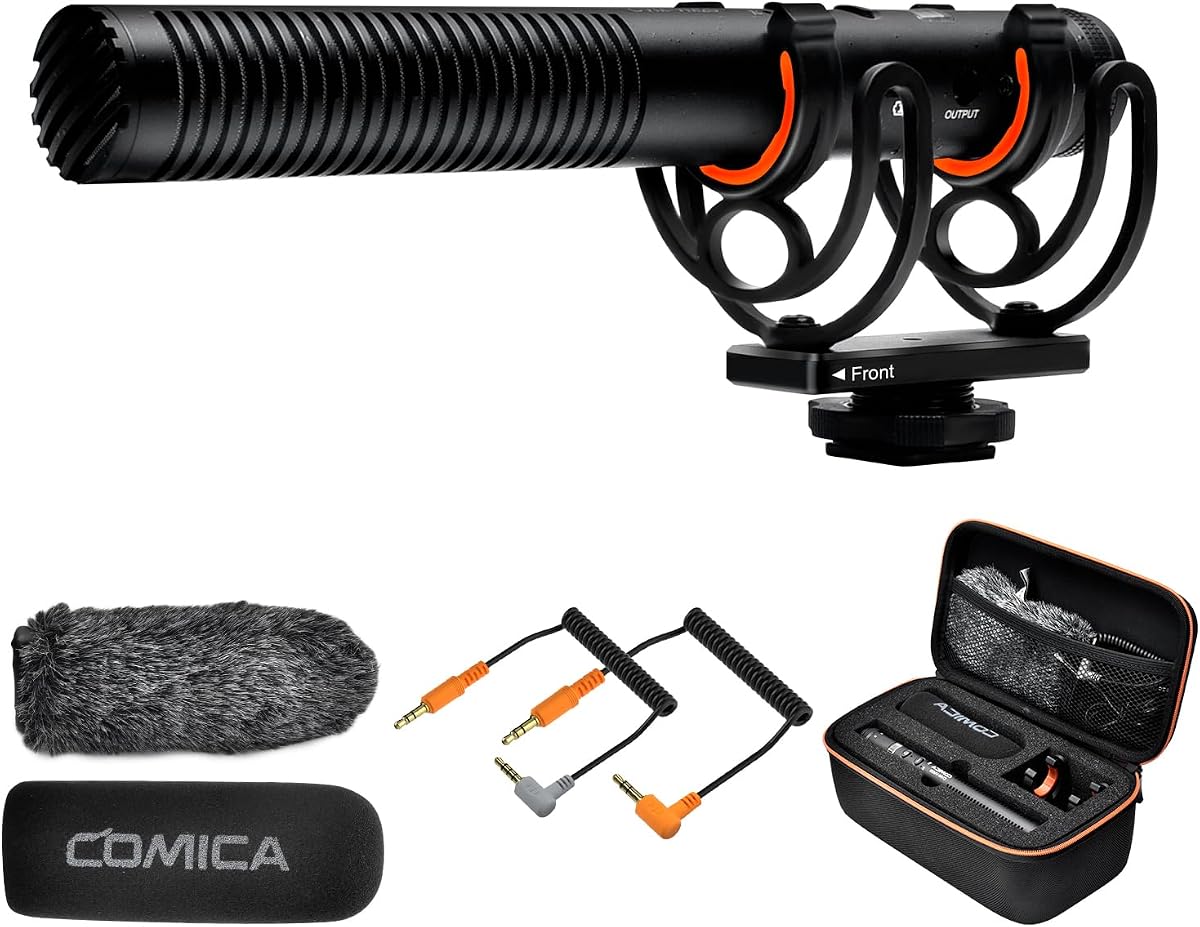
The COMICA VM20 is a compact shotgun microphone designed for cameras, camcorders, iPhones, and Android devices. Its 4.4 customer rating reflects a balanced result, while the OLED display, selectable filters, gain control, and rechargeable battery distinguish it from basic on-camera microphones. It is a good fit for filmmakers who need flexible mobile compatibility more than traditional XLR integration.
We may earn a commission when you buy through this link, at no additional cost to you.
The supercardioid pattern concentrates on the target source and reduces unwanted background pickup. Two low-cut modes, below 75Hz and 150Hz, provide choices for controlling low-frequency noise, while ten-level gain adjustment covers a sensitivity range of -43dB to -23dB. The OLED display shows real-time battery status, helping users avoid unexpected power loss.
Its built-in 3.7V, 300mAh rechargeable lithium battery is advertised for up to 60 hours of standby time, and the USB-C interface permits charging while the microphone is in use. A Rycote-style shock absorption design is also included. These features make the VM20 convenient for mobile productions, although the 3.5mm connection architecture does not drop directly into a conventional XLR mixer or boom input.
The VM20 is recommended for vloggers, documentary makers, interviewers, and filmmakers working across a mixed device setup. Included 3.5mm TRS and TRRS cables cover many Canon, Nikon, Sony, DSLR, camcorder, phone, and tablet configurations. A USB-C phone may still require a separate adapter, and an XLR cable is not included, so traditional boom operators must verify their connection requirements first.
The OLED display and external gain control make operating states easier to check during setup. Filmmakers can adjust sensitivity and monitor remaining battery power without navigating an unseen menu, which is useful in changing location conditions.
TRS and TRRS support expands the microphone beyond compatible XLR cameras. The included cables allow it to move between a camera, a phone, or a tablet, while the rechargeable battery removes the need for disposable cells.
We may earn a commission when you buy through this link, at no additional cost to you.
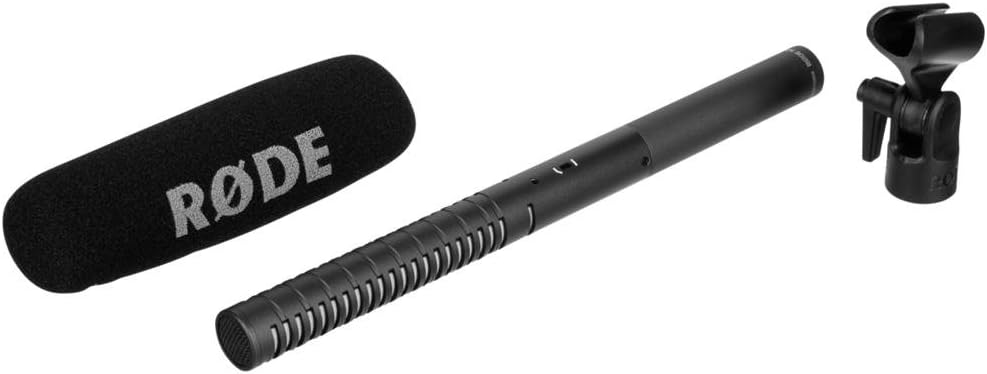
The RØDE NTG-2 is a lightweight, highly directional shotgun microphone with a 4.6 customer rating. It is designed for video production, interviewing, and location recording, and its dual-power architecture makes it compatible with professional phantom-power equipment as well as setups that rely on an AA battery.
We may earn a commission when you buy through this link, at no additional cost to you.
The microphone's key features include low noise, full frequency response, a highly directional pickup pattern, and an 80Hz high-pass filter. The filter is useful for reducing low-frequency rumble in some recording environments. Dual power gives the operator flexibility, while the compact, straightforward design is convenient for camera mounting, a stand, or a compatible boom pole.
As a standalone microphone listing, the NTG-2 does not arrive as a complete boom package. Users will need to consider the appropriate XLR cable, suspension, boom pole, and wind protection for their environment. Its directional pattern can also make microphone placement sensitive because the source needs to remain aligned with the microphone's front axis.
The NTG-2 is an excellent recommendation for filmmakers who want a familiar XLR shotgun with flexible power options and a strong customer rating. It works particularly well for users who already own a field recorder, camera mount, boom, and windshield. Those building a first kit should budget for the additional accessories and compare them with a bundled alternative.
Operating from either phantom power or an AA battery means the microphone can serve both professional recorders and simpler field arrangements. This flexibility is useful when the shooting location or equipment package changes from day to day.
The highly directional pattern helps isolate a frontal source, while the lightweight body is easy to position. The 80Hz high-pass filter provides a straightforward option when unwanted low-frequency energy becomes a problem.
We may earn a commission when you buy through this link, at no additional cost to you.
The SYNCO D2 is an XLR condenser shotgun microphone with a 4.5 customer rating and a robust physical design. Its CNC-machined brass body, hypercardioid pattern, and included XLR cable make it appealing to filmmakers who want a substantial microphone for camera, stand, or boom-pole use.
We may earn a commission when you buy through this link, at no additional cost to you.
The hypercardioid pickup pattern is described as highly sensitive to sound in its target direction while attenuating off-axis sound. The specification lists a sensitivity of -32dB plus or minus 3dB and off-axis attenuation of -18dB. Its frequency response extends from 20Hz to 20kHz, and the listed self-noise figures are 12dB A-weighted and 24dB under the CCIR 268-3 standard.
The solid brass construction is intended to provide durability and resistance to interference. A black speckle finish is designed to avoid reflecting light during formal on-camera work and to permit operation in rainy conditions. The microphone uses a gold-plated three-pin XLR connector, and a standard 19.7-inch XLR male-to-female cable is included.
The D2 is recommended for filmmakers who value a robust microphone body, conventional XLR connectivity, and a supplied cable. It does not include a boom pole or a dedicated shockmount, so complete boom deployment still requires additional equipment. Users should also confirm that the recorder supplies the appropriate power and can accommodate the microphone's output and operating requirements.
The CNC-machined brass body gives the microphone a substantial feel and is intended to withstand regular production handling. Its non-reflective finish is also useful when the microphone enters the frame near talent.
The hypercardioid pattern, broad frequency range, and stated low self-noise target clear, focused capture. A standard XLR connection and included cable simplify integration with compatible recording equipment.
We may earn a commission when you buy through this link, at no additional cost to you.
This Sennheiser listing is titled as a wireless microphone system, but its listed features identify the product as the MKE 600-style highly directional video microphone. It has a 4.7 customer rating and includes a foam windshield and shockmount. Because the product title uses potentially confusing wireless terminology, buyers should confirm the actual contents and connection format before purchasing for an XLR workflow.
We may earn a commission when you buy through this link, at no additional cost to you.
Its high directivity favors sound coming from the direction in which the camera points while attenuating noise from the sides and rear. A switchable low-cut filter helps minimize wind noise, and the microphone can operate with phantom power or a battery. These features are closely associated with compact shotgun microphones intended for video cameras, camcorders, and difficult filming environments.
The supplied foam windshield and shockmount provide basic protection and mounting support, but this is not a complete boom-pole package. Exterior productions may benefit from an appropriate furry windshield, and the exact length or type of XLR cable should be confirmed. The ambiguous system wording also warrants care when comparing the listing with the separate MKE 600 packages elsewhere in this guide.
This option is recommended for filmmakers who understand the product's listed specifications and can confirm what the package contains. Its directional performance, dual power, and strong rating make the underlying microphone concept appealing. However, the unclear wireless label creates more uncertainty than the specification-focused alternatives, so careful review of the package information is essential.
The high directivity is designed to prioritize sound from the camera axis. That makes the microphone more practical when the desired source is known and background noise is not part of the intended recording.
The supplied information describes a wired microphone with phantom or battery operation, despite the word wireless appearing in the title. Prospective buyers should confirm the physical microphone, connector, and included components before ordering.
We may earn a commission when you buy through this link, at no additional cost to you.
The second COMICA VM20 listing highlights a compact, metal-bodied shotgun microphone with a 4.5 customer rating. It is designed for smartphones, laptops, tablets, Canon, Nikon, and Sony cameras, camcorders, and other compatible equipment. The OLED display, dual low-cut modes, gain control, rechargeable battery, and included shockmount make it a convenient mobile production microphone.
We may earn a commission when you buy through this link, at no additional cost to you.
The supercardioid pattern targets sound directly in front of the microphone while reducing unwanted background pickup. A top-mounted button switches between 75Hz and 150Hz low-cut settings, and the external gain knob provides ten adjustment levels across a stated -43dB to -23dB sensitivity range. Those visible controls can be useful when balancing a scene or filtering environmental noise.
The built-in 300mAh rechargeable lithium battery is listed for up to 60 hours of standby time after approximately three hours of charging. USB-C charging can continue while the microphone is used. The package includes 3.5mm TRS and TRRS adapter cables and a Rycote shockmount. It does not include an XLR cable, and a USB-C phone requires an additional adapter that is not supplied.
The VM20 is recommended for mobile filmmakers, vloggers, and content creators who want more control than a basic fixed camera microphone provides. It works best for camera, phone, or tablet arrangements using 3.5mm connections. Filmmakers with an XLR boom-pole workflow should choose a microphone designed around that connection standard rather than relying on unsupported adapters.
The OLED display provides an immediate view of remaining battery power, reducing guesswork during a long production day. A visible power state is especially useful for mobile crews that cannot easily access the microphone controls.
Top-mounted filter selection and an external gain knob make the key adjustments direct and accessible. The 75Hz and 150Hz options give operators a choice between broader and more selective low-frequency filtering.
We may earn a commission when you buy through this link, at no additional cost to you.
Choosing a boom microphone requires balancing directionality, connection standards, power requirements, wind protection, mounting needs, and the type of footage you plan to capture. The most important decision is whether your production needs a conventional XLR microphone, a compact 3.5mm camera microphone, or a complete pole-and-microphone bundle.
XLR microphones are the traditional choice for location sound because they use balanced connections and integrate with professional field recorders, mixers, and many cameras that provide microphone inputs. They are also the natural choice when the microphone will hang from a boom pole. The Movo, Sennheiser, BOYA, RØDE, and SYNCO options in this guide use XLR, although boom poles, cables, and appropriate power may still need to be sourced separately. A 3.5mm connection is more convenient for phones, compact DSLRs, and consumer-oriented camera rigs. The COMICA VM20 supports TRS and TRRS arrangements, making it versatile across those devices, but it does not provide a native traditional XLR workflow. Choose the connector first, then confirm that the camera or recorder supplies the correct input and power.
Phantom power is common on professional recorders and many higher-end cameras, but some camera microphones are designed to run from batteries instead. The Sennheiser MKE 600, RØDE NTG-2, and BOYA BY-BM6060 offer phantom or battery operation, which makes them flexible across more equipment combinations. The COMICA VM20 uses an internal rechargeable lithium battery and a USB-C charging port, offering long stated standby time and the ability to charge while operating. The Movo bundle is presented as a standard XLR location-sound system, so users should verify its exact power requirements against the intended recorder. Always check voltage, connector format, and battery support before purchasing, because a physically compatible connector does not guarantee that the microphone will power or operate correctly.
Shotgun microphones concentrate their sensitivity in front of the capsule and reduce sound arriving from the sides and rear. The listed products use supercardioid, hypercardioid, or simply high-directivity designs, all of which are intended to favor a clearly defined source. This rejection is valuable on a noisy street, in an uncontrolled interior, or when unwanted sound sits near the intended dialogue. Directionality does not automatically eliminate interference, however, and placement remains important. A mismatched source can fall outside the most sensitive area, while excessive off-axis sound can still color the recording. Test the microphone with the actual camera framing and likely actor position whenever possible, and monitor the result rather than relying on the polar pattern alone.
Wind protection is essential whenever a boom microphone is used outdoors or near moving air. Foam windshields help with moderate airflow, while furry windshields offer greater coverage for exposed location work. The Movo bundles include both foam and furry windshields, the Sennheiser bundle includes a foam windshield, and the BOYA kit includes foam and furry protection. A low-cut filter can also reduce problematic low-frequency energy, but it should not be treated as a substitute for physical wind protection. Match the windshield to the conditions, keep the microphone as shielded as practical from direct wind, and listen for changes in the low end before and after applying protection. A microphone that sounds clean in a quiet room may reveal rumble or distortion as soon as it enters a windy environment.
A shotgun microphone can sit on a camera, stand, or boom pole, but the mounting system must match the production. A complete pole lets the microphone remain above or outside the frame while reaching toward dialogue. Both Movo bundles include a telescoping boom pole that extends to 9.8 feet and incorporates an internal XLR cable. Their included shockmount provides the basic connection to the pole. Standalone microphones require compatible shockmounts or clamps, and some listings include only a camera-shoe mount. If you already own a lightweight pole and a suitable suspension, a standalone premium shotgun may provide a better microphone for less money. If you are building a first boom setup, the bundled Movo option reduces the number of separate purchases and gives the user a working baseline.
Compact microphones are easier to carry, quicker to reposition, and less conspicuous in documentary or run-and-gun work. The Sennheiser MKE 600 is explicitly described as compact, while both COMICA VM20 listings use a portable on-camera format. The SYNCO D2 uses a solid brass body, and the RØDE NTG-2 is also described as lightweight. Portability matters when a single operator must move between locations, carry a camera, manage a recorder, and position a boom. Larger or heavier equipment can remain stable on a stand but may fatigue a person operating a pole for an entire shoot. Consider the full rig, including cables, windshields, batteries, and mounts, rather than comparing the microphone body alone.
Onboard controls can simplify a shoot when the operator cannot reach a recorder or menu. The COMICA VM20 provides two low-cut modes, ten gain levels, an external gain knob, and an OLED power display. The Sennheiser MKE 600 and RØDE NTG-2 offer switchable high-pass filtering, with the RØDE filter specified at 80Hz. These controls are useful for managing rumble, handling noise, and level differences, but they should be adjusted with care. Excessive low-cut filtering can remove natural character from a voice, and aggressive gain can introduce distortion. Begin with moderate settings, record a short test, and compare the result with and without each adjustment whenever the production schedule permits.
A useful accessory package can determine how quickly a new microphone can enter production. Important additions include a compatible XLR cable, a shockmount suitable for the intended pole, and an appropriate windshield. The Sennheiser MKE 600 bundle includes a universal shockmount, twenty-foot XLR cable, foam windshield, and cleaning cloth. The BOYA package includes a suspension mount and two windshields. The SYNCO D2 includes a standard XLR cable, while the COMICA VM20 includes a Rycote shockmount, wind protection, and device cables. Consider warranty coverage and manufacturer support as well, particularly for emerging filmmakers making an initial investment. A complete, clearly documented package can be more valuable than a small saving elsewhere.
Begin by confirming that the microphone, recorder, camera, and boom system use compatible connections and power. For an XLR model, check the pin arrangement, required phantom voltage, and whether the recorder provides XLR microphone input. For a 3.5mm model, determine whether the destination device expects TRS or TRRS and whether a USB-C phone requires another adapter. With a complete Movo bundle, connect the microphone to the shockmount, attach both to the boom pole, and route the internal XLR cable toward the recorder without creating tight bends.
Set the microphone and then move to the sound source. Mount the camera first, establish the intended composition, and position the microphone just outside the frame and above or below the speaking subject. On a boom pole, keep movements smooth and avoid tapping the grip or pole against nearby surfaces. Leave enough distance to reduce plosive bursts, angle the mic toward the mouth, and listen for a balanced level. Adjust gain or the supplied low-cut control only after establishing a clean baseline.
For outdoor work, fit the appropriate foam or furry windscreen before checking levels again. Listen for wind distortion, low-frequency rumble, traffic rumble, handling noise, and reflections. After the shoot, switch off the microphone, disconnect cables without pulling on the connector, remove the battery if the model uses one, and wipe the body and grille gently. Store the microphone in a dry place, protect the capsule from impact, and keep the shockmount, pole locks, and cable connections free of dirt. Check the battery or rechargeable charge before each production day, especially when the microphone is used outdoors or in a long recording schedule.
A boom microphone is positioned away from the camera on a pole, stand, or boom operator's arm, keeping the microphone outside the frame while it points toward the speaker. An on-camera microphone attaches directly to the camera or a support near the lens. A boom setup often offers more placement flexibility, but it requires suitable mounting hardware, careful handling, and proper cable management.
Many traditional boom poles and professional field recorders use XLR connections, so an XLR shotgun microphone is often the most straightforward choice. Some compact systems use 3.5mm connections instead, but they may require adapters and may not provide the same balanced signal path. Confirm the pole output, recorder input, power method, and cable requirements before purchasing.
Yes, boom microphones are widely used for seated and standing interviews because their directionality can isolate the speaker from unwanted room noise. A properly positioned boom can also remain outside the frame for a clean talking-head composition. Monitor the recording and maintain a consistent microphone distance, since moving too far away can change tone and level.
Phantom power is convenient when the recorder supplies it through the XLR input, while battery operation can be useful for recorders that do not. The Sennheiser MKE 600, RØDE NTG-2, and BOYA BY-BM6060 support both approaches. Always verify the required voltage and operating instructions for the exact microphone and recorder combination.
A furry windscreen is highly useful whenever the microphone will be exposed to moving air, especially outdoors. It helps reduce wind turbulence and the low-frequency noise that can spoil dialogue. Foam protection is useful for lighter airflow, but neither filter nor foam should be viewed as a complete substitute for correct placement and physical shielding from the wind.
A bundle is usually more convenient for a first setup because the microphone, pole, mount, and some wind protection are already coordinated. It also reduces the chance of discovering a missing adapter or incompatible mount on the shoot day. An experienced recordist may prefer a separate premium microphone and a pole selected for weight, balance, and handling characteristics.
A 3.5mm shotgun microphone can work with many smartphones when the phone provides a compatible TRRS headset input or accepts the appropriate digital connection. The COMICA VM20 includes TRS and TRRS cables for many devices, but a USB-C phone may need a separate adapter. Confirm port type and audio-input support before the shoot, and monitor for latency or device-specific recording limits.
Keep the pole balanced, use smooth deliberate movements, and avoid resting the microphone against clothing, walls, or hard surfaces. A suspended shockmount helps isolate movement, but it cannot prevent noise caused by a bumped grip or an unstable pole. Keep the operator's body out of the microphone's front axis and pause briefly after repositioning so the recording settles.
The Movo XLR Boom Pole Kit is the most convenient all-in-one option because it combines a microphone, 9.8-foot pole, shockmount, internal cable, and two windshields. The Sennheiser MKE 600 offerings lead in customer ratings and traditional XLR performance, while the BOYA BY-BM6060 provides a cost-conscious entry into a flexible shotgun microphone setup. Each serves a different need, but connection compatibility should come before every other consideration.
Prioritize the microphone body when your equipment package is already mature, and prioritize the complete bundle when you are building a first boom configuration. Check directionality, phantom-power requirements, mounting options, cable length, and wind protection against the exact camera or recorder you will use. Compact 3.5mm models can be excellent for mobile video, while XLR remains the natural standard for conventional location sound and boom work.
Ratings, bundle contents, availability, and prices can change, so review the current listing before making a final purchase. Confirm the connector, included accessories, power method, and compatibility notes, then test the microphone in a quiet room and in representative location conditions. A short setup test is one of the most useful ways to prevent avoidable problems during production.