
Esinkin Bluetooth Audio Adapter
4.5Editor score
RCA and 3.5mm outputs
Automatic device reconnection
Indoor range up to 40 feet
This Bluetooth Receiver for Home Stereo guide compares ten adapters for sound quality, range, connectivity, controls, and easy setup.
A Bluetooth receiver for home stereo can transform an older amplifier, powered speaker, or AV receiver into a convenient wireless system. The right model should pair reliably, preserve strong audio quality, connect to the outputs your stereo offers, and fit naturally into your listening routine.
We compared ten receivers based on the supplied specifications, including supported codecs, wireless range, audio outputs, power requirements, pairing behavior, built-in controls, and compatibility with common home audio equipment. The list covers basic adapters, portable models, premium DAC-equipped receivers, and a full stereo system.
Each review highlights the strongest reasons to choose a particular receiver while noting relevant limitations. The top selections represent different priorities, from straightforward value to advanced decoding and expansive connectivity. Product prices and availability can change, so check the current listing before purchasing.
4.5Editor score
4.4Editor score

4.6Editor score
The comparison chart summarizes the most important differences among all ten options, including Bluetooth generation, codec support, wired outputs, range, and distinctive features. It is designed to make compatibility and listening priorities easy to assess before buying.


The Esinkin Bluetooth Audio Adapter is a straightforward receiver-only solution for adding wireless playback to a home stereo or powered speakers. Its 4.5 rating reflects a generally practical design built around familiar RCA and 3.5 mm connections, uncomplicated pairing, and automatic reconnection with a previously linked device.
We may earn a commission when you buy through this link, at no additional cost to you.
Installation is refreshingly simple. Connect the adapter to the stereo through the appropriate cable, power it with the included AC-to-DC adapter or USB connection, and press the large Bluetooth-symbol button. The same control handles connection or disconnection with a single press, while holding it for three seconds turns the unit on or off.
Its main limitation is range. The stated indoor reach is approximately 30 to 40 feet in unobstructed conditions, which is suitable for a phone remaining in the same room but less appropriate for a large home. The supplied specifications also do not mention advanced codecs such as LDAC or aptX HD, so audio quality depends on the phone and its standard Bluetooth encoding.
This is an attractive choice for anyone who wants to modernize a capable stereo without replacing it or navigating a complicated network-based adapter. It works with Bluetooth-enabled phones, tablets, computers, and laptops, making it a versatile pick for straightforward music streaming in a living room, office, or workshop.
The Esinkin adapter gives older powered speakers or a conventional stereo receiver a modern streaming path without requiring a new amplifier. Its standard analog outputs should suit a wide range of household audio equipment.
Automatic reconnection reduces the need to pair repeatedly, while the central Bluetooth button keeps the physical controls simple. The absence of an internal battery also means it can remain connected to power for long-term listening.
We may earn a commission when you buy through this link, at no additional cost to you.
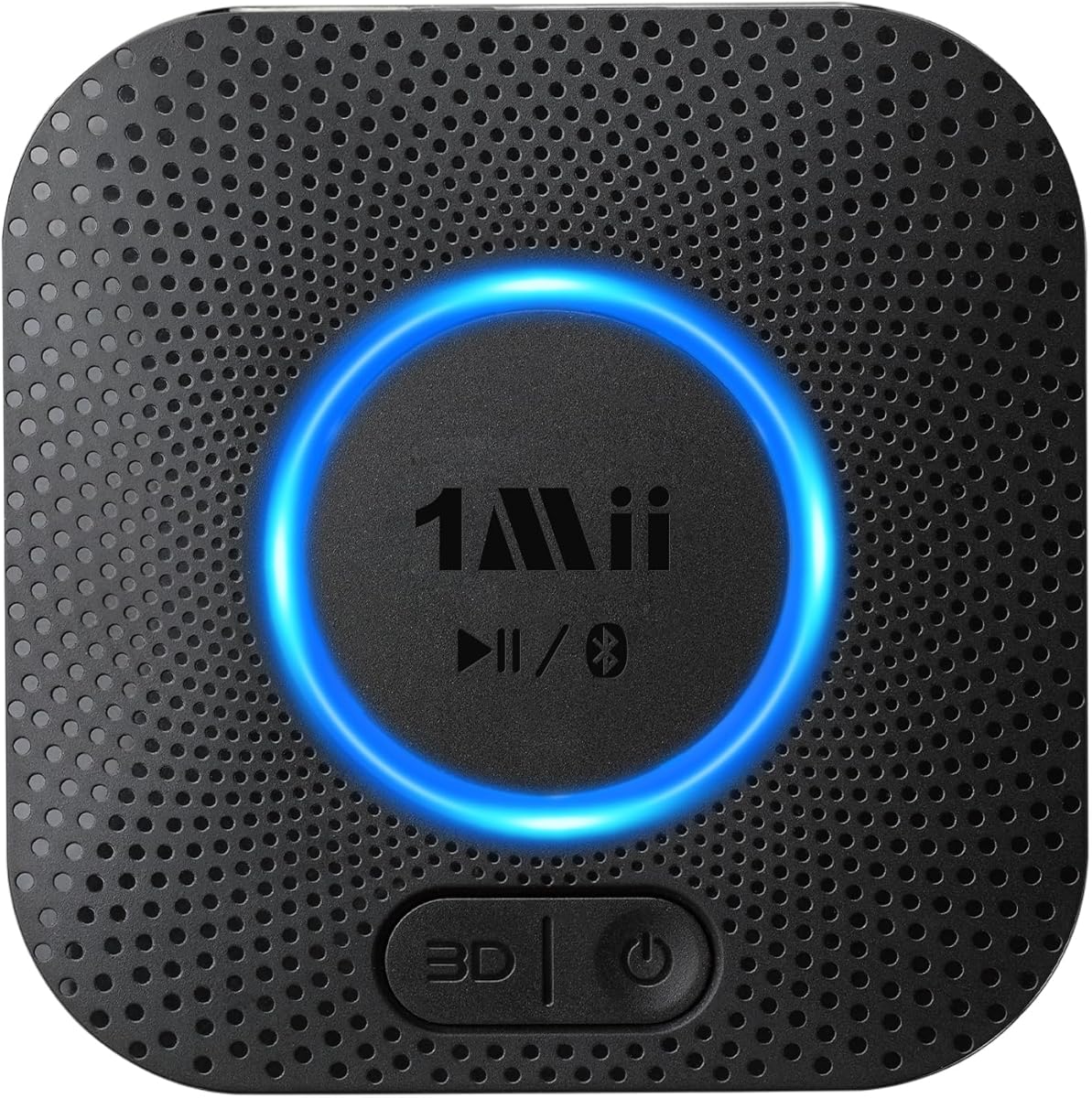
The 1Mii B06+ combines modern Bluetooth performance, flexible source switching, and convenient home-audio connections in a compact receiver. Its 4.4 rating and support for aptX HD, aptX Adaptive, and a switchable 3D mode make it a strong all-around choice for listeners who want more than basic Bluetooth streaming.
We may earn a commission when you buy through this link, at no additional cost to you.
The receiver can maintain connections to two Bluetooth devices at once, which is useful for moving between a phone and tablet without repeating the pairing process. Class 1 Bluetooth technology is specified for up to 98 feet outdoors and approximately 50 to 70 feet indoors without obstacles, offering considerably more flexibility than a compact room-only adapter.
The outputs are conventional RCA and 3.5 mm, so it integrates readily with many amplifiers and powered speakers. It lacks the optical connection found on several competing models, and the advanced codec benefits depend on whether the transmitting phone supports the same format. The 3D setting can also change the sound character, so listeners seeking a completely neutral signature may leave it off.
It is best for people who want a versatile receiver with long-range capability, strong codec support, and effortless switching between phones. The included USB power adapter and automatic reconnection further improve the daily ownership experience, making the B06+ our overall recommendation for a typical home stereo upgrade.
aptX HD and aptX Adaptive support can provide a cleaner and more detailed result when supported by the source device. The receiver also includes AAC through the broader capabilities expected of its Bluetooth implementation, giving users more flexibility in everyday streaming.
Simultaneous dual-device pairing simplifies shared listening situations. Users can move between a personal phone and another compatible source without erasing the first connection, while the stereo remains the central playback destination.
We may earn a commission when you buy through this link, at no additional cost to you.
The 1Mii B06Pro is built for listeners who need extensive wireless reach and unusually broad output compatibility. Its 4.4 rating reflects a feature-rich receiver with dual antennas, Bluetooth 5.3, aptX HD, aptX Low Latency, 3D audio, and both digital and analog connection options.
We may earn a commission when you buy through this link, at no additional cost to you.
The stated line-of-sight range reaches up to 197 feet, while indoor range is listed at approximately 60 to 100 feet without obstacles. Actual performance can vary with Wi-Fi routers, antennas, walls, and the layout of the home. The two antennas are intended to maintain a stable signal in larger spaces where a basic adapter may be less consistent.
It supports optical, RCA, coaxial, and 3.5 mm connections, making it a strong choice for an older home theater or stereo setup with different input options. A further advantage is the built-in volume and track adjustment: the volume buttons can be pressed and held to move between tracks, reducing the need to handle the phone during playback.
The B06Pro is ideal for a multi-room home, larger listening area, or stereo with an optical or coaxial input. It cannot transmit audio to Bluetooth headphones or televisions, and its larger design may be less convenient for a small shelf. Even so, the combination of range and input flexibility makes it a particularly versatile receiver for a permanent home installation.
Dual antennas and Class 1 Bluetooth technology distinguish this model from compact adapters. The advertised maximum is especially useful for listeners who move between rooms or keep their phone farther from the stereo.
Optical, coaxial, RCA, and 3.5 mm outputs offer a practical path into nearly any wired entertainment system. This is especially useful when combining a newer streaming source with a legacy stereo component.
We may earn a commission when you buy through this link, at no additional cost to you.
The Auris Blume HD is the premium decoding choice in this guide, combining Bluetooth 5.3, LDAC, aptX HD, aptX Low Latency, AAC, and a true hi-fi DAC. Its 4.6 rating reflects a carefully positioned receiver for listeners who want a more advanced path from a phone or computer to a home stereo.
We may earn a commission when you buy through this link, at no additional cost to you.
Its most distinctive component is the built-in 384 kHz/32-bit upsampling digital-to-analog converter. The stated intention is to decode and play lossless source material with greater resolution, while the codec selection allows a compatible transmitter to send higher-quality audio when the content and application permit it.
The receiver also supports analog RCA and digital optical S/PDIF outputs. An included RCA-to-AUX cable broadens compatibility with equipment using a 3.5 mm input, and the precision-tuned antenna is specified to maintain a stable connection across multiple walls. The premium feature set does not benefit every setup equally, since an older phone may not support LDAC or aptX HD.
This model makes the most sense for an enthusiast with a capable amplifier, AV receiver, or powered speakers and a source device that supports high-resolution Bluetooth codecs. It is a strong candidate for the main listening area, where improved decoding and a built-in DAC may provide more visible value than on a secondary system.
The 384 kHz/32-bit upsampling DAC is the centerpiece of the Blume HD. It gives the receiver a dedicated conversion stage rather than relying entirely on the source device and connection path.
LDAC, aptX HD, aptX Low Latency, and AAC give compatible devices several ways to transmit audio. The practical benefit is greatest when the phone can supply a high-quality file or stream through a supported codec.
We may earn a commission when you buy through this link, at no additional cost to you.
The UGREEN Bluetooth 6.0 Receiver stands apart with a rechargeable, cordless design and support for up to 15 hours of uninterrupted playback. Its 4.4 rating makes it a compelling option for people who want to move a Bluetooth receiver between rooms or use it with speakers away from a wall outlet.
We may earn a commission when you buy through this link, at no additional cost to you.
The receiver supports LDAC and audio sampling rates up to 24-bit/96 kHz, and it has received Hi-Res Audio Gold Label certification according to the supplied information. It can connect to two phones at once, although the second device must pause playback before the first becomes active. USB-C charging takes approximately two hours, and use while charging is supported.
The included box contains a three-foot USB-C cable and a three-foot 3.5 mm audio cable, but no RCA cable or wall charger. Consequently, a buyer who needs RCA stereo connectivity may need to obtain that cable separately. Some iPhone and Galaxy devices also require manual reconnection after the link is lost, although powering the receiver off and on restores automatic reconnection.
UGREEN is best for mobile listening setups that cannot remain tethered to power. It suits a portable speaker, a secondary room, or a stereo where cord management matters. For a fixed installation that always has access to a wall outlet, one of the continuously powered models offers simpler long-term use.
LDAC and 24-bit/96 kHz support make this a capable portable receiver for compatible phones. The compact form preserves the high-resolution feature set while allowing placement away from the stereo's power cord.
A stated 15-hour runtime supports parties, outdoor meals, and other sessions away from an outlet. USB-C charging and operation while plugged in add flexibility for stationary use.
We may earn a commission when you buy through this link, at no additional cost to you.
The 1Mii B06T3 is the easiest receiver in the group to operate once it is set up. Its 4.7 rating is the highest among the listed products, while the integrated rotary knob gives users direct control over volume, playback, and track selection without reaching for a phone.
We may earn a commission when you buy through this link, at no additional cost to you.
Bluetooth 6.0 provides the connection foundation, with a stated streaming range of up to 98 feet. The adapter can pair with two Bluetooth devices simultaneously, allowing playback to move between a phone and tablet without repeating setup. This makes it well suited to households in which different people regularly play different music.
The main specification gap is the absence of detailed codec information in the supplied listing. Buyers who prioritize aptX HD, LDAC, or another named high-resolution codec may receive a more transparent feature comparison from a different model. It is also a receiver only, so it cannot send audio outward to Bluetooth headphones or televisions.
Choose the B06T3 when tactile controls and fast device switching are the priorities. It can upgrade wired home stereos, wired speakers, and other powered audio systems using RCA or 3.5 mm outputs, while its non-battery wired-power design is intended for continuous operation.
The rotary knob centralizes the most common playback functions. Users can adjust the level, pause or resume, and skip tracks while remaining near the speakers instead of returning to the source device.
Dual-device pairing keeps two compatible sources associated with the receiver. The result is convenient switching for shared spaces where different phones and tablets take turns providing music.
We may earn a commission when you buy through this link, at no additional cost to you.
The Sony STRDH190 is not a small add-on adapter; it is a complete two-channel home stereo receiver with Bluetooth built in. Its 4.5 rating reflects a traditional, feature-rich receiver designed for listeners who want an all-in-one system rather than a way to add wireless audio to existing equipment.
We may earn a commission when you buy through this link, at no additional cost to you.
The receiver supplies 100 watts per channel into 8 ohms at 1 kHz and supports speaker impedances from 6 to 16 ohms. It includes a phono input, four stereo RCA audio inputs, a 3.5 mm input, stereo RCA output, a quarter-inch headphone jack, and an FM radio with 30 presets.
Bluetooth is integrated directly into the receiver, so there is no separate streaming dongle to power or connect. A/B switching allows up to four speakers to be configured for either simultaneous playback or separate zones. The five-and-a-quarter-inch chassis is relatively low profile and can fit into a conventional AV cabinet, although it still requires considerably more space than a compact adapter.
This is the right choice for a new primary system or for replacing an aging receiver while preserving familiar analog functions. It does not make sense for someone whose current amplifier and speakers already meet their needs, because the primary job of an add-on Bluetooth receiver is to preserve that investment.
The STRDH190 combines amplification, source selection, radio, headphone support, and Bluetooth in one enclosure. This reduces cable complexity and makes it easier to build a coherent two-channel or multi-speaker system.
A/B switching gives users control over up to four connected speakers. One pair can play together, or two pairs can operate in separate zones, depending on the room arrangement and listening needs.
We may earn a commission when you buy through this link, at no additional cost to you.
The KAIY Bluetooth 5.4 receiver is designed as an approachable upgrade for classic and modern home systems. Its 4.4 rating is supported by broad wired connectivity, a visible LCD, direct controls, and a useful USB flash-drive function that can play music without a Bluetooth connection.
We may earn a commission when you buy through this link, at no additional cost to you.
Optical, RCA, and 3.5 mm outputs make it easy to connect the receiver to amplifiers, powered speakers, and other wired systems. The LCD displays volume, playback mode, and connection status, reducing uncertainty when changing settings. Bluetooth 5.4 supports a stated range of approximately 33 feet, which is suitable for one-room listening but not expansive coverage.
The receiver supports only one Bluetooth device at a time and has no internal battery. It requires a suitable 5V/1A power adapter, which is not included. The instructions specifically advise against relying on a TV, computer, or projector USB port because insufficient power can cause rebooting, and the unit enters standby after ten minutes without audio.
KAIY is most useful for a listener who values visible controls, multiple output choices, and local USB playback. It is a practical option for an older stereo in a single room, though buyers should plan for a proper wall adapter and should not expect the extended range or multi-device convenience offered by some competitors.
The built-in LCD makes the receiver easier to manage without an app. Volume, playback mode, and connection status can be checked directly on the unit, which is especially useful for older users.
USB flash-drive support provides a second way to play music. A locally stored collection can be used for gatherings or occasions when wireless pairing is inconvenient.
We may earn a commission when you buy through this link, at no additional cost to you.
The 1Mii DS200Pro is a high-resolution receiver aimed at home listeners who want careful digital-to-analog conversion and modern codec support. Its 4.6 rating places it among the strongest entries in the guide, particularly for an amplifier, AV receiver, or powered-speaker system with RCA or optical inputs.
We may earn a commission when you buy through this link, at no additional cost to you.
The built-in ESS SABRE DAC is intended to reduce noise and distortion while preserving detail in the incoming signal. Bluetooth 5.3, LDAC, aptX HD, aptX Low Latency, and AAC provide a broad codec menu. A Class 1 chipset and external antenna are specified for a stable link of up to 100 feet, although walls and other obstacles can reduce the result.
RCA and TOSLINK optical outputs cover many standard home-audio configurations, and the supplied information states that both types of cable are included. That makes setup less dependent on finding an appropriate cable, particularly for an optical-equipped receiver or amplifier. The product is still receiver-only and cannot be used as a transmitter.
The DS200Pro is a strong match for a dedicated music system where the source device supports LDAC or aptX HD and the user values a dedicated DAC. It may be overkill for casual listening or a basic pair of powered speakers, but it provides a more advanced and polished path for a serious stereo setup.
The integrated ESS SABRE DAC is designed to lower noise and distortion during digital-to-analog conversion. It gives a home system a dedicated high-quality conversion stage for compatible Bluetooth sources.
The external antenna and Class 1 chipset are intended to provide a dependable connection through a home. Up to 100 feet is the stated maximum, with actual performance depending on walls, interference, and placement.
We may earn a commission when you buy through this link, at no additional cost to you.
The AUX RCA Bluetooth Adapter is an accessible receiver for adding wireless playback to a home stereo, car, or powered speaker. Its 4.1 rating is the lowest in this list, but the product covers the essential functions with a compact design, familiar RCA and 3.5 mm outputs, and quick NFC pairing.
We may earn a commission when you buy through this link, at no additional cost to you.
NFC provides a convenient way to connect an NFC-enabled phone or tablet by bringing it close to the receiver. The device also pairs automatically after initial setup, reducing the need to repeat the process every time it is powered on. A stated 33-foot unobstructed range is sufficient for a single room or nearby work area.
TF card playback adds a non-wireless option for stored music, while the included USB cable allows connection to a phone charger or another suitable USB power outlet. The 3D playback mode is intended to create a wider presentation, although listeners should judge whether it suits their stereo and preferred sound signature.
This adapter is best for simple, occasional streaming in a modest room. It cannot transmit to Bluetooth headphones, and the limited range and sparse codec information make it less appealing for a large home or a listener focused on advanced high-resolution formats. For those needs, a more capable receiver is a better fit.
NFC removes much of the conventional pairing friction. A compatible phone or tablet can make the connection simply by being brought near the receiver, while automatic pairing handles later powered-on sessions.
TF card support allows the receiver to play stored files without a wireless source. It is a useful alternative for parties or casual listening when a phone is unavailable or charging.
We may earn a commission when you buy through this link, at no additional cost to you.
The right receiver depends on your existing audio equipment, source device, room size, and desired level of control. Start with connection compatibility, then prioritize wireless stability, supported codecs, power, and convenience features that match how you listen.
Begin by inspecting the input options on the amplifier, AV receiver, or powered speakers. RCA stereo inputs are extremely common, while 3.5 mm AUX inputs suit smaller systems. Optical or TOSLINK and coaxial inputs can provide a digital connection, but only work if the stereo actually has a matching input. A receiver's output format is not interchangeable with the stereo's input format, so verify both ends before buying.
Choose the output set that matches your equipment without requiring unnecessary adapters. RCA and 3.5 mm are the safest broad choices, while optical support is useful for a more advanced home theater or stereo system.
Advertised maximum range is usually measured under favorable conditions with a clear path between the transmitter and receiver. A specification of 30 to 40 feet is generally suitable for one room, while models near 100 feet or more are more appropriate for larger homes. Walls, furniture, electrical interference, Wi-Fi equipment, and antenna placement can all reduce practical performance. Dual external antennas and Class 1 chipsets may improve reliability, but placement still matters.
For a single-room system, prioritize a stable connection over a headline maximum. For a multi-room home, favor a receiver with stronger stated range, external antennas, and a placement where the receiver can receive a clean signal.
Bluetooth codecs influence the quality and latency of transmitted audio. Standard Bluetooth is perfectly adequate for many listeners, while aptX HD, LDAC, AAC, and aptX Adaptive can offer higher quality or lower latency when both the receiver and transmitting device support the same format. A codec printed on the receiver cannot improve the stream if the source encodes audio in a lower-quality mode. Compatibility with the phone, tablet, or computer is therefore essential.
Prioritize the codec used most often by your preferred source devices. LDAC and aptX HD suit quality-focused music listening, while aptX Low Latency and aptX Adaptive can be valuable for video or interactive audio.
Most home receivers use a permanent power connection and remain ready for continuous use. This is convenient for a fixed stereo but requires access to a suitable outlet or powered USB source. Battery-powered receivers are better for moving audio between a patio, kitchen, and living room, though they need regular charging. Check whether a receiver can operate while charging, how long its battery lasts, and what charging connector it uses.
Choose continuous wired power for a permanent installation. Select a rechargeable model when portability and flexible placement matter more than always-ready operation.
Some adapters rely entirely on the phone, while others provide buttons, a rotary knob, or an LCD. Physical controls are useful for volume, pause, and track changes when the phone is across the room. Dual-device pairing allows a receiver to remember two sources at once, which helps households sharing music. A single-device design may be simpler, but it requires a full reconnection when moving between phones.
Prioritize direct controls and dual-device pairing if multiple people use the stereo. For a dedicated source, a minimal adapter with automatic reconnection may be sufficient.
A built-in DAC can be useful in a system where the source device has limited audio output options or the goal is a dedicated conversion stage. High-resolution upsampling and premium DAC chips do not automatically create detail absent from the transmitted file, but they can provide a cleaner conversion path and reduce the impact of source limitations. Codec support, source quality, cables, and system components all remain important.
Treat the DAC as one part of the signal chain. For a serious listening system, pair a capable receiver with a high-quality source, suitable cables, and amplifiers or speakers that can reveal the difference.
Additional features can make an adapter more useful, but they should not distract from core compatibility. A 3D or sound-field mode may create a wider presentation, though it is not equivalent to true multichannel processing. USB flash-drive playback can provide a convenient local music option. Voice-command support depends on correctly pairing a compatible assistant device to the receiver while connecting the audio cable to the stereo. Automatic standby can save energy in infrequently used rooms.
Treat extras as useful when they match a specific habit. Reliable pairing, appropriate outputs, and sound quality remain more important than a long feature list.
A Bluetooth receiver accepts audio from a Bluetooth-enabled source and sends it into a wired stereo. It does not normally send music outward to Bluetooth headphones or transmit to a television. This distinction matters for people who want to watch TV audio through wireless headphones or create a multi-room transmitter chain. Products described as receiver-only should be purchased for a phone or computer feeding an existing amplifier or powered speakers.
Confirm the signal direction before ordering. If you need to transmit to wireless headphones, choose a dedicated Bluetooth transmitter rather than any receiver in this guide.
Start by identifying the correct input on the stereo. Connect the receiver's RCA, 3.5 mm, optical, or coaxial cable to the matching input, then connect the other end to the receiver. Select that input on the stereo and set the volume low before pairing. Connect the receiver to an appropriate power source, following the included instructions and avoiding undersized USB ports when the product requires a dedicated power adapter.
Put the Bluetooth source device into pairing mode and select the receiver's model name in its Bluetooth menu. Once connected, start playback at a moderate level and raise the stereo volume gradually. If the sound is distorted, interrupt playback and check the cable seating, source volume, and stereo input. For models with volume-sync settings, adjust synchronization on the phone if levels are unusually low.
For long-term care, keep the receiver away from moisture, excessive heat, and crowded cable areas. Dust the vents and connections gently, and avoid using the analog or digital cable to pull the unit from its position. Follow the model-specific pairing, charging, and standby instructions, especially when reconnecting an iPhone or Galaxy device, and maintain clear space around external antennas for the most reliable wireless result.
A receiver takes audio from a Bluetooth-enabled phone, tablet, or computer and sends it through wired outputs to a stereo, amplifier, or powered speakers. A transmitter does the opposite, receiving wired audio from a television or stereo and sending it to Bluetooth headphones or speakers. The products in this guide are receivers designed to add wireless playback to wired home audio equipment.
Use the output that matches an available input on your stereo. RCA is the most broadly available option, 3.5 mm works with many compact systems, and optical or coaxial is useful when the stereo has a compatible digital input. Avoid using a Bluetooth receiver's output cable as a direct substitute for an input with a different format.
Only if your usual source device supports those codecs and you want to prioritize higher-quality Bluetooth transmission. A phone without codec support will still work, but it will use a common Bluetooth encoding method. The receiver's advertised codec support cannot improve audio beyond the quality of the source, stream, and transmission path.
A range of roughly 30 to 40 feet is generally adequate for a single room with few obstacles. Larger homes benefit from a receiver advertising around 100 feet or more, especially one with external antennas. Actual range can be reduced by walls, furniture, wireless interference, and poor placement, so positioning the receiver in an open central area is helpful.
No. These are receiver-only products, so they accept Bluetooth audio from a source and output that audio through wired connections. They cannot transmit to Bluetooth headphones. A home stereo setup using wireless headphones generally requires a Bluetooth transmitter placed between the stereo and headphones.
A battery-powered receiver is convenient when you want to move it between rooms or operate away from an outlet. A wired model is generally simpler for permanent use because it can remain powered continuously. If portability matters, check the stated battery life, charging time, and whether the unit can operate while charging.
Automatic reconnection behavior depends on the operating system, Bluetooth implementation, power state, and prior pairing record. For example, the supplied UGREEN specifications state that some iPhone and Galaxy models may require manual reconnection after disconnection, while powering the adapter off and on restores the connection. Updating device software and completing the initial pairing carefully can also improve the experience.
A full receiver makes sense when you want an all-in-one system with built-in amplification, multiple inputs, speaker control, radio, or zone switching. A small adapter is usually better when you already own a capable amplifier or powered speakers and only need to add wireless playback. The Sony STRDH190 is the complete-system option in this guide, while the other products are primarily add-on receivers.
The Esinkin Bluetooth Audio Adapter is the practical budget choice for uncomplicated single-room streaming, while the 1Mii B06+ is the most balanced overall recommendation thanks to aptX HD, aptX Adaptive, long-range capability, and two-device pairing. The Auris Blume HD takes the premium route with LDAC, a high-resolution DAC, and flexible analog or digital outputs.
Your stereo's connections should guide the decision more than any single advertised feature. Confirm RCA, 3.5 mm, optical, or coaxial compatibility first, then choose based on source-device codec support, room size, power arrangement, and desired physical controls. Advanced DACs and long-range claims are most valuable in a thoughtfully matched system.
Ratings, product details, prices, and availability can change over time. Review the current listing and latest specifications before ordering, and verify that every included cable, power accessory, and required input is suitable for your particular home stereo setup.