
Lexar Play PRO 1TB
4.6Editor score
Up to 900 MB/s reads
Up to 600 MB/s writes
One terabyte capacity
Limited lifetime warranty
Our guide compares the 10 best Bestsamsung Microsd Express Card options, covering speed, capacity, durability, compatibility, and value for gamers and creators.
microSD Express cards bring PCIe-level performance to a familiar, portable format, making them especially appealing for modern handheld gaming, cameras, and other compatible devices. The best option balances fast transfers, generous capacity, thermal management, durability, and reliable compatibility rather than focusing on a single headline specification.
We compared ten cards based on the supplied manufacturer and retailer information, focusing on read speed, write speed, capacity, host-device support, physical protection, thermal features, and warranty coverage. The list includes Samsung, SanDisk, Lexar, PNY, and SUNEAST options across multiple capacities and performance tiers.
Each numbered review explains the strongest reasons to consider that card and the compromises buyers should understand. The top selections represent the most balanced choices for different priorities, while capacities and device requirements can narrow the field quickly. Prices and availability change, so verify current listings before purchasing.
4.6Editor score

4.7Editor score
4.7Editor score
The comparison below places all ten cards side by side, highlighting the differences in capacity, advertised performance, device compatibility, durability, and software or warranty support.




The SanDisk 512GB microSD Express Card earns a 4.7 rating and stands out as a balanced high-speed option for gaming, photography, and video workflows. Its headline advantage is performance of up to 4.4 times that of SanDisk's fastest microSD UHS-I cards, while the 512GB capacity provides useful room for games, downloads, and media.
We may earn a commission when you buy through this link, at no additional cost to you.
ThermAdapt is one of the most meaningful features for sustained use. The specially designed enclosure and controller use dynamic adaptive thermal management to help limit heat-related issues. The card also supports Nintendo Switch 2, remains ready for future products using a PCIe-NVMe interface, and operates at UHS-I speeds in compatible UHS-I and UHS-II devices.
SanDisk advertises exceptionally quick transfers with its compatible PRO-READER SD Express Dual Card, which is sold separately. That includes transferring a two-hour HD movie in less than 3.5 seconds and moving an hour of 30 fps 4K UHD footage while saving up to 2.8 minutes. The broad protection package adds waterproofing, temperature, humidity, drop, shock, magnetic, x-ray, and wear-out resistance.
This is the strongest general recommendation for someone who wants more than ordinary UHS-I performance without committing to the largest capacity. The main practical compromise is that maximum Express transfer rates require compatible hardware, including a suitable Express reader for the most demanding file transfers. For a modern handheld owner, a camera operator, or a creator moving large files, however, the combination of speed, thermals, capacity, and protection is exceptionally well rounded.
ThermAdapt combines a specialized enclosure and controller with dynamic adaptive thermal management. That focus on heat control is particularly relevant when moving large 4K files or repeatedly loading content on compatible gaming devices.
A 512GB capacity sits between the compact 256GB options and the larger one-terabyte cards. It gives handheld gamers room for multiple installations and gives photographers or videographers a practical amount of removable media without carrying the largest format available in the list.
We may earn a commission when you buy through this link, at no additional cost to you.
The Samsung P9 Express 512GB carries a 4.7 rating and is the strongest Samsung-specific option in this guide. It offers sequential read speeds up to 800 MB/s, described as up to four times faster than Samsung's standard UHS-I microSD cards. That performance makes it well suited to Nintendo Switch 2 games, downloadable content, and other Express-compatible workloads.
We may earn a commission when you buy through this link, at no additional cost to you.
Dynamic Thermal Guard is designed to reduce overheating during demanding activity. Samsung Magician Software adds another layer of ownership value through product authenticity verification and drive health monitoring. The card also supports six types of protection and comes with a three-year limited warranty, covering the durability and support expectations that matter for a card used on the move.
Compatibility is broad for a modern high-speed card. It works with Nintendo Switch 2 and microSD UHS-I devices, including tablets, drones, and cameras. In a non-Express host, performance falls back to UHS-I speeds, as expected, but the card remains usable rather than becoming limited to one specific device category.
For buyers searching within the Samsung range, this 512GB version offers a persuasive blend of speed, thermal management, monitoring software, and protection. The three-year warranty is shorter than the limited lifetime coverage advertised for several Lexar models, but the management features and strong performance claims help make it a particularly complete choice for gaming and mixed creative use.
Samsung Magician Software provides authenticity verification and drive health monitoring. Those tools can help buyers confirm that the card is recognized as expected and monitor its condition through Samsung's software ecosystem.
Samsung advertises sequential reads up to 800 MB/s and compatibility with Nintendo Switch 2. In a compatible Express host, the card is designed to reduce game-loading waits while retaining a large 512GB capacity for games and downloadable content.
We may earn a commission when you buy through this link, at no additional cost to you.
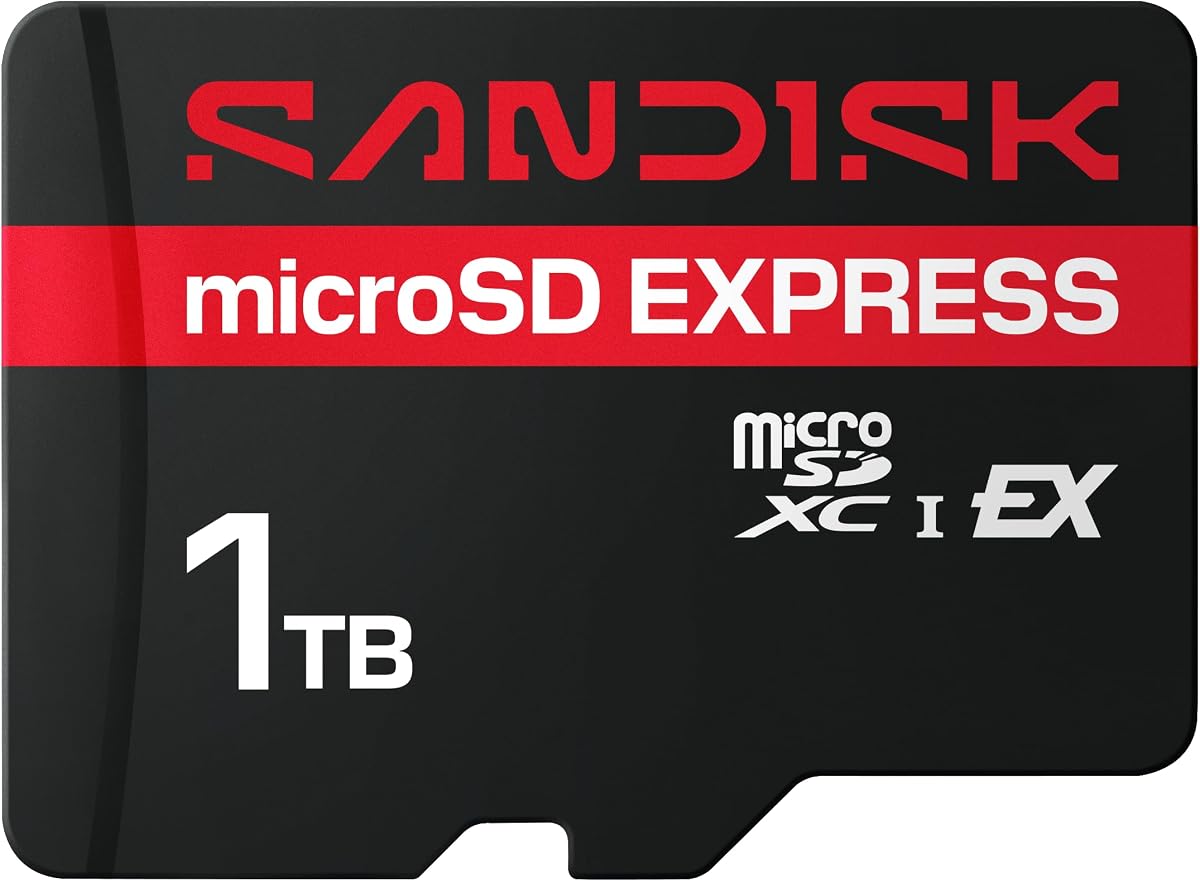
The SanDisk 1TB microSD Express Card has a 4.7 rating and is the top option for buyers who prioritize capacity alongside leading transfer speed. Its advertised performance reaches up to 880 MB/s and up to 3.5 times the read speed of SanDisk's fastest microSD UHS-I cards, making it particularly attractive for expansive handheld game libraries.
We may earn a commission when you buy through this link, at no additional cost to you.
The one-terabyte format reduces the need to delete games or media regularly. It is also suitable for photographers and videographers who want fewer card changes, especially when working with large source files. SanDisk says the card can transfer 60 minutes of 30 fps 4K UHD video in less than 15 seconds and up to 1,000 10MP RAW photos in less than 50 seconds when paired with the compatible PRO-READER, sold separately.
Its future orientation comes from support for PCIe-NVMe interfaces, while use in microSD UHS-I and UHS-II devices operates at UHS-I speeds. The card carries extensive protection against water, temperature, humidity, drops, shock, magnets, x-rays, and wear-out, which makes it credible for portable storage rather than only a desktop speed accessory.
This is the premium recommendation for users who want maximum room and high transfer throughput. It is less compelling for someone who only needs a few games or documents, and the compatible reader is not included. Nevertheless, for a Nintendo Switch 2 user building a substantial library or a creative professional moving large media sets, the combination of one-terabyte capacity, 880 MB/s advertised performance, and extensive durability is hard to overlook.
One terabyte provides substantially more removable storage than the 256GB and 512GB options. That makes it easier to keep several large games, downloadable content, captures, and other files together without frequently transferring data back to another device.
The advertised transfer scenarios are aimed at photographers and videographers moving large batches. Pairing the card with the compatible SanDisk PRO-READER allows the Express interface to deliver its intended speed, while older host devices remain usable at UHS-I speeds.
We may earn a commission when you buy through this link, at no additional cost to you.
The Lexar Play PRO 1TB has a 4.6 rating and combines the list's highest advertised read speed with one-terabyte capacity. Its PCIe-based design delivers read speeds up to 900 MB/s and write speeds up to 600 MB/s when paired with the Lexar microSD Express card reader, making it an appealing high-performance choice for Nintendo Switch 2 and other compatible devices.
We may earn a commission when you buy through this link, at no additional cost to you.
Lexar describes the card as delivering performance around four times that of typical UHS-I microSD cards. It remains backward compatible with UHS-I and UHS-II host devices, although those hosts operate it at UHS-I speeds. Its one-terabyte capacity gives buyers more room for games, downloadable content, 4K footage, and high-resolution images than the smaller Lexar versions in the guide.
Ownership support is another differentiator. The card includes a limited lifetime warranty and lifetime access to Lexar Recovery Tool, which is useful for users who want recovery software available alongside the storage product. It is also listed with 4K, V30, and UHS-I specifications, indicating an orientation toward both high-resolution media and general host compatibility.
This card makes the most sense for a buyer who wants high capacity and strong performance without paying for a smaller format. It may not be the right choice for someone who already owns a compatible Lexar Express reader, since reaching the full advertised transfer rate requires appropriate equipment. For everyone else, the combination of 900 MB/s reads, 600 MB/s writes, and one terabyte of capacity is compelling.
Lexar advertises read speeds up to 900 MB/s through its PCIe technology. This is especially useful for reducing loading delays between a compatible host and large stored files, provided the card reader or device also supports the full Express interface.
Lifetime access to Lexar Recovery Tool gives buyers access to a dedicated recovery utility. Combined with the card's limited lifetime warranty, this adds support and maintenance value to its high-speed specifications.
We may earn a commission when you buy through this link, at no additional cost to you.
The SanDisk 256GB microSD Express Card offers a 4.7 rating and delivers the same major performance platform as the larger SanDisk option in a more compact capacity. It can run up to 4.4 times faster than SanDisk's fastest microSD UHS-I cards and works with Nintendo Switch 2, making it suitable for users who do not need to carry a one-terabyte card.
We may earn a commission when you buy through this link, at no additional cost to you.
ThermAdapt remains a central feature. Dynamic adaptive thermal management, a specially designed enclosure, and a compatible controller are intended to control heat during sustained activity. That is useful in compact handheld environments where cooling room is limited and where a card may be expected to handle repeated game loads or large file transfers.
SanDisk advertises transferring a two-hour HD movie in less than 3.5 seconds and an hour of 30 fps 4K UHD video while saving up to 2.8 minutes when paired with its PRO-READER. A separate compatibility statement says 60 minutes of 4K UHD video can be transferred in under 70 seconds and 1,000 10MP RAW photos in 51.7 seconds with the same separate reader.
The trade-off is straightforward: 256GB may require deleting games or media more often than a 512GB or one-terabyte card. It is still a strong choice for a smaller game selection, focused photography projects, or travel where minimizing card capacity matters more than keeping an expansive library. For compatible-device owners who want Express speed without the largest format, it delivers the core SanDisk benefits at a more manageable capacity.
A 256GB card can be convenient when a smaller, lighter storage option is preferred. It still provides enough room for a focused collection of games, a camera roll, or a defined body of video, although large game libraries will fill it more quickly.
The combination of dynamic adaptive thermal management, a specialized enclosure, and controller helps manage heat. It is a meaningful advantage for portable Express devices where sustained transfers can raise operating temperatures.
We may earn a commission when you buy through this link, at no additional cost to you.
The Samsung P9 Express 256GB carries a 4.7 rating and gives Samsung buyers the same core platform as the 512GB model in a smaller format. Sequential read speeds reach up to 800 MB/s, and Samsung claims users can enter a game up to four times faster than with its standard UHS-I microSD cards in suitable conditions.
We may earn a commission when you buy through this link, at no additional cost to you.
Dynamic Thermal Guard helps reduce overheating, while the card's six types of protection are intended to handle the realities of portable use. The supplied information also emphasizes compatibility with Nintendo Switch 2 and microSD UHS-I devices such as tablets, drones, and cameras. In those legacy hosts, the card operates according to the host's UHS-I capabilities.
Samsung Magician Software remains valuable even with the lower capacity model. It offers product authenticity verification and drive health monitoring, giving owners a way to manage the card and confirm that their hardware recognizes the expected product. The included three-year limited warranty provides a defined support period for manufacturing-related concerns.
This is the Samsung choice for buyers who need Express performance but want to avoid a larger card. The 256GB capacity may be restrictive for extensive Nintendo Switch 2 libraries, and buyers seeking longer warranty coverage may prefer Lexar. Still, for a smaller collection of games, tablet use, drone storage, or camera work, the P9's 800 MB/s advertised reads, thermal design, and software support make it a balanced and convenient choice.
Samsung Magician provides authenticity verification and drive health monitoring. These features help owners check that the card is properly recognized and maintain visibility into its condition over time.
The smaller capacity does not reduce the advertised 800 MB/s sequential read specification. It therefore preserves the principal performance advantage for compatible hosts while offering a more compact storage option.
We may earn a commission when you buy through this link, at no additional cost to you.
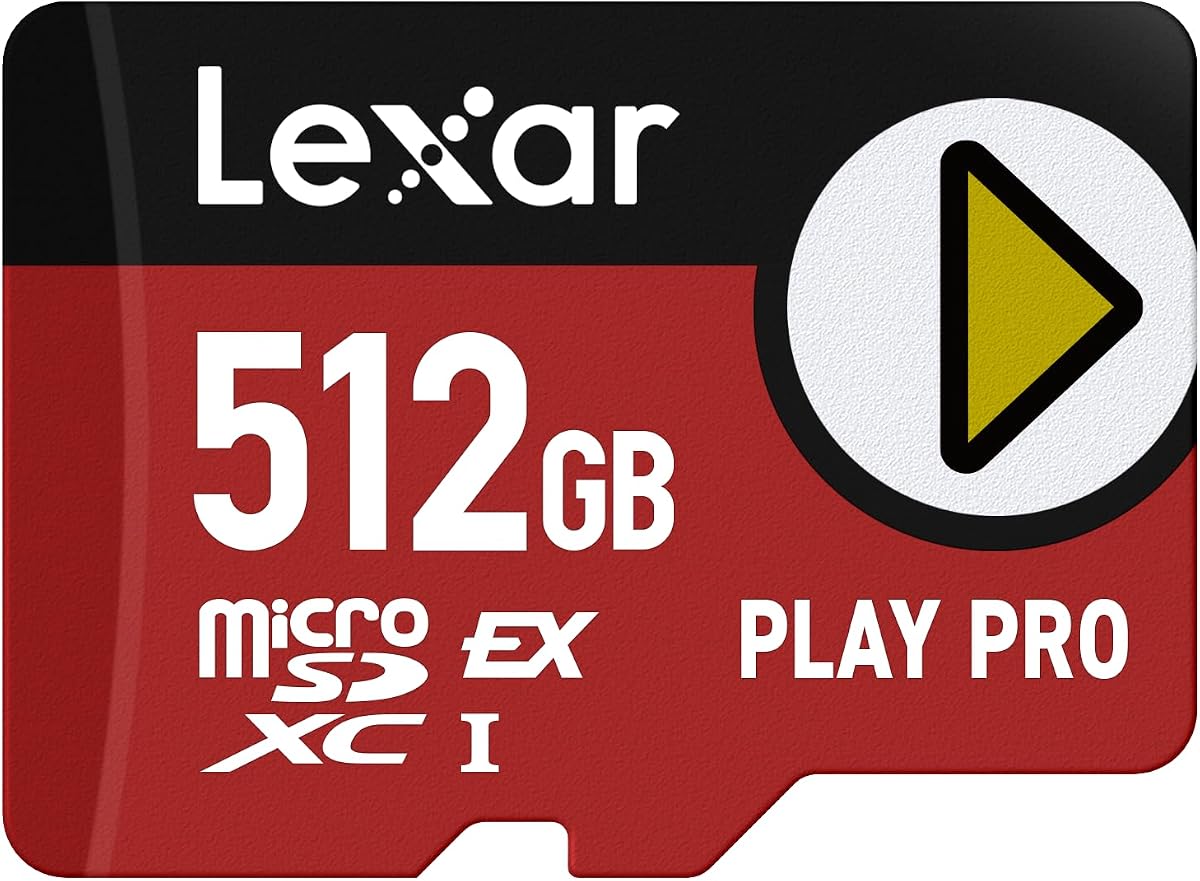
The Lexar Play PRO 512GB has a 4.6 rating and offers a middle-ground combination of capacity and speed. It delivers advertised read speeds up to 900 MB/s and write speeds up to 600 MB/s through PCIe technology, with the highest write result shown when used alongside the Lexar microSD Express card reader.
We may earn a commission when you buy through this link, at no additional cost to you.
The card is specifically positioned for Nintendo Switch 2 and next-generation gaming, where faster loading can make a visible difference. At the same time, it remains backward compatible with UHS-I and UHS-II devices at UHS-I speeds. This means it can move between newer Express hardware and older tablets, cameras, drones, or portable gaming systems without becoming unusable.
Its 512GB capacity is practical for moderate game collections and substantial batches of media. The 4K, V30, and UHS-I designations add useful context for photographers and videographers, while the limited lifetime warranty and lifetime access to Lexar Recovery Tool improve the ownership package beyond raw transfer speed.
This is an excellent middle option for buyers who want more capacity than a 256GB card but do not need a full terabyte. It suits Nintendo Switch 2 users building a respectable library and creators who regularly move files between modern and legacy hosts. The requirement for a compatible reader to reach peak performance is the main limitation, but within the guide it offers one of the strongest combinations of speed, capacity, and support.
512GB is a flexible middle capacity. It can hold multiple games and downloadable content, or a substantial body of photographs and video, without reaching the physical and financial commitment associated with the largest cards.
Lexar uses PCIe technology for read speeds up to 900 MB/s and write speeds up to 600 MB/s. Compatibility with both Express and conventional UHS hosts makes the card flexible, even though conventional devices limit it to UHS-I performance.
We may earn a commission when you buy through this link, at no additional cost to you.
The PNY 256GB microSD Express Card has a 4.3 rating, the lowest customer-rating figure in this guide, but it offers distinctive performance and application features. PCIe Gen 3×1 technology provides advertised read speeds up to 890 MB/s and write speeds up to 750 MB/s, making it one of the strongest options for sustained transfers in a compatible host.
We may earn a commission when you buy through this link, at no additional cost to you.
Its A1 Application Performance rating distinguishes it from many ordinary gaming-oriented cards. The rating supports running gaming apps directly from the card and is associated with faster application launch and performance. PNY also positions the card as a way to expand a compatible gaming device's internal storage by up to 256GB, while its U3 and V30 classifications suit demanding video workflows.
Thermal design is another strength. PNY describes a heat-dissipation-oriented physical design paired with adaptive thermal technology. Its protection suite covers shock, temperature, water, drops, x-rays, wear-out, vibration, electrostatic discharge, and humidity. The card is backed by a lifetime limited warranty, with PNY Photo Recovery software also available.
The lower rating warrants attention, although it does not erase the strong advertised specifications. The 256GB capacity is the more significant practical limitation for Nintendo Switch 2 owners with multiple large games. This card is best suited to buyers who value A1 app performance, strong write throughput, cooling, or recovery software and need a compact-capacity card for compatible applications.
The A1 Application Performance rating is designed for applications loaded directly from removable storage. It can benefit users who run compatible apps from the card while also indicating a focus beyond conventional file transfer.
PNY combines a heat-dissipation design with adaptive thermal technology. That focus is especially relevant given the card's advertised write speed of up to 750 MB/s and its intended use in performance-oriented compatible devices.
We may earn a commission when you buy through this link, at no additional cost to you.
The SUNEAST 1TB microSD Express Memory Card has a 4.7 rating and combines one-terabyte capacity with read speeds up to 900 MB/s and write speeds up to 620 MB/s. It is advertised for Nintendo Switch 2 and also supports laptops, tablets, cameras, and Android devices that use microSD Express or UHS-I.
We may earn a commission when you buy through this link, at no additional cost to you.
Its Class 10, U3, V30, and A2 performance ratings make it relevant to both high-resolution photography and 4K UHD video. The one-terabyte capacity allows users to retain large media collections, expanded game libraries, or a mixture of both without changing cards frequently. SUNEAST notes that usable capacity may be slightly lower after system formatting and card-management reservations, which is normal for flash storage.
The protection design covers shock, temperature, water, and x-ray resistance, supporting use in mobile and outdoor contexts. Unlike some premium alternatives, the supplied specifications do not highlight a dedicated drive-health application, authentication utility, or detailed limited-warranty term, so ownership support is less clearly documented in the available information.
This card is a strong high-capacity choice for compatible Nintendo Switch 2 devices and Android workflows where one-terabyte storage is valuable. Its A2 rating and strong write specification add appeal for compatible application and media use. Buyers who place greater importance on management software or clearly stated long-term warranty coverage may prefer Samsung Magician support or Lexar's lifetime warranty, but SUNEAST delivers a capable specification set.
A one-terabyte card can consolidate game installations, downloaded content, photographs, and video. That makes it useful for buyers who want one removable volume rather than a collection of smaller cards.
Class 10, U3, V30, and A2 ratings provide useful context for demanding applications and high-resolution recording. Buyers should still confirm that the specific camera, tablet, phone, or console supports the features and host interface they intend to use.
We may earn a commission when you buy through this link, at no additional cost to you.
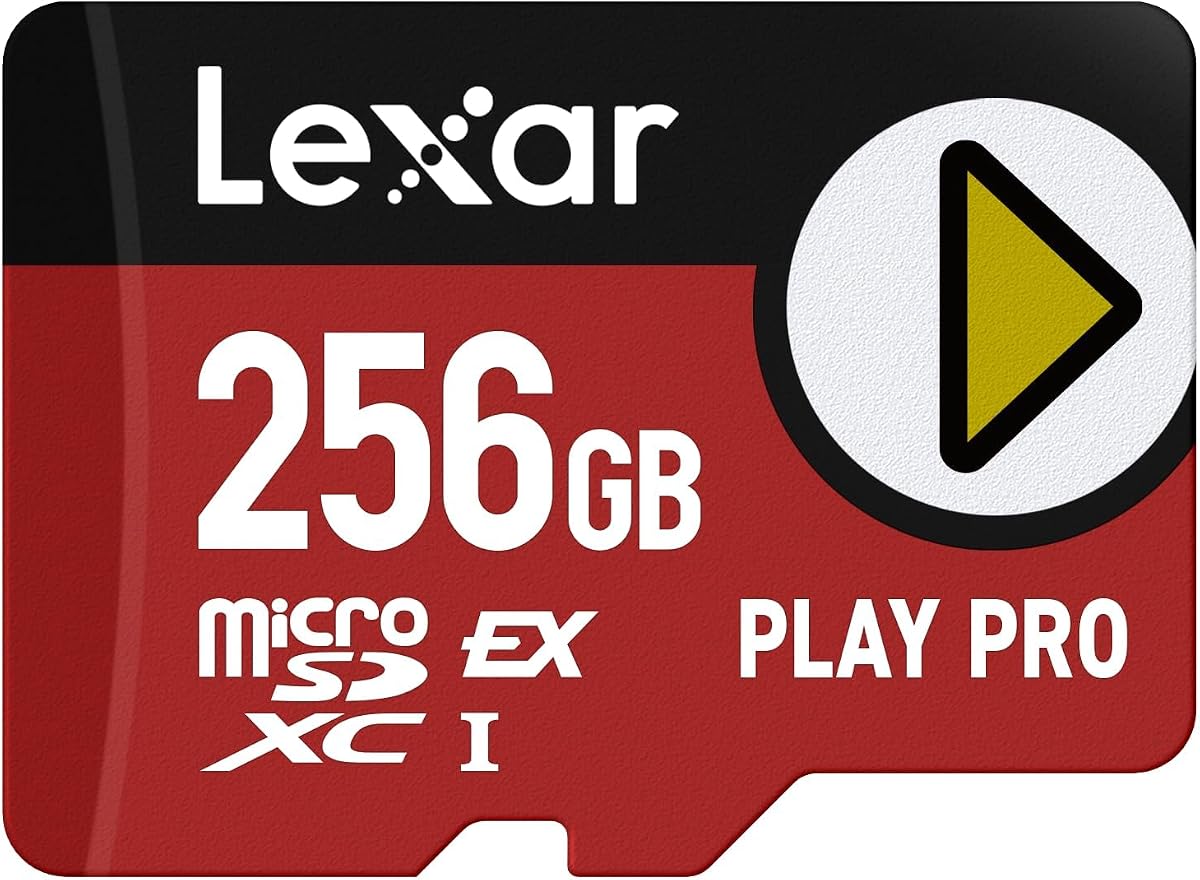
The Lexar Play PRO 256GB has a 4.6 rating and serves as a compact entry point into the microSD Express category. Lexar advertises PCIe read speeds up to 900 MB/s and write speeds up to 600 MB/s, with the highest write performance reached when paired with the Lexar microSD Express card reader.
We may earn a commission when you buy through this link, at no additional cost to you.
The card is designed around modern gaming, particularly Nintendo Switch 2, while remaining backward compatible with UHS-I and UHS-II host devices at UHS-I speeds. Its 4K, V30, and UHS-I designations also make it relevant to high-resolution media workflows, although those applications will quickly fill a 256GB card depending on file sizes and retention needs.
A limited lifetime warranty and lifetime access to Lexar Recovery Tool strengthen the package. The recovery utility can assist with accidental deletion or file-loss scenarios, while the warranty provides a clear support commitment. The supplied product information also emphasizes future readiness for microSD Express devices.
This is the most compact Lexar option in the guide and a sensible choice for a focused gaming setup, a smaller camera workflow, or users who want high read speed without carrying a larger card. Its limitation is straightforward: 256GB leaves less room for games and media than the 512GB and one-terabyte models. For compatible-device owners who prioritize speed and recovery support over maximum capacity, it remains a practical recommendation.
The 256GB capacity keeps the card physically and economically positioned for lighter storage needs. It is best suited to smaller game selections, active working sets, or users who regularly offload data to another drive.
Lifetime access to Lexar Recovery Tool provides a dedicated utility for recovering files. That feature complements the limited lifetime warranty and makes the card more attractive for photographers or mobile users whose data cannot be easily recreated.
We may earn a commission when you buy through this link, at no additional cost to you.
The right microSD Express card depends on host compatibility, the amount of data you need, sustained thermal performance, and the kind of files you plan to move. These factors help separate meaningful differences in this increasingly fast category.
Choose a card only after confirming your equipment can use it at the speed you need. Compatibility alone is not the same as full performance.
Prioritize write speed for recording and frequent transfers. Prioritize read speed for gaming and retrieving existing files.
Choose capacity based on your active library and how often you can offload files. More capacity reduces interruptions but creates a larger card to manage.
Look for active thermal design when the card will be used for long transfers or confined devices. Good thermals matter more than a small headline-speed advantage.
Favor cards with broad protection coverage for travel, handheld gaming, cameras, and drones. Treat any durability rating as risk reduction rather than permission to neglect the card.
Consider software and warranty coverage alongside speed. They can be decisive for a card containing irreplaceable photos, game saves, or work files.
Buy the right reader if maximum desktop throughput matters. Without one, the card remains useful but cannot realize its fastest advertised transfer results.
Match the card to the workload first, then use ratings and warranty coverage as supporting considerations. A card is only as useful as the environment in which it operates.
Before inserting the card, confirm that the device supports microSD Express and that its operating-system and firmware requirements are current. Format the card in the device that will use it most often, and avoid interrupting writes or removing it while files are being transferred. For desktop transfers, use a compatible Express reader and a host interface capable of handling the card's advertised performance.
Handle the card by its edges and keep the contacts clean and dry. Avoid bending, crushing, or exposing it to extreme heat, moisture, strong magnets, or equipment that can generate static discharge. Store it in a protective case when it is not in use, particularly during travel, and do not treat it as the only copy of irreplaceable photographs or recordings.
For ongoing maintenance, use the manufacturer's available software to verify authenticity or inspect drive health where supported. Keep recovery software accessible, back up important files regularly, and replace a card that produces repeated errors or unexplained corruption. Also check current host compatibility before moving an Express card into a camera, drone, console, or other device that may only operate it at UHS-I speeds.
Yes. All of the featured cards are described as compatible with conventional microSD UHS-I devices, and most also support UHS-II hosts at UHS-I speeds. The important limitation is performance: an Express card cannot deliver its full read and write rates in a host that lacks a PCIe-NVMe microSD Express interface. Always check the host device's supported media formats before expecting maximum transfer speeds.
Every product in the list is presented as compatible with Nintendo Switch 2, although compatibility descriptions vary by brand. A supported card can add removable game and downloadable-content storage, but actual game-loading improvements depend on the console, card, and workload. Buyers should also confirm that the intended game or content is supported on removable storage and keep free space available for system and save data.
Higher read speeds can reduce loading times because the console must retrieve game data from the card. The listed cards advertise reads ranging from 800 to 900 MB/s, while PNY specifies up to 890 MB/s. Real-world results vary, so capacity, thermal behavior, game size, and the device's own requirements can affect the visible benefit as much as the peak transfer number.
You need one to use the full desktop transfer performance of a microSD Express card with a computer. The cards remain usable in compatible UHS-I readers, but performance will be limited by that interface. SanDisk's stated media-transfer examples use its PRO-READER SD Express Dual Card, which is sold separately, while Lexar's highest write figures reference a compatible Lexar Express reader.
It can be enough for a smaller selection of games, but modern titles and downloadable content may fill it quickly. The one-terabyte options are better suited to extensive libraries, while 512GB provides a practical middle ground. Users should also remember that a portion of nominal capacity is reserved for formatting and card management, leaving less space for games and other files.
V30 indicates a minimum sustained write speed of 30 MB/s. It is a meaningful classification for recording high-resolution video because it describes a guaranteed minimum sequential write rate rather than a momentary maximum. Cards with U3 and V30 markings are better aligned with demanding 4K workflows than ordinary lower-rated microSD cards, although host compatibility remains essential.
Recovery chances depend on the card's condition and whether the deleted data has been overwritten. Lexar provides lifetime access to Lexar Recovery Tool, and PNY makes PNY Photo Recovery software available. Stop writing to the card after an accidental deletion and use suitable recovery software on a computer; continued use can reduce the possibility of recovery.
No. Ratings are useful evidence of buyer satisfaction, but they cannot replace checking specifications, warranty coverage, software features, and device compatibility. For example, the PNY card has a lower listed rating but offers A1 application performance and a strong advertised write speed, while other cards with higher ratings may better suit buyers seeking management software or a longer warranty.
The SanDisk 512GB is the most balanced overall recommendation because it combines high Express transfer performance, 512GB capacity, ThermAdapt thermal management, extensive protection, and Nintendo Switch 2 compatibility. Samsung P9 512GB is the leading Samsung-focused option, while the Lexar Play PRO 1TB stands out for its high advertised reads, generous capacity, recovery software, and limited lifetime warranty.
Prioritize compatibility first, then match capacity to your game library or media workload. Choose a larger capacity for extensive collections, a 256GB option for focused use, and a card with strong write performance and thermals for recording or repeated transfers. Management tools, warranty coverage, and access to a compatible reader can also influence the best value.
Prices, promotions, bundle contents, and availability can change over time, so review the current listing before buying. Confirm the host device supports microSD Express, check whether a separate reader is needed, and compare the final capacity and warranty terms. With those details settled, one of these ten cards can provide a strong foundation for faster storage.