XHDATA D220
4.4Editor score
Pocket-sized three-band receiver
Broad AM FM SW coverage
DSP-assisted signal reception
Our battery powered shortwave radio guide compares 10 portable models for reception, power options, weather alerts, audio, ease of use, and emergency readiness.
A battery powered shortwave radio gives you access to local broadcasts, international programming, news, music, and emergency alerts without depending on a wall outlet. The most useful models combine sensitive reception, flexible power options, clear controls, and enough battery capacity for travel, camping, or power outages.
We compared these ten radios across frequency coverage, power sources, weather alert functions, speaker and headphone performance, portability, and operating convenience. The list includes compact pocket sets, room-filling portable radios, and rugged emergency models designed for solar charging, hand cranking, and backup batteries.
Each review highlights the product that best fits a particular use rather than treating every listener identically. Our top three cover different priorities, including value, all-around versatility, and emergency readiness. Product availability and prices can change, so confirm the current listing and specifications before purchasing.
4.4Editor score
4.5Editor score

4.5Editor score
This side-by-side comparison shows the distinct strengths of each model, from pocket-sized shortwave reception to multi-power emergency radios with weather alerts, lights, and device-charging features.


This digital radio combines a rechargeable battery, AM, FM, NOAA weather channels, programmable presets, and local media playback in one portable package. Its 4.1 rating places it among the more highly reviewed products in the group, although that figure also suggests some buyers have encountered imperfections. Its clearest attraction is the unusually broad feature set for a compact radio.
We may earn a commission when you buy through this link, at no additional cost to you.
The internal 4000mAh battery is rated for up to 18 hours of listening after a roughly five-hour USB Type-C charge. It can also run on four D cells, although those cells are not included. A digital input method makes station selection more precise than a purely analog tuner, while 40 preset slots provide quick access to favorite stations. The clear LCD and backlight are especially helpful at night or in dim rooms.
NOAA reception adds practical emergency value, with seven stations available for weather warnings. The radio also supports MP3, WMA, and WAV files from microSD cards and USB storage up to the stated maximum capacity of 256G. Two tone modes offer different audio characters, while a 10- to 90-minute sleep timer can conserve power overnight. A lock function helps prevent accidental button presses.
The principal compromise is that its 4.1 rating is the lowest in this roundup, and the product description does not identify a specific shortwave range even though shortwave listening is part of its positioning. You should therefore verify the detailed frequency specifications if international shortwave stations are essential. It is most suitable for a listener who values charging flexibility, presets, weather alerts, and media playback in one device rather than a dedicated pocket shortwave receiver.
The internal rechargeable battery makes the radio practical for bedrooms, offices, picnics, and travel where an outlet may not be available. Four-D-cell backup operation adds another layer of resilience, so a listener can remain informed when the internal battery is exhausted or when carrying spare cells is convenient.
Programmable stations, a backlit display, a sleep timer, and removable-media playback make this model useful as more than a basic receiver. The NOAA warning function is a notable addition for households in regions served by the listed weather stations.
We may earn a commission when you buy through this link, at no additional cost to you.
This portable transistor radio is a straightforward choice for listeners who want strong speaker output and uncomplicated operation. It receives FM, AM, and shortwave, with a stated FM range of 88-108 MHz, AM range of 530-1710 kHz, and SW range of 2.8-22 MHz. Its 4.2 rating reflects a generally favorable reception of its straightforward design.
We may earn a commission when you buy through this link, at no additional cost to you.
The most prominent feature is the enhanced five-watt speaker. That output should be more noticeable than the tiny drivers found in many pocket radios, making the set suitable for a kitchen, bedroom, workshop, or campsite where shared listening is expected. A DSP anti-jamming chip is included to improve sensitivity, and the telescopic antenna is designed to support signal pickup across the available bands.
Controls are intentionally simple. An AM/FM/SW selector, a large channel tuner, and separate volume buttons make the radio approachable for older users and anyone who prefers physical knobs over menu-driven interfaces. The internal rechargeable battery means the unit can be moved away from a wall, while USB charging provides an easy way to replenish it when needed.
This model does not list NOAA alert functions, a flashlight, an SOS beacon, or device-charging output. It is therefore better suited to ordinary radio entertainment, news, sports, and talk listening than to serving as a comprehensive emergency kit. Choose it when a clear speaker and uncomplicated three-band operation matter more than weather-warning automation.
The five-watt speaker is the model defining feature. It gives the radio a different role from a pocket receiver, allowing music and talk programming to remain audible in a shared room without relying entirely on headphones.
The broad stated shortwave range is useful for listeners interested in distant stations. The DSP chip and telescopic antenna are positive additions, although actual results will depend on location, antenna positioning, atmospheric conditions, and the target station's broadcast strength.
We may earn a commission when you buy through this link, at no additional cost to you.
The Greadio radio sits between a compact transistor set and a home entertainment unit, offering a large LCD, easy tuning controls, dual speakers, and flexible power. Its 4.3 rating is among the stronger results in the group, and the design appears especially well suited to families, older listeners, and people who want shortwave capability without a complicated digital interface.
We may earn a commission when you buy through this link, at no additional cost to you.
A long antenna and advanced DSP chip support stable reception across AM, FM, and shortwave. The large LCD makes frequencies and the displayed clock easy to read, while large knobs reduce the learning curve. A built-in handle makes the radio easier to carry to a picnic, campsite, party, or another room without treating it like a pocket device.
Two built-in speakers produce a fuller presentation than a single miniature driver. The high and low tone modes let listeners adjust the character of the audio, and a 3.5mm earphone jack supports private listening. For home use, the included charging cable and AC connection allow extended operation, while four D cells provide a useful backup during an outage.
The radio does not list NOAA alerts, a hand crank, a flashlight, or a phone-charging port, so it is not the strongest dedicated emergency device. It is also larger and heavier than a true pocket receiver. Even so, it offers a balanced combination of readable controls, good sound, broad tuning, and dual power sources, making it a strong general-purpose recommendation.
The large LCD and oversized tuning knobs improve usability in dim conditions and for listeners with limited familiarity with small digital radios. The carry handle and time display further separate it from basic pocket models.
Dual speakers give music, sports, and talk programming more body than a compact single-speaker receiver. Headphone support provides a convenient option for quieter late-night listening without changing the radio's placement around the home.
We may earn a commission when you buy through this link, at no additional cost to you.
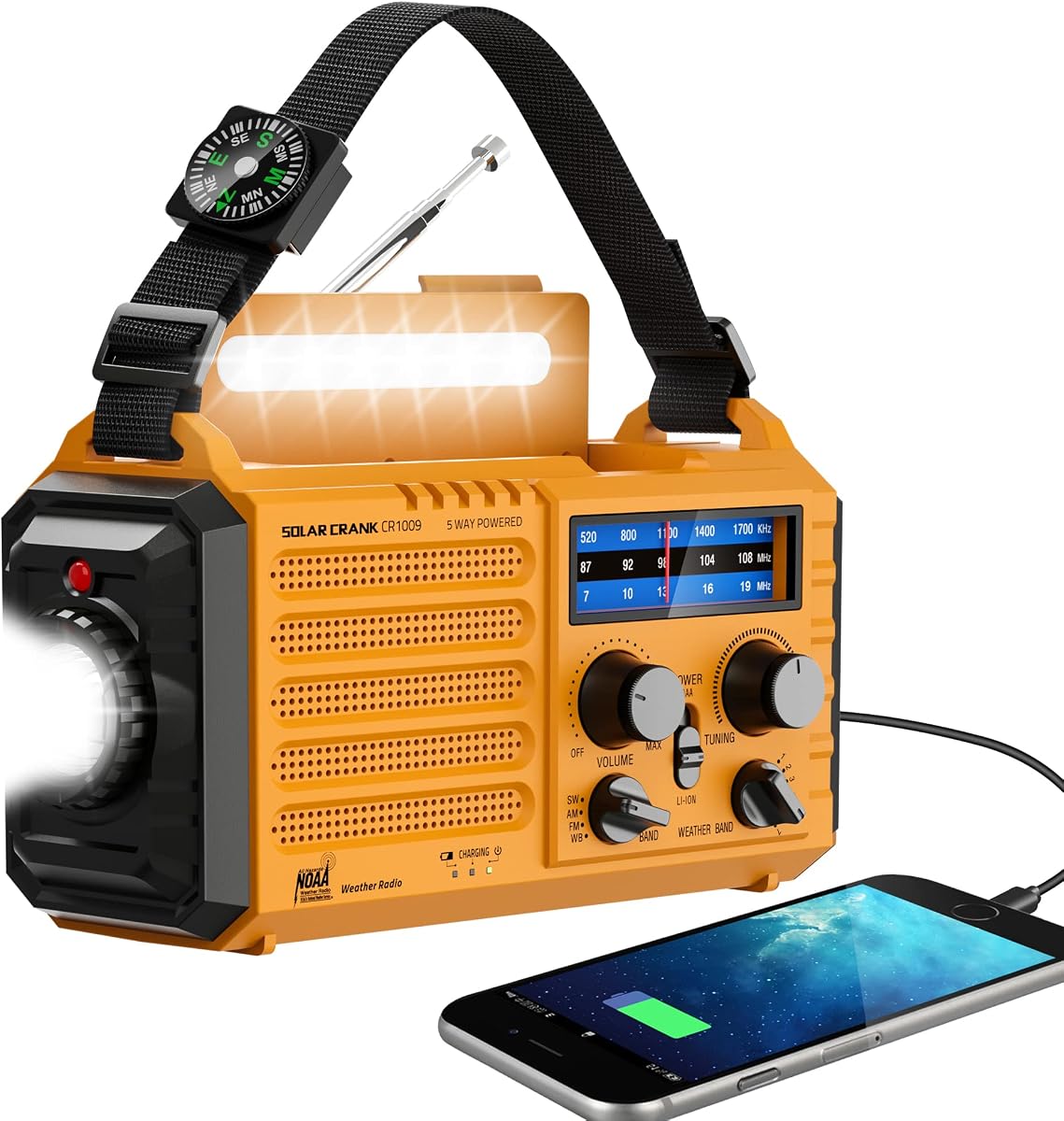
The Eoxsmile emergency radio is built around resilience, offering AM, FM, shortwave, NOAA channels, multiple charging methods, a flashlight, a reading lamp, and a USB output. Its 4.5 rating makes it one of the strongest-reviewed products here, while the broad emergency design gives it a clear role in a kit for outages, storms, camping, and travel.
We may earn a commission when you buy through this link, at no additional cost to you.
The radio can be recharged through a solar panel, hand crank, power plug, or included USB cord. A compartment for three AAA batteries provides a fifth source of backup power, and the internal rechargeable battery is rated for up to 13 hours of FM playback when fully charged. The included power plug is not part of the package, so buyers who rely on that method should note the stated omission.
NOAA capability is a major advantage. Users can select the weather band and one of seven preset stations, then receive a loud SOS alarm lasting nine seconds with a flashing red light when the National Weather Service issues a severe-weather alert. The telescopic antenna supports AM, FM, and 7-19 MHz shortwave reception, while a 3.5mm jack allows private nighttime listening.
Its lighting options distinguish it from a normal portable radio. A three-watt side flashlight is described as reaching 80 meters, while a 2.5-watt reading lamp with adjustable brightness uses six LEDs. A USB output can charge phones and other devices, and a compass and hand strap support outdoor use. The trade-off is that some batteries and the plug are excluded, and the quoted 13-hour figure applies only to FM playback. Overall, it is our top all-around choice for a listener who wants a radio that can do much more than play broadcasts.
Solar, hand-crank, USB, plug, and removable-battery options make the radio less dependent on any single energy source. That flexibility is especially valuable when a storm causes a prolonged outage or when a campsite lacks easy access to mains electricity.
A focused flashlight and adjustable reading lamp add everyday utility beyond radio reception. The reading light can provide convenient campsite or room illumination, while the alert beacon helps draw attention to emergencies.
We may earn a commission when you buy through this link, at no additional cost to you.
The Panasonic RF-2400D is a traditional portable AM/FM radio with a reassuringly straightforward design. It receives local broadcast stations, includes an AC adapter, and also operates with four AA batteries. Its 4.5 rating indicates strong buyer satisfaction, and the model is attractive to anyone who prefers a direct tuning dial to digital menus or preset-based controls.
We may earn a commission when you buy through this link, at no additional cost to you.
The large dial and fluorescent pointer make the frequency position easy to see, including in low-light conditions. A digital tuner with automatic frequency control supports more stable tuning while preserving the familiar feel of an analog radio. That combination can be particularly useful for older listeners or people who find small screens and complicated settings inconvenient.
A standard 3.5mm headphone jack allows private listening, which is useful at night or when the radio is used in a shared living space. The radio's supported program material is limited to AM and FM, so it does not cover shortwave, NOAA weather channels, or emergency bands. It also lacks a flashlight, hand crank, solar panel, and USB device-charging function.
Those limitations mean the RF-2400D should not be chosen for international shortwave reception or severe-weather monitoring. Its strength is the opposite: it is a direct, dependable-feeling local radio for bedrooms, kitchens, offices, camping trips, and outages. Choose it when uncomplicated tuning, visible controls, and familiar operation are more important than specialized emergency features.
The large dial and fluorescent pointer make the radio easy to understand at a glance. Automatic frequency control helps maintain stability, reducing the need for repeated fine adjustments when a station is difficult to locate.
The included AC adapter supports regular home listening, while four AA batteries keep the radio available during a power failure. A headphone connection supports quieter personal listening in either setting.
We may earn a commission when you buy through this link, at no additional cost to you.
This NOAA Weather Radio emphasizes emergency alerts and self-sufficient charging, making it closely matched to campers, hikers, households in storm-prone areas, and anyone assembling a preparedness kit. It combines AM, FM, shortwave, seven NOAA presets, a 116dB SOS alarm, flashing red light, two lights, a compass, and USB device charging.
We may earn a commission when you buy through this link, at no additional cost to you.
Its 4.5 rating reflects a strong overall response, particularly for a model with such a broad range of emergency functions. The radio can be charged by solar panel, hand crank, power plug, included USB cord, or three removable AAA batteries. Its internal rechargeable battery is rated for up to 13 hours of FM listening when fully charged.
The side SOS button activates a loud alarm and flashing red beacon. A separate red flashing indicator accompanies the nine-second NOAA alert alarm when a severe-weather warning is issued. These visual and audible signals are useful for nighttime warnings, when a user may not immediately understand why a station's sound has changed.
The radio also provides a three-watt flashlight, a 2.5-watt reading lamp, a telescopic antenna, and a 3.5mm headphone jack. A USB output can charge mobile devices during an outage. Its stated shortwave range begins at 7 MHz, so listeners interested in the lower frequencies covered by some other models may find it less expansive. It also lacks the larger LCD found on the Raynic, but the loud SOS function and multiple power options make it a compelling outdoor emergency radio.
A nine-second SOS alarm and flashing red indicator make weather warnings harder to miss, especially while sleeping. The separate 116dB SOS control adds another way to attract attention in an emergency.
Solar charging, hand cranking, removable batteries, a compass, a flashlight, and a reading lamp cover several needs beyond entertainment. USB output adds a useful way to preserve access to communications devices when mains electricity is unavailable.
We may earn a commission when you buy through this link, at no additional cost to you.
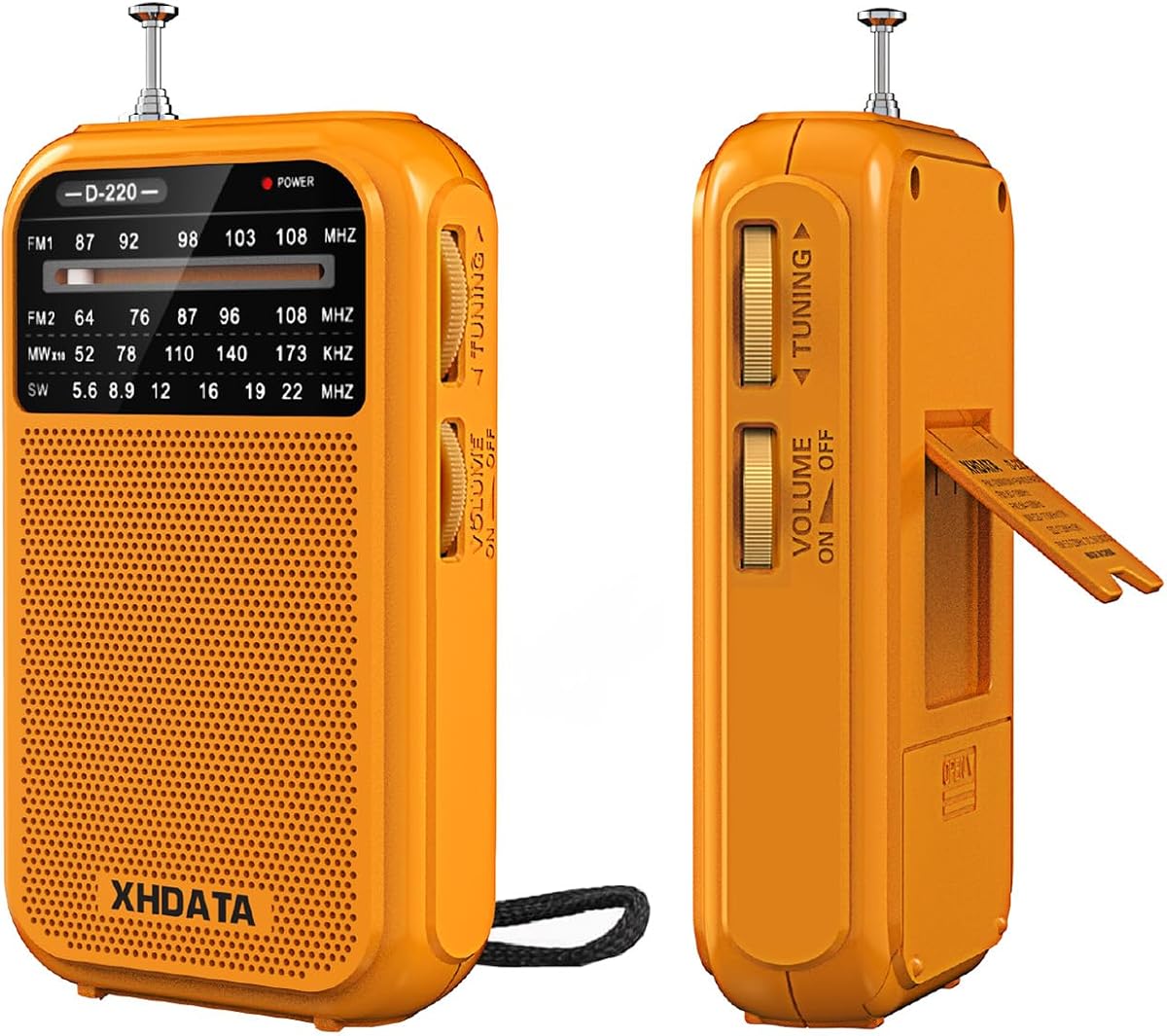
The XHDATA D220 is the most compact model in this guide, offering AM, FM, and shortwave reception in a 125-by-74-by-30mm body. At 125 grams without batteries, it is easy to carry in a pocket or handbag. Its 4.4 rating makes it a well-regarded choice for travelers who want more range than a standard pocket radio without carrying a large emergency device.
We may earn a commission when you buy through this link, at no additional cost to you.
Only three primary controls are needed: a tuning knob, band switch, and combined volume and power button. That simplicity makes the radio approachable for older adults, children, and anyone who prefers a compact analog tuner. The small footprint is balanced by a stated weight of only 125 grams without batteries, so it can remain comfortable during a long walk or trip.
A DSP chip supports reception across FM1 at 87-108 MHz, FM2 at 64-108 MHz, AM at 520-1730 kHz, and SW at 5.6-22 MHz. The broad SW range is notable for a pocket unit and makes it relevant to international listeners. A built-in speaker provides clear sound, while a 3.5mm headphone jack supports private listening or improved audio in noisy environments.
The main limitation is power flexibility. It runs on two AA batteries, which are not included, and has no listed internal rechargeable battery, solar panel, hand crank, or USB charging. It also does not offer NOAA alerts. Its strengths are portability, simple operation, and capable shortwave coverage, making it ideal for travel and everyday listening rather than emergency-preparedness duty.
The D220 provides a broad 5.6-22 MHz shortwave range in a body small enough for a pocket. This makes it a practical option for travelers who want access to distant stations without carrying a larger tabletop or emergency radio.
A tuning knob, band switch, and power/volume control keep operation straightforward. The radio is easy to place into a travel routine, while its headphone socket provides an alternative when shared listening is inconvenient.
We may earn a commission when you buy through this link, at no additional cost to you.
The Kaito KA500 is a well-established emergency radio that combines AM, FM, two shortwave bands, seven NOAA channels, and six power options. Its 4.5 rating demonstrates strong buyer satisfaction, while the feature-to-cost balance makes it our top value-oriented pick. It is particularly suitable for people who want serious emergency capability without paying for a large collection of separate devices.
We may earn a commission when you buy through this link, at no additional cost to you.
Power can come from the hand-crank generator, solar panel, three AA batteries, 5V USB input, 5V AC or DC input, or the built-in replaceable NiMH battery pack. The wall adapter is sold separately, but the breadth of alternatives means the radio can often be recharged in more than one way. A standard 5V USB output can charge phones, GPS units, MP3 players, and digital cameras.
Reception benefits from a telescopic antenna that extends up to 14.5 inches. An LED signal-strength indicator assists precise tuning, and the built-in speaker is designed for loud, clear sound. Alongside the radio functions, a five-LED reading lamp, flashlight, and red SOS beacon improve its usefulness as an emergency and camping device.
The housing is made from impact-resistant and water-resistant ABS, supporting both indoor and outdoor use. NOAA reception is limited to the United States and Canada, as the product states, and the separate AC adapter is not included. Those are important limitations for international travel, but for a household preparedness kit in the covered regions, the KA500 offers exceptional versatility and value.
Six power configurations create unusual resilience for a portable radio. The internal NiMH pack supports regular use, while hand cranking, solar energy, removable batteries, and wired inputs provide alternatives when conventional power is missing.
The USB output can maintain small communication devices, while the reading lamp, flashlight, and red SOS beacon support visibility and signaling. A long antenna and signal-strength indicator help make the radio itself more useful during an event.
We may earn a commission when you buy through this link, at no additional cost to you.
The Raynic emergency radio is the most feature-rich premium model in this roundup, combining a 5000mAh battery, automatic NOAA scanning, a large HD LCD, six charging options, AM, FM, shortwave, and weather bands, a flashlight, a reading lamp, a USB charger, and an SOS siren. Its 4.5 rating supports its reputation as a capable all-in-one emergency device.
We may earn a commission when you buy through this link, at no additional cost to you.
Automatic scanning is particularly useful. When switched on or placed in standby, the radio can look for emergency and weather warnings, alert the user when an official warning is issued, and avoid the need to monitor weather programming continuously. The large display shows the battery level and current tuning frequency, while digital tuning provides more precise selection than a basic analog scale.
Power comes from the internal rechargeable battery, an AC adapter, a 5V USB input, the hand crank, the solar panel, or three AAA batteries. A power-saving mode turns off the LCD backlight when it is not required. The 5000mAh internal capacity also serves the radio's device-charging function, allowing a connected phone to draw from the unit during an outage.
The radio weighs 1.2 pounds and measures 6.8 by 3.7 by 2.9 inches, so it is portable but noticeably more substantial than a pocket set. Its IPX3 rating offers some water resistance, though it should not be treated as fully waterproof. The trade-offs are size, weight, and the omission of AAA batteries. In return, the Raynic offers the most polished display and most automated alert experience in the group, making it our premium recommendation.
Automatic scanning checks for official alerts when the radio is on or in standby. This reduces the need to remain beside a constantly audible weather broadcast and helps important warnings reach the listener promptly.
The large backlit LCD presents frequency and battery information in a readable format. A dimmer control can remove the backlight for power saving, while automatic scan buttons make finding channels more convenient than continuous manual tuning.
We may earn a commission when you buy through this link, at no additional cost to you.
This portable AM/FM/shortwave radio focuses on uncomplicated analog operation, with a large rotary knob, a visible frequency scale, and separate volume and tuning functions. Its 4.4 rating is favorable, and the design appears well suited to older listeners, people with visual impairments, and anyone who finds digital menus unnecessarily complicated.
We may earn a commission when you buy through this link, at no additional cost to you.
A DSP anti-interference chip is included to improve sensitivity, while a telescopic antenna supports reception across the available bands. The radio is intended for music, news, traffic, and general broadcasts, making it a straightforward receiver for home use, travel, and emergency-kit preparation where basic shortwave access is enough.
Sound comes from a speaker with adjustable bass controls, giving listeners some control over the tonal balance of music and talk programming. The large knob can make frequency and volume adjustment more direct than the tiny buttons or screens found on compact digital models.
The radio supports AC power and four C, LR-14, or equivalent 1.5-volt batteries, giving it more flexibility than a purely mains-powered set. However, it has no listed built-in rechargeable battery, solar panel, hand crank, NOAA channel, flashlight, or USB output. Choose it as a straightforward shortwave and local-broadcast radio rather than a complete survival device.
The large rotary knob and analog scale make the radio easy to understand and operate. This is an advantage for households that want dependable access to news and entertainment without navigating complex menus.
AC operation is convenient in a bedroom, kitchen, or office, while four removable batteries allow the radio to move with the listener or remain available during an outage. The lack of a rechargeable cell means spare batteries should be considered part of the planning process.
We may earn a commission when you buy through this link, at no additional cost to you.
The most useful choice depends on where the radio will be used, which broadcasts you want to reach, and how much emergency capability you need. Review the frequency coverage, power options, controls, audio, and alert functions before comparing models.
A true shortwave radio should support the AM, FM, and SW bands, but the usable frequency range varies considerably. The Digital AM FM Shortwave Radio has a broad general-purpose feature set, while the Greadio and Eoxsmile models use multi-band receivers with clear displays. The XHDATA D220 is especially notable for covering 5.6-22 MHz in a pocket-sized body, while the Kaito KA500 provides two shortwave bands. The RF-2400D is the important exception: it offers AM and FM only, so it does not meet the needs of a dedicated shortwave listener. Check the published ranges carefully because descriptions may use broad band names without listing every lower or upper frequency.
Battery operation is only useful if you can keep the radio supplied with energy. Simple models may use two AA batteries or four larger cells, while others add a built-in rechargeable pack and USB charging. Emergency-focused radios go further with hand cranks, solar panels, AC adapters, and backup compartments. The XHDATA D220 is convenient because AA cells are easy to find, but the Raynic, Kaito KA500, Eoxsmile, and NOAA Weather Radio offer greater resilience when a prolonged outage makes conventional charging impossible. Remember that removable batteries and some plug-in accessories are not always included.
NOAA weather reception can be more valuable than additional entertainment features for households exposed to tornadoes, hurricanes, floods, wildfires, or winter storms. The Eoxsmile and NOAA Weather Radio provide seven preset stations, while the Raynic automatically scans for alerts when on or in standby. The Kaito KA500 also provides seven NOAA channels, although its coverage applies only in the United States and Canada. Other radios in the list do not advertise NOAA functionality. A weather radio does not replace official phone alerts or emergency instructions, but it can provide a valuable additional warning channel.
Portability means more than the stated weight. Consider the dimensions, antenna handling, controls, and whether you will listen with the speaker or use headphones. The XHDATA D220 is the clear pocket option at 125-by-74-by-30mm and 125 grams without batteries. The Greadio has a convenient handle but a larger tabletop-oriented body, while the Raynic weighs 1.2 pounds yet remains compact for an emergency kit. Solar panels, hand cranks, and larger speakers naturally add bulk, but that weight may be justified for camping and preparedness rather than everyday carry.
A five-watt speaker, as found on the Portable AM/FM Transistor Radio, can fill a room more convincingly than a pocket model's miniature driver. The Greadio uses two built-in speakers and offers high and low tone modes, while the Digital AM FM Shortwave Radio includes two tone settings and removable-media playback. Most models also provide a 3.5mm headphone jack, which is useful for private listening at night, in a shared room, or in noisy outdoor environments. Decide whether room-filling sound or compact private listening is the priority.
A radio intended for emergencies may be more useful with a flashlight, reading lamp, SOS beacon, compass, or USB device-charging output. The Eoxsmile, NOAA Weather Radio, Kaito KA500, and Raynic all include combinations of these features. The Kaito is particularly comprehensive, while the Raynic combines its emergency tools with automatic alert scanning and a large display. If your priority is ordinary music and news, these additions may be unnecessary, but if a blackout or severe storm is a realistic concern, they can make one device serve several roles.
Controls should be understandable without instruction, particularly during a stressful emergency. Analog models with large knobs and visible scales offer a direct approach, while digital models provide frequency precision, presets, and status information. The Digital AM FM Shortwave Radio stores 40 stations and uses an illuminated LCD, whereas the Greadio combines a large display with large physical knobs. The XHDATA D220 uses only three core controls, making it one of the simplest designs in the group. Backlighting, large print, and a lock function can also improve daily usability.
NOAA channels are intended for the United States, and the Kaito KA500 specifically limits its weather coverage to the United States and Canada. Shortwave station schedules, transmitter reach, and the types of local programming also vary by country. International examples in the product descriptions are examples of possible broadcasts rather than a guarantee that every station can be received from every location. If you live outside the primary market for these products, confirm that ordinary AM, FM, and SW stations in your area operate on the radio's stated frequency ranges.
Before first use, install the specified batteries or fully charge the internal battery through the correct connection. Consult the included manual, identify the band switch, and check the power or volume control. For models with NOAA channels, determine the correct local preset before an emergency and confirm that the alert volume is high enough to hear in the room where the radio will be kept.
Tune slowly across the relevant band, extend the telescopic antenna fully, and rotate it gradually when reception is weak. Keep the radio away from computers, chargers, and large metal objects that can create interference. For shortwave listening, move the antenna position and try different times of day, as atmospheric and daylight conditions influence distant broadcast reception.
To preserve capacity, turn the radio off when it is not being used and use its sleep timer or dimmer where available. Store removable batteries separately when they are not needed, and keep rechargeable packs attached only as directed by the manufacturer. Clean the exterior with a lightly damp cloth, keep charging ports dry, and avoid exposing any model to water beyond its stated resistance level.
AM stations include local news, talk radio, and regional programming, usually on medium-wave frequencies. FM provides clearer local music and talk broadcasts. Shortwave supports international and distant services across a wider high-frequency range, but reception depends more heavily on antenna conditions, time of day, and interference.
No. NOAA support appears in the Eoxsmile, NOAA Weather Radio, Kaito KA500, and Raynic products. The other radios focus on AM, FM, shortwave, portability, media playback, or general emergency functions. Check the specifications carefully if official weather warnings are an essential requirement.
The XHDATA D220 is the most compact option, with dimensions of 125-by-74-by-30mm and a weight of 125 grams without batteries. Its three-control layout and two-AA power supply also keep packing simple. Larger emergency models offer more utilities but are better suited to a backpack, vehicle, or home kit than a pocket.
They are especially useful for emergency backup because they can operate without wall power. Solar charging depends on available sunlight, while hand cranking requires regular effort to replenish energy. For everyday listening, an internal rechargeable battery or conventional USB charging is usually more convenient, with alternate power methods retained for emergencies.
Yes. Extending the telescopic antenna fully and changing its angle can reduce interference and help pull in weak stations. Moving the radio away from electronics and obstructions may also help. Results vary by band, location, weather, and transmitter power, so a better antenna cannot guarantee every distant station will be available.
No model in the list is restricted to mains power. Some use removable batteries, some add rechargeable internal packs, and the emergency models provide combinations of USB, AC, solar, hand-crank, and backup-battery options. Check which accessories and batteries are included, since several emergency radios exclude their backup cells or wall adapters.
NOAA programming is specifically associated with the National Weather Service in the United States, and the Kaito KA500 states that its weather coverage is for the United States and Canada. International users can still use the AM, FM, and shortwave portions where those services are available, but should seek a product with weather channels relevant to their region.
Prioritize multiple power sources, NOAA alerts if applicable, a visible display, a flashlight, and a headphone or speaker output. USB charging can be valuable for maintaining access to a phone, while water resistance and a sturdy housing help during outdoor use. Extra features are most useful when they work together as a compact emergency toolkit rather than as disconnected extras.
The Eoxsmile Emergency Radio is the strongest all-around option because it combines genuine shortwave reception, NOAA alerts, five power sources, useful lighting, and device charging. The Kaito KA500 delivers similar preparedness value with a strong 4.5 rating and an especially broad power configuration, while the XHDATA D220 is the most practical pick for travelers who want shortwave reception in a genuinely compact body.
Your priorities should determine the final selection. Choose a pocket radio for mobility, a clear-speaker model for shared listening, and a multi-power NOAA unit for storm warnings and outages. Exact frequency coverage, included accessories, battery types, regional alert support, and water resistance deserve closer attention because they materially affect real-world usefulness.
Ratings and specifications provide a useful starting point, but availability, package contents, and prices can change over time. Before purchasing, open the current Amazon listing, confirm the latest band ranges and included accessories, and compare the model with your specific listening locations and emergency-planning needs.