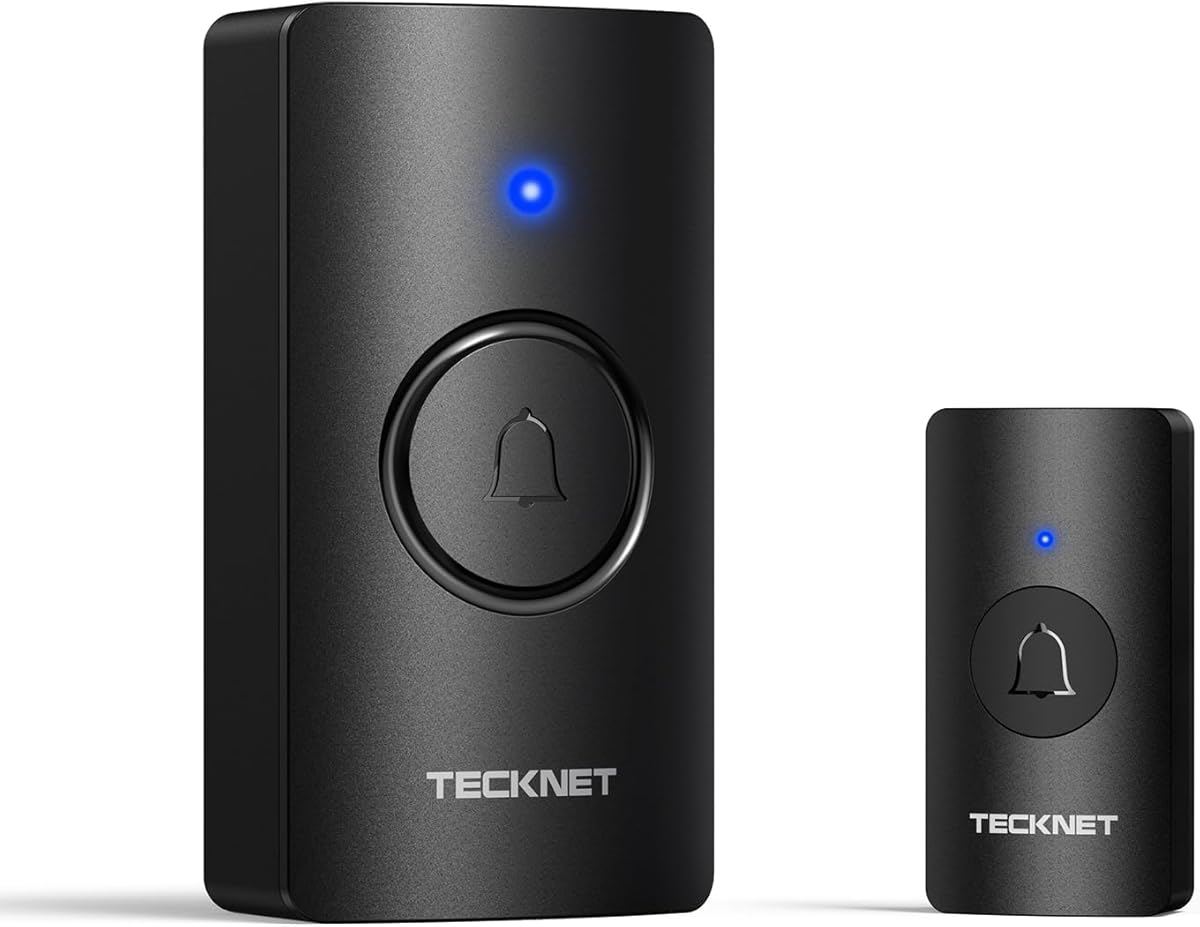
TECKNET Wireless Doorbell 1312FT
4.6Editor score
1312-foot open-area range
Fully portable battery receiver
IP67 weatherproof button
60 melodies and five volumes
Explore the best battery operated doorbell chime options, comparing range, sound, setup, weather resistance, power needs, and value for your home today.
A battery operated doorbell chime offers a convenient way to hear visitors without connecting new wiring to an electrical circuit. The right kit balances dependable signal range, recognizable sound, straightforward mounting, useful controls, and resistance to everyday outdoor weather. It should also fit the way your household moves, works, and rests.
We compared ten wireless doorbell chime kits using the information supplied for each product, including range, melody options, volume controls, receiver power, water resistance, installation requirements, and expandability. The list covers plug-in receivers, fully battery-operated portable receivers, one-button sets, and multi-button configurations for homes, offices, and other spaces.
Each review explains the strongest reasons to consider a particular model while noting practical limitations. Ratings, product details, and availability can change over time, so readers should confirm the current listing, included accessories, compatibility, and seller information before making a final purchase decision.
4.6Editor score

4.5Editor score

4.7Editor score
This side-by-side comparison highlights the main differences in range, sound selection, receiver power, weather protection, and expandability, helping you identify the most suitable battery operated doorbell chime for your space.

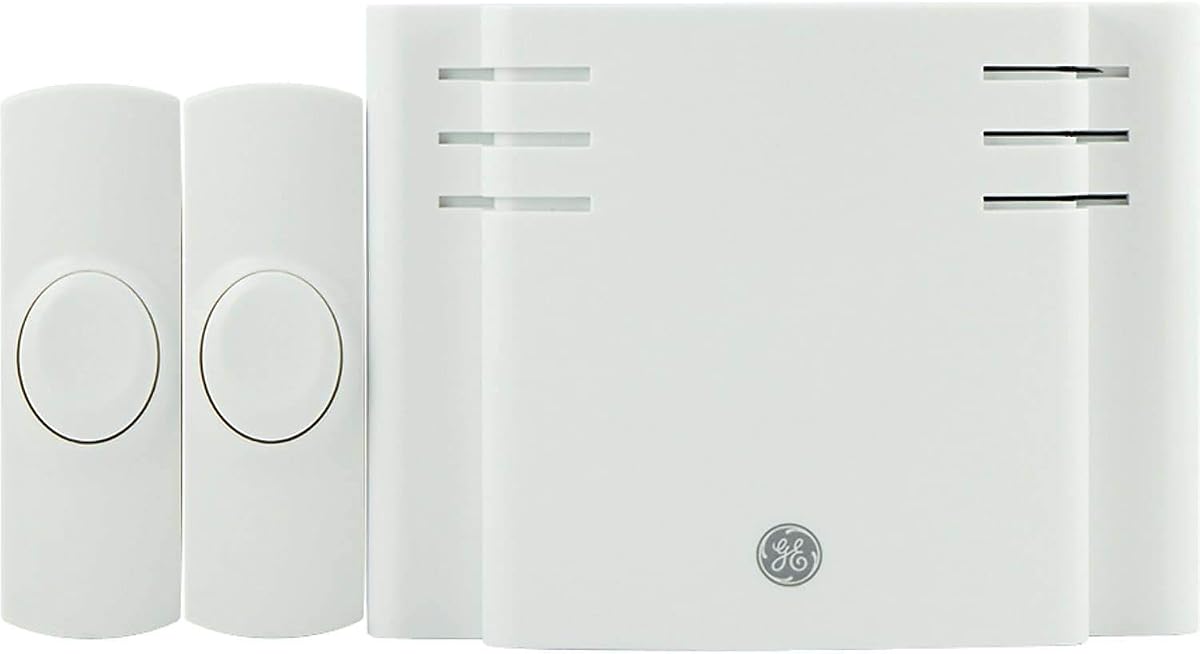


The GE Wireless Doorbell Kit with one push button is a straightforward option for anyone who wants a familiar indoor chime without installing hardwired doorbell equipment. It carries a 4.5 rating and favors uncomplicated operation over extensive sound selection. The kit includes a battery-operated receiver, one push button, a CR2032 battery for the button, mounting hardware, and instructions.
We may earn a commission when you buy through this link, at no additional cost to you.
Its most appealing feature is the straightforward matching process. The push button arrives paired with the receiver, eliminating the need to program a complicated code before installation. Users can select from two melodies, including familiar ding-dong and Westminster-style tones, along with four volume options. The receiver can also pair with up to four buttons, while each button can pair with up to four receivers according to the supplied product information.
The main limitation is the stated range of 150 feet, which is much shorter than the open-area ranges advertised by several newer kits. Obstacles such as thick walls, floors, and metal structures can further affect actual performance. The receiver also requires three AA batteries that are not included, so buyers should plan for that small additional expense and know where the batteries will be replaced.
This kit is a sensible match for apartments, offices, workshops, or homes where the receiver and button will remain within a relatively short wireless distance. It is also well suited to users who prefer a traditional appearance and uncomplicated tones over a large melody library. For those needs, the GE One-Button Kit is a dependable, uncomplicated choice.
Two recognizable melodies and four volume levels provide enough variety for a single entrance without creating a complicated setup. The controls make it easy to choose a tone that is noticeable indoors without being unnecessarily loud.
Although the package contains one button, the receiver supports as many as four GE-branded buttons. This gives users a path to distinguish visitors at different doors while retaining a coordinated indoor alert.
We may earn a commission when you buy through this link, at no additional cost to you.
The SECRUI M520+F55 Black combines a 4.7 rating with extensive customization, making it a compelling premium-style choice within this guide. Its defining feature is a library of 58 chimes, including a Christmas ringtone, plus five adjustable volume levels. That gives households far more tonal choice than the two-melody GE kit.
We may earn a commission when you buy through this link, at no additional cost to you.
The receiver connects directly to a wall outlet, so it is not a fully portable battery-operated chime despite the doorbell button using a battery. The stated range reaches up to 1000 feet in an obstacle-free environment, and the product uses an FM signal scheme with one-to-one pairing intended to reduce confusion with nearby devices. The button carries an IP55 dustproof and waterproof rating and is described as operating from -4°F to 140°F.
There are some practical compromises. Plugging the receiver into an outlet means its placement is less flexible than a receiver powered entirely by AA batteries, and the stated maximum range should not be treated as a guaranteed distance through heavy walls or multiple floors. Aesthetics are subjective, but the black finish may coordinate less readily with an all-white entrance than the white SECRUI version.
The kit is ideal for buyers who want many sounds, a generous open-area range, and minimal pairing work. It can also suit a home, classroom, shop, or office, with the ability to arrange two buttons and one receiver or other compatible combinations as needed. For those priorities, the SECRUI M520+F55 Black is a flexible and feature-rich recommendation.
The large chime library makes it practical to assign distinct sounds to separate buttons. Buyers can create an audio cue that indicates where a visitor is calling instead of hearing one undifferentiated sound throughout the home.
The IP55 button protection and broad stated operating-temperature range provide useful reassurance for exposed entrances. Proper placement still matters, particularly where direct driving rain or severe weather could collect around the housing.
We may earn a commission when you buy through this link, at no additional cost to you.
The GE Two-Button Kit builds on the straightforward appeal of the one-button model by including a second push button and eight melody choices. Its 4.6 rating reflects a balanced feature set for homes with more than one entrance, rental units, dorm rooms, or small businesses that need to know which door is being used.
We may earn a commission when you buy through this link, at no additional cost to you.
A key benefit is the ability to choose a different melody for each button, according to the product information. The receiver can pair with up to four compatible GE buttons, giving buyers room to expand later. Four volume options and recognizable tones such as ding-dong, Westminster, knocks, and Mozart provide a balance of useful variety and conventional character.
The 150-foot range is the clearest drawback, especially for buyers comparing this kit with products advertising 1000 feet or more. That figure represents maximum reach under suitable conditions rather than a guarantee of reception through every building material. The receiver also needs three C batteries, which are not supplied, although the button batteries and mounting hardware are included.
This GE kit is a strong option for users who value familiar styling, simple installation, and the ability to identify different entrances. It may be less suitable for a sprawling property where the receiver and buttons are separated by extensive masonry, multiple floors, or other substantial obstacles. For a compact residence or business, it delivers useful flexibility without unnecessary complexity.
Assigning a unique melody to each button turns the chime into a basic visitor-location system. That is particularly helpful in homes with a front and back entrance or in shared small-office spaces.
The bright white styling is understated and intended to blend into conventional interiors. The same kit is also described for apartments, dorms, RVs, businesses, and rental units where a simple portable alert is useful.
We may earn a commission when you buy through this link, at no additional cost to you.
The SECRUI M520+F55 White offers a 4.7 rating and a clean appearance alongside a large library of 58 chimes. It is essentially a color-focused counterpart to the black model, and the white finish may be a more natural fit for a bright front door, pale wall, or modern interior.
We may earn a commission when you buy through this link, at no additional cost to you.
Installation is designed to be quick: the compact receiver plugs into an outlet, while the button can be mounted with double-sided tape or screws. The wireless system is listed with a range of up to 1000 feet using an FM signal scheme. Five volume levels allow users to tune the sound for different rooms or times of day, while the colorful LED adds a visual notification when the chime is difficult to hear.
The product's outdoor button is described as waterproof and suitable for wind, snow, sleet, and hot or cold conditions. However, users should interpret the maximum range as an open-environment claim. Walls, reinforced concrete, and other dense materials can reduce reception. The plug-in receiver also requires a nearby outlet, limiting placement in locations without convenient access to mains power.
This model suits people who want extensive sound options, quick installation, and a visually understated white unit. It works for homes, classrooms, offices, stores, and similar environments. Compared with a portable AA-powered receiver, it offers a simpler daily power arrangement but less freedom in where the receiver can sit.
Users can browse 58 sounds and five volume levels, then configure the unit to their preferences. The pre-paired approach and straightforward receiver placement reduce the work normally associated with adding a new wireless alert.
The LED indicator gives the product a second notification method. This can be useful in noisy environments, during quiet hours, or for household members who respond more readily to a visual cue.
We may earn a commission when you buy through this link, at no additional cost to you.
The AIDA Two-Button Kit is a strong all-around choice because it combines a useful two-entry configuration with 58 melodies, five volume levels, a visual LED alert, and a stated 1000-foot range. Its 4.5 rating reflects a versatile package that is well suited to homes, classrooms, and offices.
We may earn a commission when you buy through this link, at no additional cost to you.
Two push buttons and one receiver make it easier to identify visitors arriving at separate doors. The system can be muted when a sound would be disruptive, including during naps or quiet work periods, while the receiver's LED continues to flash. A smart memory function restores the previously selected melody and volume after a power interruption, avoiding the need to repeat that configuration.
The outdoor button is listed with an IP55 waterproof rating and an operating range of 14°F to 122°F. It includes batteries according to the supplied description, while the receiver itself plugs into an electrical outlet. That makes the setup wire-free at the door but less portable than a fully battery-operated receiver. The 1000-foot range is a maximum figure and will depend heavily on walls, floors, and other obstructions.
This is a well-rounded recommendation for buyers who want multiple buttons, extensive personalization, and a helpful silent visual mode. It may not be the first choice for someone who wants to carry the receiver between rooms without plugging it in, but it offers a refined feature set for a fixed indoor location.
A second button can serve another entrance without requiring a separate complete kit. This reduces equipment clutter while making it possible to hear or visually recognize alerts from different locations.
The receiver remembers the selected melody and volume following an outage. That attention to detail is helpful in homes where a brief power interruption should not erase carefully configured alert settings.
We may earn a commission when you buy through this link, at no additional cost to you.
The AIDA One-Button Kit delivers the same broad feature set as the two-button version in a more focused package. With a 4.5 rating, 58 chimes, five volume levels, and a 1000-foot stated range, it is a versatile choice for a single entrance where sound and visual customization are important.
We may earn a commission when you buy through this link, at no additional cost to you.
Mute mode is one of its most practical features. Rather than switching off all awareness, the receiver continues to flash an LED when a visitor presses the button. That approach suits nurseries, home offices, classrooms, and any location where audible alerts may be inconvenient but visitors still need to be acknowledged.
The smart memory feature stores the chosen melody and volume through a power outage. The button has an IP55 rating and is described as operating from 14°F to 122°F, while the receiver connects to a wall outlet. As with other long-range kits, the 1000-foot figure is most applicable in unobstructed conditions and should not be assumed across every wall and floor construction.
This kit is a good fit for a home with one primary door, a small office, a classroom, or a store. It may be less appealing for users who expect to add several exterior buttons immediately or who want a receiver that can move freely around the home without access to an outlet.
The visual alert is the key advantage in this configuration. It provides a discreet way to know someone is at the door when a full-volume chime would be unwelcome.
One button, one receiver, and a broad selection of sounds cover the essentials without adding unnecessary components. It is a straightforward entry point for shoppers who are still learning which chime will suit their home.
We may earn a commission when you buy through this link, at no additional cost to you.
The TECKNET 1312FT stands out because the receiver is entirely battery powered, giving it more placement freedom than most plug-in competitors. It carries a 4.6 rating and includes a 1312-foot open-area range, 60 chimes, five volume levels, silent mode, and a bright LED visual alert.
We may earn a commission when you buy through this link, at no additional cost to you.
True portability is the defining advantage. Users can place the receiver on a desk, carry it to the garden, or move it to a workshop without searching for a wall outlet. The button also has an IP67 rating, which represents stronger stated dust and water protection than the IP55 ratings used by several other selections in the guide.
The receiver's stated battery life is up to 4.5 years under normal usage, but maintaining that result depends on the actual power source, use frequency, and battery quality. Because it is not a plug-in model, users will eventually need to replace or recharge its batteries. Maximum wireless range is also an open-area claim; substantial walls and multi-story layouts may require the receiver to be placed closer to the entrance.
This is an excellent choice for renters, large homes, warehouses, classrooms, and anyone who wants a receiver that can move around freely. It is also a compelling budget-oriented option because its core features exceed many simpler kits. Buyers seeking the most flexible placement should prioritize it over outlet-bound models.
A battery-powered receiver can follow a user from the kitchen to the garden, garage, or workbench. That flexibility is especially useful for people who do not want to install wiring or depend on a nearby outlet.
The stated IP67 rating provides enhanced protection against dust and powerful water jets. It is a reassuring specification for exposed doors, although sheltered placement remains sensible in severe weather.
We may earn a commission when you buy through this link, at no additional cost to you.
The AZ4U White Kit is a 4.4-rated product that combines a 1000-foot stated range with 60 melodies and an expandable wireless system. Although the range figure is line-of-sight based, the kit's versatility makes it interesting for more than the conventional front-door use case.
We may earn a commission when you buy through this link, at no additional cost to you.
The receiver runs on three AA batteries, so it can sit on a shelf, desk, or other convenient surface without a wall outlet. Its four volume levels include mute mode, and the LED ring continues to flash silently. A 12V 23A trial battery is included for the transmitter, while receiver batteries are sold separately. The system can be expanded with multiple transmitters and receivers, and units are paired to reduce interference.
Its stated IP55 rating makes the button suitable for outdoor residential, office, shop, garage, and garden-gate use. Users can mount the transmitter with double-sided tape or screws. The maximum range is listed as 1000 feet under line-of-sight conditions, so walls and other obstacles should be considered when deciding where to position the receiver.
The AZ4U is especially useful as a caregiver call button, a kitchen-to-children's-room meal bell, or an office and classroom calling system. It is also a practical front- or back-door chime. Those additional uses make the expandable design a notable advantage, although the included one-button configuration and separate receiver batteries are worth considering before checkout.
The system can support caregiver alerts, meal-time calls, classroom communication, and shop or office signaling. This expands its value for buyers who want one wireless calling solution for several household tasks.
Compatible transmitters and receivers can be paired to accommodate a more complex layout. This makes it possible to start with a simple kit and expand as additional doors or call points become necessary.
We may earn a commission when you buy through this link, at no additional cost to you.
The AZ4U Black Kit offers the same core functionality as the white version with a darker finish that suits modern interiors, black hardware, and understated shelves or desks. It has a 4.4 rating, 60 selectable melodies, four volume levels, silent mode, and a 1000-foot line-of-sight range.
We may earn a commission when you buy through this link, at no additional cost to you.
The black button and receiver create a coordinated appearance, while the blue LED ring provides a visible signal when the unit is muted. The receiver's three-AA battery design preserves freedom of placement and makes it possible to relocate the chime when furniture or room arrangements change. The included 12V 23A trial battery serves the transmitter, and paired multi-unit configurations are supported.
As with the white AZ4U, the receiver batteries are not included. The kit also offers four volume levels rather than the five found on several competitors, although the practical difference is small for many users. Its 1000-foot range should be viewed as a line-of-sight maximum; dense walls, multiple floors, and long building layouts may shorten the usable distance.
This model is a good fit for buyers who prefer a modern dark finish and want a wireless system that can do more than announce a front door. It can serve as a caregiver alert, a child or meal-time call button, or an office and classroom pager. Its expandability and portable receiver are the most compelling reasons to consider it.
The black finish and blue LED create a modern appearance that can blend into darker shelves, desks, and contemporary entryways. It gives buyers the same functional platform as the white model without matching a pale wall or white trim.
Three AA batteries let the receiver operate without a power outlet. Users can move it between rooms or use it in a garage, garden, or office without installing permanent electrical connections.
We may earn a commission when you buy through this link, at no additional cost to you.
The TECKNET 1300FT combines a 4.6 rating with a 1300-foot open-space range, 60 melodies, five volume levels, and a distinctive RGB light on the receiver. It is particularly appealing for users who want a portable chime with a clear visual indication when the sound is muted or cannot be heard.
We may earn a commission when you buy through this link, at no additional cost to you.
The receiver uses three AA batteries and may be placed on a tabletop, carried in a bag, or positioned in a cellar, garage, or garden. A sleep function activates after several minutes of inactivity, and pressing any button wakes the receiver. The RGB indicator flashes when a signal is received, while the stated maximum output of 110 dB can provide a stronger audible alert for elderly or hearing-impaired users.
The memory function retains the selected melody and volume even through a power interruption. The outdoor button has an IP66 waterproof and dustproof rating and a stated operating range of -4°F to 140°F. As with the other long-range kits, however, 1300 feet applies to open spaces, and dense walls or multiple floors may substantially alter actual reception. Receiver batteries are not included.
The kit is well suited to apartments, homes, classrooms, and portable calling situations where a visual signal adds value. Buyers who prioritize a fully wireless receiver, a bright alert, long stated range, and extensive sound choice will find a compelling option. It is a particularly strong fit for users who cannot or do not want to place the receiver near a wall outlet.
The RGB indicator is more conspicuous than a small conventional status light. It makes the receiver easier to notice in a busy room and provides a useful alternative when the sound is muted.
The automatic sleep function is intended to reduce unnecessary energy use. Waking the unit with a button restores operation, while the stated receiver battery life of up to 36 months assumes suitable batteries and normal daily use.
We may earn a commission when you buy through this link, at no additional cost to you.
The best battery operated doorbell chime depends on your building, the number of entrances, preferred sounds, and tolerance for replacing receiver batteries. Compare these practical factors before choosing a kit.
Range is one of the most important specifications, but the largest advertised figure usually represents an open-area maximum. Walls, concrete, metal, windows, and multiple floors can reduce the effective distance between the button and receiver. A 150-foot kit may work perfectly within a compact apartment, while a house with a detached garage or garden entrance may need a model advertising 1000 feet or more. Placement matters as much as the headline number: put the receiver near the center of the occupied area rather than immediately beside the exterior button. If the entrance is on another floor, test the signal before relying on it and consider adding a second receiver or relocating the original receiver.
Some chimes use a plug-in receiver, while others run entirely on AA batteries. A plug-in receiver is simpler to power continuously but must remain near a wall outlet. A battery-powered receiver is more portable and can move to the garden, garage, desk, or another room without a power connection, though its batteries will eventually need replacement. Check whether receiver batteries are included, what type is required, and whether the listed battery life assumes normal use. Portable receivers are particularly useful for people in apartments, renters who cannot modify outlets, and households wanting alerts in more than one location.
A traditional ding-dong can feel familiar, but a wider selection helps users identify different entrances or avoid a tone that becomes irritating. Models in this guide offer between two and 60 selectable sounds. Additional tones are useful when family members have different hearing preferences, when a quiet household wants a subtle sound, or when multiple buttons are assigned different melodies. More choices do not automatically mean better audio quality, so buyers should still consider alert duration, maximum volume, and the ease of changing settings. A memory function is another valuable feature because it restores the chosen melody and level after a power interruption.
A useful chime should be loud enough to be noticed but adjustable enough for sleeping children, home offices, or shared walls. Five levels provide greater granularity than four, while mute mode removes audible disruption. The best solution in a quiet zone is often mute mode combined with a flashing LED, since the system can still communicate that someone arrived. For users who are elderly or have hearing difficulties, maximum volume and a conspicuous light may be more important than a large melody library. Check the stated maximum output and ensure the light is positioned where it can be seen from the places people spend time.
The transmitter is normally the component exposed to rain, snow, heat, and dust, while the receiver remains indoors. IP55 indicates protection against dust and water ingress, while IP66 and IP67 represent stronger stated levels of water resistance. Those labels do not make every installation completely immune to weather, so sheltered placement is still sensible in exposed locations. Review the stated operating-temperature range and compare it with local seasonal conditions. Also consider direct sun, standing water, and salty coastal air. A physically secure mount and properly installed gasket can help preserve long-term performance even when the button carries a strong protection rating.
A one-button kit is sufficient for one main entrance, while two-button packages are more useful for front and back doors. Expandable systems can also accommodate a gate, garage, caregiver room, or business entrance. The ability to assign a different melody to each transmitter makes the setup easier to interpret. Check whether additional buttons and receivers are available within the same product family, and confirm the maximum supported combination. Compatibility matters because not every wireless doorbell in the market can pair with buttons from another brand. Purchasing a complete coordinated kit is often simpler than mixing unrelated components.
Most wireless doorbell buttons can be mounted using screws or adhesive tape, but the supplied hardware varies. Before buying, check whether mounting screws, tape, a battery for the transmitter, and receiver batteries are included. A plug-in receiver needs an available outlet, while a battery receiver should be placed within comfortable hearing range. Some models arrive pre-paired, while others may require pairing or coding. The instruction sheet and product listing should be reviewed before installation, especially if the button will be mounted on brick, metal, stucco, or another surface that may require special fasteners.
Wireless calling bells can be adapted to numerous everyday tasks. A button beside a caregiver's chair can create a simple call system, while a kitchen receiver can summon family members from another room. Offices, classrooms, shops, warehouses, and garden gates can also use the same basic technology. For these uses, expandability, receiver portability, and visual alerts may matter more than traditional appearance. Select a waterproof button for exposed locations and choose a receiver that can be moved as routines change. Review compatibility and placement carefully, because a chime intended for a door may need different sound and volume settings when used as an internal call button.
Begin by identifying where the receiver will be most useful and confirming that the transmitter can maintain a dependable signal at the intended button location. Mount the button securely near the entrance, away from locations where it may be exposed to persistent water or direct extreme heat. For a plug-in receiver, connect it to a suitable outlet; for a portable model, install the specified receiver batteries. Complete pairing or coding according to the product instructions, then test the link before treating the installation as finished.
After pairing, choose a melody and volume that remain noticeable throughout the occupied area without being unnecessarily disruptive. If the kit supports different sounds for different buttons, assign them before inviting visitors. Use mute mode with the visual LED in sleeping or quiet areas, and use the loudest practical level in a garage, workshop, or larger property. Test the alert from several rooms, floors, and exterior positions to identify dead zones or weak reception.
For maintenance, clean the button gently with a soft, slightly damp cloth and avoid spraying cleaner directly into the housing. Inspect the mounting screws, adhesive, and weather seal periodically. Replace the transmitter battery when signals become inconsistent, and check the receiver batteries at a schedule suited to the listed battery life. If the range declines suddenly, look for newly installed metal objects, moved walls, or interference-producing equipment before assuming the unit has failed.
No. The transmitter button is generally battery powered, but many receivers plug into a wall outlet while operating on mains electricity. Other models use a receiver powered by AA batteries, which allows greater portability. Check the product specifications carefully, and note that receiver batteries are not included with some kits.
It depends on the kit, building construction, and placement. Products advertising 1000 to 1312 feet generally describe maximum open-area range, not guaranteed reception through dense materials. Thick walls, reinforced concrete, metal, and multiple floors can reduce distance, so a receiver placed near the center of the home usually works better than one beside the transmitter.
That varies by model. Some kits include two buttons, while the GE one-button receiver can pair with up to four compatible buttons, and another button can also pair with up to four receivers. Expandable AZ4U and SECRUI systems offer additional combinations. Confirm compatibility within the same product family before buying extra components.
Mute mode stops the audible chime, while a silent visual alert continues to communicate through a flashing LED. This combination is useful when a sound could disturb a sleeping child, a patient, or someone working at home. It also helps household members who have difficulty hearing the normal alert.
It depends on the model. The GE kits specify that receiver batteries are not included, and the AZ4U receiver uses three AA batteries sold separately. Some other listings include a battery for the transmitter but still require separate receiver batteries. Read the included-components section and product specifications before checkout to avoid an unexpected trip to the store.
These ratings describe different levels of protection against dust and water. IP55 models are designed to resist dust and water ingress, while IP66 and IP67 provide stronger stated water protection. Ratings do not make any button immune to every installation condition, so sheltered placement and regular visual inspection remain advisable.
Yes. They can serve as back-door alerts, garage or garden-gate chimes, classroom call systems, office pagers, caregiver buttons, or kitchen-to-childroom meal bells. For non-door uses, portable receivers, silent visual alerts, and multiple-button expansion become especially valuable.
Pair the components, then press the button while people listen from different rooms, floors, and exterior locations. Check the sound level, LED visibility, and reliability of the signal in the places you actually use. If reception is weak, move the receiver toward the center of the occupied space or consider a kit with a longer stated range.
The TECKNET 1312FT is the leading budget-oriented option because it combines a fully portable battery receiver, a 1312-foot open-area range, 60 chimes, and IP67 button protection. The AIDA Two-Button Kit is the most versatile all-round choice for a home with multiple entrances, while the SECRUI M520+F55 Black stands out for extensive customization and a 4.7 rating.
Prioritize the needs of your actual building rather than selecting solely by the largest range claim. Consider the number of doors, receiver power, signal-obstructing walls, outdoor exposure, preferred melodies, and whether a visual alert is needed. A compact GE kit may be entirely adequate for an apartment, while a portable TECKNET receiver or expandable AZ4U system may make more sense in a larger home or multipurpose space.
Before ordering, confirm the current listing, included components, required battery types, pairing method, and expandability details. Ratings, seller information, product availability, and pricing can change, so compare the live listing with the features discussed in this guide before making your final choice.