
Cantonape 2000W Sump Pump Battery Backup System
4.4Editor score
2000W pure sine wave output
20A fast battery charger
Three protected AC outlets
LED battery voltage display
This guide compares the best battery for sump pump backup options, covering power, charging, protection, monitoring, installation, and runtime.
A dependable sump pump backup battery can keep water moving when household electricity fails, protecting a basement from the costly effects of flooding. A useful system must deliver enough starting and running power, transfer quickly, recharge safely, and provide clear information about the condition of the battery and connected pump.
The products in this guide include inverter-based backup power systems, preassembled pump combinations, and integrated primary and backup pump packages. We compared their stated output, battery compatibility, charging features, monitoring tools, safety protections, installation requirements, and suitability for different sump pump setups.
Each review highlights the reasons a product may fit a particular household, from compact systems with straightforward outlets to higher-capacity units designed for demanding loads. Ratings and specifications reflect the supplied product information, while availability, promotions, and prices can change over time.
4.4Editor score

4.8Editor score
4.7Editor score
This side-by-side comparison shows the major differences among inverter systems and complete pump combinations, including rated output, charging approach, monitoring, and battery or installation considerations.


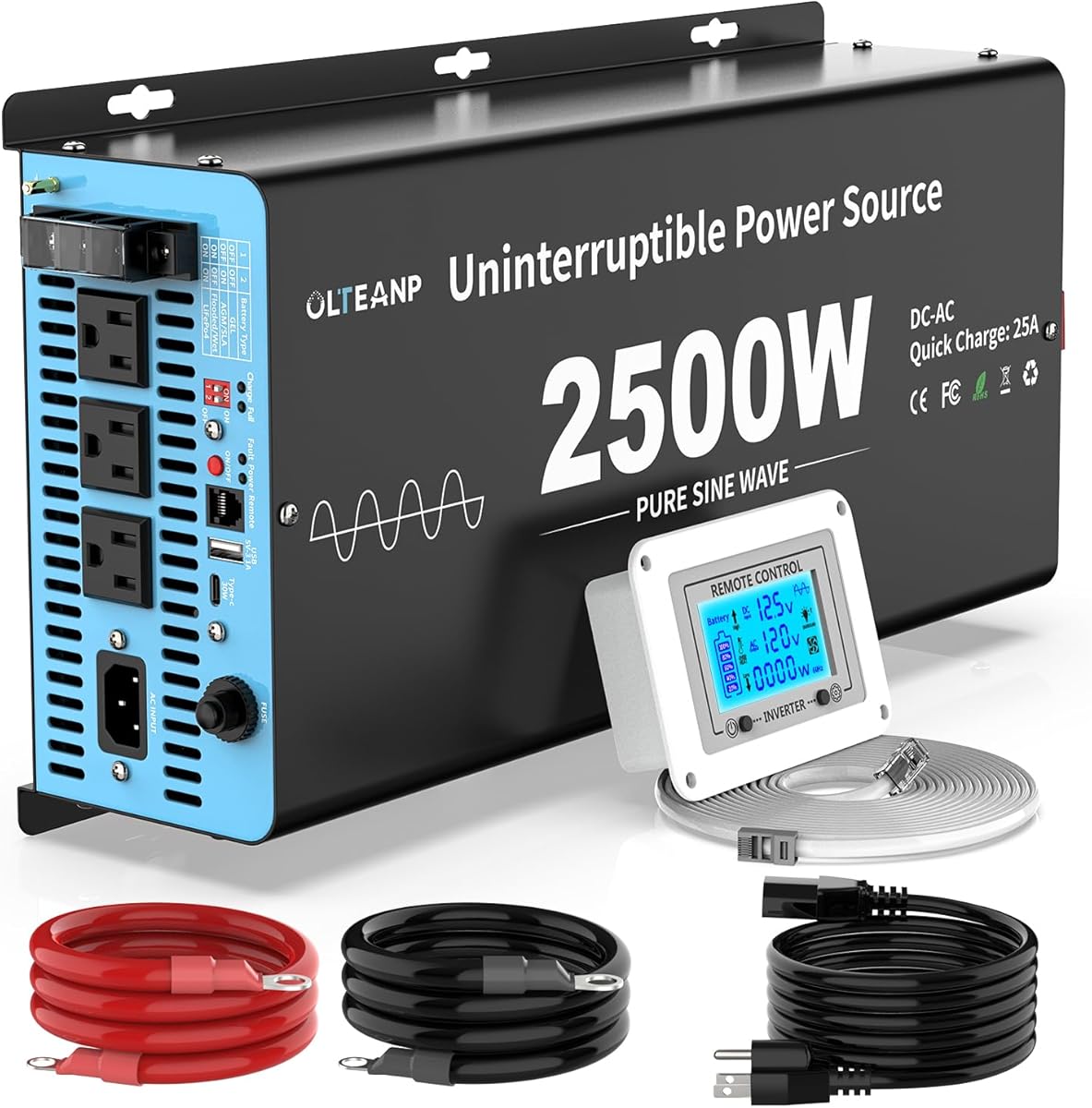
This 2500W sump pump battery backup system offers one of the most capable feature sets in the guide, combining a pure sine wave inverter, automatic transfer switching, a 25A charger, and an LCD remote. Its 4.7 rating reflects a favorable balance of capacity, monitoring, and installation flexibility.
We may earn a commission when you buy through this link, at no additional cost to you.
The system is designed around a 12V deep-cycle battery and supports LiFePO4, AGM, gel, and flooded types. Selectable charging modes, overcharge and low-voltage protection, three AC outlets, a USB port, and a Type-C port make it useful for more than a single pump. Wall mounting or flat placement also makes it easier to fit into a finished basement.
The main trade-off is that the battery must be purchased separately, so the complete installation still requires a suitable deep-cycle battery and correctly sized cabling. The extensive display and control features are not necessary for every household, but they are valuable when the system serves critical basement equipment.
This is a strong choice for owners who want generous power capacity, rapid battery replenishment, and detailed remote monitoring. Confirm your pump’s startup requirements, match the battery type to the charging mode, and arrange safe, accessible installation before relying on the system during severe weather.
The 2500W rating provides comfortable headroom for many residential sump pump arrangements and leaves room for selected household loads during an outage. Pure sine wave output is particularly appropriate for motor-driven equipment that benefits from smoother, more grid-like AC power.
The LCD remote displays battery voltage, load status, and operating mode, helping owners check readiness without approaching the unit. This visibility is especially useful in a finished basement where the inverter may be mounted close to the sump pit.
We may earn a commission when you buy through this link, at no additional cost to you.
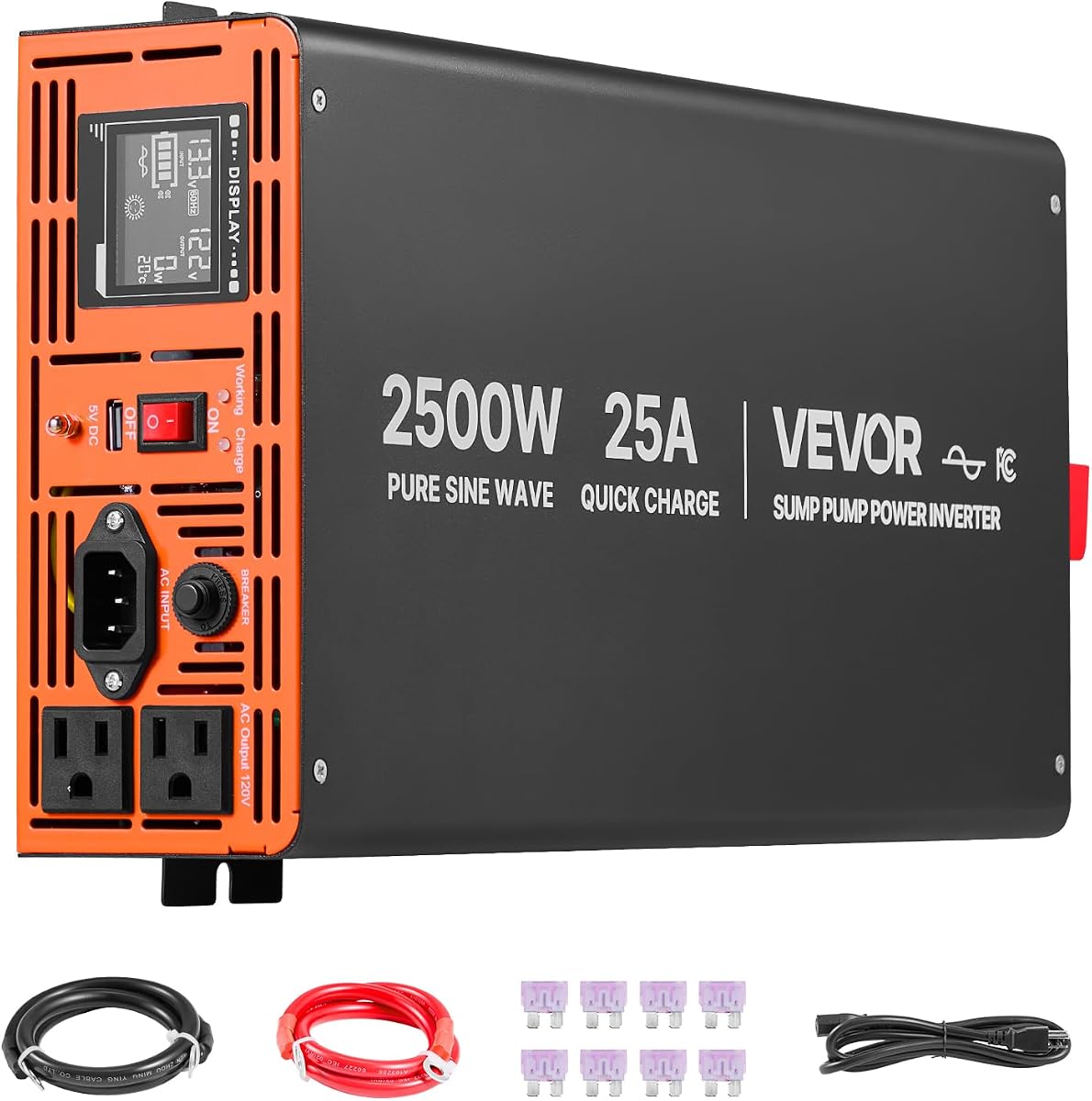
The VEVOR 2500W system combines substantial inverter output with a quick plug-in installation approach. Its 4.3 rating reflects a practical balance of dual-pump support, pure sine wave power, clear status displays, and broad compatibility with common 12V deep-cycle batteries.
We may earn a commission when you buy through this link, at no additional cost to you.
One standout feature is its stated ability to support a 1 HP main pump and a 1/3 HP backup pump, subject to the inverter’s operating limits. Three-stage charging covers bulk, absorption, and float phases, while the LCD and LEDs report voltage, battery level, and working status.
The system adds protection for overcurrent, overvoltage, short circuits, reverse polarity, and high temperature, plus a circuit breaker. Compared with more elaborate remotes, its controls are simpler, which may appeal to users who want basic status information without a more advanced interface.
It is a sensible option for a household seeking a higher-output inverter and an uncomplicated connection process. Buyers still need to provide a separate compatible battery and should verify the total startup load of both pumps before relying on simultaneous operation.
A standard three-prong plug reduces the amount of permanent wiring required. The unit is positioned near the sump pump, connected to the battery, and the pump is plugged into its AC output, creating a more approachable setup for many homeowners.
The three charging stages help manage the battery more deliberately than a basic maintain-only charger. Compatibility with lead-acid, AGM, gel, and LiFePO4 types gives owners flexibility, although the proper charge profile should be selected for the installed battery.
We may earn a commission when you buy through this link, at no additional cost to you.
This Viopumpo system combines 2500W pure sine wave output with automatic grid-to-battery switching and a 25A charger. It carries a 4.8 rating, the highest numerical rating among the products reviewed, and stands out for its balance of capacity, remote monitoring, and protective design.
We may earn a commission when you buy through this link, at no additional cost to you.
The built-in charger supports fast and trickle charging for suitable deep-cycle lithium, AGM, and other deep-cycle batteries. Overcharge, overheat, short-circuit, and low-voltage protections help manage operating risk, while a cooling system and overload protector support sustained operation.
Installation is based on assembling the supplied AC and DC cables and plugging the sump pump into the system. Side mounting holes allow flat or wall placement, and the LCD remote reports voltage, power, and battery charge status. Battery compatibility must be handled carefully, as the unit is not intended for non-deep-cycle batteries.
This is the most broadly balanced pick for a homeowner seeking high output, quick recharge, and clear status information. It is especially compelling when a battery is already available, although the complete system still requires a separate 12V deep-cycle battery and appropriate protection for the installation area.
The inverter’s pure sine wave output is designed to resemble utility AC more closely than a basic modified waveform. This is useful for sensitive electronics and motor loads, including pumps with demanding startup behavior.
Voltage, power, and battery charge information can be viewed through the LCD remote. Routine status checks make it easier to notice a depleted battery or abnormal operating condition before an outage leaves no time for troubleshooting.
We may earn a commission when you buy through this link, at no additional cost to you.
The Cantonape 2000W system provides the essential ingredients of a sump pump inverter at a more modest stated output than several 2500W alternatives. Its 4.4 rating and feature list make it a practical choice for a single primary or backup pump installation.
We may earn a commission when you buy through this link, at no additional cost to you.
Pure sine wave output supports resistive and inductive loads, while a 20A charger replenishes a compatible 12V deep-cycle battery. The LED display reports battery voltage and AC voltage, and three AC outlets offer some flexibility for additional devices during an outage.
The system includes cooling, overload, overheat, short-circuit, low-voltage, and overcharge protections. It also works with lights, phones, monitors, and similar equipment, although those secondary uses should never compromise the pump’s available power.
This unit is a good match for owners who want clean pump power and automatic switching without paying for a large remote-control interface. A separate 12V gel, AGM, SLA, or flooded battery is required, so prospective buyers should include that need in the total installation plan.
With 2000W of continuous output, the system can serve many standard residential sump pumps with room for inrush and running demands. Checking the pump nameplate remains important because starting power can exceed steady operating power.
The LED display focuses on the two values most useful for basic readiness checks: battery voltage and AC voltage. While less elaborate than a full LCD remote, it offers convenient awareness of system condition.
We may earn a commission when you buy through this link, at no additional cost to you.
This 1500W model brings many of the same conveniences as higher-output inverter chargers into a smaller stated capacity. With a 4.7 rating, automatic switching, a 25A charger, and an LCD remote, it is a compelling option for appropriately sized pumps.
We may earn a commission when you buy through this link, at no additional cost to you.
Pure sine wave power is designed for stable operation of standard residential sump pumps. The battery system accepts LiFePO4, AGM, gel, and flooded deep-cycle batteries, while the remote reports battery voltage, load level, and operating mode.
Three AC outlets plus USB and Type-C ports make the unit a potential emergency power center for selected devices. Protection against overcharge, overload, short circuits, low voltage, and overheating strengthens its safety proposition, although 1500W offers less load headroom than 2500W alternatives.
Choose this model when its output comfortably covers the pump’s running and startup needs and you value fast charging with remote monitoring. It is a sensible middle ground for many homes, but households considering a large pump, several pumps, or substantial emergency loads should size the system carefully.
The 25A multi-stage charger can restore a compatible battery rapidly after utility power returns. That speed is valuable for storm-season preparation because it reduces the time a deep-cycle battery spends in a partially depleted state.
USB and Type-C connections add convenience during a broader outage, while three AC outlets offer room for essential loads. The sump pump should remain the priority, with other devices used only when their combined draw stays within the inverter’s limits.
We may earn a commission when you buy through this link, at no additional cost to you.
The InsensVert system is built around fast power transfer, detailed monitoring, and a 2500W continuous output. Its 4.5 rating reflects a technically focused design, including an under-10ms switch to battery mode and a 5000W peak power rating.
We may earn a commission when you buy through this link, at no additional cost to you.
The LCD and LED indicators report voltage, power output, battery level, frequency, internal temperature, and active protection states. Soft start raises power gradually during pump startup, which may reduce current surges and support motor longevity. Three AC outlets allow multiple pumps or devices to be considered within the overall capacity.
Its 25A three-stage intelligent charger supports common lead-acid categories and LiFePO4, and the stated charge time for a 100Ah battery is about four hours. The package includes 3AWG copper battery cables and a ground wire, while extensive protection covers thermal, short-circuit, voltage, overload, charging, and polarity faults.
This is a sophisticated option for users who prioritize quick transfer and a detailed view of operating conditions. It requires a compatible battery and careful configuration, but the included heavy-current cables and grounding hardware support a more robust installation than a basic inverter package.
Transfer under 10ms reduces the interruption experienced by a connected pump. That quick response is the defining advantage of a UPS-style design compared with systems that may take longer to recognize and switch to battery power.
Gradual power ramp-up during startup helps limit sudden current demands on the inverter and motor. It is a useful feature for sump pumps, whose startup draw can otherwise create a challenging load for a battery-backed inverter.
We may earn a commission when you buy through this link, at no additional cost to you.
The Viopumpo 1500W system offers automatic outage switching, three AC outlets, and a high-definition LCD remote. Its 4.4 rating reflects a capable design whose most distinctive feature is adjustable input voltage for different battery types.
We may earn a commission when you buy through this link, at no additional cost to you.
The input can be adjusted from 9.5V to 11V while the inverter is off, which is intended to improve compatibility with certain lithium batteries and reduce unnecessary consumption. Pure sine wave output, a cooling system, and a self-recovering overload protector reinforce reliability.
The remote gives clear information about voltage, power, and battery charge status. Protection also covers overheating, short circuits, low voltage, and overcharging. As with other inverter-only products, the battery must be purchased separately, and the correct input setting should be confirmed before operation.
This is a good option for a standard pump where 1500W is sufficient and adjustable battery input is valuable. It combines useful outlet flexibility with remote monitoring, though buyers should carefully follow the battery-setting instructions to avoid mismatched charge and discharge behavior.
The adjustable input range can help accommodate batteries with differing discharge characteristics. The adjustment must be made while the inverter is off, making correct setup a critical part of installation rather than a routine operating control.
Three grounded AC outlets provide more than a single pump connection, while USB and Type-C ports support common emergency devices. These extras are convenient, but pump operation should retain priority whenever overall output is constrained.
We may earn a commission when you buy through this link, at no additional cost to you.
The Basement Watchdog CITS-50 is a complete primary and battery backup pump system rather than a standalone inverter. Its 4.3 rating reflects the appeal of a preassembled, preplumbed package with built-in monitoring and a copper-wound half-horsepower primary motor.
We may earn a commission when you buy through this link, at no additional cost to you.
The primary pump moves 73 GPM at zero-foot lift and 59 GPM at a ten-foot lift. The backup delivers 48 GPM at zero-foot lift and 35 GPM at ten feet, providing a meaningful second line of water removal when the primary system is interrupted.
The monitoring controller continuously checks pump, power, and battery conditions, sounding an alarm, illuminating a warning light, and describing corrective action. It is WiFi-capable through the separately sold Basement Watchdog CONNECT Module, which adds text, email, push, and app notifications.
This combination is best for a homeowner who prefers an integrated installation rather than choosing an inverter and pump separately. It works with AGM or wet-cell batteries, and two batteries can be connected in parallel for increased runtime. The sump basin must be at least 16 inches in diameter, and the optional WiFi module adds another purchase.
Including both a primary and backup pump removes much of the component selection involved in building a separate system. It also provides flow figures at both zero and ten feet of lift, helping buyers compare performance against their own basin depth.
The controller identifies problems with the pump, power, or battery and provides guidance for maintenance. Adding the optional WiFi module extends those notifications to a phone, helping owners act while away from home.
We may earn a commission when you buy through this link, at no additional cost to you.
The PumpSpy 2000W system is a standalone inverter/charger that produces stable 120 VAC pure sine wave output. Its 4.1 rating is the lowest among the listed products, but the system offers useful features for homeowners who want cooling-focused protection and support for two primary pumps.
We may earn a commission when you buy through this link, at no additional cost to you.
Two grounded outlets can serve two pumps when their combined current draw does not exceed 16.6 amps. During an outage, the system switches to battery power, then returns to charging when AC power is restored. A trickle charge maintains a fully charged battery, while overcharge prevention and smart cooling support safe operation.
The unit is described as tested and packaged in Kalamazoo, Michigan, with domestic and imported parts, and it carries CE certification for electrical safety compliance. It measures 17.5 by 6.75 by 4 inches and weighs 10.5 pounds. A 12V deep-cycle battery is required separately.
This product may suit a buyer who values manufacturer support and thermal management, particularly in a setup with multiple pumps. Because its rating trails the rest of the field, it is best considered alongside the available features, pump load, and installation needs rather than on rating alone.
The intelligent cooling feature is designed to manage heat and support component life. Thermal management is particularly relevant in a confined basement installation where ventilation may be limited.
The stated 16.6-amp combined limit gives buyers a concrete way to evaluate whether two pumps can operate together. Checking the motor labels prevents an attractive dual-outlet design from being pushed beyond its intended load.
We may earn a commission when you buy through this link, at no additional cost to you.
The Wayne WSS30VN is a preassembled indoor combination of a primary sump pump and battery backup. It carries a 4.6 rating and emphasizes straightforward installation, substantial stated pumping capacity, and a complete mechanical approach to outage protection.
We may earn a commission when you buy through this link, at no additional cost to you.
Its half-horsepower primary pump is rated to move up to 5,100 gallons per hour. The included battery backup can remove up to 10,000 gallons on one charge when paired with the specified 75Ah WAYNE WSB1275 battery, which is required but not included.
The system arrives ready for drop-in installation and is stated to install in 15 minutes or less without drilling a weep hole. It fits a sump basin at least 16 inches in diameter, includes an eight-foot SJTW power cord, and is tested to one million cycles. A three-year warranty provides added reassurance.
This combination is appropriate for indoor installations where convenience and a ready-made pump package matter. Unlike the standalone inverters, it does not provide general emergency power, so buyers should consider this more specialized approach when a complete sump pump system is preferable to flexible backup outlets.
The ready-made combination reduces the number of separately selected mechanical components. Its stated 16-inch basin requirement and simple drop-in design should be checked against the existing pit before ordering.
The backup pump’s stated gallon-per-hour capacity provides a concrete second stage of removal during heavy water flow. Battery runtime still depends on battery condition, capacity, pumping frequency, and the specific load imposed by the system.
We may earn a commission when you buy through this link, at no additional cost to you.
Choosing a sump pump backup involves matching inverter or pump capacity to your equipment while accounting for battery chemistry, installation conditions, monitoring, and the type of protection you need.
Start with the pump nameplate rather than choosing from wattage alone. A backup system must support the pump’s running power and its higher startup surge without overloading the inverter. General-purpose models in this guide range from 1500W to 2500W, while some preassembled packages are judged primarily by pump flow at the relevant lift height.
Choose capacity with headroom. A pump that operates near an inverter’s maximum may behave poorly during startup or when a second load is connected. For deeper basins, higher static lift, larger pumps, or two-pump operation, the 2500W class offers more margin than a 1500W model.
Automatic transfer is important because a sump pump must continue removing water immediately after an outage. Pure sine wave output is the preferred specification for motor-driven pumps because it provides a smoother waveform than modified or simplified inverter output. Systems advertising transfer under 10ms may be especially attractive where interruption must be minimized.
Pure sine wave power also reduces the likelihood of interference with sensitive electronics. That matters if the inverter will supply phones, monitors, controls, or communications equipment in addition to the sump pump.
Most inverter systems require a separate 12V deep-cycle battery, while complete pump packages may also require a specified battery. AGM, gel, flooded, and certain LiFePO4 batteries appear among the supported options, but charging profiles differ. Do not assume every battery is electrically or chemically identical to the system’s default setting.
Battery capacity and age directly affect runtime. Larger capacity can extend operating time, but the inverter, charger, cables, physical space, and ventilation must all be sized appropriately. Check the required battery type and whether parallel-battery operation is supported before selecting a second battery.
A fast charger helps restore runtime after a power interruption, while multi-stage charging manages bulk, absorption, and float phases more thoughtfully. Systems with intelligent or selectable charging modes provide useful control, particularly when a household uses more than one battery chemistry.
Trickle or float maintenance is also important because a backup battery may sit for weeks between outages. Choose a charger that is designed for deep-cycle service and that matches the battery’s chemistry and voltage requirements.
Local displays that show battery voltage, load status, and operating mode can reveal problems before they become emergencies. LCD remote controllers add convenience, while integrated pump controllers may provide audible alarms and WiFi-capable notifications. These features are especially valuable when the equipment is installed in a finished basement or away from the main living area.
Remote monitoring is not the same as complete remote control. A buyer who wants alerts while traveling may need to add a separately purchased communication module, as offered by the Basement Watchdog combination.
Look for protection against overcharge, overload, overheat, short circuits, undervoltage, overvoltage, and reverse polarity. Soft start and circuit breakers add further safeguards, while a ground wire is important in damp basement environments. These protections reduce risk but do not replace correct wiring and electrical judgment.
Consider mounting conditions, ventilation, access to the battery, cable length, and the location of the sump basin. Flat or wall-mounted inverters are flexible, whereas preassembled pump combinations must fit the physical dimensions of the existing basin and discharge plumbing.
A standalone inverter is flexible because it can use existing pumps and provide limited emergency power to other devices. A preassembled combination simplifies selection and installation by including primary and backup pumps, but it is more specialized and may require a particular basin size or plumbing arrangement.
Standalone systems are often attractive for retrofitting around an existing sump pump. Pump combinations are generally more cohesive for a new installation where the entire mechanical assembly can be planned around the product package.
Install the system according to the manufacturer’s instructions, beginning with the sump basin, pump, discharge pipe, and power source. For an inverter, position the unit in a dry, ventilated, accessible location, connect the correctly sized battery cables, attach the ground wire, and then plug in the pump. Check every connector before energizing the system.
Select the charging profile that matches the installed deep-cycle battery, especially if the battery is LiFePO4, AGM, gel, or flooded lead-acid. If the system has an adjustable input voltage, make that change while it is off. Do not connect or operate the inverter with a battery type that is not listed as compatible.
Test the installation before severe weather by confirming normal grid operation, opening a protected test circuit where appropriate, and checking that the unit transfers to battery power and restarts the pump. Periodically inspect battery voltage, fluid or charge condition, cable connections, pump operation, alarms, and display readings, and recharge or replace the battery according to its manufacturer’s guidance.
Most of the standalone inverter products in this guide do not include a battery. They are designed to work with a separately purchased 12V deep-cycle battery, such as a compatible AGM, gel, flooded, or LiFePO4 model. The Basement Watchdog and Wayne pump combinations also require a compatible backup battery. Always check the exact package contents before ordering.
The best capacity depends on the inverter’s charge rate, the pump’s power draw, how frequently it runs, and how long protection is required. A larger battery generally provides more runtime, but it must be compatible with the charger and physically manageable. Follow the inverter or pump system’s battery requirements rather than choosing solely by amp-hour rating.
Pure sine wave output provides smoother, more grid-like AC power and is a safer choice for sensitive electronics. It is also well suited to inductive motor loads because the waveform is less abrupt than a simplified modified sine wave. While many basic pumps may operate with a modified-wave inverter, pure sine wave gives a homeowner more flexibility if other devices are also connected.
Several models in this guide are designed to support more than one pump, but only within stated power and current limits. Add the normal operating draw of each pump and consider the much higher startup surge. Never assume that multiple outlets automatically permit simultaneous operation at full capacity.
Test it regularly throughout the year and perform a more complete check before storm season. Confirm that the battery is charged, the pump starts, the transfer works, and the controller shows no fault. Testing during a warm, dry period is easier and safer than waiting for a real outage to discover a failed connection or depleted battery.
It depends on the product. Some inverter systems include local LCD remote controllers, while the Basement Watchdog CITS-50 supports WiFi-capable monitoring through a separately purchased CONNECT Module. Local displays are sufficient for checking status at home, while WiFi alerts can help owners receive information while away.
The listed inverter products generally call for a 12V deep-cycle battery, and several explicitly exclude non-deep-cycle designs. Automotive batteries are optimized for short, high-current starts rather than prolonged, repeated discharge, so they may not provide suitable backup runtime. Choose a deep-cycle battery approved for the product’s charging system.
Maintenance depends on battery chemistry, but all systems benefit from periodic inspection. Check the charge state, clean and tighten terminals, look for corrosion or swelling, confirm that displays and alarms work, and test automatic transfer. Flooded batteries may require electrolyte and water checks, while sealed AGM and lithium batteries still need regular charge verification.
The Cantonape 2000W system is a practical budget-minded choice for a standard pump, the Viopumpo 2500W system offers an excellent balance of high output, fast charging, and remote monitoring, and the 2500W inverter charger with 25A charging stands out as the feature-rich premium option. Each requires a separate compatible battery.
Prioritize the factors that directly affect protection: adequate startup and running capacity, correct battery chemistry, dependable automatic transfer, safe charging, and an installation suited to a damp basement. Monitoring and additional outlets are helpful, but they should not compensate for an undersized inverter or poorly matched battery.
Before purchasing, verify the package contents, pump requirements, battery type, basin dimensions, and grounding needs. Current prices, promotions, availability, and product configurations can change, so confirm the latest listing details and manufacturer instructions at the time of purchase.
