
TroyStudio 12-Pack Bass Traps
4.5Editor score
Twelve 4-by-4-by-12-inch panels
High-density polyurethane foam
Cuttable corner-friendly design
Flame-retardant construction
Our expert guide compares the best bass traps for recording rooms, covering corner coverage, foam depth, density, installation, room fit, and key options.
Bass traps help recording rooms control low-frequency buildup, especially where walls, ceilings, and floors meet. The right foam design can reduce muddy bass, improve speaker monitoring, and control echoes without consuming excessive floor space. Important choices include shape, depth, density, quantity, fire performance, and mounting method.
We compared all ten products by examining their dimensions, corner configurations, pack quantities, acoustic purpose, material characteristics, installation guidance, and supplied customer ratings. The guide covers triangular and column designs, compact foam blocks, large super chunks, and modular systems for home studios, control rooms, podcast spaces, and home theaters.
Each review explains where a product fits best and where its limitations may matter. The top selections highlight strong value, broad usefulness, and room-filling capability. Ratings and product details reflect the supplied listings, while prices can change frequently, so confirm the current listing and fit before ordering.
4.5Editor score

4.0Editor score

4.4Editor score
The comparison below organizes the ten bass traps by geometry, dimensions, treatment depth, quantity, and practical use. It helps reveal which products suit small podcast rooms, larger studios, ceiling corners, or vertical wall corners.





This eight-pack consists of 8-by-8-by-12-inch black corner foam panels and carries a 4.1 rating. Its principal appeal is flexibility: the same compact traps can be placed in vertical room corners, arranged from the floor toward the ceiling, or grouped at an upper corner. That makes the set useful for a home studio, podcast booth, rehearsal room, office, or home theater.
We may earn a commission when you buy through this link, at no additional cost to you.
The panels use high-density acoustic foam and are described as meeting CA117 testing standards with B1-class fire-retardant performance. Their principal acoustic role is to increase porous treatment depth where low-frequency energy tends to accumulate. Because they are deeper than ordinary flat foam panels, they can address corner buildup more directly while remaining lighter and less imposing than large super chunks.
The main compromise is that the traps arrive compressed, so they need 24 to 48 hours in a ventilated area to recover their shape. Double-sided tape or spray adhesive is suggested for mounting, but neither is included. Buyers who need immediate installation or want a finished look may prefer a trap that arrives at full size, while buyers who value compact shipping will appreciate the compressed format.
This is a sensible choice for recording rooms that need multiple low-frequency absorbers without dedicating too much visual or floor space to treatment. Its eight-piece quantity allows several corners to be addressed at once, and the simple square profile makes it versatile. For studios needing a complete treatment plan, it can also serve as corner treatment alongside broader wall absorbers.
The panels can be mounted vertically in wall corners or arranged at ceiling junctions. Their 12-inch length makes it possible to build useful treatment columns without the bulk of a full-height super chunk.
The listing identifies the foam as high density and CA117 compliant with B1 fire-retardant performance, giving buyers an important safety specification to compare when treatment will be installed around electronics and occupied rooms.
We may earn a commission when you buy through this link, at no additional cost to you.
These Foroomaco traps are designed specifically for trihedral ceiling corners, where two walls meet the ceiling. Each 16.5-inch-wide triangular pyramid has 12 inches of depth and uses open-cell polyurethane foam. The product has a 4.0 rating, and its geometry sets it apart from square blocks intended for floor-to-ceiling stacking.
We may earn a commission when you buy through this link, at no additional cost to you.
Placing porous foam at an upper corner attacks one of the strongest meeting points in a room. The result can be less boomy playback and easier evaluation of kick drums, bass notes, and other low-frequency content. Because the traps fit overhead, they preserve floor space while adding depth where elevated speaker and boundary interactions often concentrate energy.
The limitation is specialization. These are not general-purpose vertical wall traps, and the listing specifically pairs them with stackable Delta traps for wall corners. A room with many vertical corners and limited need for upper treatment may get better use from another product in this guide. Installation hardware is also not described as included.
They are a strong option for studios that already have basic reflection-point absorption but lack upper-corner depth. Buyers can place one trap at each of several ceiling corners, use them selectively above problematic positions, or combine them with vertical bass traps for a more complete room strategy.
The three-surface shape places foam where wall and ceiling boundaries converge, a location the product listing identifies as a common source of low-frequency buildup.
Overhead installation keeps the walking area open, making the set attractive to recording rooms where floor-based equipment, furniture, or microphone stands already occupy valuable space.
We may earn a commission when you buy through this link, at no additional cost to you.
The 12-piece TroyStudio set is the highest-rated product in this guide at 4.5. Each panel measures 4 by 4 by 12 inches and weighs just 0.07 pounds, giving users a large number of lightweight absorbers for corners, ceilings, walls, and other problem areas. That combination of quantity, density, and manageable weight makes it unusually versatile.
We may earn a commission when you buy through this link, at no additional cost to you.
The high-density polyurethane construction is intended to reduce muffled bass, overlapping sound, and unwanted echoes more effectively than conventional shallow wall foam. The panels can be cut to fit, allowing installers to adapt them to uneven corners or create custom arrangements. Their rectangular profile also makes multiple pieces easy to align in a vertical column.
Buyers need to account for two practical details. The listing says mounting accessories are sold separately, and it recommends spray adhesive, compatible double-sided tape, or small screws or T-pins. The included options offer useful flexibility, but purchasing the correct adhesive before installation will prevent delays. The narrow 4-inch face also means more units may be needed to cover a large corner face.
This is our top overall and budget-oriented recommendation for recording rooms because it supports numerous layouts without introducing a complicated installation system. It works for vocalists, podcasters, musicians, YouTubers, engineers, and home theater users. The quantity makes it especially practical for treating several boundaries in a small-to-medium studio.
The panels are easy to cut and mount between walls, floors, and ceilings, allowing users to build stacks, shorten pieces, or adapt them to different room dimensions.
The listing supports use in home studios, offices, bedrooms, basements, drum rooms, classrooms, vocal booths, and other rooms where clearer sound and reduced overlap are desirable.
We may earn a commission when you buy through this link, at no additional cost to you.
The Foroomaco Delta pair is engineered for dihedral corners, where two vertical walls meet. Each trap measures 16.5 by 15.8 by 12 inches and has a 4.0 rating. Rather than presenting a generic rectangle, the wide delta profile uses the corner itself as part of the treatment area, providing more depth than a flat wall panel.
We may earn a commission when you buy through this link, at no additional cost to you.
Its standout feature is modular stacking. Flat top and bottom surfaces allow multiple Delta units to be stacked into a continuous column, supporting partial-height or floor-to-ceiling treatment. This lets recording-room owners increase coverage over time or concentrate the first pair in the corners that produce the most obvious low-frequency buildup.
The trade-off is that only two traps are supplied, so a large room will need additional packs. The product is also specialized: it does not fit the three-surface ceiling junction as directly as the Foroomaco pyramid set. Installation methods are not specified in the supplied details, so buyers should plan suitable mounting hardware for the room surface.
We recommend this pair for recording studios and critical-listening spaces that want substantial vertical corner treatment without building an entirely custom system. It is particularly useful when the walls are tall, the floor area is limited, and a continuous corner column would be desirable.
Flat upper and lower surfaces make the traps easy to align vertically. Multiple packs can create a uniform run from partial height to the ceiling.
The 12-inch body places more open-cell foam at the corner than a standard wall panel, which is useful when low-frequency energy needs a deeper treatment path.
We may earn a commission when you buy through this link, at no additional cost to you.
This 16-pack from JBER uses column-shaped acoustic wedges to provide corner treatment and a finished studio appearance. It holds a 4.2 rating and is described as fire retardant, making it suitable for recording studios, control rooms, home entertainment spaces, offices, and smaller performance environments.
We may earn a commission when you buy through this link, at no additional cost to you.
Its high panel count offers considerable placement flexibility. Users can build vertical columns, finish the edges of larger treated wall areas, or spot-treat reflective surfaces around a workstation. The product information identifies use in reducing reverb, flutter echoes, undesirable reflections, and unwanted noise, with particular emphasis on small and medium rooms.
The primary drawback is the shipping and recovery process. The panels arrive compressed and should be opened and left in a ventilated area for roughly 24 to 48 hours or longer before installation. Some listed recovery methods involve wetting or warming the foam, but allowing natural expansion in a ventilated space is the simplest starting point. The column profile may also look less substantial than a broad super chunk.
This set suits recording-room owners who want numerous matching pieces for both functional and visual treatment. It is less compelling for a single troublesome corner than a dedicated large trap, but the quantity makes it useful for creating a broader, more uniform treatment system.
The column profile is intended to give treated corners a clean, deliberate appearance, making it easier to integrate acoustic treatment into a visible recording space.
Beyond bass buildup, the listing describes benefits for reverb, flutter echo, reflections, and general unwanted noise within small and medium rooms.
We may earn a commission when you buy through this link, at no additional cost to you.
The 24-piece TroyStudio set expands on the same 4-by-4-by-12-inch format as the smaller pack but provides twice as many panels. It carries a 4.0 rating and remains based on thick, high-density polyurethane designed to reduce low-pitched buildup, echoes, and overlapping sound across multiple spaces.
We may earn a commission when you buy through this link, at no additional cost to you.
The exceptional quantity makes this a practical option for a serious home studio, editing suite, rehearsal area, or larger room needing treatment on numerous boundaries. At 0.07 pounds per panel, the pieces are light enough to position easily, and their cuttable construction lets users adapt the layout to vertical corners, ceilings, and wall positions.
More panels also mean more planning. A narrow profile requires deliberate stacking to create broad treatment, and every mounted piece needs secure adhesive or mechanical attachment. Installation supplies are not included, so a project involving two dozen pieces benefits from purchasing enough adhesive in advance. The periodic structure is designed to add visual definition as well as function.
Choose this pack when coverage across several corners matters more than minimalism. It can create a nearly continuous system across a studio without requiring several separate foam purchases. For a small room needing only one or two absorbers, a smaller set would leave more panels than necessary.
Twenty-four panels provide enough material to distribute treatment across several corners, ceiling positions, and wall zones, reducing the need for a piecemeal installation.
At 0.07 pounds per piece, the panels are easier to lift and align than large solid foam chunks, although careful adhesive application remains important.
We may earn a commission when you buy through this link, at no additional cost to you.
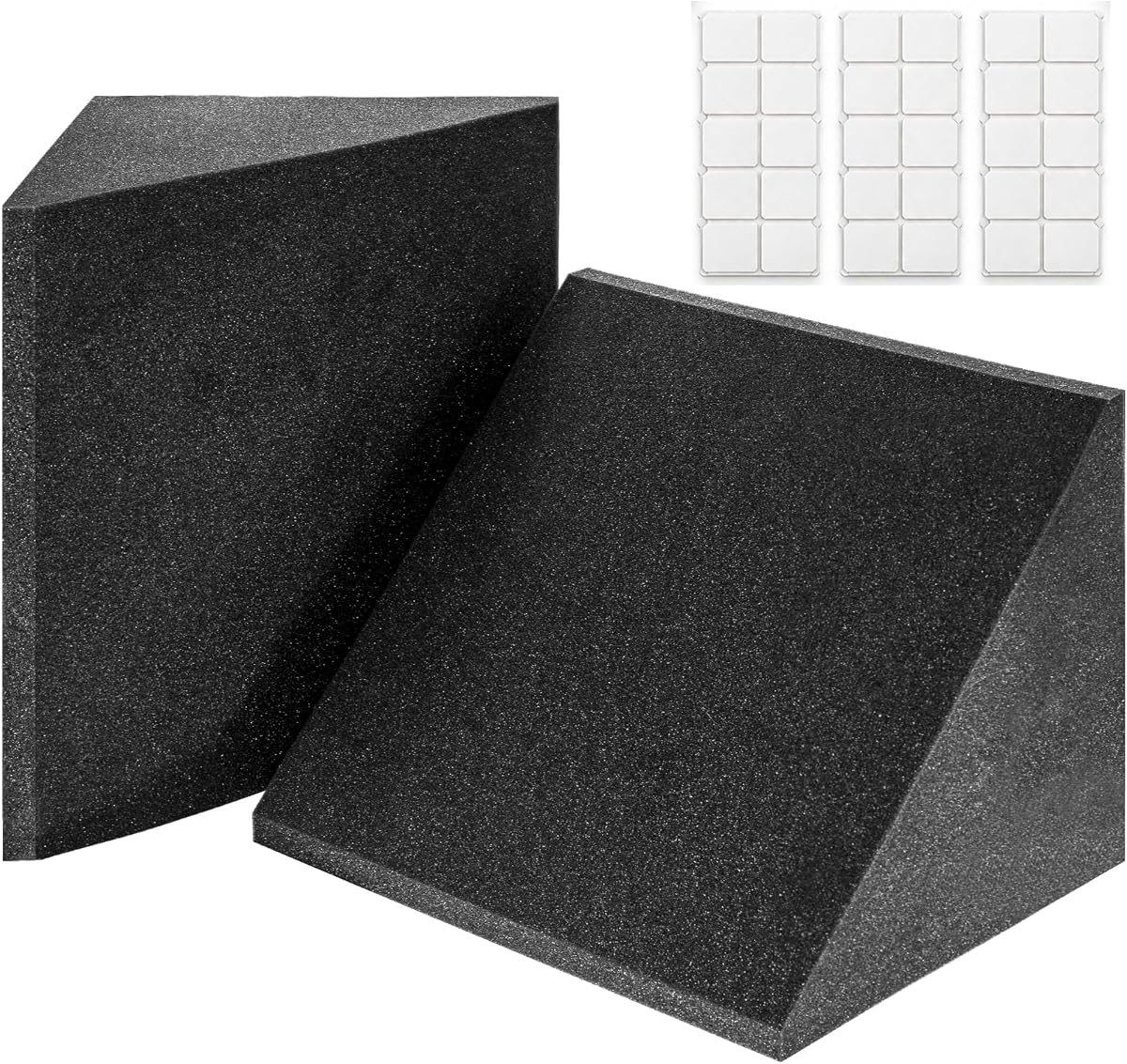
This four-pack of triangular corner bass traps has a 5.0 rating, the highest customer rating among the listed products. Each piece has a 16.5-inch face and 12 inches of depth, with a triangular shape designed to fit wall corners and provide more treatment depth than a flat wall panel.
We may earn a commission when you buy through this link, at no additional cost to you.
The traps are positioned to reduce low-frequency buildup, unwanted reflections, echoes, and reverberation. Their angled geometry follows the room boundary, making them visually recognizable as corner treatment while adding substantial porous volume. The listed applications include recording studios, podcast rooms, gaming rooms, rehearsal spaces, music rooms, and home cinemas.
Installation is one of the strongest aspects of this set because the listing says each trap includes double-sided adhesive dots. That avoids requiring buyers to source basic mounting material before beginning a simple installation. However, the adhesive may need careful surface preparation, and the triangular design is less versatile than a cuttable rectangular panel.
This product is a strong fit for a user who wants a ready-to-mount upper-corner solution and values the highest listed rating. It is especially useful in rooms where reflections and bass buildup are noticeable but a full modular treatment system would be excessive.
The triangular profile fills a wall junction more efficiently than a flat panel, increasing effective treatment depth without pushing foam far into the room.
Included double-sided adhesive dots provide a straightforward mounting option, reducing setup time for recording rooms and home theaters.
We may earn a commission when you buy through this link, at no additional cost to you.
The JBER four-pack is a compact option for lowering low- and mid-frequency buildup in a recording room. It carries a 4.2 rating and uses a square-edged corner-block design intended to produce a cleaner visual finish than untreated or randomly placed foam.
We may earn a commission when you buy through this link, at no additional cost to you.
Its defining flexibility is the ability to mount the blocks between walls and ceilings or horizontally on a wall. That makes the four pieces useful in studios, podcast rooms, home cinemas, and living spaces where treatment may need to adapt to furniture, doors, windows, or irregular boundaries. The listing identifies low- and mid-frequency absorption as the main acoustic purpose.
Because the pack contains only four pieces, it may not address several room corners in a larger studio. Mounting can use glue, double-sided tape, or nails, but those supplies are not described as included. The blocks also appear less specialized for deep low-frequency work than the larger triangular or delta designs in this guide.
This set works well for targeted treatment in a compact studio or as an add-on to a larger system. It is a practical choice for users who need several matching corner absorbers without committing floor space to oversized super chunks.
Although designed for corners, the blocks can also be placed horizontally on walls, giving users a simple way to address troublesome reflection or buildup areas.
By absorbing low and mid frequencies, the blocks can help flatten room response and reduce the muddy or boomy character that makes monitoring and listening difficult.
We may earn a commission when you buy through this link, at no additional cost to you.
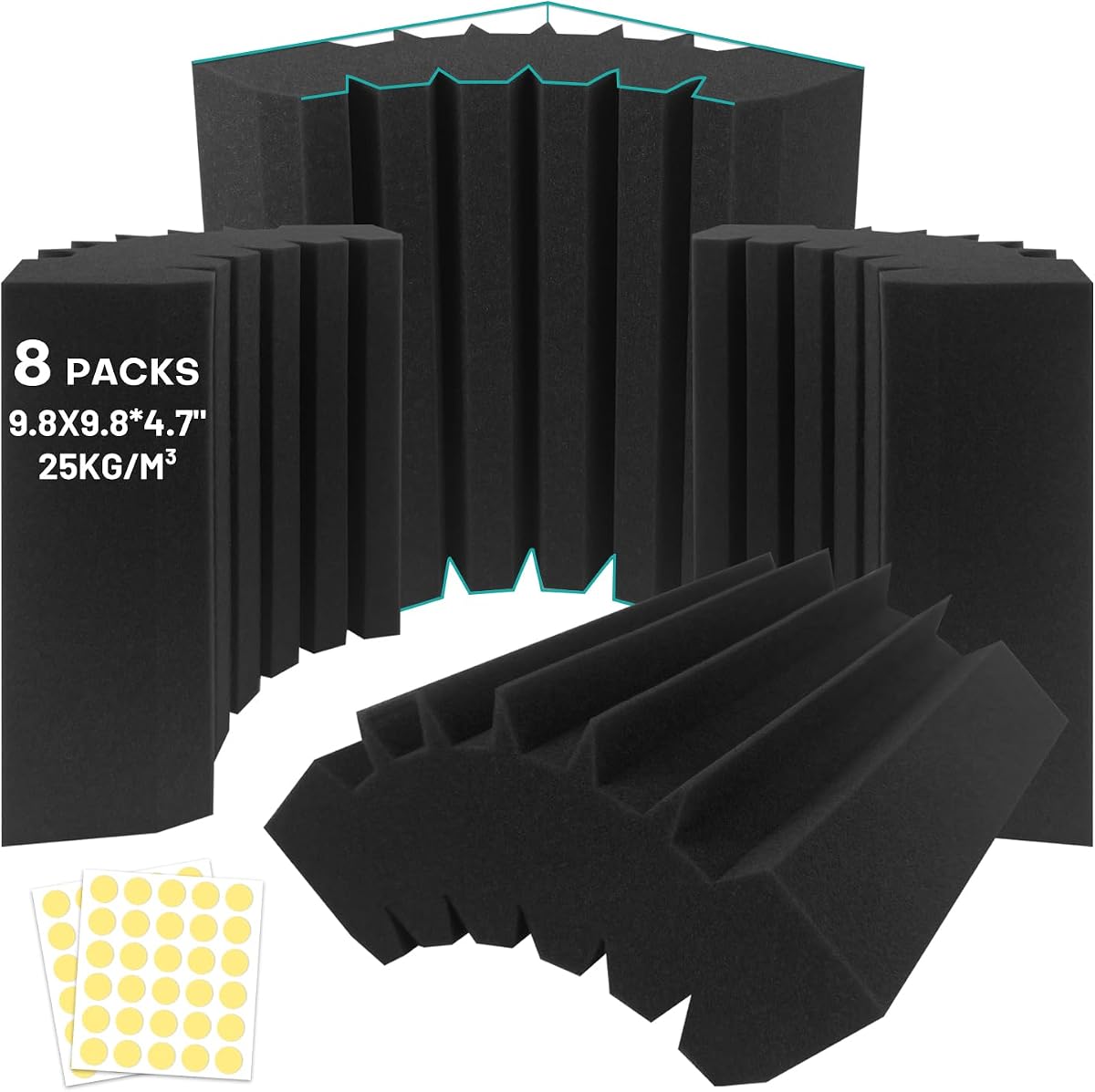
This compact eight-pack provides 9.8-by-9.8-by-4.7-inch corner foam traps and has a 3.9 rating. Its smaller depth distinguishes it from most of the 12-inch designs in the guide, making it most appropriate for recording rooms where corner coverage matters but visual bulk and floor usage need to be controlled.
We may earn a commission when you buy through this link, at no additional cost to you.
The foam is described as high density, CA117 compliant, and B1 fire retardant. Its intended function is to improve low-frequency response and reduce or delay standing waves, particularly where bass energy collects in corners and near ceilings. The eight-piece quantity provides enough units to place several pieces in one corner or distribute them among multiple locations.
This product has the lowest customer rating in the list, although rating alone does not reveal the underlying reasons. Its 4.7-inch depth is shallower than the treatment offered by most competing sets, so it is better suited to supplementary treatment than to replacing every form of deep corner absorption. It also arrives compressed and requires 24 to 48 hours of ventilation before mounting.
Buyers with limited space, a small vocal or podcast room, and a need for multiple lightweight absorbers can get good utility from this set. Larger studios focused on severe low-frequency buildup may achieve more with deeper 12-inch traps.
The shallow profile takes up less corner space than 12-inch traps, making it convenient for compact studios, offices, bedrooms, and media rooms.
Despite its smaller format, the foam is listed as CA117 compliant with B1 fire-retardant performance, providing a useful specification for occupied rooms.
We may earn a commission when you buy through this link, at no additional cost to you.
The two-piece super chunk set is the largest physical product in the guide, with each trap measuring 19.5 by 16.5 by 12 inches. It carries a 4.4 rating and is designed for corner placement, where the listing says low-frequency sound waves are likely to build up. Its scale makes it the premium option for recording rooms needing concentrated treatment depth.
We may earn a commission when you buy through this link, at no additional cost to you.
The broad dimensions create a larger porous mass than narrow column traps or compact blocks. According to the product information, the foam absorbs low-to-high frequencies and can help reduce echoes and reverberation, improving the perceived clarity and depth of recordings. A pair can address two major corners, providing a strong visual and acoustic statement in a home studio.
Large size is both its advantage and its main limitation. Only two units are included, and their footprint may be substantial in a small room. Buyers should verify that the corner geometry and available wall area will accommodate the product before purchase. Although described as lightweight and easy to move, securing the traps securely remains important.
This set is recommended for users willing to dedicate corner space to treatment. It suits dedicated studios, home theaters, rehearsal rooms, and serious listening spaces where stronger low-frequency control justifies a larger profile than the rest of the guide provides.
Its large 19.5-inch profile and 12-inch depth place much more foam into a corner than compact or narrow products, supporting more substantial treatment of low-frequency buildup.
The listing describes absorption from low to high frequencies, allowing the traps to contribute to both bass control and the reduction of echoes or reverberation.
We may earn a commission when you buy through this link, at no additional cost to you.
Choosing bass traps involves balancing room dimensions, corner geometry, treatment depth, and installation needs. The most effective option is not necessarily the biggest product; it is the one that places enough porous material where your room develops low-frequency buildup without interfering with recording work.
Bass traps come in several useful geometries. Triangular and delta-shaped pieces are designed to fit junctions between walls and ceilings, while rectangular blocks can be stacked vertically in floor corners. Compact square traps work well in less expansive rooms and at ceiling positions. Before choosing, sketch each wall, ceiling, and floor junction and decide whether the treatment should run vertically, sit overhead, or remain compact and out of the way.
Choose a shape that naturally fits the location. A specialized upper-corner pyramid will not be as versatile as a cuttable column in a floor corner, while a broad super chunk requires enough room for its substantial footprint.
Low frequencies have long wavelengths and generally need deeper, denser treatment than mid and high frequencies. Products in this guide range from 4.7 inches to 12 inches in depth. The deepest 12-inch designs place more open-cell material into corners and can be more appropriate when bass buildup is substantial, while shallower traps are useful for supplementary treatment and compact rooms.
Depth alone does not guarantee a balanced room, but it is one of the most important physical comparisons. Match the product depth to the severity of the room problem and the space available.
A large piece does not necessarily provide more coverage than several smaller ones. Count the corners and ceiling junctions that need treatment, then estimate how many pieces can be stacked at each position. Four-packs suit highly targeted rooms, eight-packs provide moderate coverage, and 12- or 24-piece sets can address several boundaries with a consistent layout.
Do not buy only by pack size. Check the usable corner area, the desired treatment height, and whether your room needs more panels on walls than in the corners.
High-density polyurethane or acoustic foam is common among the listed products and is intended to resist compression while providing porous absorption. Density can contribute to durability and consistent shape after installation, but effective performance also depends on depth and placement. Products described as high density, flame retardant, odorless, and non-toxic are particularly appealing for occupied recording spaces.
Choose a material specification that suits your room and installation method, then confirm that the panels will recover their intended shape after shipping.
Acoustic foam should be considered when treatment is installed in a home, studio, classroom, or commercial room. Three products in this guide specifically reference CA117 testing and B1-class fire-retardant performance, while the JBER 16-pack is also described as fire retardant. These claims do not replace local building or safety guidance, but they give buyers meaningful information beyond generic acoustic claims.
Check fire-related specifications, installation recommendations, and room requirements before purchasing. Use the stated compliance information as one part of a broader safety review.
Mounting options differ across the list. Some products include double-sided adhesive dots, while others recommend spray adhesive, double-sided tape, small screws, or T-pins. Adhesive is convenient for foam panels, but surface preparation matters for reliable attachment. Mechanical fasteners may be useful where panels are heavy or where users may want to remove them later.
Purchase mounting materials separately when the listing does not include them. Also verify that the chosen adhesive is appropriate for the wall, ceiling, or other mounting surface.
Several foam sets arrive compressed to reduce shipping volume. The 8-pack corner sets and JBER column wedges specifically call for expansion in a ventilated area, generally over 24 to 48 hours or longer. The traps should regain their normal shape before installation. Planning for this recovery period prevents distorted panels, weak mounting points, and a rushed setup.
Open the package promptly, remove any wrapping, and allow the foam to expand naturally away from direct sunlight unless the manufacturer directs otherwise.
Bass traps solve a specific part of the acoustic puzzle. They are most effective when combined with appropriate treatment at reflection points, over speakers, behind microphones, and across other surfaces that create flutter echoes or comb filtering. The Foroomaco pyramid and delta products are even designed to work as a system, with pyramid traps for ceiling corners and delta traps for vertical corners.
Start with the most audible problem areas, then expand treatment gradually. Recording decisions should be made after the room has enough treatment to reveal the true sound of the instruments and voices.
Begin by mapping the room before mounting anything. Listen for boomy bass, uneven monitoring, excessive echo, and a different sound when speaking from different positions. Mark floor corners, ceiling junctions, and wall reflection points, then choose the trap geometry that fits each location. Place only the panels you can mount securely, because stable installation is more important than filling every visible gap.
For compressed foam, open the package and allow the traps to expand in a ventilated area for the stated 24 to 48 hours or longer. Clean the mounting surface, apply the recommended adhesive evenly, or use suitable mechanical fasteners when permitted. Align panels into straight columns or consistent triangular arrangements. Leave the traps undisturbed while the adhesive sets and check periodically that each piece remains firmly supported.
Keep the treatment area clear of moisture, direct heat, and obstructed airflow. Dust the foam gently with a soft brush or use low suction, and do not saturate it with cleaning liquid. Periodically inspect compressed edges, loose corners, and adhesive failure, especially in rooms with temperature changes. After making a change, record a short reference passage and listen again from the same position to evaluate whether clarity, bass balance, or echo control has improved.
Bass traps add porous absorption where low-frequency energy commonly accumulates, particularly around room corners and ceiling junctions. They can reduce boomy buildup, muddy playback, standing-wave effects, and some forms of echo. They work best as part of a broader treatment plan that also addresses reflections and other acoustic boundaries.
Not exactly. Bass traps primarily absorb sound energy within the room and help control acoustic response, especially at lower frequencies. Soundproofing panels are generally intended to reduce transmission between spaces. A recording room may need both absorption and isolation, but bass traps alone do not prevent sound from passing through walls.
The correct number depends on room size, shape, construction, existing treatment, and the severity of the problem. A small room may need only a few targeted panels, while a larger studio may use several pieces in each vertical corner and at ceiling junctions. Start with the locations that create the most obvious boom or unevenness, then evaluate and expand as needed.
Not necessarily, although every corner can be a useful location for low-frequency treatment. Rooms often have one or two corners that produce more obvious buildup, and those should receive priority. Effective treatment can also be distributed among upper corners, adjacent walls, and other reflection points rather than concentrated only at the floor.
Neither shape is universally better. Triangular and delta designs often fit wall or ceiling junctions more efficiently and can provide more depth in less space. Square blocks are often easier to stack, cut, and arrange in vertical columns. Choose based on the room geometry and the placement you want rather than the shape alone.
The listed products state that compression does not adversely affect foam performance or shape, provided the panels are allowed to expand properly. Keep them in a ventilated area for the recommended period before mounting. Installing a trap before it has recovered can produce an uneven profile and weak mounting contact.
No. Bass traps are designed primarily for low-frequency absorption and corner buildup, while many audible echoes come from reflections across broader wall and ceiling surfaces. Reducing all echoes usually requires a combination of corner treatment, reflection-point panels, speaker positioning, and careful source placement.
Use the method recommended by the product listing, such as spray adhesive, double-sided tape, adhesive dots, screws, or T-pins. The surface should be clean and suitable for the chosen fastener or adhesive. Large or heavy pieces need especially secure support, and no panel should be installed if its mounting surface cannot hold it safely.
The TroyStudio 12-pack stands out as the strongest overall choice because it combines the highest listed rating, twelve useful panels, high-density construction, low weight, and easy customization. The Foroomaco Delta pair is the editor's selection for vertical corners, while the large two-piece super chunk set offers the most substantial physical treatment in the guide.
Prioritize the room's actual geometry before focusing on pack size. Compact traps work well when space is limited, triangular pieces suit upper corners, stackable columns cover vertical boundaries, and large super chunks make the strongest visual and physical statement. Build a balanced plan that includes corner treatment for bass and broader absorbers for reflections.
Finally, verify current product details, dimensions, mounting supplies, fire-related information, and current prices on the linked listings before purchasing. Foam specifications and availability can change, and prices fluctuate. A careful fit check will help ensure that the chosen bass traps address your recording room without interfering with equipment, doors, windows, or the usable workspace.