
BN-LINK 7-Day Programmable Digital Timer Outlet
4.4Editor score
Two controlled grounded outlets
Eight programs per timer
Two timers included
This expert guide compares 10 automated light switch timers by scheduling, compatibility, ease of installation, energy control, and standout features.
An automated light switch timer can control connected lights or fans according to a daily or weekly schedule, reducing the need for manual switching. A worthwhile model offers understandable programming, dependable manual overrides, and compatibility with the wiring and loads already in your home.
We compared the ten products in this guide using their stated scheduling options, installation requirements, electrical ratings, controls, and special features. The list covers in-wall digital switches, astronomical timers, programmable outlets, and mechanical models for shoppers with different installation needs and preferences.
Each review identifies the most useful strengths and any visible limitations, followed by a recommendation based on the product's documented capabilities. Ratings reflect the listed customer feedback, while specifications and availability can change, so confirm the current product details before purchasing.
4.4Editor score

4.3Editor score

4.4Editor score
The comparison below places each timer's control method, scheduling system, installation needs, and load capabilities side by side. It includes programmable wall switches, outlet timers, an astronomical switch, and a straightforward mechanical alternative.


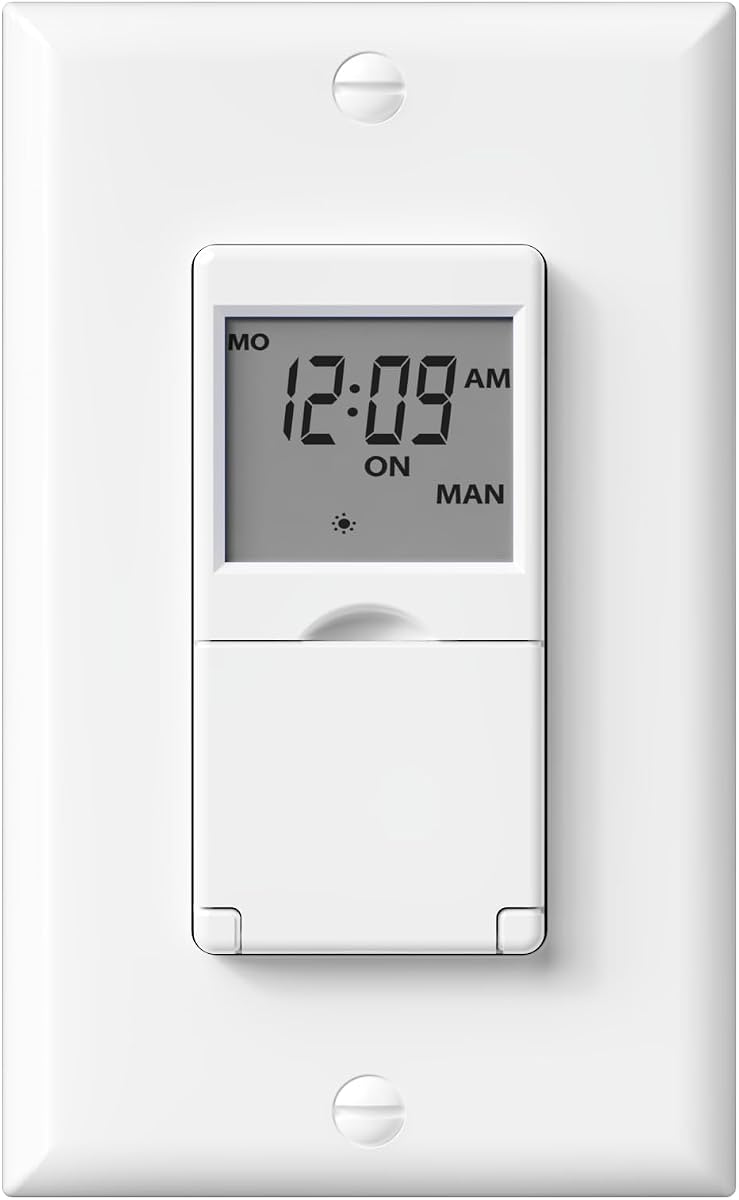


This BN-LINK in-wall timer combines a seven-day schedule, 18 programmable on/off events, and an easy-to-read blue backlight. Its 4.3 rating reflects generally favorable customer feedback, while the product's stand-out qualities are its scheduling flexibility, manual mode, and support for both single-pole and 3-way installations.
We may earn a commission when you buy through this link, at no additional cost to you.
The timer can operate in automatic or manual mode, and its rechargeable backup battery helps retain settings during a power interruption. Daylight Saving Time mode simplifies seasonal clock changes, while random vacation mode varies programmed operation to create a more natural lived-in appearance. Intervals can be configured as short as one minute, giving it useful precision for different routines.
A neutral wire is required, and replacing an existing switch involves working with residential wiring. Some users may find the menu-based setup less convenient than a mechanical timer, particularly when creating numerous weekly combinations. However, those limitations are reasonable for a feature-rich digital switch that supports 18 programs and two-switch control.
This is a strong all-around choice for homeowners who want weekly automation, multiple daily events, and flexible 3-way control. It is especially appropriate for hallways, stairways, entryways, garages, and rooms where lights or fans should follow a dependable routine. Buyers who do not have a neutral wire should choose a plug-in model instead.
Up to 18 on/off programs can be assigned to individual days or preset day combinations, with intervals beginning at one minute. The blue backlight makes the display easier to read during setup and routine schedule checks.
Random vacation mode changes the timing of programmed lights to suggest occupancy, while the rechargeable battery helps preserve settings if power is interrupted. Manual mode remains available whenever immediate control is required.
We may earn a commission when you buy through this link, at no additional cost to you.
The GE 7-Day in-Wall Digital Timer Switch is designed for shoppers who want a conventional weekly schedule with automatic daylight tracking. Its 4.2 rating indicates positive customer feedback, and its primary distinction is SunSmart technology, which adjusts sunrise and sunset times throughout the year after the appropriate regional setting is configured.
We may earn a commission when you buy through this link, at no additional cost to you.
Up to seven on/off programs can be created across the week. A random security feature can alter programmed times by as much as 30 minutes, helping connected lights appear less rigidly scheduled. The switch can replace a single-pole or three-way switch when a neutral wire is present, and it is compatible with LED, CFL, incandescent, and halogen bulbs.
The weekly program count is more limited than the 18-event capability of several BN-LINK models, so highly specific users may prefer a deeper schedule. Installation also requires a neutral wire and appropriate electrical knowledge. Even so, the automatic sunrise and sunset adjustment reduces the need to revise seasonal lighting times manually.
This timer suits porch, landscape, entryway, or other exterior-facing lighting where daylight-responsive operation is useful. It also fits indoor installations that need a simple recurring schedule and randomized security behavior. Homeowners seeking the broadest program selection should compare it with higher-capacity digital switches before finalizing their choice.
SunSmart technology accounts for changing daylight conditions across the year. Once the correct regional information is entered, the timer can adjust astronomical on and off times without requiring repeated schedule edits.
The timer can serve as a single-pole or three-way switch replacement when a neutral wire is available. Compatibility with LED, CFL, incandescent, and halogen bulbs gives it broad residential utility.
We may earn a commission when you buy through this link, at no additional cost to you.
This BN-LINK astronomical timer combines automatic sunrise and sunset control with 18 weekly programs. Its 4.4 rating places it among the stronger customer-rated options in the group, and the model is particularly appealing for outdoor lights that should follow daylight conditions without receiving a fixed clock-time schedule.
We may earn a commission when you buy through this link, at no additional cost to you.
After setup, the timer calculates sunrise and sunset from the selected location, with six preset time zones available: PAC, MOU, CEN, EAS, HAW, and ALA. Users can still add individual days or preset combinations, and schedules can be adjusted to intervals as short as one minute. Daylight Saving Time mode and random vacation mode add further automation.
Unlike some programmable wall timers in the roundup, this model is for single-pole installations only. It also requires a neutral wire, so it is less flexible for homes with existing three-way switch arrangements. The documented 30-day money-back guarantee and 12-month warranty provide additional purchase reassurance.
This is an attractive option for porch, entryway, patio, and outdoor lighting when automatic astronomical timing is the main goal. It also works for indoor fixtures where a high program count is valuable. Buyers with three-way wiring should select a timer explicitly designed for that configuration.
The six preset time zones help establish the local reference used for sunrise and sunset calculations. Selecting the appropriate zone is an important setup step for predictable automatic operation.
The 18-program capacity provides more daily events than many competing digital timers. Random mode varies the schedule to create a less predictable appearance while the home is occupied or away.
We may earn a commission when you buy through this link, at no additional cost to you.
This BN-LINK programmable wall timer offers 18 on/off programs, seven-day scheduling, and support for both single-pole and three-way arrangements. Its 4.2 rating reflects solid customer feedback, while the model stands out for its broad schedule capacity, selectable day combinations, and compatibility with lights and fans.
We may earn a commission when you buy through this link, at no additional cost to you.
Programs can run at intervals as short as one minute, and users may choose individual days or convenient combinations. A one-touch Daylight Saving Time adjustment reduces seasonal maintenance, and a manual mode provides direct control outside the programmed timetable. The built-in rechargeable battery is intended to preserve settings during a power outage.
Random vacation mode gives scheduled lights a less predictable pattern, which can make a home appear occupied. The switch also includes a wall plate and supports SPDT arrangements. The main trade-off is that its astronomical timing is not listed as an automatic feature, so outdoor users who want sunrise and sunset control should look at a dedicated astronomical model.
This is a good general-purpose digital timer for hallways, garages, patios, ceiling fans, and other permanently installed fixtures. Its combination of 18 programs, one-minute intervals, 3-way compatibility, and manual override makes it practical for households with varied daily routines. Confirm neutral-wire availability before choosing it for a new installation.
Eighteen programs and one-minute intervals offer enough granularity for early-morning, evening, and occasional short-duration needs. Individual-day and combination-day choices make it easier to mirror weekday and weekend behavior.
Single-pole and three-way compatibility broadens where the timer can be installed. The same scheduling approach can control compatible lights or fans without requiring separate control styles.
We may earn a commission when you buy through this link, at no additional cost to you.
The Leviton Decora VPT24-1LW combines a 24-hour digital schedule, astronomical timing, and a countdown function in a single in-wall switch. Its 4.4 rating reflects favorable customer feedback, and it stands out as a premium option for users who want extensive load support and several methods of automated control.
We may earn a commission when you buy through this link, at no additional cost to you.
Ten on/off events can be assigned by day or combination of days, while the astronomical clock adjusts for sunrise and sunset. A preset six-hour countdown is included to meet CA Title 24 Part 6 and IECC requirements. Random timing creates a natural lived-in appearance, and the switch supports single-pole or three-way configurations with a suitable three-way switch.
Load support is unusually broad for this category: the timer handles up to 600W LED/CFL, 1800W incandescent or halogen, 15A resistive or inductive loads, and 1 HP motors. Its stated use is indoors only, however, and it requires a neutral wire. Those constraints rule it out for exposed outdoor placement or installations without the necessary wiring.
This model is well suited to homeowners seeking a single timer for lighting, fans, and qualifying motor loads. It is particularly compelling when indoor astronomical behavior, code-oriented countdowns, and three-way flexibility matter. Buyers should verify the connected load and local electrical requirements before installation.
The device combines scheduled events, astronomical sunrise and sunset control, and a countdown timer. This makes it adaptable to different routines without relying on a separate controller for each function.
Documented limits cover LED and CFL fixtures, incandescent and halogen bulbs, resistive and inductive loads, and motors up to the stated horsepower. Compatible load selection should be confirmed before purchase.
We may earn a commission when you buy through this link, at no additional cost to you.
This two-pack of BN-LINK digital timer outlets is a practical alternative for people who cannot or do not want to install a wall switch. Each unit contains two grounded outlets controlled together, and its 4.4 rating reflects positive customer feedback for the straightforward plug-in approach.
We may earn a commission when you buy through this link, at no additional cost to you.
Each timer supports up to eight on/off programs, with intervals as short as one minute. Users can select individual days or preset combinations, activate Daylight Savings mode, and use random vacation mode to vary connected lights. A long-lasting backup battery helps retain settings during a power outage, and a red LED indicates when the outlets are on.
The two outlets on each timer are synchronized rather than independently programmable. If a lamp and a fan need different schedules, the included two timers allow them to be assigned separately. The product is also described as an indoor digital outlet timer and should not be assumed suitable for damp or exposed outdoor locations.
This set works well for renters, apartments, offices, and areas where modifying existing wiring is undesirable. It can automate lamps, coffee machines, fans, and other compatible electrical devices. It is also a sensible entry point for shoppers who want programmable control without learning an in-wall switch's installation process.
The plug-in format is the main convenience of this model. It can be moved between outlets and placed wherever a grounded receptacle is available, subject to the product's stated indoor use.
Although each timer's two outlets operate together, the pack provides two independent timers. This allows different devices or room areas to follow separate weekly schedules.
We may earn a commission when you buy through this link, at no additional cost to you.
This BN-LINK digital wall timer emphasizes readable programming through its blue backlight while retaining 18 weekly on/off programs. Its 4.3 rating indicates generally positive customer feedback, and the combination of visible controls, flexible scheduling, and manual operation makes it a practical option for everyday residential use.
We may earn a commission when you buy through this link, at no additional cost to you.
The timer supports one-minute intervals, individual days, preset day combinations, and automatic or manual modes. Daylight Saving Time functionality reduces clock changes, and the rechargeable battery is designed to preserve programming during outages. Random vacation mode varies the schedule for a more natural appearance while the home is away.
The model is rated for single-pole and three-way configurations, with compatibility stated for SPDT switches and a wall plate included. A neutral wire remains necessary. Unlike dedicated astronomical versions, automatic sunrise and sunset calculations are not included in the listed functions, so daylight-responsive installations need another model.
This switch is well matched to hallways, entryways, garages, patios, and ceiling-fan locations where a regular weekly routine is desired. The illuminated interface is especially helpful for users who make frequent schedule adjustments. It is less appropriate for someone seeking automatic daylight tracking or a no-wiring outlet solution.
The blue backlight illuminates the interface, helping users read settings during setup or make changes in dim spaces. This is a practical refinement rather than a change to the underlying scheduling capacity.
Eighteen programs, short intervals, and day selections allow the timer to mirror changing household routines. Automatic and manual modes provide both scheduled and immediate operation.
We may earn a commission when you buy through this link, at no additional cost to you.
The myTouchSmart 26893 takes a different approach from menu-driven digital timers by using four programmable buttons and two direct on/off buttons. Its 4.7 rating is the highest listed among these products, and the button-based interface gives users visible, dedicated controls for programmed and immediate operation.
We may earn a commission when you buy through this link, at no additional cost to you.
Each programmable button can support a 24-hour daily cycle, while the two override buttons control connected lights or fans outside the scheduled periods. Blue LED indicators show which buttons or programs are active. The timer is compatible with LED, CFL, incandescent, and halogen bulbs, including dimmable LED and dimmable CFL bulbs.
It is designed to replace an existing light switch and requires a neutral wire, but screw terminals simplify wire connections compared with models using flying leads. A wall plate is not included, so buyers may need to reuse the existing cover or purchase one separately. It also does not provide the seven-day distinction offered by several competitors, which may be limiting for weekday and weekend differences.
This timer is ideal for users who prefer physical buttons and immediate overrides over a display-driven menu. It can control ceiling lights, fans, exhaust fans, patio lights, and other compatible fixtures. Its stated indoor or outdoor light and fan applications broaden its potential uses, although local installation conditions and electrical requirements should always be reviewed.
Four dedicated programmable buttons and two override buttons make the operating model visible and direct. This can be easier for household members who do not want to navigate a digital programming menu.
The override controls allow connected fixtures to be switched outside programmed times. Blue indicators reveal active programs and current button selections without requiring users to interpret a clock display.
We may earn a commission when you buy through this link, at no additional cost to you.
The BN-LINK U47 is a compact mechanical outlet timer for shoppers who prefer a simple plug-in device over digital programming. Its 4.4 rating indicates favorable customer feedback, and the pull-pin design makes the schedule visible without a display, menu, battery, or complex setup.
We may earn a commission when you buy through this link, at no additional cost to you.
The timer provides up to 24 on and off settings per day, with a minimum interval of 30 minutes. Pressing the pins downward turns the connected device on, while pulling them upward turns it off. Once configured, the schedule repeats every day, providing consistent automation for lamps, small appliances, Christmas trees, and other electrical devices.
The smallest interval is less flexible than the one-minute minimum offered by digital models, and the daily repeat cannot represent different weekday and weekend routines. Each pack includes two mini timers, which makes it easy to automate two locations independently. Compatibility includes compact fluorescent lighting, LED bulbs, and most small appliances.
This is a strong option for anyone seeking dependable automation without digital menus or in-wall installation. It is especially useful for holiday displays, decorative lamps, and appliances that follow the same schedule every day. It is not the best choice when minute-level control, weekly variation, or astronomical timing is important.
Mechanical pins make the timer's status immediately visible and the daily program easy to adjust. This reduces setup complexity for users who want a repeatable pattern rather than intricate control.
The two-pack offers separate timers for different rooms or devices. Their compact plug-in format also makes them easier to deploy where an in-wall switch would require wiring.
We may earn a commission when you buy through this link, at no additional cost to you.
The Honeywell PLS750C1000 is a permanent wall timer designed around sunrise and sunset timing, with support for single-pole or three-way configurations. Its 4.6 rating is the second-highest listed customer score in the group, although the supplied product information gives limited detail about its programming and electrical specifications.
We may earn a commission when you buy through this link, at no additional cost to you.
Its clearest advantage is astronomical automation. Instead of keeping a fixed evening schedule through every season, the timer can account for changing daylight hours. This makes it conceptually suitable for exterior or daylight-sensitive lighting, as well as indoor fixtures that benefit from consistent sunrise and sunset behavior.
The available listing does not state the number of daily or weekly programs, minimum intervals, load ratings, battery behavior, or neutral-wire requirements. Those omissions make direct comparison with the fully specified digital timers more difficult. The listed package dimensions describe the retail package rather than the switch's complete operating features, so they are of limited value when assessing performance.
The Honeywell model is worth considering for shoppers already comfortable with the PLS750C1000 and seeking sunrise and sunset control in a single-pole or three-way wall-switch format. Before purchasing, verify the manufacturer instructions, wiring requirements, supported loads, and full scheduling capabilities on the current listing.
The sunrise and sunset function provides the central reason to consider this model. It is intended to follow daylight changes rather than depend on a fixed clock schedule throughout the year.
Single-pole and three-way compatibility makes the product relevant to common wall-switch arrangements. Confirm installation details, especially wiring and load requirements, before replacing an existing switch.
We may earn a commission when you buy through this link, at no additional cost to you.
The right automated light switch timer depends on wiring, scheduling habits, load type, and how much control you want after installation. Comparing these factors before buying can prevent an unsuitable purchase and make daily operation more convenient.
Choose an in-wall model for permanent integration, or a plug-in model for flexible placement and easier setup.
Prioritize sufficient program capacity, useful minimum intervals, and independent schedules for different devices.
Use astronomical timing for daylight-responsive lighting; use fixed schedules for routines unrelated to sunrise or sunset.
Match the timer's wiring configuration to the location, and ensure any required companion three-way switch is supported.
Verify the exact load, voltage, wattage, and motor rating before connecting any device.
Look for battery backup when retaining the schedule after an outage is important.
Favor clear overrides, countdown control, and away randomization alongside the primary schedule.
Check neutral wiring, switch compatibility, mounting hardware, and included wall plates before ordering.
Begin by identifying the load, wiring configuration, and intended schedule. For an in-wall model, confirm that a neutral wire is available and that the existing switch is single-pole or the required three-way type. For a plug-in timer, test it in a suitable indoor outlet and avoid extension cords or other setups that could add load beyond the product's instructions.
Program the timer before putting it into regular use. Set the correct clock, select the appropriate days, and add on and off times from the shortest required interval upward. Astral models also require the correct region or time-zone information, while Daylight Saving Time mode should reflect the local observation schedule. Confirm each programmed event and test a manual override before leaving the fixture unattended.
For care, wipe the digital face or mechanical pins with a dry cloth and keep the unit free of moisture and debris. Periodically verify the schedule after a power interruption, clock change, or bulb replacement. Do not exceed the listed electrical ratings, and consult a qualified electrician when the existing wiring is old, unclear, or unfamiliar.
Most of the in-wall digital timers in this guide require a neutral wire, including the BN-LINK models, the GE timer, the Leviton Decora, and the myTouchSmart model. Plug-in timers do not require wall wiring because they connect to an existing receptacle. If the switch box lacks a neutral conductor, choose an outlet model or have an electrician evaluate the wiring.
Yes, but only when the timer's load rating supports the connected motor and the fixture is compatible. The Leviton Decora lists support for 1 HP motors, while several BN-LINK models list a 1/2 HP rating. Check the motor type, wattage, voltage, and whether the connected light requires dimming before programming the timer.
A daily timer repeats the same schedule every day, while a weekly timer can assign different programs to different weekdays. A weekly model is useful for routines that differ between workdays and weekends. Daily or mechanical models are simpler and may be sufficient when the same on and off times work every day.
Astronomical timers are designed to calculate sunrise and sunset from the correct location after initial setup. This allows exterior lighting to follow changing daylight rather than remain tied to one fixed clock time. The correct time zone or region still matters, so setup errors can lead to inaccurate activation times.
A backup battery usually preserves the schedule and settings, but it does not necessarily keep the connected light operating without grid power. Products with a rechargeable or long-lasting backup battery are intended to restore the programmed schedule after electricity returns. The myTouchSmart and several BN-LINK digital models list battery backup as a feature.
A three-way-capable timer can be used where a fixture is controlled from two switch locations. Several BN-LINK models and the Leviton Decora list three-way compatibility, while the BN-LINK astronomical model is single-pole only. The existing wiring and companion switch must match the timer's requirements.
Only use an outlet timer outdoors when the product and connected receptacle are specifically rated for that exposure. The BN-LINK digital outlet timer is described as an indoor product, while the BN-LINK U47 is also labeled indoor. Outdoor installations generally require a weather-rated fixture, a covered and properly located receptacle, and equipment approved for the conditions.
The right number depends on how many distinct events occur in a day and whether the schedule changes by day of the week. Models with 18 programs provide considerable flexibility, while seven or ten events may be enough for simpler routines. Also consider minimum intervals, manual overrides, and astronomical features rather than focusing on program count alone.
The BN-LINK 7-Day Digital Timer stands out as the most flexible general-purpose choice because it combines 18 weekly programs, one-minute intervals, manual control, backup battery, and three-way compatibility. The BN-LINK Programmable Timer Outlet is the most accessible plug-in option, while the Leviton Decora offers the most advanced premium feature set with astronomical timing, countdowns, randomization, and broad load support.
Before choosing, prioritize the type of installation, neutral-wire availability, required switch configuration, and the complexity of your routine. Outdoor lights may call for an astronomical model, while renters and offices can benefit from plug-in timers. Users with several unrelated daily events should look for deeper scheduling, and anyone controlling a fan should verify motor-load compatibility.
Specifications, customer ratings, and product availability can change, so review the current listing before ordering. Compare the installation instructions and electrical limits with your home's wiring, confirm that the timer is appropriate for the intended location, and check current prices and warranty information at the point of purchase.