
ASRock 970M PRO3
4.0Editor score
Compact MicroATX design
AMD 970 chipset
Socket AM3+ support
Quad CrossFireX platform
Our Asrock AM3 Motherboard guide compares 10 models for socket support, memory, expansion, storage, networking, graphics, form factor, and compatibility.
The AM3 platform remains relevant for builders repairing, upgrading, or reusing an older AMD processor. Choosing an Asrock AM3 motherboard requires matching socket generation, chipset capabilities, memory limits, case size, and expansion needs. The right board can make a legacy system more capable without requiring a complete platform change.
This guide compares ten ASRock boards associated with AMD AM3 and AM3+ processors. The evaluation considers processor support, memory configuration, expansion slots, SATA connectivity, USB support, integrated graphics, networking, audio, and ATX or MicroATX sizing. Specifications come from the supplied product information rather than personal testing.
The selections reveal distinct use cases, from compact everyday boards to enthusiast-oriented models with multi-GPU, RAID, and high-speed storage capabilities. Ratings are shown where available, but platform age means CPU, memory, operating system, and driver compatibility deserve equal attention. Current prices and availability can change, so compare the latest listing information before purchasing.
4.0Editor score

4.2Editor score

5.0Editor score
The following side-by-side comparison highlights the major differences among these ten AM3-era ASRock motherboards, including socket compatibility, memory capacity, expansion capability, storage connections, and physical form factor.




The ASRock 970A-G/3.1 stands out as the most adaptable general-purpose board in this guide, earning a 4.2 rating and offering the Editor's Choice designation. It combines AM3+ and AM3 processor support with an AMD 970 northbridge and SB950 southbridge. Its 64GB memory ceiling, six SATA3 ports, M.2 support, and USB 3.1 connectivity make it unusually complete for this platform.
We may earn a commission when you buy through this link, at no additional cost to you.
Storage is a major strength. The board provides six SATA3 ports and one M.2 PCIe 2.0 x4 connection, allowing a builder to combine conventional hard drives with a compact PCIe SSD. Four DDR3 DIMM slots support up to 64GB in dual-channel mode, a generous limit compared with many contemporaneous AM3 boards that stopped at 16GB or 32GB.
Expansion options include two PCIe 2.0 x16 slots, although one operates at x4, along with two PCIe 2.0 x1 slots and a conventional PCI slot. The USB selection includes one rear Type-A USB 3.1 port, one Type-C port, four USB 3.0 ports, and eight USB 2.0 ports. That is useful for newer peripherals, although users should verify that their case and devices support the relevant connections.
This is the best general choice for an AM3 or AM3+ build that needs storage flexibility, substantial memory capacity, and modern-style external connectors. Its main limitations are inherent to the platform: DDR3 is required, graphics output depends on a discrete card unless the chosen processor provides it, and modern operating-system support may be restricted. For a carefully planned legacy system, though, the combination of features and flexibility is difficult to surpass.
Six SATA3 connectors and a PCIe M.2 slot provide useful options for combining hard drives, optical storage, and a compact solid-state drive. Support for up to 64GB of dual-channel DDR3 also makes the board suitable for memory-heavy legacy workloads.
USB 3.1, USB 3.0, and USB 2.0 connections cover everything from high-speed storage to legacy keyboards and mice. The included Type-C port is especially helpful for buyers who want a more current external interface on an older motherboard.
We may earn a commission when you buy through this link, at no additional cost to you.
The ASRock 970M PRO3 earns a 4.0 rating and receives the Best Budget designation for bringing an AMD 970-based board into a smaller MicroATX enclosure. It supports Socket AM3+, DDR3 memory, Quad CrossFireX, SATA3, USB 3.0, Gigabit Ethernet, and integrated audio according to its supplied product title.
We may earn a commission when you buy through this link, at no additional cost to you.
Its main attraction is the combination of chipset and physical size. The AMD 970 platform is more versatile than many entry-oriented AM3 boards, while MicroATX dimensions can make a system easier to fit in a compact case. Quad CrossFireX support also gives buyers a way to use multiple compatible graphics cards when their workload and hardware allow it.
The supplied description emphasizes authenticity, functionality, and the importance of matching the original part number correctly. It does not provide a full slot, port, memory-capacity, or storage breakdown, so buyers should not assume features that are not confirmed. Those same cautions apply to system builders: the processor, memory modules, operating system, and case must all be verified independently.
The 970M PRO3 is best for a compact legacy build where MicroATX dimensions matter and the buyer already knows the processor and chassis involved. It may also suit a repair or upgrade because the board combines a recognizable chipset with a practical size. The recommendation depends on confirming the complete hardware specification, but among these listings it represents an efficient route into the AM3 platform.
The MicroATX format makes this board attractive for builders who want AM3 capability without using a full-size ATX chassis. That can simplify case selection and reduce the physical space required for an otherwise legacy-based system.
Using the AMD 970 chipset brings SATA3 and USB 3.0 to a platform that began with much older storage and peripheral standards. That balance is useful when preserving an existing processor while avoiding obsolete connectivity.
We may earn a commission when you buy through this link, at no additional cost to you.
The ASRock 890FX Deluxe4 has a 5.0 rating, the highest listed score among the ten boards, and takes the Best Premium position for its unusually rich storage and expansion configuration. It uses the AMD 890FX and SB850 chipsets, supports Socket AM3 processors, and provides six SATA3 ports plus an external eSATA3 connection.
We may earn a commission when you buy through this link, at no additional cost to you.
Storage is the feature that distinguishes this model. Six SATA3 connectors support RAID 0, 1, 5, and 10 according to the supplied details, and an additional two SATA3 ports are attributed to a Marvell SE9120 controller. That makes the board appealing to a builder who already owns several hard drives or wants a more elaborate RAID-oriented arrangement.
The board also provides four USB 3.0 ports, ten USB 2.0 ports, two IEEE 1394 ports, Gigabit Ethernet, and Realtek 7.1-channel audio. Two PCIe 2.0 x16 slots support Quad CrossFireX, while two PCIe 2.0 x1 and two PCI slots preserve additional expansion options. Four DDR3 DIMM slots support up to 16GB.
This premium recommendation is best for collectors, builders with existing AM3 hardware, and users who value abundant SATA connectivity over maximum memory capacity. Its 16GB limit is modest even for the era, and it lacks the explicit AM3+ support shown by several alternatives. Even so, the combination of a 5.0 rating, high-speed storage, multi-GPU capability, and extensive legacy connectivity makes it the strongest feature-focused pick here.
Six internal SATA3 ports, two additional SATA3 connections attributed to a Marvell controller, and eSATA3 support offer exceptional flexibility for legacy storage. RAID support extends the board's usefulness for users organizing multiple conventional drives.
Quad CrossFireX support, two PCIe x1 slots, two PCI slots, IEEE 1394, and numerous USB connections help preserve compatibility with specialized and older peripherals. The board is particularly compelling for restoring or expanding an existing AM3-era workstation.
We may earn a commission when you buy through this link, at no additional cost to you.
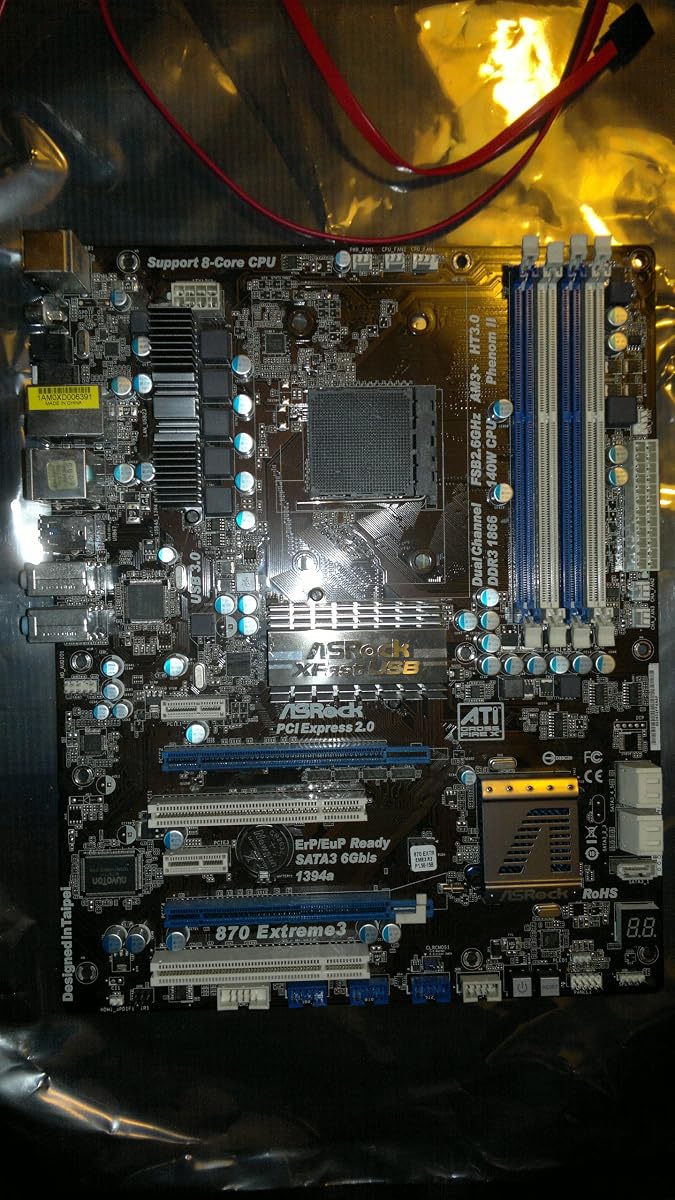
The ASRock 970 EXTREME3 carries a 3.6 rating and offers a straightforward full-size ATX option based on the AMD 970 and SB950 chipsets. It supports Socket AM3+, four DDR3 DIMM slots, two PCIe 2.0 x16 expansion slots, and five SATA3 ports with RAID support.
We may earn a commission when you buy through this link, at no additional cost to you.
Its expansion layout favors systems that may eventually need more than a basic CPU and graphics card. Two PCIe 2.0 x16 slots support a primary discrete graphics card and an additional accelerator, while two PCIe 2.0 x1 slots and two conventional PCI slots allow older or specialized cards to remain useful.
Connectivity includes two USB 3.0 ports and ten USB 2.0 ports. Storage support consists of five SATA3 connectors and one eSATA3 port. The board also uses a standard 24-pin main power connector and 8-pin CPU power connector, familiar conventions that can simplify installation for builders who have worked with older ATX systems.
The 970 EXTREME3 makes sense for an ATX case and an AM3+ processor when the builder values established expansion support and RAID-capable SATA3 storage. Its rating is lower than those of the leading selections, and it does not offer the newest USB interface or the 64GB memory ceiling of the 970A-G/3.1. It remains a balanced full-size option for compatible legacy hardware.
Five SATA3 connectors support RAID 0, 1, 5, and 10, while eSATA3 provides a path for an external high-speed drive. The arrangement is well suited to a desktop that already relies on multiple conventional hard drives.
Two full-length PCIe slots and two PCI slots provide a generous mix of modern and legacy expansion. This makes the board useful when a system must accommodate older capture cards, networking adapters, or additional graphics hardware.
We may earn a commission when you buy through this link, at no additional cost to you.
The ASRock 960GM-VGS3 FX has a 3.7 rating and is a compact option for users who want to reuse an AM3+ processor without building a full-size ATX system. Its AMD 760G foundation, MicroATX form factor, and support for processors with up to eight cores make it relevant for entry-level legacy desktops and compact office systems.
We may earn a commission when you buy through this link, at no additional cost to you.
The board includes solid capacitors for CPU power, 5.1-channel HD audio through a Realtek ALC662 codec, Gigabit Ethernet, and ASRock features such as X-Boost, XFast 555, and App Charger. Its memory section supports dual-channel DDR3 at speeds up to 1866 with overclocking, giving it enough performance for general productivity tasks and light multimedia use.
Because the supplied information focuses on the 760G platform rather than a modern processor, users should not treat it as a high-end overclocking or multi-GPU solution. Its strongest use is practical: keeping an older processor usable in a smaller enclosure while retaining useful features such as integrated audio and wired networking.
This model is best for a compact general-purpose build, repair, or inexpensive AM3+ upgrade. Buyers should confirm processor and memory support directly and ensure that their operating system has appropriate drivers. The 3.7 rating reflects a solid but dated platform, and the MicroATX footprint makes it more approachable for everyday legacy computing than a full enthusiast board.
The MicroATX design reduces the space required for an AM3+ system. That makes the 960GM-VGS3 FX a natural consideration for small office builds, secondary computers, and projects centered on reusing existing components.
Integrated graphics, 5.1-channel audio, Gigabit Ethernet, and dual-channel memory cover the fundamentals of a functional everyday desktop. ASRock's X-Boost and XFast 555 features add platform-specific utilities for supported processors.
We may earn a commission when you buy through this link, at no additional cost to you.
The ASRock 880GXH/USB3 is the most visually oriented board in this selection, with a 3.0 rating and support for the AM3 socket. Its defining feature is integrated ATI Radeon HD 4250 graphics with 512MB of shared memory, allowing a compatible processor to output video without requiring a discrete graphics card.
We may earn a commission when you buy through this link, at no additional cost to you.
The board includes VGA, DVI, and HDMI outputs, making it useful for adapting an older computer to different displays. It also provides Realtek ALC892 7.1-channel audio and Gigabit Ethernet. A PCIe 2.0 x16 slot supports ATI Hybrid CrossFireX, while two PCIe 2.0 x1 slots and three conventional PCI slots offer additional expansion.
Storage and memory are the main constraints. Five SATA2 ports support RAID 0, 1, 10, and JBOD, alongside an ATA133 channel and eSATA2. Four DDR3 slots support up to 16GB, which is low by modern standards and even by the standards of several other boards in this guide.
The 880GXH/USB3 is best for a value-oriented legacy desktop where integrated graphics and legacy connections matter more than high-speed storage or large memory capacity. Its low rating and older SATA2 interface limit it as a general recommendation, but its broad display support and full ATX layout remain distinctive for compatible AM3 processors.
VGA, DVI, and HDMI allow the board to work with a wide variety of displays. Integrated Radeon HD 4250 graphics can make it possible to revive an AM3 processor for basic desktop use without adding a graphics card.
Five SATA2 ports, eSATA2, an ATA133 channel, and several PCI slots offer broad support for older drives and expansion cards. The RAID options are useful when the system is being configured around conventional hard disks rather than modern SSDs.
We may earn a commission when you buy through this link, at no additional cost to you.
The ASRock 870 EXTREME3 R2.0 has a 3.9 rating and uses the AMD 870 and SB850 chipsets to deliver a well-equipped full-size AM3+ platform. It supports both AM3+ and AM3 processors, up to 32GB of dual-channel DDR3 memory, and a strong collection of storage and expansion connections.
We may earn a commission when you buy through this link, at no additional cost to you.
Five SATA3 ports support RAID 0, 1, 0+1, and 5, and there is also an eSATA3 connection. Two PCIe 2.0 x16 slots operate at x8 when configured for ATI Quad CrossFireX or CrossFireX. Additional expansion comes from two PCIe 2.0 x1 slots and two PCI slots, which is especially useful for systems retaining older hardware.
Connectivity includes two USB 3.0 ports and twelve USB 2.0 ports. It also has two IEEE 1394 ports, coaxial and optical S/PDIF outputs, Gigabit Ethernet through an Atheros controller, and Realtek 7.1-channel HD audio. Wake-on-LAN support adds another practical network feature for an established workstation.
The 870 EXTREME3 R2.0 is a good fit for a legacy desktop that needs RAID storage, multi-GPU capability, or numerous specialized connections. Its full ATX format demands a correspondingly sized case, and the 32GB memory ceiling is below the 64GB offered by the 970A-G/3.1. Within its category, however, it balances storage, expansion, and connectivity well.
Five SATA3 connectors and support for RAID 0, 1, 0+1, and 5 make this board suitable for multi-drive legacy systems. The eSATA3 port can also accommodate an external high-speed storage device.
Twelve USB 2.0 ports, two USB 3.0 ports, IEEE 1394, and digital audio outputs cover a broad range of peripherals. These older interfaces are valuable when preserving equipment that was designed for the AM3 era.
We may earn a commission when you buy through this link, at no additional cost to you.
The ASRock 990FX EXTREME3 is designed for enthusiast-oriented AM3+ systems and carries a 3.8 rating. Its AMD 990FX and SB950 chipsets support Socket AM3+ and AM3 processors, up to 140W of processor power, and an unusually broad set of graphics expansion options for the platform.
We may earn a commission when you buy through this link, at no additional cost to you.
Three PCIe 2.0 x16 slots are provided, with one operating at x4. Depending on compatible graphics hardware, they support AMD Quad CrossFireX, three-way CrossFireX, NVIDIA Quad SLI, or SLI configurations. A PCIe 2.0 x1 slot and two PCI slots add further expansion. This is a motherboard for deliberate platform planning, not a basic office upgrade.
The storage section includes five SATA3 ports with RAID 0, 1, 5, and 10 support, plus eSATA3. Memory consists of four DDR3 DIMM slots supporting up to 32GB. Broadcom Gigabit Ethernet includes Wake-on-LAN, while Realtek 7.1-channel audio supports THX TruStudio Pro. Two USB 3.0 and twelve USB 2.0 ports cover peripheral needs.
The 990FX EXTREME3 is best for enthusiasts assembling a high-end AM3+ workstation or a specialized multi-graphics system around components they already own. It lacks M.2 support and offers only a 32GB memory ceiling, so it is not as flexible for modern compact storage. Even so, its processor power allowance and extensive PCIe layout make it the strongest dedicated enthusiast option here.
Three full-length PCIe slots provide more graphics capacity than most competing AM3-era boards. Quad CrossFireX, three-way CrossFireX, Quad SLI, and SLI support can deliver substantial graphics throughput when the selected cards and drivers are compatible.
Support for processors up to 140W, untied overclocking features, Hyper-Transport 3.0, and AMD Cool 'n' Quiet technology position the board for higher-power legacy configurations. Broadcom networking and premium audio hardware round out the enthusiast feature set.
We may earn a commission when you buy through this link, at no additional cost to you.
The ASRock 970DE3/U3S3 combines an unusual model name with a recognizable AMD 770 and SB710 platform, earning a 3.9 rating. It supports Socket AM3+ and AM3 processors, dual-channel DDR3 memory up to 32GB, and a full ATX layout with both newer PCIe and conventional PCI expansion.
We may earn a commission when you buy through this link, at no additional cost to you.
Its most distinctive feature is a PCIe 3.0 x16 slot, which distinguishes it from most AM3-era motherboards whose graphics slots operate under PCIe 2.0. Three PCIe 2.0 x1 slots and two conventional PCI slots provide additional expansion. The available graphics and device bandwidth therefore depends on which of these slots the chosen hardware uses.
Storage is divided between two SATA3 ports and six SATA2 ports, with RAID 0, 1, 10, and JBOD support. It also retains an ATA133 channel, which is helpful for older optical drives and hard disks. There are two USB 3.0 ports, ten USB 2.0 ports, Gigabit Ethernet, and separate PS/2 connections for keyboard and mouse.
This board is best for a builder who values the unusual PCIe 3.0 slot or wants access to several older storage devices. Its mixed SATA generations and lack of M.2 support limit modern storage options, while the ATX size rules out many compact cases. For the right legacy system, however, it provides a distinctive combination of expansion and connectivity.
The primary PCIe 3.0 x16 slot offers a meaningful specification difference from typical AM3 boards. It can be valuable with a compatible graphics card, although other platform components still operate under older PCIe standards.
Six SATA2 ports, two SATA3 ports, and an ATA133 channel preserve compatibility with a broad collection of legacy storage hardware. This makes the board particularly interesting for restoring or extending an older desktop.
We may earn a commission when you buy through this link, at no additional cost to you.
The ASRock 890FX Deluxe4 has a 5.0 rating, making it one of the strongest selections by customer feedback in this guide. It uses the AMD 890FX and SB850 chipsets, supports Socket AM3 processors, and offers a full ATX layout focused on substantial storage and multi-graphics expansion.
We may earn a commission when you buy through this link, at no additional cost to you.
Six SATA3 connectors support RAID 0, 1, 5, and 10. Two more SATA3 connections are listed through a Marvell SE9120 controller, and an eSATA3 port extends the high-speed storage options. For builders with several conventional hard drives, this is a notably generous arrangement. Four USB 3.0 ports and ten USB 2.0 ports support both newer and older peripherals.
Two PCIe 2.0 x16 slots support Quad CrossFireX, while additional conventional PCI and PCIe x1 expansion allows specialized cards to be retained. Realtek 7.1-channel audio and Gigabit Ethernet cover standard desktop functions. The board uses a 24-pin main connector and an 8-pin CPU power connector.
The 890FX Deluxe4 is best for an AM3 system whose priorities are numerous SATA drives, RAID capability, and multiple graphics cards. The 16GB memory limit and lack of AM3+ support are important constraints, and it has no M.2 connection for compact modern SSDs. With the highest listed rating and rich legacy connectivity, it remains an excellent choice for the right components.
Six internal SATA3 ports plus two controller-based SATA3 connections provide exceptional flexibility for conventional drives. RAID support and eSATA3 make the board well suited to storage-intensive legacy workstation concepts.
Quad CrossFireX support allows multiple compatible graphics cards to work together, while ten USB 2.0 and four USB 3.0 ports accommodate a wide range of equipment. The balance favors established AM3 workstations over modern compact PCs.
We may earn a commission when you buy through this link, at no additional cost to you.
Selecting an AM3 motherboard is primarily a compatibility exercise. Confirm the socket, processor model, memory type and capacity, case size, graphics requirements, storage devices, and operating system before choosing a board.
AM3 and AM3+ are closely related but not identical in every respect. Several boards in this guide accept both socket types, while others explicitly support only AM3. AM3+ can accommodate certain later AM3-compatible processors, but socket labeling alone does not guarantee that every board can power or initialize every CPU. Check the manufacturer's processor list for the exact model, including any exceptions for particular Phenom II models.
Also consider the processor's power requirement and integrated graphics. The 990FX EXTREME3 supports CPUs up to 140W, whereas the 760GM-HDV supports up to 125W. Integrated graphics support can also determine whether a separate graphics card is necessary. A supported socket is only the first step; power limits, BIOS support, and graphics features also matter.
The chipset determines much of the board's character. The AMD 970 and SB950 combination found in the 970A-G/3.1 and 970 EXTREME3 supports modernized SATA3 and USB 3.x connectivity on an AM3 platform. The 990FX EXTREME3 targets high-end multi-GPU configurations, while the 890FX and 870 boards emphasize RAID storage and legacy expansion.
Expansion slots matter when using discrete graphics, capture devices, network cards, or specialized controllers. Check both the number of slots and their electrical operating mode. Two physical PCIe x16 slots do not always mean two cards can run at full x16 bandwidth, as noted for the 990FX EXTREME3, 870 EXTREME3 R2.0, and 970A-G/3.1.
Every board in this selection uses DDR3 memory rather than DDR4 or DDR5. Confirm that the modules are unbuffered, non-ECC DDR3 and are compatible with the board's supported speeds. Mixing module capacities and speeds can reduce performance or prevent the full memory configuration from operating as expected.
Capacity requirements vary sharply among the choices. The 970A-G/3.1 supports up to 64GB, the 870 EXTREME3 R2.0 and 990FX EXTREME3 support up to 32GB, and the 880GXH/USB3 and 890FX Deluxe4 support up to 16GB. Those limits are especially relevant to 64-bit operating systems, virtual machines, memory-heavy workstations, and large creative projects.
SATA version can materially affect the experience with an older motherboard. The 970A-G/3.1, 970 EXTREME3, 870 EXTREME3 R2.0, 990FX EXTREME3, and 890FX Deluxe4 provide SATA3 connections, while the 880GXH/USB3 uses SATA2 and the 970DE3/U3S3 mixes two SATA3 and six SATA2 ports. A SATA3 drive can often operate on a SATA2 controller at reduced speed, so the interface choice affects transfers.
RAID support is another differentiator. Several boards list RAID 0, 1, 5, and 10, while the 880GXH/USB3 adds JBOD and the 970DE3/U3S3 also lists JBOD. RAID does not create a backup, and RAID 0 does not provide redundancy. Confirm drive compatibility, boot-device support, and operating-system driver requirements before assembling an array.
Some AM3 processors include integrated graphics, but motherboard support varies. The 880GXH/USB3 explicitly includes Radeon HD 4250 graphics with VGA, DVI, and HDMI outputs. Other boards may depend on a supported processor with integrated graphics or require a discrete graphics card. Check the board manual and processor specifications rather than assuming all AM3 boards provide video.
For a dedicated graphics card, confirm the primary PCIe slot's operating mode and whether multiple-card arrangements are officially supported. Multi-GPU platforms also require compatible cards, suitable power delivery, adequate spacing, and a case that can accommodate the physical hardware. The 890FX Deluxe4 and 990FX EXTREME3 are strongest in this area, while simpler office-oriented boards may have no need for it.
ASRock offers both full-size ATX and compact MicroATX boards in this category. ATX models such as the 970A-G/3.1, 990FX EXTREME3, and 890FX Deluxe4 require a chassis that accepts ATX motherboards. The 970M PRO3, 760GM-HDV, and 960GM-VGS3 FX use MicroATX and may fit a broader range of cases, including some designs that do not accept ATX boards.
Physical size is only one part of the fit. Large graphics cards, tall CPU coolers, and dense rear-port arrangements can interfere with smaller cases even when the motherboard format fits. Check maximum component dimensions and compare them with the case's specifications. Full-size boards usually provide more rear ports and expansion slots, while MicroATX boards can reduce the overall footprint.
Modern external-device support varies considerably. The 970A-G/3.1 includes USB 3.1 with a Type-C connector, while several alternatives stop at USB 3.0. The 890FX Deluxe4 has four USB 3.0 ports, and the 880GXH/USB3 offers only one USB 3.0 port. Older peripherals remain important too, with many boards providing numerous USB 2.0 connections and legacy PS/2, IEEE 1394, or optical audio sockets.
All ten products list Gigabit Ethernet, making wired networking available for compatible processors. Audio capabilities range from 5.1-channel sound on the 960GM-VGS3 FX to Realtek 7.1-channel codecs with S/PDIF on several enthusiast models. Choose based on the actual audio equipment, speaker arrangement, and legacy interfaces you intend to use.
AM3 boards predate several modern operating systems and may lack current drivers for their networking, audio, and integrated graphics components. Windows 10 can be relevant for some legacy configurations, while newer releases may have narrower hardware support. Linux compatibility varies by distribution, kernel, and device driver, particularly for older chipsets and integrated graphics.
Before committing, check the operating system version, networking driver, graphics driver, and any required RAID or storage drivers. This is especially important for niche models such as the 970M PRO3, where the supplied data confirms the major platform features but does not lay out every connector or driver. Compatibility research is part of the purchase, not an afterthought after assembly.
Before installation, read the manual, identify the socket type, install the correct CPU, and confirm that the chosen heatsink and power supply match the processor. Install memory according to the board's recommended slot order for dual-channel operation. Connect the 24-pin power connector, 8-pin CPU power connector, storage cables, front-panel wiring, and the correct display output.
Enter the BIOS after the first boot to confirm that the processor, memory, storage devices, and correct date are detected. Confirm that the boot order matches your intended drive and enable only the relevant platform features. If a new drive is not listed, verify its connection type and mode before changing firmware settings or considering replacement hardware.
Keep the board stable by using a surge protector, maintaining airflow around the heatsink and power connectors, and avoiding exposed conductive objects near open slots. Dust can restrict airflow and contribute to overheating. Update chipset, networking, audio, and graphics drivers only from reputable sources, and take regular backups because RAID and legacy storage systems are not substitutes for separate backups.
Some AM3+ processors can physically fit in an AM3 socket, but compatibility depends on the board's chipset, BIOS, power delivery, and supported processor list. A socket fit alone does not guarantee operation. Check the ASRock support information for the exact CPU and confirm that the board supplies adequate power before purchase.
AM3+ boards can support certain later processors that may require more power or newer electrical characteristics than earlier AM3 boards fully support. AM3-only boards remain suitable for many compatible Phenom II, Athlon II, and Sempron processors. The processor support list, chipset, and BIOS version should determine which board is appropriate.
No. The motherboards in this guide use DDR3 memory and are not compatible with DDR4 because the physical notch and electrical design differ. Confirm the memory standard and supported module capacity before ordering. For systems already using AM3, DDR3 is also generally the only memory type supported by the platform.
It depends on both the board and the processor. The ASRock 880GXH/USB3 explicitly has Radeon HD 4250 integrated graphics with VGA, DVI, and HDMI, while some other boards rely on a processor with integrated graphics. Boards without confirmed integrated graphics generally need a compatible discrete graphics card for display output.
Only the ASRock 970A-G/3.1 has a confirmed M.2 connector, and it supports an M.2 PCIe 2.0 x4 device according to the supplied specifications. The other boards do not have a confirmed M.2 interface, so an NVMe drive would require an appropriate PCIe adapter and compatibility with the board's available lanes and drivers. SATA SSDs are generally the simpler choice.
No. RAID can improve availability, performance, or storage flexibility, but it does not protect against accidental deletion, malware, theft, or physical failure affecting an entire array. RAID 0 provides no redundancy, while RAID 1, 5, or 10 still require regular backups to an independent device or location.
The MicroATX options are the 970M PRO3, 760GM-HDV, and 960GM-VGS3 FX. Among them, the 970M PRO3 offers a modernized 970 chipset and CrossFireX support, while the 760GM-HDV and 960GM-VGS3 FX are more compact-oriented 760G boards. Confirm case dimensions, processor requirements, and component clearances before selecting one.
Support varies by model and operating-system release. Older chipsets and components may have limited or discontinued driver availability, even when the hardware can technically run an operating system. Check motherboard support pages, networking and audio drivers, and integrated graphics compatibility before installation. A backup plan is essential when reusing an aging platform.
The ASRock 970A-G/3.1 is the strongest overall selection because it combines AM3+ support, a 64GB memory ceiling, six SATA3 ports, M.2 storage, and USB 3.1 Type-C. The 970M PRO3 is the leading compact option, while the 890FX Deluxe4 stands out as the premium storage choice with its 5.0 rating and extensive SATA3 connectivity.
Prioritize exact processor compatibility, required memory capacity, case format, and storage needs before considering secondary features. A board with the correct socket and expansion layout may serve an AM3 build better than a more elaborate model that does not fit the processor, case, or devices already in hand. Integrated graphics, RAID, and multi-GPU support matter only when the planned system will use them.
Current prices, listing details, and availability can change, so check the latest product page before ordering. Verify the exact model number, supplied processor list, memory support, connector layout, operating-system drivers, and included accessories. Those checks are especially important with an older platform, where accurate compatibility information is the foundation of a successful build.