
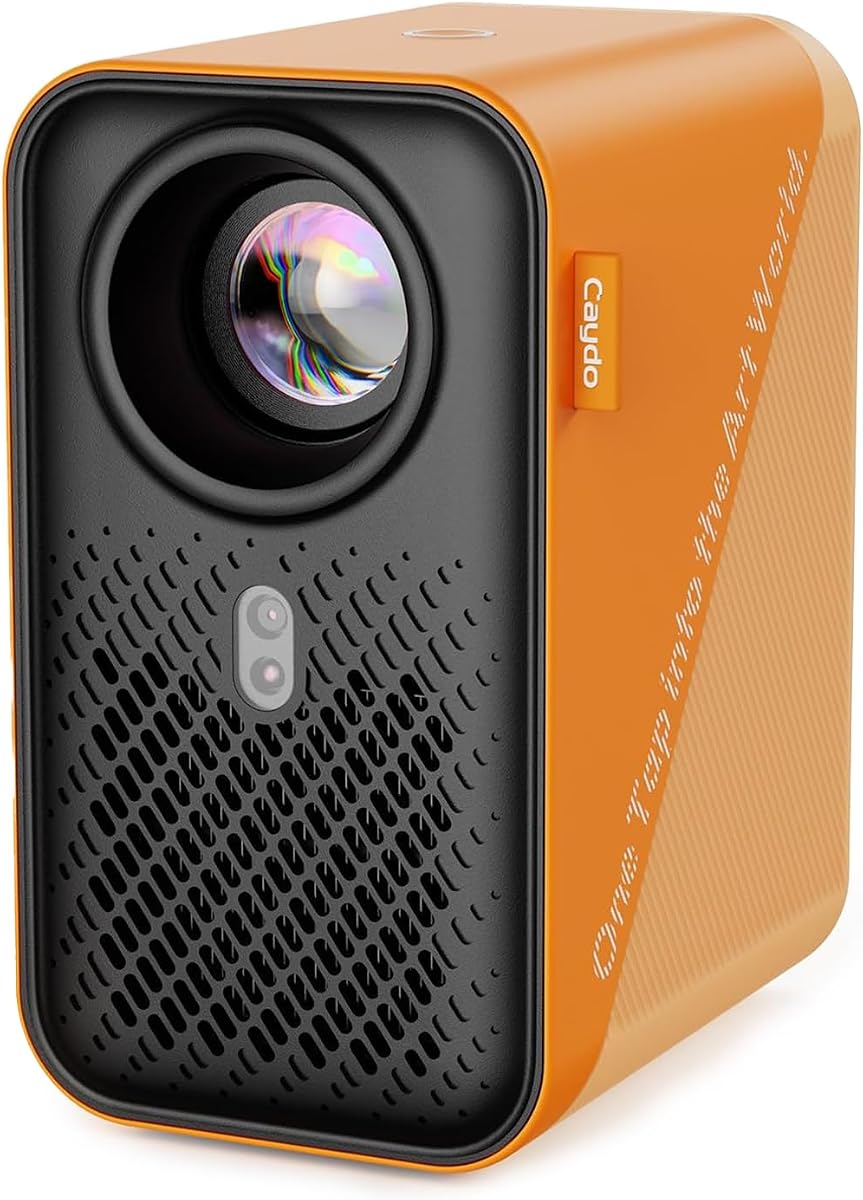
Caydo S1 Art Projector
5.0Editor score
Dedicated optical tracing
20-to-80-inch projection
20,000-hour LED life
Compare 10 leading art tracing projectors for brightness, connectivity, focus, image controls, portability, and ease of use in this expert buying guide.
An art tracing projector places a reference image on a wall, canvas, tabletop, or other work surface so artists can transfer outlines with greater accuracy and less guesswork. The best models combine sharp projection, simple image adjustment, flexible placement, and dependable connections for phones, tablets, computers, and USB drives.
This guide compares ten art tracing projectors based on the stated resolution, brightness, focus features, image controls, connectivity, placement options, and intended creative uses. It covers digital projectors that display files as well as a dedicated optical projector for printed line art, helping readers distinguish between different approaches.
Each review highlights the strongest benefit, practical limitations, and the artist or crafter most likely to appreciate the product. Ratings and specifications reflect the supplied product information, while current prices and availability can change, so shoppers should confirm the latest listing details before purchasing.
5.0Editor score

4.0Editor score

5.0Editor score
The table below compares the ten projectors by projection method, resolution, image controls, connections, and placement flexibility, making it easier to identify the model that matches a particular tracing workflow.

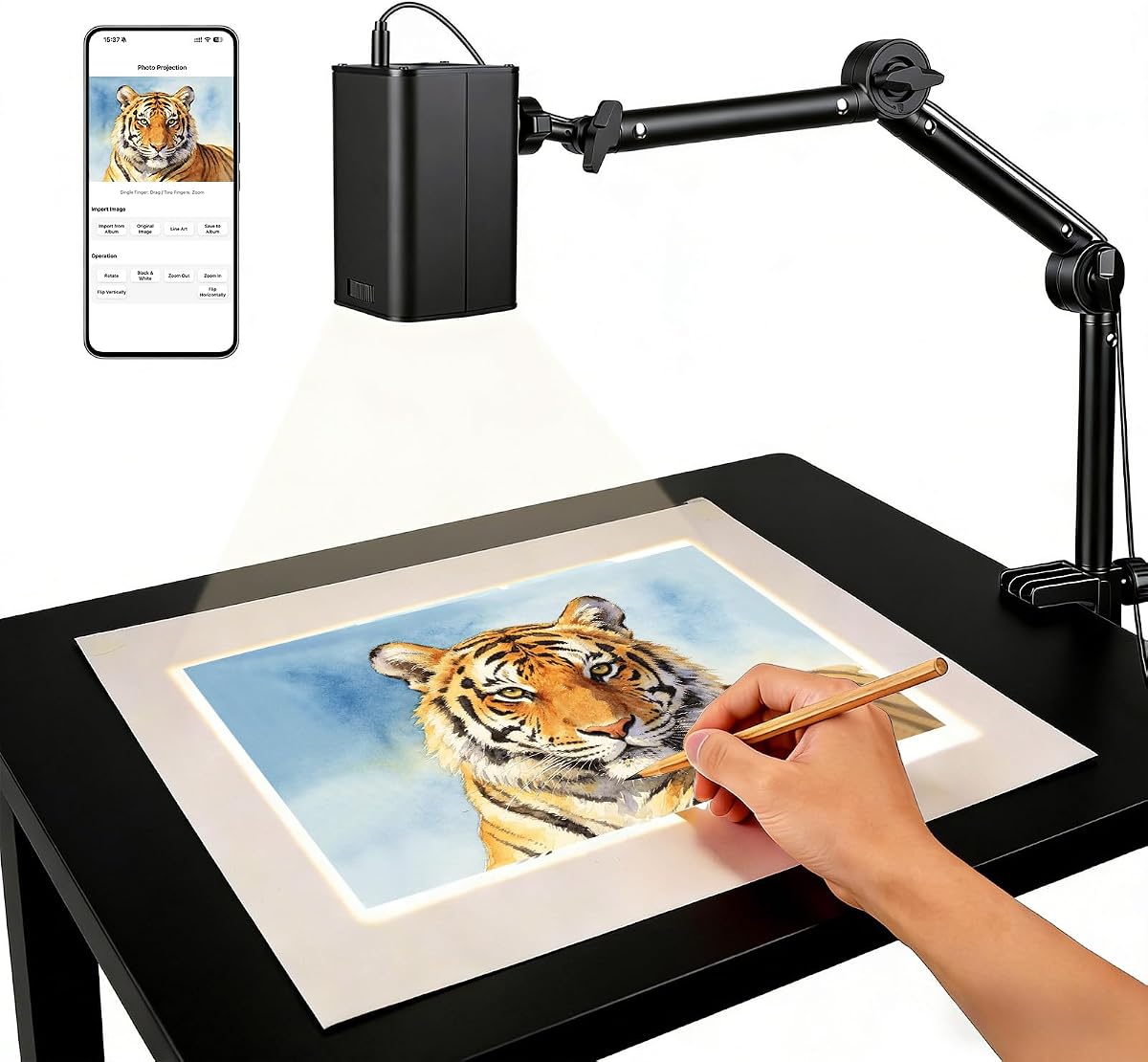


The Art Projector for Tracing and Drawing earns a 4.5 rating and stands out for a balanced approach to wireless tracing. Instead of requiring a dedicated mobile application, it uses a QR code and browser-based controls for rotation, scaling, and other projection settings. This keeps the workflow approachable for artists who want to move from a phone or tablet to a projected reference without managing extra software.
We may earn a commission when you buy through this link, at no additional cost to you.
Its dual-band WiFi is designed to provide a stable, low-latency connection for detailed sketches and intricate line work. Manual focus adjustment gives the user direct control over sharpness, while the adjustable stand can be raised, lowered, or tilted for horizontal canvases, walls, and small craft projects. The supplied information also indicates that offline operation is supported, which is valuable in studios, workshops, and locations with unreliable internet access.
The main drawback is that the product data does not specify native resolution or ANSI brightness, making direct comparison with the more technical Caydo models difficult. It also lacks the richer drawing modes, automatic keystone correction, and automatic focus found on higher-end digital projectors. Those omissions may matter to artists who need highly precise geometric reproduction or rapid changes to image scale.
Despite those limitations, this projector is a strong general-purpose choice for students, hobbyists, teachers, and working artists who value flexible connectivity. It is particularly attractive for users who dislike app-dependent controls and need a projector that can handle both connected and offline creative sessions. For most general tracing workflows, it offers an unusually accessible combination of wireless control and physical placement flexibility.
The app-free web interface lets a phone act as a remote control after scanning a QR code. Rotation, scaling, and focus adjustments are grouped into a browser-based experience that can be more approachable than installing and navigating a dedicated application.
The adjustable stand changes both height and tilt, allowing the projector to work with vertical walls, horizontal canvases, and smaller craft projects. This is especially useful when the same reference needs to be transferred to several differently shaped surfaces.
We may earn a commission when you buy through this link, at no additional cost to you.
The Caydo P3 is an Editor's Choice because it combines native 1080P resolution, 400 ANSI lumens, automatic focus, and a versatile drawing assistant in one package. Those specifications make it the most technically complete option in this group for artists who need a clear, controllable image across a broad range of creative assignments.
We may earn a commission when you buy through this link, at no additional cost to you.
The built-in 360-degree swivel base removes the need for a separate stand when projecting onto walls, tilted easels, chalkboards, or ceilings. Drawing tools include 0-to-200% zoom, 360-degree rotation, 3-by-3 grids, three background colors, and four artistic modes named Gridify, Sketchify, Comicize, and Monochromize. These functions help an artist simplify a photograph, compare proportions, and compose a reference before placing pencil or charcoal on the surface.
Image transfer can happen through a QR code and app or through the included 8GB USB flash drive, which is valuable for artists working without a stable connection. Automatic focus reportedly becomes clear in under three seconds, and keystone correction helps maintain proportion. The stated 3.6-to-8.7-foot projection range, 4K video playback support, and 30,000-hour lamp life add flexibility beyond basic tracing. Copyrighted streaming services cannot be mirrored, however, so entertainment compatibility is limited.
This is the strongest all-around recommendation for a professional artist, serious student, or instructor who wants crisp specifications and sophisticated image controls. It may be more than a beginner needs, but the combination of brightness, resolution, offline file support, and automated setup makes it easier to move quickly from reference preparation to actual artwork.
Zoom, rotation, grids, background colors, and artistic modes provide useful ways to simplify a source image before tracing. These controls can improve line visibility and make it easier to match proportions on a larger surface.
With 400 ANSI lumens and native 1080P resolution, the P3 is well suited to rooms that are not completely dark. The combination should also preserve fine line detail better than lower-resolution or unspecified alternatives.
We may earn a commission when you buy through this link, at no additional cost to you.
The Caydo S1 holds a 5.0 rating and represents a different approach from the digital projectors in this roundup. It is a dedicated optical tracing device: place a printed image beneath the 5-by-5-inch copy area, plug in the projector, and trace the projected outline. There is no wireless module, HDMI input, or USB input, and no media playback features to complicate the process.
We may earn a commission when you buy through this link, at no additional cost to you.
The S1 enlarges artwork from 2.5 to 11 times, producing a diagonal projection from 20 to 80 inches. A smooth sliding focus knob allows quick manual correction as the projector is repositioned. Its built-in handle, non-slip base, cord compartment, and front tool tray make it feel purpose-built for a studio, classroom, garage, or portable art setup rather than a general entertainment projector.
Its strongest limitation is environmental: as with a traditional opaque projector, the projected outline is most visible in a darkened room with overhead lights off and curtains closed. The device also cannot display a photograph from a phone or load a digital file. The stated LED life of up to 20,000 hours reduces maintenance, although the base may warm during extended sessions as a normal LED behavior.
For artists who already have clean printed line art and want the least complicated tracing process, the S1 is an excellent value. It removes wireless connections, apps, and menus from the workflow. Choose it over a digital model when simplicity, physical artwork, and large optical enlargement matter more than viewing digital files or working in a brightly lit room.
The S1 is built for artists who prefer placing a printed reference beneath the lens. That direct optical method eliminates file transfer, wireless pairing, and software navigation, leaving only placement, focus, and tracing.
Moving between 20-inch and 80-inch diagonal projections gives the S1 considerable range for sketches, studies, lettering, and wall outlines. Re-focusing after each move is necessary, but the sliding knob is designed to make this adjustment quick.
We may earn a commission when you buy through this link, at no additional cost to you.
The Caydo P1 has a 3.8 rating and offers a broad collection of tools for artists who want more control than a basic screen mirror. Its built-in drawing app includes zooming, 360-degree rotation, 3-by-3 grids, background color choices, and four artistic modes. Those features can turn a photograph or design into a more useful tracing reference before projection begins.
We may earn a commission when you buy through this link, at no additional cost to you.
The upgraded version 1.8 supports image transfer through an app and QR code or through a USB drive, and it offers EShare, AirPlay, and Miracast screen mirroring. Automatic focus, automatic screen fit, and keystone correction simplify setup, while the stated projection distance of 3.1 to 10.5 feet offers considerable placement flexibility. The sealed optical core is intended to reduce dust entry and associated image degradation.
The P1 is less impressive than the P3 and P2 in two stated areas: its lamp life is up to 10,000 hours rather than 30,000, and its brightness is not specified. It also carries the same restriction on mirroring copyrighted content from services such as Netflix and Hulu. Its 3.8 rating suggests it may be less consistently satisfying across every use case than the best-rated models.
It remains a credible choice for painters, designers, instructors, and students who value the built-in drawing app and broad mirroring support. Artists willing to compare the newer P2 and P3 specifications may find those models more future-oriented, but the P1 can still deliver a practical and feature-rich tracing setup.
The P1 makes it possible to rotate, enlarge, grid, and stylize a reference without leaving the project workflow. These options are more useful for drafting than a basic projector that only mirrors a device screen.
QR code transfers, USB media, and three mirroring methods provide several ways to bring in artwork. The sealed optical core also targets long-term image quality by limiting dust-related degradation.
We may earn a commission when you buy through this link, at no additional cost to you.
This 5G WiFi art projector has a 3.5 rating but shares several appealing qualities with the first-ranked model. It uses app-free web control, allowing users to scan a QR code and adjust projection settings, image rotation, and scaling through a phone or tablet browser. The result is a less application-dependent experience for casual artists and beginners.
We may earn a commission when you buy through this link, at no additional cost to you.
Its upgraded 5G and 2.4G dual-band chip is intended to provide a stable connection with less latency than standard wireless setups. The projector also supports local offline use, which is helpful for studio work or remote locations. An adjustable stand changes height and tilt so references can be projected onto horizontal canvases, walls, and small DIY projects.
The main concern is the lack of stated resolution and brightness information. Without those specifications, it is difficult to judge fine-line clarity or performance in ambient light. Manual focus is useful, but a 3.5 rating may also indicate that the overall experience is not as consistent as the strongest alternatives. The product nevertheless supports a wide range of applications, including architectural tracing, cookie decoration, and art instruction.
Shoppers who prioritize simple browser-based control and an adjustable physical setup should give it serious consideration. It is best suited to users who will work primarily in a controlled room and already understand the importance of a dark tracing environment. Those needing verifiable sharpness, automatic setup, and comprehensive drawing modes may prefer a specified-resolution model.
Browser control keeps setup centered on a QR code and familiar phone interface. It is a practical advantage for artists who switch devices or do not want to maintain a dedicated projector application.
Offline operation means a weak internet connection does not have to stop a tracing session. Combined with adjustable placement, this supports studio, classroom, and remote creative environments.
We may earn a commission when you buy through this link, at no additional cost to you.
The HI-REEKE art projector has a 3.7 rating and distinguishes itself through a substantial three-section metal stand measuring 32.3 inches. It can project an image from 9.5 to 150 inches, making it suitable for everything from embroidery and small craft details to canvas, leather, fabric, wood, and mural outlines.
We may earn a commission when you buy through this link, at no additional cost to you.
Its native 1280-by-720 resolution provides a clearly stated baseline for line-art visibility. Manual focus, keystone correction, and image zoom give users direct control over sharpness, alignment, and scale. Compatible content can be sent through 2.4G WiFi, USB, or HDMI, while supported iOS and Android devices provide convenient access to reference images.
The included remote makes routine changes easier without approaching the projector, and the unit weighs approximately three pounds, so it can be repositioned with less effort. The trade-off is that 2.4G WiFi is less suited to busy networks than dual-band models, and focus is not automatic. Its 3.7 rating also suggests that some users may find aspects of the overall experience less compelling.
This projector is best for artists working across unusually large or unusually small surfaces who also value a tall, robust stand. It is particularly relevant to mural artists, pattern makers, and crafters working on multiple substrates. For users prioritizing automatic focus, higher resolution, or modern dual-band wireless performance, one of the Caydo models offers a more advanced specification set.
The three-section metal stand can be rotated for overhead or angled placement and reaches 32.3 inches. This creates more freedom than a compact desktop projector when matching the height of a wall, easel, or oversized workpiece.
WiFi, USB, and HDMI connections accommodate both connected devices and locally stored files. The 9.5-to-150-inch range allows one projector to serve detailed craft work and large composition outlines.
We may earn a commission when you buy through this link, at no additional cost to you.
The Caydo P2 combines native 1080P resolution, 250 ANSI lumens, and a drawing assistant designed to remain available offline. It is a strong option for artists who want to transfer an image with a QR code or USB drive and then continue working without depending on a live wireless connection.
We may earn a commission when you buy through this link, at no additional cost to you.
Zoom from 0 to 200%, 360-degree rotation, a 3-by-3 grid, four artistic modes, and three background colors give users meaningful control over reference preparation. The rotating base allows projection onto walls, ceilings, tabletops, and tilted canvases. Automatic focus, manual focus, and keystone correction help maintain a sharp and proportional image, while the stated 2.3-to-5.8-foot throw distance produces images from 40 to 100 inches.
Compared with the P3, the P2 has lower stated brightness and a shorter maximum projection distance. That may make it less suitable for a large room or a wall-sized mural, though its native 1080P resolution remains a strong specification. The P2 also supports 4K video playback, dual-band WiFi, Bluetooth 5.4 audio, and a 30,000-hour lamp life, but Bluetooth is limited to audio rather than video.
The P2 is most appropriate for an artist who prioritizes detailed resolution, offline drawing features, and flexible placement more than maximum room brightness. Compared with the P1, it offers a newer brightness specification, a longer lamp life, and offline operation for the drawing tools. It is a well-rounded mid-tier option, although the P3 remains stronger for bright environments and very large projections.
Once an image has been transferred, the P2's drawing controls continue to work without an internet connection. This makes the projector dependable in basements, rural studios, and other spaces where live mirroring would be unreliable.
The integrated rotating base changes the projection angle without requiring a separate stand. Artists can reposition the image across a wall, ceiling, tabletop, or tilted easel with less equipment.
We may earn a commission when you buy through this link, at no additional cost to you.
This art projector receives a 4.1 rating and stands out for a smart image-processing tool aimed specifically at tracing, drafting, and pattern work. In addition to keystone correction, rotation, and zoom, it offers line-art extraction and right-angle marking. Those features are particularly relevant to sewing patterns, technical drawing, mural outlines, and precision-oriented craft projects.
We may earn a commission when you buy through this link, at no additional cost to you.
The projector supports 1280-by-720 HD resolution and 4K video playback. Its projection can move from roughly smartphone size to a much larger wall image, while the included telescopic stand extends from 15 to 40 inches for desktop use. Four connection routes—phone upload, HDMI, USB, and wireless phone mirroring—make it possible to work with different reference sources, and the included USB drive supports offline use.
The image is described as clear without fully closing curtains and better in a darker room, but no numerical brightness is provided. The 720P resolution is adequate for many outlines and can be less revealing than native 1080P models when fine texture matters. The stand's clamp also requires a table edge less than 2.4 inches thick or protruding for a secure hold.
This is an attractive pick for sewists, decorators, teachers, and mixed-media artists who value image-processing tools over entertainment features. It can also handle drawing, painting, banners, cookie decoration, and presentations. Buyers who need the sharpest possible image should consider 1080P alternatives, while those with thicker tabletops should confirm stand compatibility before ordering.
Line-art extraction can reduce photographic detail into a more traceable outline, while right-angle marking helps preserve perpendicular relationships. These are useful additions for technical and pattern-based artwork.
Phone uploads, HDMI, USB, and wireless mirroring provide useful flexibility. The included USB drive also allows a project to continue offline, reducing dependence on stable WiFi.
We may earn a commission when you buy through this link, at no additional cost to you.
The KODAK Luma 150 Mini Projector Kit has a 5.0 rating and is the most mobile-oriented product in the roundup. Its compact white body, built-in battery, and included precision mounting hardware make it particularly useful for artists who trace in different locations, present overhead references, or need a projector that can be carried between studios.
We may earn a commission when you buy through this link, at no additional cost to you.
The battery lasts up to 2.5 hours, allowing a drawing or presentation session away from a continuous power source. Wireless streaming supports Android, iOS, and Windows through Miracast and AirPlay, while HDMI, USB, and microSD inputs cover wired and locally stored media. This variety of connections is more accommodating than relying on a single wireless standard.
The included adjustable overhead tripod and articulating arm clamp provide a level of placement precision that is particularly valuable for tracing. These tools can help keep the image aligned above a work surface or at a controlled angle, reducing the repeated adjustments that affect ordinary projector placement. The 60-ANSI-lumen DLP engine is compact and capable in dim or brightly lit environments, although 60 lumens is modest next to the 250- and 400-ANSI-lumen Caydo models.
Unlike the art-focused projectors, the Luma 150 does not advertise built-in grids, artistic modes, line-art extraction, or keystone-focused drawing tools. Its appeal lies instead in portability, precise mounting, battery freedom, and broad streaming support. It is best for a mobile artist, teacher, or craft presenter who values a complete positioning system more than specialized tracing software.
The adjustable overhead tripod and articulating clamp make it easier to position the projection consistently. Accurate alignment reduces the need to redraw lines that shifted because the projector was tilted or placed too low.
Up to 2.5 hours of battery life supports tracing and presentation away from a wall outlet. This is useful for mobile workshops, classroom demonstrations, and outdoor craft sessions where dependable power is limited.
We may earn a commission when you buy through this link, at no additional cost to you.
The Wireless Art Drawing Projector has a 3.4 rating and is designed as a relatively simple tracing tool for children, beginners, and artists working with Apple devices. It supports wireless screen projection or AirDrop for iPhone and iPad, while USB and HDMI inputs provide alternatives for compatible media sources and computers.
We may earn a commission when you buy through this link, at no additional cost to you.
Its adjustable focus lens supports an effective projection distance of 11 to 80 inches. The projected area can range from a small 6-by-10-inch image to approximately 60 by 90 inches, allowing a user to work on a desk, wall, or canvas. A height-adjustable stand and 360-degree holder make repositioning straightforward, while the folding, lightweight construction is convenient for storage.
The primary restriction is platform compatibility. Android phones are not supported for wireless projection, so buyers with an Android device would need to rely on USB or HDMI if the relevant file and device support that route. The stated 480P resolution is lower than every other digital model in the list, which may soften fine lines and reduce detail when the image is enlarged.
This projector makes the most sense for an Apple-equipped beginner who wants a lightweight, uncomplicated device for basic outlines, small crafts, and introductory projects. Its low rating and limited resolution mean it is less appropriate for detailed professional work, large murals, or a mixed household with both Apple and Android devices. The adjustable holder and compact body nevertheless make it a functional first tracing projector.
Wireless projection, AirDrop, USB, and HDMI offer straightforward ways to display a reference. The limited software feature set keeps the focus on getting an image onto the work surface.
The folding body and integrated adjustable holder make the projector easier to carry and store than a unit requiring a separate tall stand. It is well matched to children, beginners, and small creative workspaces.
We may earn a commission when you buy through this link, at no additional cost to you.
The right art tracing projector depends on whether you trace physical paper or digital files, the size of the finished work, the lighting in your room, and how much setup complexity you accept. Resolution, brightness, focus, image controls, connections, and mounting options should be considered together.
Optical projectors such as the Caydo S1 use a physical sheet of artwork placed beneath a copy area. They are exceptionally direct, need no apps or file transfers, and work best for printed line art in a dark room. Digital projectors display photographs, drawings, and other files from a phone, tablet, computer, or USB drive, offering more varied source material and useful image-processing controls. Choose based on the references you actually use rather than on the word projector alone.
Native resolution is one of the clearest ways to compare image detail. The Caydo P2 and P3 provide native 1080P, while the HI-REEKE and phone-compatible art projector list 1280 by 720. The KODAK uses a compact DLP engine, and the entry-level wireless model lists 480P. Higher resolution is especially helpful when enlarging fine line art, subtle photographic contours, facial features, or complex patterns. It cannot compensate for a poorly aligned projection, so sharp focus and correct placement remain equally important.
A darkened room makes faint lines much easier to see and allows lower-output projectors to remain useful. Higher stated brightness is valuable in classrooms, studios with ambient light, and daytime craft sessions. The Caydo P3 leads the listed specifications at 400 ANSI lumens, the P2 provides 250 ANSI lumens, and the KODAK Luma 150 uses a 60-ANSI-lumen engine. Some products do not provide brightness figures, which makes control of the environment especially important.
A tracing projector must hold a sharp, correctly proportioned image. Automatic focus and keystone correction reduce setup time, as seen on the P1, P2, and P3, while the S1, HI-REEKE, and app-free models use manual focus. Keystone correction compensates for angled placement, but perfectly square projection still starts with the projector facing the work surface. Users should consider how often they reposition the device and whether automatic adjustments justify the additional complexity.
Digital projectors can save time by adjusting the reference before it reaches the surface. Zoom, 360-degree rotation, 3-by-3 grids, background colors, and artistic modes help isolate contours and compare proportions. The phone-compatible projector adds line-art extraction and right-angle marking, which are useful for sewing and technical work. The P1, P2, and P3 have the most developed drawing assistants in the group. These controls are useful but not substitutes for correct placement, focus, or a clear projection surface.
Connection support should match the devices and files in your workflow. Dual-band WiFi can be more reliable on crowded networks than 2.4G-only WiFi, while browser control avoids an app installation. USB and HDMI are dependable alternatives when wireless performance is inconsistent. Apple-specific wireless projection may be unsuitable for Android households, and some models note restrictions on mirroring copyrighted streaming content. Always check device support, file formats, and whether image-transfer features work without a live internet connection.
The finished artwork determines the required image size and throw distance. The S1 scales printed work from 20 to 80 inches, the P2 supports 40 to 100 inches, and the HI-REEKE spans a much wider 9.5 to 150 inches. Larger ranges demand more careful placement and may require the included stand. Small craft projects need magnification control, while murals require enough brightness, stand height, and distance to place the entire composition accurately.
A projector that must move between rooms, workshops, or classes benefits from a folding body, carry handle, battery, and compact mounting system. The KODAK kit includes an overhead tripod and articulating clamp, while the S1 has a handle and built-in tool tray. Other models rely on adjustable stands with varying height ranges. Portability should be balanced against stability: a lightweight unit needs a secure base or correctly rated stand to keep the projected image from shifting.
Begin by choosing a clean, appropriately sized surface and setting up the projector before placing your original artwork. For a digital model, connect the phone, tablet, or computer using the preferred input, open the reference file, and use the rotation, zoom, grid, and keystone controls to establish a sharp, correctly proportioned image. For the S1, print the line art, place it under the copy area, and position the unit so the full outline fits the work surface.
Darken the room whenever possible and make small focus corrections from the normal viewing position. Use the stand or included mounting hardware to bring the lens level with the center of the intended image. Check several edges and corners, particularly when using keystone correction, because a rectangular projection can still be misleading near the limits of the adjustment. Start with light construction lines and confirm proportions before committing to a detailed outline.
Avoid leaving the lens aimed at direct sunlight or an intense heat source, and let the unit cool naturally after extended use. Keep vents unobstructed, clean the lens with a soft lint-free cloth, and store the projector in its case or on a stable surface. For digital units, transfer files through a USB drive when connectivity is uncertain; for optical units, keep printed originals flat and free from creases that could distort the projected lines.
A native 1080P model such as the Caydo P3 or P2 is generally the most appropriate choice for fine lines and enlarged references. The P3 also offers the highest stated brightness in this group, while the P2 retains useful drawing controls offline. Make sure the image is sharply focused and the projector is positioned squarely before tracing.
Most of the digital projectors support phones or tablets through wireless mirroring, QR-code-based transfer, USB, or HDMI. Compatibility varies: the entry-level wireless model supports Apple devices for wireless projection but not Android phones. Check the specific connection requirements and file formats before buying.
A dark room generally produces the clearest outlines and reveals faint details more easily. Higher-brightness models such as the Caydo P3 can be easier to see in ambient light, while optical projectors and lower-output devices benefit greatly from closed curtains and reduced overhead lighting.
An optical projector enlarges a physical sheet of artwork placed beneath a built-in copy area. It is simple and works well with printed line art in a dark room. A digital projector displays files from connected devices or storage media, supports photographs and editable images, and often provides grids, rotation, zoom, and artistic filters.
Yes, digital models are generally better suited to photographs because they can load an image file and sometimes extract simplified line art. The phone-compatible art projector specifically includes a line-art extraction tool. An optical model works only with physical artwork placed under its lens, so it cannot display a photograph directly from a phone.
Match the projected size to the physical dimensions of your canvas, wall, or craft surface. The included models range from about 20 inches to as much as 150 inches diagonally. Projection should match the original artwork closely, while a slightly larger image can be useful for sketches and room planning.
Several models support offline use. The S1 needs no digital connection at all, and the app-free projectors, P1, and P2 are described as supporting local or offline operation. For the digital models, using a USB drive is generally the most dependable way to load a file without relying on a network connection.
Sharp focus, stable placement, sufficient brightness, and accurate proportions matter most. Zoom and rotation help match the reference to the surface, while keystone correction can compensate for angle. A sturdy stand is also valuable because even a slight shift in the projector can change the projected line and distort tracing accuracy.
The Caydo P3 is the strongest all-around recommendation because it pairs native 1080P resolution, 400 ANSI lumens, automatic focus, and a capable drawing assistant. The Caydo S1 is the leading budget and simplicity choice for tracing printed artwork, while the KODAK Luma 150 Mini Projector Kit is the premium pick for portability, battery operation, and precise mounting accessories.
Choose according to the source and scale of your work. Digital projectors are more versatile with photographs and files, optical projectors are simpler for physical line art, and brighter 1080P systems offer greater control over ambient lighting. Pay close attention to focus behavior, image alignment tools, connection compatibility, and the size of the included stand before finalizing a purchase.
Specifications, ratings, prices, and availability can change over time, so check the current product listing before buying. Confirm that your chosen projector supports your device, reference files, intended surface, and preferred tracing method, then review the latest setup requirements before starting a project.