
Telephone Phone Line Network Cable Tester
4.4Editor score
Three external line plug options
Caller ID information display
Compact hands-on line testing
Our Analog Telephone Line Tester guide compares ten options for technician-grade line checks, clip connections, call testing, tracing, and field portability.
An analog telephone line tester helps technicians and property owners verify traditional phone lines, identify wiring faults, monitor calls, and check ring or dial signals. A useful model should provide clear feedback, connect securely, and remain practical for routine troubleshooting in homes, offices, and field-service environments.
This guide compares ten analog telephone line testers by examining their stated functions, connection methods, line-monitoring capabilities, caller ID support, tracing features, and physical accessories. It covers compact butt sets, outlet-oriented testers, professional analog test sets, and a tone-based wire tracing kit rather than treating every product as the same kind of tool.
Each review explains who the product is best suited for and where it falls short of a more specialized or rugged instrument. Ratings and specifications reflect the supplied product information, while availability and prices can change, so readers should confirm the current listing before making a purchase.
4.4Editor score

5.0Editor score
4.6Editor score
The comparison below places all ten products by their core purpose, connection style, supported test functions, and practical field features, helping readers distinguish basic line checks from professional monitoring and wire-tracing tools.



This telephone line network cable tester is a compact hands-on option for basic analog line checks, carrying a 4.4 rating. Its standout feature is the selection of three exterior line plugs, which allows a technician or property owner to choose the connection arrangement that best matches the available telephone socket. It also supports incoming caller information and includes familiar on and hangup controls.
We may earn a commission when you buy through this link, at no additional cost to you.
The product functions as a practical butt-style test set rather than a full wiring diagnostic suite. Its controls allow the user to answer a ringing line, use a general dialing sequence, and manage a call with a reply function when a busy tone is encountered. Caller ID information is shown when the relevant local telephone service is enabled, while an in-use indicator provides a visible cue that the tool is active.
Its principal trade-off is that usefulness depends partly on the telephone service and connection environment. The supplied information notes that caller ID service must be applied for at the local telephone office before incoming caller information is normally available. It is also less focused on formal polarity, voltage, or data-safe monitoring than the professional Jonard and Fluke models, so it is best treated as an affordable general-purpose line tester.
This is a compelling selection for installers, facilities staff, and homeowners who want more control than a simple outlet tester without moving to a full professional analog set. The included connectors and straightforward controls make it adaptable to several line arrangements, while the compact format supports mobile use. For general line checks, call handling, and caller ID visibility, it delivers useful functionality at an accessible price point.
The three external line plug choices are the most important convenience feature. They let the user select an appropriate connector instead of forcing one universal fitting onto every telephone installation.
The display and on, hangup, and reply controls turn the unit into a small hands-on test telephone. Caller ID visibility depends on the corresponding service being enabled by the local telephone provider.
We may earn a commission when you buy through this link, at no additional cost to you.
The C019 is a compact analog telephone line tester built around the practical needs of a lineman checking a line fault. Its 4.3 rating reflects a well-rounded feature set for this category, including FSK and DTMF caller ID, an on/off and hangup control, a redial function, and three types of line plug. The included connector and joiner broaden the ways it can be adapted to a telephone line.
We may earn a commission when you buy through this link, at no additional cost to you.
Its caller ID support is especially useful when a technician needs to confirm not merely that a line carries a signal, but that inbound information can pass through the service and reach the connected device. Dual FSK and DTMF support accommodates two common approaches to caller information delivery. The redial and hangup functions also make it easier to place the tester directly into normal call workflows during a fault investigation.
The C019 does not advertise the same diagnostic precision as higher-end analog test sets. There is no stated polarity detection, DataSafe monitoring, or formal voltage-measurement capability in the supplied information, so it should not be mistaken for a fully featured network certification instrument. Its advantage is instead a straightforward collection of line-facing functions in a more compact package.
This model is a sensible choice for a technician who repeatedly connects to varied line sockets and values caller ID, redial, and hands-on call controls. It is also useful for a homeowner or small office that wants a dedicated test telephone. Buyers who need rigorous polarity or data-safe monitoring should choose one of the professional Jonard or Fluke sets instead.
Supporting both FSK and DTMF helps the tester work with different caller information systems. That makes it more adaptable across locations and service configurations.
Three line plug types and the included joiner reduce the need to carry separate adapters for every test. This is useful when moving between sockets, patch points, and line terminals.
We may earn a commission when you buy through this link, at no additional cost to you.
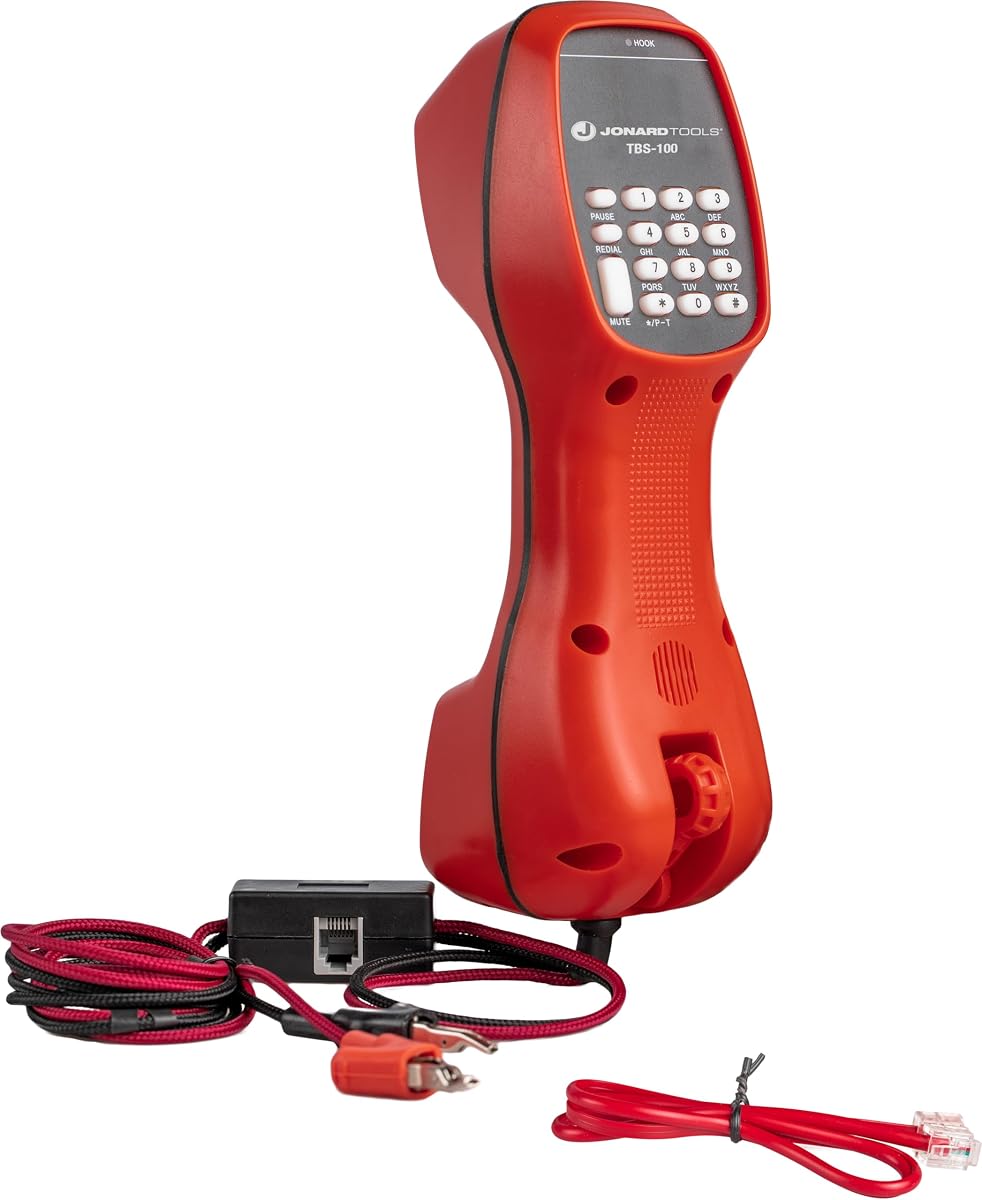
The Jonard Tools TBS-100 is an analog telephone line tester designed for technicians who need to place calls, answer incoming calls, and evaluate the operational condition of a line. Its 3.9 rating is the lowest among the selected products, but its stated features target a clear professional use: dial tone detection, tone and pulse operation, a direct RJ11 connection path, and angled bed-of-nails clips.
We may earn a commission when you buy through this link, at no additional cost to you.
The angled bed-of-nails clips are particularly valuable when testing at a terminal block or another exposed connection point. They are intended to clamp securely rather than rely on a loose connector, making the instrument more useful for intermittent or temporary field connections. The built-in RJ11 switchbox adds another useful path for checking a standard telephone line directly.
Its weather-resistant housing is a meaningful advantage when service work continues in basements, utility rooms, or partially exposed work areas. The trade-off is that the supplied feature list does not mention caller ID, polarity detection, high-impedance monitoring, or a display. It is therefore a focused butt set for basic analog line interaction rather than an advanced diagnostic console.
The TBS-100 suits field technicians who regularly work around terminal blocks and value a rugged connection method. It is less attractive for users whose main goal is identifying individual conductors in complex wiring. For those tasks, a dedicated tracer or outlet analyzer will be more direct. Otherwise, it offers a solid combination of dialing, listening, and secure line access.
Angled bed-of-nails clips are designed for firm contact with exposed line connections. This makes the TBS-100 useful when a technician needs a quick, stable way to test a pair of conductors.
The housing is designed to protect the tool in inclined or otherwise unfavorable weather. That protection supports use in service areas where a lightweight, less protected handset would be less dependable.
We may earn a commission when you buy through this link, at no additional cost to you.
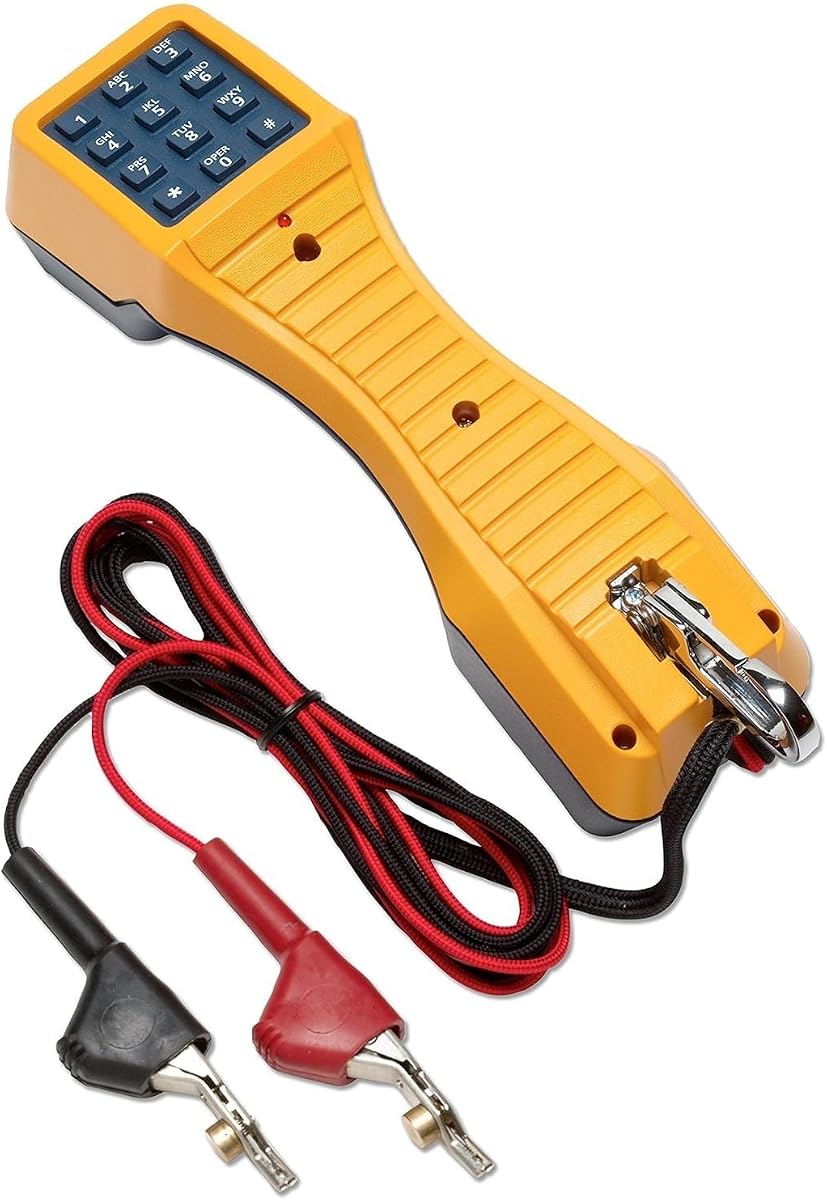
The Fluke Networks TS19 is a professional analog telephone test set with a 4.6 rating and a strong emphasis on line awareness. It detects dial tone and polarity, supports placing and receiving calls, and operates in both tone and pulse modes. Its high-impedance DataSafe operation in monitor mode is the most important feature for users who must observe a line without unnecessarily interfering with the traffic on it.
We may earn a commission when you buy through this link, at no additional cost to you.
The angled bed-of-nails clips are suited to field work involving exposed pair wiring. Combined with direct call and signaling functions, they allow a technician to move from determining whether a line is active to interacting with it and identifying polarity. The monitor mode broadens the role from an active test telephone to a tool that can inspect an established circuit more conservatively.
This model is specialized rather than universal. It does not present itself as a general cable mapper or multi-system tone tracer, and its analog telephone focus is intentional. Compared with the more compact caller ID-oriented sets, the TS19 emphasizes professional operational functions and a premium physical design. That makes it a better fit for established analog service work than for a quick check of a modern structured wiring outlet.
The TS19 is recommended for professional technicians, telecommunications installers, and facilities staff who need reliable polarity detection, call testing, and data-safe monitoring. It is especially relevant where a line may carry more than voice and an intrusive connection could interrupt a customer service. The 4.6 rating and comprehensive feature set justify its place among the premium choices in this guide.
Polarity detection helps distinguish the orientation of an analog pair. That information can be crucial when tracing a fault or connecting a test instrument to the wrong conductor.
High-impedance monitoring is suited to checking a line while minimizing interference with data, conversations, or signals already present. The result is a more appropriate instrument for live-service environments.
We may earn a commission when you buy through this link, at no additional cost to you.
This Landline Test Phone Line Set is a lightweight, feature-focused test telephone rated 4.2. It automatically identifies FSK and DTMF caller ID, displays the real time, date, and week, and includes flash and redial functions. An LED indicator provides immediate visual feedback when the instrument is in use, making it easy to understand its state during a test.
We may earn a commission when you buy through this link, at no additional cost to you.
The combination of caller information and clock display is unusual for a simple line tester. It gives a technician a small information terminal rather than just a handset, which can help when the purpose of the test is to confirm inbound signaling and call information. Flash and redial also mirror common telephone operations, allowing the tool to fit naturally into an active troubleshooting process.
The product appears less focused on advanced electrical diagnosis than the Fluke and Jonard professional sets. No polarity identification, high-impedance monitoring, or formal voltage measurement is stated. The alligator-clip set and dedicated line-checking format help it function as a hands-on instrument, but complex pair identification would still require a more specialized tracer.
This set is best for a field technician or advanced user who wants caller ID and familiar call-handling functions in a lightweight package. It is also attractive for checking whether a line can deliver basic analog services in a home or small office. Buyers who need circuit-level assurance should choose an instrument with explicit polarity and monitoring specifications.
The real-time, date, and week display gives the instrument more utility during extended line surveys. It can serve as a compact information reference while the tester is connected.
Flash and redial controls reproduce common handset behavior. These functions make it easier to confirm basic service operation without relying on a separate telephone during every stage of the test.
We may earn a commission when you buy through this link, at no additional cost to you.
The Southwire P700 is a compact phone outlet tester designed around wiring faults rather than active call handling. It has a 4.5 rating and identifies Line 1 and Line 2 wiring, connection status, AC ring voltage, dead lines, and reversed lines. That makes it a focused diagnostic tool for electricians, installers, and property maintenance personnel who need to inspect the condition of a telephone outlet.
We may earn a commission when you buy through this link, at no additional cost to you.
The strongest benefit is fault specificity. Simply establishing that a line appears active does not tell the user whether conductors are reversed or whether one side of the pair is dead. The P700 is built to distinguish those conditions, giving a technician a quicker route to a likely cause and a clearer repair target.
It should not be confused with a butt set or analog test telephone. The supplied information does not list call placement, receiving, caller ID, tone dialing, or live-line monitoring functions. Its purpose is to assess wiring and ring signaling at the outlet, so users who need to place a test call will still require a separate line tester.
The P700 is a strong recommendation for anyone troubleshooting two-line telephone outlets, reversed pairs, or intermittent connection issues. It is particularly useful during installation and inspection, when a compact plug-in instrument provides an immediate indication of line state. It is less appropriate as the sole telephone service-testing tool, but excellent as a dedicated outlet diagnostic.
The tester is designed to separate several common wiring conditions. That allows an installer to identify the fault category before opening a connection or replacing a cable.
Identifying Line 1 and Line 2 is valuable in offices and homes that still use paired analog services. It helps confirm that each intended circuit is connected and oriented correctly.
We may earn a commission when you buy through this link, at no additional cost to you.
The S4 Telephone Butt Test Tester earns a 4.8 rating and focuses on information display, call functions, and convenient number review. It automatically identifies and displays FSK or DTMF call information, supports call testing and caller ID detection, and includes a last-group dial-number replay function. A real-time date and time display adds further utility for line survey work.
We may earn a commission when you buy through this link, at no additional cost to you.
Automatic identification is a useful design choice because it reduces the need to determine which caller signaling method is in use before the information appears. The replay function can also reduce repeated manual entry when the user needs to revisit a recently displayed number. Together, these features position the S4 as a convenient test telephone for basic line verification and incoming call checks.
The specification is centered on call information and everyday telephone behavior rather than circuit-level analysis. Polarity identification, high-impedance monitoring, and explicit voltage measurement are not included in the supplied details. It therefore offers less diagnostic depth than the professional Fluke and Jonard models and is better suited to confirming that basic analog service is working.
This tester is recommended for technicians, installers, and office support staff who want an approachable hands-on line instrument with a strong rating and a useful display. It is particularly suitable when caller ID compatibility and quick number review matter more than formal wire mapping. For complex pair faults, combine it with an outlet tester or tone tracer.
The tester recognizes FSK and DTMF call information automatically. This reduces setup decisions and lets the user concentrate on the result of the line check.
The replay function makes recently displayed dial information easy to revisit. It is convenient during repeated line surveys or when a number must be checked more than once.
We may earn a commission when you buy through this link, at no additional cost to you.
The Klein Tools VDV500-705 is a tone generator and probe kit rather than a traditional analog telephone butt set. It carries a 4.4 rating and supports tracing across Ethernet, telephone, speaker, coax, video, and data cables. RJ45, RJ11, and RJ12 support makes it useful when the objective is to identify conductors within a bundle or follow a specific wire through a pathway.
We may earn a commission when you buy through this link, at no additional cost to you.
Its tracing approach is practical for open-ended, non-active low-voltage wiring. The generator applies an analog tone, while the probe helps locate that tone at accessible points. The supplied alligator clips support unterminated conductors, and the included RJ45-to-RJ45 cable supports testing standard network-style connections. The probe and generator can also create a pin-to-pin wire map.
The distinction from a telephone test set is important. This kit is not listed with dial tone detection, call placement, polarity measurement, ring voltage testing, or caller ID. It is intended for wire discovery and mapping under appropriate low-voltage conditions, not for evaluating an active analog service. A line tester should be used when the goal is to determine whether a telephone circuit can dial, ring, or carry a call.
The VDV500-705 is an excellent companion to a line tester when a technician needs to identify which cable or conductor belongs to a particular service. The adjustable volume, headphone jack, and work light improve usability in confined or dark spaces. For installers and network technicians working across several cable systems, it offers broader tracing value than a single-purpose telephone handset.
Support for telephone, data, coax, video, and speaker wiring makes this a useful shared instrument. It reduces the need to carry separate tone tools for common low-voltage systems.
The probe's work light helps in dark spaces, while adjustable volume and headphone output support different listening environments. These details are especially useful inside cabinets and pathways.
We may earn a commission when you buy through this link, at no additional cost to you.
This Fluke Networks TS19 configuration pairs a professional analog test telephone with banana-jack-to-alligator-clip leads. It has a 4.6 rating and provides dial tone detection, polarity indication, call placement and receiving, tone and pulse operation, last-number redial, and high-impedance DataSafe monitoring. These features make it a broad line-interaction tool for technicians working at terminals or temporary connection points.
We may earn a commission when you buy through this link, at no additional cost to you.
The alligator clip configuration provides a practical way to reach a pair of conductors without relying solely on a wall jack. Once connected, the user can check the line, monitor it at high impedance, place or receive calls, and inspect polarity. Last-number redial is useful during iterative testing, while DTMF and pulse support accommodate both tone and legacy pulse dialing environments.
Its main limitation is its focused scope. It is an analog telephone test set, not a complete cable mapper, and the supplied information does not mention caller ID or a visible time display. The banana-to-alligator lead configuration also differs from the angled bed-of-nails version in the related listing, so buyers who require that style of clip should select the corresponding model carefully.
This TS19 version is best for field technicians who need flexible temporary connections and a broad set of professional line functions. It is a particularly good fit for technicians who want both active call testing and conservative monitoring in one instrument. The 4.6 rating reflects a strong overall proposition, although buyers focused only on simple outlet checks may find a dedicated outlet tester easier to use.
Banana jacks to alligator clips let the user reach conductors in a way that suits many field arrangements. This is helpful when no standard telephone socket is conveniently available.
Combining polarity indication with DataSafe monitoring lets the user understand line orientation and observe service without the same disruption risk associated with a low-impedance connection.
We may earn a commission when you buy through this link, at no additional cost to you.
The Jonard Tools TBS-200 is the strongest all-around professional choice in this guide, carrying a 5.0 rating. It is an analog telephone butt set that detects dial tone, makes and receives calls, supports tone and pulse dialing, and switches among Talk, Ring, and Monitor modes directly from the handgrip. That combination covers both active line interaction and less intrusive observation.
We may earn a commission when you buy through this link, at no additional cost to you.
High-impedance monitoring is the defining feature. It is designed to observe lines without disturbing data, conversations, or signals, making the TBS-200 appropriate for live environments where a technician needs information but does not want to interrupt service. The dedicated Talk and Ring modes provide practical ways to assess line behavior when monitoring alone is not enough.
Safety and connection reliability are also emphasized. Built-in voltage protection is intended to guard against excess voltage and transient ringer signals, while angled bed-of-nails clips provide a stable connection to exposed conductors. The absence of a stated caller ID display means it is not the right choice for users whose priority is reading incoming caller information, but that omission is reasonable for a focused professional line tester.
The TBS-200 is recommended for professional technicians, network installers, and facilities teams that need broad analog line testing with safe monitoring. It covers call testing, signaling modes, line observation, connection stability, and electrical protection in one instrument. Its 5.0 rating, versatile mode control, and professional connection system make it the leading recommendation for serious field work.
Talk, Ring, and Monitor modes let a technician move from passive observation to active call testing and ring-signal evaluation. Direct handgrip switching keeps the controls accessible in the field.
Built-in voltage protection is designed to guard against excess voltage and transient ringer signals. This adds confidence when connecting the instrument to a line that may not behave exactly as expected.
We may earn a commission when you buy through this link, at no additional cost to you.
The right analog telephone line tester depends on the fault you need to diagnose, the connection points you work with, and whether you need an active test telephone, passive monitoring, outlet analysis, or conductor tracing.
Begin by defining the problem. A hands-on butt set is suited to detecting dial tone, placing calls, receiving calls, and testing tone or pulse dialing. A telephone outlet tester is better when the question concerns Line 1, Line 2, reversed conductors, dead lines, or ring voltage. A wire tracer is the right choice when you need to identify a conductor inside a bundle or follow wiring through a wall or pathway.
Check how the tester attaches to the line. Standard plugs are convenient for accessible jacks, while alligator clips and angled bed-of-nails clips are more useful at terminal blocks or exposed wiring. Some products include multiple line plugs or a switchbox, which can reduce adapter clutter. Verify that the supplied connector style matches the service points you regularly use rather than assuming all telephone interfaces are physically identical.
High-impedance monitoring is important when testing a line that may be carrying an active conversation, data, or another signal. A high-impedance connection is designed to observe without intentionally disturbing that traffic. Models with explicit DataSafe monitoring are particularly relevant to professional work, while simpler test phones may be enough for a basic installation where no live traffic is present.
Useful diagnostic output goes beyond saying that a telephone is active. Dial tone detection establishes that a basic signal is present, while polarity identification helps determine the orientation of a pair. Ring voltage can reveal whether a line is energized, and reversed-line or dead-line detection narrows the fault category. Choose the most detailed instrument your normal work requires rather than paying for functions you will never use.
Caller ID can be valuable when confirming that inbound signaling reaches the connected device. Several compact testers support FSK, DTMF, or automatic detection and include a number or time display. However, this is different from a dedicated analog test set optimized for polarity, monitoring, and professional line interaction. Decide whether readable call information is a primary requirement or simply a convenience.
Field tools need to be easy to carry and dependable in the environment where they are used. Compact and lightweight designs suit mobile service, while a weather-resistant housing provides better protection in damp, inclined, or exposed areas. Also consider control layout: accessible buttons and a readable display can reduce mistakes, while a simple status light can be enough for a quick outlet or line check.
Accessories can determine how immediately a tester is useful. Look for the appropriate test cord, connector types, clips, joiner, spare fuse, or alligator leads relevant to your installation. A bundled RJ11 test cord simplifies direct testing, while alligator clips and ABN clips support exposed or temporary connections. A work light, headphone jack, and adjustable volume improve a tracing probe in confined spaces.
Occasional users and property maintenance staff may need only an outlet tester or a basic compact test telephone. Technicians who make and receive calls while visiting multiple sites will benefit from a more capable butt set. Professionals working around live analog circuits, exposed terminals, or complex wiring can justify higher-end tools with polarity detection, high-impedance monitoring, voltage protection, and secure angled clips.
Before connecting the tester, identify the correct line or outlet and confirm whether the circuit is active. Choose the appropriate plug, clip, or lead, inspect it for damage, and make sure the instrument is in the mode required for the task. For a basic butt set, determine whether you need Talk, Ring, Monitor, dial tone, caller ID, or another function before touching the line.
Connect the tester carefully and observe the line before placing a call. On a monitoring instrument, use the high-impedance mode when live conversations or data may be present. For an outlet tester, compare the displayed line and fault indication with the expected wiring. When using a tone generator and probe, work with open-ended, non-active low-voltage wires, separate conductors when possible, and ground properly for the clearest tone response.
After the test, disconnect the leads in a controlled manner, switch the instrument off, and return any protective covers or accessories to their designated places. Clean the housing with a dry or slightly damp cloth, avoid harsh solvents, and keep contacts free of dirt. Store the tester in a dry, ventilated place away from corrosive gas, protect clip tips from impact, and follow the manufacturer's guidance for replacing a fuse or changing accessories.
An analog telephone line tester checks traditional telephone circuits for conditions such as dial tone, polarity, ring voltage, active or dead lines, and reversed wiring. Depending on the model, it may also place and receive calls, monitor live service, display caller ID, or help identify individual conductors. The correct tool depends on whether you are diagnosing a wall outlet, terminal block, cable run, or active subscriber line.
No. A telephone outlet tester primarily identifies wiring and signaling conditions at an outlet, such as Line 1, Line 2, dead lines, reversed pairs, and AC ring voltage. A butt set is a hands-on test telephone used to detect dial tone, place or receive calls, and sometimes monitor a line. One may diagnose the wiring while the other helps evaluate actual analog service.
A high-impedance connection is intended to observe a circuit with minimal disturbance to the traffic it carries. That makes it safer for checking live lines that may support a conversation, data, or another signal. It is especially valuable for professional troubleshooting where an intrusive connection could interrupt customer service or affect the result of the test.
Only a product specifically designed as a tone generator and probe is intended to follow a conductor through a pathway. A model such as the Klein Tools VDV500-705 uses an injected tone and probe to help locate or identify wiring, including telephone and data cables. Ordinary outlet testers and butt sets diagnose line conditions but do not trace concealed conductors.
FSK and DTMF are two methods used to deliver caller information on an analog telephone line. A tester that supports both or automatically identifies the method is more adaptable across services and regions. The presence of caller ID support should not be confused with a guarantee that information will always appear, since the telephone service itself may need to be enabled.
Tone and pulse support broadens compatibility with older and newer dialing systems. Most modern analog services use tone dialing, but pulse operation can still be useful when working with legacy equipment, specialized lines, or installations that must support both methods. A technician who handles varied networks will benefit more from dual support than someone testing one specific modern system.
Each has practical advantages. Angled bed-of-nails clips can provide firm contact with exposed terminal-block conductors and are often favored for professional line access. Alligator clips are flexible and convenient for reaching conductors in less standardized locations. The best choice is the one that matches the terminal geometry, available space, and type of connection you need to make.
Store the device in a dry, ventilated location away from corrosive gases, excessive heat, and direct impact. Protect clip tips and test leads from bending, remove any source of moisture, and keep contacts clean. If the model includes a replaceable fuse, follow the manufacturer's replacement instructions. Regular inspection helps ensure that corrosion or damaged insulation does not compromise future tests.
The Jonard Tools TBS-200 stands out as the most versatile professional recommendation, combining a 5.0 rating with talk, ring, monitor, high-impedance, and protected connection features. The Telephone Phone Line Network Cable Tester is the budget-focused pick for general hands-on testing, while the Fluke Networks TS19 with angled bed-of-nails clips is the premium option for polarity detection and data-safe monitoring.
Prioritize the task before the feature count. Choose an outlet tester for Line 1, Line 2, reversed-line, dead-line, or ring-voltage identification; choose a butt set for dial tone, calls, and field interaction; and choose a tone probe for conductor tracing. Then match the connection style, monitoring requirements, environmental conditions, and accessories to the work you actually perform.
Ratings, listings, and prices can change, so confirm the current product details before ordering. The included Amazon links provide convenient access to the exact models reviewed, while a final check of the current listing can help verify the supplied configuration, included accessories, and availability.