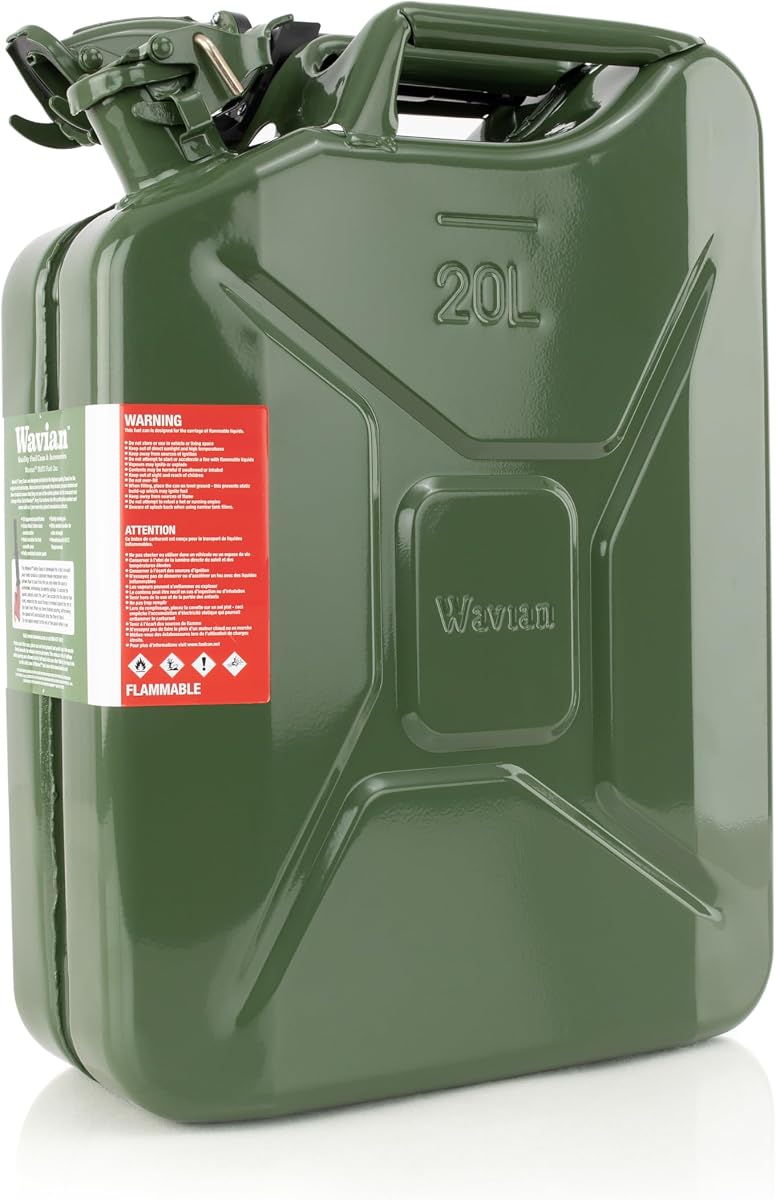
Wavian USA Authentic NATO Jerry Can and Spout System
4.4Editor score
NATO-style quick-release spout
0.9mm cold-rolled steel
EPA and CARB compliant
Our All Metal Jerry Can guide compares ten steel fuel containers for capacity, safety, dispensing, durability, and compliance to help you choose with confidence
An all metal jerry can offers a durable, flame-conscious way to store and transfer gasoline, diesel, kerosene, and other flammable liquids. The strongest containers pair rugged steel construction with secure closures, effective flame arrestors, stable handles, and dispensing systems that help control spills during routine vehicle, workshop, farm, or emergency use.
We compared ten metal jerry cans across capacity, steel gauge, protective finishes, closure systems, dispensing controls, safety certifications, portability, and intended fuel type. The list includes compact Type I cans, larger 20-liter containers, and a premium NATO-style system, allowing readers to compare practical details rather than relying on appearance alone.
Each review explains the standout strengths, limitations, and best use for every model, with the top selections earning the only awards in this guide. Product availability, certification details, and pricing can change, so readers should verify current specifications and compare their local safety requirements before purchasing a fuel container.
4.4Editor score

4.7Editor score

4.5Editor score
This side-by-side comparison highlights the major differences among ten steel fuel containers, including their capacities, intended fuels, closure systems, construction, safety features, and practical applications.


The Wavian USA Authentic NATO Jerry Can and Spout System is a substantial 20-liter container built around 0.9mm cold-rolled steel and an anti-corrosive coating. It has a 4.4 rating and stands apart through its military-style appearance, thick steel body, locking bayonet closure, and stated EPA and CARB compliance for use across North America.
We may earn a commission when you buy through this link, at no additional cost to you.
The defining feature is the quick-release nozzle and safety lock. Rather than relying on a conventional Type I cap, the system is designed for secure attachment and controlled fuel transfer. The locking arrangement helps reduce the chance of an accidental disconnect, while the sizable capacity makes the can useful for long trips, outdoor vehicles, generators, and emergency reserves.
Its weight is the most obvious trade-off. The 0.9mm steel construction and 20-liter capacity make it more substantial than lighter basic containers, which matters when a full can must be lifted repeatedly. Its distinctive NATO-style spout may also require a dedicated connection arrangement rather than being interchangeable with every generic transfer hose.
This is the strongest premium choice for buyers who value thick construction, a secure dedicated spout, large capacity, and documented environmental compliance. It is particularly compelling for overlanding kits, remote equipment storage, and vehicle emergency supplies where a locking transfer system matters more than minimal weight.
The bayonet-style nozzle and safety lock create a more involved connection than a basic screw cap. That additional restraint is useful during transport because the spout remains secured to the container and is less likely to shift during handling.
The 0.9mm cold-rolled steel and anti-corrosive coating prioritize durability over weight savings. The green finish and NATO-style layout also make the container immediately recognizable in a vehicle, workshop, or emergency equipment cache.
We may earn a commission when you buy through this link, at no additional cost to you.
This 5.3 Gallon Metal Jerry Can for Trucks SUV is a 20-liter steel container designed for vehicle beds, trunks, and off-road racks. Its 4.0 rating reflects a straightforward utility product, while the rectangular shape, high-grade cold-rolled steel, rust-resistant coating, and integrated handle emphasize capacity and portability.
We may earn a commission when you buy through this link, at no additional cost to you.
The locking cap and heavy-duty gasket are the most useful elements for travel. A sealed closure helps contain liquid and limit vapor escape, while the cap remains more suitable for repeated transport than an open-top vessel. The can is presented as compatible with most standard transfer accessories, making it adaptable for tractors, generators, mowers, and general vehicle preparedness.
Compared with certified safety cans, however, this model's supplied information does not identify FM, UL, ULC, TÜV, OSHA, or NFPA compliance. Buyers using it in a professional workplace should verify whether local rules require a listed safety container. The listing also provides less detail about flame arrestors and pressure-relief features than the better-documented products in this guide.
Choose it when a large rectangular steel can, simple locking cap, and broad accessory compatibility are the priorities. It is well matched to farm, garage, and off-road applications, but safety-critical commercial users should favor a product with clearly stated regulatory certifications.
The box-shaped body uses space efficiently and is easier to position in a truck bed, SUV trunk, or rack than a round vessel. Its integrated handle supports controlled carrying despite the larger 5.3-gallon capacity.
A precision-sealed cap and heavy-duty gasket are intended to resist leaks and vapor escape during transport. The locking design is straightforward, though buyers should confirm that the closure is compatible with every pump or transfer adapter they plan to use.
We may earn a commission when you buy through this link, at no additional cost to you.
The Eagle 5 Gallon Type I Red Safety Gas Can for Gasoline combines a familiar five-gallon format with thorough safety documentation. It carries a 4.7 rating, uses hot-dipped 24-gauge galvanized steel, and is listed as meeting OSHA Standard 1910.106 and NFPA code 30 while holding FM, UL, and ULC approvals.
We may earn a commission when you buy through this link, at no additional cost to you.
Its self-closing, gasketed spout cap automatically vents internal vapors when opened, which supports controlled filling and pouring. A non-sparking flame arrestor helps limit ignition risks, while the fixed handle, double interlock no-weld bottom seam, and protective baked-on powder coat add strength and wear resistance.
Type I cans use one opening for both filling and dispensing, so they are not as convenient for frequent small pours as a Type II model with a separate flexible hose. The fixed handle also differs from some contemporary designs that use a swinging handle to improve balance. Neither limitation undermines its strong safety-focused proposition.
This is the most balanced choice for ordinary gasoline storage because it combines a useful capacity with extensive certification information. It is an excellent option for home workshops, farms, vehicle kits, and professional users who need a recognizable safety can without moving to the more complex dispensing system of a Type II model.
The gasketed spout cap self-closes after pouring and opens automatically to vent internal vapors. This balanced design helps control leakage while preserving the straightforward filling process expected from a Type I safety can.
The galvanized steel body resists rust, dents, and certain chemicals, while the baked-on powder coat helps resist scratches, chipping, and fading. That combination is valuable in garages, truck beds, and other environments where containers are repeatedly handled.
We may earn a commission when you buy through this link, at no additional cost to you.
The Justrite Type II Gasoline Safety Can is designed for users who want more precise dispensing than a conventional single-opening safety can. It has a 4.6 rating, galvanized steel construction, a chemical-resistant powder coat, and a patented manifold with a Safe-Squeeze trigger that supports smooth, glug-free flow.
We may earn a commission when you buy through this link, at no additional cost to you.
A flexible metal hose directs fuel into smaller openings, making the can useful for filling equipment whose filler neck is difficult to reach with a standard spout. The ergonomic lift lever aids refilling, while the stainless steel flame arrester helps reduce flashback ignition risk and the self-closing lid supports secure storage.
The hose and trigger system make this less convenient for people seeking the simplest possible container. It also has more moving and interconnected components than a Type I can, so the flexible hose and closure deserve regular inspection. Nevertheless, those complexities are the reason to choose it: the design prioritizes controlled, accurate transfer.
This is an excellent pick for workshops, maintenance departments, and experienced users who refill smaller tanks or hard-to-reach openings. Its FM approval, UL/ULC listing, TÜV certification, and stated support for OSHA and NFPA requirements also make the documentation more compelling than many generic alternatives.
The metal hose can reach small or awkwardly positioned openings that may be difficult to serve with a fixed spout. Its shape also lets the operator keep the main body more upright while controlling where fuel is directed.
The patented manifold and Safe-Squeeze trigger are intended to reduce glugging and improve transfer consistency. For users who transfer fuel frequently, that level of control can be more valuable than the simplicity of a basic screw-cap container.
We may earn a commission when you buy through this link, at no additional cost to you.
The Eagle 5 Gallon Type I Yellow Safety Gas Can for Diesel is a certified, color-coded option for storing diesel and other compatible flammable liquids. It earns a 4.6 rating and uses the same well-documented Type I format as Eagle's red gasoline model, including a self-closing gasketed spout cap and automatic vapor venting.
We may earn a commission when you buy through this link, at no additional cost to you.
The can is made in America from hot-dipped 24-gauge galvanized steel with a baked-on powder-coat finish. It meets OSHA Standard 1910.106 and NFPA code 30 requirements and is FM, UL, and ULC approved. A non-sparking flame arrestor, fixed handle, and double interlock no-weld bottom seam support its safety-focused design.
Its primary limitation is dispensing flexibility. With one opening for filling and pouring, diesel transfer is less precise than with a Type II can and flexible hose. The fixed handle also offers less balancing assistance than a counterbalanced swinging model, although that is a minor issue for many routine applications.
Choose this can when diesel identification and certified safety construction are the central requirements. The yellow finish makes fuel type recognition easier, while the five-gallon size remains a familiar, manageable format for trucks, tractors, generators, workshops, and farm equipment.
The yellow finish clearly distinguishes the can from red gasoline containers. That visual cue helps prevent accidental fuel mixing and makes it easier to identify the correct container in a busy garage or equipment area.
FM, UL, and ULC approvals, combined with OSHA and NFPA compliance, give this can a strong safety profile. The flame arrestor and self-closing cap are particularly relevant for routine storage and dispensing of diesel.
We may earn a commission when you buy through this link, at no additional cost to you.
The Justrite Type I Gasoline Safety Can, Red Galvanized Steel, Made in the USA, combines certified safety design with a practical counterbalanced handle. It has a 4.6 rating and a five-gallon format suited to storage, transport, and dispensing of flammable liquids in industrial facilities, workshops, and maintenance operations.
We may earn a commission when you buy through this link, at no additional cost to you.
The 24-gauge galvanized steel body receives a chemical-resistant powder coat, and the can is described as leak tested. A stainless steel flame arrestor helps reduce flashback ignition risk, while the self-closing lid with automatic positive-pressure relief is designed to control vapor release and minimize pressure buildup.
The counterbalanced swinging handle and integrated bottom lip improve balance and pouring control compared with a fixed-handle model. As a Type I container, it still uses a single opening, so it does not provide the flexible-hose access of a Type II can. This makes it better for general transfers than repeated small-volume dispensing.
This Justrite is a strong all-around pick for users who want recognized certification, a familiar five-gallon capacity, and easier handling. It is especially suitable for maintenance teams, workshops, and property operations where a single-opening safety can is sufficient and a simple, balanced carry system is preferred.
The counterbalanced swinging handle shifts the grip as the can tilts, while the integrated bottom lip adds control near the receiving opening. These details make the container more manageable than many fixed-handle safety cans.
The automatic positive-pressure relief is intended to reduce pressure buildup as internal vapors develop. Combined with the self-closing lid and flame arrestor, it supports safer routine handling of flammable liquids.
We may earn a commission when you buy through this link, at no additional cost to you.
The Eagle 2 Gallon Type I Red Safety Gas Can for Gasoline is the compact choice in this roundup. It has a 4.6 rating, a two-gallon capacity, and the same certified Type I design language found in larger Eagle cans, including a self-closing gasketed cap and automatic vapor venting.
We may earn a commission when you buy through this link, at no additional cost to you.
Its hot-dipped 24-gauge galvanized steel construction resists rust, dents, and certain chemicals, while the baked-on powder coat helps withstand scratches and fading. The can also includes a fixed handle, double interlock no-weld bottom seam, non-sparking flame arrestor, and is listed as FM, UL, and ULC approved.
The obvious compromise is capacity. Two gallons is suitable for a small generator, mower, or limited reserve, but it requires more refill trips than a five-gallon can. Because it uses a Type I opening, it also cannot match the reach and measured flow of a Type II model with a flexible hose.
This is a practical choice for buyers who want certified safety features without the weight and bulk of a five-gallon container. It suits small equipment, short emergency reserves, and transport situations where compact dimensions and lower full weight matter more than maximum capacity.
The two-gallon format reduces the amount of fuel carried at once, making the can easier to lift than a full five-gallon model. It is a practical middle ground for small equipment and limited reserves.
Compact size does not eliminate the important protective features. The automatic vent, self-closing cap, flame arrestor, galvanized steel body, and FM, UL, and ULC approvals remain central to the design.
We may earn a commission when you buy through this link, at no additional cost to you.
The Justrite Type I Kerosene Safety Can in blue galvanized steel provides a clearly identified and thoroughly documented option for kerosene. It has a 4.7 rating, a chemical-resistant powder-coat finish, and a design intended for safe storage, transport, and dispensing of flammable liquids.
We may earn a commission when you buy through this link, at no additional cost to you.
Its counterbalanced swinging handle and integrated bottom lip improve balance and pouring control, while the stainless steel flame arrestor helps reduce flashback ignition risk. The self-closing lid includes automatic positive-pressure relief to limit vapor release and pressure buildup during normal use.
The blue finish helps users identify the contents, but the Type I format still relies on a single opening. It therefore lacks the flexible-hose precision of the Justrite Type II model, and buyers should not treat it as a substitute for a container specifically designed for unusually narrow or difficult-to-reach openings.
Choose this can for kerosene storage in workshops, homes, or maintenance settings where fuel identification and established safety certifications are priorities. The steel construction, pressure management, and balanced handle make it especially suitable for users who want more control than a basic generic jerry can provides.
The blue finish makes the intended kerosene use immediately visible. Clear labeling reduces the likelihood of confusing a kerosene container with gasoline or diesel cans during a busy refill or maintenance session.
The lid closes after use and provides automatic positive-pressure relief. This supports safer storage by limiting vapor release and helping prevent pressure buildup inside the galvanized steel container.
We may earn a commission when you buy through this link, at no additional cost to you.
This Eagle 5 Gallon Type I Yellow Safety Gas Can for Diesel is a well-rated, high-capacity option for diesel storage. It has a 4.7 rating, yellow identification, and a 24-gauge galvanized steel body coated with a baked-on finish designed to resist scratches, chipping, fading, and other wear.
We may earn a commission when you buy through this link, at no additional cost to you.
Its gasketed spout cap self-closes to help prevent leaks and spills, and the cap assembly opens automatically to vent internal vapors. A fixed handle, double interlock no-weld bottom seam, and non-sparking flame arrestor support safe routine handling. The can is also listed as FM, UL, and ULC approved and as meeting OSHA Standard 1910.106 and NFPA code 30.
As with other Type I designs, filling and dispensing share one opening. That simplifies the closure but offers less precise control than a Type II flexible hose. The fixed handle also provides less balance during a pour, although five-gallon containers are inherently heavier and benefit from stable handling.
This model is a solid selection for farms, trucks, generators, and diesel equipment where a familiar five-gallon capacity and visible color coding are important. It is particularly appealing for buyers who prioritize recognized approvals and durable galvanized construction without needing a more complex dispensing assembly.
The galvanized steel is intended to resist rust, dents, and certain chemicals. Its protective powder coat adds another layer against abrasion and fading, supporting repeated use in garages, farm areas, and vehicle environments.
The cap opens automatically to release internal vapors and self-closes afterward. This sequence supports more controlled use than a loose closure while maintaining the familiar Type I filling method.
We may earn a commission when you buy through this link, at no additional cost to you.
The VEVOR Metal Container with Spout and Handle, Yellow 20 L is the straightforward utility option in this guide. It has a 4.5 rating and focuses on the essentials: a metal body, a 20-liter capacity, an integrated handle, and a dedicated pouring spout for storage or transfer tasks.
We may earn a commission when you buy through this link, at no additional cost to you.
Its practical design suits users who need more capacity than a compact safety can provides and who do not require the regulated dispensing mechanisms found in premium professional containers. The carrying handle makes the large vessel more manageable, while the separate spout offers a more controlled pour than an open-top container.
The supplied product information is much less detailed than that of the Eagle and Justrite models. It does not identify a steel gauge, closure type, gasket, flame arrestor, pressure-relief system, or recognized FM, UL, ULC, OSHA, or NFPA certification. Those omissions matter when selecting a can for regulated workplaces.
This is the best budget-oriented pick for straightforward fuel storage or transfer when a metal container, generous 20-liter capacity, handle, and spout are the main requirements. Buyers handling flammable liquids in commercial settings should check local rules and choose a properly certified safety can instead.
The 20-liter volume provides useful storage for larger equipment and extended reserves. The yellow finish also makes the container easy to identify, although buyers should confirm that the color matches their local fuel-identification practices.
The integrated handle supports carrying, and the dedicated spout provides a defined pouring point. These simple features make the can more practical than an open metal pail for controlled transfer.
We may earn a commission when you buy through this link, at no additional cost to you.
The right all metal jerry can depends on the fuel, amount of storage required, transfer frequency, work environment, and applicable safety rules. Capacity, certification, closure design, construction, and intended fuel color should be evaluated together rather than treated as isolated features.
Choose a capacity that minimizes both excess fuel and repeated refilling. A small can is easier to carry but may create unnecessary trips, while a large can can be awkward for a single operator.
Choose Type I for general-purpose transfers and Type II for frequent, precise dispensing into constrained openings.
Look for galvanized or coated steel, then check whether the stated gauge and finish match the demands of your storage environment.
Prioritize a flame arrestor, self-closing closure, gasket, and automatic venting when fuel safety is the central concern.
For regulated work, choose documented approvals and verify that the certification applies to your exact container and intended fuel.
Match the closure to the transfer task: simple spout for occasional use, flexible hose for precision, and locking system for transport.
Choose a finish that matches the fuel and make sure the contents remain unmistakably labeled after filling.
Test the full-can weight and available storage space before buying, and plan for upright, ventilated, source-free storage.
Before filling, confirm that the container is approved or suitable for the exact fuel, is clean and empty, and has no visible rust, dents, corrosion around seams, or damage to its spout, gasket, handle, and closure. Inspect the flame arrestor and pressure-relief features where applicable, and make sure any pump, funnel, hose, or adapter is compatible with the can's fitting.
Place the can upright on a stable surface and use the intended funnel or transfer equipment. Fill only to the marked safe level, avoid overfilling, and wipe away fuel or kerosene from the exterior. Secure the cap or hose after transfer, check for drips around the closure, and move the container slowly to avoid sloshing or impact.
Store the can upright in a cool, dry, well-ventilated location away from heat, sparks, open flames, and children. Clean only with an approved method and material, let it dry fully before refilling, and retire the container if it develops a leak, serious corrosion, a loose fitting, or a compromised safety component.
Not every metal container is approved for every flammable liquid. Look for a can specifically identified for gasoline, with a suitable flame arrestor, self-closing closure, and relevant safety certification. A general-purpose metal container may be useful for nonhazardous liquids but could fail local workplace requirements for flammable-fuel storage.
A Type I can uses one opening for both filling and dispensing, while a Type II can adds a separate flexible hose and controlled dispensing mechanism. Type I models are simpler and often less expensive, whereas Type II cans can provide more precise transfers into small or difficult-to-reach openings.
Choose a two-gallon can for small equipment and light portability, a five-gallon can for general vehicle and workshop use, or a 20-liter container for larger reserves and remote equipment. Consider the full weight, available storage, and how often you expect to refill before choosing.
Yes, the products in this guide use red for gasoline, yellow for diesel, and blue for kerosene. Color coding helps users identify fuel types quickly, but it should be reinforced with clear labels and careful handling procedures.
A flame arrestor helps reduce flashback ignition risk by preventing external flames from traveling through the opening into internal vapors. For gasoline, diesel, and kerosene storage, especially in professional or high-risk settings, choosing a can with a flame arrestor is a prudent safety priority.
Only if the container is explicitly designed and approved for kerosene or the relevant flammable liquid. The blue Justrite Type I in this roundup is identified for kerosene, while gasoline and diesel cans should not be assumed to be interchangeable without checking manufacturer guidance and local regulations.
Keep them upright, closed, and away from heat, sparks, open flames, and direct sunlight. Store them in a ventilated area where they cannot be struck by vehicles, and follow workplace rules concerning quantities, secondary containment, labeling, and separation from incompatible materials.
Inspect the entire container for rust, dents, cracked seams, leakage, and a loose or damaged closure. Check that the gasket, flame arrestor, spout, hose, and pressure-relief mechanism are clean and functional. Replace a damaged can rather than attempting to repair a safety-critical component with improvised materials.
The Wavian USA NATO Jerry Can is the premium selection for buyers seeking thick steel, a secure quick-release spout, and stated EPA and CARB compliance. The Eagle five-gallon red Type I earns the Editor's Choice for its balanced combination of capacity, recognized approvals, automatic venting, and durable galvanized construction, while the VEVOR 20-liter model is the budget-oriented utility pick.
Most buyers should begin with fuel compatibility, required certifications, and the amount they need to store. Add a flexible hose or Type II mechanism when precise dispensing matters, and favor a documented safety can for professional work. Compact capacities improve handling, while larger containers reduce repeated refills.
Finally, verify the current manufacturer details, local storage rules, and current price before ordering. Metal fuel containers can develop corrosion or damaged closures over time, so inspect a new can upon arrival and replace any container that no longer provides secure, leak-free operation.