
2026 AI Drive Assist 5G WiFi Dash Cam
4.7Editor score
Dual AI driving assistance
4K front and 1080P rear
GPS and Wi-Fi 6
AI dash cams combine continuous road recording with features such as driver-fatigue detection, collision warnings, blind-spot alerts, and smart parking monitoring. The right model can document incidents, discourage risky behavior, and provide useful context when ordinary forward-facing cameras miss a vehicle entering from the side.
This guide compares ten AI dash cams across four-channel and dual-camera designs, native and upscaled 4K recording, night performance, GPS, Wi-Fi, voice control, ADAS, parking mode, storage, and event protection. It covers options for commuters, professional drivers, families, rideshare operators, and vehicles needing wide-angle rear visibility.
Each review explains the model's strongest capabilities, practical limitations, and ideal owner. The overall selection favors clear evidence, usable night footage, reliable incident locking, and understandable installation. Features vary considerably, and prices, availability, accessories, and promotions can change, so check current listings before buying.
4.7Editor score

4.8Editor score

4.6Editor score
As an Amazon Associate we earn from qualifying purchases.
The table below compares all ten dash cams by coverage, AI safety features, image system, and connected functionality. It highlights the difference between conventional front-and-rear recording, rotating cameras, four-channel surround systems, and the Neideso model's additional rear-cabin view.


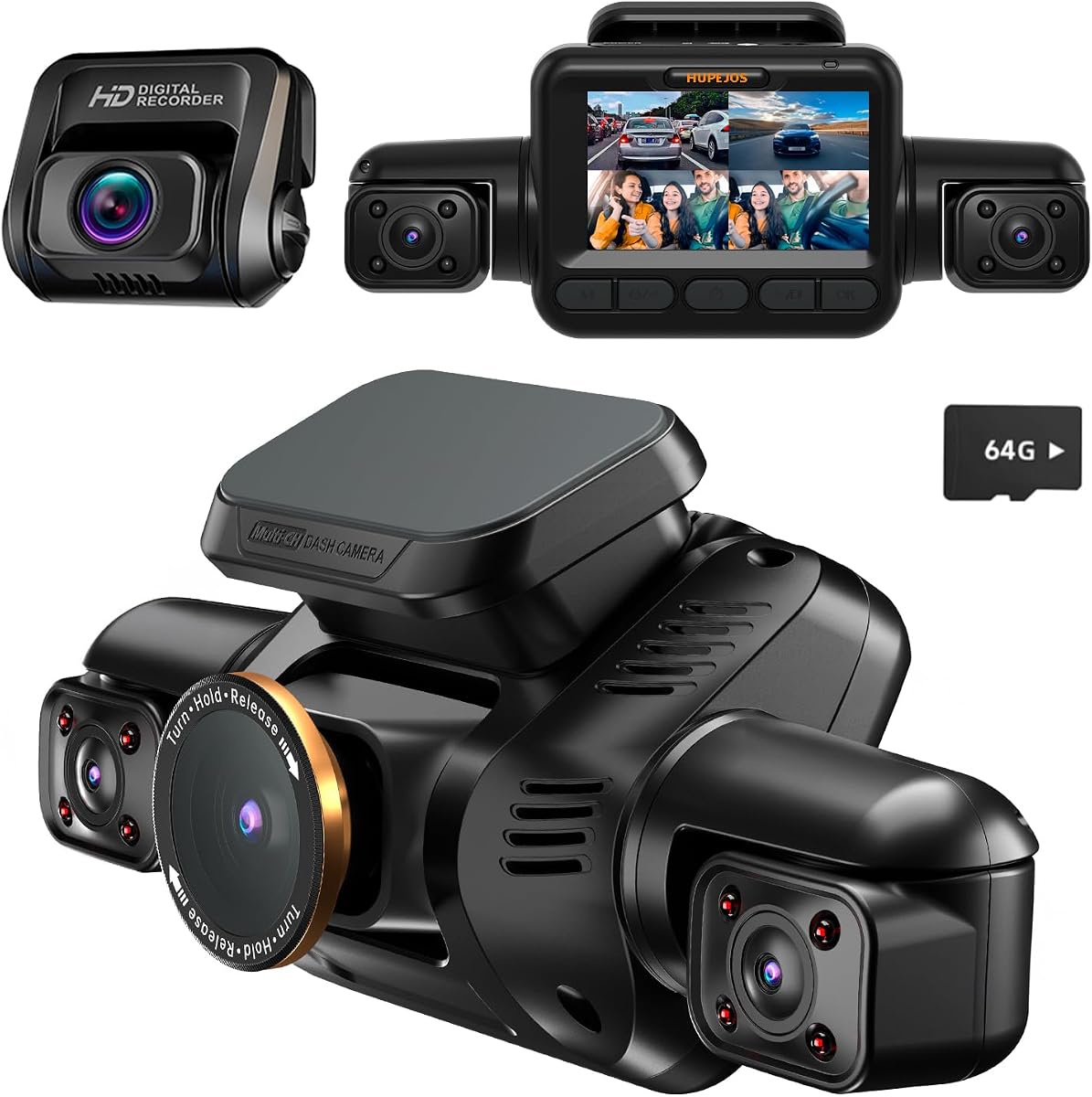


The HUPEJOS AI 360° View 4K Dash Cam combines four independently adjustable 150-degree lenses with an AI Driver Monitoring System, giving it one of the most complete feature sets in this guide. Its 4.3 rating reflects a capable all-around recorder with especially broad coverage.
We may earn a commission when you buy through this link, at no additional cost to you.
The cameras can record simultaneously toward the front, left, right, and rear, in either a 4K-front configuration with 1080P auxiliary views or a 3K-front setup with three 1080P channels. AI monitoring detects distraction, yawning, driver absence, phone calls, and smoking above a configurable speed threshold. Built-in 5GHz Wi-Fi, GPS, app access, and voice commands make evidence retrieval and routine control convenient.
Low-light recording combines eight IR lamps, six glass lenses, automatic exposure, and a CPL filter. Three-minute loops overwrite older material, while the G-sensor protects collision footage in an event folder. The main compromises are practical rather than fundamental: continuous parking operation needs a separate hardwire kit, and AI behavior detection can be influenced by hats, glasses, facial obstructions, or an unsuitable speed threshold.
This is a strong choice for commuters, rideshare drivers, fleet operators, and anyone who regularly needs footage of both the road and the vehicle's sides. Its balance of surround recording, night tools, connectivity, and driver monitoring makes it more versatile than a basic dual-camera system without requiring cloud storage.
Recording all four directions helps address side impacts, turning collisions, and incidents that occur outside a conventional front-and-rear field of view. The adjustable lenses also make the system more adaptable to larger vehicles than a fixed compact dual-camera arrangement.
Setting the DMS speed threshold to match normal roads can reduce unnecessary alerts. Turning the system off when it is not useful may also help drivers focus, especially during nighttime or long trips.
We may earn a commission when you buy through this link, at no additional cost to you.
The HUPEJOS V9 4K Dash Cam earns the Editor's Choice designation because it combines four-direction recording, AI driver monitoring, strong night tooling, and modern connectivity in one coherent package. Its 4.8 rating is the highest among the ten products considered.
We may earn a commission when you buy through this link, at no additional cost to you.
Four adjustable 150-degree lenses record the front, rear, left, and right simultaneously, with 4K resolution on the front camera and 1080P on the other three. A 3-inch touchscreen and English voice commands support hands-free operation. Wi-Fi 6 on 5.8GHz can transfer video at up to 20MB/s, while GPS records route, speed, coordinates, and altitude through the companion app.
The F1.8 aperture, eight infrared LEDs, intelligent IR balancing, and WDR are intended to preserve detail under difficult lighting. Privacy mode keeps only the three latest clips, and the G-sensor protects collision recordings from loop overwrite. A 128GB memory card is included, with support for larger cards. The main limitations are that there is no cloud storage or remote viewing, and parking mode requires an additional hardwire kit.
This model is best for drivers who want complete spatial awareness without a rotating-camera compromise. It suits daily commuting, truckers, rideshare work, family travel, and anyone worried about side or parking-lot incidents. Its broad feature coverage and strong rating make it the most balanced recommendation here.
The 5.8GHz Wi-Fi 6 connection and 20MB/s stated transfer speed make it practical to pull important clips onto a phone quickly. Since the system relies on a local connection rather than cloud storage, footage remains under the user's direct control.
A large aperture, IR illumination, and WDR work together to balance headlights and darker surroundings. Users can also adjust how the infrared system behaves for the conditions in which the vehicle is most often parked or driven.
We may earn a commission when you buy through this link, at no additional cost to you.
The 70mai A810S is a front-and-rear AI dash cam built around genuine 4K front recording, a 1080P rear camera, and two Sony STARVIS 2 sensors. Its 4.3 rating reflects a strong image-focused system that also offers ADAS, AI motion detection, GPS, and optional 4G LTE access.
We may earn a commission when you buy through this link, at no additional cost to you.
The IMX678 front sensor and IMX662 rear sensor work with 70mai's color and low-light processing to improve details such as signs and license plates. The 146-degree front and 130-degree rear lenses provide broad road coverage. Built-in positioning supports GPS, BDS, GALILEO, GLONASS, and QZSS, while Wi-Fi 6 supports app previews, transfers, and updates.
Its clearest advantage is optional remote monitoring. With the separately sold UP05 hardwire kit, owners can view live footage, locate the vehicle, and receive motion or collision alerts through the 70mai app. AI motion detection is designed to distinguish people and vehicles, and time-lapse parking mode reduces the amount of footage needed for extended surveillance. The trade-off is dependence on an optional accessory for both 4G and hardwired parking functionality.
Choose the A810S if native 4K detail, advanced sensors, and remote cellular access matter more than multi-camera 360-degree recording. It is particularly attractive for road trips, rideshare use, and drivers who want a conventional front-and-rear layout with sophisticated nighttime performance.
Unlike systems that upscale a lower-resolution image, the A810S records natively at 4K on the front. Its STARVIS 2 hardware is especially relevant for night roads, parking areas, tunnels, and other scenes where ordinary sensors can introduce substantial noise.
The optional 4G hardwire kit adds a distinct layer of utility by enabling live viewing, location checks, and event alerts away from the vehicle. Drivers who only need local recording can use the camera without that added cellular hardware.
We may earn a commission when you buy through this link, at no additional cost to you.
The 2026 AI Drive Assist 5G WiFi Dash Cam is the strongest budget-oriented selection in this guide, pairing a 4.7 rating with front ADAS, rear blind-spot detection, a rotating front camera, Wi-Fi 6, GPS, and a touchscreen.
We may earn a commission when you buy through this link, at no additional cost to you.
The front camera records true 4K through a 170-degree lens, while the rear camera records 1080P through a 140-degree lens. Its 1.8 AI NPU supports tailgating and pedestrian warnings at the front and alerts for vehicles approaching from behind or changing lanes. The rotating front design can also aim toward a side intersection, side window, or passenger area for specialized recording needs.
The rear camera is described as waterproof and supports installation under the rear bumper or inside the rear windshield, plus automatic reversing display. STARVIS 2, HDR, a six-glass lens, and an F1.4 aperture support low-light recording. A 3-inch IPS touchscreen, GPS, and 5.8GHz Wi-Fi 6 at up to 20MB/s round out the feature set. Parking surveillance requires hardwiring, and the included storage is 32GB rather than the larger cards offered with several rivals.
This camera is a good fit for new drivers and owners who want useful ADAS and flexible front-camera positioning at a lower-tier cost. It is especially relevant to truck, RV, and SUV drivers who can benefit from the alternate rear-camera placement.
Offering both bumper-mounted and windshield-mounted rear-camera options lets owners adapt to different vehicle shapes. Automatic reversing display adds convenience for parking and maneuvering.
The front module can be repositioned beyond the usual road-facing angle when the driver needs to monitor a side intersection, passenger area, or another unusual point of interest. The rear camera remains dedicated to the view behind the vehicle.
We may earn a commission when you buy through this link, at no additional cost to you.
The ROVE R2-4K Dual pairs a 2.5K front image with intelligent upscaling to 4K, a 1080P rear camera, and a 4.5 rating. It is a balanced front-and-rear system whose strengths include good night capture, app transfers, flexible parking modes, and substantial included storage.
We may earn a commission when you buy through this link, at no additional cost to you.
Its Sony STARVIS 2 IMX675 front sensor, F1.5 aperture, and HDR are designed to improve clarity in darkness, while the rear camera uses an F1.8 aperture. The 3-inch IPS display shows speed and compass information, and built-in GPS records routes, locations, and speed stamps. Dual-band 2.4GHz and 5.8GHz Wi-Fi supports transfers at up to 20MB/s through the ROVE app.
The package includes a 128GB card and supports cards up to 1TB. Motion detection, collision detection, and one-frame-per-second time-lapse parking modes offer three different approaches to monitoring a parked vehicle, with events recorded and locked. A supercapacitor and thermal protection address heat resilience. The key caveat is transparency about the 4K label: the front image is upscaled rather than recorded natively at 4K.
The R2-4K Dual suits owners who want a refined dual-camera setup with generous storage and adaptable parking surveillance without moving to a multi-camera surround system. It is a good choice for daily driving, road trips, and evidence-conscious drivers who value sensor specifications and app management.
Time-lapse, motion-detection, and collision-detection modes let the owner choose between a visual timeline, event-triggered recording, or a combination that emphasizes impacts. A hardwire kit is still required for the parking feature.
The dual-band connection, app support, large included card, and generous maximum capacity reduce storage bottlenecks. GPS and compass data can be useful when sorting footage by trip or reviewing route context.
We may earn a commission when you buy through this link, at no additional cost to you.
The 70mai Omni X800 distinguishes itself with 4K 60FPS front recording, a rotating camera, AI motion detection, ADAS, and optional 4G LTE monitoring. Its 4.3 rating aligns with a premium feature set aimed at drivers who want detailed, fluid footage.
We may earn a commission when you buy through this link, at no additional cost to you.
The front camera records 3840 by 2160 at 60FPS, with Maicolor Vivid+ processing and region-of-interest enhancement for license-plate areas. Its 146-degree lens and 340-degree rotation can expand coverage toward the vehicle's sides. The rear camera and rotating front module work with STARVIS 2 night-vision technology, while Wi-Fi 6 transfers footage at up to 20MB/s and GPS tracks location and speed.
Incident handling is particularly thorough: the system can save up to 180 seconds before and 30 seconds after a detected event. AI motion detection is designed to reduce false alerts, and optional 4G allows remote location, live view, and event notifications. The separate UP05 hardwire kit is required for 4G and parking surveillance. High-speed U3-or-better cards are recommended, and the supercapacitor is intended to preserve the last recording during sudden power loss.
Choose the Omni X800 for drivers who value smooth high-frame-rate recording and a rotating front camera. It is a strong option for highway use, parking-lot monitoring, and anyone willing to add the appropriate cellular hardwire kit for remote functions.
Recording at 60FPS can make fast-moving vehicles and road details easier to inspect frame by frame. The trade-off is greater data demand, making the recommended high-speed memory-card class especially important.
Saving footage before and after an impact gives more context than a clip that begins only after the collision. Automatic locking helps preserve that sequence in a separate protected folder.
We may earn a commission when you buy through this link, at no additional cost to you.
The HUPEJOS V8 Max combines a STARVIS 2 front sensor, four-channel 360-degree recording, AI driver monitoring, and a CPL filter. Its 4.2 rating reflects a broad and capable system with particular strengths in low light and physical controls.
We may earn a commission when you buy through this link, at no additional cost to you.
The front camera records 4K UHD, while left, right, and rear cameras record 1080P. The AI Driver Monitoring System can flag fatigue, yawning, distraction, and phone use above a set speed. A 3-inch touchscreen, physical buttons, and English voice commands give the driver several ways to lock clips, take photos, or start and stop recording without handling the device manually.
Eight IR lights, HDR/WDR, and the STARVIS 2 IMX675 sensor support nighttime clarity, while the CPL filter is intended to reduce reflection and improve color. Fast 5GHz Wi-Fi allows app-based viewing and downloads, and GPS logs route and speed. Three-minute loop recording and G-sensor event locking safeguard important files. A 64GB card is installed, and support extends to 512GB. There is no remote live viewing, while parking mode requires the separately sold hardwire kit.
The V8 Max is well suited to safety-focused commuters, professional drivers, and families wanting an inward-facing view of the cabin. Its combination of sensor quality, surround coverage, and flexible controls makes it a practical alternative to the closely related HUPEJOS models in this ranking.
Touch, voice, and physical buttons cover different driving situations. A quick physical control can be useful when speaking a command would distract the driver or when the screen is off.
The sensor and infrared package targets dark roads and parking areas, while the CPL filter can reduce glare from reflective surfaces. Together they improve the usability of nighttime evidence, although actual results depend on installation and scene lighting.
We may earn a commission when you buy through this link, at no additional cost to you.
The Neideso N900Ultra is the most specialized camera in the guide, using five simultaneous channels to cover the front, sides, rear road, and rear cabin. Its 4.6 rating and unusually broad configuration earn the Best Premium designation.
We may earn a commission when you buy through this link, at no additional cost to you.
Owners can select a five-channel 2.7K-front mode or a four-channel 4K-front mode. Two rear-facing modules distinguish the design: one camera points outward for traffic and license plates, while the other includes four IR lamps and points inward toward rear seats or cargo. This makes the system particularly relevant to rideshare drivers, parents, and fleet operators monitoring passengers or valuable cargo.
The AI Driver Monitoring System detects fatigue, yawning, distraction, and phone use after a configurable speed threshold. STARVIS 2, HDR, an F1.8 aperture, and eight IR lamps strengthen low-light performance. Five GHz Wi-Fi supports transfers at up to 8MB/s, while GPS records route, speed, location, and altitude. Loop recording, G-sensor locking, voice control, and 360-degree parking motion detection round out the core feature set. A 128GB card is included, and 24-hour parking requires a separate hardwire kit.
The N900Ultra is the premium recommendation when full surroundings and cabin awareness matter more than simple installation. Its complexity demands careful camera placement, but the result is the broadest documentation package in this comparison.
The inward-facing camera adds a perspective that conventional dual-camera systems cannot provide. It can document passenger interactions, rear-seat activity, or cargo-area events under infrared illumination.
The five-channel mode emphasizes simultaneous surround recording, while the four-channel mode prioritizes a 4K key view. Choosing between them allows the driver to balance surround detail and usable storage.
We may earn a commission when you buy through this link, at no additional cost to you.
The Neideso N700Pro uses four 150-degree views to cover the front, rear, and interior while adding an AI fatigue-monitoring system. Its 4.2 rating makes it a compelling option for drivers who prioritize broad viewing angles, glare control, and behavior alerts.
We may earn a commission when you buy through this link, at no additional cost to you.
Two recording configurations are available: 4K plus three 1080P channels, or 3K plus three 1080P channels. The AI Driver Fatigue Monitoring System analyzes drowsiness, phone calls, and inattention, providing audible and visual warnings. Audio is also recorded, adding context to some driving events.
Night performance comes from eight IR lamps and six glass lenses, while the CPL filter is designed to reduce glare and retain clearer detail. Built-in 5GHz Wi-Fi supports app viewing, downloading, and sharing, and GPS records travel data. Three-minute loop recording, an incident-locking G-sensor, voice commands, and a 24-hour parking mode add everyday utility. The included storage is 64GB, and parking surveillance requires a separately sold hardwire kit.
The N700Pro is a good fit for commuters, fleet operators, and drivers who need more context than a basic front-and-rear system. Its lack of cloud storage and remote viewing keeps the design focused on local control, while the 150-degree lenses make side coverage a central strength.
The four wide-angle views are especially valuable at intersections, narrow streets, and parking areas. They can capture evidence from directions that a conventional two-camera setup would omit.
Owners can preview and transfer recordings through the mobile app without a cloud subscription. GPS adds route and location context, but the system is intended for connected-device access rather than remote live monitoring.
We may earn a commission when you buy through this link, at no additional cost to you.
The Type S T400 Plus emphasizes driver-assistance alerts more than surround-camera coverage. Its AI features cover blind spots, forward and rear collision risk, lane departure, stop-and-go situations, and pedestrians, while a 4K front camera handles the main road view.
We may earn a commission when you buy through this link, at no additional cost to you.
The optional 1080p rear camera expands the conventional dual-camera arrangement. Visual or audible alerts notify the driver about vehicles in blind spots, unsafe following distance, a rapidly approaching rear vehicle, lane deviations, and pedestrians in the vehicle's path. A stop-and-go reminder also helps when traffic ahead starts moving while the driver remains stopped.
The built-in G-sensor preserves collision footage in a separate folder, and the hardwired Park & Record mode can capture a 20-second impact video. Wi-Fi provides app access for viewing and downloading on Android and iOS devices. This is a focused design rather than a 360-degree system, and the rear camera must be purchased separately. Its 3.4 rating is the lowest among the listed models, so buyers should weigh feature breadth carefully against user feedback.
The T400 Plus may suit drivers who prioritize active safety warnings over multi-angle recording. It is less compelling for rideshare operators or families seeking cabin monitoring, but its range of ADAS reminders and incident protection remains a useful focus for newer or safety-conscious drivers.
The system covers both forward and rear risk, lane position, blind spots, stopped traffic, and pedestrians. This broad alert set can help drivers become more aware of developing hazards, though alerts should support rather than replace attention.
The Type S Drive app removes the need to connect the camera or card to a computer for routine viewing. Owners can review and download files on supported Android and iOS devices over the built-in Wi-Fi.
We may earn a commission when you buy through this link, at no additional cost to you.
The best AI dash cam balances recording quality, the direction of coverage, the usefulness of its automated alerts, and the effort required to install and maintain it. Drivers should compare how each system behaves in darkness, how it protects incident footage, and whether they need cellular access or cabin monitoring.
A standard dual-camera system records the road ahead and behind, while a four-channel surround model adds the left and right sides. The Neideso N900Ultra goes further with five channels, including a rear-facing cabin camera. Coverage should match the risks associated with your driving: side impacts and parking-lot incidents favor surround systems, while ordinary commuting may be adequately handled by a front-and-rear pair. Rotating cameras add another approach because the front module can be aimed toward different directions when needed.
Native 4K records more image information than a lower-resolution image enlarged by the camera. The 70mai A810S and Omni X800 specify native 4K recording, while the ROVE R2-4K Dual clearly identifies its front output as 2.5K upscaled to 4K. Resolution alone does not determine clarity, so sensor size, aperture, HDR, lens quality, and night processing also matter. Consider whether 4K front footage is more useful for your driving than additional channels or infrared cabin coverage.
A dash cam must preserve useful evidence after dark, not merely record a bright image. STARVIS 2 sensors appear in the 70mai A810S, Omni X800, ROVE R2-4K Dual, and HUPEJOS V8 Max. Other systems use large apertures, WDR, infrared LEDs, and noise-reduction features. Check whether the camera is intended primarily for night driving, interior monitoring, or parking surveillance, because infrared illumination may produce monochrome footage when enabled and different models handle glare differently.
AI features fall into several categories. DMS systems watch the driver for fatigue, yawning, distraction, phone use, smoking, or absence. Road-safety ADAS warns about lane departure, forward collision, pedestrians, tailgating, blind spots, and stop-and-go situations. Parking-oriented AI identifies motion and helps ignore irrelevant triggers. Compare the alerts with the driving problem you want to solve, and consider whether the system can be disabled or tuned when it produces unnecessary interruptions.
Local Wi-Fi is useful for previewing, downloading, and sharing without a cellular subscription. The HUPEJOS V9, 70mai A810S, and Omni X800 support Wi-Fi 6, while several others use 5GHz Wi-Fi. Optional 4G LTE on the 70mai models can provide remote viewing, tracking, and alerts, but requires a compatible hardwire kit. Storage also matters: included cards range from 32GB to 128GB, while several systems support 512GB or more. Choose a card class suitable for the bitrate and recording mode.
Loop recording is useful only if important clips survive routine overwriting. Every featured system uses a G-sensor to detect sudden movement or impact and lock incident footage into a protected folder. The Omni X800 extends the saved window with footage from before and after an event, while the ROVE R2-4K Dual provides a full one-minute parking event. Familiarize yourself with where protected files appear in the app and copy critical clips to another device promptly.
Continuous parking surveillance generally requires a hardwire kit because the accessory supplies the necessary power arrangement. Available approaches include radar-triggered motion recording, collision-only recording, and low-frame-rate time lapse. Radar modes on several HUPEJOS and Neideso systems detect movement within approximately 3–4 meters, while the Type S T400 Plus records a short impact clip. Installation quality, battery protection, and the selected mode all affect results, so compare the full hardwiring requirements rather than assuming parking mode is included.
Cars, trucks, and RVs need different camera positions. The 2026 AI Drive Assist offers rear-camera mounting below the bumper or inside the rear windshield, an advantage for large vehicles. Surround systems demand careful placement of side cameras so they do not obstruct one another's views. Professional drivers may also value a visible cabin camera, adjustable mounts, or a screen for quick confirmation. Installation instructions, cable routing, and the supplied accessories should be reviewed before ordering.
Begin by reading the model's manual, identifying every camera and cable, and confirming that the supplied memory card is properly seated. Mount the front camera behind the windshield without blocking the driver's view, clean the glass, and route cables so they do not interfere with airbags, controls, or the hood. For surround systems, position each side camera with a clear view and minimal obstruction. Test the front, rear, side, or cabin image before driving away.
Configure the recording mode, resolution, loop length, G-sensor behavior, GPS, Wi-Fi, voice commands, and DMS or ADAS settings while parked. Set the AI speed threshold to match normal driving conditions, and test each relevant alert. If using parking surveillance, install the correct hardwire kit, identify the parking mode, and confirm the unit powers down after the selected event sequence ends. Low-frame-rate parking modes conserve storage, while motion and collision modes prioritize particular events.
Review footage periodically and back up any important clips to a phone, computer, or cloud service outside the camera. Keep the memory card, lenses, and connectors clean, and check that the card remains properly seated after temperature changes. Avoid leaving the unit exposed to direct sun while parked, and use the specified compliant power source. When changing vehicles, recheck the angle, privacy settings, storage capacity, and hardwire routing.
A dual-camera system normally records the road ahead and behind with two cameras. A 360-degree system adds side-facing views, often using four adjustable lenses, to cover the entire vehicle. The surround design is more useful for side impacts and parking-lot incidents, while a dual-camera setup is generally simpler to install and position.
No dash cam can guarantee that an accident will be prevented. AI warnings can help a driver notice lane departures, pedestrians, blind spots, following distance, fatigue, or distraction earlier. They remain supplementary tools, and the driver must remain attentive, follow local traffic laws, and respond safely to every alert.
Not always. A native 4K camera can preserve more detail than a lower-resolution model or an upscaled image, but lens quality, sensor performance, HDR, compression, and lighting all affect the result. A 1080P system with better low-light performance may be more useful at night than a 4K model that produces dark or noisy footage.
For the parking features listed in this guide, yes, a compatible separately sold hardwire kit is generally required. The kit provides a suitable constant-power connection for extended surveillance. Use the kit and power source specified by the manufacturer, and have the wiring routed safely if you are not comfortable with vehicle electrical work.
Only certain models offer remote viewing. The 70mai A810S and Omni X800 can provide remote access when paired with the compatible optional 4G hardwire kit. Other featured cameras primarily support local Wi-Fi connections for app preview, download, and sharing, so check the listing before assuming remote access is included.
The right capacity depends on channel count, resolution, loop length, and parking-mode use. Included cards range from 32GB to 128GB among the listed products, and several systems accept 512GB or more. For 4K or multi-channel recording, choose a reliable card with a suitable speed rating and leave enough capacity for the expected recording volume.
Position the camera where it can clearly see the driver's face, keep the lens clean, and configure the activation speed to match normal driving. Avoid obscuring the face with items or accessories, and review false alerts after the first few trips. The system can usually be disabled if it is not useful for a particular driver.
Most are designed for ordinary passenger vehicles, while large trucks and RVs may require specific mounting or camera-length options. Check the dimensions, included cables, power requirements, and installation guide. Multi-camera systems also need enough windshield, pillar, or interior mounting locations to provide clear views without obstructing the driver.
The HUPEJOS V9 4K stands out as the best overall option because it combines four-direction recording, AI driver monitoring, a strong night-vision feature set, Wi-Fi 6, GPS, and useful storage in one balanced package. The 2026 AI Drive Assist delivers the most compelling budget-oriented mix of ADAS, 4K front recording, a rotating camera, and flexible rear-camera placement.
For comprehensive coverage, the Neideso N900Ultra is the premium standout, adding an inward-facing rear camera and a fifth recording channel to its 360-degree system. Drivers prioritizing native 4K and optional cellular access should examine the 70mai A810S, while those who value a rotating front camera and 60FPS footage may prefer the Omni X800.
Before ordering, verify memory-card support, parking-mode requirements, hardwire-kit compatibility, AI alert behavior, and the view from every camera. Prices, bundles, app availability, and accessory costs can change over time, so compare the current listing and included components before making a final purchase.