
DUMOS ADHD Meditation Chair
4.6Editor score
Multiple active sitting positions
Adjustable lumbar backrest
Rotating seat and footstool
Our Adhd Office Chair guide compares ten flexible seating options for posture support, active sitting, comfort, adjustability, mobility, and daily use in home
An Adhd Office Chair is designed to give restless users more freedom than a conventional desk chair, often supporting cross-legged, kneeling, squatting, and standard sitting positions. The most useful models combine a wide or low-profile seat, supportive backrest, adjustable height, swiveling base, and a flexible footrest so the chair can adapt as attention and posture change throughout the day.
We compared the ten featured chairs using the specifications and customer feedback provided for each product. Our evaluation considers posture range, seat and back support, adjustment options, footrest flexibility, mobility, materials, maintenance, assembly, and suitability for work, study, gaming, meditation, and other home-office activities.
Each review identifies the chair's defining strengths and reasonable trade-offs, while the comparison table makes the major differences easier to scan. Ratings and product details can change over time, so shoppers should confirm the current listing, specifications, dimensions, and available options before making a final purchase.
4.6Editor score

4.7Editor score

4.8Editor score
This side-by-side comparison highlights each chair's supported postures, adjustment systems, seating dimensions, mobility features, and support components to help active sitters find a practical match for their workspace.

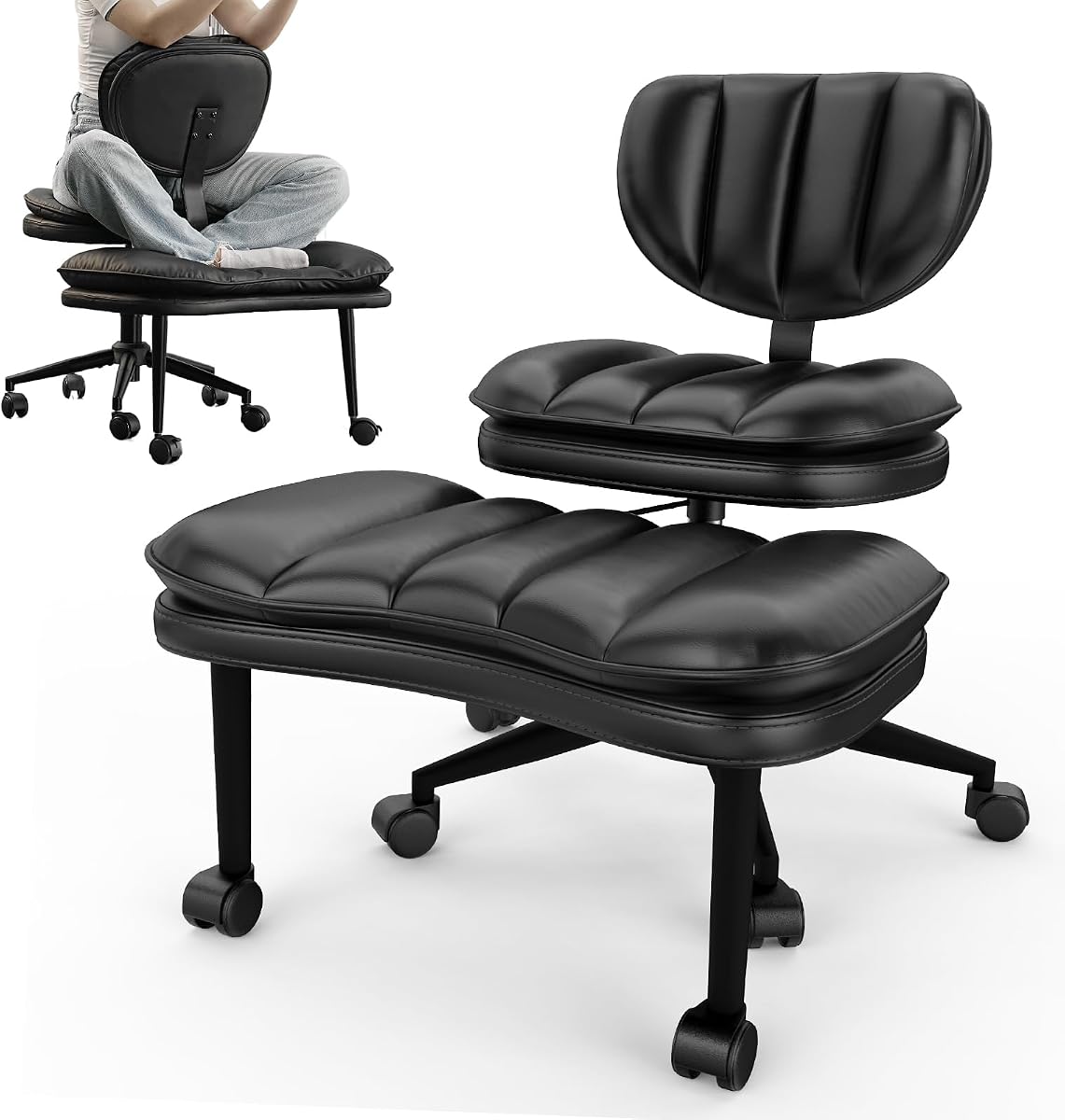


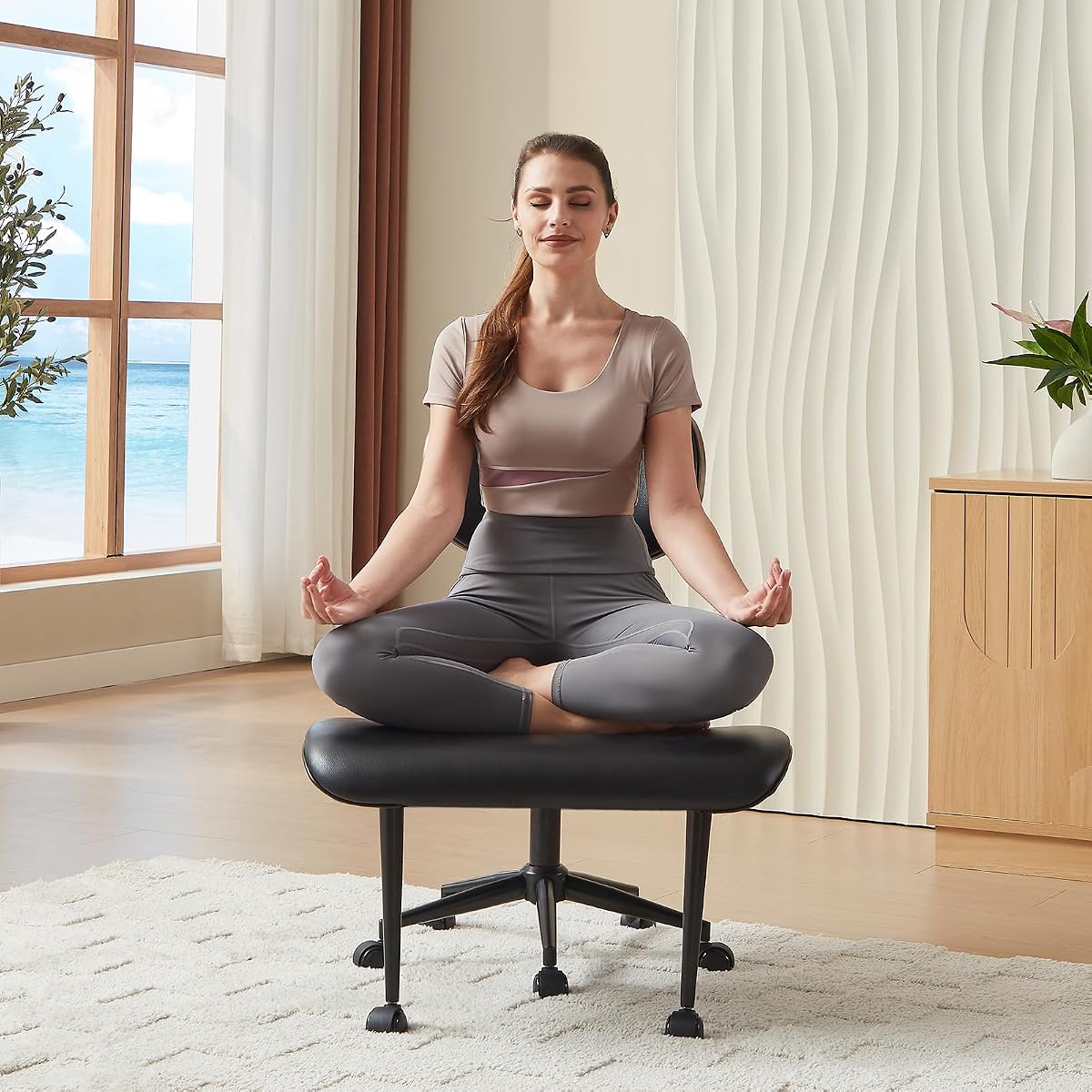

The DUMOS ADHD Meditation Chair combines a low, deeply padded seat with a height-adjustable backrest and a large rotating footstool. Its 4.6 rating reflects a broadly favorable response, while its main attraction is the ability to move among cross-legged, squatting, kneeling, and conventional seated positions without changing chairs.
We may earn a commission when you buy through this link, at no additional cost to you.
One of the strongest features is the seat and footstool system. The nearly four-inch-thick cushion creates a softer landing than many standard office chairs, and the nearly 30-by-16-inch footstool can support the feet, knees, or ankles as the user changes position. Meanwhile, the knob-adjustable backrest provides personalized lumbar support and can be changed while seated, reducing the need to repeatedly stand and reset the chair.
The base also includes a 360-degree rotating seat and footrest, along with height adjustment from 0 to 4.7 inches. Those specifications make the chair more versatile around a desk than a fixed meditation stool, although the lowest setting is unlikely to suit every conventional desk. Buyers should also note that the listing offers breathable teddy bear fabric and easy-clean PU leather, so the exact finish and feel may differ between options.
This is a strong choice for an active sitter who wants several posture options without a complicated frame. It is particularly useful for a home office, study area, or meditation corner, and the stated steel base, hydraulic cylinders, and casters suggest a durable rolling design. It is less suitable for someone who needs conventional desk-chair arm support or a strict seat-height range, but for cross-legged and varied-position use it offers an impressive balance of cushioning and flexibility.
The chair's open construction should also make everyday care straightforward, and the product is described as easy to assemble. SGS-certified hydraulic cylinders are included for height changes, while the rotating components allow the user to redirect the chair rather than repeatedly dragging it. That combination of freedom, adjustment, and simple upkeep makes this one of the most approachable active-sitting chairs in the guide.
The wide, low seat gives users room to cross their legs or fold into kneeling and squatting positions. This is more useful than merely adding a footrest to a standard chair because the entire seating geometry can accommodate different leg arrangements.
A knob-adjustable backrest and a 360-degree rotating seat and footstool let the user reposition the chair while remaining seated. For restless workers, that convenience can be more valuable than a completely fixed support system.
We may earn a commission when you buy through this link, at no additional cost to you.
The Pinmoco ADHD Cross Legged Office Chair is a compact, low-profile option centered on ergonomic contours and high-density memory foam. It has a 4.0 rating, placing it behind several other featured models in customer feedback, but its adjustable height and tilt make it a practical candidate for people who prioritize a soft, pressure-relieving seat.
We may earn a commission when you buy through this link, at no additional cost to you.
The product is specifically designed around cross-legged sitting, with contours intended to support the back, hips, and legs. Its memory foam is a notable differentiator from the firmer padded seats used by many competing chairs. Adjustable height and tilt add a familiar office-chair element, allowing the user to modify the seat angle as well as the overall height rather than committing to one posture immediately after assembly.
Trade-offs include the absence of detailed information about a rotating footrest, armrests, and specific lumbar-adjustment mechanisms in the supplied listing. Buyers who require a large platform for the feet or a backrest that can be moved through a broad range of angles may need to compare the listing carefully. The 4.0 rating also suggests less consistency than the higher-rated alternatives, although the chair's core ergonomic concept remains appealing.
This model is best suited to a home office, study desk, or relaxation area where the user wants to sit cross-legged and values a soft, contoured seat. It also appeals to pet owners because the stated fabric is durable and easy to clean. People who spend substantial time typing may prefer a model with more visible arm support, but for relaxed work and active sitting, the Pinmoco design is flexible and approachable.
High-density memory foam and shaped contours are intended to distribute pressure across the hips and legs. That makes the chair a practical choice for users who find the hard, narrow seat of a conventional office chair uncomfortable.
Adjusting both height and tilt gives the user more control over the relationship between the seat, knees, and desk. Those familiar adjustments add office-chair versatility to a design primarily intended for cross-legged sitting.
We may earn a commission when you buy through this link, at no additional cost to you.
The HOMRELEXA Cross Legged Office Chair is designed as a broad, low seat that can shift among cross-legged, kneeling, meditation, and standard sitting positions. It carries a 4.2 rating and emphasizes an extra-wide, cloud-soft cushion, an extended backrest, height adjustment, and easy-to-clean PU leather.
We may earn a commission when you buy through this link, at no additional cost to you.
Its most immediately appealing feature is the generous seating area. A wide cushion gives users room to shift their legs rather than squeezing into a fixed position, while the extended backrest is intended to keep the spine aligned during work or gaming. The waterproof, stain-resistant PU leather also adds a practical maintenance benefit, especially in a home office where drinks, pets, and daily wear are common.
The listing reports a sturdy steel base, durable casters, and an assembly process that generally takes about 15 minutes without extra tools. However, detailed information about seat width, exact height travel, and backrest adjustability is not included in the supplied specifications. That makes it important for shoppers to check the current product dimensions and confirm that the chair will fit beneath their desk before ordering.
The HOMRELEXA is a good middle-ground choice for someone who wants a broad cushion, mobile base, and several posture options but does not need the elaborate articulated armrests found on more premium models. It is especially relevant to gamers and remote workers who alternate between leaning back, kneeling, and sitting cross-legged. The straightforward materials and assembly also make it an accessible option for a first active-sitting chair.
The extra-wide cushion creates more room for knees and folded legs than a conventional task chair. That extra space matters when the user intends to move between the desk, floor-facing postures, and relaxed sitting without repeatedly repositioning the whole chair.
The PU leather is described as waterproof, stain-resistant, soft, and easy to wipe down. Hardware is included for assembly, and the stated tool-free process makes setup less intimidating for first-time owners.
We may earn a commission when you buy through this link, at no additional cost to you.
The Cross Legged Office Chair with Arms stands out for its unusually broad 19.68-inch seat, flip-up armrests, and 360-degree rotating footrest. Its 4.5 rating places it among the stronger performers in the group, and the design is clearly aimed at users who want room to kneel, cross their legs, tuck one leg under, or shift frequently while working.
We may earn a commission when you buy through this link, at no additional cost to you.
The flip-up arms are especially useful in a home office because they provide support during standard typing periods but can be moved upward when the user wants more space to cross their legs. The rotating footrest supports the legs from multiple directions, reducing the need to drag or pivot the entire chair. Together with height adjustment and a swivel base, these features create a more adaptable alternative to a fixed kneeling stool.
The trade-off is size. A chair designed around a 19.68-inch-wide seat and a broad footrest may occupy more floor space than a compact meditation chair, even though the arms can be raised. The supplied information also does not state a precise user-weight limit, so buyers seeking a heavy-duty product should verify that detail in the current listing rather than relying only on the product wording.
This chair is a strong choice for remote workers, creatives, gamers, and anyone who dislikes remaining in one position for hours. The active design can provide small opportunities for movement throughout the day, while the padded and spacious seat should be more accommodating than a narrow stool. It may be less suitable for a very small work area, but the flip-up arms help conserve space when the chair is pushed under a desk.
Assembly is described as straightforward, with the required components and instructions included and an estimated setup time of about 15 minutes. That accessibility makes it a practical upgrade for someone moving away from a standard desk chair without wanting to learn a complicated adjustment system.
The 19.68-inch width gives cross-legged and kneeling users more space to move without immediately contacting the frame or armrests. It also allows one leg to be tucked beneath the body when a fully cross-legged position is not comfortable.
Raising the arms converts a supportive task chair into a more open active-sitting platform. This is useful when the user changes from typing posture to floor-facing or meditation-style seating during the same session.
We may earn a commission when you buy through this link, at no additional cost to you.
The Criss Cross Legged Office Chair with Wheels is a versatile active-sitting chair for cross-legged, kneeling, squatting, and relaxed positions. It has a 4.1 rating and stands apart through a thick high-density foam seat, a footrest that can be pulled closer, pushed away, or adjusted in height, and a five-star base with silent casters.
We may earn a commission when you buy through this link, at no additional cost to you.
The footrest is the central feature. Instead of a fixed platform, it can move to suit the user's leg angle, which is valuable when transitioning between sitting on the seat, sitting cross-legged, kneeling, or squatting. High-density foam provides cushioning for longer sessions, and the stated PU leather surface is soft, breathable, and spill-resistant according to the product information.
The base is listed as supporting up to 300 pounds, giving this model one of the stronger stated capacity figures among the featured options. Silent casters and a five-star base also make it easier to move between a desk, reading area, and meditation space. On the other hand, the detailed backrest mechanism and exact seat dimensions are not provided, and the listing's promotional language is more expansive than its technical information.
This chair is a good fit for a user who wants an adjustable footrest and mobility more than extensive armrest articulation. It may be especially useful for yoga enthusiasts, remote workers, and people who fidget while reading or using a computer. Those needing a tall conventional office chair or a very structured lumbar system may want to compare one of the more heavily specified back-support models.
The adjustable footrest can be moved closer, farther away, and into a different height, reducing the need to force the legs into one fixed position. That flexibility is particularly helpful for cross-legged and kneeling users.
A five-star base and silent casters allow the chair to move between work, leisure, and meditation areas. The stated 300-pound capacity also makes it worth considering for a wider range of adult users than products without a published capacity.
We may earn a commission when you buy through this link, at no additional cost to you.
This DUMOS ADHD Meditation Chair listing shares the same core design as the first-ranked product and also carries a 4.6 rating. It combines a nearly four-inch-thick seat, an adjustable lumbar backrest, a 360-degree rotating footstool, and broad posture support for home-office work, yoga, and meditation.
We may earn a commission when you buy through this link, at no additional cost to you.
The adjustable backrest is one of the most useful details. Because it can be changed with a knob while the user is seated, the lumbar position can be modified as the body shifts between standard, cross-legged, squatting, and kneeling postures. A nearly 30-by-16-inch rotating footstool provides a substantial place for the feet, knees, or ankles, while the seat itself rotates through 360 degrees for easier repositioning.
Height adjustment ranges from 0 to 4.7 inches, giving the chair a broad range of configurations. That range is useful for low floor-facing postures but may be lower than a user expects from a desk chair. There are no conventional armrests listed, so people who require forearm support while typing may need a separate armrest or a different model.
This listing is a compelling choice for users who prioritize a soft seat and a movable foot platform over traditional office-chair features. It is well suited to a meditation area, flexible home workspace, or room where the user frequently changes position. The open design also makes cleaning easier, while the steel base, hydraulic cylinders, and heavy-duty casters support the expectation of regular movement.
The backrest moves through a height range and can be adjusted with a knob without requiring the user to get up. This is useful when the torso angle changes substantially between standard and floor-facing positions.
Both the seat and footstool can rotate, giving users another way to redirect their legs and torso. The large footstool is particularly helpful when the user folds into a cross-legged or kneeling position.
We may earn a commission when you buy through this link, at no additional cost to you.
The Criss Cross Office Chair is the most technically detailed model in this guide and carries the highest customer rating at 4.8. Its combination of a 21-inch-wide seat, dual lumbar support, six-direction 3D armrests, a 4.7-inch lift, and a retractable footrest gives it the broadest range of adjustments among the featured products.
We may earn a commission when you buy through this link, at no additional cost to you.
The dual backrest is designed to maintain the spine's natural curvature and reduce pressure during extended work. It works with a four-inch-thick plush leather cushion rather than replacing that need for cushioning with structure alone. The wide seat has a low front edge, allowing the user to tuck their legs underneath or kneel without pressure directly behind the knees, while the retractable leather-padded footrest supports the legs in cross-legged and kneeling positions.
The 3D armrests are a meaningful differentiator. They can move up, down, forward, back, left, and right, which helps support the elbows in conventional typing positions while also being moved or flipped up for more open postures. The stated 200-pound capacity and robust steel base offer a clear limit, and the broad frame may require more space than compact models.
This is the strongest recommendation for a user who wants one chair to transition between active and conventional work. It is appropriate for home offices, remote employees, yoga practitioners, and anyone who uses long calls while changing posture. The retractable footrest and flip-up arms make it easier to move from deep work to relaxed cross-legged sitting without moving to a separate meditation stool.
Six-direction adjustment allows the armrests to be aligned with the elbows during standard typing and repositioned as the legs change. This is especially useful in a chair that serves both a conventional desk and floor-facing postures.
The 21-inch seat and low front edge create room to tuck the legs under the body. Combined with the retractable padded footrest, it offers a more complete support system for cross-legged and kneeling work.
We may earn a commission when you buy through this link, at no additional cost to you.
The Bestier Cross Legged Office Chair uses a two-layer design to support cross-legged, squatting, and kneeling positions while retaining a more familiar office-chair base. Its 4.2 rating reflects positive but moderate customer feedback, and the defining benefits include a curved backrest, five rotating casters, 360-degree swivel movement, and easy-clean PU leather.
We may earn a commission when you buy through this link, at no additional cost to you.
The two-level height mechanism offers a simple way to alter the seat position for different postures or desk heights. Its wide seat and two-layer construction are intended to provide more legroom than a standard chair, while the curved backrest is positioned to support the spine during work, meditation, or gaming. The upholstery is described as waterproof and wear-resistant, making it straightforward to wipe clean.
The main limitation is the simplicity of the height system. Two levels offer less continuous adjustment than the hydraulic or lifting mechanisms found on several competing models. There are also no listed armrests, and the information does not provide a precise width measurement or a detailed account of how the two seat layers articulate. Buyers should confirm that the lower setting is low enough for their preferred posture.
This model is well suited to users who want active sitting without complex controls. The rolling base and 360-degree swivel make it easy to move between a desk and a nearby relaxation area, and the cleanable leather is practical for shared or high-use spaces. It is a sensible option for someone who values posture range and mobility over the extensive armrest articulation offered by the most premium design.
The two-level height adjustment changes the seat position without requiring a complicated control. It is a straightforward system for moving between desk work, cross-legged sitting, and kneeling positions.
Five casters and a 360-degree swivel allow the chair to be moved without dragging. This is useful in multipurpose home spaces where the same chair may serve as a desk seat and meditation chair.
We may earn a commission when you buy through this link, at no additional cost to you.
The YFO Ergonomic Cross Legged Office Chair combines a 4.7 rating with a notably versatile design for adults who alternate among standard, cross-legged, stretching, and meditation-style positions. It includes a 360-degree swivel, adjustable height, a retractable footrest, rubber wheels, and a back pocket.
We may earn a commission when you buy through this link, at no additional cost to you.
The retractable footrest is a practical space-saving feature. Users can pull it out to support the legs when working cross-legged or stretching, then return it when it is not needed. The rotating seat provides additional freedom, while the rubber wheels are described as quiet and suitable for wood floors, carpets, and marble, making the chair more accommodating in a shared home environment.
Comfort comes from high-quality sponge, and the surface is described as scratch-resistant, durable, and easy to maintain. The back pocket adds a small but genuine convenience for items such as a notebook or tablet accessory. On the other hand, the supplied specifications do not state the exact seat width, height range, or backrest adjustment, so shoppers wanting firm numerical fit information should review the current listing.
This chair is an excellent choice for a home office, game area, or meditation space where quiet movement and flexible leg support matter. It is particularly attractive to users who switch between the desk and a relaxed floor-facing posture and do not want a large footrest permanently occupying the area. Assembly uses the included tools, and the listing provides support if components are missing or steel bars arrive bent.
Its high rating and balanced feature set make it an easy recommendation for many buyers. The 360-degree swivel, retractable footrest, and floor-friendly wheels create a chair that can genuinely function as both a desk chair and a meditation seat without requiring every accessory to remain deployed.
The retractable design provides support when the user wants to cross their legs or stretch but removes visual and physical bulk when it is not needed. It is especially useful beneath a compact desk.
Rubber wheels are intended to roll quietly over wood, carpet, and marble. That makes the chair more suitable for a shared household than a caster design that may be louder on hard flooring.
We may earn a commission when you buy through this link, at no additional cost to you.
The AtHope Cross Legged Office Chair offers cross-legged, squatting, and kneeling positions in a mobile frame with a wide rotating footrest. It has a 4.2 rating and combines a fixed lumbar-support backrest with a steel base, durable casters, an FSC-certified wooden cushion frame, and water-resistant PU leather.
We may earn a commission when you buy through this link, at no additional cost to you.
The footrest is the most versatile component. Because it rotates through 360 degrees, the user can reposition the legs without shifting the chair itself. This helps when moving between a conventional desk position and a cross-legged or kneeling posture, particularly if the chair is positioned in a tight area where rotating the entire base would be inconvenient.
The fixed backrest provides consistent lumbar support throughout the session, although the lack of listed backrest adjustment means it may not accommodate every body as precisely as an articulated model. Armrests are also not specified, so the chair offers no stated forearm support for typing. Its easy-clean PU leather and durable construction are positive features for regular use in a home, office, or gaming setup.
The AtHope is best for a user who values a rotating leg-support platform and straightforward maintenance. It can serve as a dedicated active-sitting or meditation chair, or complement a work area where users alternate among different floor-facing positions. Those wanting a more complete conventional task chair may prefer a model with arms and a more highly adjustable backrest.
The 360-degree rotating footrest changes the direction of support while the chair remains in place. This makes posture transitions faster and easier in confined workspaces.
An FSC-certified wooden frame supports the cushion, while a steel base and durable casters provide the rolling structure. The water-resistant PU leather can be wiped clean after regular work or gaming sessions.
We may earn a commission when you buy through this link, at no additional cost to you.
The right Adhd Office Chair should match your preferred postures, desk setup, floor type, and need for adjustment. Comparing the seat geometry, back support, footrest, mobility, and maintenance requirements is more useful than focusing on a single feature.
Begin by identifying which positions you actually expect to use. Most models in this guide support conventional sitting, cross-legged sitting, kneeling, and squatting, but the degree of freedom varies. A low, wide seat is better for folding the legs beneath the body, while a conventional front edge may make standard typing more natural. Models with two-layer seats or retractable platforms often provide more positional variation, so they can be especially useful for users who shift frequently.
Choose a chair based on your most common posture, not the broadest list. A dedicated meditation position is only helpful if it matches how you work.
Seat width determines whether there is enough room for crossed legs, bent knees, or a kneeling position without contacting the frame. The featured chairs range from a very wide 19.68-inch design to a 21-inch premium model, while others prioritize contoured or memory-foam comfort. Thick high-density foam can reduce pressure during long sessions, but excessive softness may not provide the stable base some users prefer for typing. Consider both the usable flat area and the front edge, because the latter affects pressure behind the knees when legs are tucked.
Look for a seat that supports your legs without requiring constant repositioning, then confirm that its height and depth suit your desk.
An adjustable backrest can follow changes in torso height as the user moves between upright typing and relaxed cross-legged sitting. Dual lumbar support or a knob-adjustable height range may provide more precise positioning than a fixed backrest. A longer backrest can also offer broader support when the user leans back, but it may take up more space. Users with specific back-support needs should consider the chair's stated structure and test the adjustment range rather than assuming all backrests provide the same support.
Prioritize consistent lumbar contact, simple controls, and enough range to match your most common posture.
The footrest is central to many active-sitting chairs because it gives the legs a supported destination when the user crosses or folds them. A rotating footrest can redirect support without moving the whole chair, while a retractable model can disappear to free floor space. Height and depth adjustment are especially useful because leg length and desk height vary. A wide platform may be more comfortable for extended cross-legged sessions, whereas a compact footrest may be easier to store and better suited to occasional support.
Choose a footrest that adjusts through your required range and can be positioned without forcing the chair to move.
Check the full height range, not just whether the chair is described as height adjustable. Some active-sitting chairs lower almost to the floor, which is excellent for kneeling and cross-legged postures but may feel too low for conventional work. A 4.7-inch lift provides more rise from the base, while hydraulic and gas-lift systems may offer more gradual adjustment. Buyers should also measure the desk clearance, including any armrests, and compare that measurement with the chair's assembled dimensions and current product specifications.
The best fit supports both your desk and your floor-facing posture without constant manual adjustment.
A swivel base, rotating seat, and smooth casters make it easier to change direction without repeatedly moving the chair. The DUMOS models offer a 360-degree rotating seat and footstool, while the YFO uses a 360-degree swivel and quieter rubber wheels. Home-office users should consider whether the casters are appropriate for wood, carpet, tile, or marble and whether the wide base will fit around desk legs. Mobility is useful in multipurpose rooms, but a larger base may be less convenient in narrow spaces.
Match the wheel system to the floor and confirm that the base footprint fits your workspace.
Armrests are important when the chair will be used for extended typing or mouse work, yet they can interfere with cross-legged and kneeling positions. Flip-up or highly adjustable arms offer a compromise by supporting conventional tasks and moving out of the way for active sitting. The 3D armrests on the premium Criss Cross Office Chair can move in six directions, while other options have no listed arm support. Users who divide their day equally between keyboard work and floor-facing postures should look for arms that are easy to release.
Treat armrests as a posture-switching tool, choosing a design that supports typing without blocking the positions you value.
PU leather is easy to wipe clean and generally practical for homes with pets or frequent snack breaks, while fabric may feel more breathable. Published capacity figures range up to 300 pounds in this group, with one premium model stating a 200-pound limit. Do not infer a load rating for models that do not publish one. Assembly complexity, hardware availability, hydraulic components, caster durability, and surface care also affect long-term ownership. A simple cleaning routine and a sturdy base are especially valuable in a chair designed to move frequently.
Check the stated material, load limit, assembly requirements, and care guidance before ordering.
Set the chair on a level surface and assemble it according to the included instructions, checking that the base, hydraulic cylinder, footrest, and casters are securely attached before sitting. Adjust the seat height while holding the chair steady, then position the backrest and footrest for your first posture. Avoid extending the footrest beyond its intended range, and never stand on it. Give the chair a gentle stability test before rolling it beneath a desk.
Use the chair as an active-sitting tool rather than treating every change as permanent. Begin with standard upright sitting for keyboard tasks, move to cross-legged or kneeling positions when they feel more natural, and use the backrest and footrest to support the new angle. If the chair has flip-up or movable armrests, raise or reposition them before folding the legs. Periodic posture changes can be more comfortable than forcing one position for an entire work session.
Wipe PU leather with a soft, slightly damp cloth and mild cleaner, avoiding harsh chemicals and excessive water. Vacuum fabric upholstery and clean the moving joints periodically. Check that casters roll freely, tighten loose hardware, and inspect the hydraulic or gas-lift section for unusual movement. Keep the load within the published capacity, and follow the manufacturer's assembly, care, and replacement-part instructions.
An Adhd Office Chair is designed to support more than one fixed sitting posture. Most models in this guide accommodate cross-legged sitting, kneeling, squatting, and conventional upright positions, often using a low or wide seat, rotating components, and an adjustable footrest. That flexibility can make it easier to change position during long work or study sessions.
It can, provided the chair's height and dimensions match the available desk clearance. Some active chairs have very low minimum heights, while others provide a taller lift for typing. It is best to measure the underside of the desk and compare it with the assembled chair, including armrests, before purchasing.
An adjustable footrest can be important because it gives the legs support in several different positions. A rotating or retractable model also allows the user to redirect or store the support as needed. The best choice depends on whether cross-legged sitting is occasional or part of the user's regular routine.
Yes. The same features that help active sitters change position can benefit anyone who prefers cross-legged, kneeling, or relaxed postures. They may be particularly useful for remote workers, students, yoga enthusiasts, gamers, and users recovering from conventional chair discomfort, although individual comfort and desk fit still matter.
They can if they remain in a low, fixed position, but flip-up and multi-directional armrests can be moved out of the way. The premium Criss Cross Office Chair allows its 3D armrests to move up, down, forward, back, left, and right, illustrating how the right design can support both conventional typing and open postures.
Wipe the surface regularly with a soft, slightly damp cloth and use a mild cleaner for marks. Avoid soaking the material, harsh chemicals, and abrasive pads. Clean underneath the seat and around joints where dust can collect, and check the manufacturer's care instructions before applying any special treatment.
The answer depends on the wheel material and the floor surface. The YFO chair is specifically described as using quiet rubber wheels suitable for wood, carpet, and marble, while other models use standard casters. Shoppers should check the current product information and test the chair on their own flooring when possible.
Memory foam is valuable when pressure relief and a softer contour are the main priorities. High-density foam can provide a firmer, more consistent support surface and may retain its shape better over time. The best choice depends on body preference, desk task, and how long the chair will be used, so comparing the stated cushion construction is important.
The three leading recommendations cover different priorities. The DUMOS ADHD Meditation Chair offers broad posture freedom, an adjustable backrest, and a large rotating footstool. The YFO Ergonomic Cross Legged Chair adds quiet rubber wheels, a retractable footrest, and a high 4.7 rating, while the premium Criss Cross Office Chair provides the most elaborate support with dual lumbar components, 3D armrests, and a 21-inch seat.
Before choosing, prioritize the postures you will use most, the amount of back and arm support you need, and whether the chair must fit beneath your desk. A rotating or retractable footrest is useful for frequent position changes, while a simpler height mechanism may suit someone who wants fewer controls. Also consider the floor, cleaning needs, published capacity, and the amount of space the assembled chair will occupy.
Finally, confirm the current listing details before ordering, as ratings, available finishes, dimensions, and included components can change. Measure the desk and intended seating area, review the manufacturer's instructions, and make sure the chosen chair supports your preferred working and movement patterns.