
WJSTN-061 90 Degree RCA Cable
4.7Editor score
Right-angle connectors at both ends
Gold-plated RCA construction
Two-pack of 1-foot cables
Our 90 Degree RCA Cable guide compares ten options for tight spaces, cable routing, shielding, connector quality, compatibility, and subwoofer setups in
A 90 degree RCA cable is designed to connect audio equipment while making tight installations easier. Its right-angle plugs reduce the space required behind televisions, receivers, amplifiers, cabinets, and wall-mounted devices, while helping prevent sharply bent cables. The right format depends on connector configuration, cable length, shielding, construction, and the equipment being connected.
This guide compares ten right-angle RCA cables, subwoofer cables, and angled adapters using their stated specifications and customer ratings. It covers products with straight-to-right-angle, right-angle-to-right-angle, and male-to-female configurations, paying particular attention to fit, conductor construction, shielding, connector materials, supported devices, and suitability for home theater or car audio installations.
The list is designed to make the differences easier to understand rather than treating every angled cable as interchangeable. Each review explains where a product is strongest, where its design creates trade-offs, and which setup it best suits. Product ratings and availability can change over time, so shoppers should confirm current details and prices before purchasing.
4.7Editor score

4.7Editor score

4.6Editor score
The table below compares all ten products by their connector arrangement, cable format, length or pack size, shielding, and stated construction. It is the quickest way to identify whether a model is a full cable, a compact subwoofer lead, or an adapter designed to alter the direction of an existing RCA connection.
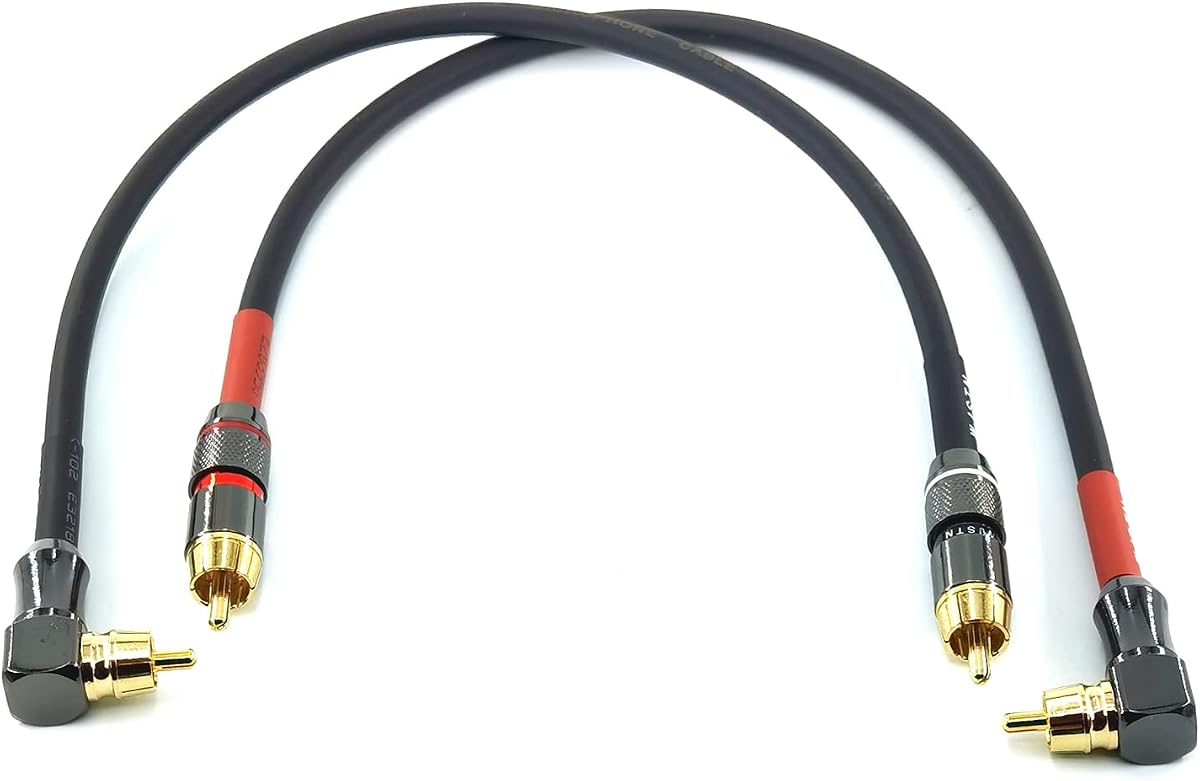



The WJSTN-061 is a compact two-pack of 90-degree right-angle RCA cables with a customer rating of 4.7. Its most useful feature is the right-angle connector at both ends, which makes it a natural choice when a television, sound bar, receiver, or subwoofer sits close to a wall. The short 1-foot length keeps the installation visually neat and limits excess cable behind equipment.
We may earn a commission when you buy through this link, at no additional cost to you.
The male-to-male format works with standard RCA audio connections, while the gold-plated construction is intended to support dependable contact and resistance to oxidation. The product information specifically identifies uses including home theater, sound bars, and televisions. Its right-angle-to-right-angle design can be especially valuable for components installed side by side, where straight plugs would occupy more horizontal space.
The principal limitation is length. At eight inches, these cables are unlikely to bridge much distance and may be inconvenient when a subwoofer or receiver is positioned away from the source component. The two-pack provides some flexibility, but it does not change the short reach of each lead. Buyers who need extended routing should look for a longer model rather than relying on excess slack.
Overall, this is a straightforward option for close-range connections behind entertainment furniture. It combines a favorable rating, dual right angles, and a useful pack quantity without adding unnecessary construction claims. It is particularly suitable for users who know the exact nearby devices they want to connect and want a compact solution for eliminating sharp cable bends.
The short cable is a feature when both devices are within a few inches of one another. It is especially useful behind wall-mounted televisions, compact sound bars, receivers, or subwoofers positioned beside cabinetry.
Right-angle plugs at both ends provide clearance from the equipment housing. This allows a cable to approach from the side without the sharp transition created by two conventional straight plugs.
We may earn a commission when you buy through this link, at no additional cost to you.
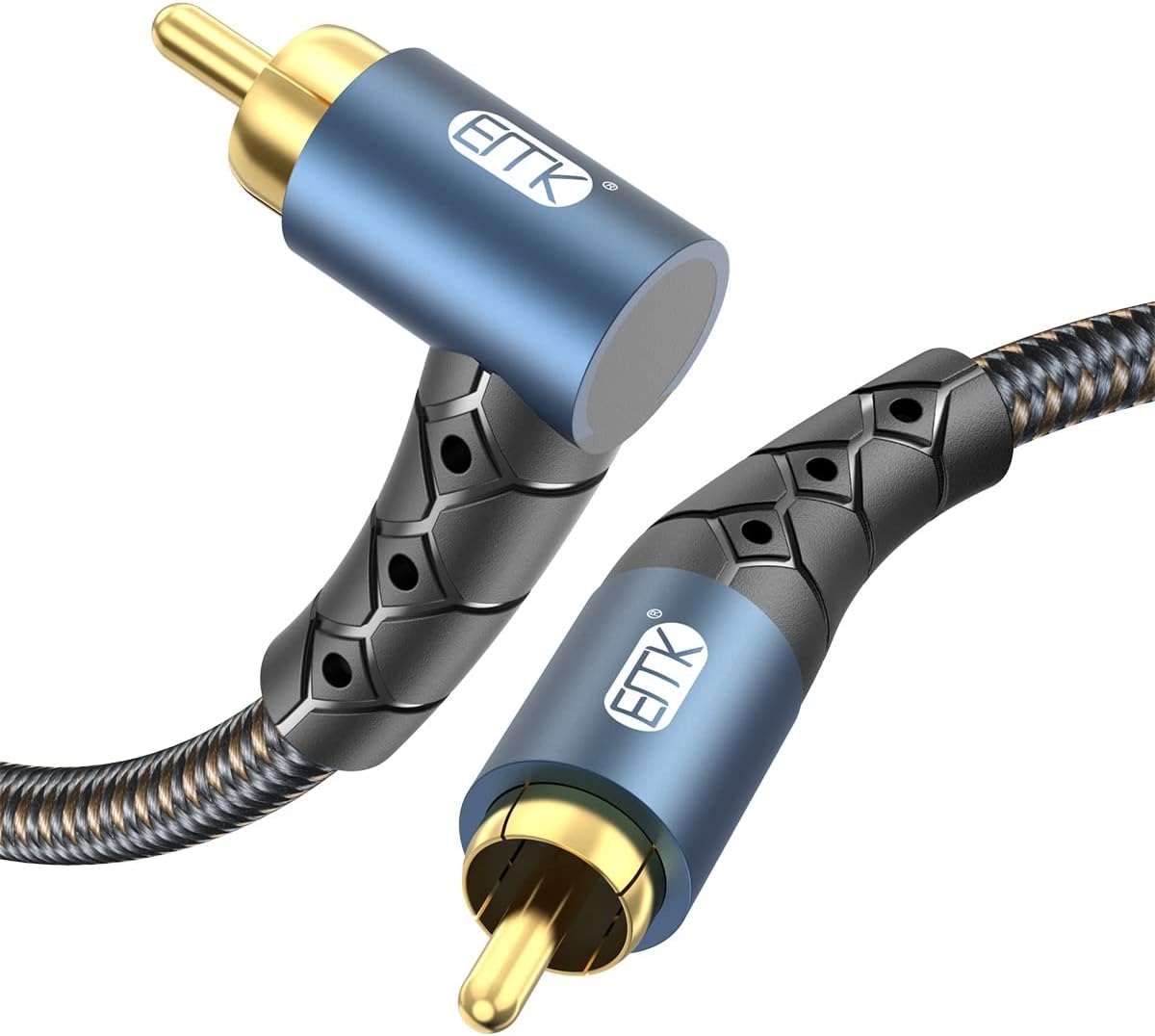
The EMK 6.6-foot cable combines a 4.7 customer rating with a construction-oriented design aimed at home audio installations. Its 90-degree plug, nylon-braided exterior, double shielding, and gold-plated contacts make it one of the most comprehensively specified conventional cables in this guide. It is marketed for amplifiers, home theaters, hi-fi systems, and subwoofers.
We may earn a commission when you buy through this link, at no additional cost to you.
The stated conductor and shielding arrangement is a major strength. A copper-clad center conductor, dielectric insulation, nylon braid, and dual shielding are intended to support clean signal transfer while limiting radio-frequency and electromagnetic interference. The product information also states that the cable supports digital coaxial and analog RCA audio ports, giving it broader relevance than a cable described only for one specific signal type.
Its 6.6-foot length sits comfortably between the very short leads in the list and the longest available options. That makes it a practical choice for a subwoofer beside an amplifier or receiver, although actual routing requirements should be measured before buying. The right-angle design saves space but may not be ideal in every orientation, especially where a connector must project outward from an unusually shallow port.
This cable is a strong all-around recommendation for buyers who value interference protection, flexible routing, and useful length. It is less obviously suited to stereo pairs than a cable explicitly sold as dual RCA to dual RCA, so users connecting both left and right channels should verify the connector arrangement. For a subwoofer or another single RCA audio link, however, the specification is compelling.
Double shielding helps protect the audio signal from interference that can appear as unwanted noise or instability. The stated copper-clad conductor and dielectric insulation also support consistent performance in home audio environments.
The nylon-braided jacket is intended to resist wear while remaining flexible around furniture and through narrow cable routes. Its right-angle connection further reduces strain at the equipment port.
We may earn a commission when you buy through this link, at no additional cost to you.
The Mygatti 10-foot cable is the most fully specified long-length stereo cable in this roundup, carrying a 4.6 rating. It uses right-angle connectors at both ends and a two-RCA-to-two-RCA layout, making it suitable for left and right audio channels. Its 23 AWG oxygen-free copper conductor, double shielding, zinc alloy shells, and 24K gold-plated plugs form the basis of its premium positioning.
We may earn a commission when you buy through this link, at no additional cost to you.
The stated 23 AWG conductor is noteworthy because the product information compares it with thinner 24 AWG and 26 AWG wire commonly used in other cables. The double shielding is intended to reduce electromagnetic and radio-frequency interference, while the zinc alloy housing is presented as a way to improve heat dissipation. The manufacturer also states that the cable has passed more than 15,000 bend tests.
Compatibility is broad across home theater receivers, amplifiers, HDTVs, soundbars, Blu-ray players, Xbox 360 systems, car audio equipment, speakers, and DJ controllers with the appropriate RCA interfaces. The trade-off is that this is a dual-channel cable rather than a single subwoofer lead, and its 10-foot length may create excess cable in a close installation. Buyers should match the physical channel and device requirements carefully.
For a larger home theater or stereo setup that needs a long stereo RCA run and wants to minimize sharp bends, this is a compelling option. It offers the most generous stated length in the guide while going beyond basic connector plating with conductor, shielding, housing, and bend-life details. It is best for installations where both right-angle routing and substantial reach matter.
The two-RCA-to-two-RCA arrangement provides separate connections for left and right audio channels. That makes the cable more suitable than a single subwoofer-style lead for conventional stereo equipment.
The 10-foot length supports connections between components that are not directly adjacent. It is useful for entertainment centers, wall-mounted equipment, amplifiers, and speakers where a short lead would not reach.
We may earn a commission when you buy through this link, at no additional cost to you.
The WJSTN-055 has a 4.6 rating and a mixed right-angle-to-straight configuration. Unlike products with two right-angle ends, this cable places the angle at one end while retaining a conventional plug at the other. That arrangement is useful when one device is mounted close to a wall but the opposite connection point has more open space.
We may earn a commission when you buy through this link, at no additional cost to you.
The product is presented as a digital coaxial audio cable for home theater systems, sound bars, televisions, PS4, Xbox, PlayStation, and compatible RCA or coaxial ports. Its male-to-male configuration fits the usual arrangement in which the source equipment provides a female RCA output and the receiving device accepts a male plug. The two-pack also makes it possible to keep a spare nearby.
The main limitation is again its 1-foot length, which sharply limits how much separation the cable can bridge. The straight connector on one end may also take up more space than a fully angled solution. Users who need a cable to exit both pieces of equipment in perpendicular directions should examine the dual-angle alternatives instead.
This is a good fit for a nearby subwoofer or audio component where only one end needs angle correction. Its rating, simple plug-and-play format, and stated compatibility make it an accessible option for improving a cramped connection without committing to a longer or more elaborate cable.
A mixed-angle cable is useful when wall clearance is an issue at only one endpoint. The straight end can still connect normally where plenty of space surrounds the corresponding port.
The stated support for home theater, television, game console, amplifier, and coaxial RCA ports makes the cable suitable for several common single-channel audio connections.
We may earn a commission when you buy through this link, at no additional cost to you.
The EMK 3.3-foot cable shares the core construction language of the longer 6.6-foot EMK option but offers a more compact 1-meter format. It has a 4.7 customer rating, a right-angle connector design, 24K gold-plated contacts, a copper-clad center conductor, dielectric insulation, a nylon braid, and double shielding.
We may earn a commission when you buy through this link, at no additional cost to you.
The product is listed for amplifiers, home theaters, hi-fi systems, and subwoofers, with stated support for digital coaxial and analog RCA audio ports. Its physical design emphasizes space savings, easier routing in hard-to-reach locations, and reduced cable kinking. For a subwoofer positioned immediately beside a receiver or amplifier, that combination of features is highly relevant.
As with all short cables, the main limitation is reach. A 3.3-foot lead is best when the connected components are close enough that a full meter provides sufficient routing freedom. Users also receive one cable rather than a pair, which may matter for a left-right stereo application. The stated construction is more involved than that of basic molded cables, but it does not extend the physical reach.
This is a strong compact recommendation for a single subwoofer or nearby RCA audio component. It offers the same useful combination of shielding, braided construction, gold plating, and angled routing as the longer EMK model, allowing buyers to prioritize installation space over maximum distance.
The one-meter length fits comfortably between a subwoofer and a nearby amplifier or receiver. It also avoids leaving a large loop of excess cable inside a cabinet or entertainment center.
Dual shielding targets interference, while the nylon braid and gold-plated contacts support a practical, durable connection. The angled plug further reduces stress where clearance is limited.
We may earn a commission when you buy through this link, at no additional cost to you.
This 10-foot right-angle subwoofer cable has a 4.6 rating and a construction focused on long reach, interference protection, and physical durability. It uses a right-angle male RCA connector, polished alloy housing, corrosion-resistant 24K gold-plated contacts, and a split-tip center pin. The stated shielding combines copper braid with aluminum foil to reduce radio-frequency and electromagnetic interference.
We may earn a commission when you buy through this link, at no additional cost to you.
The right-angle geometry is designed for wall-mounted equipment and other installations where a straight plug would force the cable into a tight bend. The product information says that the design helps prevent cable bending and supports a longer service life. Its outer construction combines a PVC sheath with nylon braid, while the stated bend life exceeds 10,000 cycles.
Compatibility is broad across HDTVs, Blu-ray and DVD players, game consoles, DVRs, cable or satellite boxes, subwoofer speakers, receivers, and other devices with coaxial RCA audio ports. As with other long cables, a 10-foot run may be excessive in a compact setup and can require careful management to avoid tangles. A longer cable is only an advantage when the devices genuinely need that distance.
This is a practical option for installations in which a subwoofer or receiver is several feet from the source device. It combines useful reach with a compact right-angle connection, a layered shielding approach, and a stated bend-life figure. Buyers seeking a shorter cable can save space, while those with longer routes should pay close attention to the specified 10-foot length.
The 10-foot length reaches across larger entertainment centers or equipment positioned farther apart. Users should route the cable in a way that preserves its flexibility and avoids unnecessary loops.
Copper braid and aluminum foil work together to limit interference, while the nylon-braided exterior and reinforced construction are designed to tolerate routine bending and handling.
We may earn a commission when you buy through this link, at no additional cost to you.
The SOUNDFAM cable is a 3.3-foot, red subwoofer lead with a 4.6 customer rating and a right-angle RCA plug at each end. Its strongest selling point is the combination of dual angles and a compact one-meter length, allowing both ends to sit close to their equipment ports without relying on sharply bent straight connectors.
We may earn a commission when you buy through this link, at no additional cost to you.
Signal-related construction includes 24K gold-plated connectors and dual shielding formed from copper braid and aluminum foil. The stated intention is to reduce signal loss and protect against radio-frequency and electromagnetic interference. A polished aluminum shell, abrasion-resistant PVC, and a flexible braided jacket contribute to the physical design, while the product information states that the cable is tested to withstand more than 10,000 bends.
The stated compatibility includes subwoofers, home theater systems, S/PDIF, digital audio, and composite video interfaces. That broad language does not mean every possible application is identical, so buyers should still check the signal requirements of their source and receiving equipment. The physical limitations are the short reach and the fact that only one cable is included.
This is a good recommendation for a subwoofer or audio device positioned very close to its connected component. It is especially attractive when both ports are crowded and the user wants a clean, low-profile route. Its construction specifications support a home audio focus, while the dual-angle configuration distinguishes it from many short mixed-angle alternatives.
Two right-angle plugs reduce the amount of space each connector projects from the equipment. This can prevent tight bends and simplify routing behind TVs, inside cabinets, or near walls.
Copper braid and aluminum foil provide layered protection from interference. The stated 24K gold-plated contacts support consistent connectivity for subwoofer and other RCA audio connections.
We may earn a commission when you buy through this link, at no additional cost to you.
The VANAUX 5-foot cable is a 4.4-rated right-angle RCA subwoofer cable with a 1.5-meter length. Its design combines a nylon-braided jacket, reinforced strain relief, double shielding, 24K gold-plated contacts, and aluminum alloy housing. That combination makes it a practical option for a subwoofer connection that needs more distance than a one-meter lead but less than a 10-foot cable.
We may earn a commission when you buy through this link, at no additional cost to you.
The product is intended for subwoofers, AV receivers, amplifiers, speakers, soundbars, home theater systems, and other RCA-enabled equipment. The right-angle connector is designed to support clean routing behind televisions, entertainment centers, cabinets, and wall-mounted devices, while the strain relief is intended to withstand frequent plugging and unplugging.
Its 4.4 rating is the lowest among the products in this guide, although it still reflects generally favorable customer feedback. The supplied information does not break down the reasons for individual ratings, so it would be inappropriate to draw unsupported conclusions. Buyers with demanding installation needs should also verify whether the pictured or described connector arrangement matches both devices.
This cable is best for a mid-range home audio route that balances space-saving connectors with useful reach. The braided exterior and reinforced strain relief are practical priorities, while double shielding and gold-plated contacts support the signal connection. It is a sensible middle option between the shortest subwoofer leads and the longest cables in the roundup.
Five feet gives a subwoofer more freedom to move away from an amplifier or receiver while remaining shorter than the 10-foot options. It works well for most nearby entertainment-center arrangements.
The nylon braid is intended to resist wear and reduce tangling, while reinforced strain relief protects the connection where repeated bending would otherwise place stress on the plug.
We may earn a commission when you buy through this link, at no additional cost to you.
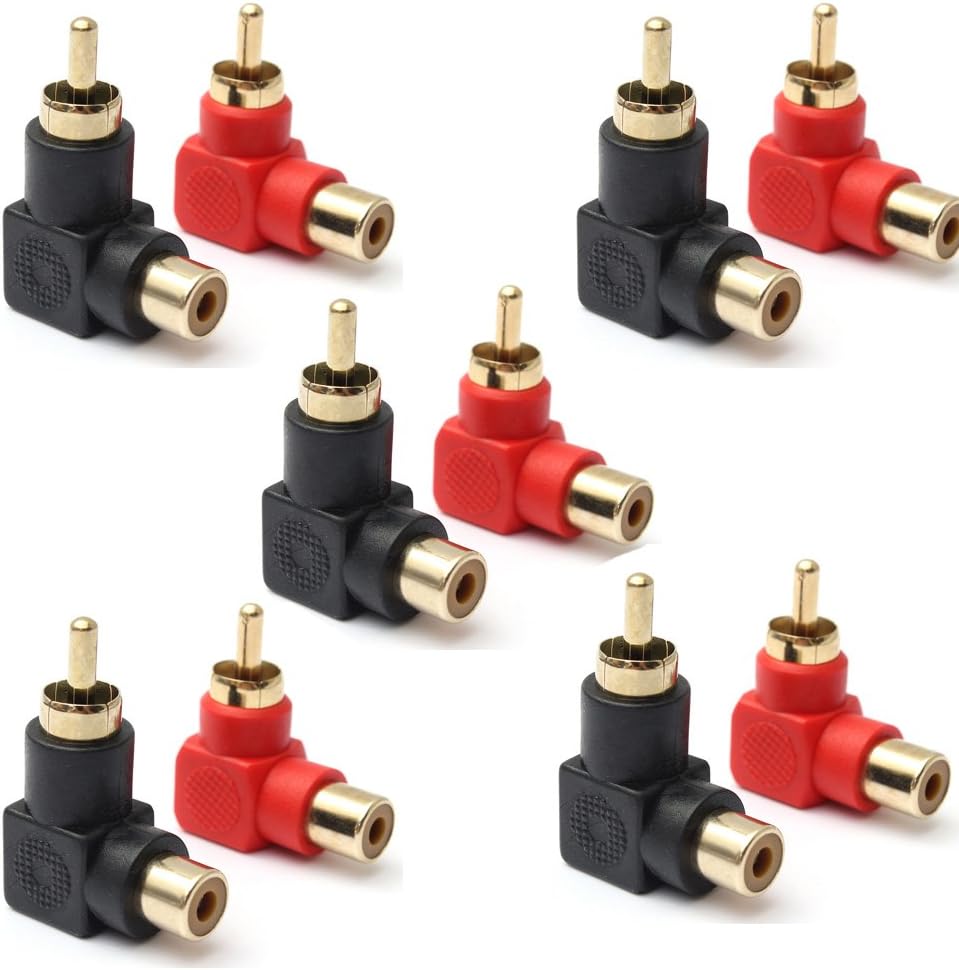
The exgoofit offering is a 4.6-rated collection of ten 90-degree RCA elbow adapters rather than a conventional ready-made cable. Each adapter converts a male RCA plug to a female RCA connection, allowing an existing cable to enter a crowded equipment port from the side. The package includes five black and five red pieces, which helps distinguish stereo channels.
We may earn a commission when you buy through this link, at no additional cost to you.
The adapters use gold-plated contacts and fully molded plastic construction. Their right-angle form is designed for tight spaces around HDTVs, Blu-ray and DVD players, game consoles, DVRs, cable or satellite boxes, subwoofers, receivers, and other RCA-enabled equipment. Each adapter is individually packaged to help guard against scratches, a useful detail for a set containing ten small pieces.
The key benefit is adaptability. Instead of replacing an entire cable, a user can change the entry direction of an existing RCA connection. The trade-off is that every adapter introduces another male-to-female junction, and the package is not itself a cable. Users must already own suitable RCA leads and confirm that the added connection arrangement suits their equipment.
This is a strong choice for installers or audio enthusiasts who work with several devices and want color-coded angled connectors on hand. The ten-piece count makes it more versatile than the two-adapter options, while the black and red organization is particularly useful for left and right stereo channels. It is best viewed as a routing accessory rather than a direct substitute for a complete 90 degree RCA cable.
The male-to-female elbow lets an existing RCA cable approach a port from the side. This is useful when a straight plug cannot be inserted comfortably because of a wall, cabinet, or adjacent component.
Five black and five red adapters make it easier to organize conventional left and right channel wiring. The sizable pack also provides spares for multiple devices or future installations.
We may earn a commission when you buy through this link, at no additional cost to you.
The Cable Matters two-pack has a 4.7 rating and is built around a very low-profile right-angle design. Each adapter combines a solid metal housing with a gold-plated RCA plug and is stated to extend less than one inch from the connected port. That makes it especially useful for flush wall boxes, furniture, and locations where even a conventional elbow may feel too deep.
We may earn a commission when you buy through this link, at no additional cost to you.
The adapters can be used with subwoofer, RCA audio, or component video cables and are compatible with receivers, DVD players, soundbars, car stereos, desktop computers, and televisions. The 360-degree easy-grip surface is intended to make the plug easier to connect and remove, particularly when there is little room for a normal grip. The pack provides one adapter for each side of a conventional stereo pair.
Unlike a complete cable, this is an accessory that must be paired with existing leads. It can also add another connection junction to the signal path. Users should therefore consider whether the low-profile benefit justifies using an adapter rather than selecting a purpose-built angled cable. For a flush installation or unusually shallow port, however, the geometry is particularly compelling.
This is a good final recommendation for users who need a very compact angle correction rather than a new cable. Its strong rating, low-profile metal construction, gold-plated plug, and easy-grip design make it a practical option for wall-mounted equipment, crowded cabinets, and tight receiver connections. It is especially effective when paired with cables that are already the correct length and signal type.
The stated sub-one-inch extension is useful behind flush wall boxes and inside narrow cabinets. The low profile can prevent the plug from taking up valuable depth behind a receiver or television.
A 360-degree easy-grip surface gives users another way to grasp the plug in confined spaces. Gold plating and a solid metal housing support the adapter's durable, low-profile design.
We may earn a commission when you buy through this link, at no additional cost to you.
The right 90 degree RCA cable depends on the physical route between your devices, the type of audio connection being made, and the amount of cable you need. Connector angle, length, shielding, conductor size, jacket material, and packaging can all affect how conveniently a cable performs in a real installation.
Right-angle connectors come in several arrangements. A right-angle-to-right-angle cable is ideal when both components are close to a wall or cabinet side. A right-angle-to-straight cable provides clearance at one endpoint while using a normal plug at the other. A male-to-female adapter is not a complete cable; it redirects an existing RCA plug and requires suitable cables of your own. Before choosing, look at each device from the position it will occupy in the finished setup.
Length should be based on the actual route rather than a rough estimate. Include the depth of each connector, the distance around furniture, and enough serviceability to unplug a device without sharply flexing the cable. The guide includes one-foot, 3.3-foot, 5-foot, 6.6-foot, and 10-foot options, along with adapters. A cable that is too short forces a difficult bend, while an unnecessarily long lead can create excess loops or tangles.
Check whether the equipment uses standard RCA audio ports, digital coaxial connections, S/PDIF, or another interface. A subwoofer cable and a left-right stereo cable may look similar but can differ in connector count and intended signal path. The Mygatti option uses two RCA connections for left and right channels, while several subwoofer products are designed for a single connection. Confirm both the source output and receiving input before purchasing.
Shielding helps protect an analog audio signal from electromagnetic and radio-frequency interference. Products in this guide use combinations such as copper braid, aluminum foil, or double shielding. These features are especially helpful when cables run near power cords, behind entertainment equipment, or through shared cabinet spaces. Shielding does not compensate for a poor connection, but it can be a meaningful part of a clean installation.
Several products specify oxygen-free copper or copper-clad conductors, while many use gold-plated contacts. The Mygatti model goes further by identifying 23 AWG oxygen-free copper and double shielding. Material specifications are useful when comparing options, but actual signal performance also depends on fit and installation. Gold plating is intended to resist corrosion and maintain stable contact, while a properly seated plug remains essential.
A cable routed around furniture or through a tight cabinet experiences repeated flexing. Nylon-braided jackets appear across several options and are intended to resist abrasion while remaining flexible. Some products also state tested bend-life figures, including more than 10,000 or 15,000 cycles. A right-angle plug reduces stress at the port, but the cable still needs a smooth route that does not twist around a sharp edge.
Package quantity affects the number of connections you can complete and how readily you can keep spares. The WJSTN cables and Cable Matters adapters are two-packs, while the exgoofit set contains ten black and red adapters. Most conventional subwoofer cables include one lead. Buying two when one will suffice adds clutter, but buying one for a left-right pair can leave the installation incomplete.
A premium material specification cannot overcome a connector that does not fit the intended port or a cable that is too short. Start with the equipment layout, port direction, required channel count, and route. Within those constraints, compare shielding, conductor construction, jacket quality, and customer ratings. The strongest choice is the one that fits the setup cleanly, routes without strain, and uses the correct connection for the intended signal.
Begin by identifying the correct output and input on each component. Power off the equipment when practical, attach the right-angle plug firmly, and route the cable before moving the devices into their final positions. The angled connector should point into open space rather than toward a wall, cabinet panel, or neighboring device. Check that the plug is fully seated without twisting the cable.
For an adapter, connect the male side to the equipment's female RCA port and then insert the existing cable into the adapter's female end. Keep the adapter and cable aligned so the connection does not bear weight. For a left-right stereo cable, connect red and white to their matching channels. For a subwoofer lead, verify that the amplifier output and subwoofer input are compatible before powering on the system.
Handle the right-angle plug by its housing rather than pulling the attached cable. Route long leads through smooth paths without tight coils, sharp bends, or contact with moving furniture. Keep the connectors clean and dry, and inspect them periodically for looseness, discoloration, or cable damage. If a connection becomes unstable, reseat it and check the route before assuming the cable itself has failed.
A 90 degree RCA cable connects RCA audio equipment while allowing the plug to enter a port from the side. This is especially useful behind wall-mounted televisions, beside subwoofers, and inside entertainment cabinets. The angled connector can reduce strain and make tight cable routing easier. Choose the connector arrangement and length that match the devices and their physical positions.
They are not inherently better for signal quality, but they can be better for particular installations. Their main advantage is physical clearance, which can prevent tight bends and reduce the chance of stressing a connector. Straight cables may be preferable when there is ample space or when a low-profile angled plug would restrict access to another port.
Yes, provided the connector arrangement and signal type match the amplifier output and subwoofer input. A male-to-male subwoofer cable is commonly suited to a female RCA output and a female subwoofer input. Some cables carry two RCA plugs for left and right channels, while subwoofer models may provide a single connection. Always confirm the port layout before buying.
Shielding is beneficial, particularly when the cable runs near power cords, amplifiers, or other electronics. Copper braid, aluminum foil, or dual shielding can help reduce electromagnetic and radio-frequency interference. It is not a guarantee against every source of noise, but it is a sensible feature for home theater, hi-fi, and car audio installations where cables may share confined spaces.
Adapters can be highly convenient because they work with cables you already own and can be reused on different devices. They also add another connection junction and may be less streamlined than a purpose-built cable with molded right-angle plugs. A complete cable is generally tidier, while an adapter is useful for correcting the angle of an otherwise suitable cable.
Choose the shortest length that reaches without forcing a tight bend. Measure the full route, including furniture depth and a little room for servicing the plug. A one-foot or 3.3-foot cable suits close equipment, while five- to ten-foot options accommodate wider entertainment centers. Excessively long leads can create unwanted loops, so length should reflect the actual installation.
An angled RCA cable is often especially useful for wall-mounted televisions, shelves, and cabinets because it gives the plug more side clearance. Confirm that the port faces an accessible direction and that the right-angle connector will not block another socket. Route the cable gently and avoid placing pressure on the plug.
No. A right-angle connector improves routing, but it does not automatically remove noise. Interference can result from poorly shielded cables, loose connections, ground-loop problems, or other equipment issues. Choosing a shielded cable, seating the plug firmly, and keeping audio and power wiring separated can help, though persistent hum may require troubleshooting elsewhere in the system.
The WJSTN-061 stands out as the most budget-friendly compact option, with right angles at both ends and a useful two-pack. The EMK 6.6-foot cable is the strongest all-around choice for a buyer who wants substantial shielding, braided construction, and practical length. For a more elaborate stereo installation, the Mygatti 10-foot cable offers the longest reach, dual RCA channels, oxygen-free copper conductors, and detailed construction claims.
The most important priorities are connector compatibility, required length, and the direction of the ports. Once those basics are correct, consider shielding for interference-prone routes, flexible braided jackets for repeated handling, and gold-plated contacts for long-term connection stability. A mixed-angle cable, dual-angle cable, or reusable adapter can solve very different physical routing problems, so the geometry of the installation should guide the choice.
Ratings, product availability, and prices can change, so shoppers should review current customer feedback and confirm the latest specifications before ordering. Measuring the route and checking both equipment ports is the most reliable way to avoid an inconvenient return. With those checks complete, the options in this guide cover compact, medium-length, long-range, subwoofer, stereo, and adapter-focused 90 degree RCA needs.