
TKENPRO 4G LTE Cellular Trail Cameras
4.8Editor score
2K panoramic live streaming
85-foot infrared range
Two-way remote audio
Compare the best 4G Trail Cameras under 200, including solar power, night vision, cellular plans, trigger speed, and monitoring features for wildlife.
A 4G trail camera brings cellular monitoring to locations where Wi-Fi and dependable electrical power are unavailable. The best models combine quick motion detection, clear night imagery, flexible capture modes, and remote app access, while solar panels help reduce battery maintenance. Your priorities may include wide coverage, detailed photos, long night-vision range, or a straightforward data plan.
We compared the available products based on cellular connectivity, resolution, trigger speed, night-vision technology, power options, detection range, field of view, app features, and storage choices. The list covers solar-powered cameras, models with included accessories, flexible-SIM options, and one non-cellular alternative whose features provide a useful point of comparison for buyers.
Each review explains the product's strongest benefits and practical limitations, including subscription requirements and compatibility details. The top picks represent the strongest combinations of features, while the remaining models offer narrower advantages for particular budgets or monitoring needs. Product availability and terms can change, so confirm current specifications and cellular coverage before purchasing.
4.8Editor score

4.3Editor score

4.9Editor score
The table below compares the ten reviewed cameras across connectivity, imaging, power, detection, and storage, with special attention to features that affect dependable use in remote locations.



The 4G LTE Cellular Trail Camera combines a 2.5K live feed, 360-degree remote viewing, and straightforward cellular setup in one field-oriented package. Its 4.3 rating reflects a capable balance between image quality, connectivity, and outdoor convenience, although buyers should account for optional services before finalizing the purchase.
We may earn a commission when you buy through this link, at no additional cost to you.
A major strength is the ability to monitor without visiting the camera. Motion activity produces smartphone notifications through the app, while the live feed allows users to check a distant property, hunting area, or backyard remotely. The camera also offers HD and SD recording modes, helping users balance image clarity against cellular data consumption. A high-efficiency solar panel reduces the frequency of battery servicing, while six infrared LEDs support both full-color and infrared night operation.
The AI species and behavior identification feature is the most distinctive part of the package, but it is not included without a paid subscription. The camera ships with a pre-inserted SIM and complimentary data for an initial trial, yet a separate top-up is required for each camera. A memory card is also not supplied, so local recording capacity must be added separately. These costs make the camera less straightforward for buyers who want every advertised function immediately.
Despite those caveats, this is the most complete choice in the guide for users who prioritize remote access and broad field awareness. It is especially suitable for monitoring wildlife across a large area, checking a property without traveling to it, and reviewing activity through a phone. Buyers who can accommodate a separate data plan and storage card will appreciate the 2.5K feed, panoramic control, and solar-assisted design.
The 360-degree live feed and 360-degree viewing are the primary advantages for hunters and property owners. They make it possible to inspect a remote area, confirm whether movement was animal-related, and decide whether a trip to the camera is necessary.
AI identification can narrow large amounts of activity into more meaningful species alerts. Because this function requires a paid service, users should include that ongoing cost when deciding whether the camera fits their monitoring workflow.
We may earn a commission when you buy through this link, at no additional cost to you.
The TKENPRO 4G LTE Cellular Trail Cameras stand out with a 4.8 rating, 2K live streaming, and extensive remote controls. They are designed for users who want more than basic motion capture, adding a microphone, speaker, digital zoom, panoramic positioning, and access for up to three simultaneous app users.
We may earn a commission when you buy through this link, at no additional cost to you.
The camera's trigger system is advertised at 0.2 seconds, allowing it to begin recording quickly when the PIR sensor detects movement. Its 2K feed, four-times digital zoom, 355-degree pan, and 120-degree tilt make it easier to inspect distant or off-center subjects. Two-way audio adds another layer of interaction, potentially helping users identify activity around farms, cabins, ranches, and remote outbuildings.
For nighttime monitoring, advanced infrared illumination provides an advertised range of up to 85 feet. The 5-watt solar panel supports continuous outdoor operation, and the IP65 rating is designed to handle rain, dust, and temperature variation. It operates from negative 20°C to 50°C according to the supplied information. The built-in SIM automatically connects to the strongest available network, reducing the need to select a carrier manually.
The important limitation is that the non-removable built-in SIM is restricted to the United States and cannot be used across regions. Wi-Fi is also unsupported, and each camera needs its own cellular plan after the included trial. Even so, the strong rating and extensive remote-control feature set make this a compelling premium-style choice for buyers who want detailed imaging, broad coverage, and interactive monitoring in one camera.
The combination of wide pan and tilt angles, digital zoom, live video, and two-way audio creates a flexible remote inspection system. It is particularly useful when monitoring large properties or checking whether an animal has entered a specific area.
The 5-watt panel, rechargeable power system, and IP65 weather sealing support long-term deployment. Solar output still depends on sunlight, placement, and local weather, so camera orientation and periodic checks remain important.
We may earn a commission when you buy through this link, at no additional cost to you.
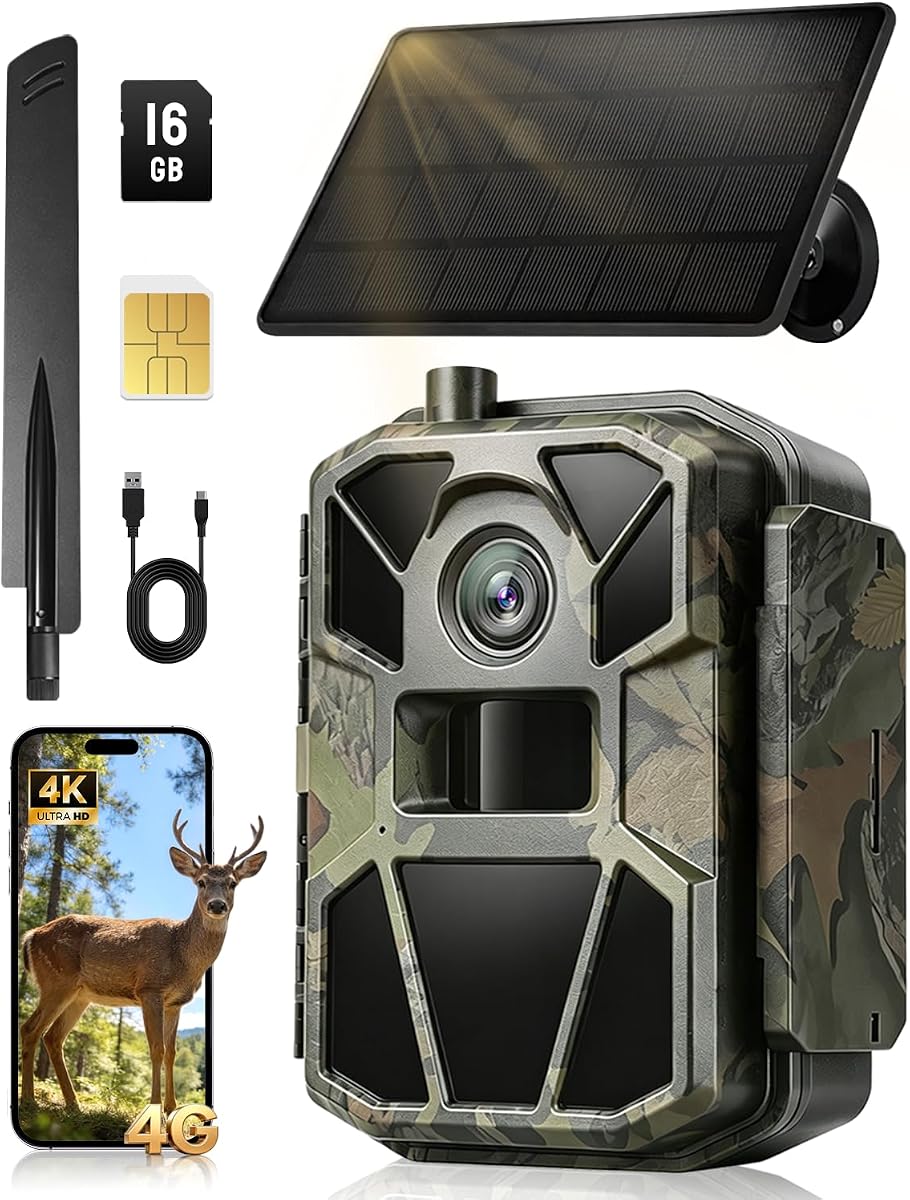
The Solar Trail Camera, 4G LTE Game Camera pairs a 4.9 rating with a straightforward set of essentials for cellular wildlife monitoring. It supports Verizon, T-Mobile, and AT&T networks, includes a prepaid SIM, and offers a seven-day unlimited-data trial, making it a practical starting point for buyers seeking remote access without a complex setup.
We may earn a commission when you buy through this link, at no additional cost to you.
Its adjustable PIR sensor can begin recording in 0.2 seconds, and app notifications keep users informed about detected movement. Images and videos can be saved to a memory card up to 128GB or handled through cloud storage. The included 30-day cloud trial provides a convenient way to evaluate the cloud workflow, although continued use requires a subscription. Phone playback and downloading are supported for reviewing activity away from the camera.
Power comes from a four-watt solar panel, with the manufacturer stating that suitable sunlight can reduce charging visits for up to 365 days. That figure is a best-case operating condition rather than a guarantee in every climate or placement. The IP66 rating adds confidence for outdoor use, and the camera remains focused on the core trail-camera job without requiring a more complex installation.
This is the best value-oriented pick for buyers who want fast triggering, familiar cellular networks, solar assistance, and app-based alerts in a relatively focused package. The lack of an included memory card and the subscription attached to cloud storage are the principal compromises. For users who mainly need photographs and videos rather than advanced live viewing, it offers an attractive balance of capability and simplicity.
A 0.2-second trigger helps preserve short-lived movement, while PIR sensitivity adjustment lets users balance detection speed against unwanted activity. Correct placement remains essential for achieving useful results.
The ability to use a card up to 128GB or cloud storage is convenient for different monitoring preferences. Local capture avoids a permanent cloud dependency, while cloud access makes phone review more convenient.
We may earn a commission when you buy through this link, at no additional cost to you.
The SEHMUA 2K Live Camera is a well-rounded cellular option offering 2K real-time video, remote app access, AI species recognition, and a 4.2 rating. Its appeal lies in making a remote camera easy to check and configure through the Ucon app, including the ability to share live footage with others.
We may earn a commission when you buy through this link, at no additional cost to you.
The camera supports Verizon, T-Mobile, and AT&T networks, with a built-in prepaid SIM and a seven-day unlimited-data trial. After the trial, each device requires a separate plan. A 0.2-second trigger helps capture quick movement, while AI recognition and seven-day activity prediction can help users anticipate when animals are most likely to appear.
The 120-degree field of view and advertised 82-foot low-glow night-vision range provide useful coverage around the mounting point. An 850nm infrared system is designed to reduce visible glow, and a four-watt solar panel supports off-grid operation. Storage options include a card up to 128GB or cloud storage with a new-user trial followed by a paid subscription.
This camera is best for users who regularly want live viewing and broad field coverage rather than only receiving still-image alerts. Its limitations are the non-detachable, U.S.-only SIM and the recurring expenses associated with cellular data and optional cloud services. Buyers who use the camera within the United States and value app-based sharing will find those constraints manageable.
Real-time viewing helps users distinguish a passing animal from unrelated movement. The ability to share footage also makes the camera useful for families, hunting groups, and property-monitoring teams.
The app's analysis of environmental data can estimate active periods over the following week. This adds planning value, although species recognition depends on the cloud subscription.
We may earn a commission when you buy through this link, at no additional cost to you.
The SPYPOINT Flex-M Twin distinguishes itself through flexible capture options and one of the most approachable cellular plans in the group. Its 3.9 rating is the lowest listed among the cellular-focused selections, but the free transmission allowance and straightforward activation process may suit buyers who primarily need delivered photos.
We may earn a commission when you buy through this link, at no additional cost to you.
Users can select Photo, Video, Time-Lapse, or Time-Lapse+ modes. Time-Lapse+ combines interval photographs with detection-triggered captures, making it useful for monitoring broad, active areas. Constant Capture technology allows images to be transmitted and captured simultaneously, reducing the chance that remote viewing interrupts recording. On-camera buttons also help with formatting and test-photo capture.
Connectivity is handled automatically, and the camera continuously monitors network performance, which reduces the complexity of carrier selection. The SPYPOINT app provides remote settings, firmware updates, maps, real-time weather information, and BUCK TRACKER AI for filtering species. The free plan permits up to 100 transmitted photos per month, while higher allowances are available as paid options.
This model is a strong choice for hunters or wildlife observers who want multiple recording styles and a modest free transmission tier. The compatible solar panel is sold separately, and the relatively modest rating suggests buyers should assess app and cellular performance in their area. Users willing to start with transmitted photos can use the camera without committing immediately to video-heavy service.
The four modes cover still photographs, conventional video, scheduled studies, and mixed interval-plus-trigger recording. This flexibility is useful when a single location serves both seasonal wildlife studies and real-time security monitoring.
The monthly free photo allowance is particularly useful for occasional monitoring. Owners can upgrade when transmission volume or video needs increase, rather than starting with a more expensive tier.
We may earn a commission when you buy through this link, at no additional cost to you.
The Misstech 4G LTE Camera is built around fast alerts, real-time viewing, and practical offline operation. Its 4.3 rating, 0.1-second PIR trigger, and built-in 2-inch display make it attractive to users who want both remote monitoring and the ability to review activity directly at the camera.
We may earn a commission when you buy through this link, at no additional cost to you.
When cellular service or a subscription is unavailable, the on-camera display lets users review captured photos and videos without relying on the app. During normal connected use, the camera supports 2K live streaming, push notifications, FHD recording, and multi-user sharing. The app also provides standard-definition previews so users can identify interesting events before downloading a larger file.
The 4-watt solar panel supports sustained field operation, while 940nm no-glow infrared LEDs and an F1.6 aperture are designed for detailed nighttime images with minimal visible illumination. An interactive map records the camera's placement, which is valuable across farms, orchards, and large timber properties where finding a camera later could be difficult.
A crucial restriction is that fully user-provided SIM cards are not supported. After the trial period, an active cellular data plan is required for app connections, live feeds, and alerts. Buyers who want a permanent low-data or offline-only camera may be disappointed, but users seeking rapid notifications and flexible SD-quality previews will find this model well suited to farms and remote properties.
The built-in display means basic review does not have to depend on a network connection. This is a meaningful advantage for hunters and ranch owners who often visit cameras in areas with inconsistent service.
The 0.1-second trigger, push alerts, and low-bandwidth previews help users move quickly from noticing movement to deciding whether full-resolution footage is worth downloading.
We may earn a commission when you buy through this link, at no additional cost to you.
The WIMIDING 2K 48MP Camera offers unusual flexibility because its SIM card can be removed and the camera can operate as a conventional local trail camera. Its 4.8 rating, 48MP photos, 2K video, and included 32GB card create a compelling package for buyers who want cellular capability without being forced into a recurring plan.
We may earn a commission when you buy through this link, at no additional cost to you.
Motion alerts and app map pinning are available when cellular service is active, and users can choose the included SIM service or install their own supported SIM without extra software fees. The camera can also capture directly to its card without cellular connectivity. A 2.0-inch color LCD allows immediate on-device review, making the package easier to start using than cameras that require separate accessories.
Image specifications include a 120-degree wide-angle view and 2K video. The 850nm low-glow infrared system reaches up to 65 feet at night, while the 0.4-second trigger is slower than the quickest options in this guide. IP66 weather protection supports outdoor deployment, although the SD card must be formatted inside the camera before first use.
This model is best for buyers who may occasionally lack cellular coverage, want to retain local recording without a subscription, or prefer bringing their own SIM. The trade-offs are the slower trigger and less expansive 65-foot night range. It remains one of the most flexible choices because cellular service is an option rather than an absolute requirement for basic trail-camera operation.
The removable SIM and local-recording mode offer freedom from permanent data commitments. Users can operate the camera offline, add connectivity when useful, or continue using it as a standard memory-card trail camera.
A 32GB card and eight AA batteries are included, reducing initial setup work. Formatting the card in the camera and confirming app compatibility before deployment will help prevent avoidable issues.
We may earn a commission when you buy through this link, at no additional cost to you.
The SEHMUA Two-Pack Camera combines two cellular trail cameras in one package, making it a logical choice for properties that need coverage in more than one location. Its perfect 5.0 rating is encouraging, though actual results will still depend on carrier service, placement, weather, and the selected data plan.
We may earn a commission when you buy through this link, at no additional cost to you.
Each camera supports Verizon, T-Mobile, and AT&T networks through its built-in prepaid SIM. The package provides 300MB of trial data for initial use, after which each camera needs its own top-up or subscription. Motion alerts are delivered through the Ucon app, and photos and videos can be stored on a card up to 128GB or in cloud storage subject to its trial and subscription terms.
The cameras have a 0.2-second trigger, 120-degree viewing angle, and low-glow 850nm infrared illumination reaching up to 82 feet. Solar operation is supported by a four-watt panel and a 7800mAh rechargeable battery, while IP66 weather sealing is intended for exposed placements. The combination is useful for monitoring separate trails, a farm perimeter, or the front and rear of a property.
The main drawback is that one-time convenience does not eliminate recurring cellular costs: two cameras require two plans. A memory card is also not included. Despite those limitations, this package is especially valuable for users who already understand SEHMUA's app and cellular system and want to monitor two related areas without sourcing separate cameras.
A two-camera setup can cover a trail and a feeder, a ranch entrance and livestock area, or the opposite sides of a property. It also provides a useful way to compare movement patterns in separate locations.
The rechargeable battery, solar panel, and 82-foot low-glow illumination provide a practical foundation for off-grid use. Positioning and local weather will influence how much the solar panel can offset normal consumption.
We may earn a commission when you buy through this link, at no additional cost to you.
The 4G LTE 64MP 4K Camera leads the group in stated image resolution and advertises one year of free photo data. Its 3.0 rating is notably lower than every other model, so buyers should weigh the generous included service and high-resolution hardware against the possibility of inconsistent user experiences.
We may earn a commission when you buy through this link, at no additional cost to you.
Photos can reach 64MP, videos are recorded in 4K, and the PIR trigger operates at 0.1 seconds. The no-glow infrared system is advertised as reaching 98 feet, making it the longest stated night-vision range in the list. A 12000mAh rechargeable battery and integrated solar panel are designed to support long intervals between visits, while IP66 sealing assists with rain, dust, and outdoor exposure.
Auto network switching is a useful feature in wooded or remote areas where carrier conditions can vary. The app provides photo delivery, media downloads, selected setting changes, GPS location information, and firmware or configuration management. A SIM and 16GB memory card are included. The free allowance covers remote photo transmission, while video transfer, downloads, and live viewing require optional paid app services.
This camera suits buyers who prioritize resolution, long-range night coverage, and a substantial included photo-data period. Its low rating makes customer feedback particularly important, and users should verify that the live-view and video services meet their needs before relying on them. For photo-first monitoring, the included service provides a more substantial starting point than a short trial alone.
The 64MP photographs, 4K recordings, and 98-foot infrared range can help users inspect distant subjects or identify fine details. File sizes and data requirements may also be higher than those of lower-resolution alternatives.
A full year of free photo transmission gives users time to determine how frequently they actually use remote monitoring. Live viewing and video delivery remain separate paid functions, so the scope of the allowance should be reviewed carefully.
We may earn a commission when you buy through this link, at no additional cost to you.
The WOSPORTS Non-Cellular Camera is not a true 4G model, but it earns a place as a useful local-recording alternative for readers who want high-resolution trail-camera performance without cellular service. Its 4.3 rating, adjustable photo resolutions, 4K video, and 0.2-second trigger make it relevant to the broader trail-camera comparison.
We may earn a commission when you buy through this link, at no additional cost to you.
Daytime photographs can be set at several resolutions up to 64MP, and video recording supports 4K and lower high-definition formats. A 120-degree detection area, one-to-three-shot burst modes, and a fast trigger help preserve action. At night, 32 940nm no-glow infrared LEDs provide illumination intended to reduce disturbance to wary animals and limit visible light around the camera.
A 2-inch color screen allows users to preview captured files without removing the memory card. The supplied information mentions a 16GB card in the product description, while the overall offer requires careful review for current package contents and card compatibility. The camera supports up to 256GB according to the listed specification. Its menu includes password protection, timestamps, and time-based functions.
Power can come from eight AA batteries, a compatible rechargeable lithium battery, or a compatible solar panel, with batteries and accessories listed separately. This is the right choice when remote viewing is unnecessary, network coverage is unreliable, or avoiding a cellular plan is the priority. It is not a substitute for a 4G camera when immediate phone alerts are the central requirement.
The camera records locally and does not need a cellular subscription. That makes it dependable for wildlife surveys or property documentation where users will retrieve media in person.
The 940nm infrared system and 120-degree coverage support broad, low-visibility monitoring. Comparing the on-camera preview with actual nighttime results can help users fine-tune placement and exposure.
We may earn a commission when you buy through this link, at no additional cost to you.
The right cellular trail camera depends on where it will operate, how quickly you need information, and how you prefer to manage connectivity, storage, and power. Evaluate these factors together rather than focusing on a single resolution specification.
A cellular camera is only useful remotely when it can maintain a dependable signal. Several models in this guide support major United States carriers, but carrier compatibility does not guarantee service at a specific wooded trail or remote property. Models with automatic network selection or switching can adapt when conditions vary, while fixed-SIM designs may be easier to activate but less flexible if the included service is unsuitable.
Check coverage for the exact deployment area before buying. Note that several products use a non-removable SIM intended only for U.S. use, and one of the reviewed models can continue operating locally with a removable SIM. The WIMIDING model is particularly useful for buyers who want cellular as an optional feature rather than a requirement.
Cellular plans differ in whether they are based on transmitted photos, videos, storage, or combinations of those services. A camera that includes a free photo allowance may suit intermittent monitoring, while frequent live viewing can create greater data demand. Some models also distinguish photo delivery from live feeds and video downloads, making it important to read exactly what each plan includes.
Choose a service model that matches your viewing habits. Look for a generous no-cost or trial tier if you are still evaluating the camera, but also consider the recurring requirement after that period. Multi-camera systems need separate plans for each unit, and cloud storage may add another subscription.
Solar panels reduce the need for routine battery changes, but their effectiveness depends on panel direction, seasonal sunlight, tree cover, and camera activity. Most reviewed models use panels between four and five watts. Some include rechargeable batteries, while the SPYPOINT requires a compatible panel and the WIMIDING bundle includes AA batteries for immediate use.
Choose a camera with a power arrangement that suits the location and your willingness to maintain it. A large battery can provide additional reserve, while a well-positioned panel can make battery changes less frequent. Avoid assuming that a stated year-long charging interval applies to every season or installation.
Trigger speed influences whether the camera records an animal before it leaves the frame. The reviewed cameras range from 0.1 to 0.4 seconds, with several clustered around 0.2 seconds. PIR sensitivity is also important because fast, adjustable detection can improve capture of moving subjects, although it may increase recordings triggered by vegetation or changing light.
For wildlife that moves quickly or approaches from different angles, a trigger below roughly a quarter of a second offers a useful margin. Image quality, field of view, and correct mounting height remain equally important, so trigger speed should be considered as part of the whole capture system rather than in isolation.
Resolution affects the amount of visible detail, but more pixels also create larger files. 2K and 4K video provide useful detail for close identification and property review, while 48MP or 64MP photographs may help users examine distant animals or fine environmental details. Actual image quality depends heavily on lens, sensor, lighting, and motion.
Consider how you will use the files. If you frequently download full-resolution recordings over cellular service, high resolution can consume more data. If the goal is basic wildlife confirmation, 2K imagery with fast previews may be more practical than maximum still-photo resolution.
Infrared systems are available in 850nm and 940nm configurations, with stated ranges from 65 to 98 feet among the reviewed products. 850nm systems commonly offer a wider view and somewhat brighter images, while 940nm systems are designed to minimize visible glow. Neither range guarantees useful identification at the maximum distance in every environment.
Balance night range against the area you need to cover. A 120-degree camera can reduce blind spots but may also capture more irrelevant foreground. Mounting parallel to the likely path, removing nearby vegetation, and avoiding reflective surfaces can produce more useful results than a long advertised range alone.
Local memory-card storage gives users control over recordings and can continue working without a cellular connection. Several models support cards up to 128GB, while the non-cellular WOSPORTS model supports up to 256GB. Cloud storage adds convenient phone access and backup, but the supplied information indicates that cloud services commonly include a trial followed by a paid subscription.
Check whether a card is included and what maximum capacity the manufacturer supports. Format a newly purchased card in the camera before first use when the instructions call for it. Users who rely on cloud services should understand trial length, retention terms, and subscription requirements before storing important footage there.
Live streaming allows immediate inspection, while AI features can identify species, filter alerts, or estimate active periods. These tools are useful, but many depend on cloud subscriptions or optional app services. Pan, tilt, zoom, microphones, and speakers can also improve remote operation, although they add complexity and may require more cellular data.
Prioritize core capture reliability before optional intelligence. A camera with fast detection, dependable storage, and useful alerts may serve you better than one with advanced software but a more restrictive service plan. Confirm which features work locally and which require a paid account.
Begin by activating the included service through the manufacturer's app, confirming that the camera reaches the cellular network, and linking it to your account. Update the firmware if prompted, format the memory card inside the camera, and verify the date, time, capture mode, PIR sensitivity, and recording resolution. Test the camera by walking through its detection zone and checking that a notification and file arrive as expected.
Mount the camera securely at an appropriate height, with the lens directed toward the expected path or monitored area. Angle the solar panel toward unobstructed sunlight and avoid pointing the infrared window at reflective surfaces or nearby branches. After installation, walk the field of view in daylight and darkness, review the on-camera display, and adjust the position if animals appear too close, too far away, or partially hidden.
For maintenance, clean the lens and window regularly, remove dirt and insects, and check that the panel is not shaded by foliage. Recharge or replace batteries according to the manufacturer's instructions, inspect seals and mounting hardware, and check card capacity regularly. Test the cellular connection and service allowance periodically so a failed plan or weak signal does not silently interrupt remote monitoring.
Not all of them. Some products include a trial or a recurring free photo allowance, while the WIMIDING model can operate as a local trail camera with its SIM removed. Once cellular features are used, a plan may still be required. Review the exact terms, especially for live viewing, video transfer, cloud storage, and multiple cameras.
That depends on the model. The WIMIDING camera is described as supporting a removable SIM and an included service option, making it the clearest choice for flexibility. Other models use a non-removable prepaid SIM, and the Misstech model specifically states that user-provided SIM cards are not supported. Check compatibility before ordering.
The cellular models are intended to operate without Wi-Fi, but they still require cellular coverage. Automatic network selection or switching can improve the chance of connecting in variable conditions, although dense forests, valleys, and remote buildings may have weak service. Test coverage at the intended location or use a model that can also record locally.
Use a compatible microSD memory card within the camera's stated maximum capacity. The included instructions should be followed, and formatting the card in the camera before first use helps prevent recording errors. Cloud storage is another option on several models, but it generally requires a subscription after the introductory period.
No. Higher resolution can reveal more detail, but large files consume more storage, take longer to transfer, and may require more cellular data. Buyers who mainly need accurate motion alerts may benefit more from fast triggering, good night vision, and efficient previews than from maximum photo resolution alone.
It is especially important for fast-moving animals or subjects that cross the frame quickly. A trigger around 0.1 to 0.2 seconds provides a useful balance between prompt recording and avoiding unnecessary recordings. Placement, detection angle, lighting, and PIR adjustment are just as important as the advertised trigger time.
No. Solar panels reduce charging frequency, but performance depends on sunlight, panel orientation, battery condition, camera activity, and weather. Some product descriptions cite long intervals under sufficient sunlight, yet that is not a guarantee for every season or wooded location. Periodic checks remain necessary.
It is included as a useful local-recording alternative rather than a true 4G option. The camera provides 4K video, high-resolution photos, fast triggering, and no-glow infrared night vision without requiring cellular service. It will not send remote alerts or live feeds, so buyers needing phone-based monitoring should choose one of the cellular models instead.
The 4G LTE Cellular Trail Camera is the strongest all-around choice for users who want 2.5K live viewing, 360-degree remote control, solar assistance, and intelligent detection. The TKENPRO model takes the lead for premium-style features such as two-way audio, a wider 2K live feed, and strong night-vision reach, while the Solar Trail Camera, 4G LTE offers an especially compelling core package for budget-conscious buyers.
Before choosing, prioritize the conditions you will actually encounter: cellular coverage, the frequency of live viewing, whether you need local-only operation, and how you will store files. Fast trigger speed, adjustable PIR, useful night vision, and a properly positioned solar panel matter more than headline resolution alone. Also account for separate plans for multiple cameras and optional cloud or AI subscriptions.
Product specifications, promotional allowances, and availability can change, so confirm the current package contents, SIM restrictions, supported networks, memory-card requirements, and service terms before buying. Those checks are especially important because a capable camera still needs dependable coverage and an ongoing data plan to deliver the remote experience that makes cellular trail cameras valuable.