
4G WiFi Router, USB Travel Modem
5.0Editor score
Supports up to 10 devices
4G LTE speeds up to 150Mbps
Works without drivers
Only 28 grams
Broad US carrier compatibility
Explore the top 10 4G LTE Car WiFi System options, comparing network coverage, device limits, power design, portability, setup ease, and ideal use cases.
A 4G LTE car WiFi system turns cellular coverage into a private, convenient connection for navigation, passengers, laptops, tablets, and other devices. The right model can reduce dead zones, avoid unreliable public networks, and support commuters, road travelers, rideshare drivers, RV users, and remote workers.
The products in this guide were compared by examining cellular compatibility, included data or service options, device capacity, power requirements, portability, display features, and ease of setup. The list covers USB-powered hotspots, battery-powered routers, globally connected models, and dedicated in-car wireless CarPlay adapters.
Each review identifies the product's strongest use case and important trade-offs, while the comparison table provides a faster overview. Ratings and product details reflect the supplied information, and current prices, carrier plans, promotions, and availability can change over time.
5.0Editor score
4.1Editor score

5.0Editor score
The following side-by-side comparison highlights the major differences in connectivity, power, portability, and device support, helping you identify the most suitable system for ordinary driving, extended travel, or global road trips.



The Spectrum Smart is a compact USB-powered 4G LTE hotspot designed for travelers, drivers, RV users, and remote workers who want cellular internet without depending on public WiFi. Its supplied rating is 3.7, but its defining advantage is flexibility: the device supports both AT&T and T-Mobile and automatically selects the stronger signal rather than remaining tied to one network.
We may earn a commission when you buy through this link, at no additional cost to you.
Its practical strengths center on straightforward operation. A SIM card is included, setup requires no special software or drivers, and connecting it to a car charger, power bank, wall adapter, or laptop creates a private hotspot for up to 10 devices. The stated 4G LTE performance reaches up to 150Mbps, making it suitable for navigation, browsing, video calls, streaming, and routine work when cellular conditions permit.
Coverage is listed across the United States, Canada, and Mexico, with an included trial-data offer intended to let buyers evaluate service before committing. The trade-offs are a 3.7 rating and the need for a continuous USB power source. Actual speeds and coverage will vary with location, tower congestion, terrain, carrier compatibility, and the selected service plan.
This is a compelling choice for North American road trips and for drivers who value dual-carrier redundancy over battery independence. It is less suitable for someone who needs to use the hotspot away from a vehicle without carrying a battery bank. For those priorities, the simple included hardware and automatic network selection make it a practical in-car option.
Supporting both AT&T and T-Mobile can improve the odds of finding usable service in areas where one network is weak. The automatic strongest-signal selection is particularly useful along highways, rural routes, and areas affected by local coverage gaps.
The lack of an internal battery reduces bulk and makes long vehicle installations straightforward. Connecting the hotspot to a reliable car charger allows phones, tablets, and passenger laptops to share one cellular connection.
We may earn a commission when you buy through this link, at no additional cost to you.
The 4G WiFi USB Travel Modem is one of the lightest and most focused options in this guide. It carries a supplied rating of 5.0 and weighs only 28 grams, making it easy to keep in a glove box, center console, bag, or laptop sleeve. Rather than functioning as a conventional adapter for a single computer, it broadcasts a secure WiFi network that up to 10 users can share.
We may earn a commission when you buy through this link, at no additional cost to you.
Its plug-and-play design is well suited to temporary connectivity. After inserting a compatible 4G SIM card, users connect their devices to the broadcast network without installing drivers or navigating a complicated setup process. It can draw power from a laptop, power bank, or car charger, so no external battery is required for normal in-car use.
The modem supports numerous 4G LTE bands used by major US operators and offers stated download speeds up to 150Mbps. That makes it appropriate for family road trips, temporary work locations, and ordinary passenger connectivity. The main compromise is that it does not include a SIM, while carrier plan requirements, coverage, and real-world speed remain outside the device's control.
This is an excellent budget-oriented pick for drivers who already have compatible service or want a minimal hotspot without unnecessary features. It is less convenient for users expecting a self-contained battery hotspot. When portability and straightforward USB operation matter most, its tiny footprint and ten-user capacity provide an attractive balance.
At 28 grams, the modem is easy to carry and unobtrusive in a vehicle. Its compact form is especially helpful for travelers who want internet access without packing a larger router or carrying a separate battery.
Support for widely used 4G bands improves the chance of finding service across multiple US operators. Compatibility remains dependent on the carrier, SIM, local coverage, and the bands available at a particular location.
We may earn a commission when you buy through this link, at no additional cost to you.
This portable WiFi hotspot is built specifically for extended vehicle use, offering a battery-free design that avoids the heat and explosion concerns associated with lithium batteries. It has a supplied rating of 4.1 and combines 4G LTE Cat4 connectivity with WiFi 6, making it appealing to drivers who want modern wireless capacity in a car, truck, or RV.
We may earn a commission when you buy through this link, at no additional cost to you.
Up to 16 devices can connect simultaneously, making the system more accommodating for families, passenger groups, and mobile workspaces. The supplied 10GB of US data lowers the initial setup barrier, while flexible pay-as-you-go plans are offered in durations such as three days, seven days, 30 days, and one year. Global coverage across more than 150 countries is supported through vSIM-based connectivity.
Its notable trade-off is that the absence of a battery requires a dependable USB power source. Another consideration is that international service depends on the selected data plan and local network availability. WiFi 6 can improve efficiency and performance on supported clients, but actual throughput still depends on cellular coverage, network congestion, and the plan selected.
The product is best suited to owners who prioritize passenger capacity, modern WiFi, and a battery-free form for permanent or semi-permanent vehicle installations. It is also practical for international travelers who want a single vSIM-based approach. For users needing standalone battery operation away from a vehicle, a battery-powered hotspot would be a better fit.
Removing the internal lithium battery can reduce overheating and fire risks in hot vehicles. It also simplifies fixed installations, although a dependable charger or power system remains necessary for continuous service.
Supporting 16 simultaneous clients makes this hotspot suitable for families and work groups. Navigation, streaming, messaging, and productivity applications can share the connection, subject to network conditions and data-plan limits.
We may earn a commission when you buy through this link, at no additional cost to you.
The EIOTCLUB hotspot is a battery-powered mobile router for travel, home backup, cars, RVs, and camping. Its supplied rating is 3.8, while its strongest distinguishing feature is a 3000mAh battery that can provide up to 12 hours of continuous use. That makes it more flexible than a USB-only modem when users need connectivity away from a parked vehicle.
We may earn a commission when you buy through this link, at no additional cost to you.
A 1.7-inch LCD display shows connection status, connected-device count, carrier information, QR codes, and access to the online manual. The preinstalled SIM and one gigabyte of trial data simplify initial setup, and the no-contract pay-as-you-go approach gives users flexibility. Up to 10 devices can connect at once for browsing, work, communication, and entertainment.
Limitations include US-only service and a less impressive supplied rating than several alternatives. The screen is small but useful for confirming basic status without opening an app, while the smart sleep mode helps preserve battery during idle periods. Users must still monitor remaining data and recharge the unit before long journeys.
This hotspot is well suited to campers, families, and travelers who want a true pocket router rather than a permanently installed vehicle modem. It is less suitable for international travel because the service is explicitly limited to the US. For flexible domestic use with a useful display and battery, it offers a balanced package.
The LCD gives fast access to signal, battery, carrier, and client-count information. Displayed QR codes can also simplify connecting a phone or laptop to the network.
A stated 12 hours of continuous use makes the hotspot useful for camping, roadside work, and travel away from a reliable charger. Actual runtime varies with client count, signal strength, screen use, and power-saving behavior.
We may earn a commission when you buy through this link, at no additional cost to you.
The Topmifi Global Car Router is designed for international travelers, digital nomads, RV owners, and drivers crossing countries with changing cellular networks. It has a supplied rating of 5.0 and offers 4G LTE service across more than 170 countries through cloud eSIM technology, removing the need to obtain and insert physical SIM cards.
We may earn a commission when you buy through this link, at no additional cost to you.
Its AI-assisted auto-switch function scans local networks and selects a stronger carrier in real time. The system is controlled through a mobile app, supports pay-as-you-go data, and avoids a long-term contract. Because it has no internal battery, it can be powered by a car charger, power bank, wall adapter, or laptop, reducing concerns associated with carrying a lithium battery on international journeys.
The principal trade-off is the need for external power. International connectivity also depends on the purchased data pack, supported destination, and local network availability. The product description emphasizes convenience rather than a specified maximum device count or peak speed, so buyers who require a large connected fleet should verify current specifications before purchase.
This is the strongest premium option for cross-border travel and international RV trips. It is particularly useful for people who would otherwise manage multiple carrier SIMs or struggle with network switching. Travelers staying within one country and already satisfied with a standard carrier plan may find simpler devices more than sufficient.
Cloud eSIM connectivity allows the router to work across national borders without physical SIM changes. Automatic carrier selection can improve continuity when local network quality or availability changes during a trip.
Pay-as-you-go data lets travelers purchase service according to a short or extended trip rather than committing to a conventional monthly contract. Users should verify which countries and plan durations are currently offered.
We may earn a commission when you buy through this link, at no additional cost to you.
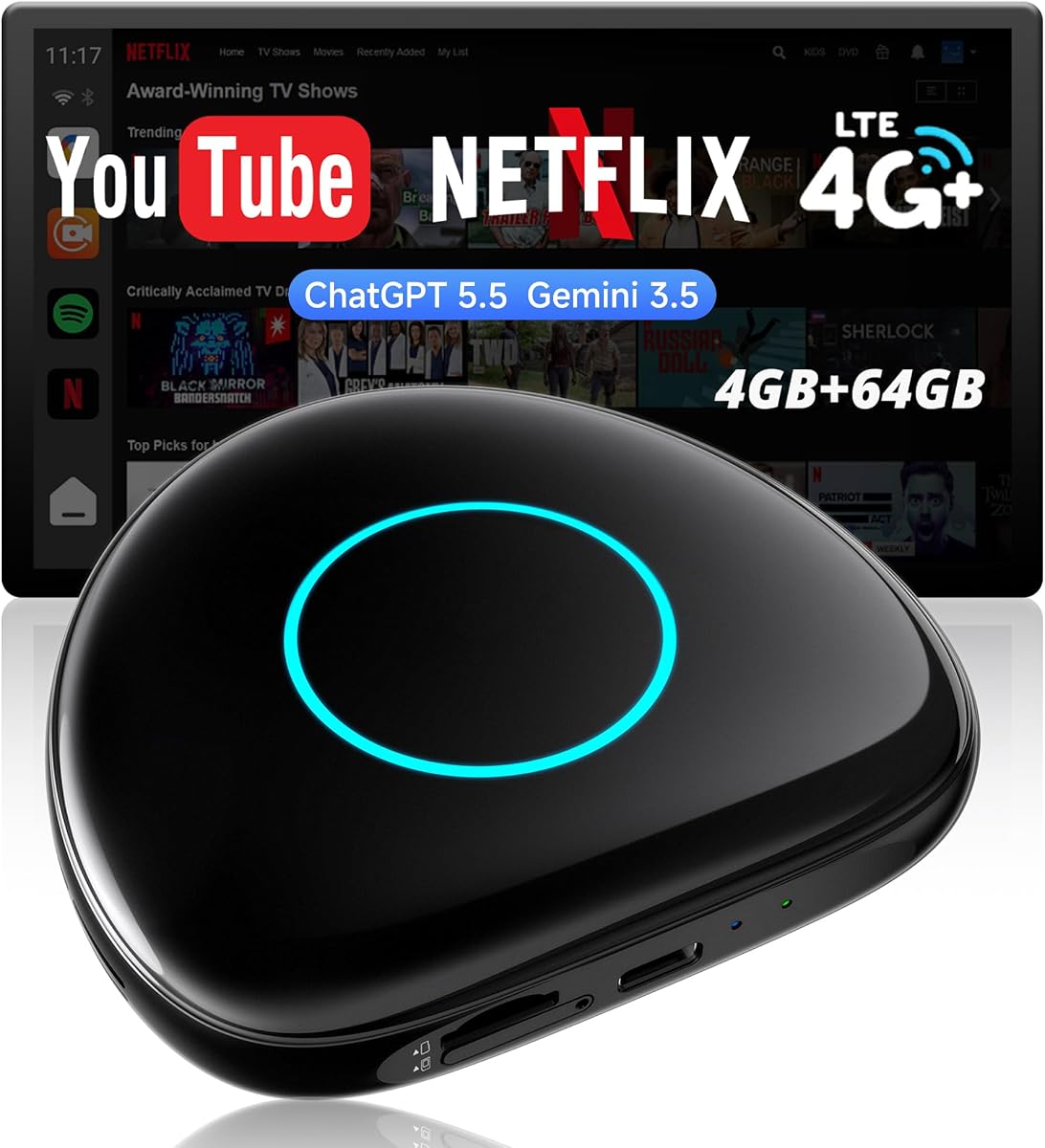
The CB6C is not a conventional hotspot for sharing internet with passengers. It is a dedicated wireless CarPlay and Android Auto adapter with a built-in 4G LTE modem, independent GPS, and a full Android 13 environment. Its supplied rating is 5.0, and it targets drivers who want a more independent in-car computing experience.
We may earn a commission when you buy through this link, at no additional cost to you.
Because cellular connectivity and positioning are built in, the adapter can maintain its own internet connection and navigation instead of relying entirely on a paired phone. An eight-core chipset supports app operation, media, and navigation, while a ChatGPT-powered assistant is advertised with more than 50 skills. A dual-Bluetooth privacy screen locks when the authorized phone leaves and unlocks when it returns.
Compatibility is the decisive limitation. The vehicle must have factory-wired CarPlay or wired Android Auto, and the listed exclusions include BMW, Tesla, most Subaru vehicles, aftermarket head units, and systems that only support wireless CarPlay or Android Auto. The vehicle screen must also support touch, a touchpad, or a rotary controller.
This adapter is best for compatible vehicles seeking independent navigation, in-car apps, cellular connectivity, and a dedicated AI assistant. It is not a substitute for a general passenger hotspot. Buyers should verify their exact vehicle, head unit, screen controls, and SIM requirements before purchasing, while benefiting from the stated 18-month warranty and OTA update support.
The integrated 4G modem and GPS allow the system to operate without borrowing a phone's connection or location services. This can be useful for routes in areas where the paired phone has weak reception but the adapter's compatible network performs better.
Automatic locking and unlocking based on the authorized phone's presence helps protect personal accounts when another person uses the vehicle. Compatibility with specific controls should be confirmed before installation.
We may earn a commission when you buy through this link, at no additional cost to you.
The TC10 combines a 4G mobile hotspot with a dashboard phone holder, adding wireless charging for compatible smartphones. Its supplied rating is 3.9, and its defining advantage is convenience: the navigation phone, charging function, and vehicle internet connection occupy one integrated product rather than three separate accessories.
We may earn a commission when you buy through this link, at no additional cost to you.
Ten gigabytes of prepaid US data are preloaded, and no SIM installation is required. Once the device is powered on and activated, passengers can connect for navigation, streaming, video calls, messaging, and work applications. The suction-based mount is intended to keep a phone stable on uneven roads while the hotspot maintains cellular connectivity.
The product description does not specify a peak download speed or exact simultaneous-client limit, so buyers should not assume the performance of a dedicated high-capacity router. Suction performance can also vary with dashboard texture, temperature, vibration, and mounting position. Wireless charging is limited to compatible phones and does not apply to every device.
This system is ideal for daily commuters, rideshare drivers, delivery operators, and families who want a visible navigation setup with internet for passengers. It is less appropriate for users who require a formal device limit, advanced enterprise security, or guaranteed mounting on a particular dashboard surface. Its integrated design nevertheless makes it a convenient all-in-one vehicle accessory.
Combining the hotspot, mount, and charging function reduces cable clutter and makes the navigation display easier to access. Drivers should position the unit where it does not obstruct visibility or required controls.
The preconfigured data service avoids physical SIM installation, while multi-device sharing supports passengers and productivity applications. Coverage and service performance depend on the included carrier and current cellular conditions.
We may earn a commission when you buy through this link, at no additional cost to you.
The Magic AI Car Adapter is a dedicated Android 13 car-computer product with 4G LTE, independent GPS, and wireless CarPlay or Android Auto functionality. It carries a supplied rating of 3.8. Like the CB6C, it solves a specialized in-car problem rather than distributing internet to a group of passenger devices.
We may earn a commission when you buy through this link, at no additional cost to you.
An eight-core processor, full Android environment, built-in modem, and separate GPS module allow the unit to handle apps, streaming, and navigation independently of the connected phone. Its AI assistant is presented as a voice-driven driving companion, and a dual-Bluetooth privacy screen automatically locks when the authorized phone leaves the vehicle.
Its most product-specific feature is the included Y-cable, designed to provide more stable power and reduce disconnects or restarts in vehicles with engine start-stop systems. As with other wired CarPlay and Android Auto adapters, compatibility is narrow: BMW, Tesla, most Subaru vehicles, aftermarket head units, and wireless-only systems are excluded.
This product makes the most sense for drivers with a supported wired vehicle who want Android apps, cellular navigation, and an AI assistant in the dashboard. It is not a substitute for a mobile hotspot when the goal is to connect several passengers. Buyers should verify their exact vehicle and controls, and should confirm their preferred app and navigation choices are supported.
The dedicated Y-cable is intended to maintain a steadier power connection than a basic cable. That can reduce interruptions during engine stop-and-start cycles, subject to correct installation.
A cellular modem and independent GPS allow navigation and selected apps to continue without relying on the paired phone's data connection. Account access, app selection, and vehicle support still require careful setup.
We may earn a commission when you buy through this link, at no additional cost to you.
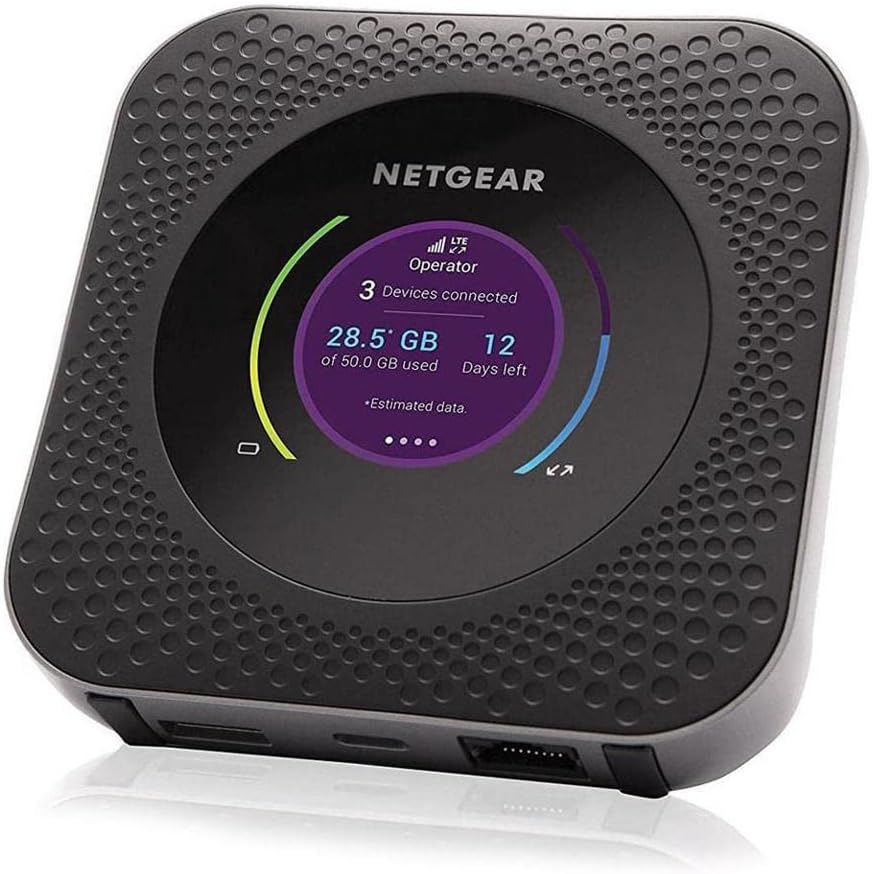
The NETGEAR Nighthawk M1 is a well-established mobile hotspot that combines high stated speeds with unusually broad device capacity. Its supplied rating is 4.1, and it supports up to 20 connected clients. That makes it a strong fit for families, small work groups, RV travel, and users who want one connection for many screens and devices.
We may earn a commission when you buy through this link, at no additional cost to you.
Download speeds are listed as up to 1Gbps, although real performance depends on carrier support, proximity to a cell tower, signal conditions, congestion, and the selected plan. The hotspot supports AT&T and T-Mobile, accepts compatible SIM cards, and offers 2.4GHz and 5GHz WiFi for flexible device connections across different ranges.
Its most versatile feature is the Gigabit Ethernet port. Connecting it to a home router can create a primary or backup internet path, which is useful during service disruptions, weak fixed broadband, or temporary remote work. This capability goes beyond many travel hotspots and makes the M1 relevant as a small mobile router.
The principal drawback is that the Nighthawk M1 requires a Micro SIM and an activated compatible bring-your-own-device plan; it does not include service or a SIM. Despite that extra setup, it is the most versatile conventional hotspot here for buyers who value capacity, dual-band WiFi, and Ethernet backup over a preloaded-data model.
A 20-device maximum gives the Nighthawk M1 an advantage over many portable hotspots. It can serve a busy family, a group of travelers, or a collection of work devices without approaching the connection limit.
The Gigabit Ethernet port allows the hotspot to serve as a wired backup connection for a home network. This adds flexibility that makes the device useful beyond a vehicle or travel bag.
We may earn a commission when you buy through this link, at no additional cost to you.
The Dual-Band Mobile Hotspot combines a removable 3000mAh battery, 2.4GHz and 5GHz WiFi, and support for up to 16 devices. Its stated download speed reaches 600Mbps, and the included SIM card makes it more self-contained than models requiring buyers to source service separately. Its supplied rating is 3.4, the lowest among the products reviewed.
We may earn a commission when you buy through this link, at no additional cost to you.
A 1.44-inch TFT display indicates signal and battery status, while the compact 136-gram body is suitable for travel, camping, family trips, office use, and vehicle deployment. The Qualcomm MDM9207 chipset is listed as supporting power efficiency, and USB Type-C charging provides a modern connection method.
Its 5GHz WiFi can reduce interference and improve throughput for compatible nearby devices, while 2.4GHz offers longer reach. Actual performance depends on signal strength, carrier congestion, the chosen plan, and whether connected clients support the relevant bands. Compatibility with major carriers is stated, but buyers should verify the included SIM's activation terms and network restrictions.
This hotspot is a reasonable choice for users who prioritize a removable battery, dual-band WiFi, and a moderate-to-high device limit. Its lower rating suggests caution, particularly regarding the included service and real-world experience. It is best chosen after confirming carrier activation, data-plan terms, and expected local coverage.
A removable 3000mAh battery lets users carry a spare charge for longer journeys. It also makes the hotspot more practical for camping and travel compared with sealed battery designs.
Separate 2.4GHz and 5GHz radios give connected devices a choice between range and shorter-range performance. Using the appropriate band can help manage interference in a crowded vehicle or travel environment.
We may earn a commission when you buy through this link, at no additional cost to you.
The most useful car WiFi system depends on whether you need passenger internet, standalone battery operation, international service, or a dedicated vehicle interface. Consider power, carrier access, capacity, and intended installation before choosing.
USB-powered systems are ideal for permanent or semi-permanent vehicle installations because they can run from a car charger without an internal battery. They are compact and avoid battery degradation during hot weather, but they stop working when the charger is disconnected or the vehicle cannot supply power. Battery-powered hotspots offer greater freedom because they can be carried to a campsite, picnic area, or roadside location, although they require regular charging and eventually need battery maintenance.
Choose USB power for a vehicle-first setup and a removable battery for travel-first use. Always consider charging time, charger output, cable quality, and whether the device supports operation while charging.
A technically capable hotspot cannot create service where no compatible network reaches. Single-carrier products may perform consistently for users who already have a strong plan, while dual-carrier or multi-carrier systems can offer more flexibility across changing terrain and congested urban areas. International travelers should look for cloud eSIM or vSIM support and a clear list of supported countries rather than assuming every destination is covered.
Check the supported bands, local carrier reputation, roaming rules, and activation requirements before purchasing. Coverage should be evaluated for the specific highways, parks, cities, and rural areas you expect to visit.
The maximum client count indicates how many phones, tablets, laptops, navigation units, and entertainment devices can connect at the same time. Ten-device systems suit couples, families, and small teams, while 16- and 20-device models offer more room for passengers or work groups. A higher limit does not guarantee equal speeds for every client because the cellular backhaul and data allowance remain shared.
Estimate the number of devices that will be active during a typical trip. Select a few extra connections if family members or coworkers may join, but do not select a high limit merely for marketing reasons if the data plan cannot support that usage.
Some products include a prepaid data allowance, while others require a separate SIM and compatible bring-your-own-device plan. Prepaid models reduce initial setup complexity but may use a specific network and require users to top up through a dedicated app. Unlocked devices offer broader carrier choice but place more responsibility on the buyer for activation, coverage, and data-plan selection.
Compare the included data, plan duration, renewal behavior, network restrictions, and whether service can be used at the intended destinations. A generous device is not a bargain if the required service is difficult to activate or unsuitable for your route.
The headline cellular speed is only one part of the experience. Dual-band WiFi gives compatible clients a choice between 2.4GHz for range and 5GHz for shorter-range, lower-interference performance. Newer standards such as WiFi 6 can improve efficiency in crowded environments. Actual throughput also depends on the cellular signal, tower load, carrier plan, and number of active users.
Prioritize stable coverage and sensible WiFi bands over the largest printed speed figure. For short-range use inside a vehicle, 5GHz performance may matter more than maximum theoretical range.
Compact size matters when the hotspot must fit in a console, glove box, pocket, or travel bag. USB-only models can be exceptionally small because they need no battery, while battery-equipped units must accommodate a larger power pack. Display screens are helpful for checking signal, battery, carrier, and connected-client status without an app, but they also add cost and may be unnecessary for basic use.
Consider where the system will live during your trip. Measure available space, identify a stable mounting point, and ensure cables can reach the power outlet without creating a driving hazard.
A standard mobile hotspot is different from a wireless CarPlay or Android Auto adapter. A hotspot creates a WiFi network for passengers and personal devices, while a car adapter runs an Android-based interface on the vehicle screen and may include its own GPS and cellular modem. These specialized adapters can be excellent for compatible cars but are not substitutes for sharing internet with multiple passengers.
Verify the exact vehicle, factory system, screen controls, and connection method before buying an adapter. For general connectivity, prioritize hotspot features, client limits, and reliable service.
Begin by identifying the required power source, installing or activating the appropriate SIM or eSIM service, and confirming that your intended carrier supports the device. Connect the hotspot using its app or web interface, update any available firmware, and change the default wireless-network credentials before sharing the connection with passengers.
Mount a USB-powered unit where it is ventilated and does not obstruct the driver, then route the cable away from pedals, sharp edges, and hot surfaces. For a battery-powered hotspot, keep some charge available for the journey and carry a spare battery or power bank if the trip extends beyond the expected runtime. The included SIM should remain seated, while cloud eSIM accounts should be protected with a strong account password.
Use a private password and avoid leaving sensitive financial, account, or work activity exposed on a shared network. Monitor data consumption, signal quality, device temperature, and remaining battery during long drives. Clean the device gently, keep ports free of dust, and follow the manufacturer's instructions for battery replacement, storage, and disposal.
It depends on the model. Products with an included or preinstalled SIM may come with prepaid service, while unlocked routers generally require a compatible SIM and an activated data plan. Cloud eSIM models use downloadable profiles and generally require activation through an app. Confirm the card and service terms before buying so you do not need an extra setup step.
Yes, within the device's stated client limit. Common limits range from 10 to 20 simultaneous devices, and one model supports 16. Every connected device shares the same cellular data allowance, so video streaming and large downloads can reduce performance for navigation, calls, and work applications.
No. The hotspot needs compatible cellular coverage and an active plan to provide internet access. It can create a WiFi network without a signal, but clients will not receive usable data. Coverage depends on the carrier, terrain, nearby towers, congestion, and local regulations.
They are often more practical for continuous vehicle use because they draw power from the vehicle and avoid internal battery degradation. They cannot operate during a power interruption, however, so installation quality and charger reliability matter. Battery-powered units remain more flexible for camping and use away from the vehicle.
Dual-band WiFi can be useful because it offers separate 2.4GHz and 5GHz networks. The 2.4GHz band generally reaches farther, while 5GHz can provide higher performance with less interference for nearby compatible devices. The best choice depends on client capabilities, distance, congestion, and the strength of the underlying cellular connection.
It can provide a shared WiFi connection for phones, tablets, laptops, and vehicle navigation devices. It does not automatically replace phone service, calls, or text messages. Phones can use the hotspot's WiFi for internet if their cellular service is otherwise limited or unavailable.
A mobile hotspot broadcasts a WiFi network for personal devices, while a wireless CarPlay adapter connects with a vehicle's infotainment system and may run its own Android environment. The latter may include independent GPS, cellular service, and an AI assistant, but it is not designed to provide general passenger WiFi.
Navigation and messaging use relatively little data, while video streaming, large file transfers, and software updates can consume much more. The appropriate allowance depends on the number of users and activities. Short trips may be fine with limited data, whereas frequent streaming and remote work benefit from a more substantial plan.
The 4G WiFi USB Travel Modem is the most compact budget-oriented solution, while the NETGEAR Nighthawk M1 stands out for up to 20 clients, strong stated performance, and Ethernet backup capability. The Topmifi Global Car Router is the leading premium travel option, offering cloud eSIM service across more than 170 countries and automatic local-network switching.
Your priorities should determine the winner. Choose USB power for permanent in-car use, a battery for camping and portable access, dual-carrier support for North American route resilience, and vSIM service for international travel. Dedicated CarPlay adapters should be considered only after verifying the exact vehicle and factory infotainment system.
Before purchasing, confirm the current carrier requirements, included data, supported countries, client limit, and device compatibility. Prices, promotions, coverage, and plan details can change, so checking the latest listing and service terms will help ensure that the selected system fits both your route and your budget.