12V 200Ah LiFePO4 Built-in 200A BMS
4.6Editor score
200A integrated battery management
Up to 15,000 stated cycles
Series and parallel expansion
Our 200Ah LiFePO4 Battery guide compares 10 models for capacity, cycle life, BMS protection, expandability, portability, and real-world use for varied off-grid
A 200Ah LiFePO4 battery is a substantial upgrade for RVs, boats, solar storage, off-grid cabins, and home backup systems, but the best model depends on more than nominal capacity. Battery management, usable energy, temperature protection, physical dimensions, cycle rating, and expansion options all shape real-world performance.
This guide compares ten current options using their stated specifications, including energy capacity, BMS ratings, enclosure protection, low-temperature handling, supported configurations, warranty terms, and intended applications. It also highlights important differences involving 100Ah dual-battery packs, high-capacity variants, monitoring features, and installation constraints.
Each pick reveals which buyer it best serves, from lighter portable systems to compact installations, high-output builds, and expandable solar banks. Product availability and pricing can change, so check the current listing and confirm your electrical requirements before making a final purchase.
4.6Editor score

5.0Editor score

5.0Editor score
This side-by-side comparison evaluates nominal energy, cycle claims, BMS ratings, environmental protections, expansion limits, and practical features such as Bluetooth monitoring, low-temperature cutoff, and compact dimensions.





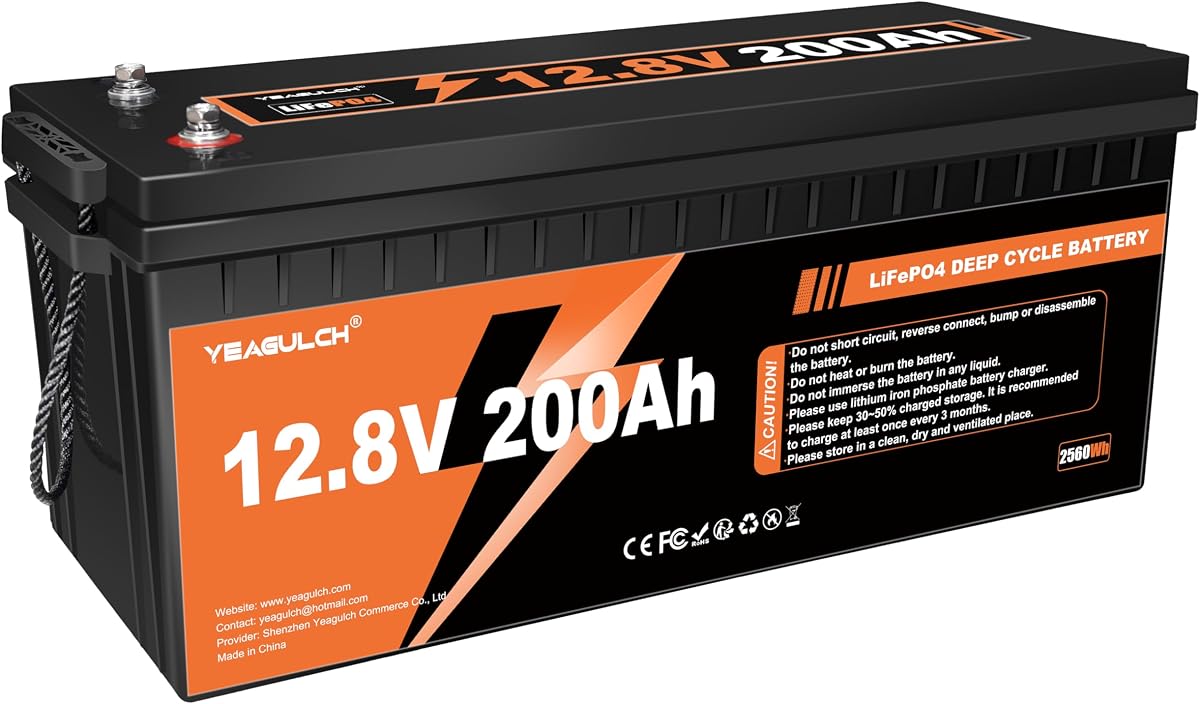
This 12V 200Ah LiFePO4 battery combines 2560Wh of nominal energy with a built-in 200A BMS and earns a 4.6 rating. Its strongest selling point is the balance between physical manageability and electrical capability: at approximately 58.86 pounds, it is considerably lighter than a similarly rated lead-acid battery while retaining enough output for substantial RV, marine, and solar loads.
We may earn a commission when you buy through this link, at no additional cost to you.
The stated cycle figures are particularly attractive, with 4,000 cycles at 100% depth of discharge, 6,000 at 80%, and up to 15,000 at 60%. The 200A BMS handles overcharging, overdischarging, overcurrent, overheating, and short circuits, while automatic high- and low-temperature cutoff adds another layer of operational control. Expansion to as many as 16 batteries supports larger projects without locking buyers into a single-unit installation.
There are important limitations. This is a deep-cycle battery and should not be used for cars, starting engines, or golf carts. The stated maximum expansion includes four batteries in series and four in parallel, but system voltage, current, wiring, fusing, and charge-controller compatibility must all be checked. The product information also recommends cycling the battery at least once every six months to maintain health during prolonged storage.
It is a strong choice for a buyer who wants a capable 200Ah unit, extensive cycle claims, and a high-current BMS without spending more for premium monitoring. RV owners, boaters, and solar users with room for a full-size battery should give it serious consideration, provided they follow the cold-weather charging and installation guidance.
Series and parallel expansion makes this battery adaptable to growing energy systems. A single unit provides 12V 200Ah, while supported combinations can reach 48V 200Ah or 12V 800Ah, depending on the arrangement and compatible equipment.
The integrated 200A BMS and temperature cutoff functions help preserve cell health during charging, discharging, and storage. These protections are especially relevant in installations exposed to heat, variable loads, or seasonal temperature changes.
We may earn a commission when you buy through this link, at no additional cost to you.
The DUMFUME 12V 200Ah LiFePO4 battery earns a 4.4 rating and distinguishes itself through an extensively specified 200A smart BMS and an IP65 enclosure. It provides 2560Wh of nominal energy and uses premium LiFePO4 cells, with stated cycle counts of more than 4,000 at 100% depth of discharge and up to 15,000 at 60%.
We may earn a commission when you buy through this link, at no additional cost to you.
Protection details are unusually clear for this category. The listed overcharge cutoff is 14.6V plus or minus 0.2V, while the overdischarge cutoff is 9.2V plus or minus 0.2V. Overcurrent protection is stated to trigger within 50 milliseconds above 200A, and short-circuit protection within 100 microseconds. UL and UN38.3 certifications add transportation and safety context for mobile or marine installations.
Its cold-weather behavior requires attention. Discharge is specified down to minus 20°C, but charging stops below 0°C and resumes once the internal temperature reaches 5°C. That protects against lithium plating, yet it means the battery cannot simply be placed on a charger in freezing conditions and left unattended. At 58.86 pounds and 21.06 by 8.07 by 8.46 inches, it is portable but not as space-efficient as a mini design.
The DUMFUME is best for buyers building a substantial expandable bank who value explicit electrical limits, certified transportability, and a five-year warranty. It also suits boats and camper systems where IP65 protection and trolling-motor compatibility align with the installation.
Published cutoffs and response times give installers clearer information than a generic protection claim. Those figures can help with system design, though they should still be checked against the current manufacturer documentation before installation.
Four-by-four configuration support allows as many as 16 units to form a 51.2V 800Ah bank with 40.96kWh of nominal energy. The communication protocol is intended to synchronize BMS operation across the connected batteries.
We may earn a commission when you buy through this link, at no additional cost to you.
The HumsiENK 12V 200Ah LiFePO4 battery stands out for its stated 3200W continuous output and 250A BMS, making it the strongest high-power option in this group. Its 4.6 rating reflects a feature set aimed at users who need to run several substantial devices at once rather than simply reserve energy for occasional loads.
We may earn a commission when you buy through this link, at no additional cost to you.
The battery delivers up to 2560Wh and is advertised for full-depth-of-discharge use. Its EV-grade cells are listed at 6,000 to 15,000 cycles, while 4S4P support allows banks of up to 40.96kWh. The claimed 3.33-hour recharge time is another differentiator, although actual charging time depends on charger output, battery temperature, state of charge, and the charging protocol used.
Its 250A BMS is rated higher than the 200A systems on several competing batteries, and the product information states that it provides overcharge, overdischarge, short-circuit, and overheating protection. The enclosure is described as IP65 waterproof with operating temperatures from minus 4°C to 140°F. It also measures 20.53 by 9.37 by 8.69 inches and weighs 81.2 pounds, making it heavier and wider than many full-size alternatives.
This is the pick for high-draw RV systems, sizable off-grid installations, or users who want inverter headroom without moving immediately to a larger battery bank. It lacks the convenient Bluetooth monitoring highlighted by some rivals, so buyers should decide whether real-time remote visibility is more valuable than the higher stated continuous output.
A 3200W continuous-output claim gives this model more room for refrigerators, inverters, tools, and other demanding equipment. Matching the inverter and wiring to that capability remains more important than the headline number alone.
The stated 3.33-hour recharge target is useful for travelers who need rapid turnaround. A compatible high-output charger and appropriate temperature conditions are necessary to approach that result.
We may earn a commission when you buy through this link, at no additional cost to you.
This 12V 200Ah LiFePO4 battery is the most complete smart-monitoring option in the group. It has a 5.0 rating, supplies 2560Wh of nominal energy, and includes an integrated Bluetooth module that connects to a smartphone app for state of charge, voltage, current, and temperature readings. That visibility makes it especially attractive for off-grid banks, campers, and marine systems.
We may earn a commission when you buy through this link, at no additional cost to you.
The built-in smart BMS provides more than 20 protections, including overvoltage, undervoltage, overcurrent, short-circuit, high-temperature protection, and charging cutoff below 0°C. Its stated cycle performance exceeds 4,000 cycles at 100% depth of discharge, while the IP65 enclosure is intended for dusty or wet installations. The battery can be combined in parallel for more capacity or in series for 24V or 48V systems up to 4S.
The lack of an explicit continuous-current rating makes careful system matching especially important. A Bluetooth meter is valuable for monitoring, but it does not determine whether the battery can safely support a particular inverter surge or high-current starter-like load. The product is a deep-cycle unit rather than a dedicated engine-starting battery, and app availability should be confirmed in the buyer's country and on their phone.
It is the most well-rounded recommendation for a buyer who values visibility, dependable protection, and straightforward expansion without paying for the premium branding of established component brands. The combination of a 5.0 rating, 2560Wh, full-depth discharge, and phone-based monitoring makes it particularly easy to recommend as the general-purpose choice.
Integrated Bluetooth gives users immediate information about state of charge, voltage, current, and temperature. This reduces guesswork when balancing a bank or deciding whether a bank needs charging.
More than 20 listed safeguards make the BMS suitable for varied charging and load conditions. Monitoring lets owners identify abnormal readings sooner, while temperature cutoff prevents charging under unsuitable cold conditions.
We may earn a commission when you buy through this link, at no additional cost to you.
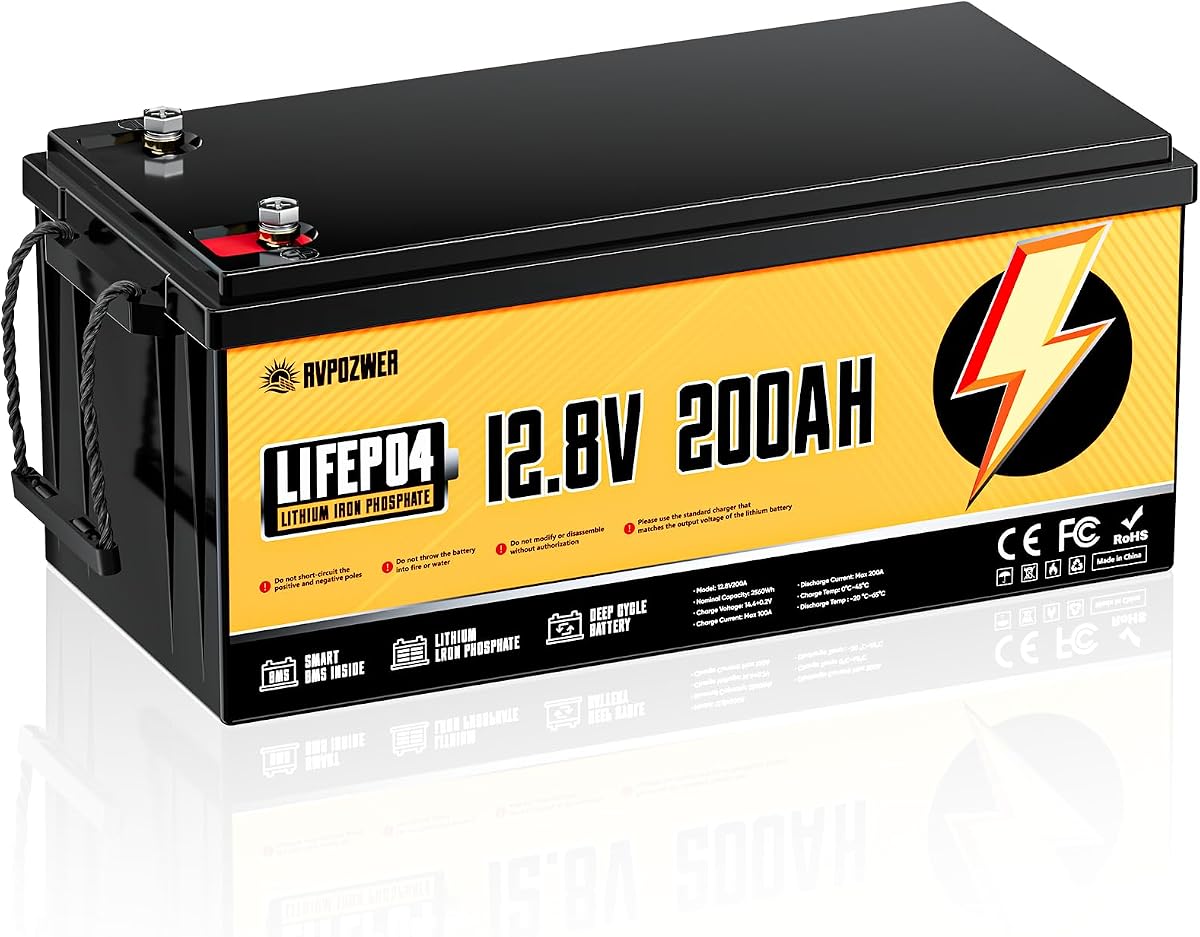
The Rvpozwer 12V 200Ah LiFePO4 battery combines 2560Wh of capacity with a 200A smart BMS and an advertised 15,000-cycle capability at 60% depth of discharge. It receives a 4.0 rating, the lowest among the listed products, but its specifications remain relevant for buyers who need broad temperature tolerance and flexible bank construction.
We may earn a commission when you buy through this link, at no additional cost to you.
The battery uses Grade-A LiFePO4 cells and includes protection against overcharge, overdischarge, overcurrent, overvoltage, and short circuits. Its stated operating range of minus 20°C to 65°C is broad, making it relevant for cold-region travel and warm environments. It also supports four series connections for voltages up to 51.2V and parallel expansion up to 800Ah.
The Group 31-style format and included nylon handle are intended to simplify installation and transport, but buyers should verify actual dimensions against their compartment before ordering. The 15,000-cycle figure applies at a reduced depth of discharge and should not be treated as equivalent to 15,000 full-discharge cycles. Actual longevity also depends on charge discipline, temperature, depth of discharge, and current draw.
The Rvpozwer suits RVs, boats, campers, and off-grid systems where temperature range and expansion potential matter most. Its lower rating and lack of a stated phone-monitoring function make it less compelling for buyers prioritizing smart diagnostics, but the core electrical package is still well suited to substantial deep-cycle use.
The listed operating range covers cold discharge and warm-weather operation. Users should still observe the manufacturer's charging instructions and use an appropriate LiFePO4 charger.
Four series and four parallel configurations create a practical path from a single battery to a large energy bank. Correct busbars, fusing, charge controllers, and ventilation remain essential.
We may earn a commission when you buy through this link, at no additional cost to you.
The Renogy 12V 200Ah Core Mini earns a 5.0 rating and addresses the most persistent problem with large lithium batteries: awkward physical size. Its housing is described as one-third smaller than a standard 12V 200Ah lead-acid battery, making it a compelling choice for crowded RV compartments, boats, and compact off-grid cabinets.
We may earn a commission when you buy through this link, at no additional cost to you.
A 200A BMS handles overcharge, overdischarge, overcurrent, and short circuits. Charging is blocked below 32°F, while discharge protection extends to minus 4°F, allowing useful cold-weather operation without charging the cells in damaging conditions. The battery is also rated IP65, vibration resistant, and listed as meeting FCC, UN38.3, ROHS, UKCA, and other global safety standards.
The stated 380A peak discharge rating provides useful startup margin for compatible inverter surges, though continuous loads should remain within the 200A BMS envelope and the inverter's requirements. Remote monitoring is not fully integrated: compatibility with the Renogy 300A Battery Shunt and Renogy monitoring tools is required. That adds installation complexity for users who want immediate phone visibility.
This is the recommendation for space-conscious RV, marine, and solar owners who prioritize a reputable protection system, certification, warranty, and compact construction. It is the premium option in this roundup because the smaller enclosure and 380A peak capability provide a clear physical and electrical advantage over bulkier full-size competitors.
The mini format preserves a full 200Ah nominal rating while reducing the space needed compared with a standard lead-acid installation. It is particularly useful in compartments shaped around older, bulkier batteries.
Separate charging and discharging temperature limits provide more nuanced protection than a single cutoff. This allows the battery to discharge in cold conditions while preventing unsafe charging.
We may earn a commission when you buy through this link, at no additional cost to you.
The HQST listing is a two-battery pack rather than one 200Ah enclosure: each unit is rated 12V 100Ah, 1280Wh, and 21 pounds, for a combined 2560Wh. That structure gives it a 4.5 rating and a distinct advantage for buyers who want flexibility, because the batteries can be installed, carried, or replaced individually.
We may earn a commission when you buy through this link, at no additional cost to you.
Each battery includes a built-in BMS with cell balancing and protection against overcurrent, overcharge, overdischarge, and short circuits. An LED meter provides a quick local indication of state of charge, while high- and low-temperature controls suspend charging below 23°F or above 140°F and stop discharge below 5°F or above 158°F. The listed cycle count is more than 4,000 at full depth of discharge.
The main trade-off is the 100A continuous discharge rating, which is lower than the 200A to 250A BMS figures offered by several competitors. It also explicitly should not be used in golf carts. Series and parallel arrangements can create 12V, 24V, 36V, or 48V banks, while the product information describes larger parallel capacities and installations involving as many as 16 batteries.
The HQST pack is best for buyers who value two smaller Group 22NF batteries, a local meter, and a long stated service commitment. It is less suited to high-inverter loads requiring greater continuous current, but it gives RV, trailer, marine, and off-grid builders a manageable modular alternative.
The paired 100Ah format lets owners position batteries separately, retain one as a spare, or configure each unit differently. It also simplifies handling compared with moving a single 200Ah battery.
The integrated LED meter gives a quick local check without an app or external monitor. It is convenient for travel systems where checking power before departure is essential.
We may earn a commission when you buy through this link, at no additional cost to you.
The Power Queen 12V 200Ah LiFePO4 battery has a 4.5 rating and emphasizes energy density, marine durability, and long-term scalability. Its 2560Wh rating equates to 56Wh per pound, while the described weight is about one-third that of lead-acid, making it more manageable for RV, camping, fishing, and backup installations.
We may earn a commission when you buy through this link, at no additional cost to you.
Its BMS includes more than 20 protections, and the enclosure carries IP65 dust and water resistance plus salt-spray protection. That makes it particularly relevant to boat decks and other exposed marine locations. Automotive-grade LiFePO4 cells are specified for more than 4,000 cycles at 100% depth of discharge, supporting a substantial service life when operated within appropriate charging and temperature limits.
The battery can be expanded to as many as 16 units in a 4P4S configuration, reaching 48V and 800Ah with a stated 20.48kWh capacity. That scale is useful for off-grid homes and larger RV systems, but it also requires properly engineered busbars, fusing, communications where applicable, and charge controls. A stated 20.48kW load figure should be treated as a configuration-level claim rather than the continuous output of one battery.
Power Queen is a good fit for marine and mobile users who want a durable, lightweight battery with strong enclosure protection and technical support. Buyers who require continuous app monitoring or a clearly stated peak-discharge figure may find more explicit options elsewhere in the list.
Salt-spray and IP65 protection address common marine and outdoor challenges. The enclosure should still be mounted securely and protected from prolonged standing water or severe impact.
A maximum 4P4S arrangement offers a clear roadmap for larger systems. Expansion also increases complexity, so installers should follow current wiring and protection guidance.
We may earn a commission when you buy through this link, at no additional cost to you.
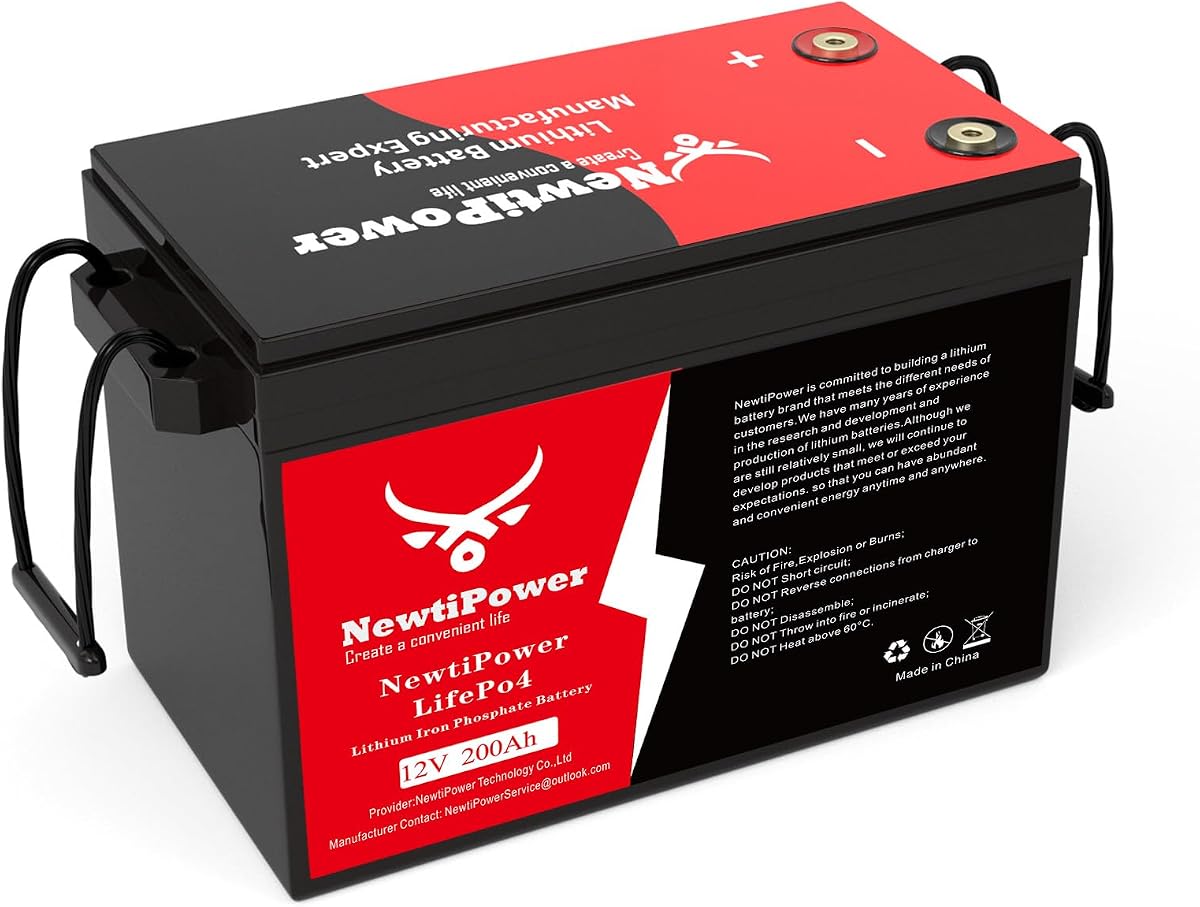
The NewtiPower 12V 200Ah lithium battery earns a 4.2 rating and stands out for its unusually broad expansion options. It supports up to 6S6P configurations, permitting nominal voltages of 24V, 36V, 48V, 60V, or 72V and parallel capacities up to 1200Ah. That makes it a flexible candidate for specialized solar, marine, and off-grid systems.
We may earn a commission when you buy through this link, at no additional cost to you.
The battery uses newer A+ power cells with a stated capacity of 210Ah or more, and the manufacturer describes strict factory inspection. Its 150A BMS protects against overcharging, overdischarge, overcurrent, and short circuits. The listed maximum load power is 1920W, which is consistent with a 12V-class system, though actual performance depends on temperature, wiring, and load duration.
The lower 150A BMS rating means it may not suit the largest inverter surge requirements as confidently as the 200A and 250A alternatives. The lack of a stated Bluetooth or app-monitoring feature is another drawback for owners who want immediate remote diagnostics. A ten-year warranty is available following serial-number activation and product registration.
The NewtiPower is best for technically confident buyers who need unusual series or parallel flexibility and value a stated capacity assurance. It may be less attractive for a simple RV installation, where a higher-current BMS, integrated monitoring, and compact Group 31-style design would be easier to manage.
Six-series support provides access to 60V and 72V nominal systems. Those voltages require careful component matching and should not be attempted with equipment designed only for 12V, 24V, or 48V.
The stated policy for insufficient capacity gives buyers an added assurance beyond the nominal 200Ah label. Keeping purchase documentation and following the manufacturer's activation process is important for warranty coverage.
We may earn a commission when you buy through this link, at no additional cost to you.
The ECO-WORTHY EnergyRock is a 12V 280Ah LiFePO4 battery rather than a conventional 200Ah unit, but it remains relevant because buyers seeking 200Ah-class or greater usable storage may prefer the extra capacity. It earns a 4.6 rating and distinguishes itself with a reinforced metal case, a 200A BMS, and a convenient physical output switch.
We may earn a commission when you buy through this link, at no additional cost to you.
The metal enclosure is designed to improve heat resistance and fire protection while also serving as a sturdy mounting platform. Four feet allow direct installation in an RV or camper without a separate battery box, reducing space and improving organization. Internal cell holders and the reinforced case are intended to resist impact and road vibration during travel.
Bluetooth monitoring provides visibility into voltage, capacity, and charging status through an app. Low-temperature charging protection is built into the BMS. The physical output switch disconnects the discharge circuit for safer maintenance or storage, although users should follow the manual for switching procedures to avoid confusing the state of the battery with a completely isolated system.
The specified charging setup is a 12V LiFePO4-compatible charger with 14.6V absorption. Float may be disabled or set to 13.8V if it cannot be turned off, while equalization is not recommended. This is the right choice for RV builders wanting more than 200Ah, secure direct mounting, and remote monitoring, but buyers seeking a compact unit should consider the smaller options above.
The reinforced case and mounting feet suit mobile installations where vibration, shifting cargo, and limited interior space are common. Proper securement and terminal protection remain necessary.
Bluetooth monitoring helps owners check operating state without accessing the battery compartment. The output switch adds a practical way to interrupt discharge during maintenance or storage.
We may earn a commission when you buy through this link, at no additional cost to you.
Choosing a 200Ah LiFePO4 battery involves balancing usable energy, current handling, physical fit, temperature limits, protection, and future expansion. The nominal capacity tells only part of the story, so installers should match the battery to their loads, charger, inverter, wiring, and mounting environment.
A 12V 200Ah lithium battery is commonly rated at 12.8V, which produces a nominal energy figure of 2560Wh. That multiplication is useful for comparing models, but it is not the same as the amount of energy available at every moment. Voltage rises and falls with state of charge, temperature, load, and cell variation. LiFePO4 can also offer greater usable capacity than lead-acid, but the final usable watt-hours depend on the BMS cutoff and the depth to which the system is regularly discharged.
Compare stated capacity with the loads you actually intend to run. A battery that supplies 2560Wh nominal may be more than adequate for overnight RV use, weekend camping, or a modest solar bank. Larger inverter loads, continuous appliances, and extended cloudy periods can require multiple batteries. Verify whether the listing describes a single 200Ah unit or a pair of 100Ah units, as the HQST option does, because the installation and current handling differ.
The BMS is the battery's internal controller, and its current rating determines the scale of load the pack is designed to manage. Options in this guide range from 150A to 250A, with several models using 200A systems. A higher rating provides more headroom for inverter surges and simultaneous appliances, but it does not replace appropriately sized cables, breakers, fuses, and connectors. Protection functions normally cover overcharge, overdischarge, overcurrent, short circuit, and temperature extremes.
Choose a BMS that is appropriate for the application rather than assuming the largest number is always best. A 250A BMS may be excessive for a modest cabin, while a 150A BMS may be marginal for a demanding inverter. Review the stated continuous and peak limits, confirm the product supports the required discharge temperature, and never allow a high-current charger to exceed the battery's accepted charging specification.
Cycle claims must be read with their depth-of-discharge conditions. Several products in this guide state 4,000 cycles at 100% DOD, 6,000 at 80%, and as many as 15,000 at 60%. The longer figure assumes shallower use and should not be compared directly with a 4,000-cycle full-discharge claim. Temperature, charge method, current, age, and maintenance also influence real-world longevity.
For owners who routinely use only part of the available energy, the 60% DOD figure may better reflect operating conditions. For users who regularly drain close to the stated cutoff, compare the full-depth rating. A long claim is not a guarantee, but selecting a Grade-A-cell battery with clear cutoff values and sound thermal management creates a better foundation for longevity.
Cold charging is one of the most important distinctions among lithium batteries. Charging below 0°C can cause lithium plating, so several models automatically block charging until the cells warm sufficiently. The DUMFUME battery resumes charging at 5°C, while the Renogy Core Mini also prohibits charging below 32°F. Discharge cutoffs vary more widely, with some products supporting operation down to minus 20°C.
In cold climates, treat charging protection as a feature rather than a defect. Use a charger that recognizes LiFePO4 chemistry, bring the battery into a suitable temperature when necessary, and do not bypass automatic cutoffs. For hot-weather systems, confirm both the operating range and how the battery is mounted, since heat above a battery's rating can shorten life even when the BMS is functioning correctly.
LiFePO4 batteries are generally lighter than lead-acid equivalents, but 200Ah units can still be heavy and awkward. Listed weights range from about 21 pounds for each 100Ah HQST battery to 58.86 pounds for several 200Ah models and 81.2 pounds for the HumsiENK. Dimensions matter as much as weight in RV compartments, battery trays, marine lockers, and solar cabinets. The Renogy Core Mini is specifically engineered to occupy less space than a standard 200Ah lead-acid battery.
Measure the available length, width, height, and lifting clearance before ordering. Include room for terminals, cable bend radius, ventilation, secure mounting, and access to any physical switch. A battery that technically fits but blocks a service panel or cannot be handled safely is not a good installation. Also account for the possibility that an expandable system will eventually require additional physical space.
Expansion is where the difference between 200Ah units becomes most visible. Most support four series and four parallel connections, while the NewtiPower lists 6S6P. Series connections increase voltage, parallel connections increase amp-hour capacity, and combinations can create banks approaching 48V. The listed maximum energy varies, so calculate from the actual nominal voltage and capacity rather than relying on a headline system watt-hour figure.
Use identical batteries with compatible age, firmware, and state of charge whenever possible. A matched bank makes balancing and fault diagnosis simpler. Every expansion also demands proper busbars, fusing near each battery, appropriately sized cables, a charge controller suited to the full bank voltage, and a device such as an inverter that can safely accept the resulting voltage.
Built-in Bluetooth can make a substantial difference in an off-grid or travel system. It allows state of charge, voltage, current, and temperature to be viewed from a phone, helping users spot imbalance, unexpected draw, or charging problems. The 12V 200Ah Bluetooth Battery and the ECO-WORTHY EnergyRock include this capability, while the Renogy Core Mini can be monitored through compatible Renogy hardware.
Convenience should be balanced against system complexity. App-based monitoring is useful, but it is not a substitute for correctly sized fuses, secure terminals, regular inspection, or understanding the battery's state of charge. Confirm Bluetooth range, app compatibility, and whether a separate shunt or monitor is required before purchase.
Outdoor and marine installations expose batteries to dust, rain, spray, vibration, impact, and changing temperature. IP65 is a common protection rating in this group and is intended to resist dust and low-pressure water jets. Salt-spray protection adds useful confidence for boating, while metal cases and reinforced cell holders can improve mechanical resilience. These features do not make a battery immune to severe impact or immersion.
Review certification and warranty information as part of the overall decision. Listed standards include UN38.3 for transport, along with product-specific safety marks such as UL, FCC, ROHS, and UKCA on certain models. Warranties range from five years on the Renogy and DUMFUME options to longer stated commitments on the HQST and NewtiPower products. Read exclusions, registration requirements, and shipping restrictions before ordering.
Before installation, verify battery polarity, cable length, terminal hardware, and the voltage requirements of every connected device. Mount the battery securely in a stable, ventilated location where it will not be crushed, punctured, exposed to excessive heat, or reached by moving cargo. Use cables and connectors appropriate for the expected continuous and peak current, and install correctly rated fuses close to the battery.
Charge the battery with a LiFePO4-compatible charger or charge controller. Observe its specified absorption voltage, low-temperature cutoff, and recommended float or equalization settings. Do not use ordinary lead-acid equalization routines unless the manufacturer explicitly permits them. During charging, provide ventilation and avoid placing combustible materials near the battery, especially when it is new, damaged, or operating in a hot environment.
For long-term storage, use the manufacturer's recommended state of charge and storage temperature, disconnect unnecessary loads, and inspect the battery periodically. Several manufacturers recommend charging and discharging the battery at least once every six months. Clean terminals, watch for swelling or impact damage, and remove the battery from service if the enclosure, wiring, or operation appears abnormal.
A 12.8V 200Ah battery has a nominal energy capacity of 2560 watt-hours. Actual usable energy varies with temperature, load, state of charge, and the BMS cutoff. LiFePO4 chemistry generally allows a greater share of nominal capacity than lead-acid, but users should not treat 2560Wh as guaranteed usable energy in every condition. For high-load systems, check continuous and peak output as well as capacity.
Yes, provided the batteries are compatible and configured correctly. Series connections raise voltage, while parallel connections increase amp-hour capacity. Most products in this guide support up to four in series and four in parallel, although the NewtiPower lists broader 6S6P compatibility. Use matched batteries, suitable busbars, proper fusing, and equipment rated for the resulting bank voltage.
Charging below 0°C is automatically blocked by the BMS on many models because charging a cold lithium cell can cause damaging lithium plating. This is a safety feature rather than a failure. Warm the battery to the manufacturer's specified resume temperature or move it to a warmer location. Never bypass the cutoff or charge below freezing unless the manufacturer explicitly provides different instructions.
Most products in this comparison are designed for deep-cycle applications and should not be used as dedicated engine-starting batteries. Starting requires very high cranking current, and the products with 200A to 250A BMS ratings may still differ from the requirements of an automotive starter. Use a battery specifically certified for starting, or follow the vehicle and battery manufacturers' guidance.
Bluetooth monitoring is not required for operation, but it can make an off-grid system easier to manage. It provides visibility into state of charge, voltage, current, and temperature without adding a separate display. It is particularly useful in remote cabins, RVs, and marine installations. Consider whether the required app, Bluetooth range, and any additional monitoring hardware suit your setup.
Only if the charger explicitly supports LiFePO4 chemistry and its required absorption, float, and temperature settings. An incompatible lead-acid charger may apply excessive voltage or inappropriate equalization. Follow the battery manufacturer's recommended charging profile. If the battery is also being charged by solar, configure the controller for lithium rather than using automatic lead-acid equalization.
A pair of 12V 100Ah batteries in parallel provides approximately 12V 200Ah and 2560Wh combined, which is why the HQST product is sold as a two-battery pack. This differs from a single 200Ah enclosure in weight, current handling, and serviceability. Check exactly how many physical batteries are included before calculating mounting space, cable length, and system expansion.
Maintenance requirements are low, but periodic inspection remains important. Check terminals, mounting security, state of charge, and unusual temperature or voltage behavior regularly. The product guidance for one model recommends charging and discharging at least once every six months to maintain health during disuse. Follow the specific storage, cycling, and warranty instructions supplied with the battery you purchase.
The 12V 200Ah Built-in 200A BMS offers the strongest balance of capacity, cycle claims, expansion, and value, while the Bluetooth-equipped 2560Wh battery is the most convenient all-round option for monitoring and protection. The Renogy Core Mini stands out for buyers with limited installation space, a strong peak-discharge claim, and a need for a compact premium enclosure.
Prioritize the details that affect your installation rather than choosing on nominal capacity alone. Match continuous and surge current to the inverter and appliances, confirm physical clearance, use the correct charging profile, and verify low-temperature behavior. If expansion is likely, plan cable routing, fusing, monitoring, and ventilation from the beginning rather than adding complexity later.
Finally, review the current listing, warranty terms, available accessories, and shipping details before ordering. Ratings and product configurations can change, and prices fluctuate across promotions and sellers. Confirm the current specifications against your electrical design so the selected battery works safely and effectively for its intended RV, marine, solar, or backup-power application.