
Clyxgs TPA3116D2 Dual Channel Amplifier Board
4.3Editor score
Dual-channel TPA3116D2 design
Over 90% stated efficiency
Comprehensive protection circuitry
Explore our Class D Audio Amplifier Board guide comparing 10 models for power, protection, connectivity, cooling, and installation ease to help you choose.
A Class D audio amplifier board converts low-voltage DC power into a high-efficiency audio output, making it useful for multichannel systems, compact DIY enclosures, home theaters, and custom speaker projects. A worthwhile board balances usable output, thermal management, protection circuitry, connection options, and a layout that can be integrated without unnecessary difficulty.
This guide compares ten boards using the specifications and product information supplied for each model. The evaluation considers channel configuration, stated power output, operating voltage, speaker-load guidance, cooling, protection features, input methods, dimensions, and intended applications, while avoiding assumptions about performance that cannot be verified from those details.
The picks reveal three distinct approaches: a practical dual-channel module for everyday projects, a versatile higher-power design with selectable bridged operation, and a feature-focused premium board aimed at serious music enthusiasts. Specifications, availability, and seller details can change, so buyers should verify the latest listing information and electrical requirements before ordering.
4.3Editor score
4.6Editor score

5.0Editor score
The comparison below places all ten boards side by side, emphasizing the trade-offs between channel count, stated output, load requirements, cooling arrangements, protection features, and installation convenience.


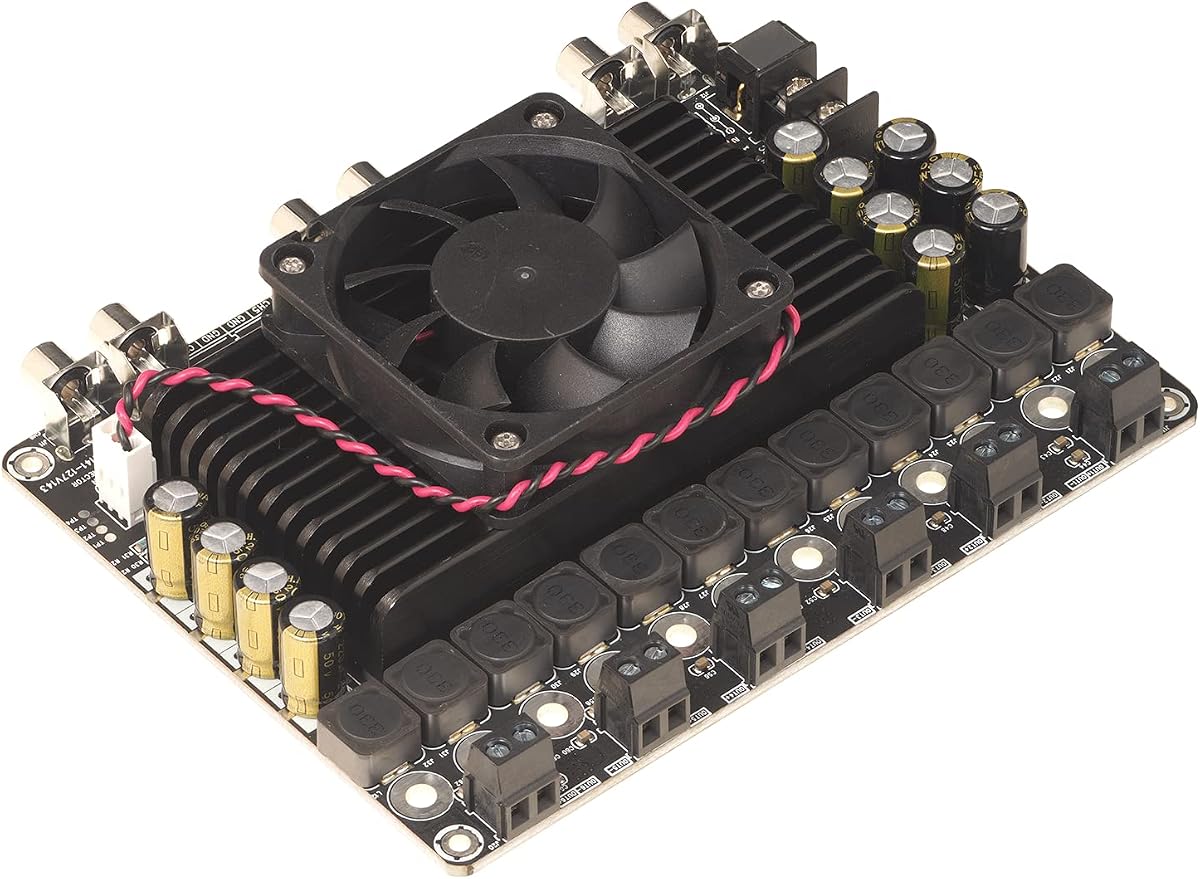


This four-channel T-AMP board is built for projects that need more speaker outputs than a conventional stereo module can provide. It carries a 5.0 rating, and its standout feature is the combination of four 100-watt channels in a relatively compact 6.00-by-4.50-inch package. The stated 100W per channel figure is measured at a 4-ohm load with 27V DC.
We may earn a commission when you buy through this link, at no additional cost to you.
The board uses a bridged BTL architecture, making it a natural fit for home theater, multi-zone audio, surround-speaker, and custom installation projects where each speaker group benefits from its own amplification. A working indicator provides basic visual status feedback, while overcurrent and overtemperature protection help address two common failure risks encountered during high-output operation.
Its listed output is 100W at 4 ohms with total harmonic distortion plus noise of 10 percent, and 69W at the same load when measured at 1 percent THD+N. That distinction matters: the maximum headline output should not be confused with the cleaner-power figure. Buyers should also account for the specified 27V supply and the 1.32-pound board weight when planning an enclosure.
This is a strong recommendation for a builder who prioritizes four-channel flexibility over analog input variety or a selectable bridged mode. It is particularly compelling when the speakers are rated for 4 ohms and the power supply can be arranged correctly. For projects needing only stereo amplification or very compact dimensions, a dual-channel board may be easier to integrate.
Driving four groups from one board can reduce the number of separate amplifier units required. That makes the design useful for surround systems, multiple room zones, and paired speaker installations where separate stereo modules would consume more enclosure space.
Overcurrent and overtemperature protection are valuable in a permanently installed system. They complement the board's thermal design, although users should still provide ventilation and an appropriately rated DC supply.
We may earn a commission when you buy through this link, at no additional cost to you.
The single-channel 200-watt T-AMP offers a focused solution for subwoofers, passive monitors, or any installation where one speaker needs substantial amplification. It has a 5.0 rating and measures 4.80 by 3.60 inches, making it smaller than the four- and six-channel boards in this list. The headline specification is 200W at 3 ohms using a 34V DC supply.
We may earn a commission when you buy through this link, at no additional cost to you.
Several practical details distinguish it from a basic power module. Power and clip indicators give users visual feedback, a temperature-control fan assists heat dissipation, and the board can support a separate VC01 volume-control board. Overcurrent and overtemperature protection add safeguards for sustained operation in a custom enclosure.
At 1 percent THD+N, the stated output is 150W at 3 ohms rather than the 200W maximum figure associated with the 10 percent measurement. The 3-ohm configuration is the key technical limitation for conventional systems, and users must ensure that the chosen speaker or passive crossover is rated for that load. The board weighs approximately 0.88 pounds.
Choose this model when a single powerful channel matters more than stereo flexibility or multichannel expansion. It is a sensible candidate for a subwoofer enclosure, a dedicated monitor amplifier, or a custom sound system with separate power stages. A stereo module would be more convenient when both channels must be driven from one board.
A dedicated high-output channel can simplify a subwoofer build by avoiding the need to power a low-frequency driver from a full stereo module. The 200W headline figure makes this board relevant for compact bass systems using suitable 3-ohm loads.
Separate power and clip indicators help identify basic operating states without complicated metering. They are especially useful during initial setup, when confirming the correct input mode or investigating an unexpectedly low output level.
We may earn a commission when you buy through this link, at no additional cost to you.
The TDA7498-based six-channel board is the broadest all-in-one amplifier in this group. It is intended for multichannel installations that would otherwise require several modules, and its stated configuration provides six 100-watt channels. That makes it relevant to home theater, cinema-room, and distributed-speaker projects with several independent outputs.
We may earn a commission when you buy through this link, at no additional cost to you.
Each channel is specified to deliver 100W at a 6-ohm load from a 36V DC supply with THD+N of 10 percent. At the more demanding 1 percent THD+N measurement, the stated output falls to 70W per channel. A working indicator, temperature-control fan, overcurrent protection, and overtemperature protection help manage operation in a confined enclosure.
The trade-off is installation complexity. Six channels require careful wire routing, balanced gain planning, and enough enclosure volume for the 6.00-by-4.50-inch board, which weighs approximately 1.34 pounds and is listed as 1.53 inches thick. The six-ohm target is convenient for many home speakers, but buyers must confirm that every connected speaker can handle the load.
This board is a compelling choice for a builder creating a multi-zone or surround system from one board. It may be unnecessary for conventional two-speaker listening, but it offers a neat solution when channel count, enclosure space, and the number of independent amplifiers are the main concerns.
A six-channel board can consolidate a theater or multi-room amplifier rack. The 6-ohm specification is especially accessible because many common home-theater and bookshelf speakers are designed around similar impedance.
The temperature-control fan is especially relevant for a board with six active output channels. It should still be positioned so that moving air can enter and leave the enclosure rather than recirculating trapped heat.
We may earn a commission when you buy through this link, at no additional cost to you.
The Clyxgs TPA3116D2 is a dual-channel digital amplifier module with a 4.3 rating. It is positioned as an efficient, broadly compatible board for car systems, computer-speaker builds, DIY installations, and home theater. Its stated efficiency above 90% and low idle loss make it a practical candidate for efficient compact systems.
We may earn a commission when you buy through this link, at no additional cost to you.
Protection is a major strength. The product information lists overvoltage, undervoltage, overheating, DC detection, and short-circuit protection, all integrated into the design. Surface-mounted capacitors, European-style three-pin wiring terminals, and a large heatsink with convection cooling support straightforward assembly and dependable operation.
What the listing does not provide is an equally detailed output specification, including a precise wattage figure tied to a defined load and distortion level. It also does not identify the available audio input format in the supplied information. Buyers should therefore consult the current documentation and pinout before integrating the board with a source or a multi-channel amplifier.
This is the best budget-oriented choice in the group for a straightforward stereo project because it combines efficiency, protection, and a broad 12-to-26V supply range in a conventional module. It is well suited to builders who already understand amplifier boards and need a robust core rather than a highly specialized input panel.
The stated efficiency above 90% means less energy is lost as heat during conversion, although actual results depend on load, supply, and signal conditions. That efficiency is attractive in vehicles and compact enclosures where cooling and power consumption are important.
Overvoltage, undervoltage, thermal, DC-detection, and short-circuit protection give the module a broader safety net than a bare amplifier design. These protections do not replace correct wiring or a properly sized supply, but they help contain common installation errors.
We may earn a commission when you buy through this link, at no additional cost to you.
This two-channel T-AMP combines a 500-watt headline output per channel with a compact 4.80-by-3.60-inch footprint. The board has a 5.0 rating and is aimed at serious DIY audio builds where substantial power is needed without moving to a full rack amplifier. Its 500W rating is specified at 3 ohms using a 48V DC supply.
We may earn a commission when you buy through this link, at no additional cost to you.
The feature set is well suited to monitoring installation. Power and clip indicators provide immediate status feedback, a temperature-control fan handles sustained heat, and the board supports a separate VC01 volume-control board. Overcurrent and overtemperature protection are included, adding safeguards for a high-output module that may operate in a confined cabinet.
At 1 percent THD+N, the stated output is 260W per channel at 3 ohms, while the 500W figure corresponds to the 10 percent measurement. This distinction is critical because marketing wattage can overstate clean, sustained power. The 3-ohm load requirement, 48V supply, and approximately 1.14-pound weight also need to be considered during planning.
The model is best suited to experienced builders who need two powerful channels, understand supply requirements, and can verify the electrical details for their chosen drivers. It is less convenient for a beginner working with ordinary 4-ohm speakers and a standard 12V supply, making a lower-power dual-channel board a more approachable alternative.
The high output rating makes the board relevant for capable subwoofers, studio-style monitors, and large passive speakers. Actual performance depends on enclosure tuning, speaker sensitivity, supply capability, and the output level required by the system.
Despite its high-power specification, the board retains a footprint smaller than the four- and six-channel alternatives here. Indicators, active cooling, optional volume-control support, and electrical protections make it particularly complete for custom installations.
We may earn a commission when you buy through this link, at no additional cost to you.
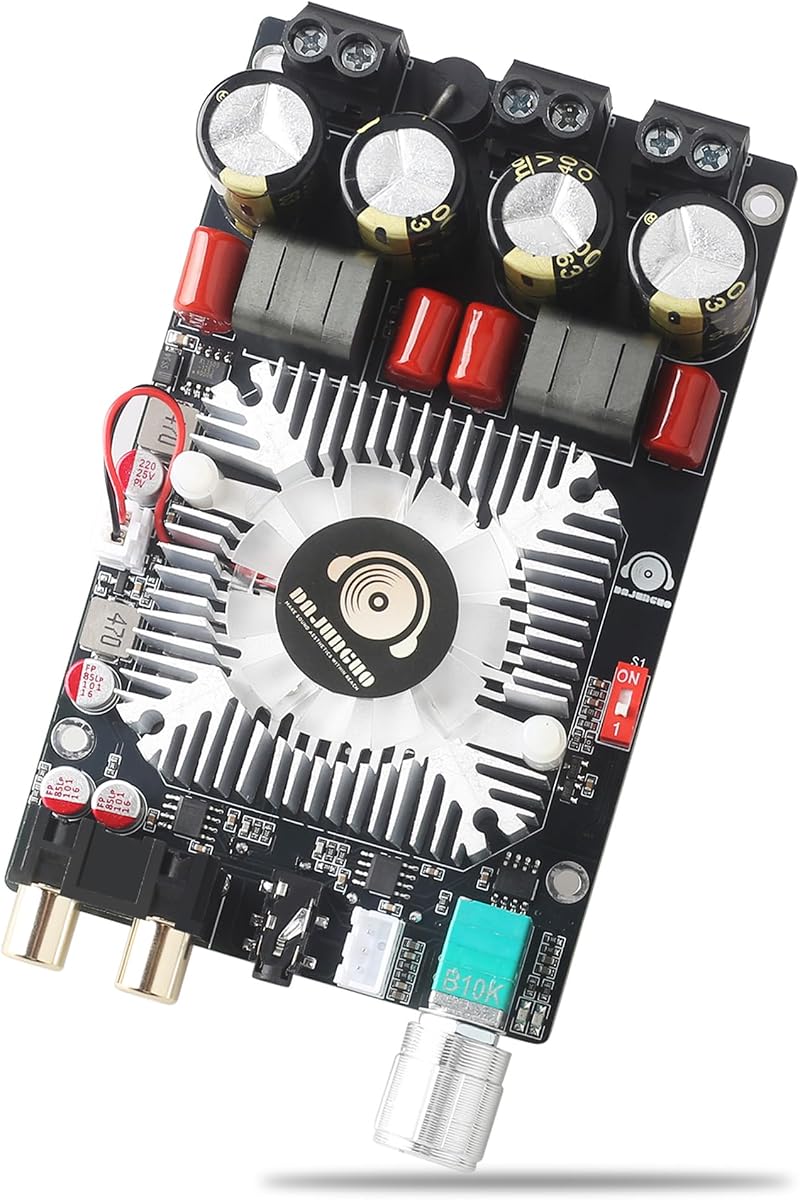
The DAJUNGUO ZK-2202 is a dual-TPA3251 design that can operate as stereo or switch to bridged mono output. It has a 4.6 rating and stands out for combining a 220-watt-per-channel stereo specification with a 350-watt bridged mode. That flexibility makes it one of the most adaptable boards for subwoofers, compact theaters, and DIY speakers.
We may earn a commission when you buy through this link, at no additional cost to you.
Input selection is another major strength. The board accepts RCA, AUX, and XH2.54 three-pin connections, allowing compatibility with more source hardware than a module with only screw terminals. The output specification is accompanied by a stated total harmonic distortion of 0.03 percent, while a cooling fan is included to support stable operation at elevated output.
There are two important operating constraints. Only one input should be active at a time because multiple sources can interfere, and the DIP switch must be changed while the amplifier is powered off. The board accepts a DC12-36V source, adding flexibility across automotive, home-theater, and portable projects, but adequate supply current remains essential.
This is the editor's choice because it combines a practical range of inputs, selectable topology, a wide supply range, and a compact feature set without tying the builder to one installation style. It suits confident DIY users who want to change the board's role as their system evolves, provided they follow the stated input and power-off requirements.
Stereo mode suits conventional left and right speakers, while bridged mode provides a higher-output mono channel for a subwoofer. This makes the board a reusable centerpiece as a project evolves from a two-speaker setup into a more specialized system.
RCA, AUX, and XH2.54 inputs make it easier to connect source modules, test equipment, or existing custom wiring. Selecting only one input prevents contention and unwanted signal interference, especially when several sources are physically close together.
We may earn a commission when you buy through this link, at no additional cost to you.
The 1000W Digital Amplifier Board is the premium-oriented pick in this guide. It has a 5.0 rating and is explicitly aimed at music enthusiasts seeking a powerful, refined Class D platform. Rather than focusing on channel count, it emphasizes component selection, thermal control, and the ability to tune the amplifier's cooling behavior.
We may earn a commission when you buy through this link, at no additional cost to you.
A major feature is the temperature adjustment at the base of the heatsink, which lets the user set the cooling-fan trigger point. The fan is positioned at the top of the board to reduce overall height and dissipate heat effectively. This arrangement is useful in tight custom cases because it helps move heat away from the enclosure interior while preserving a relatively compact profile.
The board uses tantalum capacitors and bipolar sound capacitors, which the manufacturer identifies as premium components selected for stable installation and consistent performance. Detailed load-specific output, distortion, and supply-current information is not provided in the supplied listing, so the 1000W headline figure should be treated as a product designation rather than a complete engineering specification.
It is best for an enthusiast who wants control over thermal behavior and values a carefully presented power-amplifier platform. Prospective buyers should verify the board's pinout, required supply, minimum load, and speaker compatibility in the current documentation before beginning a build.
Setting the fan trigger temperature allows the enclosure designer to balance noise, warm-up behavior, and cooling demand. An earlier trigger can improve heat management, while a later trigger may reduce fan operation in a well-ventilated enclosure.
Tantalum and bipolar sound capacitors form part of a premium-oriented signal and power path. Their inclusion supports the board's positioning for discerning listeners, although real sound quality still depends on the complete chain, speaker pairing, grounding, and system calibration.
We may earn a commission when you buy through this link, at no additional cost to you.
This TPA3116D2 package includes two stereo amplifier boards, each with a stated 2 x 50-watt output. It has a 4.3 rating and appeals to builders who want two independent stereo modules rather than one larger board. Two units can power separate pairs of speakers, form a multichannel system, or provide redundancy in a professional installation.
We may earn a commission when you buy through this link, at no additional cost to you.
Its operating-voltage range is unusually broad at DC4.5-26V, with 24V recommended. The boards are stated for 4-ohm to 8-ohm speakers, giving them flexibility across common passive speaker loads. High-performance inductors and capacitors are used, and the product information identifies the amplifier device as the original TDA3116D2 chip.
Protection features include short-circuit, thermal, overvoltage, undervoltage, and DC protection, along with reverse-connection protection. These safeguards are helpful for DIY wiring, where incorrect terminal orientation or supply errors are common. The two-board format does add installation complexity because each module needs its own inputs, outputs, and power connection.
The package is a good match for distributed stereo, multizone audio, or a two-stage project in which each board drives a different area. It is less suitable for someone wanting maximum output from a single enclosure, because the 50-watt per-channel rating is modest and each board still needs suitable wiring, cooling, and supply capacity.
Independent boards offer a simple way to amplify two separate speaker groups. They can also be deployed at different stages of a build or placed in separate zones, although each module must receive adequate power and cooling.
The DC4.5-26V range allows the same board family to work with several power arrangements. The 24V recommendation offers additional headroom for appropriate projects, while reverse-connection protection helps reduce the consequences of incorrect supply wiring.
We may earn a commission when you buy through this link, at no additional cost to you.
The IRS2092S board is a compact 500-watt Class D module intended primarily as a single-channel power solution for home theater or custom audio projects. It has a stated 4-ohm output, an efficiency above 90 percent, and a frequency-response range from 20Hz to 20kHz. The supplied product information does not include a customer rating.
We may earn a commission when you buy through this link, at no additional cost to you.
Its compact 3.94-by-1.65-by-1.38-inch dimensions make it appealing for projects where enclosure space is limited. The package includes one board and supports dual power-supply compatibility, along with output DC-bias and speaker protection. Short-circuit and overheat protection are also highlighted as core safeguards.
The absence of a numerical distortion specification and a clear input description leaves some technical questions that buyers should resolve through the seller or documentation. Likewise, the listing does not state a precise channel configuration, so it should not be assumed to provide two independent stereo channels. A qualified power supply and careful load selection are essential for a high-output module.
This board is best considered for a builder seeking a small, efficient mono power stage, potentially for a subwoofer or active speaker. Those wanting a stereo amplifier with clearly documented input controls may prefer the ZK-2202, while the absence of a listed rating means this model deserves extra verification before purchase.
The stated efficiency above 90 percent and low heat generation are valuable attributes for a compact board. These figures indicate a Class D design suited to projects where enclosure volume and cooling are limited.
A stated response from 20Hz to 20kHz suggests suitability across the conventional audible range. Actual in-system response also depends on the speaker, crossover, source, and enclosure, particularly in a dedicated subwoofer application.
We may earn a commission when you buy through this link, at no additional cost to you.
The three-channel 500-watt T-AMP offers a flexible middle ground between the two-channel and six-channel boards. It carries a 5.0 rating and provides three 500-watt output channels, making it particularly useful for surround systems, three-way installations, or projects combining full-range and low-frequency amplification.
We may earn a commission when you buy through this link, at no additional cost to you.
The headline output is specified at a 3-ohm load using a 50V DC supply. At 1 percent THD+N, the board is rated to deliver 312W per channel at the same load. A power indicator, temperature-control fan, overcurrent protection, and overtemperature protection provide useful feedback and safeguards. The board measures 6.00 by 4.50 inches and weighs approximately 1.69 pounds.
The primary consideration is the 50V supply requirement, which is higher than most common automotive or basic DIY supplies. Users must also ensure that the load is appropriate for the advertised output. Three channels require balanced gain staging so that all speaker groups receive comparable levels without one channel overwhelming the others.
This board is a strong candidate for a dedicated theater amplifier or custom three-channel system, particularly when high output is important. It is less convenient for compact two-speaker listening, where a dual-channel module would be simpler. Experienced builders who can provide the correct supply and load will find the three-channel layout unusually versatile.
A three-channel layout can support front left, front right, and center speakers, or serve a custom three-zone installation. It provides a practical middle ground between a conventional stereo board and a larger six-channel module.
The 50V DC requirement and 3-ohm headline-load condition must be satisfied before installation. Correct supply capability, speaker ratings, and enclosure ventilation are central to obtaining the intended performance safely.
We may earn a commission when you buy through this link, at no additional cost to you.
The right amplifier board depends on channel count, speaker impedance, required output, supply characteristics, thermal limits, and the available input connections. Reviewing those factors before ordering helps prevent a mismatched board from becoming an expensive installation problem.
Choose the smallest channel count that cleanly matches the system. Extra channels can be useful for expansion, but they should have a defined purpose from the outset.
Prioritize the lower-distortion output figure and use the headline number only for comparison. Match power realistically to speaker sensitivity and listening requirements.
Confirm the minimum supported load and calculate the impedance seen by each channel. Do not assume that a higher-power rating makes a lower-impedance load safe.
Use the specified voltage and a supply with sufficient current capacity. Correct polarity, fusing, grounding, and safe separation from mains wiring are essential.
Plan ventilation before choosing a high-output board. Leave clearance around the heatsink, mount fans for one-way airflow, and verify the complete enclosure fit.
Match the input connector to the source and confirm its pinout. A convenient socket is useful only when its electrical interface is supported by the board.
Look for relevant protection features, especially thermal and short-circuit safeguards. Indicators are valuable for setup and routine diagnostics.
Value flexible modes only when they serve a plausible project need. Follow switch instructions carefully, especially when changing between bridged and stereo configurations.
Before installation, read the board's current documentation, identify every power and speaker terminal, and confirm that the supply voltage, speaker impedance, input method, and cooling requirements match the project. Check the board visually for damage, make a wiring diagram, and verify polarity before applying power. The DIP-equipped model must be switched to its intended operating mode while powered off, and only one of its alternative input methods should be connected at a time.
Power up the amplifier without speakers first when practical, listen for abnormal fan behavior, and confirm that the expected channels are active. Then connect speakers with the amplifier powered off and begin at a low source volume. Raise volume gradually while watching for distortion, clip indicators, unexpected heat, or unstable operation. Do not operate a high-output board continuously at maximum output merely because the advertised wattage figure is available.
For long-term care, keep the enclosure clean, dry, and ventilated. Inspect connectors for looseness or corrosion, confirm that protective fuses remain correctly rated, and check that cables do not obstruct the fan or heatsink. After each substantial wiring change, return the volume to minimum before reapplying power. If the amplifier behaves unusually, stop testing, disconnect the supply, and investigate protection activation, overload, grounding, or cooling before trying again.
A Class D audio amplifier board is a module that uses switching transistors to convert DC power into an amplified audio signal. Its design is known for high conversion efficiency, which can reduce heat and power consumption compared with many older amplifier classes. The board still requires correct input wiring, a suitable speaker load, an adequate DC supply, and proper ventilation.
Choose a board whose specified load matches the impedance presented by the speaker or passive crossover network. A 4-ohm speaker connected to a board designed for 3-ohm loads may operate outside the intended conditions, while an 8-ohm speaker may limit the board's stated maximum output. In bridged configurations, always follow the board's connection diagram and confirm the load at the amplifier terminals.
No. Wattage determines how much output is available under stated conditions, but perceived quality also depends on distortion, frequency response, signal-to-noise performance, speaker compatibility, and the complete signal chain. A correctly sized board with suitable speakers and clean headroom is generally more useful than an oversized model that is difficult to power or run at its limits.
Often, yes, provided the board has a suitable channel configuration, voltage, and speaker-load rating. Single-channel and selectable bridged designs are especially convenient for subwoofers. Verify the final speaker impedance, provide a capable DC supply, allow for heat, and use a properly designed enclosure and crossover or low-pass filter.
It needs a DC supply at the voltage and current level specified for that board and its intended output. The product listings include several different requirements, ranging from broad low-voltage compatibility to fixed 48V and 50V systems. A supply with the correct voltage but insufficient current may cause instability, protection activation, or shutdown under load.
Every board needs adequate heat dissipation, even though Class D designs are generally efficient. Low-output boards may rely on their heatsink and convection in a ventilated case, while high-output versions benefit from active cooling. Fans must be positioned to move air through or away from the heatsink rather than recirculating hot air inside a sealed enclosure.
It can be useful when the amplifier is installed away from the listener or source. Only certain boards in the list explicitly support the referenced VC01 volume-control board, so compatibility should be confirmed before ordering. An external control also does not replace correct gain staging or solve an otherwise unsuitable impedance or power configuration.
There is no universal opening size because heat depends on output level, efficiency, ambient temperature, enclosure volume, and fan arrangement. The practical approach is to leave clearance around the heatsink, provide openings for a one-way airflow path, and check enclosure temperature during sustained use. If a board becomes excessively hot or repeatedly enters thermal protection, the cooling layout needs improvement.
The Clyxgs TPA3116D2 is the most practical budget selection because it combines high stated efficiency, a broad operating-voltage range, and several layers of protection in a conventional dual-channel module. The DAJUNGUO ZK-2202 stands out as the editor's choice for its flexible RCA, AUX, and XH2.54 inputs, selectable stereo or bridged operation, and wide DC supply compatibility. For enthusiasts focused on thermal control and premium component selection, the 1000W Digital Amplifier Board provides the most feature-focused premium option.
When choosing among the other models, prioritize the number of channels actually needed, the speaker impedance, the stated lower-distortion output, and the required DC supply. A four-channel board may be ideal for a theater, a six-channel board for a larger multizone installation, and a three-channel board for a flexible surround layout. High-power single-channel modules can simplify subwoofer builds, but their 3-ohm requirements and elevated supply voltages demand more careful planning.
Before ordering, check the current listing, manufacturer documentation, connector pinout, protection details, and enclosure dimensions. Supplier information and technical claims can change, and the latest product page is the best source for confirming what is currently offered. Buyers should also compare current seller terms and availability before making a final decision.