
Battery Tender Junior 12V 750mA Charger
4.8Editor score
Compact 750mA charging output
Four-step charging program
AGM and gel compatibility
Spark-proof connection protection
Our Agm Battery Tender guide compares ten smart chargers for AGM, lithium, lead-acid, multi-battery, powersports, and long-term maintenance needs.
An AGM battery tender does more than keep a parked vehicle ready for the road: it replenishes stored power, monitors voltage, and transitions into a maintenance mode that helps limit unnecessary discharge. A useful tender must match your battery chemistry, voltage, charging demand, and the number of batteries you need to maintain.
This guide compares ten chargers and maintainers using the supplied product specifications. It covers general automotive use, compact powersports, selectable 6V and 12V systems, onboard installation, high-output charging, and multi-bank maintenance. We also consider battery compatibility, charging stages, safety protections, display visibility, included accessories, and weather resistance.
The selections show that the most useful Agm Battery Tender depends on the job: a compact model may suit a motorcycle, a multibank unit may serve a collector, and a higher-output charger may be preferable for larger vehicles. Ratings and product availability can change, and current prices should be checked before purchasing.
4.8Editor score
4.8Editor score

4.5Editor score
The table below compares charging output, supported battery types, maintenance features, and safety protections across ten smart chargers suited to automotive, powersports, and multi-battery applications.


The Battery Tender 4 AMP is a flexible maintainer for vehicles with either 6V or 12V electrical systems, and it holds a 4.7 rating. Its standout feature is the ability to handle lead-acid, flooded, sealed maintenance-free, AGM, gel-cell, and lithium LiFePO4 batteries with a button selection. That broad compatibility makes it useful when garage inventory includes more than one battery type.
We may earn a commission when you buy through this link, at no additional cost to you.
The charger first supplies a full charge before automatically moving into float mode to maintain voltage without overcharging. A solid-state two-color LED communicates the charging stage, while ISM adaptive charging restores full output if voltage falls too far under load. The combined reach is 11 feet, including a six-foot AC cord and five-foot DC charging lead, and the ring-terminal and alligator-clip combination provides attachment flexibility.
Its primary compromise is a 4-amp ceiling, which is lower than the 8-amp and 15-amp options available in the category. The simple LED also gives less immediate detail than a model with an LCD. Even so, reverse-polarity detection, spark-proof lead connection, and listed safety approvals make the basic monitoring interface reasonable for routine long-term storage.
Choose this model when you need a single charger for mixed 6V, 12V, AGM, or lithium applications and do not need rapid recovery. It is especially attractive for owners of several smaller vehicles or a motorcycle collection that will be stored intermittently. For one mainstream automotive battery, it offers a capable balance of chemistry flexibility, compactness, and straightforward maintenance.
The selectable battery chemistry is more important than the label alone because an AGM, gel, conventional lead-acid, and LiFePO4 battery should each be charged according to its requirements. This model's broad selection reduces the need to own separate maintainers for different equipment.
The two-color status LED and adaptive charging behavior supply the essential maintenance feedback without adding a display or complicated controls. It is a practical choice for owners who want a connect-and-forget format for vehicles in seasonal storage.
We may earn a commission when you buy through this link, at no additional cost to you.
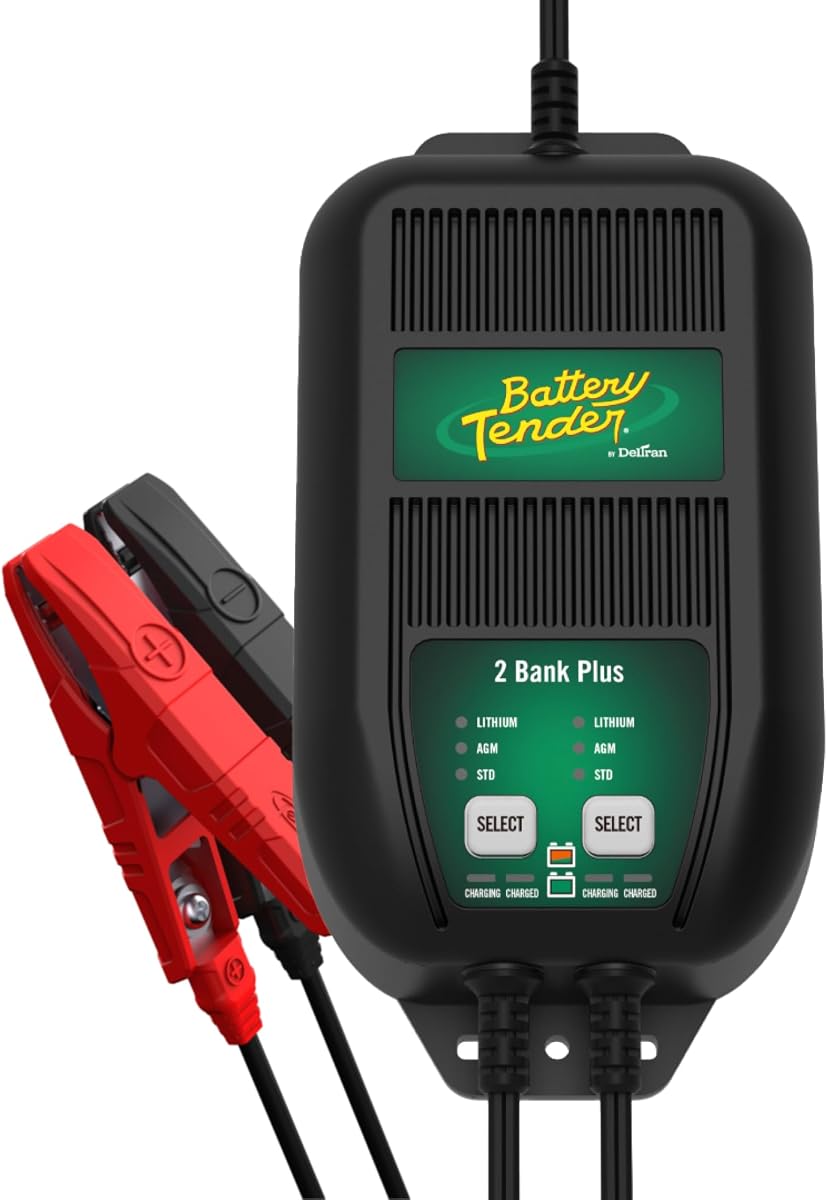
The Battery Tender Plus 2 Bank is one of the strongest choices in this roundup, combining a 4.8 rating with two independent 12V charging stations. It is designed for owners who need to maintain two standard, AGM, or lithium LiFePO4 batteries at the same time, such as a pair of cars, a car and motorcycle, or two batteries installed in different vehicles.
We may earn a commission when you buy through this link, at no additional cost to you.
Each bank delivers 1.25 amps, allowing both batteries to receive a controlled charge without treating the unit as a high-output recovery charger. Temperature compensation adjusts the charge voltage according to ambient conditions, while the three-step sequence of initialization, bulk charge, and float mode provides a clear progression toward storage voltage. A solid-state two-color LED communicates the stage of charging.
The tradeoff is that it handles only 12V systems, so buyers with 6V batteries will need another unit. The two-year limited warranty is also shorter than the five- to ten-year coverage listed on several single-battery products. Even so, for a dual 12V setup, the convenience of two independent stations generally outweighs the modest per-bank output limitation.
This is our Editor's Choice because it addresses a common ownership situation more effectively than a collection of disconnected single chargers. It is ideal for seasonal vehicles maintained together, especially when both batteries use the same 12V chemistry. Select it when multi-battery convenience and controlled parallel maintenance matter more than rapid charging.
Independent banks make the charger more practical for households with multiple stored vehicles. Each connection follows its own charging process, reducing the need to alternate a single tender between batteries and helping both remain ready for use.
Temperature compensation is especially relevant during seasonal storage, when ambient temperature can change the appropriate charge voltage. The feature helps the charger adapt its output instead of applying one fixed profile in every environment.
We may earn a commission when you buy through this link, at no additional cost to you.
The Battery Tender 15 AMP is the most configurable charger in the group, offering selectable output levels of 15, 8, and 2 amps. Its 4.5 rating is slightly below the leaders, but the combination of an interactive LCD, four chemistry choices, and three amperage settings gives this model a premium range of uses.
We may earn a commission when you buy through this link, at no additional cost to you.
The LCD displays the selected charging rate, selected battery type, estimated battery percentage, and error messages. This level of feedback is useful when charging a battery through several stages or when you need to confirm that a setting was applied correctly. Spark-proof lead connection, reverse-polarity detection, and automatic float mode support safe, unattended maintenance.
The obvious trade-off is that the highest setting is much more than many small vehicle batteries need. A 15-amp output should not be viewed as a reason to force a deeply discharged battery into rapid charging without considering its specifications. The display and selectable controls also make this less minimalist than a basic maintainer, though that complexity benefits users who want clear status information.
Buyers with large automotive batteries or varied storage needs can use the lower settings for routine work and reserve more output for recovery situations. It is best suited to someone who wants one versatile 12V charger rather than a dedicated powersport tender. The feature-rich design and included handle make it a strong premium choice for a capable garage.
The three amperage settings let the owner match the charger more closely to the battery and intended task. A lower setting can suit smaller or already charged batteries, while the larger options provide greater output for demanding automotive applications.
Showing battery type, charge percentage, selected amperage, and errors at a glance reduces uncertainty. This visibility is a meaningful advantage over simple LED indicators, particularly when the unit serves multiple vehicles or battery chemistries.
We may earn a commission when you buy through this link, at no additional cost to you.
The Battery Tender 5 AMP is a general-purpose automotive maintainer with a 4.7 rating and a more substantial output than the 4-amp model. It supports 12V lead-acid, flooded, sealed maintenance-free, AGM, gel-cell, and lithium LiFePO4 batteries, making it a practical choice for common cars, SUVs, and trucks.
We may earn a commission when you buy through this link, at no additional cost to you.
The charger moves from full charging into float mode to hold the battery at the proper voltage without overcharging. Its solid-state two-color LED shows operating status, and ISM adaptive charging resumes full output if the battery voltage falls too far while under load. An 11-foot combined reach includes a six-foot AC cord and five-foot DC output cable, while the ring-terminal and alligator-clip combination adds attachment options.
Compared with the 15-amp model, this charger offers less recovery capacity and no LCD, but that limitation can be an advantage for buyers who prefer a simpler unit. It is limited to 12V batteries, so 6V equipment requires a different charger. The five-year warranty provides reassuring coverage for a regularly used maintenance tool.
This is a sensible selection for one vehicle battery that needs dependable seasonal maintenance rather than maximum charging speed. It offers enough output for routine storage duties, broad chemistry support, and simple monitoring. Owners with mixed 6V and 12V fleets should choose a dual-voltage model, while those wanting live charge percentages should look for a display.
The 5-amp setting provides a middle ground between lightweight powersport tenders and high-output automotive chargers. It gives routine maintainers more capability without introducing the controls and size of a 15-amp model.
Adaptive charging is useful because a battery can lose voltage after the initial charge, particularly during connected accessory use. The charger can respond by restoring its full output and then returning to float maintenance.
We may earn a commission when you buy through this link, at no additional cost to you.
The Battery Tender Plus 12V is a straightforward one-battery maintainer aimed at automotive, motorcycle, ATV, and lawn-mower applications. Its 4.7 rating reflects a proven format built around a 1.25-amp output and a four-step charging program that adapts to the needs of a connected 12V battery.
We may earn a commission when you buy through this link, at no additional cost to you.
Its most distinctive convenience is the quick-disconnect harness, which allows the fixed connection to remain in place while the charger is removed when needed. The included fused ring-terminal and alligator-clip cables provide alternative ways to attach the unit. A solid-state two-color LED reports charge status, and charging resumes at full output if voltage falls too far under load.
The main limitation is that only one battery can be serviced at a time. There is also no 6V option, and the 1.25-amp output is better suited to maintenance and smaller batteries than substantial recovery work. Against those limitations, the ten-year manufacturer warranty and lifetime customer support stand out as unusually long coverage.
This model is a good fit for one car or motorcycle stored at home, particularly for a buyer who values straightforward operation and a durable harness. It is less suitable for a collector needing simultaneous maintenance. Choose it when simplicity, long warranty coverage, and easy disconnection matter more than multi-bank capability or high output.
A permanently attached harness can simplify routine checks and prevent repeated battery-terminal connections. The quick-disconnect option is particularly helpful when the vehicle is driven intermittently and the tender needs to be removed.
A ten-year manufacturer warranty makes this model attractive for buyers planning to use the same tender across multiple battery or vehicle changes. The warranty adds confidence without requiring a more complex operating process.
We may earn a commission when you buy through this link, at no additional cost to you.
The Battery Tender Junior 12V is a compact charger and maintainer designed around the smaller batteries found in motorcycles, ATVs, and other powersports. It has a 4.8 rating, and its 750mA output makes it a sensible budget-oriented option when a larger automotive charger would be unnecessary.
We may earn a commission when you buy through this link, at no additional cost to you.
The unit uses a four-step charging program covering initialization, bulk charge, absorption mode, and float mode. It is compatible with 12V lead-acid, flooded, AGM, and gel-cell batteries. The charging cycle changes automatically after the battery is full, while adaptive charging restores full output if voltage drops too far. A two-color LED shows the operating status.
Its compact dimensions and low weight make storage and transport easy, but the 750mA ceiling is the decisive limitation. It should not be confused with a high-output recovery charger, and it offers only one connection. Conversely, those limitations can help prevent an owner from applying excessive current to a small powersport battery during routine storage.
This is our Best Budget pick for a buyer who needs a dedicated motorcycle or powersport tender rather than a general automotive unit. The included 12-foot output cord, fused-ring terminal harness, alligator clips, five-year warranty, and compact enclosure make it especially convenient for a storage area with limited space.
A low-current output is appropriate for many motorcycle and powersport batteries because the goal is maintenance rather than fast recovery. Matching the charger to the battery's intended use can make the Junior more useful than a more powerful unit.
The small, lightweight enclosure takes up little room and is easy to carry between a garage, shed, or seasonal storage location. That physical simplicity complements the automatic charging cycle and uncomplicated LED feedback.
We may earn a commission when you buy through this link, at no additional cost to you.
The NOCO GENIUS2D differs from most portable tenders because it is designed to mount permanently near a 12V battery. It carries a 4.6 rating, delivers 2 amps, and supports AGM, gel, SLA, VRLA, flooded, maintenance-free, deep-cycle, marine, and RV lead-acid batteries.
We may earn a commission when you buy through this link, at no additional cost to you.
The included snap-fit bracket and truss-head self-tapping screws create a secure under-the-hood installation. An integrated thermal sensor adjusts charging for ambient temperature, while the smart monitoring system allows the unit to remain connected for maintenance. It can charge from as low as 1 volt, and Force Mode is available for batteries that have fallen to zero volts.
A permanent installation is not ideal for every owner. Moving the charger between vehicles becomes less convenient, and a permanently mounted unit may not suit a battery that changes frequently. The 2-amp output is also modest, and the three-year warranty is shorter than the longest coverage offered in this list.
This onboard model is best for a vehicle that remains connected to mains power during extended storage. Its deep-discharge charging and recovery features distinguish it from basic float maintainers. Choose it when installation, recovery, and consistent temperature adjustment matter more than portability.
Mounting the charger near the battery removes the need to make external connections each time a vehicle is stored. For long-term storage on a driveway, in a garage, or at a seasonal property, that can be a meaningful convenience.
Charging from one volt and the optional Force Mode are the standout recovery features. They make the unit more relevant when a battery has been deeply discharged rather than merely left at a normal storage level.
We may earn a commission when you buy through this link, at no additional cost to you.
The Battery Tender 6V/12V 2 AMP is designed for a broad mix of powersport and legacy batteries, with selectable voltage and chemistry. Its 4.7 rating reflects a versatile approach, and the ability to choose between 6V and 12V makes it useful for classic vehicles, motorcycles, and other equipment that may not use modern 12V systems.
We may earn a commission when you buy through this link, at no additional cost to you.
After supplying a full charge, the unit switches to float mode for long-term storage. Its four-step program covers initialization, bulk charge, and float stages, while the two-color LED reports the operating state. If battery voltage falls too far, adaptive charging returns the unit to full output. Ring-terminal and alligator-clip combination cables are included for flexible placement.
The product title indicates lithium support, while the supplied feature details specifically describe compatibility with 12V lead-acid, flooded, AGM, and gel-cell batteries. Buyers should verify the exact lithium configuration and instructions for the battery being serviced rather than assuming every lithium type behaves identically. The 2-amp output is also modest, and there is only one charging channel.
This charger is most appropriate for someone maintaining a mixed collection of 6V and 12V powersports or vehicles. Its seven-year warranty and certification across ETL US/CSA, FCC, ICES, and BC standards support long-term use. It is less appealing for owners seeking rapid charging, a detailed display, or simultaneous multi-battery maintenance.
Selectable voltage broadens the pool of batteries the charger can serve, while the chemistry option helps users match the charging profile. This combination is useful in mixed-vehicle garages where a fixed 12V-only tender would be restrictive.
The automatic sequence reduces the need to manually monitor every stage. Once charging is complete, float mode helps maintain the battery, and adaptive output can respond if voltage falls further under load.
We may earn a commission when you buy through this link, at no additional cost to you.
The CTEK MXS 5.0 is a fully automatic 4.3-amp charger and maintainer with a 4.7 rating. Its eight-step program and reconditioning function distinguish it from simple float chargers, making it a compelling choice for car and motorcycle owners who want a more structured approach to battery care.
We may earn a commission when you buy through this link, at no additional cost to you.
CTEK states that the MXS 5.0 is designed to optimize charging in varying conditions and can support marine, car, bike, RV, and tractor applications. The patented float and pulse charging approach is designed for extended connected use. Its conditioner is also intended to improve the lifespan of healthy batteries and revive some underperforming batteries.
Reconditioning should not be confused with a guaranteed battery repair, because battery age, damage, and deep discharge can limit what any charger can recover. The unit is designed for 12V lead-acid and AGM batteries rather than every lithium chemistry, and it has only one charging output. These are important limitations for buyers with mixed battery inventories.
The MXS 5.0 is a strong general choice for a single 12V vehicle battery, especially when a user values a detailed automatic program and rugged environmental protection. Splash, dust, spark, and shock resistance add confidence in a garage, while short-circuit and reverse-polarity protection improve setup safety. It is less appropriate when 6V or lithium charging is a requirement.
The reconditioning stage can help some underperforming batteries return to better usable condition. It adds value for owners of older batteries that have sat unused, though it cannot reverse every form of physical deterioration or sulfation.
Splash, dust, spark, and shock resistance make the charger practical in working garages and seasonal storage environments. Those protections complement the automatic charging behavior for users who want to leave it connected for extended periods.
We may earn a commission when you buy through this link, at no additional cost to you.
The Battery Tender Plus 4 Bank is the broadest simultaneous-maintenance option here, designed to charge up to four 12V batteries at 1.25 amps per bank. It has a 4.7 rating and makes sense for collectors, workshops, or properties where several cars, motorcycles, or stored machines need attention at once.
We may earn a commission when you buy through this link, at no additional cost to you.
Each bank moves from full charging into float mode, while a four-step algorithm supports standard, AGM, lithium LiFePO4, and gel-cell batteries. The package includes four separate alligator and ring-terminal combination clips. Reverse-polarity protection, spark-proof operation, and a 25-hour safety timer help make unattended use more controlled.
The IP65 weather-resistant enclosure is a meaningful advantage for chargers used in garages, sheds, or other storage environments. The tradeoff is that output is divided among four banks, and the unit is restricted to 12V batteries. It is not a fast charger, and owners with only one or two batteries may get more flexibility from a less elaborate model.
This four-bank unit is the natural choice for a sizable collection or an active multi-vehicle property. It consolidates four maintenance connections into one housing and offers extended-weather protection. Choose it when simultaneous coverage is the priority, but consider a higher-output single charger for individual battery recovery.
The IP65 enclosure provides protection against dust and water intrusion, which is useful in garages and storage sheds. It makes the charger more practical for long-term maintenance in environments where an indoor-only unit would be inconvenient.
Four independent stations and four included connection leads allow several batteries to remain maintained without rotating plugs. This is especially useful for collectors who want every stored vehicle ready to start when the season changes.
We may earn a commission when you buy through this link, at no additional cost to you.
The right AGM battery tender should fit the battery's voltage and chemistry while providing the number of connections, charging behavior, and environmental protections required for the intended storage setup.
Match the tender to both voltage and chemistry before considering other features. A 12V-only model cannot safely charge a 6V battery, and a lithium setting does not make every lithium battery identical to LiFePO4.
Choose a lower current for small maintenance and a higher selectable current for capable automotive recovery. Always follow the battery manufacturer's charging limits.
Count every battery that must remain ready, then match the charger to that number. Independent banks are preferable for simultaneous, unattended maintenance.
Prioritize a complete charge, automatic float mode, and adaptive response to voltage loss. These features are more important for unattended storage than maximum amperage.
Choose an LED for uncomplicated maintenance and an LCD for detailed control and troubleshooting. More information is useful only when it remains easy to understand.
Match the connection style to the storage routine. Use quick-disconnect or onboard installation for frequent storage and removable clips for shared equipment.
Check polarity protection, spark-resistant connections, automatic float behavior, and any weather-resistance rating. Match cord reach to the installation location.
Before connecting the charger, identify the battery voltage and chemistry, then select the matching settings on the tender. Use the supplied instructions and the battery manufacturer's recommendations if any information conflicts. Clean the battery terminals, check for damage, and position the charger in a dry, ventilated location. Connect the positive lead first and the negative lead second; when disconnecting, reverse that order. Confirm that the charger displays or indicates the selected configuration before beginning a long storage cycle.
For routine maintenance, attach the charger and let it complete its bulk charging and absorption stages before it enters float mode. Do not repeatedly interrupt the charging cycle or switch chemistry settings while the battery is connected. If the charger shows an error, check polarity and connections before trying another setting. For an onboard installation, mount the bracket securely near the battery, protect the wiring from moving components, and ensure the power cable cannot be pinched or exposed to damaging weather.
Inspect the charger, leads, and terminals periodically. Replace damaged cables rather than continuing to use compromised connections, and keep the vents and housing free of dirt and moisture. Unplug the unit from mains power before moving it or changing connections. A tender is intended to keep a healthy battery maintained; it cannot restore a physically damaged, badly sulfated, or deeply abused battery. If a battery repeatedly loses charge, swells, leaks, or fails to hold a proper voltage, have it assessed by a qualified technician.
Yes, a charger designed as a maintainer can generally remain connected because it should switch into float mode after completing the charge. Automatic float behavior, adaptive charging, and overcharge protection are important features to verify. The battery and charger should still be inspected periodically, and a battery that swells, leaks, or will not hold a charge should not be left on maintenance.
Only when the charger explicitly supports the relevant lithium chemistry, such as LiFePO4. Standard lead-acid charging profiles are not automatically suitable for lithium batteries. Check the charger title, battery selection controls, and instructions, and confirm that the battery manufacturer recommends the supported charging mode. Do not assume that a generic automotive trickle charger is lithium compatible.
It depends on the battery and the purpose of the charger. A 15-amp setting may suit some 12V automotive batteries, but it is unnecessary for a small motorcycle battery and may exceed a specific battery's recommended charging current. Check the battery label or manual, and use a lower selectable output when the tender offers one. The goal of a maintenance tender is controlled charging, not simply applying the highest available current.
A smart maintainer is generally more informative and controlled than a basic trickle charger because it can move through charging stages, monitor the battery, and use float mode. Some very basic trickle chargers do not adapt to the battery's condition. Choose a model with automatic charging stages, reverse-polarity protection, and a clear maintenance mode for long-term storage.
The primary difference is the voltage the charger is designed to recognize and deliver. A 6V-only tender is intended for older 6V batteries, while a 12V model serves most modern cars, motorcycles, and powersports. A switchable 6V/12V charger offers flexibility, but the voltage setting must match the connected battery. Using the wrong setting can damage a battery or charger.
A multibank charger is convenient when several batteries need maintenance at the same time. Independent banks let each battery follow its charging process without moving one connection between vehicles. If the vehicles are used frequently or maintained one at a time, separate single tenders may be simpler, while collectors and seasonal-storage properties can benefit substantially from two-bank or four-bank models.
Adaptive chargers can restore full output when battery voltage falls too far under load. This may occur if the battery is deeply discharged, if accessories remain connected, or if the battery's condition prevents it from holding a stable voltage. Check the connection, load, and battery condition. A battery that repeatedly drops voltage may need testing rather than continuous maintenance.
Some smart chargers can charge very low-voltage batteries, and the NOCO GENIUS2D specifically supports charging from one volt with a Force Mode for zero-volt batteries. Success is not guaranteed, especially for batteries that are damaged, severely sulfated, or aged beyond useful service life. Follow the charger instructions and consult a battery specialist when recovery fails.
The strongest general choice is the Battery Tender Plus 2 Bank because it combines independent 12V charging stations, temperature compensation, broad chemistry support, and a strong 4.8 rating. The Battery Tender Junior is the economical pick for a smaller powersport battery, while the 15 AMP model takes the premium slot for buyers who value selectable output and detailed LCD feedback.
Prioritize voltage and chemistry compatibility first, followed by the number of batteries you need to maintain. Output, charging stages, status visibility, connection style, and environmental protection should then reflect how and where the equipment will be used. A simple LED model may be ideal for one motorcycle, while a collection owner needs multiple independent channels and a weather-resistant enclosure.
Ratings, product features, and current prices can change, so confirm the latest listing and specifications before purchasing. Compare the tender with the actual battery label, planned storage duration, and available connection space. With those details settled, the right Agm Battery Tender should deliver controlled charging, clear maintenance behavior, and dependable protection for the battery it serves.
