
StarTech HSB3SATSASBA
4.3Editor score
Three 3.5-inch drive bays
Independent power and status lights
Adjustable-speed cooling fan
Key-lock ejection protection
Hot swap drive bays let users replace or add storage while a system remains operational, making them especially useful in servers, workstations, industrial computers, and other storage-focused builds. A worthwhile enclosure balances drive density, interface compatibility, cooling, secure connections, and a maintenance process that does not require opening the chassis.
This guide compares ten internal hot swap drive bays spanning single-bay, dual-bay, and high-density multi-bay designs. The evaluation considers supported drive sizes, SATA and SAS compatibility, cooling provisions, backplane features, access mechanisms, indicators, installation requirements, and the practical value offered to different types of computer users.
The selections show why the right hot swap drive bay depends on the system rather than on bay count alone. Compact options suit individual SATA or SAS drives, while larger cages support dense server storage and fast maintenance. Product availability and prices can change, so readers should confirm current specifications and listings before purchasing.
4.3Editor score

4.3Editor score
4.4Editor score
As an Amazon Associate we earn from qualifying purchases.
The following side-by-side comparison highlights the major differences in drive capacity, interface support, cooling, access style, and physical bay requirements. It makes it easier to match an enclosure to an existing chassis and its storage priorities.




The Rosewill RSV-SATA-Cage-34 is a four-bay hard drive cage designed to convert three conventional 5.25-inch drive positions into a front-accessible storage area. It holds four 3.5-inch SATA hard drives or SAS hard drives, making it a practical choice for a workstation or server that needs more removable storage than a traditional external bay can provide.
We may earn a commission when you buy through this link, at no additional cost to you.
Its defining advantage is the combination of density and interface flexibility. The cage supports SATA I, SATA II, SATA III, and SAS 6Gbps drives, while the listed specifications also describe accommodation for 2.5-inch SATA drives. A single 120mm rear exhaust fan provides the cooling needed for a densely populated enclosure without requiring several separate cooling assemblies.
The trade-off is that the unit occupies three 5.25-inch positions and is not designed around compact 2.5-inch storage. Its specifications specifically call out compatibility with Rosewill L4000U, L4500U, and R4000U systems, so buyers using another enclosure should verify mounting space, connectors, airflow, and backplane requirements before buying.
Despite those restrictions, this is a capable hot swap drive bay for compatible systems that need four full-size drive positions. It offers useful drive and interface options, durable construction, and a straightforward cooling solution. It is our Editor's Choice because the combination of capacity, removable storage, and broad drive support is difficult to find in one compact cage.
The cage converts three 5.25-inch positions into four 3.5-inch hot-swappable drive locations. That makes it especially useful when a system has limited front-bay room but still requires several serviceable hard drives.
A dedicated 120mm rear fan creates a directed cooling path through the enclosure. This is a meaningful advantage when several hard drives operate in the same confined area for extended periods.
We may earn a commission when you buy through this link, at no additional cost to you.
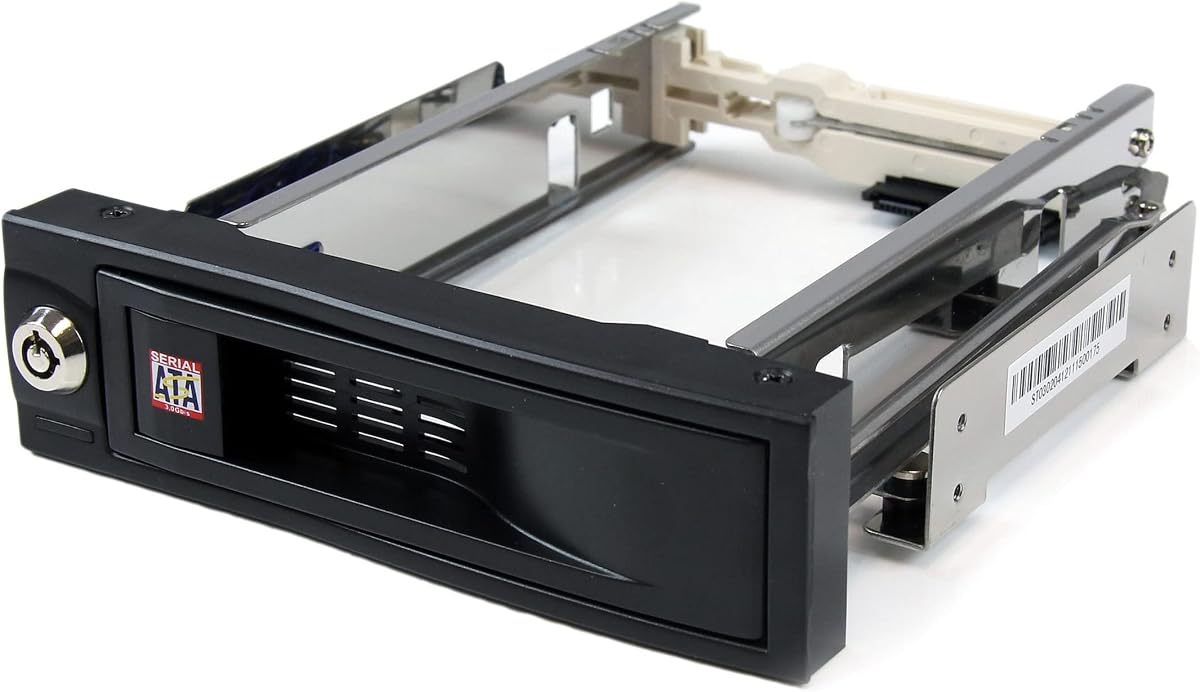
The StarTech HSB3SATSASBA is a trayless mobile rack backplane that converts two 5.25-inch positions into a front-accessible interface for three 3.5-inch hard drives. It combines SATA and SAS support with a design oriented toward IT professionals who need clear drive access, visible status information, and controlled removal.
We may earn a commission when you buy through this link, at no additional cost to you.
The enclosure provides individual ejection levers for every bay, each bay has power and status LEDs, and a key-lock design adds optional protection against unauthorized drive removal. Its solid aluminum construction, vented enclosure, and built-in fan with speed control address both physical durability and heat management.
Its interface support is limited to SATA I through SATA III and SAS I and II, so it should not be treated as a match for newer SAS 3.0 systems. It also consumes two front drive positions, which is the expected tradeoff for a full three-drive trayless enclosure.
The StarTech model is our Best Premium pick for buyers who value organized maintenance controls and a more security-conscious design. The included keys, individual indicators, trayless access, adjustable fan, and professional support make it especially attractive for shared workstations, rack-oriented systems, and other environments where drive changes should be deliberate and easy to monitor.
Each bay uses its own ejection lever, while the key-lock mechanism can provide an added layer of control. This is useful when drives need to remain protected in a shared or physically accessible system.
Dedicated power and status LEDs make it easier to identify the state of individual drives. Separate indicators are particularly useful in multi-drive installations.
We may earn a commission when you buy through this link, at no additional cost to you.
The StarTech HSB100SATBK is a straightforward trayless mobile rack that places one 3.5-inch SATA hard drive in a front 5.25-inch bay. It targets users who want a cleaner, more accessible drive installation without committing to a multi-bay server cage.
We may earn a commission when you buy through this link, at no additional cost to you.
Because the drive mounts directly without a separate tray or enclosure, installation and removal are less involved. Internal rubber shock absorbers help reduce vibration, the solid aluminum construction supports durability, and the listed 50,000-plus insertion rating indicates a design intended for repeated servicing.
This simplicity also defines its limitations. It provides only one drive position and is listed for SATA drives rather than SAS compatibility, so it cannot replace a multi-drive hot swap backplane in a high-density storage system.
The HSB100SATBK is our Best Budget pick for a targeted upgrade: adding one serviceable full-size hard drive to a compatible chassis. It is best when simplicity, front access, and a compact footprint matter more than multi-drive capacity or enterprise-style locking controls.
The drive mounts directly into the bay without a separate carrier. That reduces the number of parts involved during installation and makes routine access more direct.
Rubber shock absorbers and a stated 50,000-plus insertion rating support long-term use in a system where the drive may be removed and reinstalled regularly.
We may earn a commission when you buy through this link, at no additional cost to you.
The ICY DOCK MB326SP-1B is a six-bay 2.5-inch hot swap enclosure that fits within a single 5.25-inch drive position. It offers an unusual density for an internal cage and supports both SATA and SAS HDDs or SSDs, making it suitable for compact servers, high-end workstations, and specialized storage systems.
We may earn a commission when you buy through this link, at no additional cost to you.
Its ExpressTray mounting system accepts 2.5-inch drives with heights from 5mm through 9.5mm and permits tool-less tray removal. Optional bottom screw holes can improve stability, while Active Power Technology avoids powering an empty bay. Two user-upgradeable 40mm fans provide cooling, with high, low, and off control settings.
The enclosure uses a single-channel architecture and two SATA power connectors for all six drives. That means buyers must not interpret the six physical positions as six independent data channels, and the host controller and backplane must be compatible with the chosen drive interfaces.
Despite the single-channel detail, this is an exceptional choice when six compact drives are the priority. It combines a very high drive count, broad drive-format support, tool-less maintenance, active cooling, and a five-star listed rating. It is particularly compelling for storage-dense systems that do not have room for multiple conventional drive cages.
The enclosure places up to six 2.5-inch HDDs or SSDs inside one 5.25-inch opening. It is a strong option for systems where physical space is more constrained than the number of available data interfaces.
ExpressTray permits quick removal without tools, while optional screw mounting adds a more permanent fastening point when vibration concerns or heavier drives warrant it.
We may earn a commission when you buy through this link, at no additional cost to you.
The ICY DOCK MB324SP-1B is a four-bay 2.5-inch hot swap enclosure that occupies one 5.25-inch position. It combines a relatively compact format with support for SATA and SAS HDDs or SSDs, individual status indicators, and a tool-less ExpressTray system.
We may earn a commission when you buy through this link, at no additional cost to you.
The enclosure accepts drives measuring 5mm, 7mm, 9.5mm, or 12.5mm in height, giving it more flexibility than many small drive cages. Durable metal construction, heavy-duty ABS trays, door latches, and locking latches for both the seven-pin SATA data connectors and 15-pin power connectors help protect the installation.
Cooling is handled through a three-speed fan control with high, low, and off settings. A single 15-pin SATA power connector powers all four drives, and the stated SATA 6Gbps or SAS 3.0 12Gbps support applies to a single channel.
This makes the MB324SP-1B a balanced option for users who want more than a dual-bay carrier without moving to a six-drive enclosure. It is particularly well suited to compact storage systems that use 2.5-inch drives and value secure connector retention.
The four bays accept 2.5-inch HDDs and SSDs across four listed thicknesses. This broad height compatibility makes the enclosure useful with both thin drives and taller 2.5-inch laptop-style drives.
Separate locking latches for the SATA data and power connectors help prevent accidental disconnection. That focus on physical retention is valuable in systems that may be moved or serviced.
We may earn a commission when you buy through this link, at no additional cost to you.
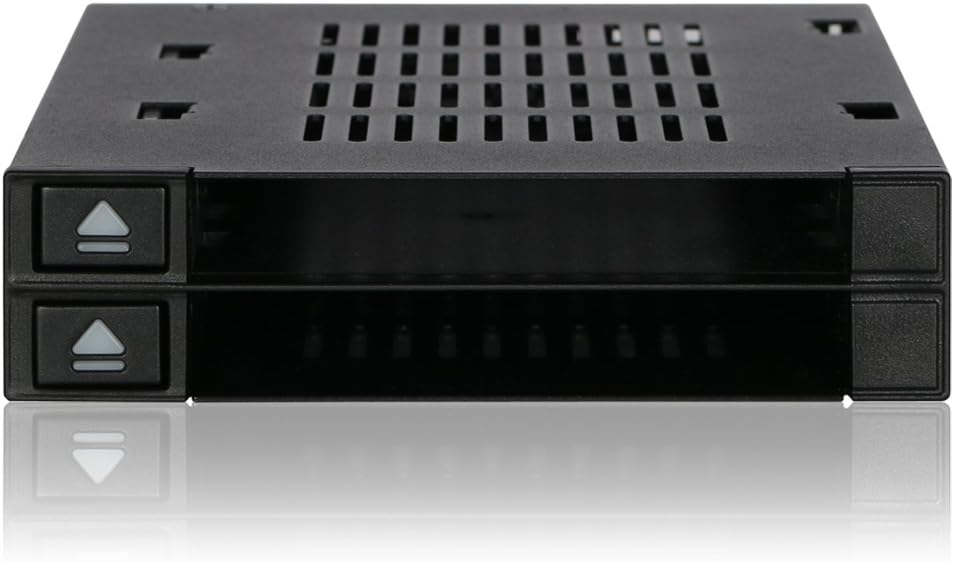
The ICY DOCK MB522SP-B is a compact dual-bay carrier for 2.5-inch SATA or SAS HDDs and SSDs. It fits an external 3.5-inch or floppy drive position, giving it flexibility in systems that cannot spare a full 5.25-inch bay.
We may earn a commission when you buy through this link, at no additional cost to you.
The completely trayless design accepts bare drives without separate holders, and the doorless layout enables quick hot-swapping. Large individual eject buttons make removal easy to identify, while activity lights are built into the buttons and Active Power Technology powers an indicator only when a drive is installed.
It supports SATA 3.0 at 6Gbps or SAS 3.0 at 12Gbps through a single channel. The listed drive height range is 5mm to 9.5mm, so it does not support taller 2.5-inch drives. It is also limited to two positions rather than the broader capacity of several other ICY DOCK products.
For a user who only needs two serviceable compact drives, the MB522SP-B remains an efficient solution. Its minimal footprint, quick bare-drive access, and clear eject controls are especially useful in mobile computers, industrial systems, rack servers, and OEM or ODM applications.
The lack of a separate tray or enclosure door removes several steps from the replacement process. A user can access a drive through the front with the system operating.
The enclosure fits a 3.5-inch or floppy position rather than requiring a 5.25-inch opening. That makes it a practical option for compact chassis with unusual available space.
We may earn a commission when you buy through this link, at no additional cost to you.
The SilverStone FS304-V is a trayless hot swap cage that fits four 3.5-inch SAS 12G or SATA 6Gbit/s drives into three 5.25-inch device positions. It is designed for users who want modern interface options along with front-accessible, individually monitored drive bays.
We may earn a commission when you buy through this link, at no additional cost to you.
Independent LEDs allow drive statuses to be monitored separately, and a built-in cooling fan provides active heat dissipation. The trayless format supports direct drive access, while the enclosure's support for SAS 12G makes it more relevant to newer SAS-oriented storage configurations than the older SAS products in this guide.
Its three-position 5.25-inch footprint is substantial, and it is limited to 3.5-inch drives. The product also carries a lower listed rating than the other selections, so buyers should pay particular attention to system compatibility and the quality of the host backplane and controller.
For a compatible system that specifically needs 12G SAS in a four-drive hot swap arrangement, the FS304-V offers a focused and capable design. It is less attractive as a general-purpose enclosure, but its combination of modern SAS support, indicators, trayless service, and cooling makes it relevant for specialized storage builds.
Support for SAS 12G is the key technical distinction in this cage. It is better aligned with newer SAS storage architectures than the products limited to SAS I or SAS II.
Independent status indicators remove the need to infer drive activity from a shared light. That simplifies troubleshooting in installations containing several full-size hard drives.
We may earn a commission when you buy through this link, at no additional cost to you.
The Kingwin Dual 2.5-inch hot swap cage provides two serviceable drive positions inside an open 3.5-inch floppy bay. It accepts 2.5-inch SATA or SAS hard drives and SSDs, and its trayless design allows bare drives to be inserted and removed without separate holders or screws.
We may earn a commission when you buy through this link, at no additional cost to you.
The stated interface support covers SATA I, SATA II, SATA III, SAS I, and SAS II, with performance listed at up to 6Gbps. LEDs indicate power and drive activity, while a key-lock feature adds a layer of physical security for shared or accessible installations.
The enclosure is built with ABS and metal to support both structural strength and heat dissipation. Its main limitation is capacity: two drives is modest compared with the four-, five-, and six-bay alternatives. The listed SAS support also stops at SAS II, so it is not intended for 12G SAS installations.
The Kingwin cage is a good fit for a desktop, server, media backup system, or security installation that needs two easily serviced 2.5-inch drives. It combines a compact footprint, tool-less access, useful indicators, and locking security without requiring a larger multi-drive chassis.
The integrated key lock helps restrict access to the drive mechanism. It adds useful physical control without requiring a full multi-bay enterprise cage.
Bare 2.5-inch drives slide directly into position, reducing the number of components that must be handled during replacement. This makes routine service faster and less cumbersome.
We may earn a commission when you buy through this link, at no additional cost to you.
The Five-Bay Hot Swap Cage expands three conventional 5.25-inch positions into five hot-swappable drive locations. It supports 3.5-inch SATA hard drives, 2.5-inch SATA hard drives, and SAS hard drives, offering a flexible middle ground between compact dual-bay products and larger server enclosures.
We may earn a commission when you buy through this link, at no additional cost to you.
Its space-efficient layout is the central appeal. A built-in cooling fan manages heat, while the rugged aluminum alloy and plastic chassis is designed for practical internal use. The slides-in installation approach allows drives to be added without a complex tray-removal sequence.
Redundant power supply ports are intended to improve operational resilience and provide an additional connection option. The product listing uses broad compatibility language, however, so buyers should carefully verify the exact interface generation, connector requirements, dimensions, and host-controller support against their own system.
This cage is most attractive to a builder seeking five serviceable drive positions without dedicating five separate 5.25-inch bays. Its combination of high density, cooling, flexible drive formats, and dual power connections makes it a compelling specialist option, provided the buyer confirms the detailed installation requirements before purchase.
The enclosure prioritizes storage density by fitting five hot-swappable positions into the space normally used by three optical-drive cages. It suits systems with a valuable but limited supply of front-bay openings.
Two power input ports provide a more flexible and potentially resilient power arrangement than a single-connector design. Compatibility with the host supply should still be confirmed before installation.
We may earn a commission when you buy through this link, at no additional cost to you.
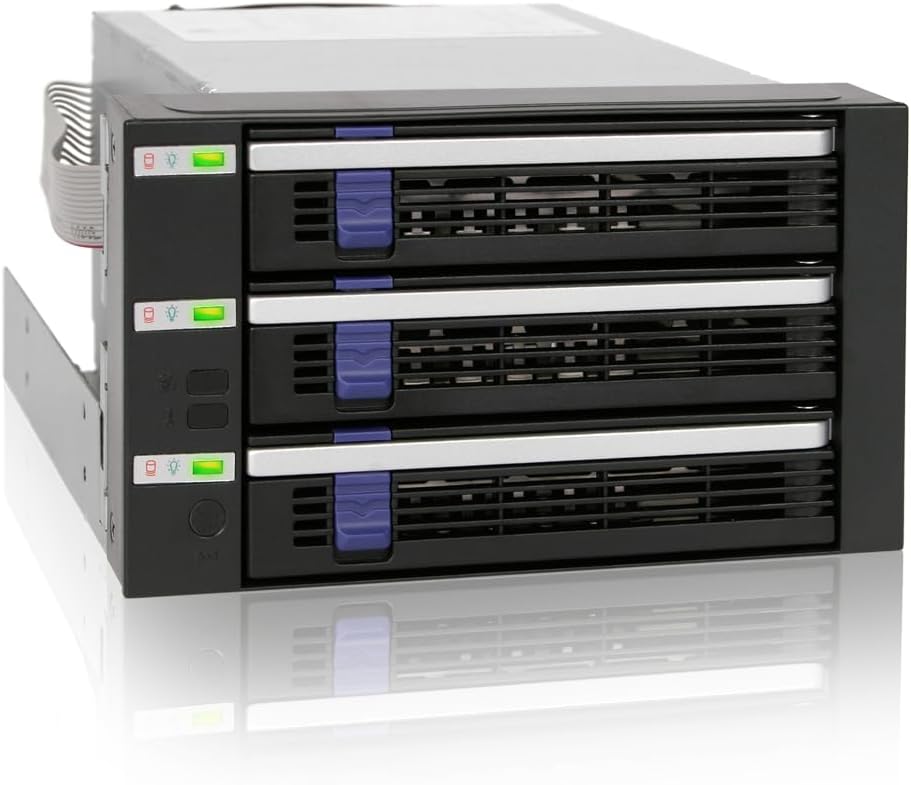
The ICY DOCK MB153SP-B is a three-bay hot swap enclosure designed to occupy two 5.25-inch positions. It supports 3.5-inch SATA hard drives and is also identified in the product title as suitable for 2.5-inch SATA or SAS hard drives and SSDs, making it a versatile mixed-drive option.
We may earn a commission when you buy through this link, at no additional cost to you.
The enclosure supports SATA 3.0 at up to 6Gbps and SAS 3.0 at up to 12Gbps. Its full metal body is intended to aid heat dissipation, and the listed cooling features include an 80mm fan, while another bullet also refers to a large 92mm cooling fan. This inconsistency should be checked in the final listing and physical product documentation.
SATA 15-pin power ports are used for compatibility with suitable power supplies. The enclosure consumes two front-bay positions, and its actual drive accommodation should be confirmed for each of the 2.5-inch and 3.5-inch formats because the title and bullets summarize the options differently.
For a compatible build that needs more than two drives, a modern SAS interface, and a durable metal enclosure, the MB153SP-B remains a capable choice. It is especially relevant to users who want to combine full-size hard drives with compact storage while keeping all media serviceable from the front.
The MB153SP-B can serve as a three-position enclosure for a mixture of 2.5-inch and 3.5-inch storage. That flexibility can simplify a system that uses SSDs for fast access and hard drives for capacity.
A full metal shell provides a rigid foundation for the backplane and drives. Active fan cooling adds another layer of thermal support for sustained storage workloads.
We may earn a commission when you buy through this link, at no additional cost to you.
A hot swap drive bay must fit the chassis, match the drives and host controller, provide adequate cooling, and make storage maintenance manageable. These factors matter more than the number of positions alone, particularly when the enclosure will support continuous data access.
Begin by measuring the space available in the computer case. Some cages require a full 5.25-inch opening, while others fit a 3.5-inch or floppy position, and high-density models can occupy multiple adjacent openings. The Rosewill RSV-SATA-Cage-34 uses three 5.25-inch positions, the StarTech HSB3SATSASBA uses two, and the ICY DOCK MB326SP-1B fits six 2.5-inch drives into one. Accurate dimensions prevent the common mistake of buying a high-capacity cage that cannot physically fit or leaves poor airflow around it.
Choose a footprint that matches the chassis and leaves room for cables, fans, and drive access. A dense cage may require a larger case or a different mounting strategy than a single-bay carrier.
Determine whether the system primarily uses 3.5-inch hard drives, 2.5-inch laptops, or a mixture of both. The Rosewill and SilverStone cages focus on 3.5-inch drives, whereas the ICY DOCK MB326SP-1B and MB324SP-1B support compact 2.5-inch storage. The MB153SP-B is listed for mixed sizes, while the Five-Bay Hot Swap Cage also describes support for both 3.5-inch SATA and 2.5-inch SATA drives. Matching the intended media prevents wasted bays and compatibility surprises.
Think beyond the raw number of positions. A six-bay compact cage may offer less total capacity than a three-bay full-size cage, so compare the actual drives you intend to install rather than relying on the bay count alone.
Interface support must match the drives, backplane, host controller, and power connections. The selections include SATA I, II, and III compatibility in different combinations, as well as SAS support ranging from older SAS I and II configurations to SAS 3.0 and SAS 12G. A cage that supports a connector family does not by itself guarantee that every drive speed or generation will work with the rest of the system.
Check the exact interface generation, signaling rate, and controller requirements before purchasing. Newer SAS support is not interchangeable with older SAS support, and an enclosure's physical SATA power connector should also be checked against the host power supply.
Hot swap cages can concentrate several heat-generating drives in a small area. Active cooling is therefore important in sustained workloads, especially with high-capacity 3.5-inch hard drives. Available options include a 120mm exhaust fan, a fan with speed control, two upgradeable 40mm fans, a built-in cooling fan, and a metal enclosure with active cooling. The best arrangement directs air through or around the drive carriers rather than merely placing a fan nearby.
Also consider chassis airflow and the position of the enclosure. A cage that blocks a case fan or sits in a poorly ventilated corner may still need additional case cooling, particularly during long write-intensive operations.
Trayless products accept bare drives and generally allow the fastest direct removal, while removable-tray designs provide a more structured way to carry and protect a drive. The StarTech HSB100SATBK, Kingwin cage, ICY DOCK MB522SP-B, and SilverStone FS304-V emphasize trayless access. The ICY DOCK MB326SP-1B and MB324SP-1B use removable ExpressTray systems with tool-less mounting.
Choose according to service frequency and handling. Trayless access is convenient in tight spaces, while a sturdy removable tray may be preferable when drives are regularly moved to another system or need additional handling support.
Security can mean preventing accidental ejection, restricting access, or improving the retention of power and data connectors. The StarTech HSB3SATSASBA includes a key-lock design and individual ejection levers, while the Kingwin dual-bay cage also incorporates a key lock. The MB324SP-1B uses locking latches for both seven-pin SATA data connectors and 15-pin power connectors. These mechanisms matter in shared systems, racks, industrial installations, and other environments where accidental removal or vibration could be disruptive.
For a home workstation, security may matter less than accessibility, but secure connector retention remains useful in any system that could be moved, transported, or exposed to frequent physical contact.
Per-drive LEDs make it easier to determine whether a specific bay is powered and active. The StarTech HSB3SATSASBA includes power and status LEDs for each bay, the SilverStone FS304-V has independent indicators, and the ICY DOCK MB326SP-1B and MB324SP-1B use individual blue lights. The Kingwin product provides power and activity indicators, while the MB522SP-B incorporates activity lights into its large eject buttons.
When troubleshooting a storage problem, separate drive indicators save time because the user can focus on the affected bay. This becomes increasingly valuable as the number of installed drives grows.
The enclosure must also be compatible with the system's internal connectors, controller, operating system, and management software. The Rosewill product specifically lists compatibility with Rosewill L4000U, L4500U, and R4000U systems. Other products use more general platform descriptions, but the backplane still needs a suitable data connection and the host must recognize hot swap events correctly. The MB326SP-1B also uses a single-channel architecture, illustrating why physical bay count does not determine logical drive count or performance.
Review the complete host and enclosure specifications together rather than focusing on the cage in isolation. Compatibility with the case, power supply, fan layout, controller, and intended workload is essential for a successful installation.
Before installation, power down the system, disconnect its power cable, and consult the computer and enclosure documentation. Confirm that the drive interface, connector orientation, mounting space, and host-controller support are correct. Install the empty enclosure according to its manual, attach the required data and power connections, and confirm that cooling components or fan controls are configured before adding any drives.
For each drive, observe the manufacturer's handling guidance, use the proper mounting method, and avoid forcing a connector. Connect the drive to its tray or bay, secure it using the mechanism specified for that model, and make sure the latch or eject control is fully engaged. When replacing a drive, follow the host system's software procedure for marking the drive offline or logically removing it before physical extraction.
After insertion, check the bay's power and activity indicators and verify that the enclosure appears in the host operating system or management interface. Maintain airflow around the cage, keep cables clear of fans, and avoid blocking vents with dust or cable bundles. Periodically inspect connector retention, tray locks, fan operation, and temperature behavior, particularly if the enclosure is used for continuous storage workloads.
A hot swap drive bay is an internal enclosure that allows storage media to be inserted or removed while the host system remains operational. It normally includes a backplane, power and data connections, cooling, and a front-access mechanism. Actual hot swap behavior also depends on the host controller, operating system, and storage management software.
No. The drive must use a supported interface, such as SATA or SAS, and must fit the enclosure's stated size and thickness specifications. The host controller and backplane must also support that interface generation and signaling rate. Always compare the drive connector, dimensions, and controller requirements with the enclosure documentation.
Many of the listed cages support 2.5-inch SATA or SAS SSDs as well as hard drives. The ICY DOCK MB326SP-1B and MB324SP-1B are specifically designed around 2.5-inch drives and SSDs, while some larger cages focus on 3.5-inch hard drives. Check drive height, connector type, and interface generation before installation.
A trayless design usually simplifies installation because the drive mounts directly without a separate carrier. It does not necessarily provide more physical protection than a well-designed removable tray. Consider shock absorbers, locking mechanisms, connector retention, and system vibration when choosing between the approaches.
Cooling needs depend on drive count, drive type, workload, enclosure material, and chassis airflow. Dense full-size hard drive cages benefit from active airflow, while compact SSD cages may have different thermal requirements. For sustained workloads, confirm that the enclosure includes a fan and that the case can supply adequate cool air around it.
Only when the enclosure explicitly supports the relevant SAS interface and generation. Products in this guide vary between no SAS support, SAS I and II, SAS 3.0, and SAS 12G. The backplane, host controller, cabling, and physical connector must all be compatible; a shared SATA power connector does not make SATA and SAS data operation identical.
A single-channel enclosure exposes multiple drive positions through one data channel, which can limit aggregate performance even when several drives are installed. A multi-channel design assigns separate channels or ports and may better utilize a capable host controller. Always check the enclosure's data architecture and the controller's supported channel configuration.
A hot swap bay is designed to support removal without shutting down, but the operating system and controller must first place the drive in a safe state. Follow the host system's procedure for logically ejecting or taking the drive offline, then confirm activity has stopped before using the enclosure's physical eject mechanism.
The Rosewill RSV-SATA-Cage-34 stands out for four full-size drive positions, broad SATA and SAS support, and a dedicated 120mm exhaust fan. The StarTech HSB3SATSASBA is a strong premium-oriented option for secure, well-monitored three-drive service, while the StarTech HSB100SATBK delivers the simplest route to adding one front-accessible 3.5-inch SATA drive.
The right choice for other needs may be the ICY DOCK MB326SP-1B for six compact drives, the MB324SP-1B for four compact drives with secure connectors, or the MB522SP-B for a minimal two-drive carrier. Full-size users may prefer the SilverStone FS304-V for newer SAS 12G support, the Five-Bay Hot Swap Cage for density, or the MB153SP-B for mixed drive sizes. Prioritize verified interface, chassis, controller, cooling, and connector compatibility before considering capacity.
Product specifications, availability, and prices can change over time, and the same enclosure may behave differently depending on the drives and controller installed with it. Before making a final purchase, review the current listing, compare the dimensions against the available chassis space, and confirm that the complete host platform supports the intended hot swap workflow.