Klein Tools VDV500-820
4.7Editor score
Five distinct tone cadences
Tracing beyond 1,000 feet
Secure angled nail clips
Continuity and polarity testing
Noise-reducing headphone jack
Our Network Cable Tracer guide compares 10 leading cable toners and testers for tracing, fault detection, wire mapping, PoE checks, and network maintenance.
A network cable tracer helps technicians identify individual cables, follow conductors through walls or ceilings, map wire connections, and locate faults without repeatedly guessing which run belongs to which port. A useful model should provide a clear signal, work with the cable types you service, and fit the testing depth required by your installation work.
We compared ten cable tracers and multi-function network testers based on their listed tracing modes, supported connections, fault-detection functions, wire-mapping tools, PoE capabilities, accessibility features, and intended work environments. The list includes both straightforward analog kits and advanced digital systems, with options for technicians, installers, and serious home-network enthusiasts.
Each pick below explains the product's most useful features, practical strengths, and limitations. Rankings reflect the supplied feature information and customer ratings rather than personal testing. Product availability, specifications, and pricing can change, so confirm the current listing details before purchasing for a particular job.
4.7Editor score

4.5Editor score

4.3Editor score
This side-by-side comparison highlights the supported media, tracing methods, diagnostic functions, and field-oriented features of all ten tools, helping readers distinguish basic cable finders from professional analog, digital, and fiber-capable systems.




The Klein Tools VDV500-820 is a professional analog tone generator and probe kit built for tracing low-voltage, open-ended wiring. Its 4.7 rating reflects a strong customer reception, while its combination of five tone cadences, a stated range beyond 1,000 feet, and direct wire attachment makes it a confident choice for installation and service work. It is designed to identify cables and conductors rather than perform a broad suite of network diagnostics.
We may earn a commission when you buy through this link, at no additional cost to you.
The kit's Angled Bed of Nails clips provide a stable connection to conductors without relying on loose alligator leads. The RJ11 plug supports telephone and data connections, while the center pins 4 and 5 allow RJ45 cables to be used for effective identification. Five distinct cadences can help distinguish a target signal from other tones in a busy environment, making the kit more versatile than a simple single-tone tracer.
Continuity and polarity results appear on clearly labeled LEDs, so a technician can confirm basic wire condition while following the cable. A 3.5 mm headphone jack on the probe provides an additional way to hear the tone in noisy spaces, although headphones are not included. The important limitation is scope: this is an analog tracer for open-ended, non-energized wiring below 60 volts, and it cannot trace through drywall or solid barriers.
This kit is best for professionals who repeatedly identify voice, data, speaker, coax, video, and related low-voltage runs. It is also suitable for advanced home installers who want a dedicated analog tone generator rather than a multi-function tester. For active-network analysis, digital decoding, or a built-in optical power meter, one of the more specialized options later in the list may be a better fit. Even with those boundaries, the VDV500-820 offers a well-balanced and dependable feature set for conventional cable tracing.
Its strongest advantage is control. Different tone cadences, secure conductor clips, and a long stated operating distance let the user adapt the trace to the installation environment. The product does not attempt to be all-purpose cable analyzer, yet the functions it does provide are central to accurate field tracing. That balance makes it a particularly practical choice for technicians who already know the cable type and need a dependable way to follow it.
Five selectable tone cadences help separate the target conductor from nearby signals, while the stated range beyond 1,000 feet supports longer building runs. RJ11, RJ12, and RJ45 compatibility extends the kit beyond Ethernet-specific troubleshooting.
The angled Bed of Nails clips hold conductors securely during tracing, while labeled continuity and polarity LEDs make basic test results easy to interpret. The probe's headphone connection helps users monitor the tone in noisy workspaces.
We may earn a commission when you buy through this link, at no additional cost to you.
The Klein Tools VDV500-705 is a straightforward analog tracing kit with a 4.4 rating and an emphasis on practical installation tasks. It traces open-ended, non-active low-voltage wires and supports Ethernet, telephone, speaker, coax, video, and data connections. Its strongest distinguishing feature is the ability to perform a pin-to-pin wire-map test with the supplied tone generator and probe.
We may earn a commission when you buy through this link, at no additional cost to you.
The included alligator clips make the tool practical for unterminated conductors, while the RJ45-to-RJ45 test cable supports terminated cable work. The system can be used across RJ11, RJ12, and RJ45 applications, giving technicians a broad range of connection options. A probe-tip work light improves visibility in dark areas, and adjustable volume gives the user more control over audible tracing feedback.
The trade-off is that this is primarily an analog tracer rather than a digital network analyzer. There is no listed digital mode for tracing on an active network, nor is there a 60Hz filter comparable to the VDV500-920. Ambient noise can also make the audible signal harder to interpret, although the adjustable volume helps. Best results are obtained by separating wires where possible and providing proper grounding, as the manufacturer advises.
Choose the VDV500-705 when you need a capable tone generator, a probe, and basic wire mapping in one package. It is especially relevant to technicians working with unterminated voice or data wiring who need to confirm a pin-to-pin relationship as part of the job. Those wanting active-network tracing, precise fault localization, or broader PoE analysis should consider a more specialized digital tester instead.
Overall, the kit delivers the essentials of professional analog tracing without a large collection of unrelated functions. The work light, adjustable audio, test leads, and mapping capability cover the common sequence of identifying, following, and confirming a cable. That makes it a versatile option for installers who appreciate straightforward controls and dependable physical accessories.
Pin-to-pin wire mapping allows the kit to confirm conductor relationships after a cable has been identified. This makes it useful when a trace is only the first part of an installation or troubleshooting process.
The integrated probe work light illuminates dark spaces such as racks, cabinets, and unfinished areas. Adjustable volume also lets technicians tune the audible signal to suit the immediate environment.
We may earn a commission when you buy through this link, at no additional cost to you.
The Klein Tools VDV500-920 combines digital and analog tracing in a kit rated 4.5 by customers. Digital mode can locate cables on an active network, while analog mode helps isolate individual pairs in voice, data, video, and audio wiring. That dual approach gives it a broader operating profile than a conventional analog-only tracer.
We may earn a commission when you buy through this link, at no additional cost to you.
A 60Hz filter is included to improve tracing accuracy around electrical interference, one of the most important advantages for a professional signal tracer. The rugged Angled Bed of Nails clips connect securely to unstripped wires, reducing the chance that a conductor will disconnect while it is being followed. RJ45, RJ11, and RJ12 testing expands the kit's relevance across common low-voltage connections.
The product also provides continuity and polarity tests with clearly labeled LEDs. Its wire-mapping function verifies pin-to-pin connections and detects shield conditions, so the kit can help validate more than simply the path of a cable. The limitation is that the supplied information does not state a specific digital tracing distance, and users may need to spend time understanding the difference between digital and analog modes.
This is a strong choice for professional cable technicians who may encounter both energized network environments and conventional low-voltage wiring. It is also a good fit for advanced installers who value wire mapping, shield detection, and noise filtering. Users seeking only a simple continuity checker may find some functions unnecessary, but for broad field tracing, the combination is unusually useful.
The VDV500-920 stands out because it does not force a choice between active-network location and analog pair isolation. Its filtering and mapping tools add diagnostic context, while the secure clips support consistent real-world attachment. For a well-equipped installation kit, it offers a compelling balance of tracing capability and verification functions.
Digital mode helps identify cable paths and destinations on an active network, while analog mode supports individual wire-pair isolation. This flexibility lets technicians adapt the same kit to both live and unenergized troubleshooting situations.
The built-in 60Hz filter helps reduce the effect of electrical noise that can interfere with signal detection. Wire mapping and shield detection add useful confirmation after the relevant conductor has been found.
We may earn a commission when you buy through this link, at no additional cost to you.
The TESMEN TLP-528C is a compact, dual-function network and telephone cable tool with a 4.3 rating. It supports CAT5 and CAT6 tracing and includes continuity, sequence, and crimp-quality inspection. Its detachable main and remote units can operate independently, allowing the user to test both ends of a long cable or reach wall-mounted ports.
We may earn a commission when you buy through this link, at no additional cost to you.
The tracer's non-metallic probe is designed to help locate cables within bundles and under finishes such as carpets, decorative walls, and ceilings. LED sequence indicators provide visual confirmation of the wire order, while a dedicated crystal-head crimping inspection offers another way to evaluate connector quality. Dual RJ11 and RJ45 interfaces let the same tool cover telephone and Ethernet wiring.
The compact shell, non-slip silicone, and included storage box make it easy to carry between jobs. The package includes four AAA batteries, a user manual, and the detachable units, so it is ready for basic field work. What it does not offer is the specialized depth of professional analog kits or the extensive PoE, port-flash, and breakpoint functions found on higher-end network testers.
This is a sensible option for home users, IT installers, and maintenance staff who need a compact tool for sorting Ethernet and telephone lines. It is also useful when basic continuity and connector inspection are as important as finding a route through a wall or ceiling. More advanced troubleshooting tasks may require a digital tester with broader protocol support.
The TLP-528C delivers the core functions most people associate with a cable finder without requiring separate tools for wire sequence and crimp inspection. Its detachable design improves flexibility, and the visual indicators make results accessible in different working conditions. For general network maintenance on a practical budget, it is one of the most approachable options in the group.
Separating the main control unit from the remote unit makes it possible to work at two cable ends or access distant wall ports. This arrangement is particularly useful for structured cabling systems and long installed runs.
Sequence testing, continuity checks, and crystal-head crimp inspection turn the tracer into a basic installation inspection tool. The result can help identify miswired or poorly terminated connections.
We may earn a commission when you buy through this link, at no additional cost to you.
The FNIRSI LPM-10A is a network-focused tracer and tester with a 4.2 rating. It combines cable and port tracing with continuity, crimp-quality, PoE, and network-speed checks. Rather than focusing exclusively on locating a wire, it is designed to help diagnose why a connection is not working as expected in Ethernet installations.
We may earn a commission when you buy through this link, at no additional cost to you.
Adjustable tracing sensitivity is intended to improve performance around noisy, bundled cable environments. The tester checks RJ45 continuity, couplers, and patch cords, and can identify opens, shorts, miswires, and other faults. It also measures cable length, verifies 10, 100, and 1,000 Mbps operation, and automatically detects standard or nonstandard PoE, making it relevant to cameras, access points, and switches.
A built-in non-contact voltage function alerts the user to live AC wiring, adding a safety-oriented awareness tool to the kit. The rechargeable transmitter and receiver, low-battery warning, and built-in flashlight support extended field work and dark installation spaces. Compared with the dedicated wire-mapping kits in this list, however, it places less emphasis on pin-level mapping.
Choose the LPM-10A for a technician who wants one device to cover both cable location and Ethernet performance questions. It is particularly useful in structured cabling environments where PoE, network speed, crimp condition, and port identification all matter. Users whose principal need is a traditional analog tone over long voice or data runs may prefer a dedicated analog tracer.
The LPM-10A stands out by joining physical fault checks with network-specific measurements. Its broad function set is appealing for IT maintenance, while the rechargeable design reduces the need to plan around disposable power. The result is a practical field tool for quickly moving from a suspected cable problem to a more informed diagnosis.
The combination of port finding, continuity testing, crimp inspection, and network-speed checks lets users investigate a complete Ethernet connection rather than only locate its route. Adjustable sensitivity supports use around bundled cables.
PoE detection, rechargeable components, a low-battery alert, and an integrated flashlight align well with camera, access-point, and switch maintenance. Non-contact voltage detection provides an additional indication around live AC wiring.
We may earn a commission when you buy through this link, at no additional cost to you.
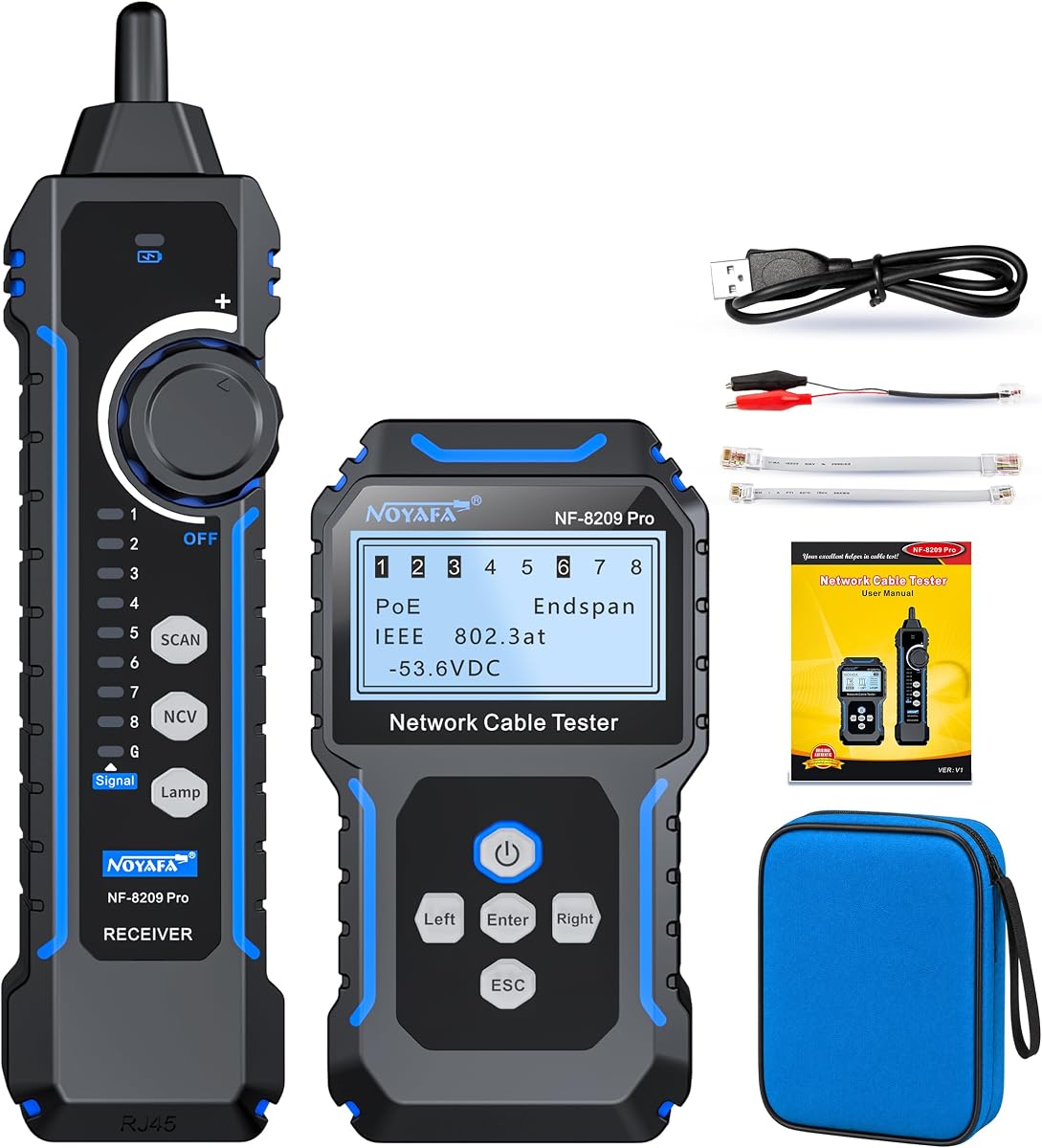
The NOYAFA NF-8209PRO is a seven-in-one network cable tester with a 4.8 customer rating, the highest listed score in this guide. It combines wire tracking, cable mapping, length testing, PoE detection, port flashing, crimp testing, and non-contact voltage detection. The result is a broad troubleshooting platform for installers and network maintenance personnel.
We may earn a commission when you buy through this link, at no additional cost to you.
Digital signal technology is used to reduce false alarms and improve tracing around interference. The tester checks open, short, and cross connections on RJ45 and RJ11 CAT5 and CAT6 cables, including shielded and unshielded configurations. It identifies standard and nonstandard PoE, displays power-related information, and can measure cable length from 5 to 350 meters while locating breakpoints.
Port flashing makes it possible to match a cable to a switch port by following the associated indicator lights. The crimp-quality function checks eight-core RJ45 connector status, which can help reduce rework on suspect terminations. A rechargeable polymer lithium battery, Type-C charging, automatic shutdown, low-battery reminder, and flashlight make the unit suitable for field use away from a convenient outlet.
The main drawback is complexity. Users must understand the distinctions among tracing, mapping, PoE, length, breakpoint, port-flash, crimp, and voltage functions, and the supplied information does not describe an audible tone output. It is therefore better suited to a technician who wants a multi-purpose diagnostic console than to someone seeking the simplest possible tone generator.
For demanding Ethernet maintenance, the NF-8209PRO offers an unusually complete set of capabilities. Digital anti-interference tracing, precise length and breakpoint information, port matching, and a rechargeable design support a structured troubleshooting process. Its top rating also makes it a particularly compelling choice when several diagnostic functions are needed from a single device.
Tracing, mapping, length, PoE, port flash, crimp, and NCV functions cover most common stages of network-cable diagnosis. Consolidating these tasks can streamline work at a patch rack or installation site.
The tester can report opens, shorts, and cross connections while measuring 5 to 350 meters of cable length. Breakpoint location and eight-core crimp inspection add more precise installation diagnostics.
We may earn a commission when you buy through this link, at no additional cost to you.
The NOYAFA NF-8209 is a digital cable tester with a 4.3 rating and a broad set of network-maintenance functions. It supports normal, anti-interference, and PoE tracing modes and can trace live cables up to 600 meters. That makes it a practical choice for larger installations where distance and electrical conditions may complicate conventional analog tracing.
We may earn a commission when you buy through this link, at no additional cost to you.
A remote adapter supports one-to-one continuity testing on shielded and unshielded RJ45 cables, including eight-pin network and nine-pin shielded configurations. The tester detects shorts, open circuits, miswiring, and normal connections. It also measures individual twisted pairs in CAT5 and CAT6 cable over a listed range of 2.5 to 200 meters, displaying length in meters, feet, or yards.
PoE testing covers standard and nonstandard systems from 5 to 60 volts and can identify IEEE 802.3af and 802.3at power methods, voltage, and polarity. Port flash and link tests support 10M, 100M, and 1000M connections. A non-contact voltage pen provides an extra way to detect AC wiring, while an LED light assists work in darker locations.
The kit includes a transmitter, receiver, remote adapter, cable set, tool bag, 9V battery, and Type-C cable. The transmitter uses a rechargeable battery, but the receiver relies on a 9V battery, which is worth considering for jobsites where batteries are easy to replace. It lacks a stated breakpoint-location function, unlike the NF-8209PRO.
This tester is well suited to IT staff, installers, and home-network repairers who need digital tracing, PoE evaluation, length information, and continuity testing in one package. Its live-cable range is a major differentiator. Users needing more compact breakpoint analysis may choose the PRO version, while those who only need cable sorting can consider a simpler tester.
Normal, anti-interference, and PoE modes give the user several ways to follow a cable. Digital decoding is intended to produce more reliable results when noise or bundled wiring complicates a trace.
PoE voltage and polarity information, 10M through 1000M port tests, and individual pair-length measurements extend the tool beyond basic continuity. The remote adapter supports verification at both ends of a cable.
We may earn a commission when you buy through this link, at no additional cost to you.
The NOYAFA NF-8508 is a nine-function network cable tester with a 4.2 rating. Its feature set covers continuity testing, cable scanning, port flashing, length measurement, PoE power testing, quality control, optical power measurement, visual fault location, and non-contact voltage detection. It is designed for engineering cabling, equipment maintenance, and broader network troubleshooting.
We may earn a commission when you buy through this link, at no additional cost to you.
The optical power meter measures seven standard wavelengths from 850 through 1,650 nanometers over a listed range of -70 to +10 dBm. FC, SC, and ST connectors are supported. A visual fault locator uses a 650-nanometer source to help locate fiber breakpoints, poor connections, bending, or cracking, while the supplied information notes built-in self-calibration and a Class IIIa laser output below 5 milliwatts.
For copper cabling, port flashing helps identify the correct line and port, and the display presents operating speed, duplex mode, and negotiation information. PoE testing checks mapping, polarity, and voltage for PoE network switches with stated tolerance up to 60 volts DC. Cable-length testing extends to 200 meters, and the unit also handles short circuits, open circuits, telephone lines, and BNC cables.
The 1,500mAh rechargeable lithium battery is stated to provide up to 10 hours of operation, while Type-C charging, a backlight timeout, automatic shutdown, and non-contact voltage testing add field convenience. The trade-off is complexity: the optical functions and nine-mode menu are more than a basic cable finder requires, and the 10-hour figure will depend on use and settings.
The NF-8508 is the clear choice for technicians who maintain both copper and fiber infrastructure. Rather than limiting it to Ethernet tracing, it adds optical signal measurement and visual fault location. Network installers working primarily with copper may not need those capabilities, but for mixed-service work, the broader platform can reduce the need for several separate instruments.
The unit combines Ethernet, telephone, BNC, PoE, and optical measurements in a single enclosure. Seven-wavelength optical power testing and visual fault location make it valuable for mixed copper-and-fiber installations.
Port displays can show operating speed, duplex mode, and negotiation settings. PoE checks cover mapping, polarity, and voltage, making the tester useful when troubleshooting powered network equipment.
We may earn a commission when you buy through this link, at no additional cost to you.
The TEMPO Communications 701K-G is a professional analog wire tracer with a 4.5 rating. It is intended for identifying wires in bundles, monitoring voltage passing through a circuit, checking breaks, and tracing runs through non-conductive construction such as wood or drywall. Its defining feature is a distinct warbling tone designed to remain recognizable in noisy environments.
We may earn a commission when you buy through this link, at no additional cost to you.
The probe's LED proximity indicator becomes brighter as the user approaches the correct wire pair. This visual cue can complement the audible signal and help narrow the search when background noise makes the tone difficult to judge. An LED worklight provides additional illumination behind furniture, inside racks, and in other dim working areas.
The kit includes a high-power 77HP-G tone generator, a 200EP-G tone probe amplifier, a modular plug, alligator test leads, an RJ11/45 socket adapter, and a nylon carrying case. It supports voice, data, and video wiring applications, making it broadly relevant to technicians who work across legacy and modern copper systems. The accessory-heavy package is well suited to organized field use.
It remains an analog tracer rather than a digital active-network analyzer, and the supplied information does not state a numerical trace distance. The large set of leads and adapters may also be more than a homeowner needs for a simple household project. Even so, the warbling signal, proximity LED, and worklight form a compelling combination for difficult or noisy locations.
The 701K-G is best for installers who value a dedicated professional tone generator and need to follow voice, data, or video wiring through building finishes. It is particularly useful in equipment rooms and active job environments where a steady generic tone could be difficult to distinguish. For Ethernet mapping or PoE analysis, a digital network tester is the better category match.
A distinct warbling tone helps the tracer stand out in noisy surroundings, while the proximity LED brightens as the target pair is approached. Together they provide two ways to confirm that the correct conductor has been found.
The high-power generator, amplified probe, modular plug, alligator leads, socket adapter, and carrying case provide a ready field set. The included worklight supports tracing inside racks and other dim locations.
We may earn a commission when you buy through this link, at no additional cost to you.
The Klein Tools VDV501-851 Scout Pro 3 is a cable testing starter set with a 4.7 rating. It tests terminated voice cables using RJ11 or RJ12, data cables using RJ45, and coax cables with an F-connector. Its primary strengths are broad fault detection, a long stated measurement range, and a readable backlit display.
We may earn a commission when you buy through this link, at no additional cost to you.
The tester identifies open, short, miswire, and split-pair faults. It can determine cable length up to 2,000 feet, or 610 meters, and presents cable length, wire map, cable ID, and test results on the LCD. This makes it useful for documenting the condition and length of installed cable, particularly when the task extends beyond simply finding a route.
Cable tracing is supported through a multiple-style tone generator, but the required analog probe, Cat. No. VDV500-123, is sold separately. The unit is also explicitly not designed for PoE testing, so it should not be treated as a powered-network diagnostic solution. Within its stated scope, it remains a useful cable tester for unenergized Ethernet and other terminated media.
Choose the Scout Pro 3 when your priority is identifying faults and measuring completed cable runs rather than following individual conductors in a bundle. It is also attractive as a starter package for basic voice, data, and coax verification. Users who need a complete tone-tracing kit should budget for the additional analog probe or choose a model that includes it.
The high 4.7 rating supports its appeal as a straightforward installation tester. Long measurement capability and clear fault categories make it especially valuable for contractors documenting cable work. Its missing probe and lack of PoE capability are important limitations, but they do not diminish its value as a focused tester for unenergized terminated cables.
Open, short, miswire, and split-pair faults are identified on the backlit display. Wire-map and cable-ID information provides a clear record of the cable's condition during installation or service.
The stated 2,000-foot measurement range suits larger building runs and structured cabling work. The tester covers RJ11, RJ12, RJ45, and F-connector terminated cable types for common low-voltage systems.
We may earn a commission when you buy through this link, at no additional cost to you.
The right network cable tracer depends on the media you service, the environment in which you work, and the level of diagnosis you need. Compare signal method, fault functions, connection support, and accessory requirements rather than treating every cable finder as the same type of instrument.
An analog tracer generates a recognizable signal on one conductor and detects that signal with a probe. This approach is effective for low-voltage, open-ended wiring and can work through non-conductive building finishes. A digital tester instead encodes and decodes signals, which can improve resistance to interference and allow tracing on an active network. Choose analog for conventional wire identification when a dedicated tone and probe workflow is preferred; choose digital when electrical noise, powered networks, or automatic fault detection are central concerns.
Digital tracing is generally more selective in complex environments, while analog tools can provide a straightforward audible signal. Consider the cable population and whether you trace individual pairs or simply match a complete route. In short, prioritize the method that matches your actual working conditions rather than assuming digital is always superior.
Look for the connectors and media your jobs actually involve. RJ45 is essential for common Ethernet, while RJ11 and RJ12 cover telephone-oriented connections. Coax support may require an F-connector, and installers maintaining both copper and fiber may need a model with optical power measurement and visual fault location. Some multi-function testers also cover phone and BNC lines.
Checking connector support before purchase prevents an otherwise capable tool from becoming frustrating at the job site. A tracer that supports more media can be useful for broad maintenance, but unnecessary functions can add complexity. Match the tool directly to the cable inventory and service plan, then confirm whether the relevant connectors are included or require separate accessories.
Signal range is important when following runs through large buildings, across floors, or between distant rooms. The VDV500-820 states a capability beyond 1,000 feet, the NOYAFA NF-8209 lists live tracing up to 600 meters, and the Klein Scout Pro 3 measures cable length up to 2,000 feet. These figures describe different capabilities, so they should not be treated as directly equivalent.
For a tracer, evaluate how far the tool must follow a signal. For a cable tester, evaluate measurement range and breakpoint support. Longer reach reduces the need to reposition equipment, but signal clarity and interference resistance may matter more in a noisy bundle. Choose the stated range that comfortably covers your typical installation.
Cable location and cable diagnosis are different tasks. A useful tester may report opens, shorts, miswires, split pairs, wrong wire sequence, or poor crimping. Pin-to-pin mapping and shield detection can confirm whether a terminated installation matches the intended configuration. A tracer with LEDs, a display, or dedicated fault indicators is more informative than one that only confirms that a tone is present.
Decide whether your work is mostly discovery or validation. Installers commissioning new runs need continuity, wire order, length, and possibly crimp inspection. Maintenance staff often also need port matching, PoE information, and break location. Choose the set of tests you will repeatedly perform, while avoiding a display packed with functions you will never use.
Power over Ethernet adds another layer to network-cable testing. A capable unit can identify standard and nonstandard PoE, display voltage and polarity, and report the pairs carrying power. The FNIRSI LPM-10A also verifies common network speeds, while the NOYAFA models add port flash, link testing, or more detailed PoE information. These features are valuable when working with powered cameras, access points, and switches.
Do not confuse PoE support with general safety around energized wiring. Some testers also include non-contact voltage detection, which provides awareness of live AC conductors but does not make a cable tracer a substitute for appropriate electrical procedures. The Klein Scout Pro 3 is explicitly not designed for PoE testing. If your duties regularly involve powered Ethernet, choose a model whose listed specifications include PoE.
The signal must remain recognizable among bundled wires, powered equipment, and ambient noise. The TEMPO 701K-G uses a distinct warbling tone, the Klein VDV500-820 provides five tone cadences, and the VDV500-920 includes a 60Hz filter. Digital systems such as the NOYAFA models emphasize decoding and anti-interference modes. Each approach addresses signal recognition differently.
Consider both the audible and visual experience of the tool. An LED that grows brighter near the target can supplement a weak or masked sound, while adjustable volume and headphone output can improve monitoring. In difficult environments, a combination of selective signal design, visual proximity feedback, and filters or decoding is often more valuable than a single headline range number.
Field usability depends on how easily you can read and operate the tool. A backlit LCD is useful for detailed wire maps, lengths, port information, and fault results. Smaller LED indicators are sufficient for simple continuity or sequence feedback. Work lights are valuable near racks, furniture, wall cavities, and other low-light areas, while adjustable volume helps users adapt an analog signal to different noise levels.
The best interface is the one that reduces interpretation time. Digital displays suit users who need exact values or fault categories, while LEDs and simple tones can be faster for basic tasks. Consider whether the controls can be understood in the dark and whether the probe provides visual as well as audible confirmation. Ease of use is not merely a convenience when time on a job site is limited.
Check the power system before relying on a tool for a full day. Rechargeable batteries, USB-C charging, low-battery warnings, and automatic shutdown can simplify field use. Other tools use replaceable AAA or 9V batteries, which are convenient when replacements are readily available. Portability also depends on size, weight, detachable parts, and whether a storage case or pouch is included.
Accessories can determine whether the tool is ready for the task. Alligator clips are useful for unterminated conductors, RJ test cables help with terminated connections, remote adapters support two-ended testing, and modular adapters expand supported media. Some packages require an analog probe to be purchased separately. Review the contents carefully so you know what is included before the job begins.
Before tracing, identify the cable or conductor as far as possible and disconnect power when the tool is intended for unenergized or low-voltage wiring. Inspect the generator, probe, leads, clips, connectors, and battery compartments for damage. Familiarize yourself with the selected mode, connect the transmitter to the target conductor using the appropriate clip or modular plug, and make a secure reference connection as directed by the manual.
Begin at the far end of the run and move the receiver or probe slowly along accessible cable paths, watching the display or listening for the signal. If using an analog tracer, separate nearby conductors when possible and maintain the recommended grounding for the clearest result. For a digital model, choose the appropriate normal, anti-interference, PoE, port-flash, or mapping mode and allow the receiver to decode the transmitted signal before moving.
After locating the route, confirm it with continuity, wire-map, polarity, length, or fault functions as appropriate. Disconnect the tester before changing cable terminations or working directly on conductors. Keep ports free of debris, recharge batteries according to the manufacturer's instructions, replace disposable batteries promptly, and store the kit in its case or a dry, organized location with cables loosely coiled.
It depends on the tracer and the construction. Products such as the TEMPO 701K-G and Klein VDV500-820 state that they can trace through non-conductive materials such as wood or drywall, but they cannot trace through solid barriers. The exact result also depends on how the cable is installed, how much signal remains, and whether other cables create interference.
A wire tracer helps identify the path of a cable or individual conductor, usually by sending and detecting a signal. A cable tester checks conditions such as continuity, opens, shorts, miswiring, wire order, length, or crimp quality. Many tools combine both functions, while specialized fiber testers add optical power measurement and visual fault location.
Only choose a model that explicitly supports active-network tracing. The Klein VDV500-920 has a digital mode for locating cables on an active network, and the digital NOYAFA models support live-cable tracing. Analog kits are generally designed around low-voltage, open-ended wiring and should not be assumed to work reliably on powered systems.
PoE testing matters when your installation includes powered devices such as PoE cameras, access points, or switches. It can identify available power, voltage, polarity, and the pairs used. For basic Ethernet routing in a home without PoE equipment, continuity, wire mapping, and route identification may be sufficient.
Choose a tracer with a selective digital mode, a distinctive tone, proximity feedback, or an interference filter. Separate conductors when possible and use the recommended grounding method for analog tracing. Start near the transmitter, learn the expected signal, and move slowly so you do not mistake a neighboring cable for the target.
Check the connection first and make sure the correct mode and cable type are selected. Recharge or replace the batteries, clean the connectors, and improve the transmitter's attachment to the conductor. If the cable is near strong electrical interference, try an anti-interference mode or filter and repeat the test from a different reference point.
A remote unit makes it easier to test both ends of a long cable or reach a wall-mounted port while the main unit remains at the opposite end. The TESMEN TLP-528C and NOYAFA NF-8209 both include detachable or remote testing components. For short bench-level projects, the added flexibility may be less important.
A copper-focused tester generally cannot provide meaningful optical power measurements. The NOYAFA NF-8508 is the exception in this list because it includes an optical power meter, seven wavelength measurements, and a visual fault locator. Confirm connector types and supported wavelengths before using it on a specific fiber installation.
The Klein Tools VDV500-920 is the most versatile overall choice because it combines digital active-network tracing, analog pair isolation, noise filtering, continuity, polarity, and wire mapping. The Klein VDV500-820 stands out for long-range analog tracing, multiple tone cadences, and secure conductor attachment, while the TESMEN TLP-528C offers an approachable, compact option for basic Ethernet and telephone maintenance.
For deeper Ethernet diagnostics, the NOYAFA NF-8209PRO provides seven functions, breakpoint testing, PoE information, and a rechargeable design. The FNIRSI LPM-10A is especially useful when network speed and PoE checks matter, while the NOYAFA NF-8508 is ideal for technicians who maintain both copper and fiber. Choose the functions your work requires rather than paying for capabilities you will not use.
Always compare the current listing before buying, because included probes, cables, batteries, adapters, and supported functions can change. Verify connector compatibility, power requirements, and safety limits, and select a trace range and signal method that match your installation environment. Current product details and pricing should be confirmed at the time of purchase.