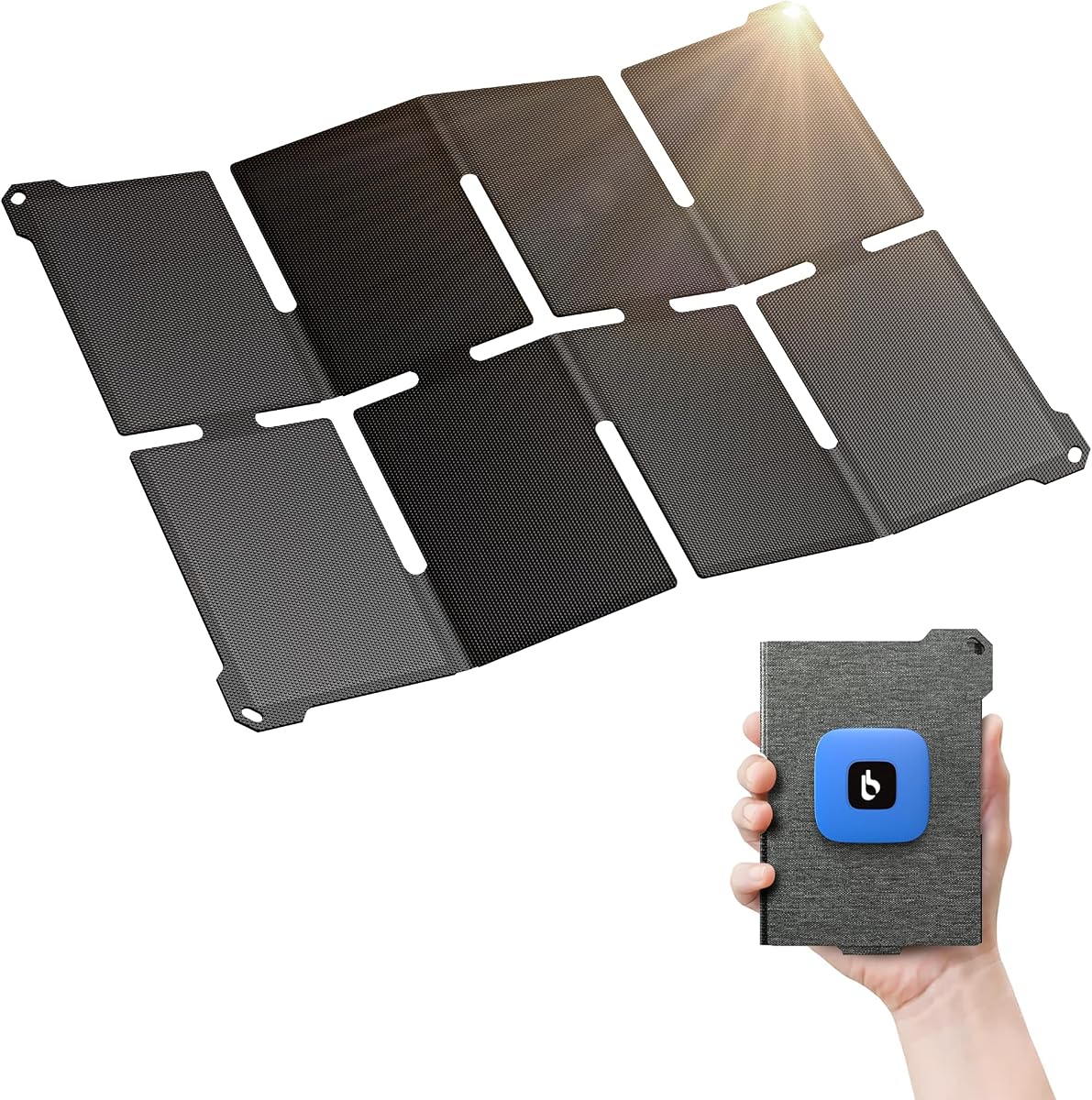
SOLUPUP 30W Portable Foldable Solar Charger
4.4Editor score
30W rated solar output
23% conversion efficiency
USB-A and USB-C outputs
Discover the best foldable solar panels for backpacking, compared for output, portability, charging ports, weather resistance, and real-world outdoor usefulness
Foldable solar panels for backpacking can keep phones, navigation devices, cameras, and small electronics supplied during long trips away from fixed power. A useful panel balances usable solar output with low packed weight, quick deployment, sturdy construction, and charging options that suit the devices you carry.
We compared ten genuine portable solar chargers on rated output, conversion efficiency, folded dimensions, carrying weight, port configuration, weather resistance, and setup features. The list covers options for ultralight hikers, campers, travelers, and backpackers who need to support multiple USB-powered devices.
Each pick highlights a different balance of portability, charging capability, and outdoor durability, while the buying guide explains the practical details that matter after the specification sheet ends. Product ratings and availability can change, and current prices should always be checked before purchasing.
4.4Editor score

4.4Editor score

4.3Editor score
The comparison below puts every panel side by side, emphasizing rated output, packed weight, charging interfaces, and outdoor construction so backpackers can identify the most suitable balance for their route and devices.


The FlexSolar 40W is the most versatile option in this guide, combining a 40-watt rating with a relatively low listed weight of 1.76 pounds. It carries a 4.4 rating and stands out because it does more than offer standard USB charging. Its three-output arrangement includes USB-C, USB-A, and a 19-volt DC connection, allowing it to serve phones, tablets, power banks, and compatible small power stations.
We may earn a commission when you buy through this link, at no additional cost to you.
The panel uses monocrystalline cells advertised at a 24 percent conversion rate, while its smart charging system is designed to identify connected devices and optimize output. Individual USB ports are rated for up to 18 watts, and the product information recommends prioritizing a single port for peak efficiency. The DC output can reach 40 watts, making this one of the more attractive choices for campers who want flexibility beyond basic USB charging.
Portability remains a major strength. The folded dimensions are listed as 8.0 by 11.1 by 1.8 inches, and the included carabiners make it easy to attach to a pack or tent. The panel has IP67 dust and water resistance with an ETFE laminate surface, but the junction box should be protected during heavy rain. It also has no internal energy storage, so its output falls sharply when shaded or when sunlight becomes weak.
This is the strongest general recommendation for backpackers who want one panel to cover several charging situations without accepting the largest possible packed weight. It may not be the first choice for someone seeking the smallest possible format or the greatest USB-C charging speed, but its combination of output, port variety, and portability is unusually well rounded. Pair it with a small power bank for steadier energy during cloudy periods.
The USB-C, USB-A, and DC ports make this panel more adaptable than many similarly sized alternatives. The USB outputs handle common phones, tablets, cameras, and power banks, while the 19-volt DC socket can directly power compatible small stations.
At 1.76 pounds, the panel remains practical for multi-day hiking and camping, particularly when compared with larger high-output designs. The compact fold and included carabiners simplify both packing and external attachment during breaks.
We may earn a commission when you buy through this link, at no additional cost to you.
The SOLUPUP 30W is a straightforward, value-focused charging panel for backpackers who need dependable USB output without a complicated device ecosystem. It has a 4.4 rating, a 30-watt maximum output, and a pair of familiar interfaces: one USB-A port and one USB-C port. Its combined output is listed at 5 volts and up to 3 amps, allowing it to charge two compatible devices at once under strong sunlight.
We may earn a commission when you buy through this link, at no additional cost to you.
Its monocrystalline construction is advertised at more than 23 percent conversion efficiency, helping it extract useful power from available sunlight. A built-in smart chip handles device recognition and charging safety, with protection against overcurrent, overvoltage, and short circuits. The automatic optimization function reconnects the system when sunlight returns after an interruption, a useful behavior when a cloud passes or a panel is repositioned.
The panel weighs 2.4 pounds, which is not the lightest option here, but the folded length of 10.63 inches keeps it manageable in a larger backpack. Included carabiners allow attachment to a pack, while an adjustable stand provides stability at camp. Its IPX5 rating supports resistance to rain and dust, though it is not as fully sealed as the strongest IP68 alternatives. There is no energy storage and no DC output.
Choose the SOLUPUP when charging phones, tablets, and power banks is the priority and a conventional 30-watt panel is sufficient. It is less appropriate for powering compatible portable stations or for hikers who assign a premium to every ounce. For most weekend campers, however, it offers a clear and approachable combination of output, protection, and setup accessories.
The intelligent chip and automatic reconnection function make the panel convenient in changing conditions. They are designed to restore useful operation when clouds pass rather than requiring the user to unplug and reconnect every device.
An adjustable stand and two included carabiners cover the most common positioning needs. The panel can sit at camp, hang from a tent, or remain clipped to a pack until a suitable stopping point is reached.
We may earn a commission when you buy through this link, at no additional cost to you.
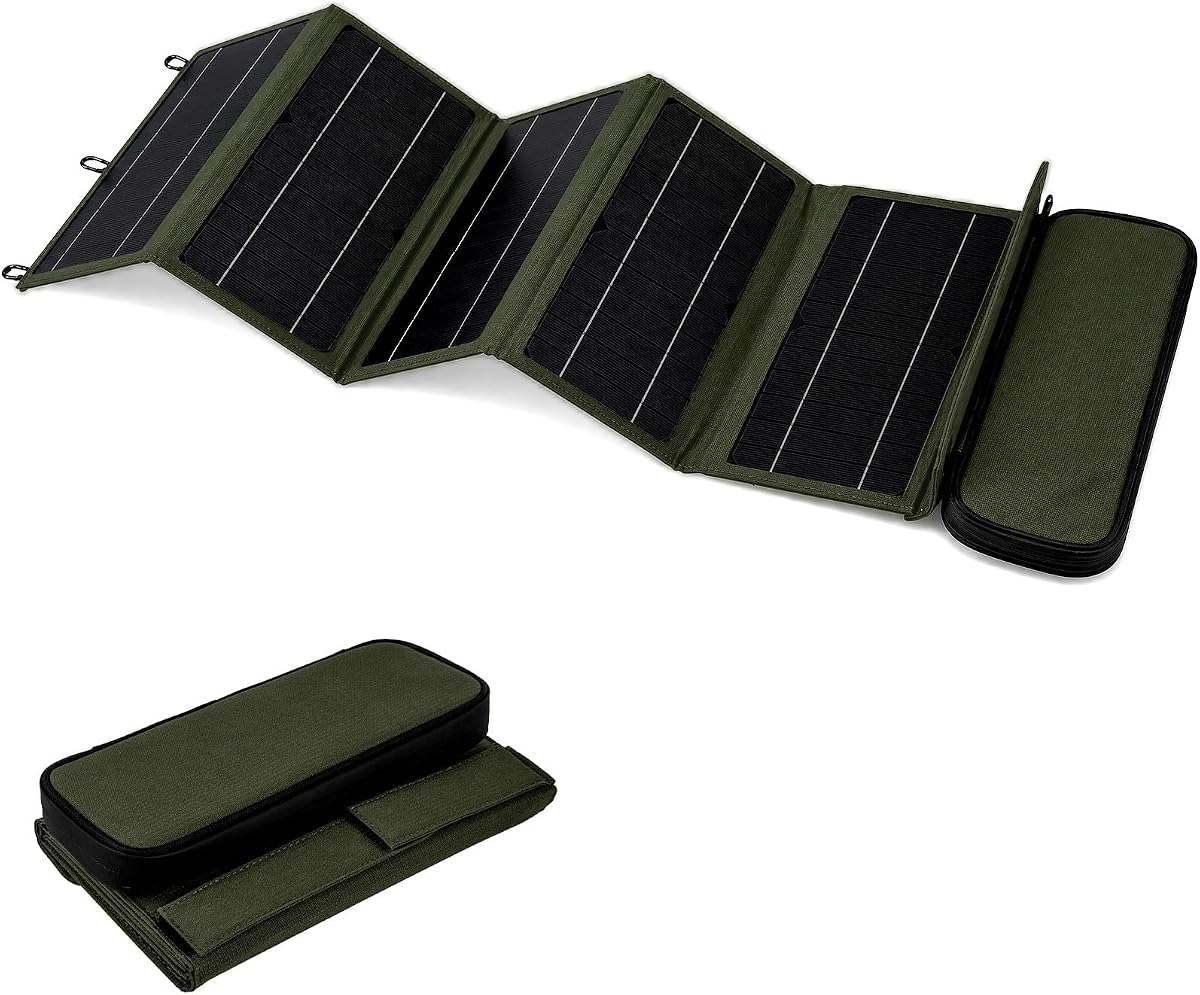
This five-panel 30-watt solar charger has a 4.8 rating, the highest customer rating among the products compared. It uses a folding multi-panel layout intended to collect sunlight across a broader surface when opened. The stated conversion efficiency of 25 percent is also among the strongest figures in this guide, although real output still depends heavily on available sunlight.
We may earn a commission when you buy through this link, at no additional cost to you.
The charging interface consists of one USB-A and one USB-C port, with up to 5 volts and 6 amps in total. The listed allocation allows 5 volts and 3 amps per port, and a USB-A-to-USB-C cable is included. This is enough for phones, GPS units, cameras, camping lights, and other USB-powered electronics, making the panel most relevant to backpackers carrying several small devices.
Its physical design emphasizes outdoor handling. The surface uses nylon fabric with wear-resistant construction, while integrated hanging loops, folding straps, and adjustable kickstands help position the panel. Those details support use on uneven ground and allow the panel to be raised toward the sun. The product information does not provide a precise folded size, listed weight, or numerical water-resistance rating, so buyers should confirm those details against their own packing limits.
The panel is best for users who value high stated efficiency and want a broad collector rather than the smallest possible package. Its 4.8 rating suggests strong customer satisfaction, but ratings alone do not establish field performance. The absence of built-in storage means it should be treated as a direct solar charger, ideally used with a power bank when uninterrupted charging is needed.
The five-panel format gives the unit a larger collection area than many compact three-panel designs. When fully opened, that geometry can help collect direct sunlight across multiple faces while the kickstands establish a stable angle.
USB-A and USB-C outputs cover most common travel electronics. The panel's 30-watt rating and 25-percent efficiency figure make it a sensible middle ground for a camper who regularly recharges a phone and power bank.
We may earn a commission when you buy through this link, at no additional cost to you.
The BigBlue SolarPowa 20 is a compact 21-watt panel aimed at backpackers who want low weight and fewer charging distractions. It has a 4.3 rating, weighs a listed 1.32 pounds, and folds down to approximately the size of a book. Included hooks make it possible to attach the panel to a backpack or tent while still walking.
We may earn a commission when you buy through this link, at no additional cost to you.
The two USB ports are each rated up to 5 volts and 3 amps, with a combined maximum of 5 volts and 4.2 amps. That is enough to handle phones, tablets, GPS devices, and power banks when all of the panel's solar sections receive adequate sunlight. An intelligent charging chip provides overcurrent and short-circuit protection, while the monocrystalline cells are listed at up to 24.7 percent conversion efficiency.
Durability is another area of strength. A PVDF surface is described as highly resistant to environmental wear, corrosion, and fire, and the panel carries an IP68 rating for dust and water resistance. As with many folding panels, the USB junction box itself is not waterproof, so rain cover or shelter remains necessary during severe conditions. The panel has no battery and cannot store energy for later use.
This model makes sense for solo hikers who mainly need emergency or top-up charging for a phone, navigation unit, and small power bank. Its 21-watt rating is lower than the leading options, and two devices connected simultaneously will not receive their full potential charging rates. In exchange, it delivers one of the strongest portability-and-weather combinations in the guide.
A listed weight of 1.32 pounds and a book-like fold make this panel easy to integrate into a smaller pack. The included hooks support moving use, although the small panels should still be oriented toward direct sunlight.
The IP68 rating and PVDF surface are useful for campers exposed to dust, splashes, and rain. The non-waterproof junction box remains the critical caveat, and the electronics should be shielded during heavy precipitation.
We may earn a commission when you buy through this link, at no additional cost to you.
The FlexSolar 25W is a small, dual-port option with a 4.4 rating and a listed weight of just 1.2 pounds. It folds to 7.7 by 5.1 inches, making it one of the more compact products in the guide. An integrated carabiner system and reinforced elastic strap give backpackers convenient ways to carry and secure it.
We may earn a commission when you buy through this link, at no additional cost to you.
USB-A and USB-C outputs can charge two devices simultaneously at 5 volts and 3 amps. The panel includes MPPT technology intended to improve energy collection in partial shade, along with intelligent power management that adjusts output to reduce overcharging. Its monocrystalline array is listed at 23.2 percent conversion efficiency, placing it near the middle of this group.
The construction uses a scratch-resistant E-film surface, UV-stabilized EVA encapsulation, and an impact-absorbing polymer baseplate. The product information states that the design has been tested for more than 2,000 folding cycles and uses hidden busbars to reduce micro-crack failures. Components carry IP67 protection, and the stated operating range is from minus 4 degrees Fahrenheit to 149 degrees Fahrenheit.
This panel is a good match for backpackers who carry a phone, camera, and small power bank but do not need a laptop or portable-station connection. Its compact package is more compelling than its 25-watt rating for some hikers. The lack of a DC socket narrows its versatility, while the absence of storage means users still need a battery bank for charging after sunset.
MPPT optimization and a 23.2-percent efficiency figure make this more than a basic trickle charger. It remains best suited to phones and small accessories, with the strongest results obtained in unobstructed sunlight.
The small folded footprint and low listed weight reduce bulk in a pack. Built-in carabiner points and an elastic strap also simplify attachment to a pack, tent, or other gear without requiring a separate pouch.
We may earn a commission when you buy through this link, at no additional cost to you.
The BigBlue 35W combines a 35-watt panel rating with unusually advanced USB output specifications, earning a 4.4 rating. It is especially relevant to backpackers carrying modern phones, tablets, cameras, GPS devices, and power banks that benefit from USB Power Delivery. The folded size is listed as 8.29 by 4.84 by 1.89 inches, and the weight is 1.54 pounds.
We may earn a commission when you buy through this link, at no additional cost to you.
Two Type-C ports and one USB-A port provide three connection options. The first Type-C port supports PD up to 25 watts with PPS, while the USB-A port supports QC up to 18 watts. The manufacturer notes that Type-C port 1 does not support Apple devices. PPS can adjust voltage and current to limit heat, making this a sensible choice for compatible Android and other USB-C equipment.
The panel uses monocrystalline cells with a listed conversion efficiency of 25.4 percent. Its dual-string parallel circuit design is intended to preserve charging if one section is shaded, which is valuable when a backpack, tent wall, or foliage blocks part of the surface. The panel is IP68 rated, although the USB junction box should remain dry. As with other direct solar chargers, it does not store power.
Choose the BigBlue 35W when fast USB-C charging is the priority and your device is compatible with the supported protocols. Its three ports and shade tolerance offer flexibility, but the Apple-device limitation on one Type-C connection should be checked before buying. The panel also cannot replace a laptop solar charger or a power station merely because its 35-watt label is relatively high.
PD 25W with PPS is a meaningful advantage for compatible modern devices. The programmable output can adjust to the device's accepted level, helping maintain a faster and potentially cooler charging session.
The dual-parallel circuit arrangement is designed to keep one section operating when another is shaded. This is more useful in real outdoor conditions than treating every part of the panel as a single uninterrupted surface.
We may earn a commission when you buy through this link, at no additional cost to you.
The BigBlue 28W offers a balanced combination of three USB ports, a 28-watt rating, and a relatively low listed weight of 1.5 pounds. It holds a 4.3 rating and folds to 11 by 6 by 1.4 inches. That footprint is larger than some pocket-oriented alternatives, but the panel remains practical for a standard camping pack.
We may earn a commission when you buy through this link, at no additional cost to you.
It includes two USB-C connections and one USB-A port. Each output is listed at up to 5 volts and 3 amps, with a combined maximum of 5 volts and 4.8 amps. This allows simultaneous charging of several small devices. A solid blue indicator confirms proper charging, which is helpful when a user cannot easily see whether the panel has received adequate sunlight.
The panel is described as using N-type cells with no metal lines on the front. Those features are intended to improve low-light efficiency, reduce front-surface heat, and support a 25.4-percent conversion rate. The polymer surface resists rain, fog, and wear, but the IP44 rating is lower than the IP67 and IP68 options in the guide. The junction box is also not waterproof.
This model is well suited to campers who want multiple modern ports and a panel capable of charging a small collection of electronics. It can serve phones, tablets, GPS units, flashlights, and power banks, but its output is not sufficient for laptops or large power stations. Users should also keep connected devices shaded to reduce thermal protection and charging interruptions.
Two USB-C ports and one USB-A port make it easy to leave several travel devices connected. The combined output allows useful charging for a small group, provided sunlight is strong and the devices share the available power.
N-type cells and the absence of front-side metal lines are intended to improve collection and reduce heat. These characteristics are particularly relevant during variable weather, although cloudy conditions can still sharply reduce the total output.
We may earn a commission when you buy through this link, at no additional cost to you.
The BigBlue Ultra-Light 25W is the lightest listed option, weighing just 0.84 pounds. It has a 4.3 rating and folds to 4.65 by 6.42 by 1.38 inches, roughly the footprint of a small tablet. That makes it especially attractive for fast hikers, minimalists, and travelers who prioritize every available gram.
We may earn a commission when you buy through this link, at no additional cost to you.
USB-A and USB-C ports can charge two compatible devices simultaneously. The USB-A output is listed at 5 volts and 2.4 amps, while USB-C supports 5 volts and 3 amps. A smart charging system optimizes power delivery. Although the solar panel itself is rated at 25 watts, the maximum listed USB-C output is only 15 watts, so users should not equate the panel rating with the speed delivered to a connected device.
N-type cells without front-side metal lines are used to capture more light and operate more coolly, with a stated conversion efficiency of up to 25.4 percent. ETFE coating, UV-resistant EVA, and a solid baseplate are intended to protect the cells and reduce hidden cracking. The panel carries an IP68 rating for dust and water resistance, making it among the strongest weather-sealed choices listed.
This is the best option in the guide for a backpacker who wants a credible 25-watt panel without carrying much extra weight. It is well suited to a phone, power bank, camping light, and similar small devices. Those needing faster laptop-class USB-C charging, a DC output, or more total power for multiple devices should consider a larger alternative.
At 0.84 pounds, the panel has the lowest listed weight in this comparison. Its small fold makes it easy to place beside a lightweight sleeping bag or emergency kit without creating a bulky pack obstruction.
USB-A and USB-C support cover the most frequently carried accessories. Smart output management and efficient N-type cells make the modest format more useful than a simple trickle charger for backpackers.
We may earn a commission when you buy through this link, at no additional cost to you.
The LUMOPAL 60W is the highest-output panel in the guide and the strongest choice for campers whose gear includes a compatible laptop or portable power station. It has a 4.3 rating and provides two USB-A ports, one PD USB-C port, and an 18-to-20-volt DC output with a 5.5-by-2.1-millimeter connector. The USB-C output can reach 60 watts, while the USB-A connection supports QC 3.0 up to 22 watts.
We may earn a commission when you buy through this link, at no additional cost to you.
Its monocrystalline cells are listed at 23.5-percent efficiency. The panel is also described as compression resistant to 176 pounds, a useful characteristic for luggage and tightly packed camping equipment. An intelligent chip identifies connected devices and provides overcurrent, overheating, and short-circuit protection. The broad port selection allows direct charging of Android and Apple phones, tablets, cameras, compatible laptops, portable stations, and other electronics.
The ETFE laminate surface resists abrasion and corrosion better than basic PET construction, and the product carries an IP65 rating. The nylon fabric and waterproof zipper add further protection, but the junction ports are explicitly not waterproof. The panel weighs 3.42 pounds and folds to 6.7 by 9.5 inches, so it is best for vehicle-supported camping, base camps, or backpackers willing to carry the extra weight.
The LUMOPAL earns the premium recommendation because its 60-watt USB-C and DC options reach beyond ordinary phone-charging panels. It still does not store electricity, and actual output remains dependent on sunlight and device compatibility. Campers who need a smaller emergency panel for a phone alone will likely gain little from its additional capability.
A 60-watt PD USB-C output can serve compatible laptops and more demanding USB-C devices. The 18-to-20-volt DC socket broadens the options further for compatible portable stations and other higher-voltage equipment.
The 176-pound compression-resistance claim and ETFE laminate are reassuring for travel gear. At 3.42 pounds, however, the panel is a substantial load, so hikers should compare its extra capability with their actual device needs.
We may earn a commission when you buy through this link, at no additional cost to you.
The ELECOM NESTOUT 28W has a 4.5 rating and takes a design-focused approach to portable solar charging. Its four-panel construction uses high-quality SunPower MAXEON cells, which are advertised to provide up to a 24-percent efficiency increase compared with traditional cells. The result is a 28-watt panel intended for phones, tablets, Bluetooth earbuds, and other small electronics.
We may earn a commission when you buy through this link, at no additional cost to you.
Two USB-A ports provide the charging connections, and an LED current display indicates the power being generated into those ports. While this is less versatile than the USB-C-heavy options elsewhere in the guide, it remains appropriate for backpackers whose essential electronics use standard USB-A cables. The panel should not be expected to offer modern laptop charging performance.
Two built-in adjustable stands help optimize the angle toward the sun. The ripstop nylon carrier is water-resistant for daily use, and three exterior loops allow the panel to hang from trees, tents, or cables. Two mesh storage pockets in the bag provide space for small items and cables, reducing the need for separate organization during a trip.
This model is best for users who value thoughtful organization, attractive design, and uncomplicated USB-A charging. The NESTOUT Outdoor Series also received an IF Design Gold Award, reflecting its emphasis on coherent product design. It is not the most technical choice for USB-C-heavy gear, but it provides a balanced 28-watt package for campers who mainly need to maintain everyday small devices.
The built-in mesh pockets offer a convenient home for charging cables and carabiners. This is a modest feature that can reduce loose gear in a backpack and make the panel easier to deploy at camp.
Two adjustable stands support solar positioning, while three exterior loops offer several hanging locations. Together, they make it easier to adapt the panel to changing sun angles and different campsite surfaces.
We may earn a commission when you buy through this link, at no additional cost to you.
The right backpacking solar panel depends on the devices you carry, the weight you can tolerate, and the conditions you expect. Review output, charging protocols, packed dimensions, weather construction, and field setup together rather than focusing on a single headline wattage figure.
The maximum wattage describes the panel's theoretical solar generation under its stated test conditions, not the speed at which every connected device will charge. A 30-watt panel may deliver enough energy for a phone and a power bank during a sunny break, while a 21-watt panel may be better suited to one small device. Higher-output models become more relevant when you need to support a tablet, compatible laptop, portable power station, or several electronics at once.
Choose enough rated output for the gear you realistically expect to recharge, but avoid carrying excess capacity solely for occasional use. A compact lower-wattage panel may be more useful than a larger one that undermines the weight savings of your entire backpacking setup.
Conversion efficiency indicates how effectively a panel converts captured sunlight into electricity. The selections in this guide range from approximately 23 percent to 25.4 percent in their published specifications, with the SOLUPUP, BigBlue 28W, BigBlue 35W, and BigBlue Ultra-Light 25W among the stronger stated performers. Efficiency is most meaningful when comparing panels of similar size and construction.
A higher number cannot overcome weak sunlight, bad positioning, or partial shading by itself. It should be treated as one factor alongside usable area, weight, temperature behavior, and the quality of the charging controller.
Backpacking solar equipment competes with shelter, sleep systems, clothing, food, and water for limited pack capacity. Listed weights range from 0.84 pounds for the BigBlue Ultra-Light 25W to 3.42 pounds for the LUMOPAL 60W. Folded dimensions are equally important because a flat but wide panel can remain awkward in a small pack.
For fast hikers, every fraction of a pound may favor one of the sub-1.5-pound models. Base-camp travelers may accept more weight in exchange for a larger collector, a DC socket, or faster USB-C charging.
USB-A remains common among power banks, older phones, lights, and small electronics, while USB-C is increasingly important for modern phones, tablets, GPS units, and compatible laptops. Some panels also provide an 18-to-20-volt DC output for compatible portable stations. The most flexible choices in this guide combine USB-A and USB-C, while the LUMOPAL adds the broadest high-voltage selection.
Fast-charging labels such as QC, PD, and PPS only matter when the connected device and cable support the same protocol. Check port-by-port limitations carefully; one of the BigBlue 35W's Type-C connections does not support Apple devices, and some older-style panels only offer USB-A.
An IP67 or IP68 panel is better prepared for dust, splashes, and rain than a lower-rated or merely water-resistant model. The BigBlue options provide several strong IP68 choices, while the FlexSolar 40W and 25W carry IP67 ratings and the SOLUPUP has IPX5 protection. A panel's rating does not necessarily cover its junction box, cables, or attached devices, and several manufacturers explicitly warn that these components are not waterproof.
Treat the numerical rating as only one layer of protection. Use a dry bag or weather cover during sustained rain, keep connection ports elevated, and allow the panel to dry before packing it away.
A foldable panel is only useful if it can be aimed toward the sun. Adjustable kickstands, built-in stands, hanging loops, carabiners, and exterior attachment points all improve usability. A stable panel positioned at the correct angle will generally deliver more useful energy than a higher-rated model placed flat or partially shaded.
The SOLUPUP, BigBlue 28W, ELECOM NESTOUT, and the five-panel option include dedicated positioning features. The FlexSolar models offer straps or carabiner attachment, while the BigBlue 35W's parallel circuit design adds some resilience to partial shade.
None of the panels in this guide includes an internal battery, so none can store sunlight for later use. They convert available sunlight into power while a device is connected. This distinction is important when planning around campsites that are shaded, nighttime charging, or periods of unsettled weather.
For dependable overnight power, use the panel to recharge a separate power bank during daylight. Keep the power bank shaded while charging, and treat direct solar charging as a top-up tool rather than an unlimited energy source.
Flexible panels repeatedly bend during packing and deployment, so surface coating, laminate quality, cell construction, and baseplate support matter. ETFE, PVDF, and specialized polymer surfaces can improve abrasion and environmental resistance compared with basic PET. The FlexSolar 25W additionally reports testing beyond 2,000 fold cycles, while the LUMOPAL describes resistance to substantial compression.
Avoid creasing the panel along the same line, keep it flat while stored, and do not place heavy gear on the active cells. A protective carry pouch and careful folding can reduce cosmetic and electrical stress over repeated trips.
Unfold the panel in direct sunlight, place it on a clean surface, and adjust the stand or hanging point so the full active surface faces the sun. Connect only one device when maximum charging speed is the goal, because the available output must be divided among connected devices. Keep phones, tablets, and power banks in the shade to prevent heat from triggering their thermal protection.
Monitor the charging indicator and reconnect the cable if output becomes unstable after substantial cloud cover or a panel adjustment. Do not expect overnight charging or stored power from a panel without an integrated battery. For more consistent availability, recharge a compatible power bank during strong daylight and use that stored energy after sunset.
Unplug devices before folding the panel, remove grit and moisture, and let the surface dry fully. Store the panel flat in its pouch or in a dry bag rather than leaving it tightly folded for long periods. Protect the junction box during heavy rain, avoid submerging the panel unless its stated rating explicitly permits it, and never place heavy objects on the solar cells.
Yes, every product in this guide includes USB charging suitable for phones when exposed to direct sunlight. Charging speed varies with solar conditions, panel orientation, device acceptance, and cable quality. A power bank is still recommended for reliable access to stored energy after sunset.
No. These are direct solar chargers rather than power stations or panels with integrated batteries. They generate usable electricity only while illuminated, so devices must remain connected to receive a charge. Carrying a separate power bank is essential for nighttime or prolonged cloudy conditions.
A small 21-watt to 30-watt panel is generally suitable for maintaining a phone, navigation device, camera, or small power bank. Larger or higher-output models become more useful for tablets, multiple devices, compatible laptops, and portable power stations. The right choice depends more on your device mix and available sunlight than on wattage alone.
Panel watts describe the maximum energy collected from sunlight, while charging watts describe the power actually delivered through a particular port. Controller limits, cable losses, sunlight, shade, and device protocols can make charging output lower than the panel rating, sometimes by a substantial margin.
Some models have strong IP67 or IP68 ratings, but junction boxes and ports are frequently not waterproof even when the active panel is well sealed. Light rain or splashes may be manageable with the right model, but sustained heavy rain calls for a protective cover or a sheltered setup.
No. The solar panel should receive direct sunlight, while the phone or other device should remain shaded. A device placed in intense sun may heat up, activate thermal protection, and charge more slowly or temporarily stop accepting power.
USB-C is more versatile for modern phones, tablets, and compatible laptops because it can support higher negotiated charging rates when the device, panel, and cable share a protocol. USB-A remains useful for power banks and older accessories, so a panel offering both is often the most broadly compatible.
Disconnect all devices, brush away dirt, and let any moisture dry before packing. Fold it according to the manufacturer's design and store it flat when possible, rather than leaving it compressed under heavy equipment. A dry bag or dedicated pouch can protect it from abrasion, dirt, and unexpected rain.
The FlexSolar 40W is the best overall choice because it combines meaningful solar output, USB-C, USB-A, and DC charging, a relatively low weight, and strong weather resistance. SOLUPUP offers the best budget-oriented balance for ordinary USB charging, while the LUMOPAL 60W is the premium option for compatible laptops, portable stations, and other more demanding devices.
Prioritize the features your route actually demands. Fast hikers should weigh the 0.84-pound BigBlue Ultra-Light 25W or other sub-1.5-pound panels; campers needing high USB-C output should examine the BigBlue 35W; and travelers carrying several devices will appreciate the FlexSolar 40W's port variety. Confirm port compatibility, folded size, weather limitations, and the need for a separate power bank before purchasing.
Customer ratings, product details, availability, and prices can change over time, so review the current listing and manufacturer information before buying. A thoughtful choice based on weight, device requirements, and realistic field conditions will provide more value than simply selecting the highest wattage figure.