
VTech Genio Bilingual JuniorBook
4.5Editor score
English and Spanish activities
More than 80 offline activities
Full-size QWERTY keyboard
Designed for ages five and up
A child’s first laptop should be approachable, engaging, and appropriately matched to their age and abilities. The most useful options balance educational activities with durable construction, manageable screens, intuitive controls, and enough parental control to keep young users in a safe digital environment.
We compared all ten products by examining their stated age guidance, learning content, display size, operating systems, connectivity, included accessories, physical design, and family-safety features. The list includes dedicated educational toys, Android mini-laptops, and a full-size Chromebook, giving parents a broad range of choices.
Each pick below highlights the product’s strongest qualities and any practical compromises based on the available specifications. Ratings and configurations can change, while prices and availability fluctuate, so shoppers should confirm the current listing and choose the model that best fits their child’s age and learning needs.
4.5Editor score
4.6Editor score

4.2Editor score
As an Amazon Associate we earn from qualifying purchases.
The comparison below places every product side by side, emphasizing age range, learning format, display, connectivity, and family controls so families can quickly distinguish simple educational toys from more capable connected computers.



The VTech Genio Bilingual JuniorBook is a dedicated first laptop for children ages five and older. It has a 4.5 rating and stands out for combining a grown-up-looking design with more than 80 preloaded activities. Rather than introducing children to an unrestricted web browser, it creates a controlled learning environment covering math, science, language arts, music, and Spanish.
We may earn a commission when you buy through this link, at no additional cost to you.
Its bilingual approach is one of the clearest advantages. Every activity can be played in English or Spanish, allowing children to explore lessons in either language and giving families a way to reinforce bilingual learning. The full-size QWERTY keyboard and separate cursor controller introduce practical computer skills, while apps such as a calendar, notebook, and music player make the experience feel more like using a real computer.
Offline operation is another meaningful benefit. No internet connection is required because the activities arrive preloaded, which makes the laptop useful for travel, waiting rooms, or households that prefer not to introduce young children to online browsing. The tradeoff is that it is a learning toy rather than a general-purpose computer, and the listed specifications do not mention modern apps, streaming, or a rechargeable battery.
This is a strong recommendation for a child around five or older who is ready to practice typing and explore structured subjects without online distractions. It may be less suitable for a child who needs web access, educational downloads, or long sessions of multimedia. Within the category of first laptops, however, its combination of usability, bilingual content, and offline learning is especially well rounded.
The ability to switch activities between English and Spanish adds meaningful value for multilingual households. Because everything is available offline, children can practice language and classroom-style subjects without encountering advertisements, inappropriate content, or open-ended web searches.
The full-size keyboard, cursor control, notebook, and calendar teach familiar computer routines in a controlled setting. This makes the JuniorBook a practical bridge between a dedicated toy and a more advanced connected device.
We may earn a commission when you buy through this link, at no additional cost to you.
The LEXiBOOK LAPTAB 10-inch is the most fully featured connected computer in this guide. It has a 4.2 rating, a 10.1-inch HD touchscreen, an octa-core processor, and 128GB of storage. These specifications position it as a capable family computer for older children who want educational apps, books, videos, and normal internet access rather than a fixed collection of toy-like activities.
We may earn a commission when you buy through this link, at no additional cost to you.
Its learning package is extensive. The Power Academy app, 300 ebooks accessible through ReadEra, and a 15-language translator create multiple routes into reading and study. Access to thousands of Google Play games and apps adds flexibility, while Google Suite, YouTube, Bluetooth 5.0, and Wi-Fi connectivity support a broader range of everyday use. The included features make it suitable for schoolwork, entertainment, and communication.
Family controls help justify the greater complexity. Customizable profiles allow children to have an experience tailored to their age, while parental controls can help manage time and applications. The Qwant Junior browser offers a more child-oriented route for web use. These features are more appropriate for a family that can establish rules and supervise online activity, rather than for a child who needs a completely sealed environment.
Parents seeking the most versatile first laptop may find the LAPTAB especially compelling. It is less focused and less immediately simple than a dedicated educational toy, and the learning ecosystem may require configuration. For a child ready for a genuine Android computer with parental oversight, though, its screen, app access, multilingual tools, and safety features provide the broadest foundation in this roundup.
Hundreds of included ebooks, a language translator, and the Power Academy app give the LAPTAB more depth than a basic activity laptop. The Google Play catalog also allows families to add age-appropriate educational software as the child develops.
Customizable profiles, application management, time controls, and a child-oriented browser make online use more manageable. These tools are most effective when parents establish clear routines and review the child's activity together.
We may earn a commission when you buy through this link, at no additional cost to you.
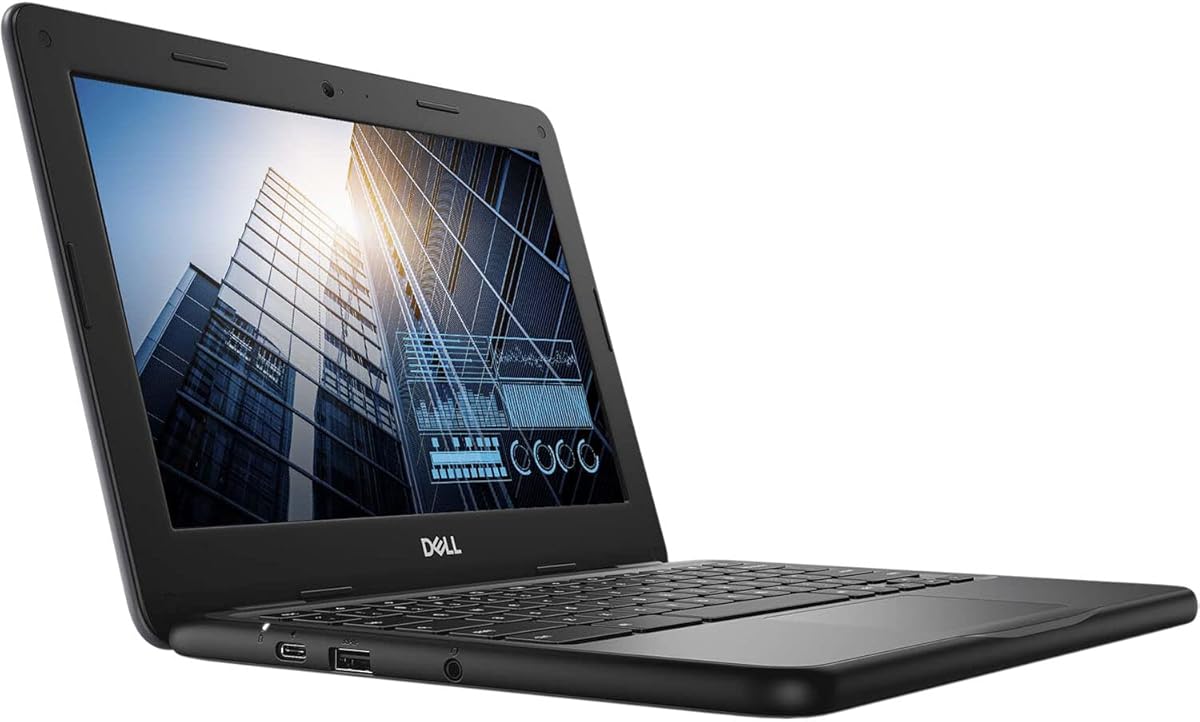
The Dell Chromebook 11 3100 is a renewed 2-in-1 Chromebook with a 4.3 rating. It provides an 11.6-inch HD touchscreen at 1366 by 768 resolution, an Intel Celeron N4020 dual-core processor, 4GB of RAM, and 32GB of flash memory. Its larger display and convertible format make it more like a compact school computer than a miniature educational toy.
We may earn a commission when you buy through this link, at no additional cost to you.
The touchscreen can support different ways of interacting, whether the child is navigating by keyboard, trackpad, or touch. Bluetooth and USB Type-C connectivity are listed, and the power adapter is included. As a Chromebook, it is better suited to browser-based productivity and online learning than the offline activity systems found on many dedicated first laptops, making it relevant for school-aged children who already have school accounts.
There are clear limitations. The renewed designation means the device's physical and cosmetic condition can vary, while 4GB of memory and 32GB of storage are modest by current computer standards. The listing does not describe detailed parental-control features, included educational software, or offline content, so families will need to evaluate the current Chromebook experience and associated account requirements themselves.
This Chromebook is best for a child who needs a larger screen and a more conventional computing environment, particularly for online assignments, web-based research, or document work. It is less ideal as a first laptop for a preschooler or a family seeking a sealed educational toy. For older beginners ready to manage an online account, it offers a useful balance of portability and familiar computer functionality.
The 11.6-inch touchscreen offers more room for web pages, documents, videos, and interactive lessons than the compact toy-style alternatives. That makes the Chromebook easier to recommend once a child's learning needs expand beyond basic games and drills.
Buying a renewed device can provide a path to a larger computer, but parents should inspect the listing, warranty information, and visible wear carefully. Cosmetic differences should be expected when purchasing a renewed model.
We may earn a commission when you buy through this link, at no additional cost to you.
The 48-Mode Educational Laptop is a compact toy-style computer for children ages five and up. It carries a 4.0 rating and centers on a 4.3-inch TFT color display, realistic keyboard, and mouse. Its defining feature is the collection of 48 learning modes spanning alphabet, mathematics, colors, animals, general knowledge, logic, music, clock reading, and calendar skills.
We may earn a commission when you buy through this link, at no additional cost to you.
The breadth of subjects gives children several ways to rotate through the device. Educational exercises come first, followed by games that test logic, memory, and speed. This structure can keep practice feeling playful without turning the product into a general-purpose computer. The slim 11-by-8-by-1.2-inch shape and laptop-inspired design should also make it appealing and easy for small hands to carry.
Compared with larger connected models, its simplicity is both an advantage and a limitation. The supplied information does not mention internet connectivity, a camera, rechargeable battery life, or account-based parental controls, so families should not assume those features are present. A protective film covers the display and must be peeled away for the clearest viewing experience, which is a minor but important setup detail.
This laptop makes sense for a child who enjoys varied, self-directed learning activities and does not need web access. It is less suitable for a parent seeking homework software, messaging, or flexible app downloads. As a colorful, approachable educational toy with a broad activity selection, it offers good utility for the intended age group.
Alphabet, math, music, time-telling, and logic activities give a child several ways to use the same device. The additional games provide a change of pace and can turn skill practice into a short challenge.
The realistic mouse, keyboard, and slim proportions create the feel of a small computer while remaining easy for young hands to manage. Its 4.3-inch display offers more visual engagement than a basic monochrome toy without becoming cumbersome to carry.
We may earn a commission when you buy through this link, at no additional cost to you.
The 10.1-inch Android Learning Laptop offers a large screen and a familiar Google-based software environment. It runs Android 12.0 on an Allwinner A133plus quad-core 64-bit processor, with 2GB of RAM and 64GB of eMMC storage. It supports Google Docs, Google Drive, and the Google Play Store, giving it more flexibility than a closed educational toy.
We may earn a commission when you buy through this link, at no additional cost to you.
The 10.1-inch IPS display has a 1280-by-800 resolution, while a built-in camera, Wi-Fi, and a range of ports make the device more like a small everyday computer. Connectivity includes two USB ports, one Type-C charging connection, and a TF card slot. The package also includes a charger, mouse, bag, and user manual, which is a generous accessory set for a compact learning device.
Its 3.4 rating is the lowest among the ten products and warrants caution. With only 2GB of memory, the laptop may feel limited when running several demanding applications. The stated battery life of five to seven hours should also be interpreted as a general estimate rather than a guarantee, and the product description does not highlight the kind of detailed parental controls found on the LEXiBOOK.
Despite those limitations, this laptop can be a practical choice for a child who wants a larger Android screen and access to standard Google tools. It is better suited to light learning and entertainment than demanding software. Families should consider its modest specifications carefully, but it delivers a broader software platform than most dedicated educational laptops in the guide.
Google Docs, Drive, and the Play Store can support writing, file storage, and age-appropriate app downloads. These capabilities make the device more adaptable as a child's interests and educational requirements develop.
Two USB ports, a Type-C charging connection, a TF card slot, Wi-Fi, and a camera give this model a practical range of connection options. The included mouse, bag, and charger further simplify everyday setup and transport.
We may earn a commission when you buy through this link, at no additional cost to you.
The 7-inch Kids Mini Laptop is designed around portability, simple setup, and familiar entertainment features. It has a 4.0 rating and runs Android 12 on a quad-core processor with 32GB of storage. Wi-Fi and a built-in camera are included, while the listing specifically calls out access to YouTube and a flash player as common uses.
We may earn a commission when you buy through this link, at no additional cost to you.
Its strongest attraction is the small footprint. The device is easier to carry than a full-size Chromebook and comes with an optical mouse, charger, and keychain light. This makes it approachable for children who are still developing comfort with computers, while Android provides a more familiar interface than a collection of isolated toy activities.
The seven-inch display is the main concern for longer sessions. Young readers may find small text more difficult to follow, and parents looking for school documents or detailed web pages may prefer a larger screen. With 32GB of storage, the laptop also has limited room for large downloaded files, although the included flash player and cloud-based services can reduce reliance on internal storage.
This model is best for a child who values a truly portable computer and primarily wants lightweight browsing, media, and simple apps. It is less suitable for detailed homework, long reading sessions, or complex creative work. Its straightforward package and compact Android design make it a functional middle ground between a toy laptop and a larger connected computer.
The seven-inch form is well suited to travel, compact play spaces, and short sessions around the home. Including a mouse and charger means the basic accessories needed to begin using the computer are already in the box.
Wi-Fi, a camera, and access to online video make this more flexible than a fully offline learning toy. Parental supervision and suitable account settings remain important because the device supports normal connected browsing.
We may earn a commission when you buy through this link, at no additional cost to you.
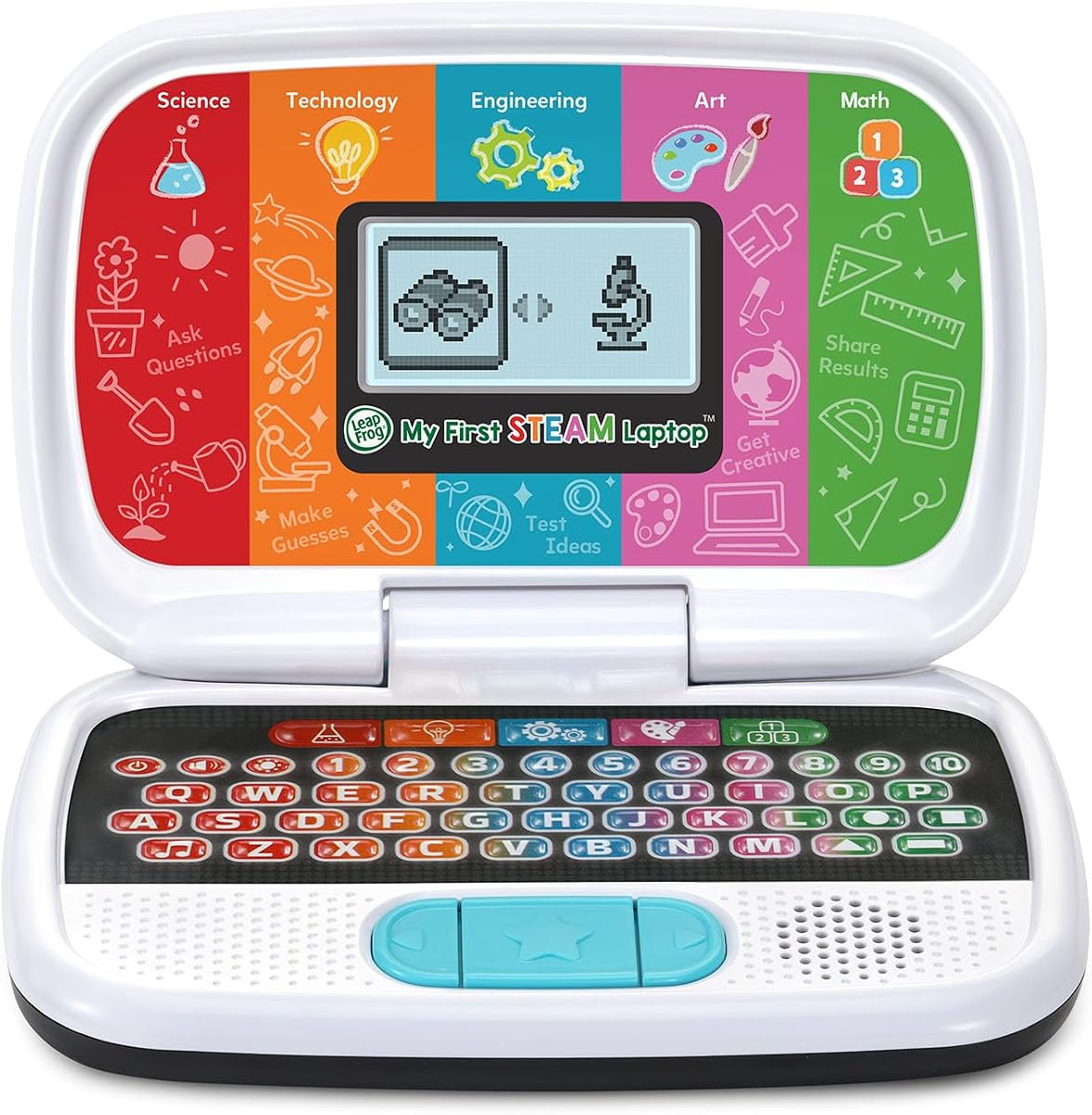
The LeapFrog My First STEAM Laptop introduces science, technology, engineering, art, and math to children ages three and up. With a 4.5 rating, it is one of the strongest choices for a preschooler or early learner. Guided by Dr. Frankensteam and STEAM-Bot, the activities focus on building curiosity through experiments, construction, and imaginative play.
We may earn a commission when you buy through this link, at no additional cost to you.
The content range is distinctive. Children can grow plants, investigate fossils, learn why sunlight matters, build robots and machines, match shapes to parts, and create animal designs. Other activities explore inventions and their uses, count dinosaur bones, and experiment with test tubes. This variety introduces scientific and engineering ideas without requiring a child to read extensive instructions independently.
Because the product is aimed at a younger age group, it is less flexible than a general-purpose computer. It needs two AA batteries, and the supplied batteries are intended for demonstration rather than regular use. The available specifications do not indicate internet connectivity, a touchscreen, a camera, or parental-control software, so it should be treated as a focused early-learning toy rather than a connected device.
For families looking for a developmentally appropriate first computer experience, this LeapFrog provides a compelling alternative to conventional lesson software. It is especially suitable for a child interested in nature, machines, art, and problem solving. Older children who need typing practice, web access, or school applications will find more capable options elsewhere in this list.
Growing plants, examining fossils, and building simple machines turn abstract ideas into visible activities. The guided format helps preschoolers connect play with early science and engineering concepts.
Animal designs and imaginative inventions balance the more technical activities. This mix is useful for children who may not yet be ready to focus exclusively on math, science, or coding.
We may earn a commission when you buy through this link, at no additional cost to you.
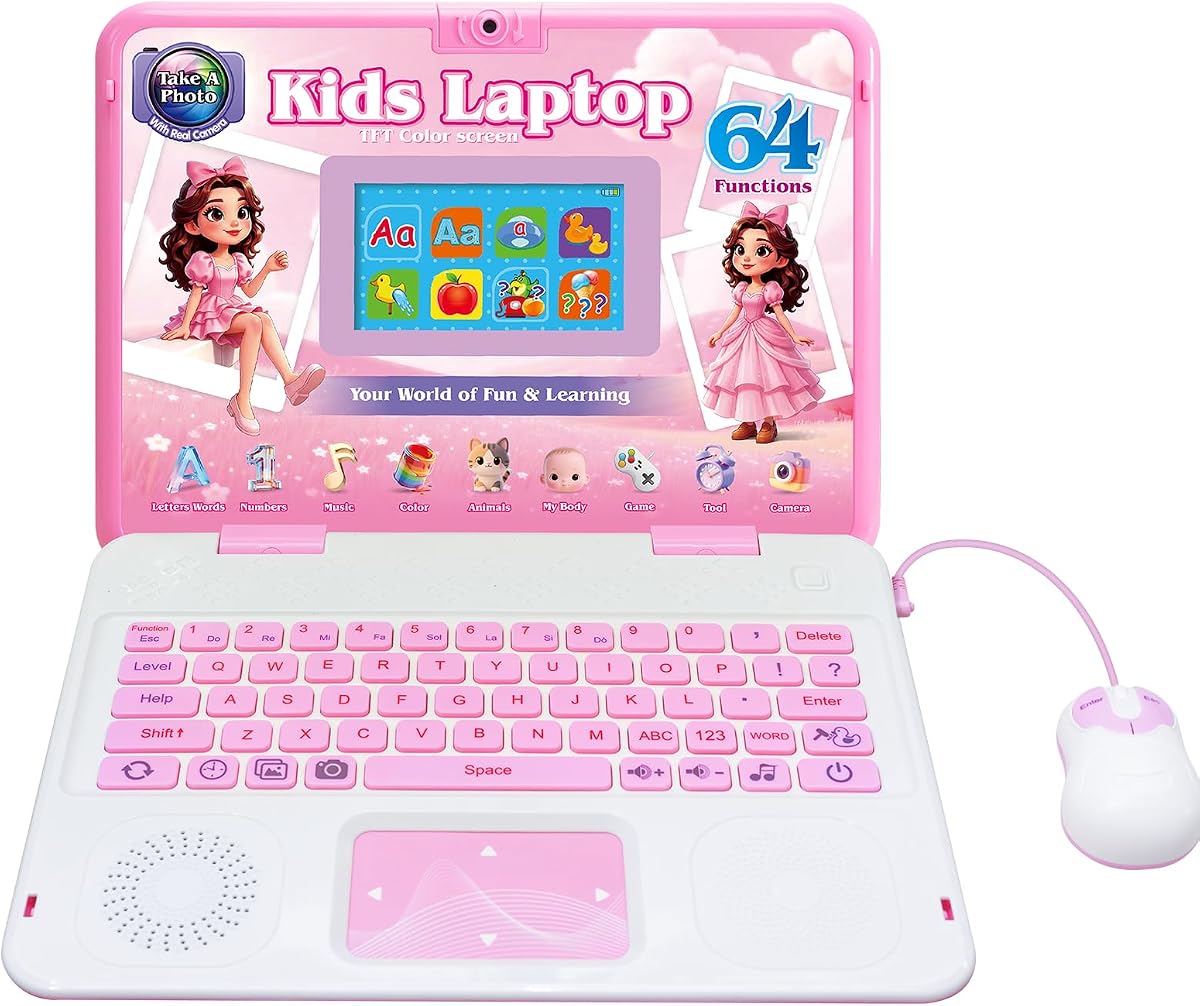
The Kids Laptop with Camera is the highest-rated product in this roundup at 4.6. Designed for ages five and up, it combines a 4.3-inch TFT color display with 64 activity modes, a built-in camera, realistic keyboard and mouse controls, and a selection of games. It offers one of the broadest combinations of education and entertainment among the dedicated learning laptops.
We may earn a commission when you buy through this link, at no additional cost to you.
Its 64 modes cover areas such as the alphabet, mathematics, colors, animals, music, and games. The camera adds a creative outlet through cute photo frames and filter effects, allowing children to make pictures for family and friends. This makes the device feel more interactive than a conventional quiz machine, especially for children who enjoy visual play and self-expression.
The product's specifications do not clearly identify internet connectivity, account support, rechargeable battery life, or detailed parental controls. Families should therefore treat it as a closed educational toy unless current listing information confirms additional functions. The compact design is easy to grip, and the screen size strikes a balance between portability and comfortable viewing, although it is smaller than the Android laptops and Chromebook in the guide.
This is our leading pick for a child around five or older who wants variety in a simple device. The camera gives it a distinctive creative element, the large activity library reduces the chance of rapid boredom, and the games provide a change of pace after lessons. It is a particularly good choice when parents prefer focused educational entertainment over an open internet-enabled computer.
The camera, decorative frames, and filters let children create playful images in addition to completing learning activities. That creative component can make the device feel more rewarding and personal than a basic keyboard-based toy.
With 64 learning modes across familiar subjects, the activity library offers considerable variety for the target age. Games focused on skill practice or entertainment can then vary the experience between sessions.
We may earn a commission when you buy through this link, at no additional cost to you.
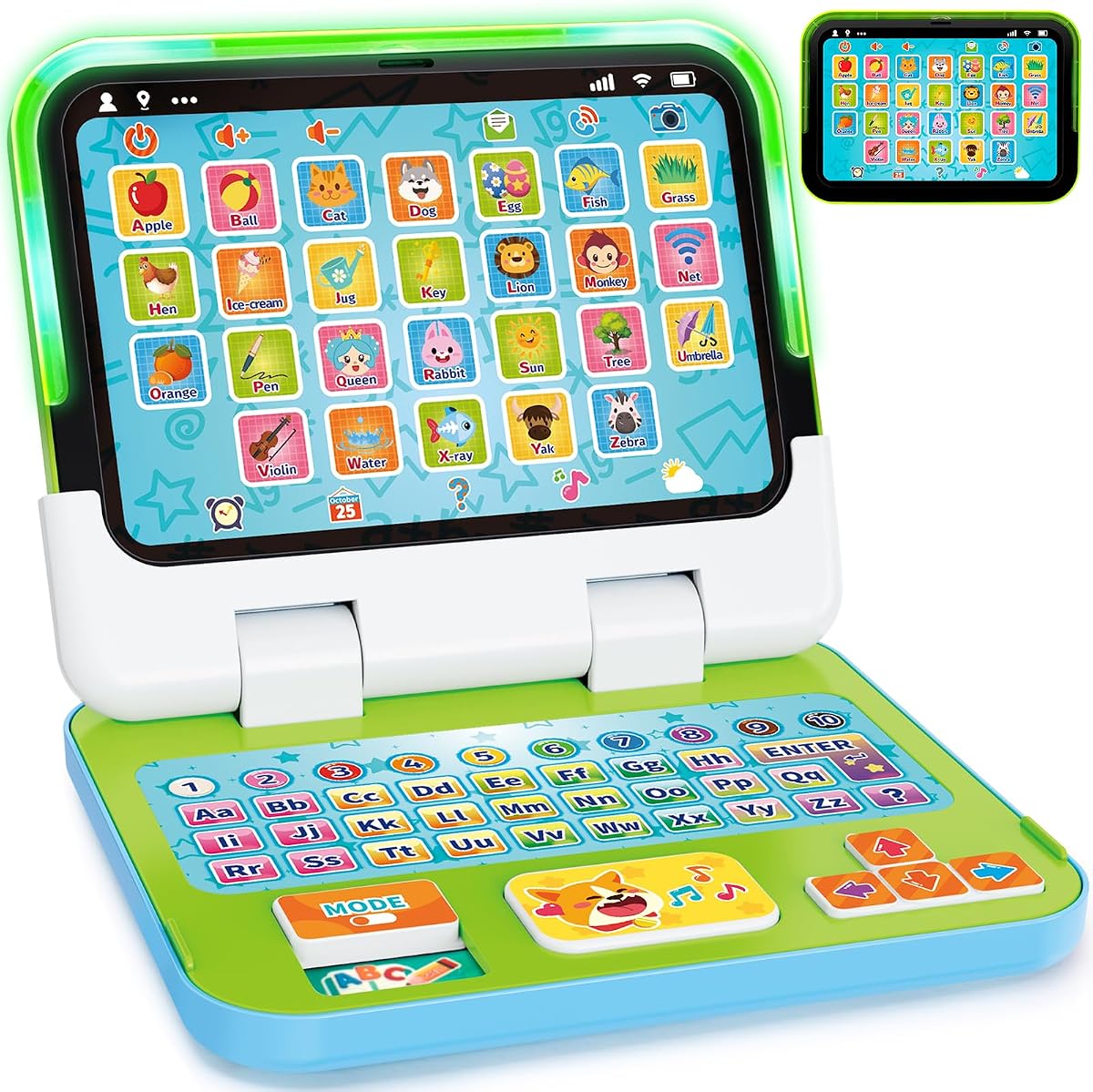
The 2-in-1 Toy Laptop Tablet is made specifically for children ages one to three. It has a 4.4 rating and can switch between a laptop configuration with a keyboard and a portable tablet mode with a detachable base. This flexibility suits the rapidly changing attention and motor skills of toddlers who may alternate between typing, tapping, carrying, and pretending.
We may earn a commission when you buy through this link, at no additional cost to you.
The activity library includes more than 120 learning themes across four interactive modes. Learning Mode introduces letters, numbers, and colors; Spelling Mode provides immediate feedback; Quiz Mode presents more than 70 questions; and Music Mode introduces melodies. Pretend-computer scenarios, including making phone calls and sending emails, also help children practice everyday communication and social routines.
The physical design emphasizes child use. Strong ABS plastic, chew-resistant material, rounded edges, anti-drop and anti-scratch construction, and a screw-secured power compartment are all intended to withstand frequent handling. The secure compartment requires a screwdriver, which is helpful for adults but means batteries cannot be changed as quickly as in a conventional toy.
This is the strongest recommendation in the guide for a toddler, daycare, or child who is too young for conventional typing. It is not a real general-purpose computer and will not satisfy an older child seeking school applications or web browsing. For a first introduction to computer-like objects, however, its age fit, durable construction, and variety of early-learning interactions are exceptionally relevant.
The detachable base allows a caregiver to choose between a keyboard-based setup and a more portable tablet arrangement. That flexibility is valuable for toddlers who enjoy both stationary activities and carrying the toy around the house.
Rounded edges, chew-resistant materials, and a protected power compartment reflect the realities of toddler use. Adult access to the battery area adds a layer of safety for homes, daycares, and travel.
We may earn a commission when you buy through this link, at no additional cost to you.
The Lexibook Unicorn Educational Laptop combines a playful unicorn theme with a broad set of early-learning activities. It has a 4.3 rating and covers English and Spanish, mathematics, typing practice, general knowledge, logic, music, and clock reading. Different activity levels allow children to learn, test their knowledge, and work on improving their skills.
We may earn a commission when you buy through this link, at no additional cost to you.
Its design is based on real laptop ergonomics, with a realistic mouse and keyboard in a slim, easy-to-hold form. The music section is especially notable, allowing children to learn notes, compose, and play melodies rather than simply repeat a fixed song. Logic, memory, and speed games provide additional ways to practice skills after the main lessons.
Compared with a modern Android laptop or Chromebook, the Unicorn's stated feature set appears more traditional and focused. The supplied information does not mention a touchscreen, internet connectivity, a camera, rechargeable battery life, or detailed parental controls. Those omissions may make it less attractive for children who want web access or school applications, but they also create a more controlled educational experience.
The Unicorn is best for a child who responds to a colorful theme and wants a wide mix of conventional subjects plus music. It is a satisfying educational toy for home or travel, particularly for families that value bilingual content. Older children who are ready for modern applications should move up to a connected model, while younger children who only need early interaction may find a more age-specific toy more appropriate.
Activities are organized so children can learn, test, and improve rather than simply repeat a single quiz. That progression can make a wider curriculum feel manageable for young users.
Note recognition, composition, and melody playing give the laptop a creative outlet alongside conventional lessons. Music activities may also help children who learn best through sound and experimentation.
We may earn a commission when you buy through this link, at no additional cost to you.
The right first laptop depends less on raw processing power and more on the child's age, attention span, hand-eye coordination, and need for internet access. These factors help distinguish a durable preschool toy from a connected computer that can support schoolwork and wider digital exploration.
Age guidance is the most important starting point because the definition of a first laptop varies dramatically. Products intended for children ages one to three emphasize lights, sounds, music, simple touch interactions, and pretend play. Devices for ages five and up may introduce QWERTY keyboards, realistic cursor controls, subjects such as mathematics and science, and more sustained learning activities. Older children ready for schoolwork may benefit from a Chromebook or a larger Android model, while a preschooler is unlikely to need web access or a full suite of applications. Checking the listed age range also helps identify whether a product's content and physical design are developmentally appropriate rather than merely attractive to a parent.
A good first laptop should make learning feel like play without becoming an endless collection of shallow games. Look for clear coverage of foundational subjects, structured lessons, and activities that encourage repetition or improvement. Some products organize content into numbered modes covering alphabet, colors, mathematics, general knowledge, logic, and music. Others add guided science projects, language translation, or electronic books. Entertainment has value too, because games can reinforce memory, speed, and logic, but the balance matters. A child who sees only high-energy games may get less developmental benefit than one who encounters a mix of instruction, practice, creativity, and play.
Offline operation provides a controlled experience with no advertisements, inappropriate content, or unplanned purchases. It also means the product can work during travel or at locations where Wi-Fi is unavailable. The VTech Genio is the clearest dedicated example in this guide, with all activities preloaded and no internet connection required. Connected laptops offer websites, downloadable applications, ebooks, video calls, and cloud services, but they also require accounts, updates, supervision, and attention to parental controls. Families should decide whether a child is ready for the benefits and responsibilities of online access before choosing a more advanced device.
Screen size affects both comfort and convenience. A 4.3-inch display is easy for small hands to hold and works well for short activities involving letters, colors, photographs, and simple questions. A seven-inch screen still prioritizes portability but may become tiring for extended reading. The 10.1-inch and 11.6-inch models provide a more conventional computer experience and are better for documents, web pages, and schoolwork. Larger displays are naturally heavier and less likely to be carried comfortably by a small child. The right balance depends on where the device will be used and whether the child's primary goal is stationary learning or portable entertainment.
Young beginners often benefit from controls that imitate a real computer without demanding advanced dexterity. A full-size QWERTY keyboard can prepare an older preschooler or school-age child for future typing. A separate mouse and cursor controller teach pointing and selection skills, although very young children may benefit more from large touch targets and simple buttons. The 2-in-1 toy for ages one to three combines a detachable tablet with a keyboard, allowing toddlers to move between modes as their coordination improves. For connected laptops, a trackpad and touchscreen provide more conventional navigation. The best choice is the one that feels inviting rather than frustrating during the first few sessions.
A connected laptop should offer tools for managing apps, browsing, screen time, and user profiles. The LEXiBOOK LAPTAB stands out with customizable profiles, parental controls, and the Qwant Junior browser. These features are helpful, but they still work best when paired with family rules and regular adult supervision. Offline educational toys offer a different kind of safety because their content is preloaded and does not expose children to open web results. Families should also consider the camera, voice communication, purchases, and account creation, especially for children who are not old enough to manage digital privacy independently.
Power is easy to overlook but can determine whether a first laptop feels convenient. Several dedicated educational toys use replaceable AA batteries, making them portable and dependable without a charger, though regular replacement can be an ongoing task. The LAPTAB includes a 4000mAh battery, and the 10.1-inch Android laptop lists an estimated five-to-seven hours of use. Families should consider how long sessions usually last and how often they travel. It is also important to distinguish batteries included only for a demonstration from those intended for regular operation, as the VTech and LeapFrog listings explicitly note this distinction.
A child may not need a powerful processor, but a device should still respond comfortably to the activities it advertises. The Chromebook and larger Android options provide more familiar productivity capabilities, while dedicated toys simplify the experience with preinstalled content. Hardware limitations matter when families expect modern applications, video calls, or document editing. A modest 2GB memory configuration may handle basic tasks but feel constrained under heavier use. Always compare the listed specifications with the intended workload, and avoid choosing solely on the word laptop. A simpler device that comfortably delivers its promised activities can be more useful than a more technically advanced model with a confusing interface.
Begin by introducing the device gradually and sitting with the child during the first several sessions. Explain the main controls, show how to open an activity, and establish a simple routine for moving between learning and games. For connected laptops, create the child's profile before handing over full access, adjust time limits and app permissions, and explain in age-appropriate language that some buttons may lead to purchases, messages, or unfamiliar content. Very young children benefit from short, consistent sessions rather than being expected to explore every feature independently.
Connect the learning to daily life whenever possible. Ask a child to find a letter, type a simple word, match a clock time, or create a photo story, then use the resulting activity as the basis for conversation. For a Chromebook or Android device, practice finding a saved file, opening an approved educational app, and asking for help when a page does not load. Keeping lessons purposeful helps children understand that a computer is a tool for creating, communicating, and solving problems rather than just a source of entertainment.
Protect the device by following its battery guidance, using the correct charger where specified, and keeping ports and screens free from dirt. Replace batteries regularly in models that use them, and use new batteries rather than relying on those supplied for demonstration. Keep the device away from water, excessive heat, and rough impacts. For internet-enabled models, periodically review recent activity, app permissions, browser history where applicable, and account settings. A supervised but not overly restrictive routine gives children room to learn while keeping their digital experience safe.
There is no single right age because development and interest matter more than a birthday. Children around one to three generally benefit from a toy-like device with lights, sounds, simple buttons, and pretend play. Around age five, a keyboard, cursor control, and structured subjects can be appropriate. Older children may be ready for a Chromebook or Android laptop with accounts, educational applications, and online access, provided that parents offer guidance and supervision.
It depends on the child's age and the purpose of the device. Offline models are simpler and avoid advertisements, inappropriate content, and online purchases, making them useful for younger children or travel. Connected models offer books, videos, educational apps, and school tools, but require secure account settings, parental controls, and ongoing supervision. Parents should introduce internet access gradually and agree on which websites, applications, and communication tools are appropriate.
Educational toy laptops are usually better for younger children because they present a limited, guided set of activities and use child-friendly controls. Regular laptops or Chromebooks become more useful as a child progresses toward schoolwork, document editing, research, and creative projects. The transition is often smoother when a child first learns typing, cursor control, and basic computer routines on a dedicated device, then moves to a more capable model with appropriate supervision.
A small screen is easier to hold but may become uncomfortable for reading, web pages, or longer lessons. The 4.3-inch displays in this guide suit short educational activities and photo play, while seven-inch screens preserve portability with somewhat more room. A 10.1- or 11.6-inch display is preferable for school assignments and detailed online work. The best size is the smallest one that remains comfortable for the child's typical activities.
Parental controls are essential for any model with open internet access, app downloads, cameras, messaging, or purchases. Useful controls include child profiles, time limits, app restrictions, and a child-oriented browser. They should be configured before the child begins regular use, but controls work best alongside family conversations and periodic reviews. Offline educational toys reduce some risks because their activities are preloaded and do not provide unrestricted web access.
The requirement depends on whether the device runs simple activities, educational applications, or browser-based schoolwork. A dedicated toy laptop needs little visible hardware because its functions are fixed, while a Chromebook benefits from more memory for multiple tabs and applications. Storage should be sufficient for books, videos, downloaded lessons, and locally created files, with cloud storage available as a supplement. Parents should also consider whether an older or renewed device has enough capacity for the intended workload.
The larger Android laptops and the Dell Chromebook are the strongest candidates for school-oriented use because they offer familiar apps, web access, a keyboard, and more conventional screens. The LEXiBOOK also includes books, a learning app, a translator, and Google Suite access. Dedicated educational toys can reinforce early literacy, numeracy, and language skills, but they are not replacements for devices intended for assignments, research, and collaborative online work.
Follow the manufacturer's instructions and avoid mixing old batteries with new ones or using batteries of an unsupported type. Several products in this guide require AA batteries, and the included batteries are intended only for demonstrations, so parents should obtain new batteries for regular use. Keep the battery compartment secure, particularly around very young children, and avoid exposing any battery to heat, moisture, or physical damage.
The strongest overall options depend on what “first laptop” means for the child. The Kids Laptop with Camera leads on activity variety and carries the highest rating, while the VTech Genio Bilingual JuniorBook offers a balanced offline introduction with more than 80 activities and English-Spanish options. For families seeking the most capable connected learning computer, the LEXiBOOK LAPTAB combines a large touchscreen, Google access, parental controls, and extensive learning resources.
Age should remain the central consideration. Toddlers are better served by the detachable 2-in-1 toy laptop, and preschoolers can benefit from LeapFrog's guided STEAM approach. Children around five and up may enjoy the dedicated educational laptops, while school-age users ready for browser-based work are better matched to the Chromebook or larger Android models. Prioritize the right balance of learning content, manageable controls, screen size, safety, and power rather than selecting on specifications alone.
Ratings, product configurations, prices, and availability can change, so shoppers should review the current listing before purchasing. Confirm the age guidance, included accessories, parental controls, connectivity, and warranty information on the live product page. With those details checked, a well-matched first laptop can become a safe and enjoyable tool for learning, creativity, and growing independence.