
Monarch PLT200
5.0Editor score
Up to 25-foot range
NIST-traceable calibration
Class 2 laser
Target and battery indicators
Our laser tachometer guide compares 10 digital photo and contact RPM meters, covering accuracy, ranges, displays, power, and ideal applications for buyers.
A laser tachometer provides a quick, non-contact way to measure rotational speed without touching fans, motors, pulleys, wheels, or other moving components. A good model combines a useful RPM range, readable display, dependable measurement system, and simple controls. The right choice depends on your equipment, required precision, and need for contact measurement or recorded data.
This guide compares ten laser and photo tachometers based on the supplied specifications, including measurement range, accuracy, display features, power requirements, accessories, and intended applications. It covers compact models for routine diagnostics as well as professional instruments offering contact modes, memory functions, longer working distances, and calibration documentation.
The top selections include the Extech 461920 for balanced professional capability, the Monarch PLT200 for calibration traceability, and the KAIWEETS 10-99999 RPM model for affordability. Each review explains who benefits most from that instrument and where alternatives may be more appropriate. Product availability and prices can change, so verify current details before purchasing.
5.0Editor score

4.6Editor score

4.8Editor score
The table below compares all ten instruments by measurement mode, speed range, accuracy, display, and practical features, making it easier to identify the right model for automotive, HVAC, industrial, or general workshop use.




The Extech 461920 is a compact laser photo tachometer and counter designed for technicians who need precise, non-contact RPM readings in the field. Its 4.6 rating reflects a strong balance of capability and portability. The instrument covers 2 to 99,999 RPM, offers 0.1 RPM resolution, and is rated at ±0.05% accuracy, placing it among the more technically ambitious options in this guide.
We may earn a commission when you buy through this link, at no additional cost to you.
The five-digit backlit LCD is particularly useful for reading results in garages, plant rooms, and other dim work areas. Extech also stores minimum, maximum, and last readings, allowing a technician to compare a machine's operating behavior without immediately writing down every result. A single included 9V battery powers the unit, while the ergonomic double-molded housing supports one-handed use and straightforward field storage.
The main limitation is that this is primarily a laser photo tachometer rather than a combination contact model. Reflective tape must be applied to the target, which requires access to the rotating component and a clean surface. It also uses a replaceable 9V battery rather than a built-in rechargeable supply. Neither limitation is unusual for this category, but both are worth considering in demanding daily workflows.
This is the strongest all-around choice for automotive, HVAC, and industrial technicians who value precision, a broad range, and practical memory functions in a portable format. Choose the Monarch PLT200 instead when traceable calibration and a much longer working distance are more important than the Extech's broader measurement functionality and included kit.
The combination of 2 to 99,999 RPM coverage, 0.1 RPM resolution, and ±0.05% stated accuracy makes this meter suitable for both slow rotating equipment and faster motor-driven systems. The broad range reduces the need to change tools when moving between different jobs.
The backlit five-digit display is designed for clear readings, while stored minimum, maximum, and last values help reveal speed variation. This is useful during startup, shutdown, or load-change observations.
We may earn a commission when you buy through this link, at no additional cost to you.
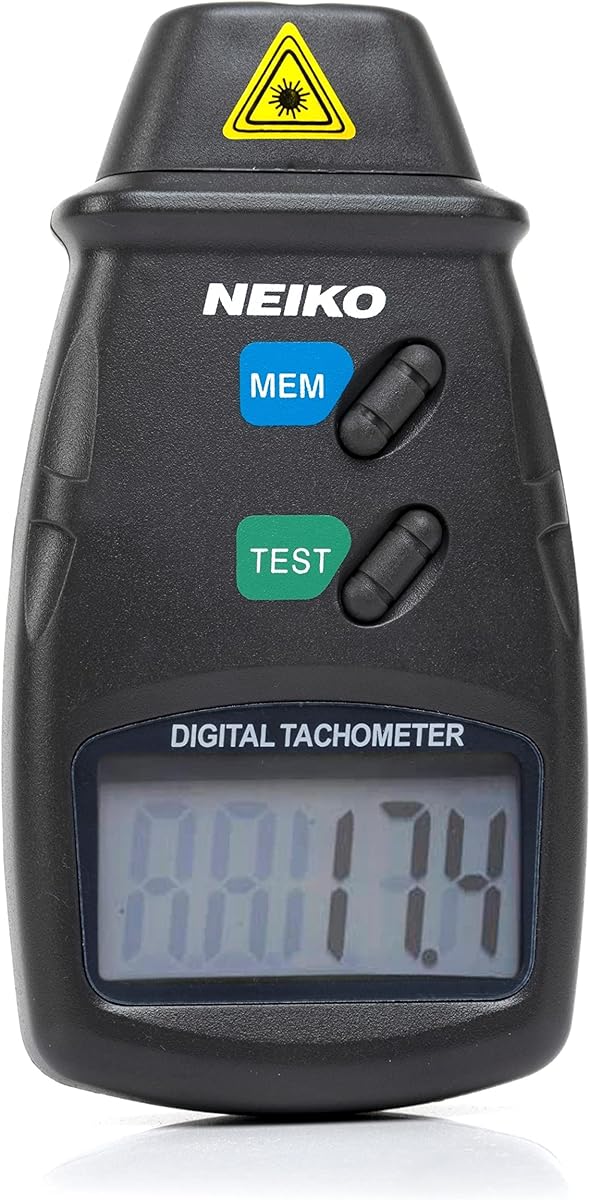
The NEIKO 20713A is a lightweight digital tachometer built around a non-contact laser photo sensor. It carries a 4.2 rating and offers a stated range of 2.5 to 99,999 RPM with ±0.05% accuracy. Its central appeal is straightforward non-contact measurement in a compact body suited to technicians, mechanics, and do-it-yourself users.
We may earn a commission when you buy through this link, at no additional cost to you.
The meter can measure from two inches to 20 inches, giving the operator enough distance to avoid a spinning component while still working in confined spaces. Readings appear on a large LCD, and the instrument samples revolutions over a one-second period. It then stores the latest, minimum, and maximum results for quick comparison during diagnostic work.
Its limitations are closely tied to its specialized design. The relatively short 20-inch maximum distance makes it less suitable for large industrial machines when access is restricted, and the lack of a contact mode means it cannot serve as a universal RPM and surface-speed instrument. Reflective target material is also generally required for a reliable photo measurement.
Choose the NEIKO 20713A when compactness, low-cost access to laser RPM measurement, and a large display matter most. For longer-distance work, consider the Monarch PLT200. For a broader mechanical toolkit, the Extech RPM33 offers both contact and laser functions plus more extensive data storage.
The lightweight, compact housing makes the NEIKO easy to carry between vehicles, appliances, and machinery. Its straightforward laser-based approach reduces setup to aiming at a prepared reflective target.
Storing the last, minimum, and maximum readings gives users a quick way to identify unstable rotational speed. The one-second sampling interval provides a practical basis for comparing operating states.
We may earn a commission when you buy through this link, at no additional cost to you.
The Extech RPM33 is a combination contact and laser photo tachometer for users who need more than rotational speed alone. Its 4.2 rating is supported by an extensive feature set that includes RPM, surface-speed, and length measurements. The laser range extends from 2 to 99,999 RPM, while the contact side expands the instrument's usefulness across belt-driven systems.
We may earn a commission when you buy through this link, at no additional cost to you.
Ten stored data sets are a major distinction in this group. Each set can track the current, maximum, minimum, and average values, creating a more structured record than simple last-value memory. The microprocessor-based design and quartz crystal oscillator support the stated 0.05% accuracy, while a backlit LCD improves visibility in field environments.
The contact accessories make this especially useful for linear belt speed and length work, scenarios that a purely optical meter cannot handle. Reflective tape, a 9V battery, and contact components are included, and everything fits into a soft carrying case. The trade-off is a larger and more involved kit than the compact photo-only instruments on this list.
The RPM33 suits maintenance teams that service conveyors, elevators, motors, and driven components and want one instrument for several measurements. It is less attractive for a buyer seeking the smallest pocket model, but its versatility justifies the added complexity for professional use.
Combining photo and contact operation allows the RPM33 to cover rotating shafts, motors, fans, and belt-driven equipment. Surface-speed and length functions further extend its usefulness beyond a basic RPM reader.
Storing up to ten sets with current, maximum, minimum, and average values helps users compare operating conditions. That makes the instrument especially valuable during repeatability checks and maintenance reporting.
We may earn a commission when you buy through this link, at no additional cost to you.
The Monarch PLT200 is a pocket laser tachometer distinguished by its NIST-traceable calibration and long working distance. It holds the highest rating in this selection at 5.0 and offers a practical reach of up to 25 feet. That combination makes it particularly compelling for controlled quality environments, calibration work, and equipment that cannot be approached safely.
We may earn a commission when you buy through this link, at no additional cost to you.
The instrument is calibrated before shipment and supplied with a NIST-traceable certificate containing data. According to the supplied information, this gives users assurance that the unit meets manufacturer specifications and is ready to meet many quality-system requirements. It also conforms to NIST standards and carries a CE mark indicating applicable EU directive compliance.
Photo measurements use a Class 2 laser beam rated at less than 1 milliwatt. The LCD shows results and the unit of measurement, while dedicated on-target and low-battery indicators help the operator avoid unreliable readings. The extended distance is the central advantage: users can inspect larger machines without walking directly into moving parts.
This is the premium selection for quality assurance personnel, calibration users, and industrial maintenance teams that value documented traceability. It costs more conceptually in terms of specialization than the combination models, but it delivers the most distinct professional feature in the group: a calibration framework supported by an included certificate.
The included NIST-traceable certificate and calibration data provide documentation that can be valuable within formal quality systems. This differentiates the PLT200 from general-purpose meters that do not emphasize traceability.
A working distance of up to 25 feet allows technicians to inspect larger or less accessible rotating equipment. The Class 2 laser and clear target indicator support focused, confident aiming.
We may earn a commission when you buy through this link, at no additional cost to you.
The KAIWEETS Digital Laser Tachometer combines a 4.8 rating with a stated ±0.05% precision level, making it an attractive budget-oriented instrument for everyday RPM checks. It covers 10 to 99,999 RPM and uses a non-contact laser system that is suitable for motors, fans, pulleys, gears, wheels, and blades.
We may earn a commission when you buy through this link, at no additional cost to you.
The large backlit LCD provides clear digital readings for RPM and count measurement. Simple buttons allow quick movement between modes, while auto shutoff and a low-battery indicator help manage unattended or intermittent use. The compact handheld shape is designed for one-handed operation in garages, workshops, and maintenance environments.
Unlike devices offering a very low starting speed, this model begins at 10 RPM. That restriction may matter when diagnosing a slowly rotating component, although it remains suitable for many common automotive, HVAC, and industrial systems. As with most photo tachometers, users should expect to place reflective material on the target for dependable results.
For users who want professional-looking specifications and a compact meter without moving to a premium calibrated model, this KAIWEETS is the strongest budget pick. The NEIKO and AGPtek are lower-cost alternatives, but this model combines a higher rating with useful automatic power management and a backlit display.
A 10 to 99,999 RPM range and ±0.05% stated precision cover a broad spectrum of common rotating equipment. These specifications make the meter useful for both automotive work and industrial troubleshooting.
The compact body, large backlit screen, simple controls, and automatic shutdown make routine use less cumbersome. It is a practical meter to keep close at hand for repeated inspections.
We may earn a commission when you buy through this link, at no additional cost to you.
This KAIWEETS model is a lightweight non-contact tachometer designed for both RPM measurement and rotation counting. Its 4.4 rating reflects a versatile feature set that includes data hold, maximum, minimum, and average functions. The speed range is 10 to 99,999 RPM, while counting mode covers 1 to 99,999 rotations.
We may earn a commission when you buy through this link, at no additional cost to you.
Its 40-millimeter five-digit LCD offers a larger reading area than many compact meters. Auto-ranging automatically selects the appropriate range, removing manual range adjustment from the workflow. The stated accuracy is ±(0.05%+1), and resolutions can be as fine as 0.1 RPM. Reflective tape is included for preparing measurement targets.
At 140 grams including batteries, the unit is particularly portable. It runs on three AAA batteries and is listed at approximately 50 milliamps of consumption. The ergonomic design and straightforward interface are intended to suit both beginners and experienced technicians, though the multiple statistical functions may take a little practice to interpret.
Choose this model for portable diagnostics where speed readings, counts, and average values are all useful. It stands out from the simpler KAIWEETS option by adding data hold and average calculations, although both share the same 10 RPM lower limit and photo-measurement approach.
Data hold keeps a reading visible, while maximum, minimum, and average functions reveal how rotational speed changes. These additions are useful for diagnosing unstable motors or comparing successive operating states.
The 140-gram body and AAA power source make the meter easy to carry between a vehicle, HVAC unit, and workshop machine. Auto-ranging further reduces setup time for users who do not want to manage multiple manual ranges.
We may earn a commission when you buy through this link, at no additional cost to you.
The AGPtek Digital Laser Photo Tachometer is an entry-level option for measuring rotational speed across a broad 2.5 to 99,999 RPM range. Its 4.3 rating and 0.1 or 1 RPM resolution options make it a useful general-purpose tool for electric motors, lathes, washing machines, paper-making equipment, and automotive components.
We may earn a commission when you buy through this link, at no additional cost to you.
The working distance of 50 to 500 millimeters balances close access with enough separation from a moving target. A clear LCD presents the measured data, while the lightweight, ergonomic housing is designed for comfortable one-handed use during prolonged inspections. The package includes a 9V battery, a manual, and three strips of high-adhesion reflective tape.
The supplied information specifically notes that the instrument does not support sawmills or lawn mowers, so those applications should be avoided. Reflective tape must be attached for a standard measurement, and users considering laser objects should be prepared to apply reflective paper. These restrictions reduce flexibility compared with more purpose-built industrial instruments.
This AGPtek is most suitable for entry-level users, automotive technicians, HVAC professionals, and do-it-yourself buyers who need a straightforward photo tachometer. It may be preferable to more expensive options when the job only requires basic RPM checks, while the Extech RPM33 is a stronger choice when contact measurement and advanced memory are required.
The 2.5 RPM lower limit is useful for slower rotating components, while the 99,999 RPM ceiling covers many fast motor applications. Resolution options of 0.1 or 1 RPM support both detailed and standard readings.
Three adhesive reflective strips are included, allowing the user to prepare a target immediately. A storage bag helps protect the unit and keeps the tape and manual together in a toolbox.
We may earn a commission when you buy through this link, at no additional cost to you.
The KAIWEETS Max Min is a feature-rich photo tachometer with a 3.9 rating, a five-digit 40-millimeter LCD, and automatic tracking of maximum and minimum values. It measures 10 to 99,999 RPM and counts 1 to 99,999 revolutions, making it suitable for motors, tools, engines, fans, and general rotating machinery.
We may earn a commission when you buy through this link, at no additional cost to you.
Its resolution is specified as 0.1 RPM between 10 and 9,999.9 RPM and 1 RPM at 10,000 RPM or higher. Counting mode has a resolution of one revolution. Microcontroller technology, photoelectric sensing, and anti-interference algorithms support consistent measurements, while the large screen presents current, maximum, and minimum results together.
The lowest rating among these ten products warrants careful consideration. A 3.9 score suggests that some users may have found aspects of the overall experience less satisfactory than the higher-rated alternatives, even though the published specifications are appealing. The 10 RPM minimum also prevents use with very slow rotations.
For buyers who value a large display, automatic memory, and an inactivity shutdown at a budget-friendly level, this meter remains a viable option. The KAIWEETS 10-99999 RPM pick has a stronger rating, while the KAIWEETS Reflection Tape model adds data hold and averages for buyers who want more statistical functions.
The meter retains maximum and minimum measurements, allowing users to review speed variation without manually recording each value. This is useful during startup, shutdown, or changing-load observations.
The five-digit 40-millimeter display is easy to read, while shutdown after approximately four minutes of inactivity helps conserve the included 9V battery. A low-battery indicator provides an additional warning before power becomes an issue.
We may earn a commission when you buy through this link, at no additional cost to you.
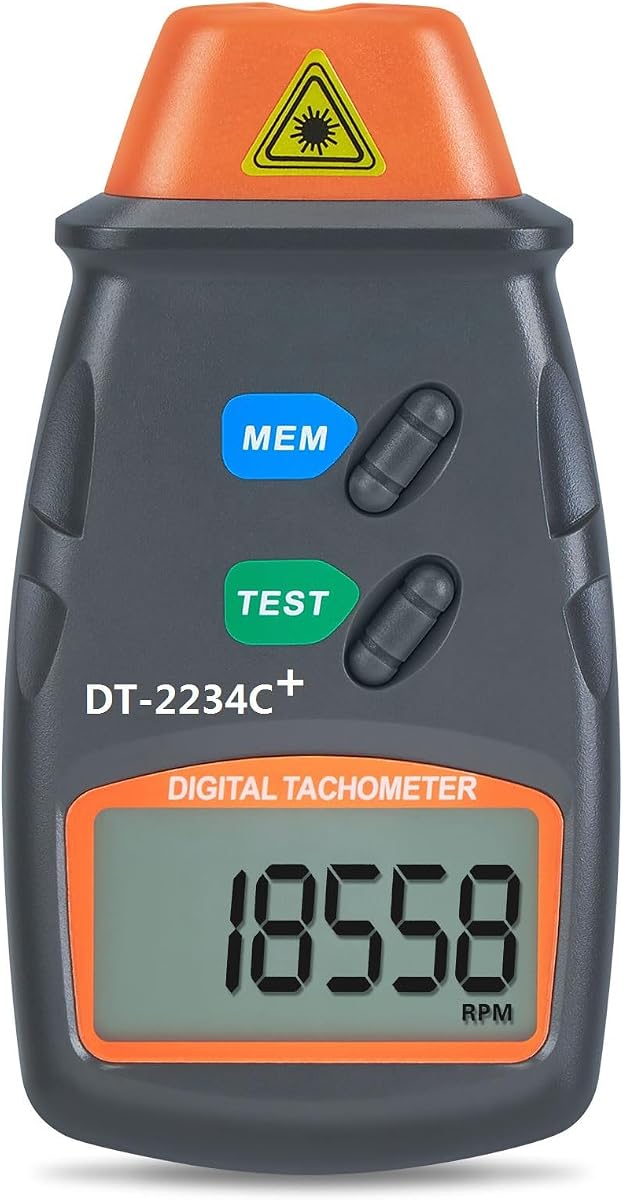
The Digital 2-in-1 Tachometer combines a non-contact laser range of 3 to 99,999 RPM with a contact range of 3 to 19,999 RPM. Its 4.3 rating and stated ±0.05% accuracy make it a compelling combined-function option for automotive maintenance, industrial machinery diagnostics, HVAC analysis, and other rotational-speed work.
We may earn a commission when you buy through this link, at no additional cost to you.
A backlit display supports visibility under different lighting conditions, while hold, maximum, and minimum functions capture results for later review. The effective working distance of 50 to 500 millimeters provides flexibility for targeting components, and sampling times of approximately 0.8 seconds for speeds above 60 RPM support responsive readings.
The contact range is lower than the laser range and will not cover the same extreme speeds as the non-contact mode. The product also lacks a recognizable manufacturer brand in the supplied title, which may make it less attractive to buyers who place greater importance on established product support or calibration documentation.
This meter makes sense for users who want both measurement styles at a relatively accessible cost. Choose the Extech RPM33 for a more substantial kit, soft case, contact accessories, and ten data sets, or choose the Monarch PLT200 when formal calibration and a 25-foot working distance are the deciding requirements.
The ability to switch between contact and laser modes broadens the range of components that can be tested. Contact mode suits suitable driven surfaces, while laser mode supports safe non-contact inspection of rotating parts.
Hold, maximum, and minimum functions make it easier to compare speed conditions. Rapid sampling at higher RPM values can be especially useful when rotational speed changes quickly during an observation.
We may earn a commission when you buy through this link, at no additional cost to you.
The Triplett TA200 is a contact and non-contact laser photo tachometer offering two ways to measure rotational performance. It has a 3.9 rating, matching the other lower-rated product in this guide. Its supplied information is concise, so buyers should examine the complete current listing before deciding whether its measurement ranges and accessories fit the task.
We may earn a commission when you buy through this link, at no additional cost to you.
The most clearly identified feature is a five-digit backlit LCD display. That makes the meter easier to read in dim workshops, garages, and mechanical rooms. Supporting both contact and non-contact modes increases versatility, allowing users to select an approach based on the target, accessibility, and safety requirements of the job.
Because the provided product data does not list RPM range, accuracy, working distance, battery configuration, or included accessories, it would be misleading to invent those details. The limited 3.9 rating also provides less evidence of broad user satisfaction than the higher-rated models. Those uncertainties are important when comparing it with more fully specified alternatives.
The TA200 is best considered for buyers specifically interested in a Triplett-branded dual-mode meter and willing to verify its current specifications. The Extech RPM33 offers much more detailed performance information, extensive memory, and a complete accessory kit, while the Monarch PLT200 leads the group for documented calibration and long-distance measurement.
Contact and non-contact laser modes let the user select a method suited to the equipment and working environment. This versatility can reduce the need for separate instruments on mixed maintenance jobs.
The five-digit backlit display supports quick interpretation of results where overhead lighting is limited. Its large numeric format is useful for focused diagnostic work and repeated field measurements.
We may earn a commission when you buy through this link, at no additional cost to you.
Choosing a laser tachometer means balancing RPM range, accuracy, measurement distance, display quality, power requirements, and the type of equipment you regularly diagnose. The most useful model is the one whose specifications and accessories align with your actual workflow.
Choose a low starting limit for very slow shafts, fans, or idling mechanisms. A 10 RPM floor may be adequate for faster motors and automotive applications.
For precision-oriented work, investigate calibration documentation as well as headline accuracy. The Monarch PLT200 includes NIST-traceable calibration data.
Longer reach improves access to large equipment, while shorter distances can be easier for confined workspaces. Verify the stated range before planning a difficult measurement.
Dual-mode meters are more versatile, while photo-only models are simpler and often more convenient for routine motor checks. Choose based on the actual measurement tasks.
Prioritize a readable backlit screen for field work. Add hold or statistical memory if you routinely compare operating conditions.
Use clean, high-adhesion reflective tape on a flat section of the target. Replace loose or damaged strips to maintain measurement consistency.
For daily mobile work, keep the correct battery type available. Models with auto shutoff are particularly useful for intermittent diagnostics.
Ask for calibration documentation whenever compliance or traceability matters. A headline accuracy rating alone may not satisfy formal quality procedures.
Prepare the rotating component before taking a measurement. Turn off the machine if possible, clean a small flat area on the shaft or hub, and attach reflective tape securely. Make sure the tape is positioned where the laser can see it without obstruction. Do not place tape on a hot, moving, or structurally weak area, and never approach an exposed rotating component that could cause injury.
Power on the tachometer, select photo or RPM mode as appropriate, and aim the laser at the center of the reflective target. Maintain the distance specified for your model and avoid angles that create glare or a weak reflection. Allow the reading to stabilize, then compare it with the expected operating speed. Use hold or memory functions when documenting multiple values, and clean the optical window with a soft dry cloth rather than abrasive material.
After use, switch off the meter and return it to a dry, protected storage area. Remove batteries for long-term storage, inspect the reflective tape, and replace it if it has peeled, dirtied, or lost adhesion. Keep contact accessories clean and avoid immersing the instrument. If readings are inconsistent, verify battery power, target placement, operating distance, and lighting before assuming the tachometer is defective.
Most laser photo tachometers work most reliably when reflective tape is attached to the rotating target. The tape creates a distinct surface for the sensor to detect, improving consistency on painted, dark, or uneven components. Some models include tape in the package, while buyers should confirm the supplied accessory list. Contact-mode instruments can serve as an alternative when tape cannot be attached.
A broad range such as 10 to 99,999 RPM covers many common engine and accessory-speed checks. For very slow idling mechanisms, a model starting at 2 or 2.5 RPM offers more flexibility. The best range is the one that comfortably covers every rotating component in your typical workload without forcing the user to work at the limits of the display.
Some combination models can. The Extech RPM33, for example, supports RPM, surface speed, and length through contact accessories as well as non-contact laser measurement. A photo-only instrument is designed primarily around rotational speed and counting, so buyers who regularly work with belts or linear equipment should look for explicit contact-wheel and surface-speed support.
Working distance is a major factor for large machinery. The Monarch PLT200 offers a stated range of up to 25 feet, making it the strongest option in this guide for inspecting equipment from farther away. Its NIST-traceable calibration is also attractive for formal quality work. For smaller or more accessible systems, a compact model with a shorter working range may be easier to handle.
Several products here advertise ±0.05% accuracy, although real readings can vary with target quality, distance, lighting, vibration, and machine condition. For regulated or formal quality processes, look for calibration documentation in addition to a stated accuracy specification. The Monarch PLT200 is the clearest example in this selection because it includes NIST-traceable calibration data.
Non-contact laser measurement is generally safer for inspecting fast-moving exposed components because the operator does not need to place an accessory directly on the rotation. Contact measurement can be useful for belt speed and other linear applications, but it requires bringing the measuring wheel into contact with the target. Follow machine lockout procedures and never operate a tachometer in a way that creates a new contact hazard.
Use clean reflective tape placed flat on the target, aim at the center of the tape, and remain within the specified working distance. Stable lighting and a steady hand also help. If several readings vary significantly, check the battery, inspect the tape, confirm the selected mode, and verify that the target is rotating steadily rather than erratically.
Maximum and minimum functions are useful when a motor speed changes during startup, shutdown, or a load transition. They can reveal variation that a single reading misses. For routine one-time checks, a basic meter may be sufficient, while technicians recording operating trends or repeated tests will benefit from data hold, average values, and multi-set storage.
The Extech 461920 is the leading all-around option because it combines a 2 to 99,999 RPM range, 0.1 RPM resolution, ±0.05% stated accuracy, a backlit five-digit display, and useful stored readings. The Monarch PLT200 is the premium choice for buyers who prioritize NIST-traceable calibration and a working distance of up to 25 feet. The KAIWEETS 10-99999 RPM model delivers the strongest budget-oriented balance with a 4.8 rating and broad stated precision.
For everyday motor and fan checks, prioritize a suitable lower RPM limit, reliable target detection, and a readable display. For formal quality work, weigh calibration documentation and long working distance more heavily. For mixed mechanical assignments, a dual-mode model such as the Extech RPM33 or Digital 2-in-1 Meter may prevent the need for separate contact and photo instruments.
Before buying, verify the current listing, included accessories, battery type, and manufacturer specifications. Prices, availability, and product details can change, so compare the current offer with the needs identified in this guide rather than choosing solely by model name.

