
galphi 4K Dash Cam
4.4Editor score
4K front-only recording
Screen-free compact design
5GHz WiFi app access
32GB card included
Compare the best Dash CAM for Teenage Drivers, including front-and-rear, 4K, 360-degree, parking-mode, and night-vision models for safer driving.
A dash cam for a teenage driver should provide dependable evidence without creating unnecessary distraction. Resolution, low-light clarity, readable controls, secure mounting, storage support, and straightforward phone connectivity matter more than elaborate features that are difficult to manage while driving.
This guide compares ten front-facing, dual-channel, and multi-camera dash cams using the supplied specifications and customer ratings. It examines recording resolution, field of view, night performance, parking-mode requirements, GPS availability, wireless transfer, included storage, installation demands, and practical limitations.
Each review shows which type of driver may benefit from a particular model, including new drivers, teen passengers, rideshare drivers, and owners seeking broader vehicle coverage. Product ratings and configurations can change, so readers should verify the current listing, compatibility, included accessories, and latest price before purchasing.
4.4Editor score

4.5Editor score
4.5Editor score
The comparison below highlights the main differences in channel count, resolution, connectivity, navigation data, and parking support, helping readers identify the most suitable dash cam for a teenage driver's vehicle and routine.




The ROVE R2-4K Dual is a front-and-rear dash cam with a 4.5 customer rating and a broad feature set. Its most appealing combination for a teenage driver is balanced coverage, built-in GPS, a 3-inch IPS display, fast WiFi transfers, and a 128GB memory card. The rear camera records at 1080P, while the front uses a Sony STARVIS 2 IMX675 sensor and records at 2.5K before intelligent upscaling to a 4K playback mode.
We may earn a commission when you buy through this link, at no additional cost to you.
Low-light performance is a major strength based on the specified Sony sensor, wide apertures, and HDR. The system also includes motion detection, a G-sensor, emergency locking, seamless loop recording, and support for memory cards up to 1TB. Built-in GPS overlays route, location, and speed information, while dual-band 5.8GHz and 2.4GHz WiFi supports downloads at up to 20MB per second through the ROVE app. Those features make it easy for a parent and teen to review a drive without navigating complicated menu structures.
The important limitation is that the advertised 4K front mode is upscaled rather than native 4K. A hardwire kit is also not included for the parking mode. Some drivers may find the on-screen speed and compass display tempting to watch, so the interface should be configured for minimal distraction before regular use. Even with these caveats, the included storage, dual cameras, GPS, and app performance create a well-rounded package for everyday evidence and route documentation.
This is a strong all-around recommendation for a teen who regularly drives alone, commutes at varied times of day, or wants front-and-rear coverage without assembling multiple separate cameras. It is particularly useful when a parent may also want speed and route context. Choose it over a basic front-only model if comprehensive coverage and integrated location data justify the larger, more involved setup.
The STARVIS 2 sensor, HDR, and wide apertures are designed to preserve detail in darkness, tunnels, and changing daylight. Those characteristics matter during early-morning school commutes and evening return trips, when a basic sensor may struggle to balance headlights, signs, and surrounding vehicles.
Built-in GPS stamps routes, locations, and speed onto the video, adding context that can be useful when discussing a trip or reviewing an incident. The 128GB card also allows the system to begin recording without an immediate extra purchase, while the app simplifies later review.
We may earn a commission when you buy through this link, at no additional cost to you.
The galphi 4K Dash Cam is a compact, front-only camera with a 4.4 rating and a restrained design. Its screen-free body is especially relevant for teenage drivers because it removes a glowing display from the windshield and reduces the temptation to interact with controls while moving. A 160-degree lens captures a broad road view, and the supplied 32GB memory card makes the package usable without buying storage separately.
We may earn a commission when you buy through this link, at no additional cost to you.
Performance features include 4K 2160P recording, an F1.6 aperture, WDR, and what the manufacturer calls super night vision. The 5GHz WiFi app supports downloads at up to 8MB per second, while seamless loop recording manages storage automatically. A G-sensor detects sudden movement or collisions and locks the associated footage so it is less likely to be overwritten. The camera also supports memory cards up to 256GB.
Its central trade-off is that it records only the forward view. It cannot document rear impacts, cabin activity, or the full surroundings without adding another camera, and the parking mode requires a separately sold Type-C hardwire kit. The included card is also 32GB, so frequent drivers may eventually want larger, higher-capacity storage. Despite those limitations, the simple installation, 4K front recording, and distraction-minimizing design remain meaningful advantages for a first dash cam.
This is a sensible match for a teen who wants an uncomplicated front camera, especially one who dislikes screen-based dash cams. It also fits drivers who primarily need evidence of the road ahead rather than complete cabin or parking surveillance. For families wanting wider protection, a dual-camera alternative will be more appropriate, but within the front-only category this model stands out for clarity and simplicity.
The lack of a built-in display is a feature rather than a missing luxury. It keeps the device visually discreet and leaves fewer controls to handle while driving, while phone-based operation handles previewing, downloading, and sharing.
The F1.6 aperture and WDR are intended to balance low-light scenes and rapidly changing exposure. That makes the camera useful for evening commutes and variable weather, although final clarity still depends on lighting, speed, and the positioning of the vehicle ahead.
We may earn a commission when you buy through this link, at no additional cost to you.
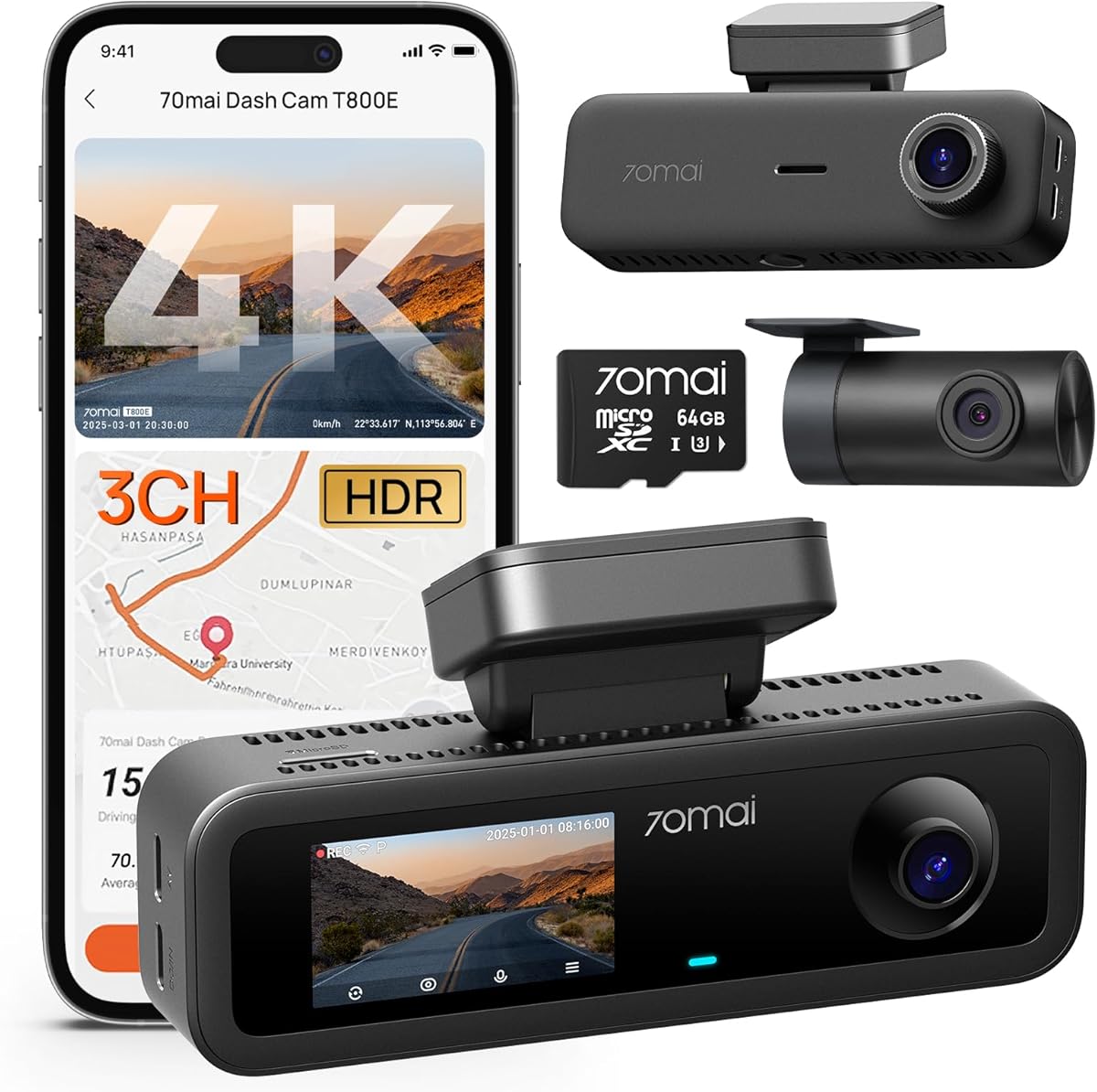
The 70mai T800E is a three-channel system rated 4.5, combining a 4K front camera with 1080P interior and rear cameras. That arrangement offers the most complete standard configuration in this list without the complexity of four separate camera bodies. It is a strong choice for teen passengers, family vehicles, and rideshare use because it can document the road, the rear, and the cabin simultaneously.
We may earn a commission when you buy through this link, at no additional cost to you.
Its standout feature is switchable infrared recording for the interior camera. HDR, three-dimensional noise reduction, F1.55 apertures, and ultra-wide lenses are also specified to improve visibility in low-light situations. Built-in GPS tracks location, speed, and route, while WiFi 6 enables transfers at up to 10MB per second. Voice control can take photos, start recording, and lock important footage, reducing the need to handle the app while the vehicle is moving.
The 64GB card supports continuous loop recording, and capacity can be expanded to 512GB. A supercapacitor is rated for operation from 14°F to 140°F, offering a useful alternative to a conventional lithium battery. Parking monitoring requires a separate UP06 or UP03 hardwire kit, and the three-camera arrangement introduces additional wiring and mounting work. Drivers should also account for increased storage consumption when recording all three channels.
This is the premium recommendation for households that want broad coverage rather than simply a forward-facing recorder. It is especially appealing when a teenage driver regularly transports passengers or drives after dark and the family wants cabin visibility. For a vehicle with limited installation space or a strict preference for minimal complexity, a dual-channel model may be easier to manage.
Switchable infrared illumination can improve the visibility of occupants and cabin details at night. It is a meaningful advantage for rideshare drivers or families frequently traveling after dark, where a conventional interior camera may struggle with shadows and reflections.
Voice commands reduce the need to touch the camera, while built-in GPS supplies route, speed, and location context. WiFi 6 also shortens the process of moving footage to a phone for review or sharing.
We may earn a commission when you buy through this link, at no additional cost to you.
The 360 View 4 Channel Dash Cam uses four Full HD cameras to cover the front, rear, left, and right sides of a vehicle. Its 4.3 rating reflects a system designed primarily around coverage rather than extreme front-camera resolution. For a teenage driver who wants visibility in multiple directions, this is one of the most comprehensive designs in the comparison.
We may earn a commission when you buy through this link, at no additional cost to you.
The front cameras are adjustable, allowing the owner to refine what each angle captures, including portions of the interior. Night vision is supported by eight infrared lights and WDR, while time-lapse mode compresses 60 minutes of parked footage into one minute. The camera supports 5GHz Wi-Fi through iOS and Android apps, and loop recording automatically removes the oldest unlocked files. Incident footage can be locked when a collision is detected.
Two important accessories are not included. A separate ACC hardwire kit is required to activate parking mode, and the optional GPS logger is needed for location, speed, and route information. With four active channels, storage demand can also be substantial, although the included 128GB card provides a useful starting point. Installation and cable routing may feel more involved than with a front-and-rear system.
This model is a good fit for drivers who prioritize a near-360 view, frequent parking in exposed locations, or a family vehicle that regularly carries passengers. It is less attractive for a teen who wants the simplest possible setup and does not need side or rear visibility. Once the optional accessories and routing are accepted, the four-angle coverage is its decisive strength.
Adjustable front camera angles help the driver avoid wasting image space on irrelevant areas. That flexibility is useful for changing between passengers, cargo, and road views without replacing the entire system.
Compressing an hour of parked activity into one minute reduces storage pressure. It does not capture every continuous detail like a standard recording, but it provides a practical overview when paired with impact detection and incident locking.
We may earn a commission when you buy through this link, at no additional cost to you.
The PRUVEEO 4 Channel Dash Cam is built around simultaneous 360-degree awareness, with four 1080P cameras covering the front, rear, left, right, and interior areas. Its 4.2 rating is slightly lower than the leaders, but the combination of integrated GPS, adjustable viewing angles, and a 128GB card differentiates it from systems that require a separate navigation module.
We may earn a commission when you buy through this link, at no additional cost to you.
Built-in GPS tracks speed, location, and routes directly on a map, which can add useful context to a trip. The front three cameras can be adjusted to capture more of the vehicle's surroundings or interior. Four infrared lights and an F1.8 cabin lens support low-light capture, while built-in WiFi provides phone access for review and sharing. Seamless loop recording overwrites old files, and collision locking protects important events.
The time-lapse parking mode compresses 60 minutes into one minute, but an ACC hardwire kit must be purchased separately. All four channels remain below 4K resolution, so the system is better suited to broad situational awareness than to maximum detail on a distant license plate. Installation also requires careful routing for multiple cameras, and a teen who has never installed a dash cam may need assistance from a parent.
This model suits drivers who want an all-around monitoring system and value GPS without buying another accessory. It is a sensible choice for night drivers, family vehicles, and teen drivers who often transport friends. The trade-off is resolution: if sharp front detail is the primary objective, a dual-camera model with a 4K or 2.5K front channel is a better fit.
Integrated GPS provides speed, location, and route information directly through the system. This reduces the number of separate accessories a driver must purchase and makes incident review more informative.
Adjustable cameras make it possible to dedicate views to different vehicle areas. A parent can therefore reorient the system as passengers or cargo change rather than accepting a single fixed perspective.
We may earn a commission when you buy through this link, at no additional cost to you.
The REDTIGER F7NP records 4K from the front and 1080P from the rear, combining a Sony STARVIS 2 sensor with a wide 170-degree front lens. Its 4.1 rating is among the lower figures in this group, but the underlying specification is strong for drivers who need high-resolution road detail and broad forward visibility.
We may earn a commission when you buy through this link, at no additional cost to you.
The front camera's F1.5 aperture, six-layer optical lens, WDR, and HDR are designed to improve nighttime and high-contrast recording. Built-in 5.8GHz WiFi supports downloads at up to 20MB per second, and GPS records route, speed, and location. The system includes a memory card and supports seamless loop recording, with incident files locked after the G-sensor detects sudden movement or a collision.
Parking protection offers time-lapse and collision-detection modes, but the required hardwire kit is not included. The 140-degree rear lens is narrower than the 170-degree front view, and the 4K front file size can consume memory more quickly than lower-resolution alternatives. Owners also need to use original or officially recommended cables and accessories and allow the unit to cool if it becomes hot.
This F7NP is a good match for teen drivers who travel after dark and want a high-resolution forward view without a screen. It is less appropriate for families seeking cabin coverage or for users unwilling to install a hardwire kit. The F17 is the more premium REDTIGER alternative for interior coverage, while this dual model offers a more focused front-and-rear arrangement.
The 4K front recording and broad 170-degree lens are well suited to identifying vehicles, signs, and lane events. A narrower rear view still captures the traffic behind, but it does not match the front camera's level of detail.
Up to 20MB per second over 5.8GHz WiFi reduces waiting when transferring large files. This is particularly useful for teen drivers who may want to review a clip promptly after a trip rather than postpone it because of slow transfers.
We may earn a commission when you buy through this link, at no additional cost to you.
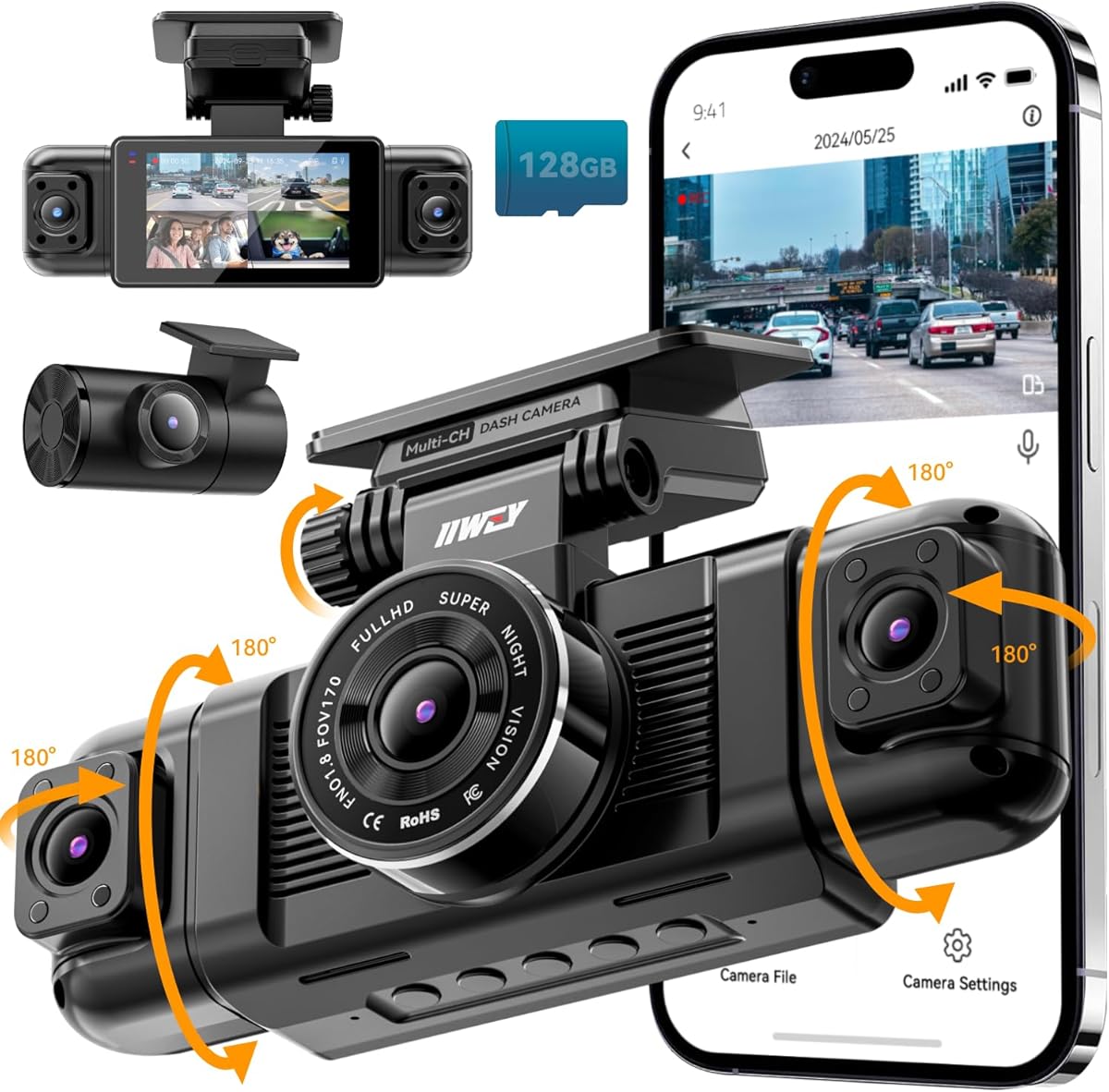
The IIWEY N5 combines a 3-inch IPS display with four cameras capable of recording the front, rear, sides, and interior. Its 4.4 rating is strong despite the absence of GPS. The front camera can operate at 2.5K while the remaining channels record at 1080P, and the front and rear use 170-degree lenses while the side cameras use 150-degree views.
We may earn a commission when you buy through this link, at no additional cost to you.
A 128GB memory card is already installed, and the system supports cards up to 256GB. Built-in 5GHz WiFi works with the iiwey or viidure apps for preview, download, control, and sharing. To conserve heat, WiFi turns off automatically if it remains unconnected for more than five minutes. The supercapacitor is specified for operation between -4°F and 167°F, and the emergency G-sensor locks clips after an impact.
The installation and power rules require attention. The product must use the original cigarette-lighter charger and cannot be powered through a USB or Type-C cable. It has no GPS function, so route, speed, and location data are unavailable. Parking mode and time-lapse monitoring require a separately sold hardwire kit. These are meaningful constraints for buyers who want a simple universal power connection or built-in navigation data.
This N5 is a good option for teen drivers who want four camera angles, a physical display, and more storage than a basic front-only model. It is best for families comfortable with a structured four-camera installation. Buyers who regularly need location data should choose a model with integrated GPS, while those wanting the least setup may prefer a screen-free single-camera design.
The 2.5K front mode provides extra detail when the road ahead is the priority, while 1080P serves the other angles. This flexibility makes the N5 useful for drivers who want broad coverage without giving up a higher-resolution forward view.
Using a supercapacitor instead of an internal lithium battery reduces one common concern about devices left in hot vehicles. The stated temperature range is broad, although correct power-source use remains essential.
We may earn a commission when you buy through this link, at no additional cost to you.
The Affver A4 is a front-and-rear dual dash cam with 4K UHD recording at the front and an upgraded 2.5K rear camera. Its 4.4 rating places it among the stronger options, while the two-camera resolution balance distinguishes it from systems that pair a detailed front view with only 1080P behind the vehicle.
We may earn a commission when you buy through this link, at no additional cost to you.
The front camera uses a 160-degree lens, while the rear uses a 155-degree lens. Built-in GPS tracks speed, route, and real-time coordinates for playback through the app or Windows and Mac GPS Player. Upgraded 5GHz WiFi 6 supports transfers at up to 10MB per second. A 3.59-inch IPS screen provides an easy-to-read interface, and the low-profile body is intended to preserve visibility through the windshield.
Night recording is supported by an F1.5 aperture, six-layer lens, and WDR, while the three-axis G-sensor locks footage following a serious collision. A 64GB card is included, and the cigarette-lighter charger includes an extra USB port for charging a phone while the camera operates. Because high-resolution dual footage consumes more storage, 64GB may be less than ideal for frequent drivers. The supplied details do not specify parking-mode availability.
The A4 is a good fit for a teenage driver who wants strong front detail, useful rear coverage, and route information without adding a separate GPS logger. It is straightforward for daily use and particularly handy for commuters who want to review where a trip occurred. Drivers whose main goal is continuous parked surveillance should choose a model with clearly documented parking modes and the appropriate hardwire kit.
A 2.5K rear channel provides more detail than a conventional 1080P rear camera. That extra clarity can help when reviewing vehicles or road events behind the car, although 4K and 2.5K files will use storage more rapidly.
The extra USB port in the car charger is a practical addition for long commutes. A teen can keep a phone charged for navigation or calls while the dash cam remains connected to the vehicle's power.
We may earn a commission when you buy through this link, at no additional cost to you.
The REDTIGER F7N TOUCH is a dual-camera model combining 4K front recording, a 1080P rear camera, a STARVIS 2 sensor, and a 170-degree front lens. Its 4.3 rating reflects a capable system with a particular emphasis on user interaction. The touchscreen and voice commands make it one of the more approachable options for teens who want direct control without navigating a small button-only interface.
We may earn a commission when you buy through this link, at no additional cost to you.
Voice commands can reduce the need to touch the device while driving, while the screen can lock emergency video, activate WiFi, or capture a still image. Built-in GPS records location, speed, and route, and 5.8GHz WiFi supports downloads at up to 20MB per second through the REDTIGER Cam app. WDR, HDR, and night-vision processing are intended to improve visibility in difficult lighting.
Loop recording manages storage automatically, with the G-sensor locking event footage. A 128GB card is included. The rear camera is limited to 1080P, so this model does not offer the balanced high resolution of the Affver A4. Parking monitoring offers G-sensor and time-lapse modes, but a separate hardwire kit is required. As with any visible screen, the parent should encourage the teen to configure controls before driving and avoid interacting with them while moving.
This is a strong choice for a teen who values a polished interface, voice control, and front-camera detail. It is also suitable for owners who want built-in route information and fast phone transfers. For a teen driver specifically, the touchscreen is useful for setup, but voice operation and automated locking should be used during actual journeys to minimize distraction.
The touchscreen offers a clear way to configure the camera before driving, while voice commands handle common actions more conveniently. Redundant controls make the device approachable without forcing every user to depend on one method.
The combination of 20MB per second WiFi transfers and built-in GPS supports relatively quick review of complete trips. Speed and location overlays can add useful context when sharing a clip or assessing an incident.
We may earn a commission when you buy through this link, at no additional cost to you.
The REDTIGER F17 is a three-channel dash cam with a STARVIS 2 IMX675-equipped front camera and 1080P interior and rear cameras. Its 4.4 rating makes it one of the better-balanced options in the list. A 150-degree front view, 160-degree cabin view, and 155-degree rear view provide broad coverage for daily drivers and family trips.
We may earn a commission when you buy through this link, at no additional cost to you.
The front channel can record at 4K, while a 2.5K dual-channel mode is also supported. With the interior camera disabled, the system can prioritize 4K front and 1080P rear recording, giving owners a way to balance image detail and storage use. WDR, HDR, and three-dimensional noise reduction support low-light and dynamic-range performance. Dual-band WiFi and built-in GPS enable app access, route data, and multi-channel playback.
The included 64GB card may be modest for three-channel 4K footage, so larger storage may be needed for heavy use. Parking time-lapse and collision detection require an extra hardwire kit. A supercapacitor supports reliability in extreme temperatures, and the manufacturer provides an 18-month guarantee with customer support. Those protections make the system more appropriate for long-term ownership than a temporary record-only device.
The F17 is a good recommendation for teen drivers who transport passengers, want rear evidence, and may need different recording configurations. Its flexible modes let an owner favor front detail when necessary or retain three-angle coverage for broader protection. Buyers seeking the absolute simplest installation should consider a two-channel system, while those wanting cabin visibility will appreciate the F17's more complete coverage.
The ability to switch between 4K front recording and a 2.5K dual-channel configuration gives the owner practical control over detail and storage use. Turning off the interior camera when it is not needed can also reduce heat and data demands.
Front, cabin, and rear cameras create a more complete account of a journey. That is especially relevant when a teen driver carries passengers, shares a vehicle, or wants evidence of what occurred inside as well as around the car.
We may earn a commission when you buy through this link, at no additional cost to you.
The right dash cam balances recording quality, ease of use, reliable power, and distraction-free operation. These factors help a teenage driver or parent compare front-only, dual-channel, and multi-camera systems without paying for capabilities that the vehicle or routine does not need.
For most teen drivers, a front-and-rear setup offers a practical balance. Choose front-only when simplicity and low storage use matter most, and consider three or four channels when passenger behavior or complete situational awareness is a priority.
Look for high resolution where it matters most, usually the forward view, but avoid assuming the largest number automatically produces the best usable video. Native resolution, lens quality, exposure control, and lighting all influence the result.
If the vehicle is often driven after dark, favor a camera with a capable sensor, wide aperture, and HDR or WDR. Cabin users may also want infrared illumination rather than relying on ordinary interior light.
Choose a model with responsive app transfers if the footage will be reviewed promptly. Confirm phone compatibility and whether separate in-car Wi-Fi connection steps are required before buying.
GPS is valuable for parents who want trip context, but it is not mandatory for basic collision evidence. Confirm that it is integrated rather than an optional accessory before making a decision.
Do not assume parking mode works out of the box. Check the included accessories, compatibility, and power requirements, and arrange proper hardwire installation before relying on it for overnight protection.
Plan storage and heat management before the first trip. Confirm card limits, use the supplied or recommended card, and mount the camera where it does not block sightlines or create a distraction.
Before the first drive, install the camera in a position that captures the road without blocking the driver's view, clean the glass, and route cables so they cannot interfere with airbags, controls, or the steering wheel. Check the supplied instructions for the correct front, rear, side, and interior camera orientation. Confirm that the memory card is seated, the camera receives power, and the display or app shows an active recording before the vehicle moves.
Configure loop recording, date and time, G-sensor sensitivity, parking mode, Wi-Fi, and GPS before relying on the system. Set any screen brightness and automatic-start behavior so the device does not become a distraction. For models with voice control or physical buttons, review the available commands while parked, and practice emergency locking while the vehicle is stationary. Parents and teen drivers should agree on how incident clips will be saved, shared, and backed up.
Review recordings regularly rather than waiting for an incident. Check that the front and rear images are aligned, the card is recognized, GPS data appears where expected, and the app can download files. Inspect the mount, charging connection, and card for looseness or damage, especially after extreme heat or a long trip. Replace damaged accessories with approved parts, and follow the manufacturer's guidance on card capacity, firmware updates, parking installation, and proper shutdown.
A 4K front camera can capture more detail than a lower-resolution model, particularly when reviewing distant vehicles or signs. It is not automatically necessary for every driver, however, and it creates larger files that require more storage and transfer time. A reliable 2.5K or 1080P camera with good low-light performance may be sufficient for ordinary trip recording. The right choice depends on the vehicle, storage capacity, and how frequently recordings will be reviewed.
A front-only model is easier to install and usually records the road ahead, which covers many common incident scenarios. A front-and-rear system adds protection for what happens behind the vehicle and can be especially useful in parking lots or traffic. Teen drivers who regularly carry passengers may also want an interior camera. More channels add complexity, so families should balance comprehensive coverage against the teen's comfort with installation and maintenance.
Many parking modes require a hardwire kit because they must continue drawing power after the engine is turned off. None of the kits should be assumed to be included; several of the reviewed systems list them as separate accessories. Hardwiring may also require careful fuse placement and cable routing. A parent or experienced installer should handle this step, and the owner should verify the vehicle-specific instructions before enabling continuous parking surveillance.
Check the card and recording status regularly, particularly if the camera is used every day or stores high-resolution files. Review a short sample recording, confirm that the timestamp is correct, and look for gaps or corrupted clips. Replace a card that produces errors, even if it appears physically undamaged. Use the card size and speed class supported by the manufacturer, and format it through the camera or according to the supplied instructions when changing devices.
A dash cam can provide evidence of road events and may make a driver more aware that trips are being recorded, but it does not replace supervision, safe habits, or proper licensing requirements. Its most practical value is documenting what happened after an incident or parking event. Parents should focus on installation, settings, and clear expectations for phone use while driving rather than treating the camera as a substitute for driver education.
GPS is not essential for basic collision evidence, but it can add useful route, speed, and location context. It may be valuable to a parent reviewing trips or to a driver documenting a specific incident. Some cameras include GPS directly, while others require an optional logger or offer only app-based location tracking. Check the exact specification and included accessories before selecting a model for this feature.
Choose a mounting location that provides a clear view without blocking the driver's sightline or interfering with sensors and airbags. Clean the glass before attaching the mount, secure all cables, and route them away from the driver's hands and controls. Test the camera and settings while parked, and ask a parent to inspect the installation if the wiring is unfamiliar. Check the mount periodically because vibration and temperature can loosen even a well-positioned device.
Recording while driving is the primary purpose of a dash cam and can be useful for documenting traffic events. Leaving it powered for parking mode requires a proper hardwire installation and awareness of the vehicle's battery and electrical system. Drivers should not operate the screen or controls while moving, and footage should be handled responsibly so that private information is not shared unnecessarily. Recording does not justify holding a phone, adjusting the camera, or otherwise creating a distraction.
The ROVE R2-4K Dual is the strongest all-around choice because it combines front-and-rear recording, low-light specifications, built-in GPS, fast WiFi, and a 128GB card. The galphi 4K Dash Cam is the best budget-oriented option for a teen who wants simple 4K front coverage and a screen-free design. For comprehensive protection, the 70mai T800E adds a 1080P interior camera, switchable infrared, three channels, GPS, and WiFi 6.
Prioritize reliable recording, a secure mount, appropriate coverage, and simple controls over the largest specification number. Teen drivers should be able to install and understand the camera, while parents should confirm that the supplied card, app, parking accessories, and power requirements meet the family's needs. A screen-free front camera is easy to manage, a dual setup adds useful rear evidence, and a three- or four-channel system makes the most sense when passengers and parking conditions justify added complexity.
Finally, verify the current listing and price before buying, because pricing, included cards, product revisions, and configurations can change. Confirm the exact camera channels, resolution mode, hardwire-kit status, memory-card limit, app compatibility, and warranty terms. Those checks help ensure that the selected dash cam fits the vehicle, the teen's experience level, and the family's recording priorities.