
Anker SOLIX C300 Portable Power Station
4.6Editor score
288Wh compact capacity
300W continuous output
Eight versatile charging ports
80% recharge in 50 minutes
Our guide compares the 10 best Anker power stations, evaluating capacity, output, charging speed, ports, durability, and uses for home backup, camping, and
Anker power stations combine rechargeable battery storage, household-style outlets, USB charging, and options for solar recharging in a portable format. The right model depends on whether you need phone charging, camping power, RV support, or serious whole-home backup, so capacity and output matter as much as the included ports.
We compared all 10 models using capacity, continuous and surge output, charging options, outlet selection, battery chemistry, app controls, expandability, and intended use. The guide covers portable units for outdoor trips, mid-size systems for outages, and high-capacity models for homes, RVs, EVs, and extended emergencies.
Each review identifies the strongest use case and important compromises, while the top three picks highlight the strongest budget, all-around, and premium options. Prices and promotions can change, so confirm current availability, bundle contents, and specifications before purchasing.
4.6Editor score
4.7Editor score
4.7Editor score
This side-by-side comparison covers every Anker SOLIX power station in the guide, with an emphasis on usable capacity, output, recharge flexibility, expansion potential, and the environments each model is best equipped to serve.


The Anker SOLIX C1000 Gen 2 is the most balanced model in this guide, earning a 4.7 rating for its combination of 1,024Wh capacity, 2,000W continuous output, and a relatively compact enclosure. It is large enough to serve as meaningful home or RV backup yet practical to move between rooms, into a vehicle, or outside for camping.
We may earn a commission when you buy through this link, at no additional cost to you.
Its standout feature is charging flexibility. The power station can accept up to 1,600W through its upgraded HyperFlash system, recharge with compatible 600W solar input, and restore its full charge in about 1.8 hours from that solar setup. Ten outlets allow numerous phones, laptops, lights, kitchen appliances, and other devices to operate at once without requiring a crowded extension-cord arrangement.
The 10ms UPS function adds another layer of usefulness for home offices and essential electronics. It can keep compatible equipment running during an outage with very little interruption, while the Anker app adds time-of-use controls, usage monitoring, and remote power management. The battery is rated to retain at least 80% capacity after 4,000 cycles, making the unit better suited to regular backup than occasional emergency use.
The main limitation is output class. A 2,000W continuous rating handles many common essentials, but it cannot substitute for a large home generator when running resistance heating, power tools, or other high-demand equipment. It is also a 1kWh-class system, so extended outages require disciplined prioritization. Even so, the C1000 Gen 2 offers the most convincing all-around balance of capacity, power, portability, and smart features, making it the strongest general recommendation.
For buyers who want substantial backup without moving into a large, heavy system, this is the model to shortlist first. It is especially well suited to apartments, offices, RVs, tailgating, remote work, and outages involving a refrigerator, router, lights, medical equipment, or several laptops.
The ability to recover a substantial amount of energy quickly is especially valuable when a storm is approaching and there is no time for a slow top-up. With the appropriate input and app setting, the C1000 Gen 2 supports up to 1,600W recharging, while compatible 600W solar can replenish it in roughly 1.8 hours.
Ten outlets give the model more flexibility than many similarly sized competitors. Separate USB, AC, and other connections reduce the need for multiple wall adapters, while the 10ms UPS mode can preserve continuity for compatible computers, network equipment, and other important electronics.
We may earn a commission when you buy through this link, at no additional cost to you.
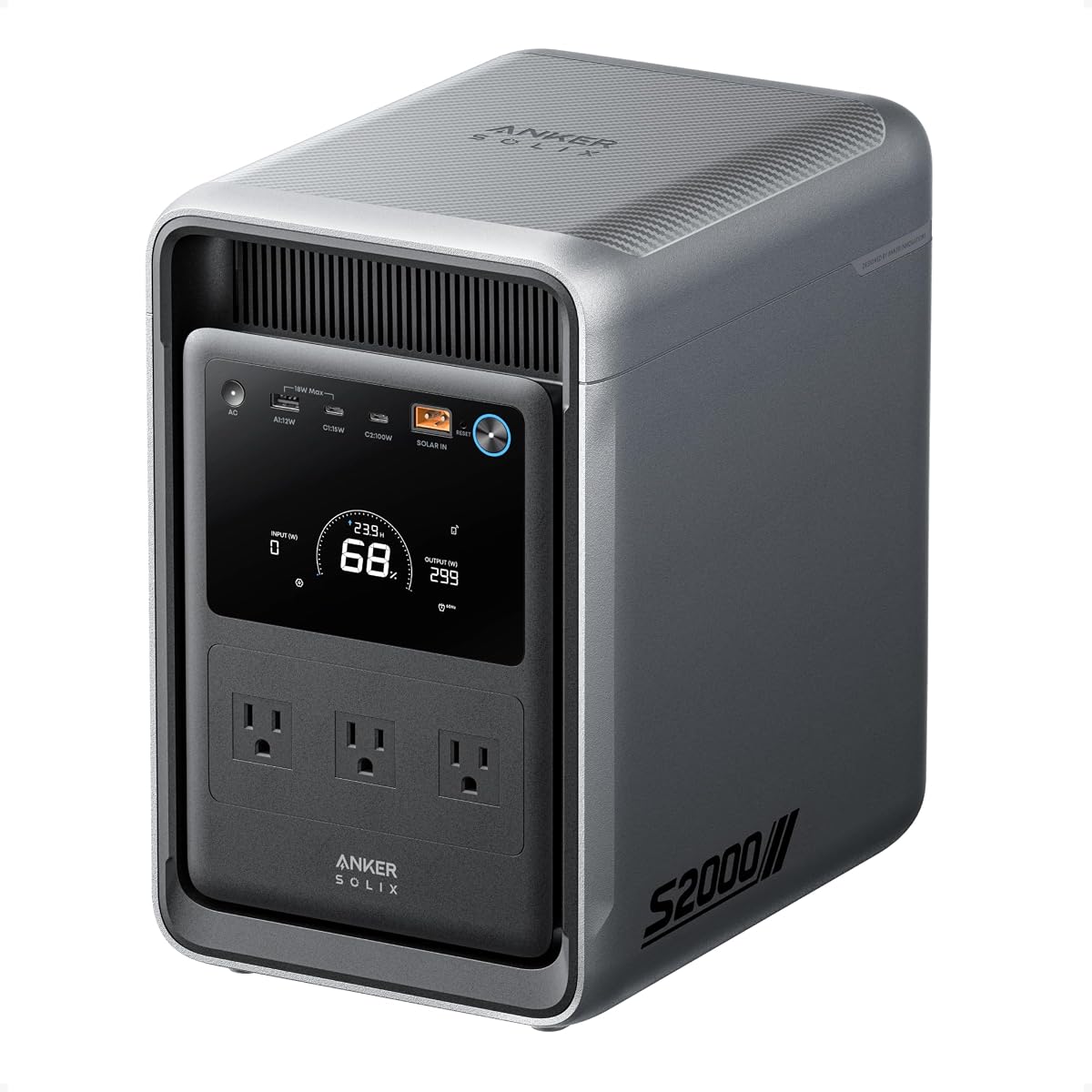
The Anker SOLIX S2000 is a polished 2kWh-class system with a 4.7 rating, 2,010Wh capacity, and 1,500W continuous output. It is designed for users who want more endurance than a camping unit without moving all the way into the size and weight of a home-scale F-series power station.
We may earn a commission when you buy through this link, at no additional cost to you.
Efficiency is central to the S2000 proposition. A stated 6W idle draw and improved efficiency allow it to run longer than many comparable 2kWh systems, with a listed refrigerator runtime of up to 35 hours under the stated conditions. The 314Ah LFP battery is rated for 10,000 cycles, giving it a particularly strong longevity proposition for daily or frequently repeated use.
Recharging options are broad: AC, solar, generator, alternator charger, car outlet, or a combination of AC and solar can restore the battery. The 400W solar input is lower than the headline input ratings of some larger models, but the unit is still flexible for homes, campsites, and vehicles. Dual-sided outlet placement also helps separate frequently connected devices from always-on loads.
One notable omission is a 12V DC port, which some campers, mechanics, and RV users may expect. It also weighs 35.7 pounds, so moving it requires planning even though the manufacturer describes it as smaller and lighter than the industry average. Runtime and output figures will also vary with appliance behavior, temperature, and other operating conditions.
Choose the S2000 when battery endurance, low idle consumption, and a refined 2kWh platform matter more than portability. It is a strong match for a medium-sized home, a serious RV power kit, or a camping setup where a refrigerator and several devices may need to remain active for a full day.
A portable power station that consumes very little energy while waiting can preserve considerably more capacity during a long outage. The S2000's stated 6W idle draw is therefore as important as its battery size, especially for refrigerators, routers, and other equipment that remain connected continuously.
The LFP battery's 10,000-cycle rating makes the S2000 attractive for regular backup use rather than strictly occasional emergencies. Its durable design, smart thermal management, and long cycle target also support users who want one system to serve travel, outages, and everyday portable power.
We may earn a commission when you buy through this link, at no additional cost to you.
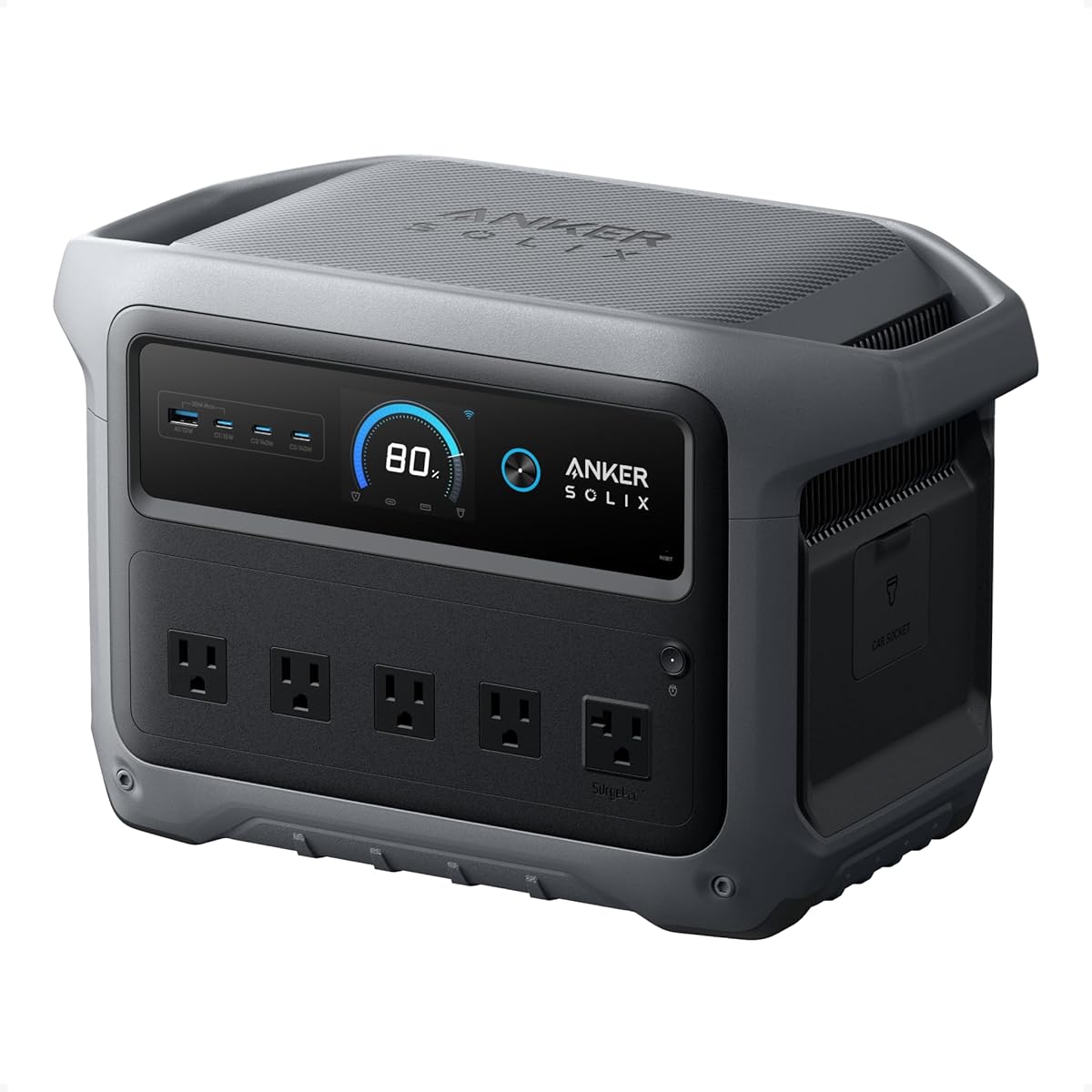
The Anker SOLIX C300 is a compact 288Wh power station with a 4.6 rating, 300W continuous output, and enough ports for a useful collection of travel and camping devices. It is the most approachable option here for users who want portable electricity without the weight and bulk of a 1kWh or larger system.
We may earn a commission when you buy through this link, at no additional cost to you.
Eight ports include three AC outlets, two 140W USB-C connections, another 15W USB-C port, a 12W USB-A port, and a 120W car socket. That selection lets a group charge phones, cameras, drones, and laptops while operating smaller camping devices without carrying a separate collection of wall adapters. The C300 can reach 80% charge in about 50 minutes with a suitable wall outlet.
Its 25dB operating level is useful for quiet campsites and bedrooms, while the LiFePO4 battery is designed for 3,000 cycles and carries a five-year warranty. The unit can recharge from compatible 100W or 60W Anker solar panels, a car, or wall power. It is also 15% smaller than similar designs, helping offset the inconvenience of carrying it.
Its limitations are inherent to the size. The 300W output and 288Wh capacity are not appropriate for sustained heating, large tools, or full-size kitchen appliances, and the battery may run out quickly when high-draw devices are used together. The shoulder strap is sold separately, and several incompatible Anker solar panel models are expressly excluded.
For weekend campers, travelers, photographers, and homeowners seeking a compact emergency box, the C300 offers a particularly strong feature set at a relatively accessible tier. It is most valuable as a supplement to regular electricity rather than a substitute for a generator.
The C300 reduces cable clutter by combining household outlets with high-speed USB-C, USB-A, and automotive-style connections in a small package. It is well suited to charging a travel kit that includes several phones, a camera battery, a laptop, and a low-power camping appliance.
An 80% wall recharge in approximately 50 minutes makes the power station practical to top up during lunch or between trips. Car and compatible solar inputs provide additional ways to replenish it, which is especially useful when users rotate between home, road, and campsite.
We may earn a commission when you buy through this link, at no additional cost to you.
The Anker SOLIX F3000 combines 3,072Wh of capacity with 6,000W of continuous output, earning a 4.5 rating. It is aimed at buyers who need serious appliance support and an extensive outage reserve rather than a light, travel-oriented power bank.
We may earn a commission when you buy through this link, at no additional cost to you.
Its headline strength is flexibility under load. The station can deliver 120V power, and pairing two units unlocks 240V output for demanding equipment. Its pass-through charging capability allows it to recharge from a 120V generator while continuing to run appliances, while its up to 2,400W solar input can restore energy quickly with appropriate panels.
Low idle consumption extends practical backup time. The listed figures include up to 125 hours of AC standby time and up to 42 hours for a 190-watt refrigerator, although actual results depend on the connected loads, environmental conditions, and operating behavior. The base capacity can be expanded with batteries to 24kWh, making a more comprehensive emergency system possible.
The trade-off is physical size. This is a stationary-class unit that is not convenient for ordinary camping or moving around a home. Some smart energy features also require compatible additions, including Anker's Bi-Directional Inlet Box and Smart Meter. Users must account for generator, solar, expansion-battery, and installation requirements before committing.
The F3000 suits households that need to run more than essential electronics during an outage, as well as users interested in pass-through charging, high output, and substantial expansion. It is less appropriate for travelers or anyone seeking a lightweight campsite companion.
With 6,000W continuous output, the F3000 can support a broader collection of household tools and appliances than portable models rated below 3,000W. The 120V and optional 240V configurations also make it useful for users whose emergency plan includes more demanding loads.
The 2,400W solar input and 6,000W combined generator-and-solar input can restore capacity quickly when the situation is urgent. Pass-through operation adds flexibility because the system can remain useful while it is being recharged.
We may earn a commission when you buy through this link, at no additional cost to you.
The Anker SOLIX F3800 is a high-capacity home and RV energy system with 3,840Wh of base storage, 6,000W output, and a 4.5 rating. It is designed to keep a household's essential infrastructure running and can scale dramatically through expansion batteries and paired stations.
We may earn a commission when you buy through this link, at no additional cost to you.
Its greatest advantage is growth potential. Up to six battery packs raise capacity to 26.9kWh, while another F3800 with 12 packs can support considerably longer off-grid scenarios. Dual 120V and 240V output can handle dryers and other demanding appliances, and two stations can be combined for up to 12,000W of maximum AC output.
The F3800 also reaches beyond ordinary backup use. Its NEMA 14-50 port can charge an EV at up to 6,000W, while NEMA 14-50 and L14-30 connections support RV power-inlet charging for compatible models. Wi-Fi and Bluetooth app controls let users monitor power sources and configure the system, while optional Smart Generator integration can provide automatic start-stop behavior.
These features come with substantial physical and financial commitment. A 3.84kWh system is far less portable than the C-series units, and expansion requires additional hardware and careful installation. Users must also confirm that their appliances, EV, RV connection, and electrical setup are compatible with the unit's requirements.
The F3800 is most appropriate for homeowners, RV owners, and serious off-grid users who want a platform capable of growing over time. Its value lies in resilience and flexibility rather than portability or simple camping convenience.
The base 3.84kWh capacity is substantial, and support for up to six expansion batteries increases the available energy to 26.9kWh. This makes the platform appropriate for households that want to start with essential backup and add capacity as their needs or renewable-energy setup evolve.
EV charging and RV inlet support distinguish the F3800 from basic emergency systems. The NEMA 14-50 connection can deliver up to 6,000W to a compatible EV, while RV-compatible power inlets allow the station to recharge from shore power infrastructure.
We may earn a commission when you buy through this link, at no additional cost to you.
The Anker SOLIX C300 DC is a USB-focused alternative to the standard C300, with a 4.5 rating, 288Wh capacity, and 300W output. It is designed primarily for travelers and campers who charge modern electronics through USB-C rather than relying on household-style AC outlets.
We may earn a commission when you buy through this link, at no additional cost to you.
Its port selection is unusual for a compact power station. Two USB-C ports support up to 140W, another reaches 100W, a fourth provides 15W, and two USB-A ports deliver 12W. A 120W car socket rounds out the seven-port arrangement. This makes it a convenient central charger for laptops, phones, cameras, drones, and other USB-powered devices.
The design is 30% smaller than similar power stations, and the included 60cm 140W USB-C-to-C cable supports a direct modern charging experience. Using the dual PD 3.1 USB-C connection, the unit can reach 80% capacity in about an hour. Solar and car recharging are also supported, although the same compatible-panel restrictions apply as with the standard C300.
The decisive limitation is the absence of household AC outlets. Users cannot directly operate a standard lamp, small appliance, or other mains-powered device. First-time activation also requires an 18W-or-higher USB-C wall charger, and only USB-C2 and USB-C3 can be used for that initial process, making setup instructions important.
For travelers who carry USB-C-centric gear, the C300 DC can be more practical than a conventional model with unnecessary AC sockets. It is best suited to phone, laptop, camera, and drone kits rather than campsite cooking, tools, or backup for household appliances.
Multiple high-wattage USB-C ports are the defining advantage of this model. They reduce reliance on bulky charging bricks and make it easier to keep a laptop, phone, camera, and smaller travel accessories connected during a long day away from wall outlets.
The 30% smaller design makes the C300 DC easier to place in a daypack or vehicle than a conventional power station, while the one-hour 80% recharge target supports quick preparation between trips. Compatible solar and car inputs provide additional replenishment options.
We may earn a commission when you buy through this link, at no additional cost to you.
The Anker SOLIX C1000 is a 1,056Wh model with a strong 4.7 rating, 11 outlets, and a 2,400W surge capability. It remains an attractive option for buyers who value many connections, quick replenishment, and portability within the 1kWh category.
We may earn a commission when you buy through this link, at no additional cost to you.
Its charging speed stands out. With UltraFast recharging enabled through the app and a compatible AC input, the unit can reach 80% in approximately 43 minutes and finish a full charge in under an hour. A smartphone is required for the relevant app setting, and the stated operating temperature range is 68–122°F. Compatible 600W solar recharging can complete a full charge in about 1.8 hours.
SurgePad technology raises the maximum output to 2,400W, while the 11-port arrangement supports many devices simultaneously. A LiFePO4 battery designed for 3,000 cycles over a ten-year lifespan supports regular use, and the enclosure is listed as 15% smaller than comparable 1kWh products. The included car charging cable adds convenience for road trips.
Fast charging is not entirely automatic, since UltraFast mode must be enabled in the app. Solar performance also depends on panel compatibility, sunlight, orientation, and weather, so the headline 1.8-hour figure should not be treated as a guaranteed result. Users should also verify surge requirements for the exact appliances they intend to operate.
The C1000 is well suited to homes, RVs, and outdoor users who want substantial 1kWh capacity without the footprint of a 2kWh model. Its 11 ports and quick charging are particularly appealing to households carrying many different kinds of electronics.
Reaching 80% in 43 minutes with the appropriate setup helps users prepare quickly for outages or continue a trip after a short stop. The app-based control adds a step, but it also gives owners direct control over charging speed and real-time power statistics.
Eleven outlets make it easier to maintain a mixed collection of AC, USB, and other devices without carrying multiple adapters. This is especially useful in RV and outdoor settings where every piece of equipment has different power requirements.
We may earn a commission when you buy through this link, at no additional cost to you.
The Anker SOLIX F3800 Plus is a 3,840Wh home-energy system built around 6,000W output, expansion batteries, and unusually strong solar charging. Its 4.3 rating is the lowest in this guide, but the underlying specifications make it a compelling option for buyers who intend to make renewable energy and extensive backup central to the purchase.
We may earn a commission when you buy through this link, at no additional cost to you.
The 3,200W solar input is the key differentiator. It can support very fast recovery from compatible panels and, together with generator charging, is advertised as reaching outage readiness in approximately 63 minutes under the stated setup. Four recharging routes—solar, generator, home power panel, and AC outlet—allow operators to choose the most practical source for the situation.
The base capacity can expand to 26.9kWh with up to six batteries. A second F3800 Plus and 12 batteries can support still longer off-grid operation. Dual 120V and 240V output handles demanding household appliances, while pairing two units raises maximum AC output to 12,000W.
This level of capability requires planning. The system is physically large, expansion adds complexity and cost, and users must ensure their solar panels, generator, electrical panel, and appliances are compatible. A 240V generator can feed the unit through a 6,000W bypass, but that arrangement should follow the manufacturer's guidance and appropriate electrical practices.
The F3800 Plus is ideal for a prepared household seeking large solar input, expandable storage, and high output. It is less relevant to ordinary travelers or users who need only a few hours of emergency power for phones and small electronics.
The 3,200W solar input distinguishes the F3800 Plus from systems focused mainly on wall or generator charging. For owners with suitable panels, unobstructed sunlight, and a comprehensive renewable-energy plan, it can restore a large amount of energy much faster than lower-input alternatives.
Starting at 3.84kWh and expanding to 26.9kWh lets buyers build capacity around changing needs. Dual-unit pairing adds output as well, while dual-voltage support keeps the platform relevant for homes that need to operate a broad range of household equipment.
We may earn a commission when you buy through this link, at no additional cost to you.
The Anker SOLIX F2600 brings together 2,560Wh capacity and 2,400W continuous output, earning a 4.4 rating. It occupies a useful middle ground: more capable than a camping unit, yet smaller and potentially less specialized than the heavy F-series home systems.
We may earn a commission when you buy through this link, at no additional cost to you.
Its 3,600W surge rating provides headroom for appliances with brief startup demands, while the 2,400W continuous output is sufficient for many common household and outdoor loads. The LiFePO4 battery, smart temperature control, industrial-grade components, and impact-resistant shell support the stated ten-year durability target.
Fast recharging is another advantage. HyperFlash can restore the unit to 80% in approximately one hour and 40 minutes. Solar charging can also reach 80% in about two hours under the stated conditions. The Anker app provides Bluetooth and Wi-Fi control, low-battery alerts, discharge-limit settings, and charging-speed adjustments.
Its size and weight make it less convenient for casual travel than a C-series model, though the greater capacity is valuable for prolonged camping or outages. The supplied information does not detail external battery expansion, so buyers who anticipate adding substantial capacity should verify future options directly with Anker. Runtime also depends on the load, weather, temperature, and equipment efficiency.
The F2600 is a good choice for a camper, van, or household seeking substantial 2.5kWh storage without stepping up to a 3.84kWh F3800. Its combination of capacity, output, app control, and fast charging makes it one of the most versatile mid-to-large systems in the lineup.
A 2,400W continuous rating is high enough for many portable uses that smaller power stations cannot handle, yet the 2,560Wh platform remains more manageable than the largest home systems. This middle position gives it broad appeal across camping, RV, and backup scenarios.
Custom discharge limits, low-battery alerts, and adjustable charging speed can help owners preserve capacity and prepare for expected outages. Wi-Fi and Bluetooth access also make remote monitoring more convenient than on a unit with basic controls alone.
We may earn a commission when you buy through this link, at no additional cost to you.
The Anker SOLIX F1500 combines 1,536Wh capacity, 1,800W output, and 13 device connections in a home-oriented package. Its 4.3 rating places it lower in the ranking, but it remains a credible option for buyers focused on device variety, renewable charging, and a long warranty.
We may earn a commission when you buy through this link, at no additional cost to you.
The 13-port arrangement includes six AC outlets, four USB-A ports, and a car outlet, allowing several device types to operate simultaneously. That makes it useful for a household in an outage or a group camping where phones, laptops, lights, and smaller appliances all need power. The 1,800W output is adequate for many essentials, though it is lower than the output of newer 2kWh and 3kWh models.
Its solar charging proposition is strong. With HyperFlash technology and a compatible 600W panel, the F1500 can recharge to 80% in approximately 1.4 hours under the stated conditions. Its battery is designed around a ten-year lifespan, and the product includes a five-year full-device warranty, which is a meaningful reassurance for a frequently used backup system.
Buyers should note that it lacks some of the newer models' higher input and output ratings, and no detailed expansion information is supplied. Because many ports share an aggregate power budget, operating all outputs at maximum may not be possible. Exact appliance compatibility, especially with surge-heavy equipment, should be verified before relying on it during an emergency.
The F1500 is most attractive to buyers who want many outlets and solar recharge in a moderate-capacity package. It is a solid home backup option for essential electronics and common portable appliances, but models such as the C1000 Gen 2 or S2000 offer stronger output or efficiency specifications for many use cases.
Six AC outlets, four USB-A connections, and a car outlet make the F1500 flexible for a mixed household load. The large port count is helpful during outages when several people need to recharge different types of equipment at once.
The ability to reach 80% in about 1.4 hours with a compatible 600W panel makes the F1500 useful where solar is a regular source. The ten-year design target and five-year full-device warranty add long-term confidence for home backup applications.
We may earn a commission when you buy through this link, at no additional cost to you.
Choosing an Anker power station starts with the loads you expect to power, the duration of the outage or trip, and the charging sources available where you use it. Capacity, continuous output, input speed, ports, and expandability should then be weighed against portability and budget.
Battery capacity, measured in watt-hours, indicates how much energy the unit can store. A small 288Wh C300 is appropriate for phones, cameras, laptops, and light camping loads, while a 1,024Wh C1000 Gen 2 can support a broader household emergency kit. The 2,010Wh S2000, 2,560Wh F2600, and 3,072Wh F3000 offer progressively more runtime, while the 3,840Wh F3800 models are designed for larger loads and expansion. Larger capacity also means more weight and a greater investment.
Choose capacity based on duration rather than device count alone. A high-wattage appliance can drain a small battery quickly, and several modest loads can consume a large battery over several hours.
Continuous output is the level a power station can maintain steadily, while surge or peak output covers brief startup surges. The C1000 Gen 2 provides 2,000W continuous and 3,000W peak output, the S2000 delivers 1,500W continuously, and the F3000 and F3800 family reach 6,000W. A higher output makes a unit suitable for tools, larger appliances, or dual-voltage equipment, but it does not increase battery capacity.
Check every appliance's label and surge requirement. A power station cannot safely operate equipment whose power requirements exceed its continuous output, even if that equipment works on household electricity.
Fast input is valuable when an outage is approaching or a campsite has limited time to replenish the battery. Several models support high-rate AC charging, while the F3000 and F3800 Plus offer especially high solar inputs. The S2000 supports six recharging methods, and most units can accept wall, car, and compatible solar charging. Faster charging usually requires compatible equipment, appropriate settings, and suitable temperatures.
Compare the fastest advertised input with the conditions required to achieve it. Solar figures depend on panel size, sunlight, orientation, weather, and compatibility.
AC outlets support standard household electronics, while USB-C, USB-A, and car sockets serve more specialized kits. The C300 and C300 DC are compact models with eight and seven ports respectively, the C1000 and C1000 Gen 2 offer 11 and 10 ports, and the F1500 reaches 13 connections. A DC-focused unit can be convenient for USB-C travelers, but it cannot replace an AC model for mains-powered equipment.
List the devices you intend to connect and check connector types, wattage, and aggregate output limits before purchasing.
Anker's models use LiFePO4 batteries in the supplied specifications, with cycle ratings ranging from 3,000 cycles in the C300 to 10,000 cycles in the S2000. Long cycle life is especially valuable for owners who use the station regularly rather than reserving it for rare emergencies. Smart temperature control, impact-resistant designs, and internal durability measures add further protection during travel and daily use.
Favor a longer cycle rating when the unit will regularly serve as an everyday power source. Also consider the warranty length and storage environment.
A power station with UPS mode can keep selected equipment operating during an outage, provided the plugged-in device is compatible with the unit's UPS function. The C1000 Gen 2 and S2000 advertise less than 10ms switchover, which is particularly helpful for computers, network equipment, and other sensitive electronics. UPS behavior should not be assumed to replace a formal uninterruptible power supply for every device.
Test the intended equipment before an emergency and identify which outlets remain active during backup operation.
Expandable systems can grow from everyday backup into a more resilient home installation. The F3800 can reach 26.9kWh with up to six batteries, the F3800 Plus supports the same expansion path and can be paired for 12,000W output, and the F3000 supports expansion up to 24kWh. Dual 120V and 240V operation also broadens the types of household equipment that can be supported.
Expansion is best considered at the planning stage because it adds cost, space, and installation complexity. Verify cable compatibility, battery support, and local electrical requirements.
Capacity and output are only two parts of the decision. The C300, C300 DC, and C1000 Gen 2 prioritize compactness, while the F3000 and F3800 systems are more substantial. Quiet operation matters for tents and bedrooms, with the C300 listed at 25dB from 3.3 feet. The Anker app can provide remote monitoring, statistics, alerts, discharge limits, charging controls, and energy-management features on supported models.
Choose the least cumbersome system that still covers your essential loads. Extra capacity is not useful if it cannot be moved or managed easily.
Before first use, read the included guide and confirm that the power station is fully charged, dry, and operating in a temperature range supported by its manufacturer. Activate the unit using the appropriate input; the C300 DC specifically requires an 18W-or-higher USB-C wall charger, and only USB-C2 and USB-C3 can be used for initial activation. For models with app-controlled charging, install the Anker app, connect through Wi-Fi or Bluetooth, and review the available settings.
Plan the load before an outage or trip. List the devices, estimate their running wattage, and identify which are essential. Start with high-priority loads such as a refrigerator, router, lighting, medication equipment, or communications devices. Avoid exceeding the unit's continuous output, and remember that some motors, compressors, heaters, and power tools require a higher surge rating. Keep ventilation clear, operate the unit on a dry, stable surface, and do not use it in unsafe environmental conditions.
Recharge promptly after use and store the unit partially charged in a cool, dry place when it will not be used for an extended period. Use compatible chargers, cables, solar panels, and expansion batteries, and inspect connectors for dirt or damage. Clean the casing with a dry or lightly damp cloth as directed by the manual, keep liquids away from the vents and ports, and contact Anker support if a unit shows physical damage, unusual heat, swelling, or repeated charging faults.
For moderate backup, the C1000 Gen 2 offers a useful balance of 1,024Wh capacity, 2,000W output, fast charging, and UPS support. Larger households or those needing heavy appliances should consider the F3000 or F3800 family. The right choice depends on the appliances, required duration, and whether expansion or dual-voltage support is important.
The C300 is the most conventional compact option, offering 288Wh capacity, 300W output, and eight ports in a travel-friendly design. The C300 DC is better suited to USB-C-heavy electronics because it lacks household AC outlets. Either remains limited for high-power appliances, so a vehicle or campsite generator may still be needed for cooking or tools.
Yes, as long as the combined device requirements remain within the power station's output budget. Models with multiple USB-C and USB-A ports are particularly convenient for charging several devices simultaneously. Check each device's charging protocol and wattage, and avoid assuming every port delivers its maximum rating at the same time.
Watt-hours describe stored energy, while watts describe power delivery. A larger watt-hour capacity can run a device for longer, while higher wattage allows a station to operate more demanding equipment. A useful comparison divides the target device's wattage by the station's wattage to estimate runtime, then adjusts for conversion losses and other conditions.
Only compatible panels with the correct voltage, connector, and power characteristics should be used. The C300 and C300 DC support suitable 100W or 60W Anker Solar Panels but are expressly incompatible with several listed models. Higher-input systems require appropriately sized panels and may also require specific voltage ports or cables.
A mid-size model can usually run a refrigerator for a meaningful period, depending on its compressor, ambient temperature, and how often it cycles. The S2000 lists up to 35 hours for a refrigerator under stated conditions, while the F3000 lists up to 42 hours for a 190W refrigerator. Actual runtime will vary.
It can be useful for compatible electronics that tolerate a brief interruption or require automatic power restoration. The C1000 Gen 2 and S2000 advertise under 10ms switchover. Test the exact device and outlet, because UPS support and behavior can vary, and keep a separate backup plan for critical equipment.
Some F-series models support configurations that increase total output, including dual-unit operation and expansion batteries. The F3800 and F3800 Plus can be paired for up to 12,000W maximum AC output, while the F3000 supports expansion to 24kWh. Use approved cables and compatible Anker equipment, and consult the relevant manuals before connecting components.
The Anker SOLIX C1000 Gen 2 is the strongest overall choice because it combines 1,024Wh capacity, 2,000W output, ten ports, rapid recharging, and 10ms UPS support in a manageable package. The C300 is the leading value option for travel and light backup, while the S2000 stands out for refined 2kWh capacity, low idle consumption, and long battery life.
Prioritize the loads you genuinely need to run, how long they must operate, and the charging sources available at the intended location. Choose a compact C-series unit for travel, a larger F-series system for extended or high-output backup, and an expandable F3800 platform when household resilience, EV charging, or dual-voltage support justifies the additional size and complexity.
Before ordering, verify the current specification, bundle contents, compatible accessories, and latest price on Amazon. Promotions and configurations can change, so the current listing is the best source for final purchasing details. With a realistic load plan and the right charging setup, an Anker SOLIX power station can provide convenient, adaptable energy well beyond a conventional battery pack.